Wolfgang Amadeus Mozart - Idomeneo
Wiener Staatsoper, 2014
Christoph Eschenbach, Kasper Holten, Michael Schade, Margarita Gritskova, Maria Bengtsson, Chen Reiss
Wiener Staatsoper Live Streaming - 14 October 2014
Until fairly recently, you wouldn't have seen much baroque or opera seria at the Vienna State Opera - although I'm sure an exception was made for the city's adopted son, Mozart. It's only fairly recently too that we've started to see Mozart played more authentically, with period instruments and in the scaling back of the size of the orchestra. It's marvellous then to see that kind of approach applied to the Wiener Staatsoper's production of Mozart's early opera seria Idomeneo, but in Kasper Holten's producton, it's not slavishly traditional either.
It may be one thing to play it with authentic period instruments, but opera seria brings with it expectations of a lot of static standing and declaiming long arias of anguish, torment and unrequited love, with some choral praise-giving for variety. A stage production needs to find a way of making that more accessible to a modern audience, and often that involves a great deal of cutting of da capo arias and ballets. Kasper Holten's production for Vienna finds a good balance between conceptual and traditional presentation, but his cuts and reorganisation of the structure of the work could be seen as rather more controversial.
Visually, the production has a strong design and state of the art stage craft, but there's not a lot visually or in terms of direction that expresses any great insight into the characters. The opening scene has impact, depicting the captivity of Ilia and the Trojans by having them bound in thick ropes, hanging high from the rafters. Ilia descends during her recitative and aria, as Idamante arrives and announces the freeing of the captives in thanks for the safe arrival (a little prematurely) of his father, the king Idomeneo, who was believed lost at sea. There are less effects in the subsequent acts - it doesn't even bother to show the traditional storm spectacle for Idomeneo's arrival - relying more on the stylised design of an ancient map of Crete and attractive, colourful costume designs to sustain visual interest.
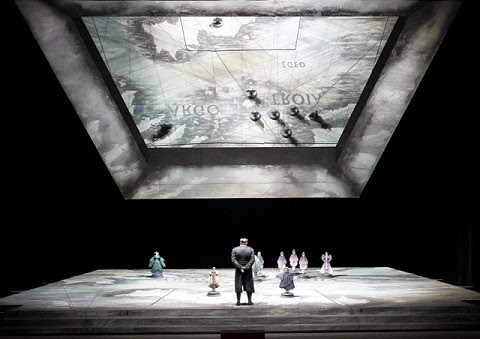
It's pretty to look at, but although there are a few stylised touches that attempt to get into the minds of the characters - most significantly in Idomeneo being haunted and tormented by bloody, faceless dark figures from the Trojan war in Act II's 'Fuor del mar' aria - there's not much in the way of interpretation in the traditional stage direction of the characters. That's not to say that Holten hasn't considered the work seriously and tried to find the best way of presenting it. It's clear from his efforts to restructure the work by reordering the musical numbers that he has thought about the characters motivations and has attempted to 'correct' things that Mozart himself might have done had he more time to work on it.
'Fixing' Mozart sounds a bit conceited and a foolhardy enterprise, but Holten's restructuring - although it goes a little too far in some of the cuts - does actually allow the work to flow better and make more sense. In opera seria, there can be a sense that arias have been included randomly just to suit specific performers, give each person their fair share of the spotlight, and just because an aria/lament/ballet/chorus is needed for variety at that specific point. (In the worst cases, works would even be corrupted by singers inserting their own favourite arias by other composers just to please the audience). Holten's editing is a serious attempt to bring greater dramatic and character consistency to the work, and largely, it succeeds.
The main change is in the placement of Ilia's aria and love duet 'Zeffiretti lusinghierei' with Idamante, which is removed from Act III to the opening of Act II. Coming immediately after securing the freedom of the Trojans and learning that Idamante may have lost his father, 'Se il padre perdei' consequently has more depth of feeling, and more convincing reason for Ilia to fall in love with the prince. The principal reason for its displacement however, is that it frees up the action of Act III and allows the drama of Idomeneo's dilemma to flow better without the interruption of the love scenes. This also allows the director to portray Idomeneo as a weak figure, bullied and punished by the gods, indecisive and willing to sacrifice Idamante, but ultimately unable to help his people. There is no sea monster here, it's Idomeneo who is the monster. At the end, his statue is toppled and he is unceremoniously dumped into a pit of demons with Electra as Ilia and Idamante are crowned the new rulers. Very much a case of out with the old...

Electra has always had a bit of a raw deal in Idomeneo, but in Kasper Holten's reworking of the opera she doesn't even get the opportunity to rage against the injustice of the daughter of King Priam of Troy replacing her in Idamante's affections. Act II - Scenes IV, V, and VI, where Electra comes into her own, are clearly considered superfluous to the drama and are all cut in this production. It's a pity as we seem to have a good Electra here in Maria Bengtsson, although admittedly we don't see here stretch her singing or acting abilities. On the other hand, Holten and conductor Christoph Eschenbach manage through the restructuring to include the new aria written for Idamante in the Vienna version of the work, and it fits in well.
What you also want to hear in Mozart are beautiful voices. Not so much for bel canto improvisation in the da capo arias, as much as in the purest sense of bel canto meaning sweet singing, as this is the way the characters express the sincerity of their feelings. The cast all fit this requirement admirably, with Margarita Gritskova most impressive as Idamante. Michael Schade's soft timbre perfectly suited a conflicted Idomeneo who has suffered and has depths of feeling for his son and his people, but not the strength to overcome the challenges he faces. Chen Reiss was a strong Ilia, her character benefitting most from the restructuring of the work (unlike Maria Bengtsson's Elettra), giving her arias and duets more depth of feeling. Eisenbach's reading of the score was light and refreshing, the clarity of the interpretation brought out wonderfully by the orchestra.
The Vienna Staatsoper have an ambitious and impressive programme of pay-per-view live performances being streamed this season. See the Live Programme on their website for details.
Links: Wiener Staatsoper Live Streaming programme; Staatsoper Live at Home video
Leos Janáček - The Cunning Little Vixen
Wiener Staatsoper, Vienna - 2014
Franz Welser-Möst, Otto Schenk, Chen Reiss, Hyuna Ko, Gerald Finley, Donna Ellen, Andreas Hörl, James Kryshak, Donna Ellen, Wolfgang Bankl, Ilseyar Khayrullova, Lydia Rathkolb, Heinz Zednik, Wolfram Igor Dentl, Sabine Kogler
Vienna State Opera Live Web streaming - 30 June 2014
Janáček's The Cunning Little Vixen is proving to be one of the most popular works of 20th century opera, and it's not hard to see why. The music is beautiful, some of the most ravishing melodies ever composed that are instantly memorable as well as being sophisticated and idiomatic. Like the music, the subject is immediate and accessible, looking at the question of existence in a way that makes it meaningful to adults and children alike. It can be heartbreakingly sad, as well as uproariously funny. It's above all a life-affirming work.
Dealing with as much as it does - all life, nature, the seasons, the passing of time, the idea of being a solitary entity making little connections with others, the loneliness of existence and the realisation that it will end, the necessity of confronting the fact that the world just moves on - The Cunning Little Vixen is also a difficult work to strike an effective balance between the large scale and the small, between the profound and the intimate. Otto Schenk's production for the Vienna State Opera is one of the best balanced versions I've seen.

Balance however isn't everything. It certainly makes the work appealing to the largest, most conservative part of the audience who don't want their preconceptions of the opera challenged. For every choice the director makes however - and here it must be said the choices are mostly safe ones - he necessarily must abandon other ways of presenting the work that can be a little more exciting and enlightening. The primary choice any director has to make with The Cunning Little Vixen is whether to play the animal world as cute and cuddly in a way that won't frighten the children and upset the delicate sensibilities of the audience, or show nature as a more violent and uncontrollable force.
Amra Buchbinder's stage and costume design is lovingly and elaborately detailed. Set almost entirely in a wood that dissolves into a starry night, it means that the beauty of nature is ever-present, even in the scenes at the Forester's lodge and the tavern. All the animals are recognisable and realistic in their costumes, movements and actions without being cute or over-stylised. As important as the beauty of nature is in the work however, the fact that animals behave as animals and not like humans should not be overlooked. Vixen however is fairly harmless here. She doesn't massacre the hens in a frenzied animal bloodlust, for example, even if she sorts the rooster out all right.

While there is a case for making Vixen a little more feral, such an approach can over-dominate as much as making her too cute and cuddly. The human connection to vixen's nature is also vital, and in order to establish that it's not so much a case of making the animals seem more human as much as giving the humans in the work due consideration. The Forester, his reflections on his life, his sense of his relationship with other people and the world around him are a vital part of The Cunning Little Vixen, and surely the aspect that Janáček would most have identified with. There's a sense of disconnect and dissatisfaction in the Forester. He observes and loves nature and his place in the world, but there's something about it that remains beyond his grasp.
He sees what is missing in the vixen, or at least he eventually comes to a better understanding of life through his connection with Vixen. Initially, he just grabs her and tries to own this wild animal, as if he can tame her nature to a condition where it can fit into his vision of order in the world. That of course proves impossible, but in Vixen's escape - although it infuriates him - in her death and her "rebirth", the Forester gains a sense of hope or comes to peace with the idea of progress and renewal, that the world will move on, that nature will look after its own, regardless of our efforts to impose a presence and a will upon it.

Director Otto Schenk brings the kinship of these two incompatible creatures of nature in a very simple way. He brings the Forester and Vixen closer together and even has them embrace at one point. There's consequently a warmth or at least a respect that exists between one for the other, or at least a connection is established showing that they can at least co-exist, even if it's never on common ground. It's not a particularly clever idea but the director at least recognises how important and true it is to the intent of the opera and how critical it is in getting the principal message of the work across in a balanced and meaningful way.
Or at least it's one part of what is needed. What proves to be just as critical to the success of this production - as it often does in this opera - is not so much the casting and performance of Vixen, as the attention given over to the characterisation of the Forester. Gerald Finley's beautiful smooth baritone isn't a perfect fit for every role - he's a little lacking in sufficient character for as complex a personality as Don Giovanni, for example - but the warmth of his timbre and his presence fills the Forester with life and a zest for life. The fact that he can handle the rhythms and expression of the Czech libretto is also impressive. No less impressive is Chen Reiss' bright vixen, and her scenes with Hyuna Ko's adoring and adorable Fox are just delightful. Franz Welser-Möst's delicate reading of Janáček's rhythmic pulse is also sensitive to the varying tones in the work as well as the balance that is achieved on the stage.
Links: Wiener Staatsoper live streaming
Wolfgang Amadeus Mozart - Die Zauberflöte
Festspielhaus Baden-Baden, 2013
Simon Rattle, Robert Carsen, Pavol Breslik, Ana Durlovski, Dimitry Ivashchenko, Kate Royal, Michael Nagy, Chen Reiss, Annick Massis, Magdalena Kožená, Nathalie Stutzmann, José van Dam, James Elliott
ARTE Live Web Internet Streaming, 1st April 2013
There's not much magic in Robert Carsen's new production of The Magic Flute for the 2013 Easter Festival at the Festspielhaus in Baden-Baden. There's a flute at least, and you can't always take that for granted - but Carsen very purposely brings this production very much down to earth. There are no big entrances and no grand effects, the settings are all related to nature and death. A rather grave Die Zauberflöte, you could say, which doesn't provide much in the way of spectacle. Mozart's music however can sustain that, but that might be more to do with the fine account of the score given by Berlin Philharmonic under the direction of Simon Rattle and some strong singing performances than with anything that Robert Carsen brings to the production.
Carsen at least applies a viable and consistent concept to the work, cutting through all the Masonic rituals and ceremonies to the heart of the conflict that lies between the opposing forces of the Queen of the Night and Sarastro. It does a little more than that and actually attempts to update some of the work's less-enlightened views on women to give a more equality-minded view of the differences between the two sexes in regard to the rational and the emotional capacity of all human beings. One is not necessarily superior to the other here. Despite some of the inconsistencies with this position within the work itself - which only enhances its ambiguity and richness - it's the joining of those two forces through the union of Tamino and Pamina to create a better world that undoubtedly forms the heart and the meaning of the work.

Carsen merely emphasises this union by showing it not so much in contrast to the entrenched positions of Sarastro and the Queen of the Night, as much it being the beginning of a new age that has the blessing of these once mortal enemies. In Carsen's staging, both Sarastro and Königen present a united force, putting aside differences for the sake of a better future, coming together even in scenes where they don't usually appear together to offer silent support to the other side, even if their stated position indicates the opposite. You'll find women (and even Königen's Three Ladies) then alongside the men in Sarastro's temple and - just to get the point across - even the Three Boys are transformed into Three Girls wearing dresses to call Pamina back from her despair and attempted suicide.
This all requires a bit of an adjustment from viewer used to the traditional certainties within Die Zauberflöte, of which there are few enough as it is. In place of the old-fashioned obscure Masonic imagery and rituals - and indeed the traditional spectacular set-pieces - Carsen's staging takes the opera back to a more natural setting, with the emphasis on Life and Death. There are no big spectacular effects scenes here, the location consisting for the most part of a cemetery of open graves set against the backdrop of a projection of woods. The opening scene then sees Tamino scramble out of a grave to be rescued from what isn't anything more than a big snake by the Three Ladies in dressed in mourning attire. Papagena makes her first appearance during Papageno's trial of silence not as an old hag, but as a skull-faced corpse climbing out of a coffin. Even the orchestra, surrounded by a platform, seem to be contained within one big pit.

It's a constant and deliberate attempt to cut back on the flash and wonder. There's no grand entrance even for Königen der Nacht, who simply walks onto the stage with a minimum of ceremony. If she still presents a formidable figure, that's conveyed in the singing delivery of that famous opening aria, and that alone is more than enough. In keeping with the sober funereal imagery, Monostatos is a gravedigger here, the Three Boys are just three boys (when they aren't Three Boys dressed as girls) with no magic flying balloons to transport them. The Speaker and Sarastro are also dressed in formal mourning coats, wearing blindfolds. In the one place where you would at least expect to see magic effects, the playing of the magic flute, we merely see shadows of birds flitting around in the trees in the background.
Carsen's staging then does take away a lot of the wonder and the humour that contributes to the richness of Die Zauberflöte without really bringing anything new out of it. What holds the viewer however, and what the staging only emphasises, is the richness of the music itself and the quality of the performances. Die Zauberflöte wouldn't be part of the normal repertoire of the Berlin Philharmonic, but perhaps because of that they seem to relish in the beauty of the work's symphonic qualities. You'd hardly think Die Zauberflöte was just a Singspiel, but of course the work is much more than that and Rattle and the Berliner Philharmoniker give a warm account of the work that contrasts with Carsen's direction but at the same time enhances it. It may give every visual appearance of being a dark, morbid version of the opera, but there's more warmth and forgiveness here that you usually find in what can sometimes be a cold and rigidly performed work. It's hugs all around at the end here, with even Monostatos being welcomed back into the big love-in finale.

The casting and the singing also make this an absolutely gorgeous Die Zauberflöte to listen to. With his pure lyrical tenor and fresh, sincere delivery, Pavol Breslik is a natural for Tamino. Alongside Kate Royal's Pamina, a more idealistically perfect couple would be hard to find. Both look good, can act well and have simply beautiful singing voices. Royal's 'Ach ich Fühls' in particular is just exquisitely heartbreaking. And there are no disappointments elsewhere in the cast. Ana Durlovski stepped in at short notice to replace an unwell Simone Kermes as Königen der Nacht and did so very impressively. Dimitry Ivashchenko's Sarastro sounded fine, but had a tendency to work to his own timing rather than follow the conductor. The toning down of the comedy and strong principals meant that there was not danger of Michael Nagy's Papageno stealing the show here, but rather it was a fine performance that was still funny but fitted in well with the overall production.
This production of Die Zauberflöte at the Baden-Baden Festspielhaus was recorded on the 1st April 2013 and broadcast via internet streaming throught the ARTE Live Web site, where it is currently still available for viewing until July. Subtitles on the broadcast are in German only.


