Showing posts with label Idomeneo. Show all posts

Sunday, 28 August 2022

Mozart - Idomeneo (Aix-en-Provence, 2022)


Wolfgang Amadeus Mozart - Idomeneo, Re di Creta

Festival Aix-en-Provence, 2022

Raphaël Pichon, Satoshi Miyagi, Michael Spyres, Sabine Devieilhe, Anna Bonitatibus, Nicole Chevalier, Linard Vrielink, Krešimir Špicer, Alexandros Stavrakakis

ARTE Concert - July 2022

There's no question that Mozart's operas are beautifully expressive of the whole range of human feelings and experience. Even at the age of 24 in his earliest masterpiece Idomeneo, Re di Creta he defies the often dry conventions and expectations of the opera seria format to create a work that imbues ancient Greek mythology with a rare humanity and authenticity. A stage director can choose to work to bring those human elements out, to interpret or reinterpret them, or they can quite reasonably rely on the music to speak for itself. That appears to be the intention of the director Satoshi Miyagi at this production for Aix-en-Provence 2022, but whether it supports Mozart's music or works against it is less certain.

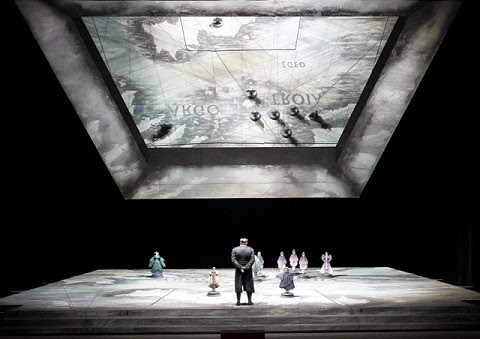
There is certainly nothing wrong with updating the setting of Idomeneo or using it to express the original ideas and themes in a different context. I must admit I had my doubts about it being a neat fit for the director's proposed intention of using the Japanese wartime emperor Hirohito as a substitute for Idomeneus the King of Crete, or whether this would be in any other way meaningful or revelatory, but it has to be said that this notion never really asserts influence over the performance of the work here. What is far more significant to how the opera plays out in this production is decision to present it in a Noh drama fashion, with minimal but highly stylised sets and movements.

It certainly looks impressive, achieving the same kind of glacial quality that Robert Wilson employs in his opera and stage productions, and they are - usually but not always - none the worse off for it. Consequently, the principal performers here, dressed in stylised Japanese costumes, remain expressionless with minimal movement, often raised on their own platforms at a distance from one another. The chorus meanwhile, wearing more familiar military uniforms, merge with the sets, becoming part of them, part of the while fabric of the opera.

As far as that goes it's fine, the sets remain fluid and slowly moving and changing, ensuring that everything doesn't remain too static. If Idomeneo were a typical opera seria, it might not be enough to enliven the work and make the drama come to life, but despite the qualities of the music and the fact that it does indeed speak for itself, it seemed to me that it didn't do Mozart any favours. Not only does the intention to relate this to Hirohito and the Japanese people fail to make any impression - the opera has been staged as a modern post-war conflict much more successfully elsewhere in numerous updated productions - but it even seems to almost work against and neutralise the music, and that is not a good thing.

Fortunately it doesn't quite do that thanks to conductor Raphaël Pichon. If there are any doubts that remain about the quality of this early Mozart opera and how it stacks up against his mature works, this was certainly dispelled by the musical direction. Sure, the composition of Idomeneo can't compare to the great Mozart operas with Da Ponte, but much of what is great about those later works can already be heard developing here in a truly exciting way. It's a strong enough work on its own terms - more than strong and certainly if compared to what preceded it in opera seria, it's hugely progressive, devoid of the mannerisms and much more relatable, the characters really seeming to engage with one another and not just wrapped in their own worlds. Which, when you get right down to it, might just be what Mozart's operas are all about and what makes them great.

Unfortunately the production's stylised Noh influenced staging pushes the opera back onto those mannerisms, removing emotional connections, putting physical distance between the characters. I personally found Satoshi Miyagi's direction cold and distracting, at odds with Mozart's warm sympathetic and deeply expressive music. Worse, it simply offered no way in to relate to the plot and the drama to find a reason to care about each of the characters, much less offer an interpretation as to their motivations and behaviours as others have done, particularly into the complex nature and behaviours of Elettra and the king himself. There is no denying however that the set designs and the lighting were terrific and this was beautiful to look at, and it did suit the elegant formality of Mozart's music, if not bring out anything deeper from it.

Up until the conclusion, that is. A blood red backdrop is projected against the characters, showing them set against the horror and devastation that their decisions have caused. While mainly abstract in its human shapes and shadows cast against the horror of war, the suffering, the trauma, the eventual release and the recognition of the folly of its leaders acting like gods, it did hit home effectively, particularly with Mozart's music and with the soaring singing of the principals and chorus. It's here that Hirohito is most effectively evoked through the voice of the god Neptune, his broadcast voice coming from a record player that appears on its own raised platform. The slow and detached build-up might have been testing, but by the time the conclusion was reached, you were left in no doubt that this production did justice to Mozart, if perhaps not exactly find anything new in it.

Despite the impositions placed on the singers to remain mainly impassive and inexpressive, there was also much to enjoy in the singing. These are already challenging roles - Mozart composing this in 1781 for the best singers in Munich at the time - and the casting of the right kind of Mozartian voices is ideal for this production at Aix-en-Provence's Théâtre de l’Archevêché. If the director had little in the way of showing any nuance in the character of Idomeneo, who can be played sympathetically or as a misguided relic of the past who gets his just desserts, Michael Spyres's soft timbre brought warmth and humanity to the role. Soprano Sabine Devieilhe's singing brought more feeling and drama to the role of Ilia than the minimal direction allowed. Anna Bonitatibus as Idamante and Nicole Chevalier as Elettra were more constricted by their roles having little room for interpretation, but both sang superbly. With a cast like that and Mozart's music beautifully interpreted by Pinchon and the Pygmalion orchestra and chorus, the greatness of Idomeneo remains indisputable. 


Links: ARTE Concert, Festival Aix-en-Provence

Monday, 11 May 2020

Mozart - Idomeneo (Madrid, 2019)

Wolfgang Amadeus Mozart - Idomeneo

Teatro Real, Madrid - 2019

Ivor Bolton, Robert Carsen, Eric Cutler, David Portillo, Anett Fritsch, Eleonora Buratto, Benjamin Hulett, Oliver Johnston, Alexander Tsymbalyuk

Opus Arte - Blu-ray


With every new production, Idomeneo is proving to be one of the most exciting of Mozart's operas, and that's even when measured up against a catalogue of mature works where each and every one is a masterpiece. It's not just the number of productions that are elevating it comfortably into the canon of regularly performed Mozart operas - even if you don't rate it as great Mozart, this early work of youth is still head and shoulders above most opera of its century - but each production seems to find new depths in the work. Not only has Mozart created marvellously drawn, living, breathing people out of these Metastasian opera seria characters, but through them you can already see the enlightened ideas and themes that are there in his mature works. What is also amazing is how a work of Greek antiquity with a late 18th century score can still be so fresh and modern, its themes remaining relevant to the present day.

Robert Carsen certainly emphasises the contemporary relevance of the work right from the outset in the Teatro Real production by hitting you with an image that looks like it is straight off a TV news broadcast; a group of refugees clinging desperately to a wire fence that cages them in. Having suffered in a terrible war and displaced from their homeland, Ilia and the Trojan refugees wonder what harsher fate have the gods in store for them. If it's not exactly a new or original perspective on Idomeneo it's only because there's nothing new in such images repeated throughout history, but they still remain relevant and powerful, a scene repeated with depressing regularity.


Imagine a world where human love and compassion could inspire a leader to assist those less fortunate? Well, Mozart could imagine that the good in mankind would always win out over greed, jealousy and lust, where love triumphs and the dissolute are punished, where goodness its own reward. It's a theme that you can see consistently throughout his opera work right through to La Clemenza di Tito. It's one thing to imagine and believe in that but it's quite another greater thing to make it seem like a genuine possibility in the composition of music that expresses such emotions and intentions.

Robert Carsen knows that it's all there in Mozart's music, and with good singers to interpret it and a conductor sensitive to the rhythm, pace and dynamic of the score, Idomeneo speaks for itself. The Madrid production fares well on all those fronts, but it would be over-simplifying to say that Carsen does no more than throw out a few powerful iconic and emotive images. As with some of his more recent productions (Glanert's Oceane also in 2019) the director uses the full dimensions of the stage with projections of nature, sea and sky, raging seas and stormy skies to create a sense of wide open space in which an opera can truly breathe.

There are some strikingly realistic, powerful images used here. The horrors wreaked on Crete by Neptune's sea monster couldn't be any more devastating than the real life images of war torn Syrian towns used here, and it gives the work added authenticity and a sense of classic timelessness. The very Parsifal-like way the production is concluded is also successful, touching on the deeper truths to be found in mythology, how tyranny can be overthrown, how compassion and innocence will save the world and rebuild it anew.


There's not really enough however to carry the narrative though in an engaging way. There are a few spectacular projection effects that capture a sense of inner conflict and turmoil, but the uniformity of the military uniforms works against a stronger sense of character definition, and by making the people an army it goes against the idea of it being ordinary people suffering at the hands of higher powers. There's too much Duty and not enough Humanity. This is recognised in the conclusion to an extent when, the war ended, the uniforms are shed and the people are able to live as humans once again.

Although the singing is excellent there's also little in the way of character interpretation to give it more context and depth. Sure, it doesn't go for black and white the way other productions might in terms of painting Elettra and Idomeneo as misguided villains and Ilia and Idamante as the great young hope for the future, but there's room for finding nuance and highlighting the differences within those worldviews. Carsen's production looks great and it makes an important contemporary commentary but a work of opera seria like Idomeneo needs a little more focus on making the narrative drive more engaging. Even Mozart's opera seria.

There are moments when it comes together, particularly in Act III. Despite the staging of Idamante and Ilia social distancing amidst a beach full of life jackets, the love declarations of the 'Spiegarti non poss'io' duet between Anett Fritsch and Benjamin Hurlett is sung beautifully and accompanied by delicate playing from the pit. The subsequent quartet with Eric Cutler and
Eleonora Buratto is also superb, underling that the conflict is not an ideological one between tradition and progress, between being tied to a sense of duty and the freedom to make individual choices, but just four people and two sides that find themselves in a difficult and irreconcilable position. Buratto's final aria as Elettra is also marvellous. Ivor Bolton's handling of the very different dramatic and emotional tones is just superb.


What is also evident right from the overture is that Ivor Bolton is returning the work back to its historically informed period instrumentation, using harpsichord and slightly reduced orchestration that gives it a wholly different feel from the more classical sounding Idomeneo of Mozart. There is consequently a lighter spacious sound with extra delicacy and punch as it hits all the points in the dynamic range. Hearing Mozart this way is always a revelation and the score is lively and percussive in drive but opening up to reveal more detail and beauty in the scoring and playing of individual instruments. Bolton himself plays the recitative accompaniment.

The quality of the production comes across well on the Blu-ray release from Opus Arte, presenting a clear image with bold contrasts that helps bring out the impact of the staging. The PCM Stereo and DTS HD-Master Audio 5.1 mixes emphasise the dynamic of the historically informed instrumentation. The surround mix in particular gives a wonderfully spacious soundstage for the orchestration, the harpsichord pinging away throughout. The only extra on the BD is a Cast Gallery but the booklet insert has a tracklist, a synopsis and a brief overview of Robert Carsen's take on the opera. Subtitles are in English, French, German, Japanese and Korean.


Links: Teatro Real

Friday, 27 December 2019

Mozart - Idomeneo (Salzburg, 2019)


Wolfgang Amadeus Mozart - Idomeneo

Salzburger Festspiele, 2019

Teodor Currentzis, Peter Sellars, Russell Thomas, Paula Murrihy, Ying Fang, Nicole Chevalier, Levy Sekgapane, Issachah Savage, Jonathan Lemalu

Medici streaming - 12 August 2019


After their take on La Clemenza di Tito in the same venue in 2017, there would have been little doubt that the 2019 Salzburg Festival production of Idomeneo would be controversial; the only question being whether it would be Peter Sellars or Teodor Currentzis who would be most wayward in their in interpretation of one of Mozart's most interesting operas. Well, it's a close run thing.

Mozart's operas are so rich in music and multifaceted in their content and themes that they are eminently amenable to deeper exploration, reinterpretation and modern revision; nothing about them has dated. As an early opera seria however, with a baroque libretto written for André Campra, Idomeneo does certainly still have one foot in a bygone age, yet it is already progressive in terms of Mozart's reworking, reinvention and humanistic outlook. Filtered through the young Mozart's sensibility and remarkable talent, all those conventional laments, jealousies, cruel twists of fate and extreme human sentiments feel vivid, alive and real.


It's so powerful an advance on the mannerisms of the past that it demands an equally imaginative, modern and humanistic interpretation in stage performance. Perhaps not everyone wants it to go as far as Dieter Dorn’s at the Munich Bayerische Staatoper or Damiano Michieletto in Vienna, or indeed as Sellas and Currentzis not unexpectedly take it here, but it's hard to argue that they don't bring a sincere response to the musical and dramatic content of Idomeneo, striving to find a way to highlight the richness of its themes and development of its characters.

Initially however, you are definitely thrown a little off-balance by the oddness of the set developed for the very specific demands of the Salzburg Felsenreitschule. Not a single object on the stage is related to the actual Crete settings of the opera, nor are they naturalistic or in most cases even identifiable. The stage on the floor of the Riding School theatre has clear plastic tubes that rise up as columns with coloured lights, the stage littered elsewhere with misshapen plastic containers, tubes and inflatable blob like creatures - perhaps a different kind of monster that is disgorged by the sea in this age of environmental disaster. The costumes of the Greeks and their Trojan prisoners is militaristic, but the coloured camouflage outfits look more like pyjamas.

As unusual as the set looks, the unfamiliar sound, pacing and rhythms that
Teodor Currentzis brings out in the period instrument interpretation of the opera with the Freiburger Barockorchester can be even more unsettling as it sounds very different here from any recording you might be more familiar with. The intention is clearly to push the range of expression that Mozart employs for this opera, marking it out as very different from the baroque works that precede it, exploiting and emphasising the dynamic that Mozart employs for this unique and brilliant work.


At times you get the impression that the intention is also to do everything possible to break away from Mozart as comfortable and easy-listening, perhaps over-emphasising and deliberately pushing against the familiar. It's slow when you expect it to be faster, fast when you expect it to be slower, aggressive when you would expect merely forceful, but it never seems to work against the intent of the work. It hints rather that all might not be as it appears on the surface of the moral, political and romantic dilemmas of each of the characters whose lives have been thrown into turmoil under the curse of Neptune; absolutes and certainties - being saved from the dead, feeling secure in love, family loyalties - are all indeed turned on their head.

What Currentzis and Sellars do however is force you to reconsider the work in new terms, not rest on the certainty of familiarity, but be challenged afresh by every scene, every aria and recitative, every single note, trying to hear what is really being expressed in the melody, the tempo and the instrumentation - the fortepiano notably playing a larger role here than in any version of this work I've heard before.

If you can put up with Peter Sellars's more annoying mannerisms - the choreographic ritualised steps and semaphore arm signals (which are at least better than park and bark performances) - his direction of the internal nature and conflict of the characters is interesting. It's almost what you would expect to find in The Magic Flute: characters out of balance, seeking to find an emotional equilibrium as well as find an accord with the forces of nature and their place in the world, seeking wisdom, seeking answers, seeking peace and willing to endure suffering and trials for it. It does show that Idomeneo is practically a prototype for Die Zauberflöte (With Electra a furious Queen of the Night and Neptune a lesson-giving Sarastro), and in that respect the treatment is thoroughly Mozartian.


Not that some sections of the Salzburg would notice. When it comes down to who upsets them most, the director traditionally gets it in the neck and Currentzis's eccentricities and indulgences are overlooked. In truth, neither are entirely successful and it comes across as a little over-laboured, over-intellectualised, existing in some theatrical vacuum that doesn't entirely connect with Mozart's Idomeneo on a relatable and instinctive human level. It's a fascinating account nonetheless of a magnificent, deeply beautiful work, one that is emphasised by some fine committed singing performances, notably from a sweetly lyrical Ying Fang as Ilya and a fiery Nicole Chevalier as Elektra (almost stealing the show at the finale), but all of the performances impress, including Paula Murrihy as an intensely sincere Idamante and Russell Thomas as a warm and troubled Idomeneo.

Links: Salzburger Festspiele

Tuesday, 24 July 2018

Mozart - Idomeneo (Buxton, 2018)


Wolfgang Amadeus Mozart - Idomeneo 

Buxton Festival, 2018

Nicholas Kok, Stephen Medcalf, Paul Nilon, Rebecca Bottone, Heather Lowe, Madeleine Pierard, Ben Thapa, Richard Dowling, Julian Debreuil

Buxton Opera House - 19th July 2018


As well as working on a trilogy of rare early Verdi works over the last couple of years, the Buxton Festival have also been presenting a number of Mozart's early operas that aren't quite as well known and rarely staged. Like early Verdi these can be a mixed bag but very worthwhile if you can find and show the qualities and the promise in the works. La Finta Giardiniera proved to be an absolute delight in Buxton's staging, wonderfully effervescent and playful, but Lucio Silla last year on the other hand came across as rather dour and uneventful. Idomeneo is certainly the best of early Mozart and consequently it is always worth exploring, but in contrast to some exciting and ambitious recent readings of the work elsewhere, Buxton's approach doesn't initially seem to have a great deal to bring to the work.

For an opera that is very much connected to the sea and the curse of Neptune, Stephen Medcalf's production somewhat counter-intuitively sets the whole three acts of Idomeneo within a dry room that is semi-buried in a sand drift. It's a simple enough image that does capture some sense of the domestic drama at the heart of the plot as well as the forces of nature at the heart of the work without having to be overly literal. If Roderick Williams and Iain Burnside could bring all the heart-freezing sentiments of Schubert's Winterreise fully into being earlier in the day during one of the hottest summers on record in the UK, well there's no reason why Buxton can't likewise test the effectiveness of Mozart's setting of Idomeneo. And you wouldn't bet against Mozart winning through.


With the same set designed by Isabella Bywater unchanged for all three acts, and only open doors and windows for the characters and chorus to make their entrances and exits, there was no other apparent concept or original reading applied. If there was any area in which Buxton's Idomeneo differed from other recent productions, it was that Stephen Medcalf took a rather more balanced view of the contrasting forces at work in the opera. This was one of the kindest and most gentle Idomeneos I've seen, particularly in its sympathetic treatment of Electra and Idomeneo, more often seen as the villains in the piece. That does actually place a very different perspective on the work, but you really have to wait a long time in this opera seria for its impact to come through.

In terms of characterisation and relationships and how they are expressed through the opera seria medium, the production is fairly 'dry'. Idomeneo's indecision, vacillation and agonising over his rash promise to Neptune to kill his own son as a sacrificial offering doesn't cut much ice in terms of eliciting sympathy. Idamante and Ilia's romance feels rather wet and unlikely to ever get off the ground, each of them delicately stepping around the subject.  In such a situation where everyone is being 'nice' and non-committal, Electra seems to have the best potential to break through here and shake the opera up, but she too seems to take it rather philosophically, mildly disappointed at her rejection by Idamante rather than filled with righteous vengeance.

How much is down to the direction and how much down to the characterisation adopted by the singers and even how much of it is down to Mozart's music potentially being rather too generous is debatable. The singing is good all around, but little of it seems to express any real personality, particularly when you want and expect an Electra full of fire and fury. But as the opera exerts its own momentum a strong central figure does emerge, and in contrast to the tendency to portray him as weak, indecisive and no longer fit to rule, it's Idomeneo who surprisingly takes centre stage. After all, the opera is named after him, so there is merit in looking more closely at his role in the drama.


And when you're looking towards characterisation in a Mozart opera, the best gauge of that is by listening to the music that Mozart writes for the characters. Mozart at this age may perhaps not have the depth and insight into human nature that is evident in is greater mature works, but he is by no means restricted by the conventions of the opera seria format, and even at this stage shows tremendous ability to create fully rounded characters out of what is a very limited dramatic situation. And it's only fully rounded by the time you get to the end of the work. So as austere as the production and the music might seem, Mozart's personality, his innovations with the form, his undoubted attention to Gluck's reformist agenda and his own sense of melody and dramatic flow still strike you as astounding. Austere it is not, but rich in detail, alive at every moment and never indulgent.

Conducted by Nicholas Kok, the music was allowed to exert its own force and carry the momentum of the accumulated scenes. Stephen Medcalf follows this line also and allows Idomeneo's curse, fate and fall to emerge from it as the true heart of the work. Idamante's love, generosity and humanity are important and Heather Lowe gives voice to that, just as Madeleine Pierard expresses Electra's anger but doesn't allow it to overwhelm and dominate. In line with Mozart's music, it's Paul Nilon who makes every moment of Idomeneo's agony to be truly felt, seemingly possessed by an evil spirit that forces him to enact the promised sacrifice, fighting with himself and his guilt at surviving the sea-wreck. Quite brilliantly supporting this interpretation, Neptune, when he makes his appearance at the end of the opera speaks chillingly through the possessed body of Idomeneo.
 

If the Buxton production of Idomeneo shows us anything it's that Mozart's writing is capable of supporting other readings and interpretations, but even in its purest and most austere form and despite its serious nature, it's a rich and involving work in its own right. Allowing each of the characters voice (although Arbace is inevitably cut back here, he's far from essential to the overall impact), allowing the set pieces to have their place - the placing of the Act III quartet 'Andrò ramingo e solo' absolutely pivotal and hugely impressive here - allowing the chorus - likewise impressive - to contribute their part, is what really drives this work and makes Idomeneo an endlessly fascinating work if you stick with it and most importantly, give Mozart's music its place.


Links: Buxton Festival

Wednesday, 9 December 2015

Mozart - Idomeneo (Theater an der Wien, 2015 - Webcast)


Wolfgang Amadeus Mozart - Idomeneo

Theater an der Wien, 2015

René Jacobs, Damiano Michieletto, Richard Croft, Gaëlle Arquez, Sophie Karthäuser, Marlis Petersen, Julien Behr, Mirko Guadagnini

Culturebox - 20 November 2015

Idomeneo is a problematic work in the Mozart canon, belonging to his youthful period and tied to the format and conventions of opera seria. It is unquestionably Mozart however, highly accomplished and full of melody and beauty, but with a darker edge of terror here. It's the latter aspect that is an unfamiliar quality from what we are accustomed to hearing in Mozart, and it often seems to be at odds or inadequately expressed by the beauty of the music itself. Damiano Michieletto's production of Idomeneo for the Theater an der Wien seems to get more from the work by focussing on that darker side, and is assisted in drawing those qualities from a closer period interpretation of the music by René Jacobs and the Freiburger Barockorchester.

Michelietto's production relies heavily on symbolism to emphasise the darker underlying context of Idomeneo beyond even the horror of the drama that unfolds. We are reminded of the fall of Troy and the damaging consequences of what the Greeks have brought back from the long drawn-out war on the highly-stylised stage set. Boxed-in by a set of curtains, the stage is a sand and mud pit filled with the boots of fallen warriors, the characters having to pick their way through it, sticking to the ground and stumbling over the lumps and bumps of this troubled landscape. It's here that we first see Ilia and get a sense of her predicament and state of mind. She can't escape from what has happened to her home and neither the love professed by Idamante nor his freeing of her captive people are enough to compensate for that.

There is more tension between Ilia and Idamante than you would traditionally see in this work since there is another lump or bump that is significant in this version. Ilia, the daughter of King Priam, is noticeably pregnant by the son of an enemy king, which only deepens her despair and confusion. The gift she had to offer Idomeneo when he returns back from the dead after the storm at sea is a package of baby clothes and an ultrasound scan of the baby she is carrying. Any kind of joyful news, whether its the liberation of the 'refugee' Trojans, Ilia's conflicted love for Idamante, or indeed Idamante's joy at the safe return of his father, is qualified and short-lived. Particularly the latter situation, since Idomeneo has rashly promised Neptune to sacrifice the first person he meets if he is allowed to survive and reach dry land.


The characterisation is thus somewhat more consistent here with the overall tone and it's very strongly developed and explored in this production; in appearance, in singing and in how each person reacts to one another. There's a lot of pent-up tension and no respite for anyone following the harrowing war that has just ended. The tension between Ilia and Idamante for example, should be obvious considering their backgrounds, but it is only really drawn out here by the symbolism, the direction of the performers and how they sing the roles, as well as by how Jacobs handles the musical direction. The usual bombastic emphasis of the romantic melodic line is toned down by the harder edge of the period instruments, Jacobs aiming for a simpler interpretation that seeks to find a truer expression for the dramatic content which might not be quite as developed here as in other Mozart works.

The casting and singing however are of the highest order, and it's noticeably this aspect - the lyrical qualities of the singing voice and what it is capable of expressing - that differentiates Mozart's late opera seria innovations from other works in this style. All of the singers here show how good this early Mozart can be when it has the right voices assigned to the roles, and when those roles are allowed to express the characterisation that is implicit in the situations they find themselves in. It's most evident in Richard Croft's Idomeneo. Like Kasper Holten's 2014 Vienna production, the King of Crete is visibly haunted here by the bloodshed and horror of the Trojan war, tormented by gore-covered ghosts. He's like Macbeth haunted by Banquo's ghost, driven mad, stumbling and flailing, self obsessed and full of self-pity, wallowing in the injustice of it all and hopelessly ineffectual as a consequence, often symbolically found in proximity to a bed.

Croft's voice has a softness, delicacy and lyricism that matches the requirements of this kind of Idomeneo. And even with the sweetest timbre, Sophie Karthäuser too can express the conflict and boiling anger that lies just beneath the surface of Ilia, making those beautiful da capo arias really express something fundamental about herself and her predicament. Just as impressive is Gaëlle Arquez as Idamante who proves here, if it needed to be made clear, that in the absence of a castrato, a mezzo-soprano can make much more of this role than a countertenor. There's a lovely voice there to be sure, but Arquez also demonstrates confidence in her expression, interpretation and colour.


The icing on the cake her is the luxury casting of Marlis Petersen as Electra. She fully involves herself in Michieletto's characterisation of Electra as a scheming glamour puss in blonde wig, wearing glittery dresses as she teeters through this landscape of misery in high-heels and shopping bags. She's the only person happy with the turn of events, since Idomeneo is forced to send her off with Idamante into the safety of exile, trying on a series of colourful outfits in a fashion-show rendition of 'Idol mio'. There's a little thinness creeping into the middle range, but Petersen is still capable of imbuing this role with great character, and her spirited performance is exactly what is needed to give the work that extra dimension and dynamic.

While the consistency of tone is maintained right through to the climax and is perhaps even bleaker in the ruins of Crete, I'm not sure that Act III holds together quite as strongly. As is often the case these days, Electra and Idomeneo are depicted as self-interested villains - and even lovers here - who pay the price for their actions. The singing and performances at least are just as strong and convincing, Sophie Karthäuser in particular delivering an amazing 'Zeffiretti lusinghieri', Gaëlle Arquez joining her impressively for the subsequent duet. Julien Behr also shows us the value of his Arbace here. If the direction throws everything in to try to make the final act a little more exciting - including the voice of Neptune seeming to come from Ilia's womb - it at least finds the right note to end on, Mozart's long chaccone accompanied by Ilia going into labour and giving birth on the stage. As far as establishing Idomeneo's out with the old and in with the new message, this production - as elsewhere - takes everything just that little bit further than most.


Links: Culturebox, Theater an der Wien

Tuesday, 28 October 2014

Mozart - Idomeneo (Wiener Staatsoper, 2014 - Webcast)

Wolfgang Amadeus Mozart - Idomeneo

Wiener Staatsoper, 2014

Christoph Eschenbach, Kasper Holten, Michael Schade, Margarita Gritskova, Maria Bengtsson, Chen Reiss

Wiener Staatsoper Live Streaming - 14 October 2014

Until fairly recently, you wouldn't have seen much baroque or opera seria at the Vienna State Opera - although I'm sure an exception was made for the city's adopted son, Mozart. It's only fairly recently too that we've started to see Mozart played more authentically, with period instruments and in the scaling back of the size of the orchestra. It's marvellous then to see that kind of approach applied to the Wiener Staatsoper's production of Mozart's early opera seria Idomeneo, but in Kasper Holten's producton, it's not slavishly traditional either.

It may be one thing to play it with authentic period instruments, but opera seria brings with it expectations of a lot of static standing and declaiming long arias of anguish, torment and unrequited love, with some choral praise-giving for variety. A stage production needs to find a way of making that more accessible to a modern audience, and often that involves a great deal of cutting of da capo arias and ballets. Kasper Holten's production for Vienna finds a good balance between conceptual and traditional presentation, but his cuts and reorganisation of the structure of the work could be seen as rather more controversial.

Visually, the production has a strong design and state of the art stage craft, but there's not a lot visually or in terms of direction that expresses any great insight into the characters. The opening scene has impact, depicting the captivity of Ilia and the Trojans by having them bound in thick ropes, hanging high from the rafters. Ilia descends during her recitative and aria, as Idamante arrives and announces the freeing of the captives in thanks for the safe arrival (a little prematurely) of his father, the king Idomeneo, who was believed lost at sea. There are less effects in the subsequent acts - it doesn't even bother to show the traditional storm spectacle for Idomeneo's arrival - relying more on the stylised design of an ancient map of Crete and attractive, colourful costume designs to sustain visual interest.


It's pretty to look at, but although there are a few stylised touches that attempt to get into the minds of the characters - most significantly in Idomeneo being haunted and tormented by bloody, faceless dark figures from the Trojan war in Act II's 'Fuor del mar' aria - there's not much in the way of interpretation in the traditional stage direction of the characters. That's not to say that Holten hasn't considered the work seriously and tried to find the best way of presenting it. It's clear from his efforts to restructure the work by reordering the musical numbers that he has thought about the characters motivations and has attempted to 'correct' things that Mozart himself might have done had he more time to work on it.

'Fixing' Mozart sounds a bit conceited and a foolhardy enterprise, but Holten's restructuring - although it goes a little too far in some of the cuts - does actually allow the work to flow better and make more sense. In opera seria, there can be a sense that arias have been included randomly just to suit specific performers, give each person their fair share of the spotlight, and just because an aria/lament/ballet/chorus is needed for variety at that specific point. (In the worst cases, works would even be corrupted by singers inserting their own favourite arias by other composers just to please the audience). Holten's editing is a serious attempt to bring greater dramatic and character consistency to the work, and largely, it succeeds.

The main change is in the placement of Ilia's aria and love duet 'Zeffiretti lusinghierei' with Idamante, which is removed from Act III to the opening of Act II. Coming immediately after securing the freedom of the Trojans and learning that Idamante may have lost his father, 'Se il padre perdei' consequently has more depth of feeling, and more convincing reason for Ilia to fall in love with the prince. The principal reason for its displacement however, is that it frees up the action of Act III and allows the drama of Idomeneo's dilemma to flow better without the interruption of the love scenes. This also allows the director to portray Idomeneo as a weak figure, bullied and punished by the gods, indecisive and willing to sacrifice Idamante, but ultimately unable to help his people. There is no sea monster here, it's Idomeneo who is the monster. At the end, his statue is toppled and he is unceremoniously dumped into a pit of demons with Electra as Ilia and Idamante are crowned the new rulers. Very much a case of out with the old...


Electra has always had a bit of a raw deal in Idomeneo, but in Kasper Holten's reworking of the opera she doesn't even get the opportunity to rage against the injustice of the daughter of King Priam of Troy replacing her in Idamante's affections. Act II - Scenes IV, V, and VI, where Electra comes into her own, are clearly considered superfluous to the drama and are all cut in this production. It's a pity as we seem to have a good Electra here in Maria Bengtsson, although admittedly we don't see here stretch her singing or acting abilities. On the other hand, Holten and conductor Christoph Eschenbach manage through the restructuring to include the new aria written for Idamante in the Vienna version of the work, and it fits in well.

What you also want to hear in Mozart are beautiful voices. Not so much for bel canto improvisation in the da capo arias, as much as in the purest sense of bel canto meaning sweet singing, as this is the way the characters express the sincerity of their feelings. The cast all fit this requirement admirably, with Margarita Gritskova most impressive as Idamante. Michael Schade's soft timbre perfectly suited a conflicted Idomeneo who has suffered and has depths of feeling for his son and his people, but not the strength to overcome the challenges he faces. Chen Reiss was a strong Ilia, her character benefitting most from the restructuring of the work (unlike Maria Bengtsson's Elettra), giving her arias and duets more depth of feeling. Eisenbach's reading of the score was light and refreshing, the clarity of the interpretation brought out wonderfully by the orchestra.

The Vienna Staatsoper have an ambitious and impressive programme of pay-per-view live performances being streamed this season. See the Live Programme on their website for details.

Links: Wiener Staatsoper Live Streaming programmeStaatsoper Live at Home video

Sunday, 12 August 2012

Mozart - Idomeneo


IdomeneoWolfgang Amadeus Mozart - Idomeneo
Bayerische Staatsoper, 2008
Kent Nagano, Dieter Dorn, John Mark Ainsley, Pavol Breslik, Annette Dasch, Rainer Trost, Guy de Mey, Steven Humes
Euroarts
Mozart had already written twelve operas by the time he was commissioned to write Idomeneo for Munich in 1780 (his earliest opera written when he was just eleven years old), and although many of those earlier works show moments of the talent and genius that would flourish in later years and are often astonishingly accomplished considering the age of the composer, they are mostly conventional in nature. It’s generally accepted that Mozart’s mature opera works commence with Idomeneo, written when he was 25 years old, but even then the implication is often that this earliest mature work, written to the dictates of the opera seria style that was even then considered outdated, is among the composer’s lesser works. Certainly, it can’t compare to Mozart at his most brilliant in The Marriage of FigaroDon Giovanni or The Magic Flute, but in its own way - perhaps seen more as the peak of the youthful Mozart rather than the beginning of his maturity - Idomeneo is remarkably innovative in its treatment of the opera seria style and in the distinctive graceful character that the young Mozart brings to the work.
The subject however, particularly as it is laid-out in the libretto by Abbé Varesco, is resolutely in keeping with the demands of the opera seria style. The theme is classical and mythological Greek in origin (although form a French source), relating to the fall of Troy it deals with ancient rulers who have to make difficult and wise decisions that the fate of their people and the happiness of young lovers depend on, and in line with convention, it’s refashioned at the conclusion to bring about a happy ending. At the centre of the drama is Ilia, the daughter of King Priam, who has been carried off as a prisoner of King Idomeneo to Crete. Ilia has been rescued by Idamante, the son of Idomeneo, from a storm that destroyed the fleet (there are plenty of those in this opera) and which is believed to have claimed the life of King Idomeneo. Ilia is in love with Idamante, but as he has been promised to Electra, the daughter of Agamemnon, she is unsure of his feelings towards her, and is therefore unaware that he also loves her.
The crisis at the heart of the drama is not so much the love triangle - although this does provide the opportunity for some fine arias of anguish for the scorned Electra - as much as Idomeneo’s fateful vow (one reminiscent of the biblical story Jephtha, the subject of a Handel oratorio) to sacrifice the first living creature he sees in gratitude for escaping a watery death in the clutches of Neptune. Inevitably, the first person he encounters is how own son, Idamante. Hoping to find a way to avoid this terrible fate, Idomeneo plans to send his son away with Electra to her homeland in Argos, which - apart from upsetting Ilia obviously - also leads to another huge storm and an attack by a sea monster. After self-sacrificing gestures from Ilia and Idamante, accommodation and the requisite happy end is reached when Neptune declares that Idomeneo must abdicate in favour of his son who will rule with Ilia by his side.
What is fascinating about Mozart’s approach to this conventional classical drama, written to cater for generic arias of anguish and despair at the whims of the gods and sentiments of love betrayed or lovers kept apart, is the unifying force of the music that makes it develop and work as a dramatic whole. There’s very little recitativo secco, more often the recitative is accompanied, flowing into ariosos and arias without the expected breaks and exits. The arias and recitatives moreover develop - very unusually for Italian opera seria - into duets, trios, into a magnificent quartet and into choruses. The continuous dramatic progression, the variations of the scenes, with ballet interludes, divertimenti, marches and choral arrangements show that Mozart was taking into account the reformist ideas of Gluck, but they show more the influence of the French style, particularly in the use of ‘le merveilleux‘ elements of spectacle - storms, sea monsters, messages from the gods. More than just introducing them for the purposes of stagecraft, Mozart uses the musical arrangements and the chorus to conjure up such imagery and apply them to the expression of each of the characters’ torments.
The Bayerische Staatsoper production, recorded in 2008 at the recently restored Cuvilliés-Theater (formerly the Residenztheater) where Idomeneo was actually first premiered in 1781, takes this idea a little bit to extremes. For the most part Jürgen Rose’s basic set designs strip the work of anything that could appear as clever stagecraft into order to, presumably, let the music alone express the dramatic content. This works to some extent, drawing the attention to the qualities of Mozart’s wonderful score and his innovative approach, but it makes for a very dull stage set in this beautiful theatre. It’s difficult to find any meaning, concept or consistency to Dieter Dorn’s stage direction, which during the Overture seems to characterise the Trojan warriors as samurai and has ninja dragging Idomeneo down beneath the waves (actually down through an open hatch in the stage), but it remains largely faithful to the action detailed in the libretto, using more traditional, if somewhat sparse, sets designs and classical costumes, with good use made of a revolving platform in the third act. Apart from one or two key scenes where the mood calls for it, the majority of the production however looks like it is set in a rehearsal studio, under bright studio lighting.
If the production isn’t much to look at, the performances give a good account of the work itself, revealing its true qualities. Best of all are the casting of John Mark Ainsley and Pavol Breslik for the father and son team of Idomeneo and Idamante. Both look the part, are completely committed to the roles and the dilemmas facing their characters and both are blessed with gorgeous light lyrical voices that nonetheless can express power and depth of emotional feeling where required. And in Mozart’s Idomeneo, it’s those little details in the singing that are all important. Annette Dasch is also powerful as Electra. In some ways it’s a thankless role - one that relies on going through the motions of the angry spurned woman - but Dasch brings an edge of dangerous passion to the role, particularly in her Act III aria (”D’Oreste, d’Aiace ho in seno i tormenti“) while assailed by ninjas (who indeed are actually Furies). I wasn’t initially so keen on Juliane Banse’s interpretation of Ilia, but she carries hesitant anguish of the role well, and can hardly be faulted for her singing performance. The ubiquitous Guy de Mey again delivers the goods as the High Priest, and the production is also fortunate to have a strong Arbace in Rainer Trost, the production including all his arias, which in the past have often been cut.
With only a few small trims to recitative and Idamante’s final aria (which was cut before the first performance in any case) absent, Kent Nagano clearly intends to keep the focus on maintaining the dramatic flow of the work. That’s done well, with an authentically smaller sized orchestra for the size of the theatre. If there are any minor reservations about the production, the singing or the playing however, everything comes together in the marvellous Act III. It’s here that Mozart’s innovations and the brilliance of the composer to come can be heard fighting their way through the opera seria constraints, and the cast rising to meet those moments in the famous quartet “Andrò ramingo e solo“, in Ainsley’s gorgeous rendition of Idomeneo’s heartfelt prayer to Neptune in the Cavatina and Chorus “Accogli, o re del mar“, and - as mentioned previously - in Annette Dasch’s “D’Oreste, d’Aiace“. The orchestra take centre stage on a raised platform for the other highpoint of the work, the Chaconne that concludes the work, reportedly the longest single orchestral movement composed by Mozart. In the absence of anything happening on stage, TV director Brian Large chooses to show us some of the features of the restoration work on the Cuvilliés-Theater, which considering its historical importance in the context of this work, is not inappropriate.
Like all Blu-ray releases from Euroarts, the disc seems to load up into the memory of the player and takes over controls to some extent, although other than not showing running times on the player display, I didn’t find this caused any problems. Image quality is fine and there’s a beautiful clarity to the PCM Stereo and the DTS HD-Master Audio 5.1 mixes that seems to capture the natural reverb and ambience of the theatre. Other than Trailers for other titles, there are no extra features on the disc, but a booklet contains information on the opera’s composition and includes a short synopsis. The disc is all-region, 1080i full-HD, subtitles are in Italian (matching the libretto), English, French, German and Spanish.