Showing posts with label Ivor Bolton. Show all posts

Monday, 26 May 2025

Mozart - Mitridate, re di Ponto (Madrid, 2025)


Wolfgang Amadeus Mozart - Mitridate, re di Ponto

Teatro Real, Madrid, 2025

Ivor Bolton, Claus Guth, Juan Francisco Gatell, Sara Blanch, Elsa Dreisig, Franco Fagioli, Marina Monzó, Juan Sancho, Franko Klisovic

OperaVision - 4th April 2025

There are limits to expression in 18th century opera seria, even for Mozart, who was only 14 years old when he wrote Mitridate, re di Ponto in 1770. Even with the long flowing arias where each of the figures pour out their hearts, it's within the context of generic feelings and expectations, the arias capable of being lifted and inserted seamlessly into other works; which was often the case, and borrowing is still common practice when rediscovering and recreating lost works of early opera. The main action tends to play out off-stage, only referred to in-between in the recitative, and in the case of Mitridate, re di Ponto - based on an Italian language adaptation of Racine's play Mitridate - the context is the war between Pompey's Roman army and King Mitridate of Pontus around 63BC.

Not that you'd get any real sense of that from Mozart's opera or the libretto written by Vittorio Amedeo Cigna-Santi. The events of the war remain in the background, the focus instead on the impact - or opportunity - that the war presents to the main characters of the opera. With King Mitridate believed to have been killed by Pompey, his sons Farnace and Sifare, both from different mothers, seek to consolidate their own position. Farnace, the elder, plans to seek an alliance with Rome, his only use of force being applied to his father's fiancée Aspasia to be his Queen. Sifare is in love with Aspasia, and the feelings are mutual. Mitridate however is not dead, the news of his death a ruse to find out the truth about his sons, and indeed his wife to be.

The plot then is somewhat contrived, but the purpose is indeed to contrive a situation where truth can be brought out into the open, where human feelings can be freely expressed, the war less important really than the personal battles even if it is merely in the context of domestic rivalry, jealousy and assertion of dominance. Essentially though, the opera is primarily an excuse or opportunity to give singers the opportunity to shine and show their range and talent, and there is a challenge - particularly in a modern production - to try to keep those emotional expressions within the realm of true human feelings. That's not easy considering the setting, the plot and the larger than life characters, but of course much depends on the inventiveness of the musical setting and that's perhaps easier to find in Mozart's music.

Mozart's early works of opera seria have languished along with many of his youthful works for this reason. Limited by the conventions of the style, there is little apart from the prodigious talent of the age of the composer to set them apart from other works of the period. Mozart would find ways to place his own stamp on the opera seria format as a mature composer in Idomeneo (1780) and advance it in La Clemenza di Tito (1791), but even the earlier works have echoes of the brilliance of those later works and that can be brought out by a sympathetic production.

Mitridate is not one of those great Mozart operas. Brilliant certainly, incredible as the work of a 14 year old composer, but to really appreciate its qualities, you need more than a static opera seria production, and you really need to pull it out of the historical period, which is little more than a pretext really for the human drama. You won't get a static production from Claus Guth, and you won't get robes and togas or ruined temples. The crux of the drama, needless to say, would be more familiar to a modern audience who has seen Succession. I haven't but I expect most people have, and as such they would immediately recognise the setting and the subsequent battle for wealth and power in Mitridate in the absence of love and respect.

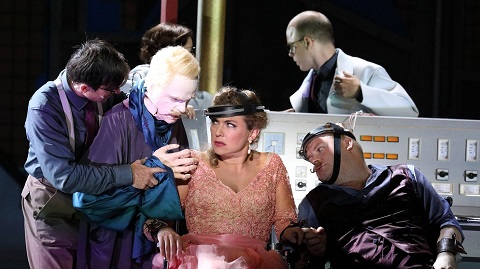
The whole of the opera (or at least half of it) takes place in a modern 'palace', a luxurious mansion. I'm not even sure how much the average person could relate to this Succession-like situation as a common family drama - Guth includes a silent servant who looks on the whole affair disapprovingly - but, as has often been established through the history of opera, everyone is capable of experiencing and indeed denying human feelings. If the incestuous situation played out here between an ancient ruler of a kingdom and his sons and a conspiracy with one of them to side with Romans is not everyone’s experience, the sentiments of love, lust, jealousy, trust, betrayal, repentance and forgiveness are more familiar, and they can indeed lead to tragic outcomes.

That would be very much within the enlightened view of Mozart, certainly more so in his greater works, but Mitridate, re di Ponto gives the young composer an early opportunity to explore those sentiments. At this stage it's very much a male power-play, although the assignment of roles of the sons to alto castrato (Farnace) and soprano castrato (Sifare) makes that a little more ambiguous, certainly when cast now as countertenor and soprano trouser role. Aspasia, the Queen, certainly has little to show in the way of personality in the early stage of the opera other than resisting the aggressive advances of Farnace, seeking help of his brother Sifare, unaware that he has deep feelings for her. Wait until their father gets home. Believed dead after battle with Pompey hence his sons’ rather inappropriate advances on their prospective mother, Mitridate is actually alive and on his way, having faked his death so that he could observe the ambitions of his sons revealed.

While it seems a little shallow of purpose and characterisation, all these roles can be given greater depth with good singers and adequate direction. If you have that, it makes it much easier to see how much Mozart's music contributes to their definition and expression. You can't argue with the likes of countertenor Franco Fagioli as Farnace, and soprano Elsa Dreisig as Sifare. Both singers put a stamp on the personalities of the two sons even within the generic characterisation, and Mozart's musical description can be seen as contributing to that; blustering defiance and lust on the part of Farnace, guilty desire and wary lack of confidence on the part of Sifare. Even the music for Aspasia, as sung superbly here by Sara Blanch, shows the conflict that rages within her over the actions of the sons and the doubts about her feelings for Mitridate. The opera is blessed with such wonderful vocal writing for all the roles, with no bass, baritone or even mezzo-soprano roles. Juan Francisco Gatell fills the typical sweet high Mozartian tenor as Mitridate, Marina Monzó an impressive Ismene, and even the roles of Marzio (Juan Sancho) and Arbate (Franko Klisovic) have something to contribute in terms of range of voice and character. 

While the setting of the opera doesn't call out for any dramatic scene changes, director Claus Guth typically tries to delve a little more deeply the sentiments of the characters and relate them to the psychological impact that the situation has on them. The 'shadow side' of the opera takes place behind the living room in a colander-like environment and it's here that the characters mostly take their interior monologue arias where grapple with their feelings and fears. Mitridate, back from the 'dead', is shown dealing with his own mortality in his first scene with a double and black masked figures, and he struggles in a shadow play struggle with a double of his unfaithful son Farnace lusting after Aspasia. Sifare grapples with his feelings for multiple aspects of Aspasia being stolen by dark figures and Aspasia expresses her conflict between duty and love. Farnace, it appears, doesn't have a conscience; his demons haunt him in the 'real world'.

These elements don't really need such separation or elaboration, but it does at least make the opera a little more interesting visually and shows that the real drama takes place on a purely psychological level. Considering the solipsistic nature of the arias, with there being little direct confrontations or expression in this opera through duets or ensemble pieces - even 'conversations' feel one-sided - there is a good rationale for this. Guth however recognises that there is a gradual overlap between the interior and exterior worlds as the opera comes to a resolution as the characters gradually come to an accommodation with their inner lives and, remembering that this is supposed to be about a war-time situation, recognise the true enemy is Rome for the defiant ensemble finale. 

I haven't heard Ivor Bolton conducting for a while (the last time indeed was Idomeneo in 2019), and here as musical director at the Teatro Real, it's always a treat to hear him conduct works from the Classical and early Classical period with sensitivity and drive. You can easily get a little tired of the opera seria conventions and repetitions, but here Bolton never lets you forget that you are listening to the music of Mozart. If it's not always original, Mozart's music in Mitridate, re di Ponto feels well suited to every situation and does have those flashes of brilliance, rhythmic drive and dramatic intensity, but with a lightness of touch that offers hope for these unfortunate figures to escape from the darkness of their personal torments. Musical direction and stage direction successfully working then working hand-in-hand then with fine singing from the entire cast, this is surely all you want from an early Mozart opera.


External links: Teatro Real, OperaVision

Monday, 11 May 2020

Mozart - Idomeneo (Madrid, 2019)

Wolfgang Amadeus Mozart - Idomeneo

Teatro Real, Madrid - 2019

Ivor Bolton, Robert Carsen, Eric Cutler, David Portillo, Anett Fritsch, Eleonora Buratto, Benjamin Hulett, Oliver Johnston, Alexander Tsymbalyuk

Opus Arte - Blu-ray


With every new production, Idomeneo is proving to be one of the most exciting of Mozart's operas, and that's even when measured up against a catalogue of mature works where each and every one is a masterpiece. It's not just the number of productions that are elevating it comfortably into the canon of regularly performed Mozart operas - even if you don't rate it as great Mozart, this early work of youth is still head and shoulders above most opera of its century - but each production seems to find new depths in the work. Not only has Mozart created marvellously drawn, living, breathing people out of these Metastasian opera seria characters, but through them you can already see the enlightened ideas and themes that are there in his mature works. What is also amazing is how a work of Greek antiquity with a late 18th century score can still be so fresh and modern, its themes remaining relevant to the present day.

Robert Carsen certainly emphasises the contemporary relevance of the work right from the outset in the Teatro Real production by hitting you with an image that looks like it is straight off a TV news broadcast; a group of refugees clinging desperately to a wire fence that cages them in. Having suffered in a terrible war and displaced from their homeland, Ilia and the Trojan refugees wonder what harsher fate have the gods in store for them. If it's not exactly a new or original perspective on Idomeneo it's only because there's nothing new in such images repeated throughout history, but they still remain relevant and powerful, a scene repeated with depressing regularity.


Imagine a world where human love and compassion could inspire a leader to assist those less fortunate? Well, Mozart could imagine that the good in mankind would always win out over greed, jealousy and lust, where love triumphs and the dissolute are punished, where goodness its own reward. It's a theme that you can see consistently throughout his opera work right through to La Clemenza di Tito. It's one thing to imagine and believe in that but it's quite another greater thing to make it seem like a genuine possibility in the composition of music that expresses such emotions and intentions.

Robert Carsen knows that it's all there in Mozart's music, and with good singers to interpret it and a conductor sensitive to the rhythm, pace and dynamic of the score, Idomeneo speaks for itself. The Madrid production fares well on all those fronts, but it would be over-simplifying to say that Carsen does no more than throw out a few powerful iconic and emotive images. As with some of his more recent productions (Glanert's Oceane also in 2019) the director uses the full dimensions of the stage with projections of nature, sea and sky, raging seas and stormy skies to create a sense of wide open space in which an opera can truly breathe.

There are some strikingly realistic, powerful images used here. The horrors wreaked on Crete by Neptune's sea monster couldn't be any more devastating than the real life images of war torn Syrian towns used here, and it gives the work added authenticity and a sense of classic timelessness. The very Parsifal-like way the production is concluded is also successful, touching on the deeper truths to be found in mythology, how tyranny can be overthrown, how compassion and innocence will save the world and rebuild it anew.


There's not really enough however to carry the narrative though in an engaging way. There are a few spectacular projection effects that capture a sense of inner conflict and turmoil, but the uniformity of the military uniforms works against a stronger sense of character definition, and by making the people an army it goes against the idea of it being ordinary people suffering at the hands of higher powers. There's too much Duty and not enough Humanity. This is recognised in the conclusion to an extent when, the war ended, the uniforms are shed and the people are able to live as humans once again.

Although the singing is excellent there's also little in the way of character interpretation to give it more context and depth. Sure, it doesn't go for black and white the way other productions might in terms of painting Elettra and Idomeneo as misguided villains and Ilia and Idamante as the great young hope for the future, but there's room for finding nuance and highlighting the differences within those worldviews. Carsen's production looks great and it makes an important contemporary commentary but a work of opera seria like Idomeneo needs a little more focus on making the narrative drive more engaging. Even Mozart's opera seria.

There are moments when it comes together, particularly in Act III. Despite the staging of Idamante and Ilia social distancing amidst a beach full of life jackets, the love declarations of the 'Spiegarti non poss'io' duet between Anett Fritsch and Benjamin Hurlett is sung beautifully and accompanied by delicate playing from the pit. The subsequent quartet with Eric Cutler and
Eleonora Buratto is also superb, underling that the conflict is not an ideological one between tradition and progress, between being tied to a sense of duty and the freedom to make individual choices, but just four people and two sides that find themselves in a difficult and irreconcilable position. Buratto's final aria as Elettra is also marvellous. Ivor Bolton's handling of the very different dramatic and emotional tones is just superb.


What is also evident right from the overture is that Ivor Bolton is returning the work back to its historically informed period instrumentation, using harpsichord and slightly reduced orchestration that gives it a wholly different feel from the more classical sounding Idomeneo of Mozart. There is consequently a lighter spacious sound with extra delicacy and punch as it hits all the points in the dynamic range. Hearing Mozart this way is always a revelation and the score is lively and percussive in drive but opening up to reveal more detail and beauty in the scoring and playing of individual instruments. Bolton himself plays the recitative accompaniment.

The quality of the production comes across well on the Blu-ray release from Opus Arte, presenting a clear image with bold contrasts that helps bring out the impact of the staging. The PCM Stereo and DTS HD-Master Audio 5.1 mixes emphasise the dynamic of the historically informed instrumentation. The surround mix in particular gives a wonderfully spacious soundstage for the orchestration, the harpsichord pinging away throughout. The only extra on the BD is a Cast Gallery but the booklet insert has a tracklist, a synopsis and a brief overview of Robert Carsen's take on the opera. Subtitles are in English, French, German, Japanese and Korean.


Links: Teatro Real

Monday, 21 August 2017

Weber - Oberon, König der Elfen (Munich, 2017)

Carl Maria von Weber - Oberon, König der Elfen

Bayerische Staatsoper, 2017

Ivor Bolton, Nikolaus Habjan, Julian Prégardien, Alyona Abramowa, Annette Dasch, Brenden Gunnell, Rachael Wilson, Johannes Kammler, Anna El-Khashem, Manuela Linshalm, Daniel Frantisek Kamen, Sebastian Mock

Staatsoper.TV - 30th July 2017

The spirit and influence of Mozart's The Magic Flute weighs heavily upon Carl Maria von Weber's Oberon, König der Elfen, although it has more of a mythological quality and less of the masonic rituals. To bring it a little more down to earth in terms of human feelings and away from the fairies, the opera also borrows from the romantic complications of Mozart's Die Entführung aus dem Serail, where the constancy of love is put to the test. It's a kind of experiment then, and this aspect is very much taken up in the Bavarian State Opera's entertaining production for their 2017 summer festival.

Oberon and Titania, like Sarastro and the Queen of the Night, are unable to reconcile their views on mankind, specifically on their capacity to love and remain constant and faithful in such matters, and they decide to conduct an experiment. Oberon selects a brave knight, Huon von Bordeaux to be his champion, his Tamino, with Scherasmin his valet as his Papageno. He is given a vision of a beautiful young maiden, Rezia, the daughter of the Caliph of Baghdad and the young knight is immediately enchanted, singing a Tamino-like 'Dies Bildnis ist bezaubernd schön' style aria.

The Magic Flute parallels continue to come with not one but three Pucks being in service to Oberon and the two adventurers being gifted with magical objects that will aid them on their quest: Huon, a horn, and Scherasmin a magic goblet. Immediately on their arrival in Baghdad, Huon is attacked by a fierce lion which he manages to overcome. Once in the caliph's court, where Huon helps Rezia escape from an unwelcome marriage to Prince, the opera becomes a little more Die Entführung aus dem Serail-like in its treatment.


Like The Magic Flute, and indeed Die Entführung aus dem Serail, the spirit in which the opera is played has a lot to do with how successfully it comes across. Nikolaus Habjan's production takes the 'experiment' side of the work at a little more literally, setting the production in a science laboratory where 'Oberon' and 'Titania' are scientists. The humans are not spirited away to Baghdad, but with a few puppet props (and a very large one for Oberon), and with the assistance of a 'magic spell' (delivered via hypodermic needle), the ordinary humans are led to believe that they have been transformed into knights on a noble quest to win the love of a beautiful damsel and her maid.

The distancing effect of this framing from a fairy tale is by no means a way to allow the work to be looked on ironically or in an inappropriately serious deconstruction, but rather as a way of making it even more playful. And perhaps a little more human. At the same time however, it's important to retain some of the magic and wonder of the fairy tale, and the Austrian director does that wonderfully by drawing on the traditional puppet shows that he grew up watching. Here they are full-sized puppets, used mainly for the Arabian characters and operated by technicians in the laboratory, and they do successfully inject a larger-than-life quality to the work.

It's a simple twist on the story, but one that is enough to lift it out of an antique fairy tale structure into the realm of the modern day without losing the essential magic spirit and the colourful character of the original work. Still, there aren't too many challenges faced by our 'heroes' in the first half of the story. As they make their escape on a ship to Greece in the second part of the work, Titania thinks that things need shook-up a little, and - in full Queen of the Night mode - she sends a huge storm to see how constant the couples remain when some turbulence is thrown their way.


And a few challenges are exactly what the opera itself needs, having coasted along fairly easily on the tails of Mozart for the first half.  Weber rises to the challenge with some lovely choruses and a huge dose of Romanticism that provides plenty of opportunity for spectacle with musical and singing fireworks to match. The production, the singing and the musical performance from Ivor Bolton all live up to those requirements as well. Brenden Gunnell is excellent as Huon, exhibiting a fine lyrical Tamino-like tenor and fully entering into the spirit of the piece. Annette Dasch is no less committed as Rezia, bringing considerable character to the role, even if she doesn't always land well when she launches at those high notes.

Oberon, König der Elfen is certainly less well known than Weber's classic Der Freischütz, but it's an enchanting piece. It's less ambitious than Mozart in sentiment and execution and certainly doesn't have the same musical genius or memorable pieces, but it has considerable character of its own, particularly when a good production like this shows its merits.

Monday, 6 February 2017

Wagner - Das Liebesverbot (Madrid, 2016)

Richard Wagner - Das Liebesverbot (Madrid)

Teatro Real, Madrid, 2016

Ivor Bolton, Kasper Holten, Christopher Maltman, Peter Lodahl, Ilker Arcayürek, David Alegret, David Jerusalem, Manuela Uhl, María Miró, Ante Jerkunica, Isaac Galan, María Hinojosa, Francisco Vas

Opus Arte - Blu-Ray

Bold, brash, colourful and comic are not adjectives that you'll find applied to a Wagner opera very often, but Das Liebesverbot is most definitely not a typical Wagner opera. Written before the composer had found his own musical voice for the expression of his philosophy of the importance of art and mythology as a foundation for German culture, Wagner's earlier non-canonical work would have been more in the thrall of the Italian bel canto and French grand opéra. Meyerbeer's 5-Act epics would be the model for Wagner's subsequent opera Rienzi, der Letzte der Tribunen, but it's the much lighter touch of Bellini and Donizetti that can be detected in Das Liebesverbot.

Das Liebesverbot is notable also for being based on Shakespeare's comedy 'Measure for Measure'. It's not one of the playwright's more famous dramatic works and it seems to be one less likely to be suited for an operatic treatment. It deals with the Duke of Vienna, who has introduced harsh measures to deal with the growing problem of drunkenness, vice, licentious behaviour and the increasing number of establishments of ill-repute in the city. Going in disguise as a friar, the Duke leaves his deputy Lord Angelo to carry out his orders, wishing to see for himself how the law is implemented. He not only sees the unintended consequences of his laws, but he also sees how they can be misused by corrupt individuals for their own ends.

Like most adaptations of Shakespeare to opera, Das Liebesverbot isn't terribly faithful to the original. Wagner relocates the setting from Vienna to the hedonistic Palermo in Sicily, where the corrupt regime in charge of implementing the strict laws are the Governor Friedrich and his Chief of Police, Brighella. The opera version at least retains the characters central to the drama, if not its main players, as it's the relationship between Claudio and Juliet that is to bring the unintended consequences of the laws. As they are not yet married, Claudio has been arrested and condemned to death, the law effectively a ban on love - Das Liebesverbot. His friend Lucio brings the news to Claudio's sister Isabella, who is a nun in a convent. She goes to plead with the governor for the release of her brother, but Friedrich intends to take advantage of the vulnerable young woman's position and tries to seduce her.


If the drama isn't exactly the type of material you would normally associate with Wagner, there is perhaps some indication of his interest in the subject in how it relates to his anti-authoritarian and libertarian views. Even in this early work, Wagner wrote both the libretto and the music as he would for all his operas, but otherwise there is very little that is recognisably Wagnerian about the subject or the musical treatment. If you can get past the idea that it has something of an academic workshop quality to it, or that it even comes across as a pastiche, Das Liebesverbot is a hugely enjoyable work, masterfully constructed to create a fine musical drama out of a difficult Shakespearean drama. Wagner works with the contrasting and inconstant tones of the drama, filling it with great melodies and racing rhythms, if not any particularly memorable arias.

Rather than try to integrate the work somehow into the Wagner universe, which seems an impossible task, Ivor Bolton and Kasper Holten instead do their best to capture the pace and dynamic of all its colourful scenes and the musical variety purely on its own terms. Visually, Holten's bold, stylised, cartoon-like approach suits the opéra-comique nature of the plot, with rolling platforms keeping things moving across the stage. The director struggles nonetheless to find ways to hold interest through some of Wagner's excesses. The duet of the meeting between Isabella and Claudio at the start of Act II, for example, is unnecessarily long drawn-out without any compensating musical qualities. Even with good direction, using mobile phones and text messages to try and catch the absurdities of the scene, it still drags.

It doesn't help that this scene is followed with another scene - a trio between Isabella, Lucio and Dorella - that likewise feels rather academic in its composition and utterly lifeless in the staging. This scene highlights another problem with the opera - although it's evident from quite early on - and that's finding the right kind of voices to sing it. Regardless of the model it is based on, Das Liebesverbot is not bel canto, and the lighter, lyrical and agile voices that are cast here might sound lovely, but they are frequently overwhelmed by the orchestration and challenged by the length of the scenes. The cast would be more at home in the post-Wagnerian works of Strauss or Schreker, but that doesn't quite work here, suggesting that Das Liebesverbot demands the range of Strauss along with traditional Wagnerian stamina. Within those limitations however Manuela Uhl is certainly pushed but copes well as Isabella, but it's only Christopher Maltman's Friedrich who holds up consistently, albeit to lesser challenges.


The colourful production however comes into its own at the absurd comedy of the finale. A little more convincingly than Shakespeare (but not much), Wagner conceives a fancy dress party as a means of tricking Friedrich into sleeping with his own wife instead of Isabella. There are still problems with this idea of the governor who banned pleasure being invited to a carnival (with the Chief of Police Brighella also being lured into making a fool of himself for good measure), not to mention the strange circumstance of his wife being a nun (María Miró an excellent Mariana), but it's a good excuse to set the revelations and resolutions to vibrant carnival music that bring the whole affair to a lively conclusion. In that respect, Kasper Holten does justice to Das Liebesverbot in a production that should satisfy Wagner completists but, much like finally getting the chance to experience Strauss's Feuersnot or Guntram, you'll probably not be in any great hurry to see it again.

The Teatro Real production of Das Liebesverbot is nicely presented on the Blu-ray release. The image is clear and colourful and the sound mixes present the musical performance well in uncompressed high definition mixes. As often seems to be the case, the mixing tends to favour the orchestral performance, particularly in the DTS HD-Master Audio 5.1 surround track, with the already weak voices further submerged in the centre channel. They come across a little better in the LPCM Stereo, but are still a little low. The only extra feature on the disc is a Cast Gallery, but the circumstances of the composition of the opera and discussion of its content (where more of its inconsistencies and problems are identified) can be found in an essay by Chris Walton in the booklet. A synopsis is also provided. The BD is region-free, with subtitles in English, French, German, Japanese and Korean.

Links: Teatro Real Madrid

Tuesday, 28 June 2016

Handel - Saul (Glyndebourne, 2015)

George Frideric Handel - Saul

Glyndebourne, 2015

Ivor Bolton, Barrie Kosky, Christopher Purves, Iestyn Davies, Paul Appleby, Lucy Crowe, Sophie Bevan, Benjamin Hulett, John Graham-Hall

Opus Arte - Blu-ray

Very much old fashioned as they might be as a form of music, Handel's oratorios have proven to still have tremendous vitality in modern performances. More informed use of specialised period instruments in the hands of skilled musicians helps and some fine singers can bring the wonder of the music to life, but the works benefit just as much from efforts to make them visually appealing as stage works. The nature of the Biblical origins of those stories and the format Handel developed in the oratorio present some difficulties on that front, but Glyndebourne's acclaimed 2015 production of Saul is a perfect example of what can be done with an imaginative director on board.

As far as the musical performance of the work goes, there's little cause for concern. The composer's first English oratorio Saul has a tremendous character of its own, Handel by-passing the limitations that the opera format had placed on him by keeping arias short and free from repetition or da capo, using a larger scale orchestration than previously and introducing new instrumental colour, punctuating the work with short instrumental "Symphony" passages and high-impact choruses. Even if it wasn't written to be performed like an opera, there's a lot of dramatic colour in Saul and Ivor Bolton conducts the Orchestra of the Age of the Enlightenment with all the necessary dynamic, capturing the sheer exuberance of the heightened passions while at the same time retaining the beauty and subtlety of more noble qualities expressed in the work.


Director Barrie Kosky's approach to the staging is a little less straightforward. The Australian director, who is also the Intendant at the Komische Oper in Berlin, operates in a style that is very much his own. A distinct, individual approach however works well in translating and putting across all the colour of Baroque opera for a modern audience who might otherwise find its structure and conventions dry, unappealing and unapproachable. Kosky's productions for Rameau and Monteverdi consequently can divide opinion, since they are unlikely to meet any preconceived ideas you might have for how those works should be staged. There's not much dramatic action in opera seria or in an oratorio like Saul, so an imaginative response is precisely what is required here.

Coming from the Biblical story of the Book of Samuel, the story of David and Saul is a familiar one, but not one that you would immediately consider lending itself to great music theatre, much less a high concept reinterpretation of it. Handel, with his librettist Charles Jennens however really give the story a colourful setting, with a particularly explosive opening and a magnificent finale. Barrie Kosky's approach seems to be simply to put those musical flourishes into visual terms, but not entirely in abstraction, retaining as much as possible of the essence of the emotional sentiments and the dramatic situation that provokes them in order for it all to remain meaningful.

You might think never think of the opening of Saul in the context of a huge feast on a banquet table before a colourfully dressed group of Israelites in 18th century costume, but there's no question that Kosky's vision for this setting entirely gets across the essence of Handel's music. It even invites you to listen to the music more closely to hear how the sentiments of joy are mixed with horror and fear at the sight of the decapitated head of Goliath lying gruesomely before them. Katrin Lea Tag's set designs don't elaborate on that a great deal over the three acts, remaining simple and expressive, but Kosky's finds other extravagant, surprising and grotesque ways of putting the dynamic across, using dance, movement, shouted interjections and shock imagery.

All of this is justified by the exuberance and extravagance that is found in Handel's composition itself - or if not justified, it at least abiding by the spirit of work. It might not appear to follow the stage directions of the libretto to the letter (although strictly there are no real stage directions to be followed in an oratorio), it still manages to adhere to the essential themes and intent of the work. Joyous celebration at the start of Saul is followed by anger, jealousy and love complications and ends in tragedy, mourning and reflection, but Handel no longer has to compartmentalise these sentiments according to old opera seria rules in the musical construction he develops for his oratorio.


That richness is reflected in the musical interpretation at Glyndebourne under Ivor Bolton, and it certainly finds an equivalent visual representation under Kosky's direction, but it's also matched on a performance level by the singing. Handel's music is a driving force in itself, but the dramatic emphasis that it requires often comes from the strength of individual performances. Unquestionably, it's Saul who is the centre of all the dramatic conflict in this oratorio, and it could hardly have a more driven Saul than the interpretation given here by Christopher Purves. Under Kosky's direction he's given full rein here to delve deep into his character's torment, and Purves expresses that fully in the beauty and nuance of the voice as well as in the very physical performance.

Saul then provides a solid core of anger, jealousy and hatred that inspires differing reactions and responses from all the other characters. Despite being charged with arranging for the death of David, Jonathan's inner compassion and his friendship with David overrides any hatred and jealousy that Saul tries to sow between them. David's response to Saul's actions are likewise more reflective and compassionate, and both men's character finds perfect expression in the performances of Iestyn Davies's lyrical countertenor David and Paul Appleby's noble Jonathan. The roles of Saul's daughters Michal and Merab are less well established, but the more sympathetic Michal comes across better in Sophie Bevan's performance, her undisguised glee at Saul's change of heart over her love for David adding another level of tone and amusement that fits in well with the intentions of the production. The gorgeous chorus writing that also plays such an important part in the overall tone of the work is superbly handed by The Glyndebourne Chorus.

Links: Glyndebourne

Saturday, 10 October 2015

Mozart - Le nozze di Figaro (Royal Opera House, 2015)

Wolfgang Amadeus Mozart - Le nozze di Figaro 

Royal Opera House, 2015

David McVicar, Leah Hausman, Ivor Bolton, Erwin Schrott, Sophie Bevan, Stéphane Degout, Ellie Dehn, Kate Lindsey, Carlo Lepore, Krystian Adam, Louise Winter, Alasdair Elliott, Jeremy White, Robyn Allegra Parton

Royal Opera House Cinema Live - 5 October 2015

David McVicar's production of Le Nozze di Figaro has been in residence at the Royal Opera House since 2006 and, based on its successful 2015 revival broadcast live to cinemas, it's going to be a hard one to evict. Mozart's great masterpiece is by no means immune to reinvention and reinterpretation, but as the efforts to reinvigorate the last couple of productions of Don Giovanni in Covent Garden show (Zambello and Holten), you can't improve on perfection. Mozart's perfection, that is, just to be clear, but McVicar's production for the Royal Opera House isn't too shabby either.

The secret to the success of the production is that it doesn't try to compete with Mozart and Da Ponte. That's a battle you are never going to win. McVicar's production looks like it is merely functional, traditional and period but there's a lot more to it than that. It's true that there's nothing particularly jarring in the set or costume design, (which is actually updated to around 1830, not that you'd notice), and nothing out of place that might distract your attention away from what it important in Le Nozze di Figaro. In no particular order since they are equally important in that they have to work together; the music, the comedy/drama and attention to the detail of the characterisation.

That all sounds pretty obvious, but it's even more important in a work like Le Nozze di Figaro, which relies on fully rounded characterisation of each one of its many individual characters. You can't really have one weaker that the rest as it will have a knock-on effect on how they interact with one another. True, some are more important to get right than others, and it's more noticeable when they have a greater impact on the key moments and scenes and in the main arias. The last thing you want to do however, particularly when you have good singers in these roles, is mess around with the characterisation. The strength of McVicar's production and the main reason it has longevity is in how he establishes those vital aspects of characterisation in such a way that a new cast can slot into it (and a revival director like Leah Housman) with minimal disruption.


So much for characterisation, if one can really just separate it out from all the other elements. The comedy/drama aspect of The Marriage of Figaro however has to integrate and support the personalities and their interaction. Mozart and Da Ponte's collaboration towards this aspect is nothing short of miraculous. It's never any simple, single emotion either in Le Nozze di Figaro, but rather there's always a deeper, sometimes contrasting and sometimes hidden emotion underlying the surface one. Most evidently the contrast is made explicit in the conflict between the characters - one person's joy brings another one disappointment - and that what brings an edge to the comedy and inspires Mozart's dazzling and incredibly intricate ensembles. The conflicting emotions are there however even within an individual at any given moment, and it's there that you find the poignancy in those famous arias.

This is something you just don't mess around with. Mozart's ability here is such that it not only takes opera into a realm far beyond what the constraints of the previous Baroque tradition, but it's a measure of his genius that there are few composers since who can even come close to him in this regard. McVicar's production seems to be fully aware of this and helps bring out the depth of underlying humanity that lies behind every individual character and in every complex scene where they interact. Given that all of them are equally important to the overall balance and effect, you might still think that particular attention needs to be given nonetheless to Figaro and perhaps Susanna, but in practice, from experience, it would appear to be more important to get the characterisation of Count Almaviva right and establish the nature of his relationship with the Countess as the key link upon which all of the others revolve.

Don Giovanni is more open to interpretation - he can be a victim of his desires and uncontrollable impulses, he can be a sleazy seducer, or he can be a vile aggressor (and an infinite degree of nuance in-between) - but, perhaps because of the more overt class issues and because it is more of a comedy, Count Almaviva is less amenable to interpretation. In some ways he has to exhibit all the characteristics of Don Giovanni's personality simultaneously, not leaning too much towards one aspect or the other. He's not a bumbling fool, nor is he as clever and scheming as he would like to think he is either. As the Countess observes at one point, the Count is jealous only out of pride, which gives one clue to rather more complex motivations, but there is also his position to consider. He acts the way he does because he is a noble and, for better or worse, he has to live up to expectations of how a Count should behave. But he also has human feelings too, and feelings for his wife, even if he has forgotten what they once were.


I would certainly give McVicar credit for his direction here in how he makes all these varied aspects apparent in Count Almaviva's interaction with the other characters, but it's also brilliantly interpreted by Stéphane Degout for all the comic potential that lies within these conflicting, frustrating impulses, weighing and judging every gesture, expression and delivery perfectly. Degout's lyrical baritone is also ideal for this role, and, as ever, he is not just note perfect but dynamically expressive for all those diverse traits. The Countess is just as precisely balanced and even more expressive of her vulnerability in this work and in its interpretation here. Ellie Dehn however isn't quite up to the vocal demands that are required to bring it out, at least not in the first half of this performance. Despite possessing a gorgeous timbre and fullness of tone, her 'Porgi Amor' was weak and imprecise. it could have been nerves, as she fared much better after the interval in her 'Dove sono' and her 'Sull'aria' duet with Sophie Bevan. Bevan herself stepped in as Susanna at the last moment for an indisposed Anita Hartig, her bright performance fitting seamlessly into the production.

Erwin Schrott is, as usual, a law unto himself.  He can appear far too casual and relaxed in a role, not really fitting in with the general tone, but his apparently off-hand manner suits Figaro here. By the same token the very relaxed delivery in his singing can appear rather mannered, but it's hard to fault his performance here. Cherubino is a great character, very much the youthful heart of the work, and he should always be a joy.  Maybe not steal the show though, and if the role was written any longer it could well do that with someone like Kate Lindsey performing. As it is, Mozart and Da Ponte know just how much of a good thing to give us, so too does Kate Lindsay who is a complete joy every moment she is on the stage.

With this kind of singing and direction, characterisation as a key to the development, pace and tone of the comedy are all perfectly in place. Even in places where the singing isn't particularly strong, the tight knit production can mitigate against any negative impact that this might otherwise have on the work as a whole. Musical support and integration is no less vital and Ivor Bolton's conducting of the Royal Opera House orchestra has a lightness of touch that doesn't exaggerate or overstate the case. This is as close to perfection as any Le Nozze di Figaro gets, and by extension it's as good as opera gets.

Links: Royal Opera House

Monday, 16 June 2014

Gluck - Alceste (Teatro Real, Madrid 2014 - Webcast)

Christoph Willibald Gluck - Alceste

Teatro Real, Madrid, 2014

Ivor Bolton, Krzysztof Warlikowski, Angela Denoke, Paul Groves, Willard White, Magnus Staveland, Thomas Oliemans, Isaac Galán, Fernando Radó, María Miró, Rodrigo Álvarez

ARTE Concert - 7 March 2014

Sometimes the simplest ideas are the best. That's the principal behind Gluck's reformist operas, reducing the stories and the nature of operatic expression to their dramatic essence, without over-elaboration or ornamentation. It's also the case this time (mostly) with director Krzysztof Warlikowski in his production of Gluck's Alceste for the Teatro Real in Madrid, one of the final productions under the artistic direction of the late Gérard Mortier. Gluck's reform operas are not puritan or spartan, but they provide a strong musical and dramatic framework for creative artists to work with and that is what is largely achieved here.

For Warlikowski, the simple question that needs to be asked when approaching an ancient drama like Alceste is what is it essentially about. For the director it's "the most philosophical story ever written" that confronts the question "could you die for someone?". It's also a royal family drama. Taking that as a starting point and thinking of it in terms of how that story has modern-day universal relevance, it seems obvious to think of Princess Diana and the impact of her death, but can a modern-day tabloid story really be considered to be comparable with ancient mythology?


Surprisingly, by getting right back to the essence of what Alceste is all about, and bringing a strong artistic and creative impulse to bear upon the work, Warlikowski is able to make the parallel meaningful. Typically, the director sets the tone and lays out his ideas in a prologue before the opera starts. This time it involves a five-minute film that shows Angela Denoke's Alceste being interviewed Princess Diana-style, where she covers many of the same issues and problems revealed in TV interviews with Diana. In it, she frankly discusses the difficulties of being in the public eye, of being unable to cope, of her post-natal depression and her rumoured suicide attempts.

That might seem like it has little to do with Alceste offering her own life in sacrifice to Apollo in exchange for her husband King Admeto who has just died, but it does provide us with some kind of background character detail that is credible for someone in her position which may be relevant as far as understanding the decision she has taken. Controversially, Warlikowski also creates entirely new dialogues (in English) to fill out the kind of anguish, confusion and uncertainty Alceste feels and reveal how it tears at family bonds. The director even introduces Admeto's father as a speaking character, and if the dialogue doesn't really carry the same kind of poetic force as Gluck's score, the purpose is clear and no less effective.


It's perhaps not so clear from the set design, but the effectiveness of the treatment is evident from the powerful pay-off in the finale. The stage and set design are of course not exactly what you would expect for Alceste, Act I taking place at a hospital, while Act III is set in a morgue rather than in Hell. That, as you might also expect, is actually the least of Warlikowski's conceits, the director even introducing a gypsy dance for no discernible reason, but much of the strangeness can be related to the state of mind of an Alceste who wanders around in a daze, more suicidal in her grief than sacrificial. Hercules however is fairly bonkers as well here. The conclusion however, a wheelchair-bound locked-in Alceste with husband and children presenting a distorted view of "happy families" is however utterly devastating, its bleak realistic view contrasting with the (forced) happy end of Gluck's music.

Warlikowski isn't afraid to confront such questions and work with the score in this way, making full use of the dance music not for ballets but to play out the dramatic setting he has imposed on the opera. Unfortunately, the performances in this production aren't quite up to the vision of the director. Ivor Bolton conducts the 1776 Paris version of the work well enough, but I'm not convinced that the Madrid orchestra really have the precision and rhythm to hold down and bring out the dynamic of the score. The timing of the chorus also occasionally seems to be out of step with the music. Musically, Alceste is one of Gluck's finest pieces, and Bolton keeps the flow well in line with Warlikowski's dramatic focus on an Alceste who is caught up in a nightmare of grief and breakdown.


This Alceste therefore needs to be a strong actress, and Angela Denoke brings a great dramatic intensity to the role. The Baroque dramatic soprano range isn't always within her comfort zone, she's inconsistent and can sound shrill when striving to reach and hold the high notes, but there's no question she gives it everything. The same could be said about Willard White as the Grand Priest and Thanatos, not always secure on the lower register, but he's a strong presence nonetheless. Paul Groves however was a strong and lyrical Admeto, equally intense on a dramatic level alongside Denoke.

Links: ARTE Concert

Sunday, 14 April 2013

Von Winter - Das Labyrinth


Peter von Winter - Das Labyrinth

Residenzhof, Salzburg, 2012

Ivor Bolton, Alexandra Liedtke, Christof Fischesser, Julia Novikova, Malin Hartelius, Michael Schade, Thomas Tatzl, Regula Mühlemann, Anton Scharinger, Ute Gfrerer, Nina Bernsteiner, Christina Daletska, Monika Bohinec, Klaus Kuttler, Clemens Unterreiner

Arthaus Musik

Such is the supremacy and brilliance of Mozart's The Magic Flute that it's tempting to think of Peter von Winter's sequel as something of a novelty. Written in 1798, only seven years after the original, both librettos were however the work of the same man, Emanuel Schikaneder, so in reality there's no reason why Das Labyrinth shouldn't be seen as a legitimate work on its own terms. Rossini's Barber of Seville after all is a worthy prequel to Mozart's Marriage of Figaro since both works are drawn from the same source in the plays of Beaumarchais. De Winter's opera is no novelty then but rather a fascinating work that has languished in obscurity for far too long. It's still nowhere near on a par with The Magic Flute, but then what is?

Well, it has to be said that unfortunately Das Labyrinth does indeed try too hard to be The Magic Flute, and on that level it can't help but struggle. Schikaneder's approach to writing a sequel for an immensely popular success is much the same as the one usually employed by movie studios today. He and de Winter simply repeat the formula of the original with emphasis on the bits that the audience enjoyed the most. As an entertainment this is a foolproof method and there is consequently much to enjoy in seeing these wonderful characters revived and put through new situations. On the other hand, without Mozart to bring his unique vision to the work and dignify the libretto with some internal musical consistency and his deep humanism, the plot of Das Labyrinth more often feels like a lot of random incidents haphazardly strung together with little in the way of originality.


Certainly, the central element that drives the plot doesn't initially appear to differ greatly from the original. Picking up straight after the events in The Magic Flute, the Queen of the Night - who is apparently called Luna, we discover here - is plotting to get her daughter back. You didn't think she would give up that easily, did you? With the help of the Three Ladies and Monostatos, who evidently holds a grudge against Sarastro for his treatment in the earlier work, the forces of darkness intend to disrupt the wedding of Tamino and Pamina, wrest the young woman away and marry her instead to the despicable Tipheus, King of Paphos. For some not entirely explained reason, Sarastro also requires Tamino and Pamina to undergo a further trial and find their way through the labyrinth. It's there that Tipheus and his men, the Three Ladies having failed in their previous attempt to carry out the abduction, capture Pamina and take her to the Queen's hideaway on the Moon.

In addition to the main plot, there are evidently other random exploits for Papageno and Papagena, whose marriage is also put on hold until Pamina is recovered and their relationship is likewise challenged. This involves many of the same kind of "trials" that were in The Magic Flute, with the Three Ladies appealing to Papageno's baser instincts and Monostatos also getting in on the act to lead him astray. He disguises himself as Papageno and his blackamoor origins played upon in a way that makes him the butt of some dubious jokes. To get her own back on Papageno however for flirting with ladies of darker skin colour, Papagena runs away with Monostatos. This means that Papageno must be involved in the rescue of Pamina if he wants to ensure his own happiness is restored.


There are just as many musical references to match the familiar plot elements, with plenty of glockenspiel playing, Papageno bird whistles and acres of pseudo-Mozart arrangements. The music is consequently often quite light and charming, even if has none of the memorable melodies of Mozart and little of the composer's carefree imagination, grace and dignity to elevate the pomposity and the silliness of much of the plot. Ivor Bolton however conducts this work with just as much respect, affording Von Winter's compositions the same loving care and attention that he would Die Zauberflöte. This certainly contributes towards making Das Labyrinth feel truly Mozartian and consequently a more interesting work than it might otherwise have been. At the very least it makes this a delightful curiosity that's hard to resist.

The production at the Salzburg Festival isn't quite so compelling. The costumes are lovely, but the sets are not the most suitable for the work. These are limited to some extent by the venue, which is the open-air courtyard of the Residenzhof, meaning that there is only room for a few narrow platforms and an all-purpose backdrop. The backdrop consists in the main of a wall of lights, which is nonetheless versatile enough to represent the canopy of stars of the domain of Königin der Nacht, flicker with storm effects, and break up into columns to represent the labyrinth. It comes into play more as the evening darkens, and there are a few nice additional mechanical effects such as Pamino seated on a crescent moon, but it is otherwise quite limiting.


Christof Fischesser is a wonderful Sarastro, his warm and comforting tones assuring you that this is a character who is powerful and can be trusted. Michael Schade's lovely lyrical tenor similarly presents a warmer and more sympathetic Tamino than is often found in The Magic Flute, and that's all to the benefit of Das Labyrinth. Julia Novikova cuts a suitably impressive figure as Luna, Queen of the Night, but she struggles a little with the challenging coloratura that has been written for the character's extended role in this work. As Pamina, Malin Hartelius often finds that the tessitura of the role is beyond her comfort zone and the timbre of her voice isn't always the most pleasant at those heights. She seems to gain in confidence in Act II however and handles her individual arias quite well. Thomas Tatzl is an excellent Papageno and Regula Mühlemann a charming Papagena.

The Blu-ray release of Das Labyrinth is region-free with subtitles in German, English, French, Spanish, Italian and Korean. The filming isn't as polished as it might be, but undoubtedly there are difficulties presented by the unconventional location. The video looks reasonably good even though it only uses a BD25 disc. The audio tracks however are excellent, with good wide use of the surrounds on the DTS HD-Master Audio 5.1 mix.

Sunday, 4 November 2012

Handel - Deidamia


George Frideric Handel - Deidamia
De Nederlandse Opera, Amsterdam 2012
Ivor Bolton, David Alden, Sally Matthews, Veronica Cangemi, Olga Pasichnyk, Silvia Tro Santafé, Andrew Foster-Williams, Umberto Chiummo, Jan-Willen Schaafsma
Opus Arte
There has been some terrific work done in recent years in terms of critical editions, in the development and playing of period instruments and through inventive stage productions, all of which have gone some way to revive even the most obscure of Handel’s operas and help restore the composer’s reputation to the place it deserves. There was however a reason why the Baroque form of opera seria went out of fashion, consigning all but a few of Handel’s operas to obscurity for several hundred years. They can be frightfully dull.
Even Handel, towards the end of career, moved away from the overly restrictive conventions of the form in preference for the oratorio, but even his late operas show a diminishing of interest and invention, and they would certainly have appeared as rather old fashioned by the time that Gluck’s reforms and Mozart’s invention took the form into a dynamic new direction. Written in 1741, Handel’s last opera, Deidamia - which only ran for three performances - is not the most involving work by the composer in its subject or treatment. With its classical theme, limited dramatic action and interaction, it might as well be an oratorio, composed as it is around da capo arias, brief recitative and the occasional duet. On the other hand, it’s still Handel, and with a little involvement and invention, even the driest of Handel’s opera serias can be enhanced with a strong and sympathetic production.
There’s a tendency to take Handel very seriously indeed, but his works are littered with comic references and many of his classical opera seria works - FlavioPartenope and even Serse can be seen as playing with or even parodying the form. Robert Carsen recognised this in his Glyndebourne production of Rinaldo, and David Alden likewise approaches Deidamia the only way that would make it watchable for a modern audience, by exaggerating the humour that is very much a part of Handel’s musical palette and certainly a part of this opera. The influence of Neapolitan opera buffa shows clearly in the situation that Handel develops through a minor figure in the story of the Greek-Trojan war, and - much like Mozart would do in Die Entführung aus dem Serail and later to perfection in Le Nozze di Figaro - Handel recognises that there’s lots of humour to be derived from hidden identities and cross-dressing. It’s evident immediately from the moment that Deidamia, on the island of Scyros, expresses her frustration that her lover - the great hero Achilles - is unable to keep in character in his female disguise. Having been sent there by his father to hide - an oracle having warned him of Achilles fate should he join the war with Troy - Achilles is disguises as a young girl, Pyrrha. Instead of picking flowers and doing some needlework, Achilles is unable to resist his red-blooded masculine urges and is off in the woods hunting wild animals.
In David Alden’s production for the De Nederlandse Opera - beautifully stylised as well as humorously inclined - Achilles (a trouser role, just to add to the confusion and humour about the nature of the character) stomps onto the stage at this moment in a frilly pink dress throwing air punches, a bloody deer carcass slung over his shoulder with what looks like a few bits chomped out of it by the Greek warrior in his predatory zeal. It’s evidently not the image that Pyrrha should be projecting, particularly since Ulysses/Odysseus has just arrived in Scyros. Ulysses (disguised as Antilochus) has managed to gain the support and warships of the Scyros’ ruler Lycomedes in the war against Troy for the abduction of Helen, but he has heard reports that Achilles is on the island and is currently looking for him. Ulysses however is not blind to the charms of Deidamia (and with Sally Matthews sporting a series of attractive swimsuits in this production, it’s not difficult to see why), and Deidamia for her part is inevitably flattered by his attentions, which only enrages the headstrong Achilles when he observes them flirting with each other from his hiding place.

Deidamia then, apart from the classical Trojan war subject populated by figures of mythological standing, is an opera that is filled of lovers who express their woes in anguished da capo arias - “You are unfaithful, you do not love me” and “You have robbed me of my happiness” are sentiments expressed here and there are others along the same lines. That’s not to say that some of the arias aren’t exquisitely beautiful - it’s still Handel after all - and, to take Odysseus’ ‘Perdere il bene amato‘ as an example, capable of expressing genuine feeling and emotion, particularly when it is sung as finely as it is here by Silvia Tro Santafé. That’s the great strength of Alden’s production - it might look tongue-in-cheek and visually stylised with little concession to reality - but it doesn’t neglect to give Handel’s beautiful musical arrangements the expression they deserve, and with Ivor Bolton conducting the Concerto Köln wonderfully through this elegant score, there’s not much chance of it being anything but respectful and attuned to all the colours of the work.
And, despite being an opera seria, despite the repetition of the aria da capo arrangements, Deidamia is indeed a colourful work that blends the humour and parody of the situation with some genuine expressions of beauty and feeling. Appropriately then, the actual set designs are equally colourful, elegant and beautiful in their simplicity. You could even see the three main characters reflected in the three acts. Deidamia’s nature is exotic, based around a tropical island theme of Act I, the little island of Scyros an Aegean paradise surrounded by a limpid sea that reflects the sun-tinted blooms of cloud in its clear blue skies. Achilles’ wild and untameable nature is reflected in the jungle of Act II, while the Greek classicism and nobility of Ulysses is the theme of the third act’s developments. There’s maybe nothing naturalistic about the sets or the costumes - submarines that convey the Greeks to the island where they hop off and walk along the reflective surface of the sea - but it relates to the characters well and looks simply gorgeous from whatever angle it is viewed (and it is beautifully filmed here on this BD release). There are more than enough reasons in Handel’s music alone for this lesser work to be of considerable interest, but Alden’s stunning sets and the stylised costumes enhance the majesty and beauty in the music even further. And the comedy.
The combination of Handel, Bolton and Alden provides good enough reason alone, but the best reason for watching this production is for the singing performances. There are a few weaker elements in the cast - Victoria Cangemi’s Nerea isn’t always capable of sustaining a pure line and has a tendency to come apart on the high notes, and Umberto Chiummo’s Lycomedes isn’t the steadiest either - but in the three main roles where it counts, the performances are utterly delightful. There are considerable singing challenges in the roles of Deidamia, Ulysses and Achilles, which are compounded by the three of them having to find a way of bringing these character’s fairly routine sentiments to life and work together dramatically. Silvia Tro Santafé, I mentioned earlier brings a forcefulness of expression and depth of sentiment that is perfectly matched by beauty and lightness of Sally Matthews’ nonetheless robust singing and her eye-catching performance, each of them further contrasted by Olga Pasichnyk performance of Achilles’ impetuous masculine vigour and enthusiasm. Although the aria form doesn’t give much of an opportunity for these characters to interact, the strength of Handel’s work is in providing just such a contrast of personalities, situations and emotional tones, and this cast really makes that work in a way that is simply spellbinding.
Beautifully staged, with wonderful colour schemes and lighting, this spectacle looks outstanding in High Definition on Blu-ray, but the HD audio tracks are most impressive. There’s a brightness and clarity and luxuriousness of tone in both the PCM stereo and the DTS HD-Master Audio 5.1 mixes that really highlights the qualities of the period instruments in a Baroque orchestra. Directed by Ivor Bolton, the qualities of the score, the construction and rhythm of the music are all the more apparent and impressive. The BD also has an interesting 24-minute featurette that looks behind-the-scenes at the music and stage rehearsals, interviewing those involved, as well as a Cast Gallery. The booklet examines the themes in Handel’s work in more depth and there’s a full synopsis. The disc is all-region, BD50, Full HD, with subtitles in English, French, German and Dutch only.