Showing posts with label Julian Pregardien. Show all posts

Monday, 21 August 2017

Weber - Oberon, König der Elfen (Munich, 2017)

Carl Maria von Weber - Oberon, König der Elfen

Bayerische Staatsoper, 2017

Ivor Bolton, Nikolaus Habjan, Julian Prégardien, Alyona Abramowa, Annette Dasch, Brenden Gunnell, Rachael Wilson, Johannes Kammler, Anna El-Khashem, Manuela Linshalm, Daniel Frantisek Kamen, Sebastian Mock

Staatsoper.TV - 30th July 2017

The spirit and influence of Mozart's The Magic Flute weighs heavily upon Carl Maria von Weber's Oberon, König der Elfen, although it has more of a mythological quality and less of the masonic rituals. To bring it a little more down to earth in terms of human feelings and away from the fairies, the opera also borrows from the romantic complications of Mozart's Die Entführung aus dem Serail, where the constancy of love is put to the test. It's a kind of experiment then, and this aspect is very much taken up in the Bavarian State Opera's entertaining production for their 2017 summer festival.

Oberon and Titania, like Sarastro and the Queen of the Night, are unable to reconcile their views on mankind, specifically on their capacity to love and remain constant and faithful in such matters, and they decide to conduct an experiment. Oberon selects a brave knight, Huon von Bordeaux to be his champion, his Tamino, with Scherasmin his valet as his Papageno. He is given a vision of a beautiful young maiden, Rezia, the daughter of the Caliph of Baghdad and the young knight is immediately enchanted, singing a Tamino-like 'Dies Bildnis ist bezaubernd schön' style aria.

The Magic Flute parallels continue to come with not one but three Pucks being in service to Oberon and the two adventurers being gifted with magical objects that will aid them on their quest: Huon, a horn, and Scherasmin a magic goblet. Immediately on their arrival in Baghdad, Huon is attacked by a fierce lion which he manages to overcome. Once in the caliph's court, where Huon helps Rezia escape from an unwelcome marriage to Prince, the opera becomes a little more Die Entführung aus dem Serail-like in its treatment.


Like The Magic Flute, and indeed Die Entführung aus dem Serail, the spirit in which the opera is played has a lot to do with how successfully it comes across. Nikolaus Habjan's production takes the 'experiment' side of the work at a little more literally, setting the production in a science laboratory where 'Oberon' and 'Titania' are scientists. The humans are not spirited away to Baghdad, but with a few puppet props (and a very large one for Oberon), and with the assistance of a 'magic spell' (delivered via hypodermic needle), the ordinary humans are led to believe that they have been transformed into knights on a noble quest to win the love of a beautiful damsel and her maid.

The distancing effect of this framing from a fairy tale is by no means a way to allow the work to be looked on ironically or in an inappropriately serious deconstruction, but rather as a way of making it even more playful. And perhaps a little more human. At the same time however, it's important to retain some of the magic and wonder of the fairy tale, and the Austrian director does that wonderfully by drawing on the traditional puppet shows that he grew up watching. Here they are full-sized puppets, used mainly for the Arabian characters and operated by technicians in the laboratory, and they do successfully inject a larger-than-life quality to the work.

It's a simple twist on the story, but one that is enough to lift it out of an antique fairy tale structure into the realm of the modern day without losing the essential magic spirit and the colourful character of the original work. Still, there aren't too many challenges faced by our 'heroes' in the first half of the story. As they make their escape on a ship to Greece in the second part of the work, Titania thinks that things need shook-up a little, and - in full Queen of the Night mode - she sends a huge storm to see how constant the couples remain when some turbulence is thrown their way.
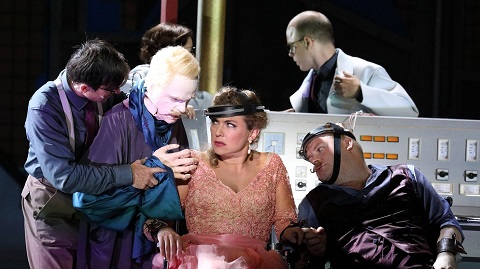


And a few challenges are exactly what the opera itself needs, having coasted along fairly easily on the tails of Mozart for the first half.  Weber rises to the challenge with some lovely choruses and a huge dose of Romanticism that provides plenty of opportunity for spectacle with musical and singing fireworks to match. The production, the singing and the musical performance from Ivor Bolton all live up to those requirements as well. Brenden Gunnell is excellent as Huon, exhibiting a fine lyrical Tamino-like tenor and fully entering into the spirit of the piece. Annette Dasch is no less committed as Rezia, bringing considerable character to the role, even if she doesn't always land well when she launches at those high notes.

Oberon, König der Elfen is certainly less well known than Weber's classic Der Freischütz, but it's an enchanting piece. It's less ambitious than Mozart in sentiment and execution and certainly doesn't have the same musical genius or memorable pieces, but it has considerable character of its own, particularly when a good production like this shows its merits.

Friday, 27 July 2012

Mozart - La Finta Giardiniera


Wolfgang Amadeus Mozart - La Finta Giardiniera
Festival d’Aix-en-Provence, 2012
Andreas Spering, Vincent Boussard, Colin Balzer, Layla Claire, Julian Pregardien, Ana Maria Labin, Julie Robard-Gendre, Sabine Devieilhe, John Chest
ARTE Live Web
Internet streaming, Aix-en-Provence - 10 July 2012
Written in 1774 for performance in Munich when Mozart was just 18 years of age, La Finta Giardiniera (’The Fake Gardener‘) is never likely to be regarded as anything more than the work of an inexperienced composer who wouldn’t really find his own distinctive voice until the composition of Idomeneo (1781). Mozart had however already written seven operas by this time, and if La Finta Giardiniera doesn’t sparkle with the brilliance of those later mature masterpieces, there are nonetheless interesting parallels and prototypical characters here that would be depicted with greater detail and finesse in The Marriage of Figaro. In its own right however, La Finta Giardiniera is still an enjoyable little opera buffa of modest ambition that seems well suited to the surroundings of a summer evening in the gardens of the Théâtre du Grand Saint-Jean in Aix (even if you are viewing it via internet streaming).
As performed by the orchestra of Le Cercle de l’Harmonie, conducted by Andreas Spering, the music of La Finta Giardiniera is as sprightly, pleasant and beautifully arranged as a Haydn opera, with delicate arias and recitative to play out the comic situation, and even if the work is mostly fairly conventional, it does have some delightful Mozartian touches. Dramatically, the situation doesn’t add up to much more than the typical opera seria plot given a bit of a buffa treatment, but even then, consisting of the old standard of mismatched couples finally finding their proper arrangement, it never really takes off dramatically or extends much beyond that. The most dramatic incident has already taken place before the opera even begins, with the Marquise Violante having survived an attack on her person by her fiancé the Count Belfiore in a fit of jealous rage. He believes that he has killed the woman that he loves, but in reality, Violante, along with her servant Roberto, calling themselves Sandrina and Nardo, are working in disguise as gardeners on the estate of the Podestà.


The opera itself operates within the romantic complications that arise out of this situation where there are characters in disguise and believed dead. The Podestà is in love with Sandrina, which infuriates his maid Serpetta. The rejected Serpetta is therefore in no mood for the attentions of Nardo who is persistently pursuing her. The Podestà moreover hopes to make a marriage of his niece Arminda to a rich noble, who turns out to be none other than the Count Belfiore. Don Ramiro, who is in love with Arminda, is evidently displeased by this. When the Count arrives for the wedding, Sandrine faints and the Count recognises her. Could it really be Violante? His love reawakened and his sense of guilt, Belfiore declares that he cannot marry Arminda. Everyone evidently is deeply unhappy and they spend their time moping and decrying their woes in arias. “Oh, how terrible things are, I don’t know what to do”, kind of sums up the content of these arias that describe their feelings of indignation, betrayal, unjust treatment and their confusion.
Oh yes, there’s lots of confusion, but evidently the idea is to somehow sort out all these mismatched couples and bring everything to a happy conclusion. In contrast however to the rather more accomplished and richly characterised Marriage of Figaro, for example, there is something rather pleasantly slapdash about the approach to resolution in La Finta Giardiniera, which is brought about by not much more than endless pleading after which the Podestà finally declares “Oh just marry whoever you want” to them all. The fact that there is an odd number of characters - seven - also means that at least one going to be left out of the rearrangements. Dramatically then, it’s far from satisfactory, since there is very little that happens to sustain interest in this situation for nearly three hours.
Musically however, the work is far from slapdash, though it is conventional and shows little in the way of inspiration or imagination. There are however one or two lovely little touches. In Act I, the Podestà describes his feelings for Sandrina as a symphony in the aria “Dentro il mio petto“, evoking instruments and sounds that the orchestra play to accompany his florid declarations. Breaking away from the strict solo aria, duet, recitative and ensemble arrangements, Mozart also manages to have the characters interact in these ensembles rather than all sing together or at cross purposes. It’s far from the complex Figaro arrangements however, as is the rather less well-developed dark garden setting for the confusion of identities and declarations of true feelings that ensue at the end of La Finta Giardiniera’s second Act, where Belfiore and Violante bewilderingly believe themselves to be Greek gods.

There are then modest pleasures to be found in La Finta Giardiniera, and they are brought out well in this production at the Aix-en-Provence Festival. Filmed on an outdoor stage, the sun setting during Act 1, the exterior location suits the garden setting beautifully. Accordingly, there is little need for stage props, the reflective floors, white chairs and the long-stemmed white roses that double as lamps providing the additional illumination and effects required for the limited drama. The sound recording is wonderful for an outdoor shoot, with no sign of intrusive microphones attached to the performers, the tone lovely and warm, with natural reverb coming from I don’t know where. The singers appear to be all new young artists, all very well cast for their respective roles with sweet voices well-suited to this early Mozart. There’s nothing too strenuous expected in the acting or the singing, and all sound and play this light buffo drama marvellously. If it’s slightly dull in places, lacking in any real verve or personality, that’s unfortunately down to the nature of the work itself.
La Finta Giardiniera is currently available to view via internet streaming on the ARTE Live Web site. Some region restrictions may apply.