
Gustav Mahler - Von der Liebe Tod
Wiener Staatsoper, 2022
Lorenzo Viotti, Calixto Bieito, Vera-Lotte Boecker, Monika Bohinec, Daniel Jenz, Florian Boesch, Johannes Pietsch, Gabriel Hoeller
Wiener Staatsoper Live Streaming - 7th October 2022
To somewhat stretch a metaphor, the idea of a Mahler opera is a bit like waiting for a bus around these parts. It can feel like you are waiting for a hundred and fifty years and then suddenly two of them come along together. Since of course there is no such thing as a Mahler opera that's even more unexpected, and it's perhaps no surprise that the directors daring to stage Mahler's symphonic and lieder works as opera are two of the most ambitious and controversial of contemporary directors; Romeo Castellucci and Calixto Bieito. As strange as it might be to imagine Mahler staged, it's even stranger that such an idea in these times is deemed controversial enough to upset a few sensitive souls who don't even have to watch it or let it impinge upon their favourite Mahler recordings on CD.
While that might not exactly be the primary intention of these directors to upset anyone, there is certainly something of a desire to stir things up - but in a good way, or perhaps a necessary way. Because these are indeed the times we are living in; a time of war in Europe, a time of global pandemic killing millions, a time of looming environmental crisis and climate change that does indeed affect everyone. It's not enough in these times for an artist to remain detached from that, but there should be some recognition that great art is drawn from such dark times and experiences, and it should reflect them and not gloss over them.
In the case of Castellucci's production of Resurrection, for example, it's not enough to just put on a work of such sublime creativity and feeling as Mahler's Sixth Symphony as a concert performance for a wealthy audience at the Aix-en Provence festival. It would almost be an injustice to Mahler to present such a work as a rich indulgence. It's a profound work that has deeper meaning and if it can move an audience - whether to applause or booing - then it ought to provoke such a reaction. Anyone however who boos the imagery of the digging up of a mass war grave while such atrocities are happening for real at that moment not so far away should really think twice about their understanding and purpose of the arts.
The same goes for anyone who manages to work themselves into a state about a creative artist taking a similar approach to this Vienna State Opera stage production of another Mahler's work. Von der Liebe Tod actually consists of two Mahler works brought together, Das Klagende Lied, a cantata from 1879/80 based on the Brothers Grimm fairy tale, and Kindertotenlieder from 1901/04, based on a poem by Friedrich Rückert. Calixto Bieito employs similar techniques to Romeo Castellucci, the two directors almost crossing over as they progress from what were not ever exactly conventional opera stagings in the first place to rather more abstract presentations of works that were never intended to be fully staged.

I say never meant to be fully staged, but the question that arises immediately when watching the first part of this production, the cantata Das Klagende Lied, is why not? It has a clear fairy tale narrative and powerful accompanying music and singing that is dramatically attuned to the developments and deeper sentiments of the story. It's mostly narrative based admittedly, and doesn't even have clear individual roles that you might find in an oratorio, but it is filled with imagery that deserves to exist more than in the mind of the individual listener. In fact it is the role of a director - much as some would seek to not credit him or her with any importance - to explore a work closely and relate it to universal concerns that any listener will recognise and identify with.
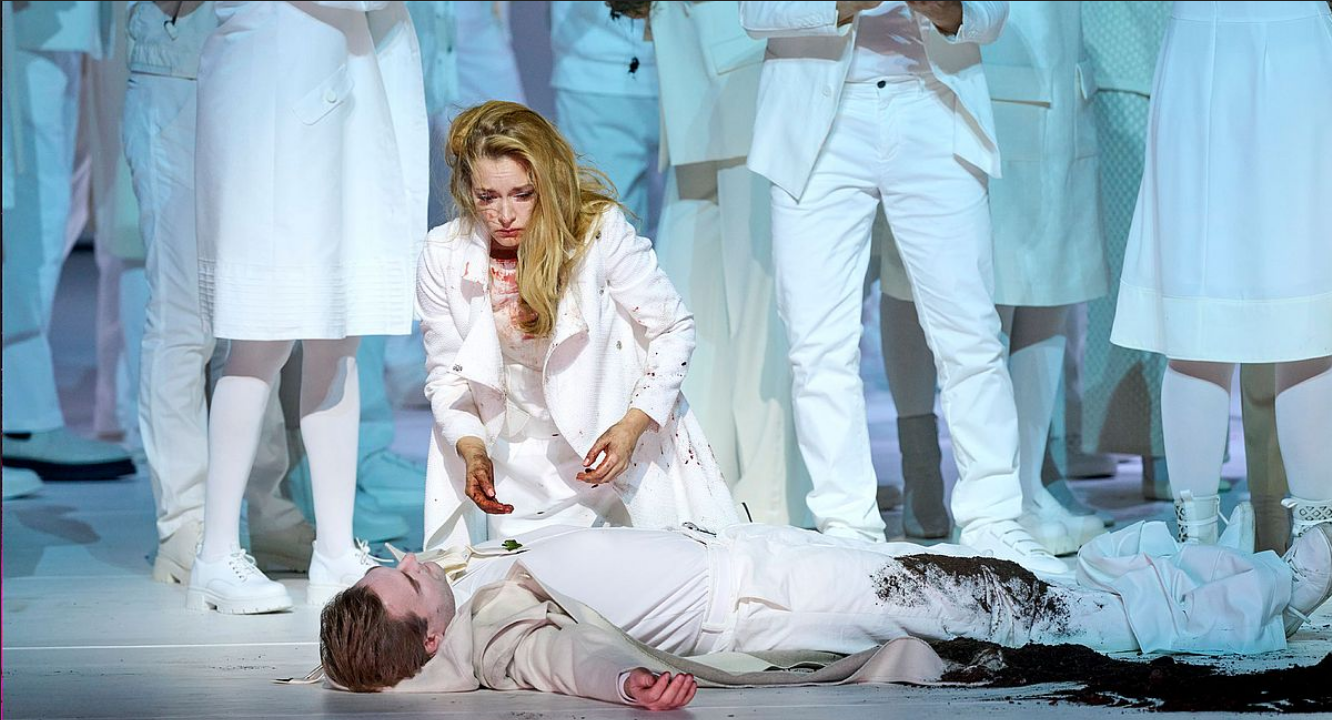
Calixto Bieito then evidently doesn't go in for straightforward naturalism or literal illustration of the story in the way of Otto Schenk's The Cunning Little Vixen at the same opera house, for example. The imagery Bieito devises for this fairy tale opera/cantata however is exactly what a director should do when confronted with a work of great art and that is to dig deeper into the underlying meaning of the fairy tale and relate it to more universal concerns. Using the red flower of the fairy tale, the imagery of the willow and the nightingale, all of them witnessing the killing of one brother by another, the overriding idea - for me at least - appears to be the impact violence has on individuals, on society, on nature. And yes, that is something we can see in many aspects of the times we are living in.
As he is wont to do, Bieto simultaneously makes this beautiful to look at but harrowing at the same time, refusing to prettify the underlying horror at the heart of the tale (see also his response to the not dissimilar fairy tale story of men dying for a cold hearted queen in his version of Turandot). In the story, the minstrel comes across a gleaming bone in the woods that he carves into a flute, but here he hacks off an arm, cuts out a bone from within the flesh and plays on a blood spattered bone. It's not the 'flute' that sings either, but the grim spectacle of the dead boy with a bloody hacked off arm singing of his fate. Evidently, this will not be to everyone's taste, but it is necessary.

The dead boy slayed by his brother over a flower leads beautifully into the second part of Von der Liebe Tod, the ruins of the wedding feast turning into an abandoned playroom for dead children in Kindertotenlieder. Conceptually this is marvellous, the earliest of Mahler works - Das Klagende Lied his Opus 1 composed when he was 19 - brought together with the later, final work of a composer capable of committing all his lived experience in the meantime into it; a fairy tale turned into reality and that reality and horror concentrated and transformed into something beautiful through art. That is the purpose of art, or one of its many purposes. It's that same art in musical performance and interpretation that ensures that such work lives on, remains vital and alive and connected not to past events, but to what people are experiencing today. Sometimes life mirrors art in shocking and unexpected ways. One need only think of another recent tragedy in Thailand to see how deep feelings run in Kindertotenlieder. The idea that anyone could even think of mindlessly heckling artists on a stage after viewing this is unconscionable.
It helps that musically this is a glorious affair. The influence of Wagner on the youthful Mahler is most pronounced in the considerable orchestral forces and choral arrangements employed in the service of emotional and dramatic content of Das Klagende Lied. The conducting of the works by Lorenzo Viotti also comes to the fore in Kindertotenlieder, with intense, heartfelt singing from Florian Boesch and Monika Bohinec. How much more alive does this become when such performances are aligned with visual imagery and artistic direction that meaningfully connects the work with reality, that doesn't sugarcoat it or diminish its sentiments, as some might be tempted to do with these two particular works. Welcome to the opera stage of the 21st century, Gustav Mahler.


