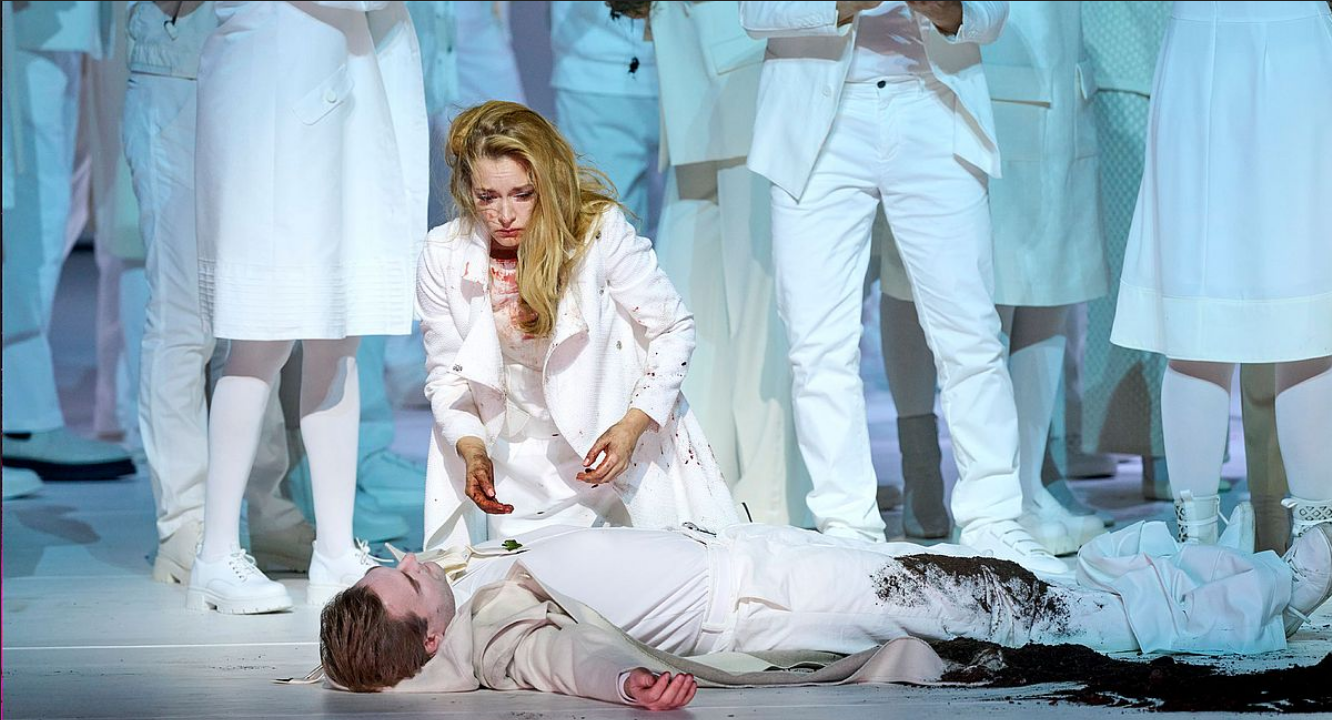
Richard Wagner - Tristan und Isolde
Bayreuther Festspiele, 2024
Semyon Bychkov,Thorleifur Örn Arnarsson, Andreas Schager, Günther Groissböck, Camilla Nylund, Olafur Sigurdarson, Birger Radde, Christa Mayer, Daniel Jenz, Lawson Anderson, Matthew Newlin
BR-Klassik - 25th July 2024
It's not often I am at a loss of words to describe or give an impression of a production of Tristan und Isolde, particularly one at the Bayreuth Festival which usually gives plenty to think about and unusual directorial touches to describe, but in the case of the new production that opens the 2024 festival I think this Isolde has taken all the words for herself. At the start of the opera we see her wearing a jewel encrusted fencing mask, dressed in a robe filled with words that spreads out around and covers the ground she lies upon, still scribbling more words onto the costume. For the remainder of the first Act however we see little more on the stage than an abstract impression of a ship with rigging sailing through misty waters. Already I'm beginning to suspect that director Thorleifur Örn Arnarsson is going to expect each person who views it to do much of the work for him on this one.
On the other hand, there is something to be said for reining in the traditional excesses seen at Bayreuth for something a little more low key than some of the wilder over-the-top productions seen there over the last few decades under the artistic direction of Katarina Wagner. You can take your pick at which is the most extravagant, whether Herheim's Parsifal, the Castorf Ring, the Baumgarten's industrial Tannhäuser… there are too many to choose from. Perhaps it's time to tone down on the distractions a little and let the music and the singing express everything that needs to be said, or at least everything that is important. In the case of Tristan und Isolde, it doesn't need a great deal of imagined action, elaborate stage sets or re-interpretation to bring out what it is about, but it should leave some openness that allows some of its mysteries to remain. There is at least a suggestion of something mystical and ambiguous in this production around the feelings that truly lie between Tristan and Isolde, even before the magic potion kicks in.

As for the magic potion, well even that is not deemed essential in this production for those feelings to well up and spill over. There is a phial, but neither seem to drink from from it, both already seemingly aware on some level of the feelings they have for each other, the simmering passions that they know are wrong, one a betrayal of Morold, the other a betrayal of King Mark. And yet despite Tristan studiously trying to avoid meeting Isolde on the journey from Ireland until she is delivered to the King in Cornwall, it just can't be avoided. When he does agree to take the drink, he appears to be well aware of Isolde's magical powers since they helped heal him while in Ireland (a source of guilt for both), and as such, knowing what is ahead, he seems willing to accept or unable to deny the fate she offers him, which is death. Isolde for her part, realises this at the last moment and casts the potion away, assuming her own share not so much of the poison as her share of guilt.
If there is not much in the way of pointers as far as the direction goes at this stage, at least there is much to enjoy in the singing. Andreas Schager and Camilla Nylund might not be the first choice singers for these roles, but there is no denying their experience in almost all the key Wagnerian roles for tenor and soprano. Schager is perhaps a bit too earnest, a little steely and overly forceful in delivery - and this becomes more of an issue in the second and third acts. Camilla Nylund is again excellent, following her recent performances as Brünnhilde in the impressive Zurich Ring Cycle. Both are well supported here by Olafur Sigurdarson's Kurwenal and Christa Mayer's Brangäne
Ok, so maybe I'm not left at a complete loss of words, but few of them point to any original observations about the work at this stage. The subsequent Acts don't add a great deal more, lack rigour and focus, but perhaps hint at the framework of an idea, with Semyon Bychkov bringing more to the musical interpretation to spur it along. The orchestral build up to the arrival of Tristan in Act II is furiously played, overwhelming, as you imagine it ought to be. The darkness enveloping Isolde and Brangäne is dimly illuminated at his arrival to show them in a rather more cluttered area in what appears to be the hull of the ship with pipes, gauges, wheels and dials, but also random luggage and objects: a globe, clocks, an urn, stuffed animals, statues and busts, pictures, Isolde's mask, all of it bathed in reddish golden glow.

All the rapturous sentiments are there in Act II, but there s little sense of it meaning anything or any sense of it being connected to the world outside - which is a valid view of two lovers for whom nothing else exists. In what becomes a running theme in this production - and hence where you suspect some intent of commentary or interpretation lies - is that the two lovers seem determined to consummate their love again though the imbibing of the death potion but are inevitably interrupted. Another attempt is made after King Mark’s speech, as Tristan holds the flask and invites Isolde to join him in his wondrous realm of night. Rather than Merlot striking him with sword, Tristan succeeds in drinking from the flask and Isolde is frustrated in her attempt to follow him by an intervention from Melot. King Marke's arrival however reveals that in the light of day, the hull of the ship is nothing more a rusted hulk. These are slim points of difference that don't seem to offer anything significant or new.
Andreas Schager is already feeling the strain a little in Act II through the sheer force of his delivery, pushing much too hard at the expense of a more nuanced interpretation of the dynamic. Camilla Nylund's lovely richness of voice is evident but she doesn't always have the necessary power and lacks any real direction from Arnarsson to help her wade through the text that spills onto her dress. It's probably about time that someone other than Georg Zeppenfeld was given the role of King Mark at Bayreuth (and every other important house in Europe performing this work), but it's only when you hear someone else sing it that you appreciate Zeppenfeld more. It's not an enviable role to enter at this stage in Act II and have to deliver a long monologue wallowing in disappointment and betrayal, but grimacing Günther Groissböck isn't able to make much of it and a section of the audience show their displeasure at the end of act curtain call.

The skeletal hulk of the decaying, rusting ship remains in Act III as Kareol, now even more disordered, with all the junk heaped together in a pile and the dying Tristan slumped against it. Again, it's a slim offering for this work and the failure to make anything significant of the circumstances that drive Tristan and Isolde to consummate their love-death, in as far as that can be done (and in Wagner's world, in his music at least it makes sense) means that it's hard to feel that the right tone has been established for this final scene. Schager gives his usual committed performance but it feels desperate rather than express desperation. His delivery then of Tristan's delirious monologue wavers, impressive in some respects, inaccurate in others as he flails around pushing his voice to its limits. Nylund at least brings a more delicate yet appropriate touch to what the director has been heading towards in the conclusion where she drains what remains in the flask and joins Tristan in death.
It's true that every director has their own interpretation of Tristan und Isolde and there should be no limits placed on that, but I can't help feel that from the small twists on the libretto that are applied here, it shows a fundamental misreading of the work or perhaps a very limited view of it. There is a suggestion that both Isolde and Tristan have deep emotional baggage or physical human limitations - one in Isolde's obsessiveness over trying to put her feelings into words, the other in the objects that almost smother Tristan in Act III - that holds them back from achieving the true transcendence they aspire towards together, both trapped within an imperfect decaying body of the ship. It's not a lot to go on, but with Wagner's remarkable score conducted by Semyon Bychkov and some good singing it's almost enough. Unfortunately with this work almost enough just isn't good enough.
External links: Bayreuther Festspiele, BR-Klassik