Showing posts with label Andreas Schager. Show all posts

Tuesday, 4 August 2026

Wagner - Rienzi (Bayreuth, 2026)


Richard Wagner - Rienzi (Bayreuth, 2026)

Bayreuther Festspiele, 2026

Nathalie Stutzmann, Alexandra Szemerédy, Magdolna Parditka, Andreas Schager, Gabriela Scherer, Andreas Bauer Kanabas, Jennifer Holloway, Michael Nagy, Vitalij Kowaljow, Matthias Stier, Michael Kupfer-Radecky, Victoria Randem

BR-Klassik Livestream - 26th July 2026

First performed in 1842, Wagner's first serious opera Rienzi, der letzte der Tribunen had never been performed before at the composer's theatre at Bayreuth. A five-act epic in the grand opera tradition, it was soon disavowed by the composer and never accepted as part of the Bayreuth canon. It has been performed infrequently elsewhere, but it is a challenge, the opera carrying a lot of historical baggage and notoriety as an opera that celebrates fascism and its association with the Third Reich. The idea that an opera can be fascist is clearly nonsense of course - it's all about how you choose to represent the rise and fall of a dictator on the stage. Some might choose to confront this legacy but another approach - surely equally as valid if it has any meaning or relevance at all (the jury may still be out on that one) - is to see the opera not defined by history, but what it means today.

The Bayreuth Festival has not been afraid to confront Wagner's history and some of the controversial elements in his works, but it has tended to shy away from making any overly political statements in recent years. Stefan Herheim's Parsifal at Bayreuth however viewed the composer's last great work in the context of German history, while the most recent challenge to the composer's legacy was Barry Kosky putting Wagner's antisemitism on trial in the 2017 Die Meistersinger von Nürnberg. Having never been performed before at Bayreuth however, the pressure on the directors to find a way of presenting this troublesome work are undoubtedly considerable, but just as important is validating the staging of the Rienzi at Bayreuth in its 150th anniversary year is also to come up with a meaningful approach that will address the question of why now?

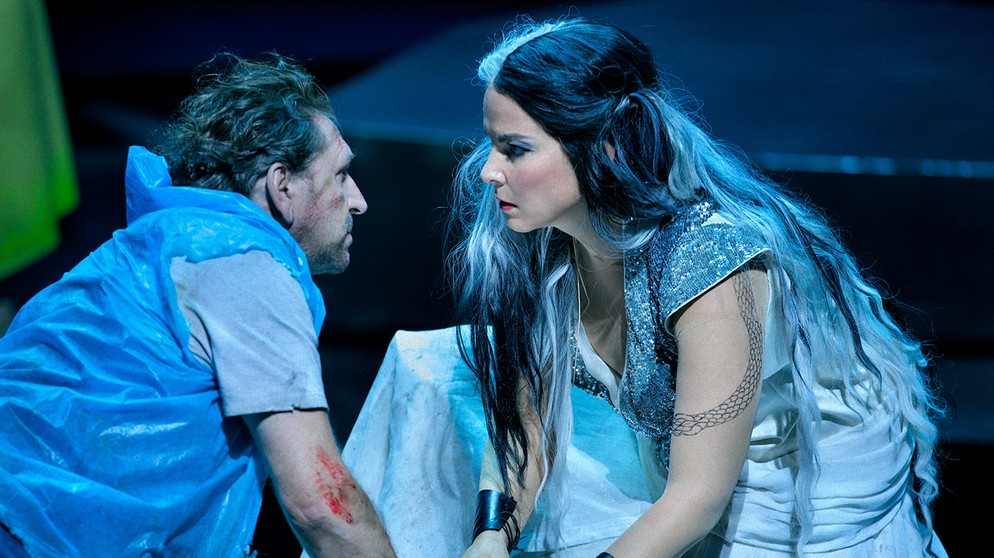
It's immediately apparent that if the directors Alexandra Szemerédy and Magdolna Parditka are going to address the legacy of Rienzi, it is going to be through the lens of the present rather than through its Nazi associations or indeed its 14th century historical drama in Rome. The famous overture - one of the enduring qualities of the work - sets a scene across three rooms of a contemporary apartment block are occupied by Cola Rienzi, his sister Irene and a young sick child who we discover is Rienzi's brother Giovanni. 'Party Chairman' Rienzi is preparing a speech venerating German Art while Irene is looking after the sick child. The child dies and as the building rises out of the stage, the neighbouring apartments are seen sharing text messages suggesting an incestuous relationship between Rienzi and his sister, and that the child may have been born out of that relationship.

Act I's clashes between the Colonna and Orsini families here take the form of a heated election debate, with graphics showing election polls and projections, TV cameras broadcasting the election addresses and debates. Talk around Rienzi isn't the only scandal doing the rounds, as Stefano Colonna, an important industrialist, has recently been acquitted of the hit-and-run accident that has led to the death of Giovanni. Rienzi steps in to bring a measured response that strikes a chord with the public and the media, pledging loyalty to Irene and Adriano Colonna, the son of Stefano to serve the people.

Despite the overheated nature of the first Act - somewhat inevitable considering Wagner's dramatic score - its is relatively based in a familiar contemporary reality that soon breaks down, or at least shows a deeper more troubling undercurrent. Having been acclaimed Tribune of Rome, the dull grey and white of Act I is momentarily replaced with a new optimism and pride in the new Rome under the command of Rienzi. But as the sun breaks through the storm clouds in this production's Act II, in Rienzi's mind his dead brother appears as one of the divine Messengers of Peace descending staircase from heaven. Scenes for Rienzi’s reception or "coronation" take place in a Roman senate arrangement where after the failed Caesar-like assassination attempt and coup by Colonna, Rienzi takes on a Christ complex.

Despite the modern trappings - mobile phones held aloft at every move - the Bayreuth production nonetheless adheres closely to the dramatic action as it plays out in the libretto without too many revisionist touches, but also without managing to say anything new about what follows. The contemporary setting at least has a ring of familiarity to it as, for all the ruler's fine words, the real test comes when the 'nobili' - or businesses and wealth holders - rise up against him. Needless to say, Rienzi fails here and it's the ordinary people who pay the price of the cost of war, resulting in the people turning against him. Even though 'modernised', Rienzi resists modernisation, Act III remains every bit as over the top as the most extravagant of grand opera, the production failing to rein its excesses in at all.

Whether a director should even attempt to hold back on Rienzi or not is of course a matter of choice. Wagner scored the work to be a grand, epic statement, but it does risk losing sight of any purpose it might have, getting carried away in its own operatic grandiosity, with caricatures of noble sentiments and foul plots, all arch declamations, formal processions, marching battle-hymns and fervent solemn choruses. It's similarly easy for the audience to just get caught up in the grand sweep of it all to the extent that they ignore the troubling undercurrents of fascism, but at this kind of drawn-out length (even in its reduced form of just under 4 hours), it's also rather wearying.

Although I have seen it a few times, I'm not as familiar with Rienzi as other Wagner operas, but it does seem as if there has been some reordering done to make it flow a little easier. Rienzi sings his Act V aria 'Allmächt'ger Vater' before Act IV's discussion of excommunication (a fair portion of which is conducted through text messages in English), but otherwise under conductor Nathalie Stutzmann, it's the full-on Rienzi experience. Some other unique directorial touches are applied to Act V where Rienzi and Irene seem to consummate their relationship in some kind of death pact while Adriano looks on in shock. The only light touch - or heavy-handed touch maybe - is the use of the Act II ballet music to run through highly compressed scenes from all Wagner's subsequent mature operas, performed in am dram costumes, complete with intervals where the well-heeled audience queue for drinks and toilets.

To be honest, the ballet-theatre scene is indicative of the style of the acting and the direction throughout. There is a token attempt to explore the psychology or psychopathy of a dictator in a proposed invented incestuous relationship with sister and death of his brother (or 'brother’), which doesn't offer a great deal - although it is something of a Wagnerian trait. There is also at least some effort to engage with contemporary political events in the production - perhaps more so than any production at Bayreuth since Frank Castorf's Ring - setting the work in the context of a modern electoral campaign where the far-right are gaining popular votes. The epic grand conclusion that Wagner scores could only be justified when depicted as the eventual complete meltdown of the capitalist system, but it all just feels empty and meaningless after fours at full tilt orchestration and booming choruses, and the work proves resistant to any attempt to inject an air of cautionary realism into it.

Vocally, aside from the chorus who have an important part to play in this work, much rests inevitably on Andreas Schager's performance as Rienzi and, as is often the case, it's a little over the top (as is the chorus, but in a good way). Certainly the role is written for grand declamation, but Schager doesn't seem to be able to bring it down to any level other than full-on forte that starts loud and gets increasingly strained over the four hours of the opera. The man is going to do himself an injury at this rate. Only when taking the 'Allmächt'ger Vater' aria - presumably placed in Act IV for breathing space - does he manage to show some restraint; in the singing at least; the 'acting' is reduced to lots of wild expressions and writhing around. Sure, the relentless pitch of the opera perhaps demands it, but Schager's performance doesn't make it any easier to relate to it. I liked Gabriela Scherer's performance as Irene, even though her role in the opera remains unfathomable in the psychodrama that is developed here with Rienzi and Adriano. Jennifer Holloway's Adriano is a heroic role that proves powerless to change the course of events; the soprano makes similarly a valiant effort all the way through, but is often overwhelmed by the bombast.

The current rise of the far-right in Germany is all the justification necessary to bring Rienzi to the stage at Bayreuth - let's just hope that the AfD don't adopt the overture for its rallies or history might repeat itself - but if that is indeed the target, it fails to make its mark and just confirms that Rienzi does not need to remain a regular fixture at Bayreuth. Despite the derivativeness of its sources though, it is an accomplished work, worth a look every now and again to admire not so much its sheer folly and ambition, but to see it as a necessary step towards the greatness that would follow from Richard Wagner. It's almost as if all the bad habits of operatic grand opera had to be expelled from the system in order to find his own true voice. This Rienzi is worth seeing, even if it's just to get over the curiosity about whether it really has any merit, and you can put any such ideas about that aside for another while.


Sunday, 4 August 2024

Wagner - Tristan und Isolde (Bayreuth, 2024)


Richard Wagner - Tristan und Isolde

Bayreuther Festspiele, 2024

Semyon Bychkov,Thorleifur Örn Arnarsson, Andreas Schager, Günther Groissböck, Camilla Nylund, Olafur Sigurdarson, Birger Radde, Christa Mayer, Daniel Jenz, Lawson Anderson, Matthew Newlin

BR-Klassik - 25th July 2024

It's not often I am at a loss of words to describe or give an impression of a production of Tristan und Isolde, particularly one at the Bayreuth Festival which usually gives plenty to think about and unusual directorial touches to describe, but in the case of the new production that opens the 2024 festival I think this Isolde has taken all the words for herself. At the start of the opera we see her wearing a jewel encrusted fencing mask, dressed in a robe filled with words that spreads out around and covers the ground she lies upon, still scribbling more words onto the costume. For the remainder of the first Act however we see little more on the stage than an abstract impression of a ship with rigging sailing through misty waters. Already I'm beginning to suspect that director Thorleifur Örn Arnarsson is going to expect each person who views it to do much of the work for him on this one.

On the other hand, there is something to be said for reining in the traditional excesses seen at Bayreuth for something a little more low key than some of the wilder over-the-top productions seen there over the last few decades under the artistic direction of Katarina Wagner. You can take your pick at which is the most extravagant, whether Herheim's Parsifal, the Castorf Ring, the Baumgarten's industrial Tannhäuser… there are too many to choose from. Perhaps it's time to tone down on the distractions a little and let the music and the singing express everything that needs to be said, or at least everything that is important. In the case of Tristan und Isolde, it doesn't need a great deal of imagined action, elaborate stage sets or re-interpretation to bring out what it is about, but it should leave some openness that allows some of its mysteries to remain. There is at least a suggestion of something mystical and ambiguous in this production around the feelings that truly lie between Tristan and Isolde, even before the magic potion kicks in.

As for the magic potion, well even that is not deemed essential in this production for those feelings to well up and spill over. There is a phial, but neither seem to drink from from it, both already seemingly aware on some level of the feelings they have for each other, the simmering passions that they know are wrong, one a betrayal of Morold, the other a betrayal of King Mark. And yet despite Tristan studiously trying to avoid meeting Isolde on the journey from Ireland until she is delivered to the King in Cornwall, it just can't be avoided. When he does agree to take the drink, he appears to be well aware of Isolde's magical powers since they helped heal him while in Ireland (a source of guilt for both), and as such, knowing what is ahead, he seems willing to accept or unable to deny the fate she offers him, which is death. Isolde for her part, realises this at the last moment and casts the potion away, assuming her own share not so much of the poison as her share of guilt.

If there is not much in the way of pointers as far as the direction goes at this stage, at least there is much to enjoy in the singing. Andreas Schager and Camilla Nylund might not be the first choice singers for these roles, but there is no denying their experience in almost all the key Wagnerian roles for tenor and soprano. Schager is perhaps a bit too earnest, a little steely and overly forceful in delivery - and this becomes more of an issue in the second and third acts. Camilla Nylund is again excellent, following her recent performances as Brünnhilde in the impressive Zurich Ring Cycle. Both are well supported here by Olafur Sigurdarson's Kurwenal and Christa Mayer's Brangäne

Ok, so maybe I'm not left at a complete loss of words, but few of them point to any original observations about the work at this stage. The subsequent Acts don't add a great deal more, lack rigour and focus, but perhaps hint at the framework of an idea, with Semyon Bychkov bringing more to the musical interpretation to spur it along. The orchestral build up to the arrival of Tristan in Act II is furiously played, overwhelming, as you imagine it ought to be. The darkness enveloping Isolde and Brangäne is dimly illuminated at his arrival to show them in a rather more cluttered area in what appears to be the hull of the ship with pipes, gauges, wheels and dials, but also random luggage and objects: a globe, clocks, an urn, stuffed animals, statues and busts, pictures, Isolde's mask, all of it bathed in reddish golden glow.

All the rapturous sentiments are there in Act II, but there s little sense of it meaning anything or any sense of it being connected to the world outside - which is a valid view of two lovers for whom nothing else exists. In what becomes a running theme in this production - and hence where you suspect some intent of commentary or interpretation lies - is that the two lovers seem determined to consummate their love again though the imbibing of the death potion but are inevitably interrupted. Another attempt is made after King Mark’s speech, as Tristan holds the flask and invites Isolde to join him in his wondrous realm of night. Rather than Merlot striking him with sword, Tristan succeeds in drinking from the flask and Isolde is frustrated in her attempt to follow him by an intervention from Melot. King Marke's arrival however reveals that in the light of day, the hull of the ship is nothing more a rusted hulk. These are slim points of difference that don't seem to offer anything significant or new.

Andreas Schager is already feeling the strain a little in Act II through the sheer force of his delivery, pushing much too hard at the expense of a more nuanced interpretation of the dynamic. Camilla Nylund's lovely richness of voice is evident but she doesn't always have the necessary power and lacks any real direction from Arnarsson to help her wade through the text that spills onto her dress. It's probably about time that someone other than Georg Zeppenfeld was given the role of King Mark at Bayreuth (and every other important house in Europe performing this work), but it's only when you hear someone else sing it that you appreciate Zeppenfeld more. It's not an enviable role to enter at this stage in Act II and have to deliver a long monologue wallowing in disappointment and betrayal, but grimacing Günther Groissböck isn't able to make much of it and a section of the audience show their displeasure at the end of act curtain call.

The skeletal hulk of the decaying, rusting ship remains in Act III as Kareol, now even more disordered, with all the junk heaped together in a pile and the dying Tristan slumped against it. Again, it's a slim offering for this work and the failure to make anything significant of the circumstances that drive Tristan and Isolde to consummate their love-death, in as far as that can be done (and in Wagner's world, in his music at least it makes sense) means that it's hard to feel that the right tone has been established for this final scene. Schager gives his usual committed performance but it feels desperate rather than express desperation. His delivery then of Tristan's delirious monologue wavers, impressive in some respects, inaccurate in others as he flails around pushing his voice to its limits. Nylund at least brings a more delicate yet appropriate touch to what the director has been heading towards in the conclusion where she drains what remains in the flask and joins Tristan in death.

It's true that every director has their own interpretation of Tristan und Isolde and there should be no limits placed on that, but I can't help feel that from the small twists on the libretto that are applied here, it shows a fundamental misreading of the work or perhaps a very limited view of it. There is a suggestion that both Isolde and Tristan have deep emotional baggage or physical human limitations - one in Isolde's obsessiveness over trying to put her feelings into words, the other in the objects that almost smother Tristan in Act III - that holds them back from achieving the true transcendence they aspire towards together, both trapped within an imperfect decaying body of the ship. It's not a lot to go on, but with Wagner's remarkable score conducted by Semyon Bychkov and some good singing it's almost enough. Unfortunately with this work almost enough just isn't good enough.


External links: Bayreuther Festspiele, BR-Klassik


Saturday, 12 August 2023

Wagner - Parsifal (Bayreuth, 2023)

Richard Wagner - Parsifal

Bayreuther Festspiele, 2023

Pablo Heras-Casado, Jay Scheib, Andreas Schager, Derek Welton, Georg Zeppenfeld, Elīna Garanča, Jordan Shanahan, Tobias Kehrer, Siyabonga Maqungo, Jens-Erik Aasbø, Betsy Horne, Margaret Plummer, Jorge Rodríguez-Norton, Garrie Davislim, Evelin Novak, Camille Schnoor, Julia Grüter, Marie Henriette Reinhold

BR-Klassik livestream - 25th July 2023

There is obviously more than one way to view an opera, particularly so in a work as rich, abstract and enigmatic as Parsifal, but this year's new production by American director Jay Scheib for the 2023 Bayreuther Festspiele actually went as far as delivering a production where the audience watching it could see two different productions playing out at the same time. The was achieved by 'augmented reality', allowing a small proportion of the audience (330 of the almost 2,000 capacity) to see enhanced elements while the majority got the plain vanilla version. As if there could be anything 'vanilla' about Parsifal. While I can't say much about the enhanced version - having watched the non-augmented reality version (or simply 'reality' as most people know it) via a livestream, I have doubts that it could offer anything more than the regular version. And even if that wasn't particularly revelatory, this Parsifal had a few interesting ideas and some fine musical and singing performances.

It's just my opinion of course, but no Wagner opera should be exempt from the kind of restless experimentation, updating, reworking, rethinking, modernisation, whatever you want to call it that Bayreuth often exercises in their stage productions of his works. Some works appear to be more suited to this than others, some are just incoherently thought out, but often they do succeed in inspiring new ways of considering some of the greatest works of opera. Parsifal has less surface narrative than most and is often interpreted in a wide variety of ways, but there are nonetheless deep important spiritual intentions in the work that should not be neglected. But if you can find other ways to tap into this, why not try?

Wagner's music score is more than capable of withstanding any conceptual conceit a stage director throws at it, and it can be just as intriguing hearing what the individual interpretation a conductor can bring to the pace, delivery and detail of the score. If you have that and when you have a good cast, you know the work has everything it needs, and anything else that the stage director decides to focus on is a bonus that you can choose to consider or not. As far as the new Bayreuth production is concerned, the musical under Pablo Heras-Casado is. I've liked others better, but that's just personal preference and as long as the purpose of the music and its relation to the underlying sentiments, philosophy, mood and drama is maintained - which it is here - then that's the basic minimum you can expect. The singing is essential also - you simply can't do Parsifal without strong experienced voices - and looking at the cast here for the roles of Gurnemanz, Parsifal and the Kundry here, there are no worries on that account, but it's supported also by fine performances in the roles of Amfortas, Klingsor, and Titurel. There can be few complaints, if any, on that score.

The deeper message of Parsifal lies in the musical expression, and perhaps even more in the responsiveness of the listener, all of which are more expressive than the relative and deceptive simplicity of the plot outline, which you would think would not allow for any great variance - although many directors have managed to successfully find other creative ways to relate to the underlying tone of the work. One can glance through past reviews here just to see how varied interpretations can be. This long preamble might suggest that I don't have a lot to say about this specific production that I haven't said before and which hasn't been expressed better in other productions - including of course Stefan Herheim's Parsifal at Bayreuth, which I have yet to say anything about - and to some extent it's true that there is not a lot that was inspired about this new version (non-augmented reality version anyway), but it was still good enough to impress.

Leaving aside the augmented reality aspect, one way a director can choose to impose or highlight a certain crucial aspect of Parsifal or any opera work, is by the use of additional silent actors. While most of us don't see the visual overlays, we do see at least one 'invisible' figure, a kind of mirror image of Kundry, or simply 'woman'. Gurnemanz upon waking, or in his waking moments, is seen grappling in the embrace of an unknown woman during the prelude. She appears to be a holy woman, judging from the image of a saint or holy figure on the back of her shirt, or perhaps just appears that way to the devout Gurnemanz. She remains in the background in Act I, tending to the unhealing wound of Amfortas and appears elsewhere throughout the work. Is she a mirror image or expansion of Kundry? In a work where the presence of woman outside of Kundry barely makes an impression other than to lead good righteous men into ruin, Kundry's expansive presence can be extended in a work where compassion is important.

And yet, although many other productions make a powerful Kundry central to the whole ethos and philosophy of the work, that aspect is not emphasised as much, or seemingly as central to the other significant spin that the director places on the work, which is in how the Grail and the worship of the Grail is depicted here. The Grail is shown as a large purple-blue crystal, but more than its physical presence, what it important is how it is depicted as something painful, an adherence to old traditions (and religions?), that need to be cast off for mankind to be free from the weight of the past in order to achieve transcendence. This is hinted at in the second Act, where there is a connection established between the Grail and the cavern where Klingsor resides, which is the same shape and colour as the crystal in Act I. This is taken through to Act III which goes as far as Parsifal destroying the 'grail', the crystal thrown to the ground and shattering into pieces.

Although pain and suffering has always been an essential part of Parsifal, the path to enlightenment being essentially a painful journey, it's a significant departure nonetheless to actually destroy the Grail at the conclusion. Yet somehow this doesn't really achieve the redemptive quality of the work that you expect, but there is clearly an effort made to tie it in with the transformative impact that all the principal figures - and even secondary ones - undergo. Personally, while the set design is at least wholly sympathetic to the work, I think the fine singing is key to bringing this together as successfully as it does. Act I at least has all the beauty, agony and magnificence you could hope for and expect, laying the seeds for what it proposed in the subsequent acts. The set is open and spacious, simple and abstract - a pool, a platform/bed/coffin, a high steel pillar and a circle of light that rises to fill the stage with light during the transubstantiation offering (this one very reminiscent of a Catholic mass communion processional), but it's Amfortas's pain and the performance of it from Derek Welton that hits the mark.

Act II is much more exotically coloured and lit than is usual for the garden of the flower-maidens, appearing genuinely enchanted (and I imagine even more so in the AR version) but again, what really brings it to life is the singing. The struggle between Klingsor and Kundry as he exerts his power over her is excellent, mainly on account of the performances and singing of Jordan Shanahan as Klingsor and Elīna Garanča as Kundry. Andreas Schager has a key role to play as Parsifal of course, and does so with characeristic intensity in this act. Building on the view of the Grail that this production takes, poor Sir Ferris exists as here as a blood splattered dummy in the background while Kundry attempts her seduction of Parsifal. Parsifal is moved to rip out his heart out and compare it to a stone, as he reflects on his failing to recognise what has prevented him from understanding Amfortas/The Saviour's suffering for our sins and begin the search for redemption. Schager makes it feel real and is matched by Garanca's expression of Kundry's torment. It's hard not to be won over, even if there is little that is new expressed here.

I can't say I've ever seen a production of Parsifal that matches the description stage directions for Act III as "A pleasant, open spring landscape with a background of gently rising flowery meadows". More often it looks more like a post-apocalyptic landscape. Here indeed the stage is dominated by some monstrous looking rock crushing truck that houses Gurnemanz, and by a crater in the centre of the stage that doesn't look much like a holy spring. The rock crushing extends then to Parsifal's destruction of crystal, ending the worship of the Grail and the ways of the past. This is also the idea emblazoned on the back of the shirts of Kundry and Parsifal, the former saying 'Forget Me', the latter 'Remember Me', the two of them united in the holy spring. Even Gurnemanz embraces his shadow Kundry. It would seem to have little to do with Wagner's idea of redemption, but it is impossible nonetheless not to be moved by the extraordinary beauty and majesty of this work and what it achieves across four hours.

That at least is supported by truly impressive singing performances and an outstanding chorus. Georg Zeppenfeld is his usual solid impressive Gurnemanz, with grave, clear intonation and authority. Andreas Schager sings with such intensity that he inevitably show a little bit of strain. Elīna Garanča makes her debut appearance at Bayreuth, but I've seen her sing the role of Kundry in an ambitious production of Parsifal at Vienna in 2021 (which interestingly doubled the role of Parsifal as they do with Kundry here). She is even more impressive here and takes the curtain call at the premiere of this new production to deservedly thunderous applause. Pablo Heras-Casado is warmly received for a consistent measured performance dramatically attuned to the stage, that nonetheless (although limited to the sound mix on the livestream) I thought sounded a little lacking in detail in places. There was inevitably a mixed reception for the production team, the louder boos trying to drown out what sounded in the main like welcome applause.

This was not a great production though. Depending on your view it fails to make the essential point of the work or you could think that it finds its own roundabout way around to it, but it has moments that are successful and it looks suitably impressive. Like many of the recent Bayreuth productions however it feels like a kind of halfway house between the extreme much-maligned but fascinating excesses of the last decade and a more traditional production that at least touches base with the original stage directions. The new developments like the use of AR here - which I've read about subsequently and it seems genuinely interesting if a little overdone (reminding me of an initial misguided and eventually rejected idea to do something similar in Robert Dornhelm's greenscreen experiments for his film version of La Bohème way back in 2006) - are welcome, showing a willingness to still trying to extend the word, the music, the significance and the legacy of Wagner into the future while at the same time trying not to lose the traditional unadventurous audience who expect something more respectful or reverential.


External links: Bayreuther Festspiele, BR-Klassik

Thursday, 19 January 2023

Wagner - Götterdämmerung (Berlin, 2022)


Richard Wagner - Götterdämmerung

Staatsoper unter den Linden, Berlin - 2022

Christian Thielemann, Dmitri Tcherniakov, Andreas Schager, Anja Kampe, Lauri Vasar, Mandy Fredrich, Mika Kares, Johannes Martin Kränzle, Violeta Urmana, Noa Beinart, Kristina Stanek, Anna Samuil, Evelin Novak, Natalia Skrycka, Anna Lapkovskaja

ARTE Concert - October 2022

To save you time - and not everyone has the endurance to last through the fourth segment of a Ring cycle - what goes for Siegfried also holds true for Götterdämmerung. There are no sudden revelations in the last part that build on what little we have been able to make of what came before in Dmitri Tcherniakov's 2022 Ring cycle for the Berlin Staatsoper. There is little that is different in style, theme, singing and musical performances. You could say that Tcherniakov has run out of ideas, but some would dispute (and it would be hard to disagree with) that he didn't really have any new ideas in the first place. The bringing down to earth of high-flown spiritual, philosophical and mythological elements in Wagner's music dramas through psychological exploration has been a feature of his Wagner productions, and indeed many of his other recent opera productions.

Götterdämmerung's opening showing a happy home and everyday domesticity before the rot sets in, has been done numerous times, not least in the just passed 2022 Bayreuth Götterdämmerung. The three Norns are wobbly bent-over old ladies, previously seen as being present in the background in the rotating passing between rooms. Perhaps the point is that they are ancient and wise, or perhaps not so wise as they can't prevent what has happened and the course that future events will take. All in all though it's a very dull prologue, lacking on any kind of drive, purpose or meaning in the context of this production, but at least consistent within it.

Also not unlike the recent Bayreuth production, Gunther (Lauri Vasar) and Gutrune (Mandy Fredrich) in Act I are styishly dressed and think themselves sophisticated, giggling and making fun of the rather square Siegfried when he turns up in his yellow pullover with elbow patches and grey blue slacks and jacket. He presents a suitably naive figure it must be said, Tcherniakov making sure you don't mistake him for anything heroic. And let's not forget that this is supposed to be taking place within a virtual reality experiment of some kind, isn't it? Is everyone else but Siegfried in on the scheme? It would appear so, Gunther playing along with the idea that this fool's cuddly toy is his horse Grane to see where the experiment will end up. Although his delusions could be dangerous. Just look at what happened to Alberich in Das Rheingold! (Johannes Martin Kränzle's shambling semi-naked figure in the prelude to Act II reminds us of that).

There is little to enliven the scene between Brünnhilde and Waltraute (long time since I've seen Violeta Urmana), who wanders into their home in a blue trenchcoat. As with Siegfried, there is a lot of pacing up and down, but Kampe and Urmana at least get across the import of Waltraute's impassioned warning to her sister about the fate of Valhalla (are we talking about the E.S.C.H.E institute?) should she fail to renounce the ring. Christian Thielemann's equally impassioned musical direction certainly helps get this across; the swirling fire leitmotif at the end of the scene heralding the arrival and menace of Siegfried and Gunther's deceit is powerfully employed. Andreas Schager is suitably threatening also in his thuggish assault as Gunther on Brünnhilde, still Siegfried in appearance, which perhaps adds to the menace.

As elsewhere, not just in the previous scenes but throughout the whole Tchernaikov version of Das Ring des Nibelungen, the subsequent prelude to Act II between Hagen and Alberich is a mixed affair. The director fails to find any interesting way to stage the dramatic scenes of confrontation in any interesting way, or indeed connect it in any meaningful way to his testing centre experiment idea, but the performances of Mika Kares and Johannes Martin Kränzle nonetheless set up very well what is at stake and the tragedy that is to ensue in the subsequent scenes.

That at least is fully realised - or at least goes someway to redeeming Tcherniakov's staging elsewhere and deliver on Götterdämmerung as an effective conclusion - in the remaining scenes in this production. Avoiding making any real connection to the stress laboratory experiments - which let's face it, have contributed very little so far - the drama of Brünnhilde revealing Siegfried's betrayal carry the full weight of Wagner's intent. Anja Kampe is excellent here, as is Kares's Hagen and Lauri Vasar's Gunter. Andreas Schager fits the bill perfectly as Siegfried, showing that attention to the characters and their reactions to this scene are critical to the charge of the scene.

This takes place in the "assembly room" of the testing centre, which stands in here for the Gibichung Hall, and for the first time, it struck me as similar to Lohengrin's playing out of tragedy and betrayal by those who would see themselves as leaders or upholders of laws as a wider act that affects/involves the public/the nation. Whether that was intended or not, it does enhance the effectiveness of the scene. I also actually liked the baseball team locker room as a stand-in for the "hunting" scene that leads to the death of Siegfried. The gossip and toxic attitudes expressed suited the context of the scene and the death scene was genuinely touching and dramatic. Likewise the mourning gathering appearance of the old lady Norns, Erda and the Wanderer sufficed as a moving substitute for the usual theatrical conclusion of conflagration and immolation.

Overall then, this was a good Das Ring des Nibelungen at the Staatsoper unter den Linden, particularly as far as the musical performance and the majority of the singing were concerned. As far as Tcherniakov's science laboratory experiment is concerned, the only worthwhile experiment here, whose results are indisputable, is the force of Wagner's music to carry mythology, narrative and opera in service of something so powerful it resists time and fashions, something capable of renewal and reexamination of its meaning which remains a remarkable piece of art and culture, something that indeed has created its own mythology around it. It's been "stress tested" again, this time by Dmitri Tcherniakov, and The Ring still endures.


Sunday, 8 January 2023

Wagner - Siegfried (Berlin, 2022)


Richard Wagner - Siegfried

Staatsoper unter den Linden, Berlin - 2022

Christian Thielemann, Dmitri Tcherniakov, Andreas Schager, Stephan Rügamer, Michael Volle, Anja Kampe, Johannes Martin Kränzle, Peter Rose, Anna Kissjudit, Victoria Randem

ARTE Concert - October 2022

Up to this point, with Das Rheingold and Die Walküre, Dmitri Tcherniakov hasn't really revealed any compelling new insights or themes in his Berlin Staatsoper production of Der Ring des Nibelungen, which makes the prospect of what is to come in the remaining two parts feel something of a chore. Aside from the music, which can always reveal new facets and colour - and I have to say is well worth listening to under the musical direction of Christian Thielemann - it takes something creative to draw me into Siegfried. Heck, even Wagner decided he needed a break in the middle and embark on a couple of new projects before he could face going back to it. There are a few compensations in this production to make it worthwhile then, but as far as seeking to find a purpose to the cycle as a whole, there's not a great deal to grasp onto here.

Tcherniakov appears to struggle to find any way to make the exposition in the first act of Siegfried a little less tedious. If anything he makes it even more pedestrian. We remain in the same open framework of a room that is seen in the first two operas, where events/experiments are being observed by the watchful eye of Wotan, the Wanderer. Tcherniakov seems to just over-emphasise the rather heavy-handed exposition, already composed in this state by Wagner before he went back and wrote the operas for the backstory, by making Siegfried even more of a child, wearing a tracksuit in a room that is a playpen of colourful building blocks. By way of contrast, Mime and Wanderer look even more doddery old men in old man clothing, with whispy strands of remaining white hair. All of them have little to do but pace up and down.


Michael Volle of course puts heart and soul into it, but it's not enough. Andreas Schager sounds fine as Siegfried, but you get the impression that he is either pacing himself for the long haul or is not really engaged with the depiction of Siegfried he has been saddled with here. There is no forge, nothing to spark and enliven the scene, Siegfried taking a teddy bear and setting fire to the contents of a table top, before taking a sledgehammer to it and anything else within reach. It's almost like Tcherniakov is mocking the heroic fantasy of the work, but doesn't have anything useful to offer as a meaningful commentary on the content of this opera or its deeper purpose. Unless it's a willful expression of destruction of the old with the intent of building something new, including destroying old Wagnerian tropes and mannerisms in order to forge it anew, not unlike Katharina Wagner's controversial 2008 Bayreuth Die Meistersinger von Nürnburg.

That would also seem to be the intention, what little you can make of it, of his approach to the second act of Siegfried, where - reminding us that this is not reality taking place in a laboratory of some sort - we are advised that the next experiment is soon to commence. Siegfried is the subject of the experiment this time, the defeat of the 'dragon' Fafner (a demented inmate of the institution) which permits him to gain an insight into the secret hidden intentions and corruption of the older generation. (The Wanderer looks even more decrepit in this act, but still more stable than Alberich with his walking frame). He is given the opportunity to deal with them in a "realisation of unconscious desire", and clearly, he rejects their greed. Presumably though, from what we know of how events play out, he doesn't have the substance to make a better world.

Whatever you want to make of this, the second act is at least considerably more entertaining and engaging than the first act. It has a solid performance from Schager, and lovely singing from Victoria Randem as the Waldvogel, able to actually grace the stage thanks to this production's overturning of Wagner's stage directions, presumably as one of the lab assistants leading him through the path of the experiment. There is also excellent sparring between Michael Volle and Johannes Martin Kränzle as the doddery old Wanderer and Alberich. I also enjoyed what Stephan Rügamer brought to the second act as Mime, the combined singing performances along with Thielemann's musical direction ensuring that it was a livelier act than the previous one.

The third Act also gets off to a good start with a powerful scene between the aged Wanderer and Anna Kissjudit's Erda, which in the context here might be another behind-the-scenes image of Wotan discussing the project with the Erda as Project Manager. Who knows? Any desire to make an effort to make sense of this disappears when the Wanderer leads a laughing and joking Brünnhilde into a Sleep Laboratory as if to carry on the experiment between her and Siegfried. Bringing her cuddly toy Grane with her she draws flames on the glass walls with a marker. Siegfried soon gets in on the joke and he and Brünnhilde then break into laughter at the pomposity of it all, try to compose themselves and then act out the heroic romantic declamation with a twinkle in the eye and a wink.

That's all very well. We know that Tcherniakov can't possibly take the Wagnerian heroic fantasy elements seriously, as we've seen in his previous Wagner operas (Parsifal, Tristan und Isolde, Der fliegende Holländer), but this time it feels like he is mocking it without being able to offer any deeper insight into the underlying meaning in the work or find some human element worth drawing out. Admittedly Parsifal and Tristan und Isolde have far more intriguing philosophical and spiritual levels that present more opportunities for ideas to be explored, but it's as if the director is not really making any effort to make sense or provide consistency here. The silliness of the direction doesn't do Anja Kampe or Andreas Schager any favours as they struggle to make the high-flown sentiments sound meaningful, but it's still a vocal challenge that Kampe can't quite measure up to. Schager does well enough, but he is certainly tested.

Yet as absurd as it gets there are moments of sublimity to be found there, not least in the work's regretful, fearful moments, mainly between Wotan and Brünnhilde, and in the ever-intriguing score that Thielemann conducts, finding that deep seam of human feeling and impending tragedy that lies within. Dmitri Tcherniakov could surely be expected to do more with Siegfried and the Ring as a whole than merely subvert it, but perhaps in some way he is also finding or attempting to find a way to express the heart of the work without all the heroic and mythological embellishments. While there are good moments here, I'm not sure he really succeeds in whatever it is he is trying to achieve.

Links: Staatsoper unter den LindenARTE Concert

Wednesday, 4 May 2022

Wagner - Tristan und Isolde (Vienna, 2022)


Richard Wagner - Tristan und Isolde

Wiener Staatsoper, Vienna - 2022

Philippe Jordan, Calixto Bieito, Andreas Schager, René Pape, Martina Serafin, Iain Paterson, Ekaterina Gubanova, Clemens Unterreiner, Daniel Jenz, Martin Häßler, Josh Lovell

Wiener Staatsoper Live - 27 April 2022

All of Wagner's mature works have their own particular qualities and strengths, and his final work Parsifal may well be the pinnacle of all opera, but nothing matches Tristan und Isolde for sheer sustained intensity. Some will be dismayed at the often controversial - more often baffling - concept and aesthetic of Calixto Bieito's stage productions being imposed upon such a work as Tristan und Isolde under the current administration of the Vienna State Opera directed by Bogdan Roščić. If you are able to get past this however, it's surely possible to recognise that the director has nonetheless found his own way of tapping into and representing the essential inner strength and intensity of a piece that should never fail to challenge.

If you can get the intensity of the inner emotional content of this opera across not just at the love potion conclusion of the first Act, but can even create that intensity from the outset and build it up to that conclusion, you're are definitely in tune with the intent of the work. There may not be a ship at sea but water does play a part throughout. Act I is a fairly sparse affair, looking like it takes place in an Irish fishing market with a couple of shallow pools of water, sluice channels, on the darkened stage while blindfolded children sit on rows of swings. There is evidently a lot of psychopathology to unpack as far as the red-haired Irish princess in her green polka dotted frock is concerned, and Isolde wields her history, her family, her regal position and her Irish heritage as a weapon to unleash against the betraying Tristan and her own self-betrayal.

Not only has she healed and fallen in love with the man she later discovers is responsible for killing her betrothed Morold, but Tristan is now bringing her as a 'tribute' to be married to his uncle King Mark of Cornwall. That outpouring of loathing and self loathing is fully felt on the stage here, with a duffel coated Tristan right there in front of her and subjected to her fury as he rolls around in the shallow waters. Such is the power and intensity of Martina Serafin's Act I performance that you don't need a love potion for it to develop into something dangerous, and indeed - since it's Bieito, there obviously isn't a flask as such. Each drink the frustration, rage, anger, delirium and love out of the hands of the other, while Brangäne walks past carrying a fish in a plastic bag in each hand. There's nothing of elevated medieval royalty about this, the production demonstrating more that it is an exercise in the human capacity to elevate themselves though love, and for love to exceed human boundaries.

Act II similarly avoids any more typical depiction of Isolde and Tristan's ill-advised and not so surreptitious encounter together, the two instead appearing in separate floating rooms - the more earthbound Brangäne scaling and gutting a fish - that they proceed to tear down. It's simple enough symbolism, the lovers rising above the earth, still trying to strip away any physical boundaries and mortal impediments that would prevent them achieving a union of perfect bliss. All the jumping around, tearing books and unbuttoning dresses does distract and impede the singers a little from fully getting across the emotional depths to which they are wrapped in each other.

At this stage however, union is of course not possible, the two of them still in separate rooms, distinct corporeal entities, unable to consummate that union on any physical or earthly plane. The necessary impossible intensity of this situation is still fully felt, and King Mark's arrival almost seems a welcome appearance that prevents them from spontaneous combustion. Much as I still enjoy seeing what René Pape brings to this role, his grave intoning precisely what is needed here, it has to be said that he is no longer the force he once was and it's beginning to show. The dynamic that he brings however is still effective as Tristan is not struck down by Melot in this scene (both Melot and Mark are sidelined as minor figures in this production), but attempts to perish by his own hand, Isolde attempting to join him.

Despite the usual provocation of full-frontal nudity - a wall of naked male and female figures slowly advance and decorate Kareol like statues, many in embrace - Calixto Bieito otherwise plays out Act III without any significant reworking of Wagner's mood and mysticism. Andreas Schager's Tristan is a bloodied, agonised figure, his anxiety and longing matched in intensity only by Iain Paterson's faithful Kurwenal here. Tristan expires on an overturned table, which is righted by Isolde who sinks to her own love-death reaching out across the table to him. It's an affecting moment however you play it.

The part that Philippe Jordan's conducting of the Wiener Staatsoper orchestra plays in this can't be underestimated. It's a perfectly controlled affair, unleashing forces in response to the stage directions, working in accordance with them, ensuring that everything seen or suggested is brought out with full impact. The performance of Andreas Schager should also be acknowledged. Any prior reservations about his singing or acting abilities are quickly dismissed as he makes a huge impression in Act I, conflicted between his heroism, his love and his betrayal. Already everything that needs to be put in place has been firmly established right from the start, the direction working beyond the surface to bring out all the competing, conflicting forces, the love/hate and love/death paradoxes. He carries this through to Act III with complete commitment. Much the same goes for Martina Serafin's performance. It's perhaps not as strong and consistent vocally, but she is utterly engaging and no less impressive alongside Schager as Isolde.

Any reservations put forward by naysayers quick to denounce anything challenging that strays too far from the familiar are also easily countered. Some will still complain at anything Calixto Bieito turns his hands to, but I would be amazed that anyone could fail to be moved by what takes place on stage and in the pit in this production, or seriously believe that the stage direction takes anything away from it. Jordan's conducting finds the rhythms and moods well, and Schager and Serafin's interpretation of Tristan and Isolde is deeply felt. Regardless of what you make of the strangeness of the set designs, there is little doubt that Bieito's direction of the cast/actors has been instrumental in achieving that, and the fact that the Vienna production carries the force of the work entirely should be abundantly clear.

Tuesday, 27 March 2018

Wagner - Tristan und Isolde (Berlin, 2018)


Richard Wagner - Tristan und Isolde (Berlin)

Staatsoper Unter den Linden, Berlin - 2018

Daniel Barenboim, Dmitri Tcherniakov, Andreas Schager, Stephen Milling, Anja Kampe, Boaz Daniel, Stephan Rügamer, Ekaterina Gubanova, Adam Kutny, Linard Vrielink

Culturebox - February 2018


Even if the setting is very different from what you might expect, and there are one or two interpolations or diversions from the script, Dmitri Tcherniakov's production of Tristan und Isolde adheres fairly closely to the original specifications in the libretto, much like his last production of a Wagner opera at the Berlin Staastoper Under den Linden, Parsifal. There's always a case to be made for a more abstract setting for both works, which operate more on a spiritual level than a geographical one, and that was certainly the case with Harry Kupfer's production which this new one replaces. Tcherniakov however seems to reject this high-flown abstraction and throw out the Schopenhauerian philosophical elements that one would think an essential element of the opera, attempting rather to bring the work firmly down to earth and see it in purely human terms.  Surely this is a mistake with a work like Tristan und Isolde?

Well, you would think so, but Tcherniakov nonetheless managed to introduce other ideas and ways of looking at Parsifal into that production, and if not quite reach the heady heights that the work can aspire to (although Daniel Barenboim, with Anja Kampe and Andreas Schager certainly helped the reach the mystical dimension of the work in the music), he did at least find an alternative and perhaps more relatably human way to address some of the questions that this work poses. The same team of Barenboim, Tcherniakov, Kampe and Schager apply a similar approach with this new Tristan und Isolde.

Act I takes place here in a wood-panelled lounge of a luxury liner, where a group of businessmen in suits sit around enjoying a few post-meeting drinks. They seem to be happy to have conducted a successful deal in Ireland, bringing back a Queen for King Marke of Cornwall. A screen shows voyage updates and video cam footage around the ship, Isolde becoming increasingly irritated as they approach the English shores. Other than the obvious modernisation of the set however, there is little that deviates (and there's little room to deviate one would think) from the original stage directions.


The one area where there is opportunity to establish a character on the work in Act I is obviously the drinking of the love potion and here Brangäne, visibly distressed at Isolde's desire to use a death potion, obviously doesn't add it to the drink, but neither does she switch it for a love potion. Sharing a hefty glass of vodka, you are left with the impression that it's just the alcohol that breaks down Tristan and Isolde inhibitions and reveals their true feelings for each other. It's hardly the most romantic depiction of the love potion scene, but there are other musical and dramatic elements at play here and Tcherniakov superimposes a brief green-tinted projection of Isolde nursing the wounded Tristan from their encounter in Ireland over the proceedings. It's not much but it does achieve the necessary background for the deep shift of overwhelming and uncontrollable desire that defies normal human boundaries.

Those boundaries however in Tcherniakov's vision remain the rather more mundane ones of middle class morality and social convention. In Act II we're in an elegant drawing room, the walls again decorated with wood panelling and images of trees and a lamp to update the original stage directions. It's the same kind of society that we see in Tcherniakov's productions of Macbeth and Lady Macbeth of Mtsensk, but here Isolde is an outsider in a world of her own, enraptured by the Goddess of Love. I don't know about Tcherniakov, but Barenboim and Kampe raise the game considerably in Act II, peaking to a fury and a force as Tristan not so much slips in to meet Isolde as practically dances in. Tcherniakov shows two people unbridled and enraptured by something greater, dancing with joy, oblivious to the world outside, giving no thought to social niceties that would restrict and bear down heavily on their illicit union.

It may take some of the spirituality and philosophical musing out of the opera, but as a reflection of how it relates to Wagner's inspiration and desires and his attempts to elevate them into something more meaningful, Tcherniakov's approach has validity and, whether you find it appropriate or not, it strips away the work's metaphysical pretensions. Tristan and Isolde's love is not some transcendence of human desire, but a defiant challenge to any kind of social convention or middle-class morality that might seek to disapprove of it or refuse to recognise the purity of feeling within it. And yet, as the green projections reappear and the "O sink hernieder" Night of Love duet establishes an otherworldly setting,you still get a sense of being in the midst of something that surpasses the mundanity of everyday existence, of something that we would all strive to be able to reach. An impossible height? Of course, but if anyone can persuade you that such a state can exist, it's in how Wagner makes the impossible possible in his music.


At the stage in Act II however the tragic crash between the ideal and reality is not yet on the radar of Tristan and Isolde or Wagner, so it's still possible to believe in the impossible and there's no need for faux-solemnity and gravity that is customary in this opera, but rather the evocation of a state of supreme sublime bliss. That element of danger crashes in by the end of Act II however, and when it does it ought to be felt viscerally. No matter what else you make of the Berlin production as a whole, it's in the musical expression and performance of those states under the direction of Daniel Barenboim that the work just soars. Barenboim's pacing and drive is superb, the score measured in mournfulness, ecstatically driven where necessary without ever being aggressive, shifting from lyrical to dramatic, from a roar to a whimper. With emphasis (at least in the mix of the streamed recording) on brass and woodwind rather than the darker strings, there is more colour given to those moods, shifting emphasis in ways I've never heard before.

Barenboim also takes care in the conducting to allow space for and support of the singing voices. Accordingly, Act III of this Tristan und Isolde is one of the most complete and impressive I've ever seen. Andreas Schager almost makes Act III look effortless, drawing on inexhaustible reserves. You might think that he is perhaps too lively for a mortally wounded man - although there is no obvious wound struck in Act II - but it's clear that if he's going to expire it's won't be from a sword wound but rather exploding with ecstasy, which indeed is more true to Tristan's fate. It's here that the director interpolates somewhat, showing Tristan lost in memories of his mother and father, or reveries even since his mother is pregnant with him in the acted-out domestic scenes that share the stage with him (and a cor anglais player) in his room on Kareol. Tcherniakov at least attempts to make something more of the words and it's certainly more thoughtful than playing the scene with him just writhing in delirium.

Whether you can rationalise it as being something to do with death and rebirth, somehow the simple image of an alarm clock and the drawing of a curtain over the little back room where the prostrate lifeless form of Tristan has been carried creates an extraordinarily effective and moving finale. I don't know if it's really within Wagner's intentions, whether it just finds another way to approach what Wagner intended, but aligned to that remarkable music, with Barenboim's conducting and Anja Kampe reaching those incredible heights, Dmitri Tcherniakov's production does seem to find its own way to capture the indescribable beauty of the sentiments of the final scene. Whatever else you might think about the production, if it gets you there and makes that kind of impact, it's done something right.

Links: Berlin Staatsoper, Culturebox

Friday, 12 June 2015

Wagner - Parsifal (Berlin, 2015 - Webcast)

Richard Wagner - Parsifal

Staatsoper Unter den Linden, Berlin, 2015

Daniel Barenboim, Dmitri Tcherniakov, Wolfgang Koch, René Pape, Andreas Schager, Thómas Thómasson, Anja Kampe, Matthias Hölle, Sonia Grané, Annika Schlicht, Stephen Chambers, Jonathan Winell, Paul O’Neil, Grigory Shkarupa, Julia Novikova, Adriane Queiroz, Sonia Grané, Narine Yeghiyan, Annika Schlicht, Anja Schlosser

Culturebox - 18 April 2015


So where does Dmitri Tcherniakov's production of Parsifal fit into the literal, conceptual or interpretative ways of presenting Wagner's final enigmatic opera? Not surprisingly, Tcherniakov places the work in a modern-day setting rather than in some ancient, mythological fantasy location, but what is surprising is how faithful and literal the controversial director actually remains to the letter of the libretto. There are few of the usual shock elements that the director is known for, revisions that have been known to completely overturn the original intentions of some operas. Tcherniakov's production of Parsifal even uses an actual chalice as a Grail (when was the last time you saw that?) and is almost reverential in its treatment. Well, up to a certain point, at least.

As far as the modern-day setting goes however, there is little here that feels out of place in relation to the context and the spirit of Parsifal. Tcherniakov's idea of modern is very much a stripped back one, the bearded Knights of the Grail shabbily dressed in loose woollen jumpers, wearing woollen hats, looking rather like they've just been released from imprisonment in a gulag. It's a familiar deglamourised look that you'll see in other Tcherniakov productions, in the populace of Macbeth, in the citizens of the Legend of the Invisible City of Kitezh, the Knights forming a fraternal parallel with the committee of nuns in the controversial Paris Dialogues des Carmélites.

The intention appears to be not so much to 'deglamourise' as 'humanise'. Whereas the lush swathes of music in Carmélites, in Kitezh and in Parsifal are essential to the spiritual side of the work, Tcherniakov clearly wants to relate it to a recognisable human condition. It seems reasonable to expect that a survivalist cult living in the woods might indeed look exactly as the shabby tramps do here in Act I, Gurnemanz relating the history of their charismatic elder Amfortas through a slideshow projection (it could have been a PowerPoint presentation if Tcherniakov really wanted to ruffle feathers). This works, but the challenge of updating the dark fantasy elements of Klingsor in Act II to a modern-day setting is rather more difficult.


This Klingsor is far from the familiar presentation and image we have of him. In the 2015 Berlin production he looks like a nerdy schoolteacher in a baggy jumper, wearing spectacles and slicked-back hair. His 'flowermaidens' are less sirens than schoolgirls of differing ages in flowery summer dresses. Is this teacher a threat because he is offering knowledge in place of the Knights' superstition, or are there more sinister motives at play? Parsifal's entry to Klingsor's kingdom is not over battlements, but through a window, wearing shorts and a hoodie, carrying a backpack, descending into the classroom where the benches are arrayed in a circle (in an echo of the seating arrangements in the castle of Monsalvat).

If Tcherniakov determinedly rejects the religious imagery and fantasy elements of the work with such an approach, it's not entirely neglectful or disrespectful of the deeper spiritual undercurrents in the work, and not entirely without a conceptual side either. In Act II indeed it all becomes a little Herheim, but only for a moment in a flashback scene where a young boy Parsifal is introduced in a scene of sexual awakening with a young girl. The intention would seem to be to have this stand in for the idea of the loss of innocence, of shame at being discovered by his mother bringing with it all sorts of psychological implications. It's a minor diversion from the script, briefly returned to in Act III with a doll and a toy knight on a horse, but despite a charged performance from Shager and Kampe as Parsifal and Kundry, it doesn't really succeed in its attempt to touch on the human nature of the sentiments here.

It's a difficult balance to achieve, and in some ways Tcherniakov's production does go a little too far in 'demystifying' the work. It's also difficult to determine where the emphasis is terms of the weighing placed on the characters. Is this Parsifal centred around Kundry, Parsifal or Amfortas? What exactly is Gurnemanz's role in this version of the work? The balance between the characters actually seems fairly even, not highlighting the experience or the suffering of one above the others. There's no wild interpretations or unusual characterisation, the relating of the work uncomplicated, holding close to the intent of the original.


It's only right at the end of the work that Tcherniakov's individual interpretation comes into play and that the relationship of Amfortas and Kundry is seen as one of the more significant aspects of the work. Whether the right spirit of forgiveness is met in Gurnemanz's actions - stabbing Kundry in her embrace with Amfortas on the final notes of the opera - or whether it is a valid reaction to the treatment of women within the work as a whole, it at least sees Tcherniakov at his controversial best, making a valid commentary on the work. There's no question that this ending clearly makes a powerful impact.

If Tcherniakov runs the risk of demystifying the spiritual side of Parsifal, that side is fortunately more than adequately catered for in Daniel Barenboim's conducting of the Staatskapelle Berlin. The score is delivered in a more spirited fashion than some somnolent interpretations that have been heard recently, reflecting strongly the fury that is there in the work in the key Act II scene between Kundry and Parsifal. Singing too has a large part to play in the humanising of these characters and their journey to transcendental redemption, and this production might not have been quite as successful were it not for some truly outstanding singing performances.

In a uniformly strong interpretation, it's hard to single out one performer above another, however it's worth noting that René Pape continues to impress and establish himself as perhaps the finest Gurnemanz in the world today, improving with each production of this work that I see him perform. His Gurnemanz is authoritative, gentle, lyrical and resonant, his sentiments appearing to come from the deep emotional core of his character's faith and beliefs. It's only if you can sing it like this that you can really carry off the twist that Tcherniakov pulls at the last moment. Thómas Thómasson has similar challenges in his characterisation of Klingsor, but it's beautifully sung, exuding an indefinable edge of danger. Wolfgang Koch looks every part the tortured, charismatic cult leader, driven wild-eyed and crazy through his own personal torments and responsibilities. It's not uncommon to see such an agonised Amfortas, but it's rare to his pain and blood so greedily exploited by the knights.


While all those roles are very much contributory to the whole fabric and tenor of Parsifal, the success of any production traditionally rests on the performances and the interaction between Parsifal and Kundry. The Andreas Schager/Anja Kampe pairing here is fascinating, energising and compelling to watch. Schager is a powerful, lyrical heldentenor, almost perfect for the role. He's perhaps not yet the finished article as far as stage presence goes, but this is still an impressive performance that holds a great deal of future promise. Anja Kampe continues to impress, reaching a new level in completeness of performance in a role that offers so much. This is a finely pitched Kundry, appropriately restained but powerful. All the passion is there but contained and controlled, only hinting at the inexpressible depths beneath, but when she allows you to catch a glimpse of them at the right moments, it's hugely impressive.

Not everyone will find Tcherniakov's interpretation of Parsifal to their taste, but it works hand in hand with Barenboim (continuing a long and successful collaboration between the two in Berlin) in a way that explores the big themes of Wagner's final work. There is emphasis on role of the true artist to suffer for their art and nourish his followers and humanity through the giving of their own life-blood, compassion through suffering leading to healing and redemption for the masses. There's a danger that such sentiments can be overpowering, overblown and detached from reality, but the Berlin Staatsoper's production provides a very human, real and personal interpretation of what Wagner's final work really means.


Links: Culturebox, Staatsoper Under den Linden