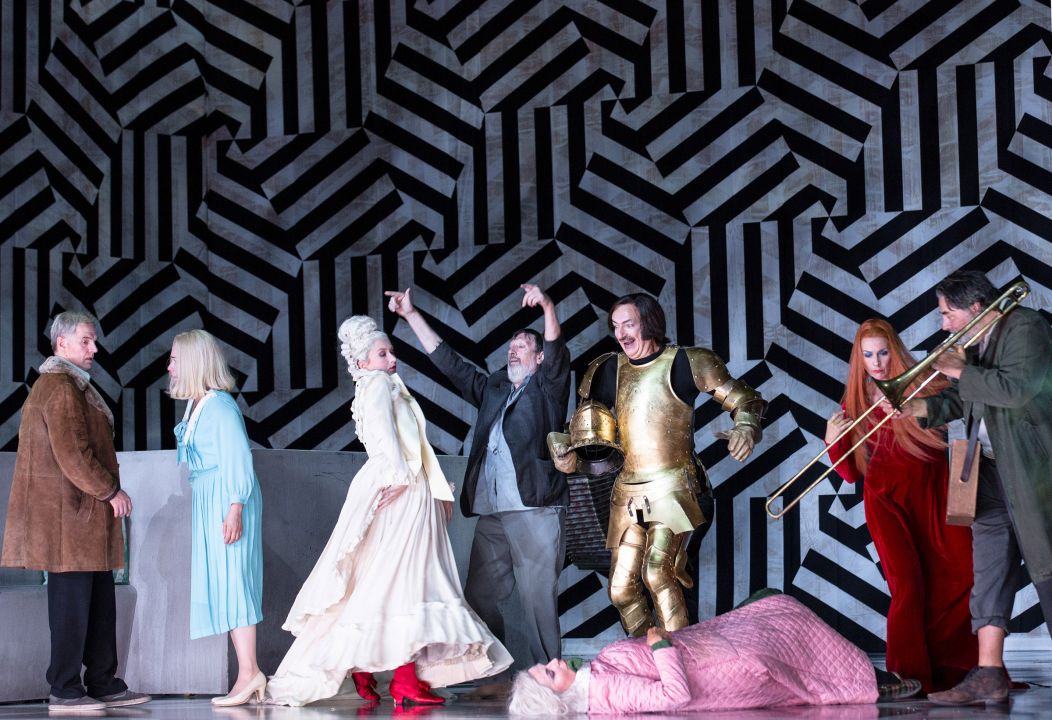
Richard Wagner - Rienzi (Bayreuth, 2026)
Bayreuther Festspiele, 2026
Nathalie Stutzmann, Alexandra Szemerédy, Magdolna Parditka, Andreas Schager, Gabriela Scherer, Andreas Bauer Kanabas, Jennifer Holloway, Michael Nagy, Vitalij Kowaljow, Matthias Stier, Michael Kupfer-Radecky, Victoria Randem
BR-Klassik Livestream - 26th July 2026
First performed in 1842, Wagner's first serious opera Rienzi, der letzte der Tribunen had never been performed before at the composer's theatre at Bayreuth. A five-act epic in the grand opera tradition, it was soon disavowed by the composer and never accepted as part of the Bayreuth canon. It has been performed infrequently elsewhere, but it is a challenge, the opera carrying a lot of historical baggage and notoriety as an opera that celebrates fascism and its association with the Third Reich. The idea that an opera can be fascist is clearly nonsense of course - it's all about how you choose to represent the rise and fall of a dictator on the stage. Some might choose to confront this legacy but another approach - surely equally as valid if it has any meaning or relevance at all (the jury may still be out on that one) - is to see the opera not defined by history, but what it means today.
The Bayreuth Festival has not been afraid to confront Wagner's history and some of the controversial elements in his works, but it has tended to shy away from making any overly political statements in recent years. Stefan Herheim's Parsifal at Bayreuth however viewed the composer's last great work in the context of German history, while the most recent challenge to the composer's legacy was Barry Kosky putting Wagner's antisemitism on trial in the 2017 Die Meistersinger von Nürnberg. Having never been performed before at Bayreuth however, the pressure on the directors to find a way of presenting this troublesome work are undoubtedly considerable, but just as important is validating the staging of the Rienzi at Bayreuth in its 150th anniversary year is also to come up with a meaningful approach that will address the question of why now?

It's immediately apparent that if the directors Alexandra Szemerédy and Magdolna Parditka are going to address the legacy of Rienzi, it is going to be through the lens of the present rather than through its Nazi associations or indeed its 14th century historical drama in Rome. The famous overture - one of the enduring qualities of the work - sets a scene across three rooms of a contemporary apartment block are occupied by Cola Rienzi, his sister Irene and a young sick child who we discover is Rienzi's brother Giovanni. 'Party Chairman' Rienzi is preparing a speech venerating German Art while Irene is looking after the sick child. The child dies and as the building rises out of the stage, the neighbouring apartments are seen sharing text messages suggesting an incestuous relationship between Rienzi and his sister, and that the child may have been born out of that relationship.
Act I's clashes between the Colonna and Orsini families here take the form of a heated election debate, with graphics showing election polls and projections, TV cameras broadcasting the election addresses and debates. Talk around Rienzi isn't the only scandal doing the rounds, as Stefano Colonna, an important industrialist, has recently been acquitted of the hit-and-run accident that has led to the death of Giovanni. Rienzi steps in to bring a measured response that strikes a chord with the public and the media, pledging loyalty to Irene and Adriano Colonna, the son of Stefano to serve the people.

Despite the overheated nature of the first Act - somewhat inevitable considering Wagner's dramatic score - it is relatively based in a familiar contemporary reality that soon breaks down, or at least shows a deeper more troubling undercurrent. Having been acclaimed Tribune of Rome, the dull grey and white of Act I is momentarily replaced with a new optimism and pride in the new Rome under the command of Rienzi. But as the sun breaks through the storm clouds in this production's Act II, in Rienzi's mind his dead brother appears as one of the divine Messengers of Peace descending staircase from heaven. Scenes for Rienzi’s reception or "coronation" take place in a Roman senate arrangement where after the failed Caesar-like assassination attempt and coup by Colonna, Rienzi takes on a Christ complex.
Despite the modern trappings - mobile phones held aloft at every move - the Bayreuth production nonetheless adheres closely to the dramatic action as it plays out in the libretto without too many revisionist touches, but also without managing to say anything new about what follows. The contemporary setting at least has a ring of familiarity to it as, for all the ruler's fine words, the real test comes when the 'nobili' - or businesses and wealth holders - rise up against him. Needless to say, Rienzi fails here and it's the ordinary people who pay the price of the cost of war, resulting in the people turning against him. Even though 'modernised', Rienzi resists modernisation, Act III remains every bit as over the top as the most extravagant of grand opera, the production failing to rein its excesses in at all.

Whether a director should even attempt to hold back on Rienzi or not is of course a matter of choice. Wagner scored the work to be a grand, epic statement, but it does risk losing sight of any purpose it might have, getting carried away in its own operatic grandiosity, with caricatures of noble sentiments and foul plots, all arch declamations, formal processions, marching battle-hymns and fervent solemn choruses. It's similarly easy for the audience to just get caught up in the grand sweep of it all to the extent that they ignore the troubling undercurrents of fascism, but at this kind of drawn-out length (even in its reduced form of just under 4 hours), it's also rather wearying.
Although I have seen it a few times, I'm not as familiar with Rienzi as other Wagner operas, but it does seem as if there has been some reordering done to make it flow a little easier. Rienzi sings his Act V aria 'Allmächt'ger Vater' before Act IV's discussion of excommunication (a fair portion of which is conducted through text messages in English), but otherwise under conductor Nathalie Stutzmann, it's the full-on Rienzi experience. Some other unique directorial touches are applied to Act V where Rienzi and Irene seem to consummate their relationship in some kind of death pact while Adriano looks on in shock. The only light touch - or heavy-handed touch maybe - is the use of the Act II ballet music to run through highly compressed scenes from all Wagner's subsequent mature operas, performed in am dram costumes, complete with intervals where the well-heeled audience queue for drinks and toilets.
To be honest, the ballet-theatre scene is indicative of the style of the acting and the direction throughout. There is a token attempt to explore the psychology or psychopathy of a dictator in a proposed invented incestuous relationship with sister and death of his brother (or 'brother’), which doesn't offer a great deal - although it is something of a Wagnerian trait. There is also at least some effort to engage with contemporary political events in the production - perhaps more so than any production at Bayreuth since Frank Castorf's Ring - setting the work in the context of a modern electoral campaign where the far-right are gaining popular votes. The epic grand conclusion that Wagner scores could only be justified when depicted as the eventual complete meltdown of the capitalist system, but it all just feels empty and meaningless after four hours at full tilt orchestration and booming choruses, and the work proves resistant to any attempt to inject an air of cautionary realism into it.

Vocally, aside from the chorus who have an important part to play in this work, much rests inevitably on Andreas Schager's performance as Rienzi and, as is often the case, it's a little over the top (as is the chorus, but in a good way). Certainly the role is written for grand declamation, but Schager doesn't seem to be able to bring it down to any level other than full-on forte that starts loud and gets increasingly strained over the four hours of the opera. The man is going to do himself an injury at this rate. Only when taking the 'Allmächt'ger Vater' aria - presumably placed in Act IV for breathing space - does he manage to show some restraint; in the singing at least; the 'acting' is reduced to lots of wild expressions and writhing around. Sure, the relentless pitch of the opera perhaps demands it, but Schager's performance doesn't make it any easier to relate to it. I liked Gabriela Scherer's performance as Irene, even though her role in the opera remains unfathomable in the psychodrama that is developed here with Rienzi and Adriano. Jennifer Holloway's Adriano is a heroic role that proves powerless to change the course of events; the soprano makes similarly a valiant effort all the way through, but is often overwhelmed by the bombast.
The current rise of the far-right in Germany is all the justification necessary to bring Rienzi to the stage at Bayreuth - let's just hope that the AfD don't adopt the overture for its rallies or history might repeat itself - but if that is indeed the target, it fails to make its mark and just confirms that Rienzi does not need to remain a regular fixture at Bayreuth. Despite the derivativeness of its sources though, it is an accomplished work, worth a look every now and again to admire not so much its sheer folly and ambition, but to see it as a necessary step towards the greatness that would follow from Richard Wagner. It's almost as if all the bad habits of operatic grand opera had to be expelled from the system in order to find his own true voice. This Rienzi is worth seeing, even if it's just to get over the curiosity about whether it really has any merit, and then you can put any such ideas about that aside for another while.