Showing posts with label Dmitry Golovnin. Show all posts

Monday, 13 February 2023

Tchaikovsky - The Queen of Spades (Brussels, 2022)


Pyotr Ilyich Tchaikovsky - Pikovaya Dama

La Monnaie-De Munt, Brussels - 2022

Nathalie Stutzmann, David Marton, Dmitry Golovnin, Laurent Naouri, Jacques Imbrailo, Anne Sofie von Otter, Anna Nechaeva, Charlotte Hellekant, Alexander Kravets, Mischa Schelomianski, Maxime Melnik, Justin Hopkins, Mireille Capelle, Emma Posman

OperaVision - 23 September 2022

Although visually it clearly takes place in late Soviet-era USSR, everyone wearing 1970s' costumes in the courtyard exterior and assumed interiors of a Soviet tenement block, it is of course tempting to see something of the current conflict in Ukraine in David Marton's 2022 production of Tchaikovsky's Pikovaya Dama/The Queen of Spades for La Monnaie, the production playing out much at the same time in September 2022 as the Russian invasion was at its height. While the period sets it apart and prevents it from making any ill-fitting and facile commentary on a serious and complex contemporary situation, Tchaikovsky's opera and indeed Pushkin's original ghost story do have something to say about the dangers of myths fuelling nationalistic delusions and war.

That's touched on in the children's chorus of the opening scene which otherwise has apparently little to do with the opera, a scene that would be difficult to imagine playing straight in the current circumstances and an example of how quickly 'innocent' intent can suddenly appear more sinister as times change. With this chorus of schoolboys lining up in a play-acted military march against Russia's enemies, Tchaikovsky could easily be outlawed (and has indeed been in some places) in the current climate where Russian artists and musicians are now viewed with suspicion. Marton however turns this into a more abstract scene, a Russian pianist centre stage, a radio playing the marching song, while a group of mothers listen to the broadcast of their sons with horror for what lies ahead.

It neatly sidesteps any controversy, not that La Monnaie ever work on the basis of playing safe in their productions, but it also sets the tone for what follows. The period and setting emphasise the divide between the rich and the poor, Liza the prize of the Prince that Hermann, hanging out with his chums in the tenement block, gambling, spending his money on black market goods, cannot hope to win. He knows he is a loser, not just in cards but in the game of life, and he feels that despair deeply, in the way that only the tragic figures of Russian literature can. And in a way that only a composer like Tchaikovsky, it his own troubled personal life, can put into music - as demonstrated in Stefan Herheim's 2016 production of this opera.

A creative director can of course delve into many different layers of this work, as Hans Neuenfels also did at Salzburg, using the children's march as a means of emphasising the strict rules of society that Hermann feels he has the right to place himself outside. What gives him the confidence to follow his own path in Marton's production is, like the empowerment of nationalistic exceptionalism expressed in the march, the lie of the myth of the Countess and the three cards that he chooses to believe in. He buys into it, but also buys a gun from a black market dealer to give him a little more power and influence. 

Marton of course doesn't keep it as simple as that and recognises the complexity of Tchaikovsky's music and the fact that art, opera and music have their part to play in exposing or examining the workings of the human mind, and indeed inspiring to go to war. Throughout the opera we see a man writing in a book, a libretto perhaps, and a pianist at the centre of the scene, Marton resisting however the temptation to go down Herheim's use of a Tchaikovsky doppelganger (or many of them, reflecting various sides of the composer). The two come together at the conclusion of the opera to reflect what they have experienced in the preceding episodes.

But art has other means and uses, particularly for ordinary people in the impoverished circumstances depicted in this era and this is also reflected in the setting. While the men are gambling, black market dealing or finding other ways of escape through alcohol, the women are seen looking to escape their surroundings, reading books, gazing into a glass of spirits, trying to catch a radio signal from the outside world. A young girl gazes at a globe, and Polina sings a melancholic song that observes: "What did I find in those enchanting dreams? A grave." Such scenes, as well as Tchaikovsky's pastorale and the arrival of Catherine the Great would feel out of place in this context, a divertissement in the middle of the near-contemporary realism depicted here, but it actually serves as another illusion to keep the peasants dreaming.
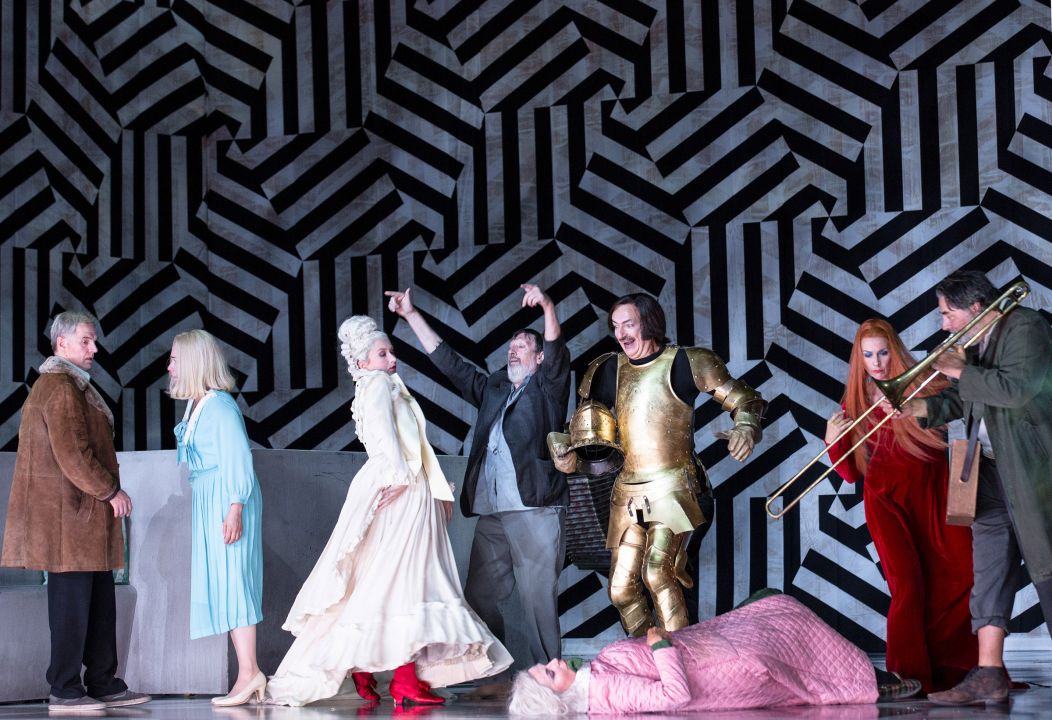
With a wealth of such material already provided by Tchaikovsky for a good director to use purposefully, there is no need then to bring any current conflict - which would certainly have been imminent during rehearsals - into the production. It's enough to perhaps just reference it to avoid any controversy of performing a Russian composer and let the opera deliver its own commentary on it, which it does most powerfully by taking things to their inevitable conclusion. Hermann is afflicted by madness to his 'cause', believing the words of an old woman on a payphone as if they are speaking a secret message to him. It means ruin and death and that is all that is left for Liza too. Dragged to her death by the same delusions of escape that had given her comfort.

Christian Friedländer set designs pitch the production into this ambiguous and divided world, somewhere between brutalism and romantic fantasy. The tenement block is stark enough to capture the romanticised view of the opera's ghost story running up against the harsh reality of ordinary people's lives, the contrasts of riches (or dreams of riches), with the impoverishment of their lives. Using the period, contrasting costumes of the real and the imagined, turning reality into art through the dreams of the secondary characters and chorus, in its own way it creates a visual representation of what opera does when art meets reality.

Conducted by Nathalie Stutzmann it's a strong musical performance, the orchestra delivering the high drama, matching the subtleties of Tchaikovsky's score to the underlying romantic sentiments and mad delusions. The singing performances are also a good fit for the roles, for the attack of the music and the intent of the stage direction. The Russian principals are excellent in this capacity, Dmitry Golovnin as Hermann and Anna Nechaeva as Liza both impassioned in their own ways. Jacques Imbrailo is fine as the Prince as is Anne Sofie von Otter, now at that stage in her career where she has the personality and character to take on the role of the Countess. There is good work also from the supporting roles and the chorus. It's not a classic production but one that is necessarily connected to a view of the times we are living under, a time of madness and a reminder that the only thing we can be sure of is death.


Links: La Monnaie streaming, OperaVision

Thursday, 14 July 2022

Prokofiev - The Fiery Angel (Madrid, 2022)


Sergei Prokofiev - The Fiery Angel

Teatro Real de Madrid, 2022

Gustavo Gimeno,Calixto Bieito, Ausrine Stundyte, Leigh Melrose, Dmitry Golovnin, Agnieszka Rehlis, Mika Kares, Nino Surguladze, Dmitry Ulyanov, Josep Fadò, Gerardo Bullón, Ernst Alisch, David Lagares, Estibaliz Martyn, Anna Gomà

ARTE Concert - April 2022

Based on a Symbolist work by Valery Bryusov with autobiographical experiences that were shared to some extent by the composer, Prokofiev's The Fiery Angel is one of the most impressive and original works of opera I've come across. Musically and thematically it is quite unlike anything else in opera and each new production - although they aren't that common - always suggests new ways of looking at it. There have been some interesting perspectives taken on the work in recent years in Munich, Aix and Rome, but the idea of seeing what a director like Calixto Bieito can make of it is always going to be an intriguing proposition. It turns out that the Madrid production of The Fiery Angel doesn't seem to have a whole lot to say that is new, but the opera nonetheless remains fascinating, particularly with Ausrine Stundyte again taking on the mesmerising role of Renata. 

Sure, in some respects you can see Renata as a typical opera heroine abused and mistreated and misunderstood by the men in her life, her behaviour out of step with society around her, but in the case of Renata, there is indeed quite a bit to misunderstand. Not that her state of mind is any excuse for the abuse she endures or indeed the exploitation of her vulnerability, but fundamentally does seem to be the rationale for the irrational here. Because for whatever reason (there are hints and suggestions but nothing is made explicit), Renata is indeed not functioning on a rational level. Whether a victim of childhood abuse or suffering from schizophrenia, she has clearly been scarred by her childhood experiences, experiencing visions of a celestial being appearing in her bedroom, a fiery angel who becomes intimate with her.

This unfortunately sets her up to become a victim to be further exploited by the men she meets. She lets herself be taken in by Count Heinrich, who she believes is the angel Madiel in a corporeal form, and his eventual rejection only deepens her trauma. Even the noble knight, Ruprecht who comes to her aid in her distress, sees a vulnerable woman he can exploit sexually. His behaviours and actions are suspect, but when he is rejected he does at least try to consider his better nature and help, although it seems to be primarily because he is still fascinated by this extraordinary woman. With his assistance, Renata is exploited even further by charlatans and astrologers, as she tries to find a way to Madiel through occultism and mysticism. 

On one level then it is a familiar situation of a woman being exploited and shunned by a conformist society, leading her to seek answers elsewhere, but The Fiery Angel is also a work that seeks to explore the far reaches and complexities of human experience, Renata's journey being one to get in touch with a spiritual dimension or existence of life outside of the common experience. She has a sense of having touched on forbidden knowledge and seeks to press it further. For Ruprecht too, there is even a fascination for the mystery of a woman that Renata represents. She stirs up a riot of feelings that involve lust, compassion, fear, jealousy and possessiveness. Combined, The Fiery Angel is an exploration of human dualism, what it means to be human, a material physical being with a spiritual mind, mortal creatures with aspirations of an eternal afterlife. On an everyday level grappling with this dualism extends to male and female divisions, base instincts and a higher purpose, purity and corruption, subjective and objective realities.

In other productions by Mariusz Treliński at Aix-en-Provence and Emma Dante in Rome, the stage directors have sought ways to bring the otherworldly level of the opera expressed in the music to the fore, whereas Barrie Kosky's Munich production highlighted the comic absurdity. Calixto Bieito takes a surprisingly much more down to earth approach, seeing the opera very much as an opening into the mind of a woman rejected for not conforming to the expectations of society. It's even set (restricted I feel) in a specific period, the 1950s, before a more general liberalisation and a sexual permissive society. Initially we see Renata seeking mystery in the spinning of a bicycle wheel, creating patterns, the bicycle perhaps alluding to a childhood trauma. The set meanwhile consists of a block of compartments that, as occasional projections of Ausrine Stundyte as Renata illustrate, are representative of the idea that we are seeing into her mind.

Those rooms or compartments are mostly bare empty rooms, ready to be filled with horrors, each in their own little world, none of them connecting up to form any coherent view of reality. Significantly, perhaps rejecting any idea of a spiritual realm beyond physical reality, the few rooms that are decorated, the only lights in the darkness, are related to Agrippa von Nettesheim who in this version is less of a sorcerer than a physician, a man of science who is aware that we are still far from having all the answers. Her childhood bedroom, the source of her trauma, is also shown in all its horror. With an older man appearing, there is the suggestion of abuse by her father, who she looks up to. She sees Heinrich, an older man, as a substitute for her father, but inevitably that is a terrible mistake that only deepens her trauma. The tavern scene with Faust and Mephisopheles pushes Renata to her limits, and is quite disturbing in its own way. As she disturbs the community of nuns in Act 5, there are correspondences with Penderecki's opera Die Teufel von Loudun, which also featured Ausrine Stundyte in a recent Munich production.

Prokofiev, in a work long laboured over that he never saw performed in his own lifetime, strives to find similar expression in the music for the tangible and intangible, and it truly is a remarkable endeavour. The music is powerful and dynamic, sweeping between sensual and disorientating, evoking objective and subjective realities. I think its complexities came across better in the Rome production, but that might just be that the recording benefitted from superb High Resolution sound mix on the Blu-ray presentation. Here, conducted by Gustavo Gimeno, the detail isn't all there, nor the same dynamic shifts of tempo and volume.

Where the opera really comes to life however here in this Madrid production is in the singing performances. Once again - a revelation in the same role in Aix-en-Provence - we have a marvellous performance by Ausrine Stundyte. It's a role that has considerable vocal challenges but there are dramatic challenges too that require expression beyond the external, a requirement for Renata to be possessed of a deep and mysterious inner life. Bieito makes it physically challenging too and Stundyte is again impressive. Leigh Melrose is also excellent, his Ruprecht grappling with things beyond his comprehension and his own limited knowledge and experience. He brings that out in a similarly committed physical performance. 

The origins of the work and its Symbolist trappings leave a lot of room for analysis in The Fiery Angel, but it seems like the controversial Catalan director Calixto Bieito uncharacteristically seeks to demystify the work and restrict its possibilities. In his hands it does indeed boil down to familiar opera themes of a woman with unconventional individual behaviours being shunned by a closed society, moulded to conform and eventually destroyed by it. Prokofiev music suggests a wider context, but in that dialectic between the score and stage representation, the opera still works and weaves its fascination. Principally of course its real human level is expressed by the singers, and with prior experience of these roles, Stundyte and Melrose are thoroughly convincing.


Tuesday, 26 June 2018

Mussorgsky - Boris Godunov (Paris, 2018)


Modest Mussorgsky - Boris Godunov

L’Opéra national de Paris, 2018

Vladimir Jurowski, Ivo van Hove, Ildar Abdrazakov, Evdokia Malevskaya, Ruzan Mantashyan, Alexandra Durseneva, Maxim Paster, Boris Pinkhasovich, Ain Anger, Dmitry Golovnin, Evgeny Nikitin, Peter Bronder, Elena Manistina, Vasily Efimov, Mikhail Timoshenko, Maxim Mikhailov, Luca Sannai

Culturebox - 7 June 2018

There's a sense of the epic in Mussorgsky's Boris Godunov that is entirely in keeping with the importance of the period in Russian history and with the nature of the Russian characteristics displayed in it. What is also essential about Mussorgsky's epic vision for the work is its ability not just to capture a sense of intimacy and personal conflict within that historical drama - a common enough characteristic in opera - but how he is able to make those personal sentiments just as grand and epic without losing their human character. Mussorgsky takes human sentiments of sadness, regret, guilt and internal conflict and gives them a Macbeth-like Shakespearean depth and complexity on a scale that befits their importance.

You get a sense of that right from the start in the opera, with the people of Russia calling out in chorus for him to be their new ruler. You also get a sense of how Boris feels about this from his very first line: "My soul grieves". He has a heavy duty to perform to live up to the expectations of the Russian people and do them justice, but there is also a sense of guilt and remorse for the manner in which he has come to power, with rumours already accusing him of murdering the young Tsarevitch Dmitriy from the line of Ivan the Terrible to ascend to the throne himself. An accumulation of misfortune and other forces, including the rise of a Pretender to the throne in Lithuania, turns the people against Godunov, and the combined results strike the Tsar in deeply troubling ways.

Finding a balance of scale between epic and intimate is one matter, but there is also the consideration of which version of Boris Godunov is the most authentic and effective in achieving the necessary impact. Historically it's been the revised 1872 version that has been most commonly used, and understandably so as it contains many extensions to Mussorgsky's brilliant score, but Rimsky-Korsakov's reworking of the original materials has also been popular. Gradually however, we are seeing more productions of the original 1869 version, commonly with a few additions from the revised 1872 version that are deemed too good to be left out.


The 2018 Paris production however, directed by Ivo van Hove and conducted by Vladimir Jurowski, takes very much a purist approach by sticking to the complete 1869 original version of Boris Godunov, with no Polish Act nor any of the 1872 additions. It's purist at least in musical terms, but clearly with the controversial Belgian theatre director Ivo van Hove involved in the project it's going to be anything but purist as far as the staging goes. That presents an intriguing team that should find a good balance between the grandly epic and the deeper underlying personal sentiments and in many respects both sides of the work are well represented, but the production seems to be more effective for the choice of the stripped down force of the 1869 version than for anything that Jurowski or van Hove bring to the work.

As is usually the case with this director, van Hove relies on a minimal staging, abstract-modern with no period or historical trappings. The use of the space, opened up with back projections of the Russian people and landscapes that are mirrored to the sides, permits a sense of epic scale that can also close the work down to a more intimate level of intensity. A staircase is often present, leading up and also leading down beneath the stage, the symbolism of which is clearly apparent, representing rise and fall, and the separation of the ruling classes from the people. Other scenes are effectively austere, such as between Pimen and Grigoriy in the cell of the monastery in Chudov, needing no further elaboration than two people in near-darkness recounting events in words and divulging the thoughts that run through their minds.

How much of the success in getting this across is down to effective direction, how much is down to the musical performance and how much of this is simply down to the power of the story and Mussorgsky's scoring of it is debatable, but it seems to me that it's Mussorgsky's score that does the bulk of the work. Even then Jurowski's conducting seems rather restrained and unfocussed, although it's hard to judge fairly from an internet stream (I'll be listening again more closely to the live radio broadcast on France Musique this weekend), and yet there's no question that the drama and the dynamic is all there. Likewise Ivo van Hove doesn't seem to bring much to an interpretation of the drama, but it doesn't get in the way of it either.


There are a few stylistic touches applied, but perhaps the only significant twist is at the conclusion. Not only does Boris Godunov finally and dramatically succumb to the pressures of family problems, famine blighting the country and growing instability in his mind over his murder of Dmitriy, but his son dies too at the hand of the Pretender Grigoriy. It's a dark dramatic moment that doubles down on the music that Mussorgsky provides for this finale and, as Boris's son's reign was indeed cut short in deference to the False Dmitriy, it even effectively conveys the suggestion in Mussorgsky's music that the conflict and turmoil of this historical period is far from over.

Ideally you want a Russian cast in Boris Godunov for maximum effectiveness, at least in the principal roles, and there's little to find fault with in team assembled for the Paris production. Ildar Abdrazakov is perhaps a little too smooth and lacking the necessary depth and edge to get across the full conflict of Boris Godunov. He sings the role well, but there's not enough emotion in the voice and too much overplaying in the acting to try to compensate for it. Ain Anger is an appropriately grave austere and occasionally ominous Pimen, there's a similar good balance of restraint and gravity in Maxim Paster's Shuysky, and Vasily Efimov brings vocal colour and some hard truths as the Holy Fool. Lots to enjoy in the singing performances then with strong a strong chorus combining to make a convincing case for the original 1869 version of Boris Godunov becoming the canonical version of this great work.

Links: L’Opéra de Paris, Culturebox

Wednesday, 5 August 2015

Rachmaninoff - Troika (La Monnaie, 2015 - Webcast)


Sergei Rachmaninoff - Troika

La Monnaie-De Munt, 2015

Mikhail Tatarnikov, Kirsten Dehlholm, Kostas Smoriginas, Sergey Semishkur, Alexander Vassiliev, Anna Nechaeva, Yaroslava Kozina, Sergei Leiferkus, Dmitry Golovnin, Ilya Silchukov, Alexander Kravets, Dimitris Tiliakos

La Monnaie Web Streaming

Based on works by Pushkin and Dante, it's not as if there aren't dramatic possibilities in the three one-act operas composed by Rachmaninoff. L'Opéra National de Lorraine at Nancy not only successfully staged a pairing of Aleko and Francesca da Rimini recently, but director Silviu Purcărete also managed to link the similar themes of the two works together into a single workable concept. Kirsten Dehlholm's approach to La Monnaie's presentation of all three Rachmaninoff's short opera works is, typically for the adventurous Belgian company, very different.

While there is an overall thematic connection between the works that is reflected in the set design, each of the three works very much has their own look and feel. None of the operas however are what you would call fully staged. Partly that may be dictated by La Monnaie's transfer to the Théâtre National while renovations are being carried out to La Monnaie's regular home, right through the next season. On the other hand, La Monnaie do tend to think 'outside the box', so to speak in their productions, and that's very much in evidence in their staging of the Rachmaninoff Troika. 

Russian opera suits big colourful spectacle and pageantry and certain productions of Rimsky-Korsakov's Sadko and The Golden Cockerel come to mind in Kirsten Dehlholm's bold setting of Aleko. A traditional staging of Rachnaminov's first opera, written as a graduation competition piece when the composer was nineteen (1892), and based on Pushkin's short story, 'The Gypsies', will usually draw unavoidable comparison with Carmen and Pagliacci. That certainly was the impression given in the recent Nancy production. Dehlholm's setting takes it far away from that.


Staged almost oratorio-like on a tiered platform of steps, Aleko doesn't really play to the storytelling drama aspect of the story. Nothing about the stylised rainbow-coloured costumes either suggests a naturalistic time period or gypsy culture. The story of Aleko's jealousy over his wife's affair with her lover that leads to their murder isn't wholly acted out either, with characters only moving into place alongside one another without acting out any drama. There are one or two props - some cut-out trees and tarot cards that indicate fate at play - but the force of the dramatic impact relies more on lighting and colouration exploding in psychedelic bursts of kaleidoscopic patterns that are nonetheless wholly informed by the music.

Rachmaninoff's music instrumentally takes up a considerable part of drama from the sparsely scripted libretti of Aleko and Francesca da Rimini, and it's no coincidence that the orchestra are more visible during these two operas. The orchestra might be on stage primarily due to the absence of a natural pit at the Théâtre National, but the instrumental elements of the operas are also very much a part of the dramatic fabric of the works. Just how important that is becomes more evident with the rich, melodic, dynamic Romantic sweep that Mikhail Tatarnikov draws from the orchestra here. Impressive singing too really gets the dramatic content across.

The Miserly Knight, again drawn from Pushkin, is more dialogue driven, taking the author's text almost directly from the page. It consequently pushes the focus back onto the characters at the front of the stage, the orchestra remaining behind the curtain that shows projections of a ruined building and a few filmed sequences. The situation is a relatively simple one that doesn't rely on a lot of dramatic action, but its still richly scored by Rachmaninoff, who sets the story, the characterisation and the relationships between the characters beautifully in the music.


The story of The Miserly Knight concerns Albert, a knight who has fallen on hard times, who can't even raise enough money to enter a tournament. It's particularly galling to Albert since his father, the Baron, is a very rich man who avariciously hoards all his wealth, horrified that his worthless son might one day inherit it all without having had to sweat for it. A Jewish money-lender suggests to Albert that he might want to hasten the day he inherits the money with a few drops of a potion that he can obtain for him, but nature takes its own course when the Earl himself suggests that the Baron might want to help Albert by placing him into his court.

Written in 1904, some nine years after his first one-act opera, Rachnaminoff's own distinctive voice is much more in evidence in The Miserly Knight. Despite the limited action it's lushly scored, giving strong character to the all the roles, not just the principals. The stage setting of the work tries to find a way to reflect this in the images of a ruined abandoned building, which means that occasional graffiti is thrown up unusual associations - Jimi Hendrix appearing on the screen at one point - but combined again here with very strong singing performances from Dmitry Golovnin and Sergei Leiferkus, it comes across impressively.

Although never composed to play as a trilogy, the order of composition sequence works well for the purposes of the La Monnaie Rachmaninoff Troika in progression and development. By the time we get to Francesca da Rimini (1905), the full force and brilliance of the orchestral composition, arrangements and dramatic intent is striking. The haunting choruses of the damned in the opening section where Dante and the Ghost of Virgil descend into the Second Circle of Hell and the musical colour and sweep that Rachmaninoff has composed for this theatrical extravaganza is given full expression too in Mikhail Tatarnikov's marvellous conducting of the rich orchestration.


Other than some projections of swirling mists and the descent of Dante and Virgil on cables, there's not really any effort made to give any traditional depiction of Hell in the staging. Perhaps recognising that the visual element needs no additional 'colour', the costumes and lighting go for a contrasting monochrome palette. As with Aleko, the effects are mostly limited to lighting and simple pattern effects that give the impression of the steps being fluid and wavy. It's visually spectacular, but not one that draws the dramatic element out as well as Purcărete's Nancy production. With a strong, consistent visual element and terrific performances across each of the three operas, the La Monnaie Troika creates a fascinating Rachmaninoff narrative of its own.

Links: La Monnaie-De Munt