Showing posts with label La Monnaie-De Munt. Show all posts

Sunday, 16 February 2025

Wagner - Siegfried (Brussels, 2024)

Richard Wagner - Siegfried (Brussels, 2024)

La Monnaie-De Munt, 2024

Alain Altinoglu, Pierre Audi, Magnus Vigilius, Peter Hoare, Gábor Bretz, Scott Hendricks, Wilhelm Schwinghammer, Ingela Brimberg, Nora Gubisch, Liv Redpath

RTBF Auvio streaming - 25th September 2024

Well this was unexpected, but in the end perhaps not totally surprising. Ring Cycles are notoriously complicated to stage and require enormous planning and resources. Sometimes they fail, sometimes they are abandoned before they start, sometimes mid-stream (as appears to be the case with the English National Opera production), but this the ambitious new production at La Monnaie in Brussels, the first two parts of which took place in the 2023/24 season with the remaining parts to be fulfilled in 2024/25, is the first I've seen where the director has jumped ship half-way through. La Monnaie issued a press statement advising that the remaining two parts would no longer be directed by Romeo Castellucci and that they had parted ways on this Ring Cycle by mutual agreement, unable to achieve what was planned within the planned timescale and budget.

The reason is probably more complicated than simply creative differences or even just budgetary concerns. It's not as if La Monnaie lack resources or ambition and have staged many extravagant Castellucci productions over the years, so his plans for the remainder of the cycle must have really been really out there. Considering the extraordinary visuals of what was staged the previous season in Das Rheingold and Die Walküre and that there was a proposal for a full length feature film using new untested technology to accompany Siegfried and a "double project" mixing theatre and opera for Götterdämmerung, it is genuinely feasible that the production team were indeed incapable of meeting the technological demands of Castellucci's vision for the remainder of the tetralogy.

The unenviable task of taking over the reins on a Ring Cycle in the middle of the race is handed to Pierre Audi, and it's not as if he even has any clear direction to follow. The horses of the Valkyrie have already bolted from this Ring stable, the previous two parts looking spectacular but having very little in the way of any coherent or even comprehensible intent to latch onto. There may have been ambitions (probably not) for the complete cycle to come together into something more thought-provoking rather than just appear as a series of bizarre visual ideas thrown out for each part by Castellucci, but either way I for one was looking forward to seeing where the director would take it next. It seems however that the next level was just simply unachievable, the artist's ambition greater than anyone's ability to realise its potential. Can Pierre Audi attempt to pull this together what has come before into something just as interesting, while at least remaining achievable?

There are maybe a few minor references to what has come before in the opening filmed footage that plays out before the opera, a group of schoolchildren putting on cardboard masks and wooden swords - a reminder at the surprising use of children to play the gods in one scene of Castellucci's Das Rheingold - and in one of children drawing a large circle - a reference found at the beginning and end of both parts directed by Castellucci. Or perhaps, like the childish drawing of a man with a sword that leads into the overture, it's more a sign that this is a return back to basics which, since that characterises Siegfried in Siegfried to some extent, is a reasonable way to approach it. The children's drawings however only make a reappearance as overlaid projections in the closing moments of the opera, so their inclusion - at this stage anyway - is a mystery.

But it's hard to find anything at all meaningful in Pierre Audi's Siegfried. It's true that he hasn't been given much to work with (apart from Wagner's account of the myth obviously) and it must be difficult to take over any project half-way through, but his style has always been for abstraction and bold grand symbolism. Not the obvious kind though. Here in Act I the scene consists of a wall of tarnished gold blocks (a familiar Audi image) with a huge jagged black ball hovering above it. You could potentially see this as representative of the two figures, one corrupted by desire for gold, the other an unformed ball of potential. You could however find a reason for reading this the other way around, so I may be giving the abstract design more credit for symbolism than it's worth, but it seems to be borne out when a long glowing spear descends and bisects the stage at the arrival of the Wanderer. On its own terms the staging is fine, the effective lighting capturing tone and mood, but it's not really enough to make the playing out of backstory between Mime and Siegfried and Mime and Wanderer any more interesting.

The credibility of Act II unfortunately suffers from poor choices in the combination of costume design and lighting. Alberich and the Wanderer skulk about the darkened stage wearing Judex capes and wide-brim homburg hats, their faces bathed in green light, making it looks like a casting session for Wicked. Perhaps that's not the worst image to hang on Alberich and Wanderer, but it looks silly and rather ruins the tone as they gather outside the formidable grotto of the dragon Fafner. The huge inflatable crumpled ball covered in heavy-duty black plastic sheeting sprouts lights for eyes as the dragon, but the spectacle is brief and the impact of Siegfried slaying the dragon is rather ineffective. There is added gravitas however when Fafner appears carrying the desiccated blackened and rotted remains of Fasolt, underlining the tragic end of the race of giants. That gravity is carried over into the scene between Erda and Wanderer but it has little else to offer, the confrontation and destruction of Wotan’s spear feeling somewhat routine.

It does however lead into a dramatic science-fiction-like Act III, the huge ball splintering or rather replaced with floating shards in a blazing red sky, before giving way to the coolness of the discovery of Brünnhilde in a frozen state in an abstract landscape of a blazing white dawn. That at least gives this scene its own distinct character and tone, although in its abstraction it could equally pass for a scene from Act II or Act III of Tristan und Isolde. It's an effective scene nonetheless on its own terms, held together by the sense of epic revelation and resolution to the tragic consequences of Die Walküre, the performance of the score and the singing all coming together to reveal the full majesty of the moment, which of course is built upon everything that has come before. It's a bit of a chore getting there, but almost worth it in the end.

Audi's taking over of Siegfried was undoubtedly a challenge and it at least looks the part, breaking away from the direction Castellucci was taking the cycle and focussing on just delivering a suitably bold spectacle with good singing. Personally I find that Siegfried needs a little more than that. Although you would be hard pressed to understand the direction Castellucci was taking this Ring des Nibelungen in, Audi's vision has no psychological or philosophical underpinning and doesn't invite one or even have any distinctive directorial stamp. It's just a routine performance, in as much as a challenging work like Siegfried can ever be 'routine'. Peter De Caluwe, the general director of La Monnaie prefers to rebrand this cycle now as two diptychs, the first two "allegorical" about the gods, the second two a "human" story about the love between Siegfried and Brünnhilde. It's a big disappointment however when you think that, however extreme and absurd his ambitions might have been, the reasons given for Castellucci's departure is an acknowledgement that his Siegfried would at least never have been dull.

There are no big gestures in the score, which is given a softer reading from Alain Altinoglu than I expected, making me think that La Monnaie were perhaps not using full scale orchestration. It's more likely however that the choices were made for the sake of dynamism, saving the impact for where it is needed and it fairly scaled up for the final scene. Another reason might be to give the singers room to be heard, but there were few problems on that front, although they were left with fairly standard characterisation with no obvious direction. Peter Hoare's Mime is excellent, but it was a familiar weasely and slimy semi-comic routine. Gabor Breitz is a solid menacing presence but brought little that was distinctive to his continuation of the role of Wotan/Wanderer. Scott Hendricks makes great efforts as Alberich but struggles a little. The Wicked outfits perhaps didn't help either of them. The best performance here comes from Magnus Vigilius as Siegfried, totally in command of the role, his voice approaching Klaus Florian Vogt lightness but with a little more steel and not so much softness, which seems ideal. Ingela Brimberg reprises her Brünnhilde from Die Walküre and sings it well, but just as importantly, captures the complexity of her condition as a formidable but now fearful Valkyrie.


External links: La Monnaie-De Munt, RTBF Auvio

Monday, 10 February 2025

Karlsson - Fanny and Alexander (Brussels, 2024)

Mikael Karlsson - Fanny and Alexander

La Monnaie-De Munt, Brussels, 2024

Ariane Matiakh, Ivo Van Hove, Susan Bullock, Peter Tantsits, Sasha Cooke, Jay Weiner, Sarah Dewez, Thomas Hampson, Anne Sofie Von Otter, Jacobi Loa Falkman, Aryeh Nussbaum Cohen, Alexander Sprague, Justin Hopkins, Polly Leech, Gavan Ring, Margaux de Valensart, Marion Bauwens, Blandine Coulon

La Monnaie Streaming - December 2024

There is an element of semi-autobiography in nearly all of Ingmar Bergman's films, or perhaps it could be described as an element of exorcism in confronting the fears, concerns and formative experiences that determined his outlook on life. Whether it's the terror of death in The Seventh Seal or the silence of God in ...well, most of his work, that outlook is not a particularly optimistic one. Perhaps the most important formative experience for Bergman and for most people is family and particularly one's childhood experiences. It was only much later in his life, in preparation for what he believed would stand as his final film and testament as a career as a writer, director and filmmaker that Bergman was able to approach those youthful moments of joy as well as the more familiar explorations of pain and fear in a masterful and probing manner through Fanny and Alexander.

As much as they draw upon personal experiences, incorporating the root causes of many of his personal fears as well as his influences that he would unflinchingly bring to the screen as one of the world's greatest film directors, Fanny and Alexander of course has a much broader outlook on life. Which it would need to, since Bergman's experience of childhood in Fanny and Alexander, fictionalised as the well-to-do Ekdahl family in provincial Sweden in Uppsala, doesn't appear to have much in common with most people's lived experience. The challenge of adapting this to opera then would be to focus on and draw out the more universal qualities and experiences from the sprawling richness of the original filmed work, as well as retaining the sense of coming-of-age drama of a turbulent family experience that is to have a profound impact on how one child relates to the wider world as an adult.

With his sister Fanny, Alexander grows up in a wealthy family of businessmen and artists, all of whom gather at the start of Mikael Karlsson's opera version of Fanny and Alexander, composed for La Monnaie in Brussels from a libretto by Royce Vavrek. The family own and run their own theatre, managed by Fanny and Alexander's father Oscar. As the extended family in formal dress gather around the lavish Christmas dinner table prepared by a host of servants after a performance of a nativity play at the theatre, Oscar tells the children that "Outside is a big world and the little world in which we were born succeeds in reflecting the big one" while Alexander and Fanny sit at the foot of the table creating their own personal little drama with a miniature toy theatre. It's a little heavy-handed maybe, but it succeeds in establishing how the opera develops the theme that art doesn't just imitate life but seeks transform those human experiences. 

What this scene also establishes is the gulf between childlike innocence and imagination and the danger of its corruption when it comes into contact with the harsh realities of the world. Certainly there is a lifetime of troubling experiences to be processed as the children unwittingly eavesdrop on the private lives of their relatives, lascivious uncles philandering with maids, their grandmother reminiscing with an old love, one uncle facing ruin from failed business interests, another depressed at aging and the declining state of the world. It would take Bergman a whole career to process these issues - some his own experiences as an adult reflected here as much as fictionalised ones for other people - and confront their roots in this ambitious project.

The most harrowing experience for the young Alexander, as it would be for many children, is their first encounter with the death of a close family member. His father Oscar is rehearsing a scene from Hamlet when he has a heart attack and dies. For the young Alexander, seeped in the family's theatrical tradition, it's as profound an experience as Hamlet’s own horror of meeting his father's ghost, and indeed his own father will later make a similar ghostly appearance in the story. It's a moment wrapped in theatrical and philosophical meaning and suitably presented as such in the staging of this premiere opera production by Ivo van Hove. The Shakespearean allusions continue as Alexander's hatred grows for his step-father, their mother Emilie remarrying to an austere authoritarian and cruel man of the cloth, a bishop who demands they abandon their former life of privilege.

All this will be familiar to anyone who has seen Bergman's film or extended TV mini-series, which is a sign that the creators of the opera have succeeded at least in retaining the essence of the work. Both composer Mikael Karlsson and librettist Royce Vavrek have a good track record in adaptations of movie-sourced material, the two having previously worked together on Lars von Trier’s Melancholia for the Royal Swedish Opera last year. Musically Fanny and Alexander is recognisably in the same style evidenced in that opera, rhythmically and melodically propulsive in the idiom of John Adams, with electronic effects used for dramatic underscoring. It's less 'science-fiction' sounding electronics this time, providing rather an undercurrent that underlines moments of intense emotional stress as well as the ghost appearances, which are also heralded by shimmering bells.

What doesn't come across in the recorded and broadcast version of the production is the effort of the composer to make the opera a visceral theatrical experience. Modern technologies don't have to be restricted to theatrical techniques - and Ivo van Hove knows all about those - but can surely also be employed for musical effect in modern opera. That however is not something that most opera houses are equipped for and it does involve a considerable amount of effort and complexity to install surround speakers and deep subwoofer technology to make the audience actually feel the musical reverberations. There is also the challenge of synchronising the electronic elements of the score with the acoustic orchestra (the performers also wear microphones so that they can be mixed into the live sound design), but the impact of all that is lost in a streamed broadcast.

As well as employing cinematic techniques in his theatre and opera productions, Ivo van Hove is a director who is also very familiar with adapting Bergman and other filmmakers for theatre and often uses extended theatrical techniques like live cameras and projections. By comparison his direction of Fanny and Alexander for the most part feels rather restrained and almost traditional. I have to say I prefer when he is a little more adventurous and avant-garde. The fact however that the scenes have the necessary impact - minimalist but for a number of key scenes like the death of Oscar, the ghost story of the two drowned children and the remarkable effects used for the Isak and Ismaël scenes - suggests that he knows when to hold back in order to give those key moments prominence (underlined by the reverberating score) and does succeed in finding the best way of presenting the material.

That's surely the essential thing, but aside from the scenes mentioned above that are creatively handled, and despite what sounds like a wonderful musical interpretation, personally I didn't find either enough to hold attention as the opera moved into the second half. It was perfectly good, but I was perhaps too familiar with the movie version, so the adherence to the original felt predictable and something of a pale copy of Bergman's film, an unnecessary reworking that didn't really add anything as an opera. I felt like that at least until the stunning and remarkably effective choices for the setting of the avant-conclusion in the puppet theatre shop of Isak and Ismaël. Here Karlsson and van Hove succeeded in establishing the value of the opera on its own terms, which, as it should be, was in the realm of bringing music, drama and singing together to lift the source material to new heights.

That is no small part was due to a stunning performance from countertenor Aryeh Nussbaum Cohen as Ismaël. His extraordinary voice and presence brings that necessary enigmatic quality to the key moment when Alexander's eyes are open to how an artist can take those mysteries and unknowns, the personal traumas and experiences and use them to not only create art, but also how they can be a vital tool for survival. That is supported, as I have said, in the music score and in the stage direction with conductor Ariane Matiakh harnessing all those varied forces of the complex musical arrangements together.

The singing and performances are excellent elsewhere, relying on some veteran performers like Susan Bullock, Thomas Hampson (first time at La Monnaie) and Anne Sofie Von Otter for smaller roles in order to bring extra significance to their roles in the drama. The principal role in the opera however is that of Emilie, the children's mother, sung impressively by Sasha Cooke. Boy soprano Jay Weiner played Alexander exceptionally well with no stage-school mannerisms or over-acting. Although Fanny is not a large role, it was equally well performed by Sarah Dewez.


External links: La Monnaie-De Munt, Fanny and Alexander streaming

Saturday, 13 April 2024

Verdi - Rivoluzione e Nostalgia (Brussels, 2024)


Giuseppe Verdi - Rivoluzione e Nostalgia

La Monnaie, 2024

Carlo Goldstein, Krystian Lada, Enea Scala, Vittorio Prato, Justin Hopkins, Nino Machaidze, Gabriela Legun, Hwanjoo Chung, Scott Hendricks, Giovanni Battista Parodi, Dennis Rudge, Helena Dix, Paride Cataldo, Saténik Khourdoian

OperaVision - 29/30 March 2024

'What will remain of our time?', a man called Giuseppe ponders at the start of Rivoluzione, a two-part opera compilation of selected arias from early Verdi operas created for La Monnaie in Brussels. Well, the music of Giuseppe Verdi remains a cornerstone of the opera repertoire 150 years after his major works, suggesting that his operas still have something that speaks to us today, but what of the lesser early works? Will the ideas expressed in those works from the 'galley years' spent honing his craft still have something to say in the future. That seems to be the question that lies at the heart of La Monnaie's early Verdi project, and if the answer is not clearly resolved in the way that the project might have hoped, it certainly suggests that Verdi's early operas have qualities that ensure that they will be around much longer than Rivoluzione e Nostalgia.

Still, there is merit or at least purpose in such a project, all of the excerpts from these two back-to-back operas being selected from Verdi's first sixteen operas, most of which in the main are rarely performed. The reasons for the lack of new productions of these works is open to debate. You could argue an opera house has to consider the commercial aspect; why put on Alzira when you have the name familiarity of a new La Traviata or Aida to bring in the punters? This suggests the other argument that indeed the early 'galley years' works are inferior, but inferior to what? To later Verdi unquestionably, but on their own merits the works can be thrilling pieces of crowd-pleasing operatic drama. The quality of the musical composition and hints of the greatness of the later Verdi can be found there - as this project ultimately proves - but the plots of those works are, not to put too fine a point on it, somewhat hokey pot-boiler melodramas. The challenge for Rivoluzione e Nostalgia is whether it can cannibalise those great moments from Giovanna d’Arco, Nabucco, Stiffelio etc. and put them into a new context with a coherent plot in order for us to see their continued value and relevance.


There's an argument then for taking the works out of their original dramatically and psychologically dubious context and applying them to a newly written drama that presents the musical qualities in a better light. It's not as if this is anything new in the world of opera, which has an ancient but now not so common tradition of the pasticcio opera. I can't think of any pasticcio that draws exclusively from the work of one composer, although some lost Vivaldi works have been reconstructed from his other compositions and Rossini is well-known for cannibalising his own works to make new ones. I recall that not too long ago a ballet was made entirely of Verdi's instrumental music and overtures, undoubtedly for similar reasons to this project, ie. the music is too good to let languish. If that's the case then the idea of an early Verdi pick 'n' mix is a good one, but - again not to put too fine a point on it - unfortunately the execution fails in this La Monnaie production of Rivoluzione e Nostalgia.

It's arguable whether it's a good idea to start the first part Rivoluzione with 'Patria oppressa' (from Macbeth). You can't make a bigger statement about the proposed subject than that, and at the same time demonstrate the quality of Verdi's composition, but the new plot context for this piece doesn't really stand up to such a moving chorus. The context for it is a video sequence showing random footage of life in the late 1960's that is to be set into turmoil by conflict and war around the world, ordinary people affected by events in Vietnam and Algeria, initiating student protests in many major cities around the world, but specifically here in Italy, presumably Rome. Starting off on such a note as 'Patria oppressa' however, it is going to find it hard to sustain the momentum and build on that, and indeed instead of a struggle between the rulers of nations and their people, Rivoluzione turns its focus on a romantic tug-of-war between Laura and Carlo and Lorenzo, with her brother Giuseppe adding to the sense of outrage. With Laura a bourgeois girl, the daughter of the chief of police falling in love with Carlo a common shipyard worker, the struggle becomes one of crossing class boundaries and accusations of being a traitor to the ideals of the proletariat.

The shortcomings of the resetting of the plot aside, there are other weaknesses in the execution of Rivoluzione. Inevitably, considering the cut-and-paste method, there is no through-composition, the cabalettas, arias and choruses drawn from the likes of Ernani, La battaglia di Legnano, I masnadieri and Luisa Miller separated by filmed segments of ponderous portentous spoken dialogue. The names of the characters of Laura and Carlo are defined by the first two arias taken from Luisa Miller ('Lo vidi e'l primo palpito' and 'Sacra la scelta è d’un' consorte'), but elsewhere names and words are subtly changed to reflect the new context, referring to the bourgeoisie and barricades (I masnadieri for example retranslated from 'brigands' to 'agitators') removing references to the diverse nationalities of the different operas.

Dancers are used to bring another element to the stage production, enlivening the stage drama with energetic modern jerky movements. They don't do much to take the heat out of Verdi's blood and thunder melodrama, but instead emphasise every single note, pushing the emotional charge of the scene far beyond its limit, certainly further than a romantic love-triangle plot between revolutionary students can sustain under the excuse that 'Il personale è politico', the private is political. Say what you like about the plots of Verdi operas, but at least they aimed for grand historical drama that merited such musical forces. The plot of this one is too slight and insignificant to bear such weight. Bizarrely - something I've never felt about Verdi operas or even any previous production - but removed from their original context, the confected love-triangle struggle feels more like a macho power struggle than the typical Verdian questions of conflict between love, family and duty.

What is indisputable however is that musically, Rivoluzione is outstanding. Nino Machaidze as Laura is sensational and Gabriela Legun as Cristina no less impressive in the supporting soprano role. Enea Scala's Carlo is a robust Verdi tenor, dramatic and lyrical, Vittorio Prato's Giuseppe and Justin Hopkins' Lorenzo less so, but capable nonetheless. When you have singers of this quality, you can admire the individual pieces from these scarcely performed Verdi operas and the passion that underlies them, even if the dramatic context in their new setting remains flawed. Across two parts totalling 5 hours of this diptych, you can imagine that the cumulative impact might be a bit much. So after the three hours of Rivoluzione I hoped for a little respite in Nostalgia.

'What will remain of our time?' Well, the question that the 1968 setting of Rivoluzione failed to establish in any significant way is explored in Nostalgia, inevitably to diminishing returns. Laura has disappeared, we later discover now dead, but there are video documents of the student days of the 'revolutionaries' who ended up betraying their cause and the revolution, accepting pay-offs and now - reuniting in a plush art gallery to view Carlo's latest barricade installation piece (which is actually rather good) - feeling somewhat guilty about their acceptance into the bourgeois world of art and commerce. There is at least some respite from the onslaught of full-throttle Verdi in Rivoluzione, and great pleasure to be found in the musical choices that include the overture from Jérusalem, an aria from Il corsaro, a romanza from I due Foscari, scenes from Macbeth and - essentially - the chorus of the Hebrew slaves 'Va pensiero' from Nabucco as a finale.

Relying on Macbeth for a large portion of Nostalgia however reveals some weaknesses in the singing. Macbeth is a bigger role than Scott Hendricks can manage, Carlo unconvincingly transforming from tenor Enea Scala into a baritone seemingly for this purpose. Helena Dix is more capable, but not convincing in the Banquet scene or the sleepwalking scene (sung bel canto style with references remaining to Banquo's ghost). Compared to the other rare Verdi operas drawn on, Macbeth is also perhaps too familiar to view in a new context. Dramatically, on the basis of being not much more than haunted by past crimes of betrayal to 'the cause' - and even then it's the banal gossip of romantic betrayal that dominates - it's not strong enough to erase memory of the original when the filmed segments between the arias and choruses fail to merge into anything that resembles a plot. Hendricks, never a Verdian baritone, I'm sorry to say fairly murders 'O vecchio cor, que batti' from I due Foscari. Only Gabriela Legun really stands out again here as Virginia, but even her 'Egli non riede ancora' from Il corsaro lacks a convincing context and emotion that a genuine plot and true characterisation might bring.

Despite the dramatic weaknesses of the diptych, its overextended length, the inconsistency of the singing and its failure to amount to a coherent opera, there is nonetheless some merit in this production of Rivoluzione e Nostalgia. Aside from reminding us that there is a treasure trove of musical richness in the rarely performed first sixteen operas of Giuseppe Verdi, it also proves that opera is not primarily about the music or the singing, but that the drama is the critical element. Without a meaningful dramatic, philosophical and human context, the singing and music alone is meaningless, or at least diminished. There are of course exceptions to any rule, just as there are exceptional productions that prove the value of many operas, including many of the early Verdi operas, thought to be lacking in substance. Just reviving any one of them (yes, even Alzira is redeemable) would have been preferable to creating Rivoluzione e Nostalgia, but as an opportunity to highlight that there is much more to Verdi than La Traviata and Aida, or indeed Don Carlos and Otello, it makes at least a semi-convincing case. 


Sunday, 24 March 2024

Wagner - Die Walküre (Brussels, 2024)


Richard Wagner - Die Walküre

La Monnaie-De Munt, 2024

Alain Altinoglu, Romeo Castellucci, Peter Wedd, Nadja Stefanoff, Ante Jerkunica, Gábor Bretz, Marie-Nicole Lemieux, Ingela Brimberg, Karen Vermeiren, Tineke Van Ingelgem, Polly Leech, Lotte Verstaen, Katie Lowe, Marie-Andrée Bouchard-Lesieur, Iris van Wijnen, Christel Loetzsch

RTBF Auvio Streaming - 8th February 2024
It's hard to describe a Romeo Castellucci production in any way that makes logical or narrative sense, especially when you're only half-way though it. That's as far as we have got with his production of Der Ring des Nibelungen cycle at La Monnaie, and at this stage with Das Rheingold presented earlier this season, the most we can say after Die Walküre is that the focus is very much on tone rather than narrative. It's an approach that is designed to avoid the conventional imagery for one that marries spectacle worthy of the status of the mythology with an intent to delve deeper into the emotional and ideological nature of the work as expressed in the music. If there's a work that can sustain many layers it's Wagner's Ring and Castellucci certainly is aiming to bring a unique response and new ideas to this tetralogy of operas.

What those ideas might be however is still hard to define at this stage, but in terms of mood and character and tone it already has made a considerable impact, particularly with the musical direction under the baton of Alain Altinoglu. That tone is set straight away in Die Walküre - as it ought to be - by the opening storm that shows a Siegmund being battered against a screen bearing a faint imprint of a ring/circle by a gushing torrent of water. His predicament is clear. Less clear maybe is the colourful apparel that Hunding's wife presents him with when welcoming him unwittingly into the trap of her home, but a pacing wolf-like black dog and a shifting array of oppressive rooms, cabinets, wardrobes and furniture enclosing the two of them in tight spaces fits perfectly with the threat that this stay presents to the Walsung.

Why Hunding reposes in what looks like a confessional however is anyone's guess, the set transforming from darkness to light, the set turning minimalist with only the confessional, a bed and a fridge shifting around the open space. The sword Nothung is not buried in an ash tree but borne by or perhaps actually buried in Sieglinde. Removed, it is stored in fridge while Siegmund and Sieglinde welcome the sudden arrival of spring by burying each other in flowers and rolling around in blood, enact a baptism or kind of rebirth as brother and sister in blood. The least you can say is that stagecraft is remarkable and holds attention even if it is hard to rationalise, the shifting props and minor adjustments of lighting, smoothly and imperceptibly changing from one scene and mood into another.

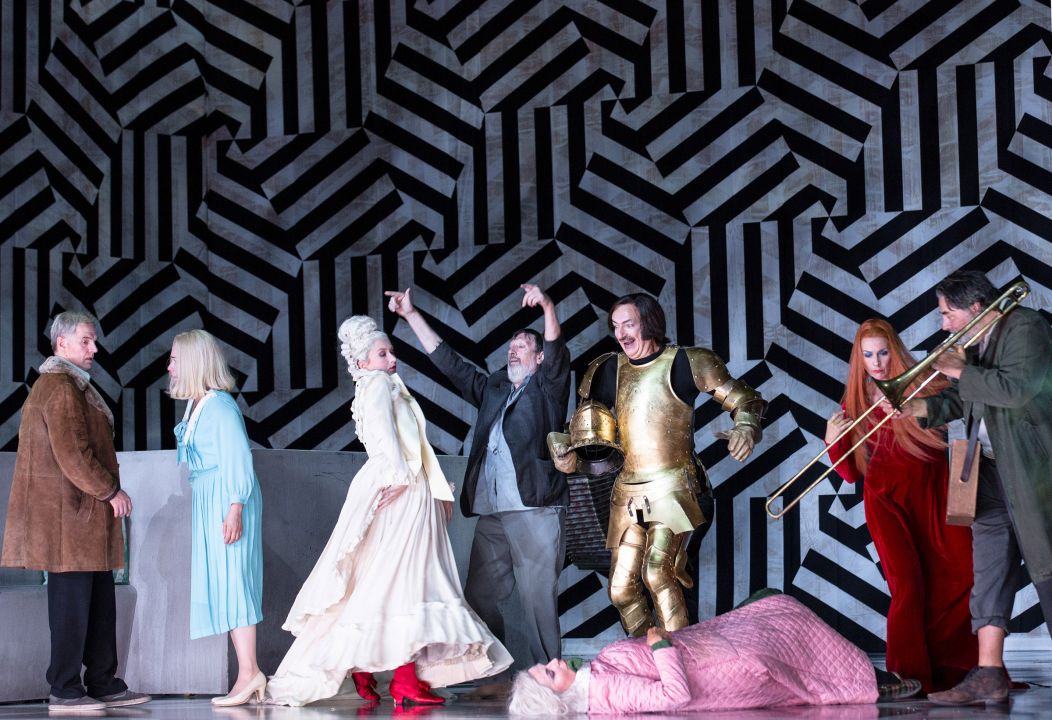
If you think Act I was peculiar, Act II despite being again rather minimalist in overall approach has many more eccentric touches, too many to go through every one of them all and you'd be none the wiser even if they were described. What matters is whether it gets across the gravity and import of this lynchpin scene of this opera and debatably the whole tetralogy. What it seems to focus on is the opposition of ideals and philosophies of the opposing forces within Valhalla, or at the very least find visual ways of establishing their character. Fricke enters Valhalla in an extravagant white wedding gown with a troupe of similarly attired followers, fairly shaking with rage at the mockery Siegmund and Sieglinde have made of the sacred sacrament of marriage. She crushes some white doves while Wotan washes the head of a statue of Buddha with milk. Whether you take any deeper meaning from this or not, there is no reason why these gods should behave as ordinary mortals.

For his part, Wotan recounts his folly and his failure to Brünnhilde wearing a red blindfold with dark semi-invisible figures of his entourage waving flags that spell IDIOT behind him. Brünnhilde's steed Grane is seen as nothing more than disembodied skeletal floating lower legs, again operated by invisible extras. Brünnhilde is crushed momentarily beneath its hoof at the weight of Wotan's will and command to the Valkyrie. Act II of course is all about revisiting the past and determining the future, and it can be a little dry, so these visual theatrics can help establish the nature of what transpires, but it's hard to see that these add anything, or really understand their intent. It seems to get even sillier still when Brunhilde gives Siegmund an orange while advising him of his fate on shifting sands, all of Act II delivered in the gravest intonations, before shapeless creatures smother him. Regardess of what you make of it, musically, vocally and in terms of the tone you expect, it delivers the depth of intensity of the Act.

Likewise, Act III fires into the Ride of the Valkyrie with the same full dark intent. These are Valkyrie to truly strike terror into the soul as, dressed in black robes with helmets and shields, they drag the hairless naked bodies of fallen heroes to their final resting place in Valhalla in the enveloping bleak darkness of the stage. The final scene between Wotan and Brünnhilde is completely stripped back to black as a large white screen is lowered and tilted over them, with only a few ominous shadows rippling across on the other side of the veil behind them. There is a brief burst of flame in a circle, the shape of the ring that has become the connecting or defining element between the beginning and end of each of the two operas so far. Nothing else is needed really when Alain Altinoglu conducts the orchestra to bring out every nuance of emotion and sensitivity from the scene.

The La Monnaie Die Walküre is given a very different treatment to the one in Das Rheingold. It's a dark shadow world for the larger part of this opera, the world unformed and unstable, from the shifting furniture of Hunding's abode in Act I, the pacing wolf, the swarming figures that swallow Siegmund, the dark mounts of the Valkyrie that pass by in the background. Individually, these things might not add up to anything meaningful, but collectively they establish a specific mood, finding the necessary balance of darkness and light (admittedly more darkness than light in this work). Like Frank Castorf's extraordinary Bayreuth Ring, Castellucci is clearly not going to be restricted to a single style across this cycle, adapting to the distinct character of each of the works and the opportunities they offer. So far however it lacks the thematic rigour of Castorf's Ring and an overall concept hasn't yet emerged other than this idea of a circle or ring being a key image, which is appropriate but hardly revolutionary.

Some might expect more from Romeo Castellucci on this epic tetralogy, but so far Das Rheingold and Die Walküre have been successful in their own context and who knows whether certain visual leitmotifs might not recur in the next two works (probably not). Certainly the musical direction of Alain Altinoglu provides the necessary heft that you would expect and perhaps the intent is to let the language of the music speak more strongly here, with the visual element supporting that in a more abstract fashion. There are some interesting choices made as far as the casting goes, and I'm all for bringing new voices into the world of Wagner, but not all of them are convincing this time around.

I wasn't too keen on the trills introduced by Nadja Stefanoff's Sieglinde in Act I, but she is excellent in the subsequent acts, looking truly anguished rather than dramatically acting it as seems to be the case with Peter Wedd's Siegmund, a joyless Wehwald. Too many of the performances are operatically earnest, the movements too choreographed to show any real feelings. It seems to afflict Gábor Bretz this time around, his delivery inexpressively intoned with little emotional engagement. There is little sign of resignation you expect from Wotan in Act II or fury in Act III. Marie-Nicole Lemieux is another fine singer who was introduced to to the Wagnerian repertoire in Das Rheingold and her Fricka here is capable, her performance good but perhaps not outstanding or as commanding as you might like. For me, Ingela Brimberg's was the most impressive here, connecting deeply with the different sides of Brünnhilde, but all of the Valkyrie were formidable on a scale commensurate with the mythology of the Ring. Whether we can say that about Castellucci's direction of this Ring cycle remains yet to be seen. 


Saturday, 14 October 2023

Foccroulle - Cassandra (Brussels, 2023)


Bernard Foccroulle - Cassandra

La Monnaie-De Munt, 2023

Kazushi Ono, Marie-Ève Signeyrole, Katarina Bradić, Jessica Niles, Susan Bickley, Sarah Defrise, Paul Appleby, Joshua Hopkins, Gidon Saks, Sandrine Mairesse, Lisa Willems

OperaVision - 14th September 2023

There are any number of Greek dramas and myths that remain applicable to today, with themes that are still capable of inspiring contemporary operas. Matthew Aucoin's Eurydice adapts Sarah Ruhl's original play and libretto to explore deeper feminist and human themes explored by the Orpheus myth, while Aribert Reimann's Medea casts a shadow over a society intolerant of outsiders, its rulers obsessed with wealth and prestige, blind to the danger of failing to respond appropriately to the needs of those seeking asylum and the price that is paid by our children. Cassandra in as far as Bernard Foccroulle's opera presents it, clearly speaks to perhaps the most immediate global crisis facing modern society, one that is being warned about daily and becoming ever more urgent, but it's apparent that again, no one is listening. Climate change is the pre-warned disaster facing us all.

Cursed by Apollo so that her premonitions for the future will fall on deaf ears, the words "Ototoi popoi da” that Cassandra struggles to express at the start of Foccroulle's opera are unintelligible and unheeded until disaster strikes. She emerges here as a ghost of the past brought into the present, the two time periods combined and overlapping through a wall of literature written on the subject. The collapse of Troy with all its classical implications - traditionally well-served in opera as well as in Greek drama - is echoed in a modern disaster, as the wall collapses leaving devastation in its wake. People buried by the disaster emerge cut and bruised and crying over the dead in the rubble, as a camera operator zooms in showing the devastation in all its horror.

It's a familiar scene that we have seen repeatedly on our own screens over the last couple of years. There's really no beating around the bush here. The opening is direct and devastating, a classical style Cassandra in full outburst, carrying a dead bleeding child plucked from the ruins of Troy as a Greek chorus ominously intones the consequences of the failure to listen and the orchestra delivers jagged blocks of chords. It's a powerful opening, the impact heightened by Foccroulle's music, not to mention the reaction of Cassandra, and yet, despite all the power of classical-inspired opera, it's a message that is still likely one to go unheeded. It needs something more to bring that message up to date, and Foccroulle and librettist Matthew Jocelyn choose to find another way to get the message across.

There is an intentionally jarring change of tone as the setting abruptly changes to the present day, where a modern day Cassandra, PhD student and published climatologist Sandra Seymour, conscious that all other attempts to express the imminency of the danger have fallen on deaf ears, chooses to deliver her warning as a comedy routine. Running models and algorithms from her studies, Sandra knows danger is real, but chooses to approach the subject with the audience by blaming 'sex fiends' going under the names of Donald, Jeff and Vladimir raping the earth, as she shatters a block of ice. There's not really any beating around the here bush either (not much comedy either), but there is disagreement about her approach from an environmental activist, Blake, who who takes her message more seriously that she does. They share the same concerns however and end up in a relationship together.

Using such means, Fouccrolle's opera seeks to provide a wider context and every means at his disposal to draw together the classical warnings and the present crisis. There are plenty of 'sex fiends' in history bringing damage to humanity and mythology is full of them, not least Apollo, so the parallels are well-established and the musical language used for each of the scenes is appropriate and effective. The subject is not exactly a new concern expressed in modern opera - Sivan Eldar's Like Flesh, Tom Coult's Violet, Perocco's Aquagranda - but these are a little more allusive towards the subject and Foucrolle's opera strives to be more direct. It's important but difficult to do that without descending into preachiness. Cassandra does do a lot of telling, quoting statistics and figures on the melting of ice caps, but it tries to present these in an accessible way, looking at classical mythology for additional substance, using a modern couple debating with each other as a way of putting fire into their relationship and the best way of putting the message out there. This might work for some observers, not for others.

The classical story however does add another element, or at least it does in the way it is presented here as overlapping with the modern-day story. Priam and Hecuba are also brought back from the books, now able to reflect on what the plays written about the fall of Troy tell us, now fully aware of the consequences of failing to listen to the warnings of Cassandra. These scenes - which flow seamlessly from a dinner party scene with Sandra's well-to do parents who are more focussed on causes that boost their image and profits doubling up the roles of Priam and Hecuba - is as charged and anguished as you would expect, equally if not as much as a classical retelling, such as in Berlioz's Les Troyens for example. We already have the benefit of hindsight to act as foresight, the opera seems to be telling us, and we don't want future generations to look back on our society incredulous that we failed to heed the obvious present warnings of the fall of civilisation.

Belgian composer Bernard Foccroulle is a former director of La Monnaie in Brussels and the Festival d'Aix-en-Provence. This is his first opera composition and it's an ambitious full-scale work, attempting to encompass a number of styles, each effective for the requirements of the libretto and the message. There's Cassandra past blending into Sandra's present, the drama and music serious on one hand, seeming blithe on the other, reflecting two ways of viewing the subject. If we truly knew what is ahead we wouldn't treat it as a joke, but at the same time, most aren't taking it seriously. Foccroulle tries every means, style and views of these conflicting worlds and tries to replicate it in the music, not least in the strong writing for female voices and the short musical interludes, Scene Four and the final scene for example consisting only of a musical depiction of a swarm of bees.

There is inevitably some banality in the modern sections in the domestic relationships, the language, the swearing, the so-called comedy and in the family crises. There is a point to be made about preserving the world for future generations, but whether the opera and its approach hits the mark or is "bullshit" as is loudly heckled by an "audience member", the point isn't convincingly made. Opera has the power to raise a subject to a higher level, elevate the mere words and drama of a libretto, achieve impact through the music and singing, but it's by no means clear that Jocelyn and Foucroulle's approach to Cassandra will be heeded any more than those unheeded warnings of its title character.

Conducted by Kazushi Ono for the premiere of this new opera at La Monnaie, the music and its effectiveness to the subject and libretto can't be faulted, the fascinating and varied score inviting the audience to listen closer to what is being presented. There is much that is equally impressive in the singing and the stage production, so every effort has been made. A new opera, the singers cast are obviously chosen as perfect for the roles. There are singing and performing challenges here but each is outstanding, Katarina Bradić in particular in a gift of a role as Cassandra, but Sandra is also a large role and is impressively sung by Jessica Niles. I also thought the performances of her mother and father, sung by Susan Bickley and Gidon Saks, doubling as Hecuba and Priam were both terrific, contributing superbly to both sides of the work.

The stage production directed by Marie-Ève Signeyrole with sets by Fabien Teigné also plays an important part in maintaining an connection and fluidity between the 'classical' sections and the modern-day sections, as well as bringing out the underlying context of the climate change debate that is drawn between them. Projections and live filming are used, every means that can enhance the central key imagery of nature and devastation. There are blocks of ice, screens of hexagonal blocks, computer-generated swarms of bees, showing life and nature interwoven and in crisis. It's an impressive looking production, serving the subject, the music and the drama well, or as well as it is possible to do considering the limitations of what the arts can really be expected to contribute to the discussion.


Externa links: La Monnaie streaming, La Monnaie, OperaVision

Saturday, 24 June 2023

Saint-Saëns - Henry VIII (Brussels, 2023)


Camille Saint-Saëns - Henry VIII

La Monnaie-De Munt, 2023

Alain Altinoglu, Olivier Py, Lionel Lhote, Marie-Adeline Henry, Nora Gubisch, Ed Lyon, Vincent Le Texier, Enguerrand de Hys, Werner van Mechelen, Jérôme Varnier, Claire Antoine, Alexander Marev, Carlos Martinez, Alexander Marev, Alessia Thais Beradi, Annelies Kerstens, Lieve Jacobs, Manon Poskin, Alain-Pierre Wingelinckx, Luis Aguilar, Byoungjin Lee, René Laryea

OperaVision - May 2023

There is no denying the lyrical beauty of the music of Camille Saint-Saëns and consequently it's always a joy to discover some of his lesser known operas, but I have to admit that I struggle to find relevance in his subjects or indeed find much in the way of true feeling or connection with the human condition in his treatments. To be fair, while Samson and Dalila remains an impressive and powerful work still worthy of continued revival, opportunities to actually see (rather than just hear recordings) of his other operas are still few and far between. Director Olivier Py, often a reliable and interesting director at La Monnaie in Brussels, certainly gives Henry VIII his best shot, but there is still a feeling that there is something vital lacking that would make a case for the work and other Saint-Saëns operas meriting a return to the main repertoire.

The challenges of adapting any period of the reign and activities of Henry VIII are you would imagine considerable. Even just choosing which of the wives as the focus for an opera, but the fate of Anne Boleyn would certainly have to be considered as a starting point, such is the impact that this marriage would have on subsequent English history. Donizetti wasn't too concerned with historical fact when he set to work on his series of operas about the English monarchs, but still managed to make them hugely entertaining, not least in his own version of the Anne Boleyn story. Whichever way you approach it, it's going to be a long one and so full of operatic incident and drama as to be almost irresistible.

Saint-Saens' approach in Henry VIII, while it inevitably is still operatically stylised, places more focus on Catherine's condition as a spurned wife, the significance of the dissolution of that marriage and the schism it caused with the church as the beginning of a reign of terror. Rather than one thing leading to another, there is instead a sense of a strange but compelling juxtaposition of love and terror that intentionally sit rather uncomfortably together. This is exemplified by the finale of Act I, where the king declares his love for the handmaid he has brought over from France at the same time as the execution of Buckingham is taking place outside. Anne Boleyn is not unexpectedly horrified at the strange (to say the least) by appetites of the English king, fearing for the Spanish ambassador Gomez who has already declared his love for Anne.

That certainly raises the stakes, but as a grand opéra it still has certain conventions that must be adhered to which can make it something of an acquired taste by today's standards. At the very least it does feel like the drama could have been tightened up a little more. Act II in particular feels a little bit overdone with Henry pressing his declarations of love still further on Anne while Gomez looks on helplessly. On the other hand, the menace is still there and the intriguing juxtaposition of declarations of love bearing more than a hint of danger that Anne is unwittingly flirting with since we know what lies ahead (or indeed a head) makes this something worth exploring. And indeed, this develops into a just as charged confrontation between the Queen Catherine and the pretender for her position, any confrontation between the two women always a sure situation for sparks to fly.


Olivier Py as ever is an interesting choice of director for the staging of this kind of rare opera at La Monnaie. Saint-Saëns in grand opéra mode presents a rich palette of dramatic scenes, musical set pieces, rousing choruses and ballet music, which Py dutifully addresses in his own way with his regular set designer Pierre-André Weitz. The stage is very dark and menacing, largely black and white with bold colours set against it, Anne notably in blood red. There is a blend of historical Tudor costume and 19th century period dress, since Py feels the work has more to do with the divisions of church and state in the French Third Republic of Saint-Saëns time than it does about English 16th century history. He makes good use of the dancers in the ballet sequences (and outside of them also), as well as his tableau arrangements (as in his Dialogues des Carmélites) to try to touch on other spiritual elements, bringing stylisations to the swirling undercurrents of violence and death as they are represented in the music, which wouldn't bear too much realism.

As much as I love Saint-Saëns and the French Romantic composers of this era, his music is fairly nondescript for the most part, reminding me Ambroise Thomas. Unmemorable maybe, even if conductor Alain Altinoglu praises the character and colouration of his writing, and a little bit academic, not really allowing you to feel any real emotional connection. But as far as the demands of the opera are concerned, the composer (and conductor) fulfil the remit, building the tension up to a high-pitched finale at the end of each of the four acts, each of the principals having several strong expressive arias. There is certainly an impact in the key scenes, such as Henry proclaiming himself head of the church in England to huge choral acclaim. Py serves such scenes well, not neglecting the ballet scenes either but making good use of this music to underline and contribute to the overall tone of the work in this production, as when for example he extends the final quartet with a silent dancer and Jane Seymour to further add to the sense of menace.

Grand opéra of this kind is a challenge but also a treat when you have good singers to deliver it. Soprano Marie-Adeline Henry takes the honours here with a superb, impressively sung Catherine of Aragon. In many ways she is the heart of the tragedy and main vehicle that establishes the tone of the opera, so it's vital that it is in good hands. Mezzo-soprano Nora Gubisch is also good as her 'lesser-equal', and Ed Lyon is still in fine voice as Don Gomez. Henry VIII is such a larger-than-life figure that it can be a challenge to show nuance or character, but there is indeed some human qualities invoked by Saint-Saëns's music and Lionel Lhote's performance. Definitely a cast worthy of the work and they do it justice. Py also treats Saint-Saëns' Henry VIII respectfully or at least appropriately, with fewer of his usual mannerisms, the extravagance of the stunning set designs commensurate with the scale and scope of the work. The spectacle, colour, movement and superb stage management brings out the contrasts, dynamic and lyricism in an opera than might not be great, but has certainly much to admire in it.

Links: La Monnaie-De Munt, OperaVision

Monday, 13 February 2023

Tchaikovsky - The Queen of Spades (Brussels, 2022)


Pyotr Ilyich Tchaikovsky - Pikovaya Dama

La Monnaie-De Munt, Brussels - 2022

Nathalie Stutzmann, David Marton, Dmitry Golovnin, Laurent Naouri, Jacques Imbrailo, Anne Sofie von Otter, Anna Nechaeva, Charlotte Hellekant, Alexander Kravets, Mischa Schelomianski, Maxime Melnik, Justin Hopkins, Mireille Capelle, Emma Posman

OperaVision - 23 September 2022

Although visually it clearly takes place in late Soviet-era USSR, everyone wearing 1970s' costumes in the courtyard exterior and assumed interiors of a Soviet tenement block, it is of course tempting to see something of the current conflict in Ukraine in David Marton's 2022 production of Tchaikovsky's Pikovaya Dama/The Queen of Spades for La Monnaie, the production playing out much at the same time in September 2022 as the Russian invasion was at its height. While the period sets it apart and prevents it from making any ill-fitting and facile commentary on a serious and complex contemporary situation, Tchaikovsky's opera and indeed Pushkin's original ghost story do have something to say about the dangers of myths fuelling nationalistic delusions and war.

That's touched on in the children's chorus of the opening scene which otherwise has apparently little to do with the opera, a scene that would be difficult to imagine playing straight in the current circumstances and an example of how quickly 'innocent' intent can suddenly appear more sinister as times change. With this chorus of schoolboys lining up in a play-acted military march against Russia's enemies, Tchaikovsky could easily be outlawed (and has indeed been in some places) in the current climate where Russian artists and musicians are now viewed with suspicion. Marton however turns this into a more abstract scene, a Russian pianist centre stage, a radio playing the marching song, while a group of mothers listen to the broadcast of their sons with horror for what lies ahead.

It neatly sidesteps any controversy, not that La Monnaie ever work on the basis of playing safe in their productions, but it also sets the tone for what follows. The period and setting emphasise the divide between the rich and the poor, Liza the prize of the Prince that Hermann, hanging out with his chums in the tenement block, gambling, spending his money on black market goods, cannot hope to win. He knows he is a loser, not just in cards but in the game of life, and he feels that despair deeply, in the way that only the tragic figures of Russian literature can. And in a way that only a composer like Tchaikovsky, it his own troubled personal life, can put into music - as demonstrated in Stefan Herheim's 2016 production of this opera.

A creative director can of course delve into many different layers of this work, as Hans Neuenfels also did at Salzburg, using the children's march as a means of emphasising the strict rules of society that Hermann feels he has the right to place himself outside. What gives him the confidence to follow his own path in Marton's production is, like the empowerment of nationalistic exceptionalism expressed in the march, the lie of the myth of the Countess and the three cards that he chooses to believe in. He buys into it, but also buys a gun from a black market dealer to give him a little more power and influence. 

Marton of course doesn't keep it as simple as that and recognises the complexity of Tchaikovsky's music and the fact that art, opera and music have their part to play in exposing or examining the workings of the human mind, and indeed inspiring to go to war. Throughout the opera we see a man writing in a book, a libretto perhaps, and a pianist at the centre of the scene, Marton resisting however the temptation to go down Herheim's use of a Tchaikovsky doppelganger (or many of them, reflecting various sides of the composer). The two come together at the conclusion of the opera to reflect what they have experienced in the preceding episodes.

But art has other means and uses, particularly for ordinary people in the impoverished circumstances depicted in this era and this is also reflected in the setting. While the men are gambling, black market dealing or finding other ways of escape through alcohol, the women are seen looking to escape their surroundings, reading books, gazing into a glass of spirits, trying to catch a radio signal from the outside world. A young girl gazes at a globe, and Polina sings a melancholic song that observes: "What did I find in those enchanting dreams? A grave." Such scenes, as well as Tchaikovsky's pastorale and the arrival of Catherine the Great would feel out of place in this context, a divertissement in the middle of the near-contemporary realism depicted here, but it actually serves as another illusion to keep the peasants dreaming.

With a wealth of such material already provided by Tchaikovsky for a good director to use purposefully, there is no need then to bring any current conflict - which would certainly have been imminent during rehearsals - into the production. It's enough to perhaps just reference it to avoid any controversy of performing a Russian composer and let the opera deliver its own commentary on it, which it does most powerfully by taking things to their inevitable conclusion. Hermann is afflicted by madness to his 'cause', believing the words of an old woman on a payphone as if they are speaking a secret message to him. It means ruin and death and that is all that is left for Liza too. Dragged to her death by the same delusions of escape that had given her comfort.

Christian Friedländer set designs pitch the production into this ambiguous and divided world, somewhere between brutalism and romantic fantasy. The tenement block is stark enough to capture the romanticised view of the opera's ghost story running up against the harsh reality of ordinary people's lives, the contrasts of riches (or dreams of riches), with the impoverishment of their lives. Using the period, contrasting costumes of the real and the imagined, turning reality into art through the dreams of the secondary characters and chorus, in its own way it creates a visual representation of what opera does when art meets reality.

Conducted by Nathalie Stutzmann it's a strong musical performance, the orchestra delivering the high drama, matching the subtleties of Tchaikovsky's score to the underlying romantic sentiments and mad delusions. The singing performances are also a good fit for the roles, for the attack of the music and the intent of the stage direction. The Russian principals are excellent in this capacity, Dmitry Golovnin as Hermann and Anna Nechaeva as Liza both impassioned in their own ways. Jacques Imbrailo is fine as the Prince as is Anne Sofie von Otter, now at that stage in her career where she has the personality and character to take on the role of the Countess. There is good work also from the supporting roles and the chorus. It's not a classic production but one that is necessarily connected to a view of the times we are living under, a time of madness and a reminder that the only thing we can be sure of is death.


Links: La Monnaie streaming, OperaVision