Showing posts sorted by relevance for query Justin Hopkins. Sort by date Show all posts

Saturday, 13 April 2024

Verdi - Rivoluzione e Nostalgia (Brussels, 2024)


Giuseppe Verdi - Rivoluzione e Nostalgia

La Monnaie, 2024

Carlo Goldstein, Krystian Lada, Enea Scala, Vittorio Prato, Justin Hopkins, Nino Machaidze, Gabriela Legun, Hwanjoo Chung, Scott Hendricks, Giovanni Battista Parodi, Dennis Rudge, Helena Dix, Paride Cataldo, Saténik Khourdoian

OperaVision - 29/30 March 2024

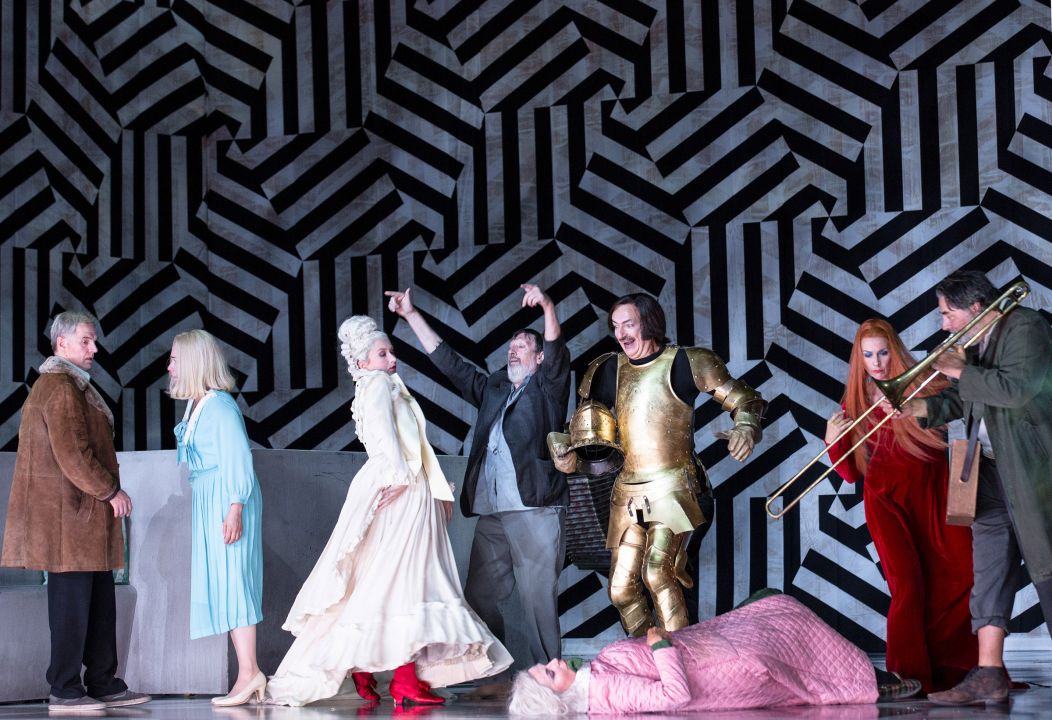
'What will remain of our time?', a man called Giuseppe ponders at the start of Rivoluzione, a two-part opera compilation of selected arias from early Verdi operas created for La Monnaie in Brussels. Well, the music of Giuseppe Verdi remains a cornerstone of the opera repertoire 150 years after his major works, suggesting that his operas still have something that speaks to us today, but what of the lesser early works? Will the ideas expressed in those works from the 'galley years' spent honing his craft still have something to say in the future. That seems to be the question that lies at the heart of La Monnaie's early Verdi project, and if the answer is not clearly resolved in the way that the project might have hoped, it certainly suggests that Verdi's early operas have qualities that ensure that they will be around much longer than Rivoluzione e Nostalgia.

Still, there is merit or at least purpose in such a project, all of the excerpts from these two back-to-back operas being selected from Verdi's first sixteen operas, most of which in the main are rarely performed. The reasons for the lack of new productions of these works is open to debate. You could argue an opera house has to consider the commercial aspect; why put on Alzira when you have the name familiarity of a new La Traviata or Aida to bring in the punters? This suggests the other argument that indeed the early 'galley years' works are inferior, but inferior to what? To later Verdi unquestionably, but on their own merits the works can be thrilling pieces of crowd-pleasing operatic drama. The quality of the musical composition and hints of the greatness of the later Verdi can be found there - as this project ultimately proves - but the plots of those works are, not to put too fine a point on it, somewhat hokey pot-boiler melodramas. The challenge for Rivoluzione e Nostalgia is whether it can cannibalise those great moments from Giovanna d’Arco, Nabucco, Stiffelio etc. and put them into a new context with a coherent plot in order for us to see their continued value and relevance.


There's an argument then for taking the works out of their original dramatically and psychologically dubious context and applying them to a newly written drama that presents the musical qualities in a better light. It's not as if this is anything new in the world of opera, which has an ancient but now not so common tradition of the pasticcio opera. I can't think of any pasticcio that draws exclusively from the work of one composer, although some lost Vivaldi works have been reconstructed from his other compositions and Rossini is well-known for cannibalising his own works to make new ones. I recall that not too long ago a ballet was made entirely of Verdi's instrumental music and overtures, undoubtedly for similar reasons to this project, ie. the music is too good to let languish. If that's the case then the idea of an early Verdi pick 'n' mix is a good one, but - again not to put too fine a point on it - unfortunately the execution fails in this La Monnaie production of Rivoluzione e Nostalgia.

It's arguable whether it's a good idea to start the first part Rivoluzione with 'Patria oppressa' (from Macbeth). You can't make a bigger statement about the proposed subject than that, and at the same time demonstrate the quality of Verdi's composition, but the new plot context for this piece doesn't really stand up to such a moving chorus. The context for it is a video sequence showing random footage of life in the late 1960's that is to be set into turmoil by conflict and war around the world, ordinary people affected by events in Vietnam and Algeria, initiating student protests in many major cities around the world, but specifically here in Italy, presumably Rome. Starting off on such a note as 'Patria oppressa' however, it is going to find it hard to sustain the momentum and build on that, and indeed instead of a struggle between the rulers of nations and their people, Rivoluzione turns its focus on a romantic tug-of-war between Laura and Carlo and Lorenzo, with her brother Giuseppe adding to the sense of outrage. With Laura a bourgeois girl, the daughter of the chief of police falling in love with Carlo a common shipyard worker, the struggle becomes one of crossing class boundaries and accusations of being a traitor to the ideals of the proletariat.

The shortcomings of the resetting of the plot aside, there are other weaknesses in the execution of Rivoluzione. Inevitably, considering the cut-and-paste method, there is no through-composition, the cabalettas, arias and choruses drawn from the likes of Ernani, La battaglia di Legnano, I masnadieri and Luisa Miller separated by filmed segments of ponderous portentous spoken dialogue. The names of the characters of Laura and Carlo are defined by the first two arias taken from Luisa Miller ('Lo vidi e'l primo palpito' and 'Sacra la scelta è d’un' consorte'), but elsewhere names and words are subtly changed to reflect the new context, referring to the bourgeoisie and barricades (I masnadieri for example retranslated from 'brigands' to 'agitators') removing references to the diverse nationalities of the different operas.

Dancers are used to bring another element to the stage production, enlivening the stage drama with energetic modern jerky movements. They don't do much to take the heat out of Verdi's blood and thunder melodrama, but instead emphasise every single note, pushing the emotional charge of the scene far beyond its limit, certainly further than a romantic love-triangle plot between revolutionary students can sustain under the excuse that 'Il personale è politico', the private is political. Say what you like about the plots of Verdi operas, but at least they aimed for grand historical drama that merited such musical forces. The plot of this one is too slight and insignificant to bear such weight. Bizarrely - something I've never felt about Verdi operas or even any previous production - but removed from their original context, the confected love-triangle struggle feels more like a macho power struggle than the typical Verdian questions of conflict between love, family and duty.

What is indisputable however is that musically, Rivoluzione is outstanding. Nino Machaidze as Laura is sensational and Gabriela Legun as Cristina no less impressive in the supporting soprano role. Enea Scala's Carlo is a robust Verdi tenor, dramatic and lyrical, Vittorio Prato's Giuseppe and Justin Hopkins' Lorenzo less so, but capable nonetheless. When you have singers of this quality, you can admire the individual pieces from these scarcely performed Verdi operas and the passion that underlies them, even if the dramatic context in their new setting remains flawed. Across two parts totalling 5 hours of this diptych, you can imagine that the cumulative impact might be a bit much. So after the three hours of Rivoluzione I hoped for a little respite in Nostalgia.

'What will remain of our time?' Well, the question that the 1968 setting of Rivoluzione failed to establish in any significant way is explored in Nostalgia, inevitably to diminishing returns. Laura has disappeared, we later discover now dead, but there are video documents of the student days of the 'revolutionaries' who ended up betraying their cause and the revolution, accepting pay-offs and now - reuniting in a plush art gallery to view Carlo's latest barricade installation piece (which is actually rather good) - feeling somewhat guilty about their acceptance into the bourgeois world of art and commerce. There is at least some respite from the onslaught of full-throttle Verdi in Rivoluzione, and great pleasure to be found in the musical choices that include the overture from Jérusalem, an aria from Il corsaro, a romanza from I due Foscari, scenes from Macbeth and - essentially - the chorus of the Hebrew slaves 'Va pensiero' from Nabucco as a finale.

Relying on Macbeth for a large portion of Nostalgia however reveals some weaknesses in the singing. Macbeth is a bigger role than Scott Hendricks can manage, Carlo unconvincingly transforming from tenor Enea Scala into a baritone seemingly for this purpose. Helena Dix is more capable, but not convincing in the Banquet scene or the sleepwalking scene (sung bel canto style with references remaining to Banquo's ghost). Compared to the other rare Verdi operas drawn on, Macbeth is also perhaps too familiar to view in a new context. Dramatically, on the basis of being not much more than haunted by past crimes of betrayal to 'the cause' - and even then it's the banal gossip of romantic betrayal that dominates - it's not strong enough to erase memory of the original when the filmed segments between the arias and choruses fail to merge into anything that resembles a plot. Hendricks, never a Verdian baritone, I'm sorry to say fairly murders 'O vecchio cor, que batti' from I due Foscari. Only Gabriela Legun really stands out again here as Virginia, but even her 'Egli non riede ancora' from Il corsaro lacks a convincing context and emotion that a genuine plot and true characterisation might bring.

Despite the dramatic weaknesses of the diptych, its overextended length, the inconsistency of the singing and its failure to amount to a coherent opera, there is nonetheless some merit in this production of Rivoluzione e Nostalgia. Aside from reminding us that there is a treasure trove of musical richness in the rarely performed first sixteen operas of Giuseppe Verdi, it also proves that opera is not primarily about the music or the singing, but that the drama is the critical element. Without a meaningful dramatic, philosophical and human context, the singing and music alone is meaningless, or at least diminished. There are of course exceptions to any rule, just as there are exceptional productions that prove the value of many operas, including many of the early Verdi operas, thought to be lacking in substance. Just reviving any one of them (yes, even Alzira is redeemable) would have been preferable to creating Rivoluzione e Nostalgia, but as an opportunity to highlight that there is much more to Verdi than La Traviata and Aida, or indeed Don Carlos and Otello, it makes at least a semi-convincing case. 


Wednesday, 3 April 2013

Donizetti - Lucrezia Borgia


Gaetano Donizetti - Lucrezia Borgia

La Monnaie-De Munt, Brussels, 2013

Julian Reynolds, Guy Joosten, Paul Gay, Elena Moşuc, Charles Castronovo, Silvia Tro Santafé, Roberto Covatta, Tijl Faveyts, Jean-Luc Ballestra, Jean Teitgen, Alexander Kravets, Justin Hopkins, Stefan Cifolelli, Alain-Pierre Wingelinckx

La Monnaie - Internet Streaming, February 2013

La Monnaie's production of Lucrezia Borgia maintains a consistency of style and quality of interpretation that has been evident in all their works broadcast this season via their internet streaming service.  Like La Traviata, Lulu and Manon Lescaut, it's not without a certain amount of controversy either.  Modern, boldly coloured and neon-lit, with a stage set that is far from conventional in concept and configuration, much less traditional in period in design, it was however another bold vision where the spectacle was rivalled by the interpretation of the music and excellent singing from an intriguing cast line-up.

It's well established that the plot and characterisation of Donizetti's Lucrezia Borgia are not the most convincing.  The work is filled with inconsistencies, improbabilities and weak characterisation.  Donizetti's music too, if we're honest, has its moments but there's an awful lot of plodding conventionality in the scoring.  It doesn't make a whole lot of sense or at least it's expecting a bit much for the audience to sympathise with the idea that there's a loving mother beneath Lucrezia's notoriety as a monstrous killer who even in the opera commits a number of atrocities that include the inadvertent murder of her own son.  The nature of her love for Gennaro is itself somewhat dubious and borderline incestuous.  Gennaro's actions and motivations and love unfortunately are no more credible.  And that's to say nothing of the plot involving poisoned wines and antidote plot twists.


The complications of the characterisation and the melodrama in Lucrezia Borgia do however provide a wealth of material that can be worked effectively by a strong cast of real personality, particularly if they have strong direction.  It's a work that builds up scene upon scene towards a magnificent dramatic finale in the way that only Donizetti or Rossini can do, if the production has singers of sufficient stature to pull it off, particularly in the title role.  La Monnaie's production benefits in this respect from a strong committed central performance by Elena Moşuc, who not only hits all those extraordinarily difficult high notes but she does so with a soft unforced expressiveness and true dramatic conviction.

As Gennaro, Charles Castronovo's lovely rounded lyric tenor is more than capable of the necessary range and power, but he's a little declamatory and unable to really bring anything out of the role and the complicated (badly-written) relationship with Lucrezia.  There's a suggestion that the director has to some extent modelled this Gennaro on Donizetti himself, but I'm not sure this is established entirely successfully.  The adventurous and successful casting of the two leads extends to the other roles.  Paul Gay's lighter bass-baritone is revealed as being much better suited to the bel canto of Don Alfonso than the boom of Grand Opéra, while Silvia Tro Santafé makes a good impression as Orsini.

It's also been well established that a "realistic" period setting isn't necessarily going to make Lucrezia Borgia any more convincing.  It's not a historical drama nor is it a movie or a documentary.  Like any operatic work from this period, the emotions expressed principally through the singing - love, anger, betrayal and revenge - are far more important than the historical characters or the period.  Guy Joosten's setting of the opera, with sets by Johannes Leiacker, looks like a circus or even a nightclub with a catwalk leading down from a curtained entrance that has Borgia written up in neon-lights.  Large menacing figures representing aspects of Lucrezia (Maternity, Death, Evil, Nobility) loom over the circular stage of the Cirque Royal, with the orchestra located to the right hand side at the back.  There's evidently some conceptual layers added here, but the drama itself is nonetheless played out within this according the intentions of the libretto.  More or less.


There are some liberties taken then in the stage production, but no more than Donizetti and Felice Romano's working of Victor Hugo's fictional drama and only as much as is necessary to make the notoriously difficult and somewhat static dramatic staging for this opera work.  This was no stand-and-deliver performance and at the very least it was visually impressive in its colourful stylisations, with figures wearing masks and costumes - pigs, clowns, 'Clockwork Orange' droogs, topless ladies in saucy nun costumes - that not only fit with the Venetian Carnival revelry in Lucrezia Borgia, they also give a sense of characterisation and personality that is hard to find in the work itself.  The success of the production was assured by the superb playing of the La Monnaie symphony orchestra and a lively, intense and invigorating interpretation of the score by conductor Julian Reynolds.

La Monnaie/De Munt's production of Lucrezia Borgia was broadcast on the internet via their web streaming service, the performance recorded on the 23rd and 26th February 2013.  The next broadcast of their exceptional season is the world premiere of a new work by Benoît Mernier, La Dispute.

Monday, 13 February 2023

Tchaikovsky - The Queen of Spades (Brussels, 2022)


Pyotr Ilyich Tchaikovsky - Pikovaya Dama

La Monnaie-De Munt, Brussels - 2022

Nathalie Stutzmann, David Marton, Dmitry Golovnin, Laurent Naouri, Jacques Imbrailo, Anne Sofie von Otter, Anna Nechaeva, Charlotte Hellekant, Alexander Kravets, Mischa Schelomianski, Maxime Melnik, Justin Hopkins, Mireille Capelle, Emma Posman

OperaVision - 23 September 2022

Although visually it clearly takes place in late Soviet-era USSR, everyone wearing 1970s' costumes in the courtyard exterior and assumed interiors of a Soviet tenement block, it is of course tempting to see something of the current conflict in Ukraine in David Marton's 2022 production of Tchaikovsky's Pikovaya Dama/The Queen of Spades for La Monnaie, the production playing out much at the same time in September 2022 as the Russian invasion was at its height. While the period sets it apart and prevents it from making any ill-fitting and facile commentary on a serious and complex contemporary situation, Tchaikovsky's opera and indeed Pushkin's original ghost story do have something to say about the dangers of myths fuelling nationalistic delusions and war.

That's touched on in the children's chorus of the opening scene which otherwise has apparently little to do with the opera, a scene that would be difficult to imagine playing straight in the current circumstances and an example of how quickly 'innocent' intent can suddenly appear more sinister as times change. With this chorus of schoolboys lining up in a play-acted military march against Russia's enemies, Tchaikovsky could easily be outlawed (and has indeed been in some places) in the current climate where Russian artists and musicians are now viewed with suspicion. Marton however turns this into a more abstract scene, a Russian pianist centre stage, a radio playing the marching song, while a group of mothers listen to the broadcast of their sons with horror for what lies ahead.

It neatly sidesteps any controversy, not that La Monnaie ever work on the basis of playing safe in their productions, but it also sets the tone for what follows. The period and setting emphasise the divide between the rich and the poor, Liza the prize of the Prince that Hermann, hanging out with his chums in the tenement block, gambling, spending his money on black market goods, cannot hope to win. He knows he is a loser, not just in cards but in the game of life, and he feels that despair deeply, in the way that only the tragic figures of Russian literature can. And in a way that only a composer like Tchaikovsky, it his own troubled personal life, can put into music - as demonstrated in Stefan Herheim's 2016 production of this opera.

A creative director can of course delve into many different layers of this work, as Hans Neuenfels also did at Salzburg, using the children's march as a means of emphasising the strict rules of society that Hermann feels he has the right to place himself outside. What gives him the confidence to follow his own path in Marton's production is, like the empowerment of nationalistic exceptionalism expressed in the march, the lie of the myth of the Countess and the three cards that he chooses to believe in. He buys into it, but also buys a gun from a black market dealer to give him a little more power and influence. 

Marton of course doesn't keep it as simple as that and recognises the complexity of Tchaikovsky's music and the fact that art, opera and music have their part to play in exposing or examining the workings of the human mind, and indeed inspiring to go to war. Throughout the opera we see a man writing in a book, a libretto perhaps, and a pianist at the centre of the scene, Marton resisting however the temptation to go down Herheim's use of a Tchaikovsky doppelganger (or many of them, reflecting various sides of the composer). The two come together at the conclusion of the opera to reflect what they have experienced in the preceding episodes.

But art has other means and uses, particularly for ordinary people in the impoverished circumstances depicted in this era and this is also reflected in the setting. While the men are gambling, black market dealing or finding other ways of escape through alcohol, the women are seen looking to escape their surroundings, reading books, gazing into a glass of spirits, trying to catch a radio signal from the outside world. A young girl gazes at a globe, and Polina sings a melancholic song that observes: "What did I find in those enchanting dreams? A grave." Such scenes, as well as Tchaikovsky's pastorale and the arrival of Catherine the Great would feel out of place in this context, a divertissement in the middle of the near-contemporary realism depicted here, but it actually serves as another illusion to keep the peasants dreaming.

With a wealth of such material already provided by Tchaikovsky for a good director to use purposefully, there is no need then to bring any current conflict - which would certainly have been imminent during rehearsals - into the production. It's enough to perhaps just reference it to avoid any controversy of performing a Russian composer and let the opera deliver its own commentary on it, which it does most powerfully by taking things to their inevitable conclusion. Hermann is afflicted by madness to his 'cause', believing the words of an old woman on a payphone as if they are speaking a secret message to him. It means ruin and death and that is all that is left for Liza too. Dragged to her death by the same delusions of escape that had given her comfort.

Christian Friedländer set designs pitch the production into this ambiguous and divided world, somewhere between brutalism and romantic fantasy. The tenement block is stark enough to capture the romanticised view of the opera's ghost story running up against the harsh reality of ordinary people's lives, the contrasts of riches (or dreams of riches), with the impoverishment of their lives. Using the period, contrasting costumes of the real and the imagined, turning reality into art through the dreams of the secondary characters and chorus, in its own way it creates a visual representation of what opera does when art meets reality.

Conducted by Nathalie Stutzmann it's a strong musical performance, the orchestra delivering the high drama, matching the subtleties of Tchaikovsky's score to the underlying romantic sentiments and mad delusions. The singing performances are also a good fit for the roles, for the attack of the music and the intent of the stage direction. The Russian principals are excellent in this capacity, Dmitry Golovnin as Hermann and Anna Nechaeva as Liza both impassioned in their own ways. Jacques Imbrailo is fine as the Prince as is Anne Sofie von Otter, now at that stage in her career where she has the personality and character to take on the role of the Countess. There is good work also from the supporting roles and the chorus. It's not a classic production but one that is necessarily connected to a view of the times we are living under, a time of madness and a reminder that the only thing we can be sure of is death.


Links: La Monnaie streaming, OperaVision

Monday, 13 October 2014

Strauss - Daphne (La Monnaie, 2014 - Webcast)


Richard Strauss - Daphne

La Monnaie-De Munt, Brussels 2014

Lothar Koenigs, Guy Joosten, Iain Paterson, Birgit Remmert, Sally Matthews, Peter Lodahl, Eric Cutler, Tineke Van Ingelgem, Maria Fiselier, Matt Boehler, Gijs Van der Linden, Kris Belligh, Justin Hopkins

La Monnaie Internet Streaming - October 2014

Richard Strauss' late one-act 'bucolic tragedy' Daphne (written originally as an unlikely companion piece for Friedenstag) is as musically sumptuous and rich in melody as any post-Elektra Strauss opera, but it has to be said that it is a very dry mythological subject that inspires such beautiful music. Directing Daphne for La Monnaie, Guy Joosten attempts to enliven the work with some contemporary relevance, but in the end, it's the visual extravagance of Alfons Flores set design and some gorgeously lyrical singing that ensures that the production suitably matches the shimmering beauty of the score.

It's not too difficult to see what differentiates the treatment of mythology in Daphne and the preceding opera Der Liebe der Danae from the likes of Elektra and Ariadne auf Naxos, and that's the difference between librettists Joseph Gregor and Hugo von Hofmannsthal. Gregor was a writer, historian and classicist, while Hofmannsthal is a poet and an artist who was capable of drawing out challenging and experimental themes from the subjects for Strauss to respond to in his music. It's particularly noticeable where passages of Daphne resemble scenes from Ariadne auf Naxos, the former having none of the edge of the latter's juxtaposition of opera seria and opera buffa, and none of the deeper exploration of the sentiments that this conflict draws out.


There is at least a strong division of sensibilities to work with in the mythical story of Daphne from Ovid's Metamorphoses. Essentially, it's a conflict between nature and order, or the world of nature and the world of man. Daphne is a child of nature who has grown up in close relationship with a laurel tree. She's suspicious of social order and conventions, refusing even to dress up and join in the celebrations for Dionysus that is the excuse for wild revelry and excess among the shepherds and fishermen. Her pure nature also makes her draw away from the declarations of love of the young shepherd Leukippos. Apollo himself appears, disguised as a herdsman, seeming to offer a love that is more pure and in touch with her feelings, but Daphne eventually shies away from his advances too.

In Guy Joosten's production, the contrast between Daphne's child of nature and the world of man is put across - and unnecessarily overemphasised perhaps - in a manner that quite literally depicts her as a tree-hugger in conflict with an economic banking system. It's a system that suggests order and prosperity, but in reality it's on the brink of collapse through its worship of technology, money and its indulgence in excess. It's not a particularly subtle commentary on contemporary society, but it is a meaningful way to define the distinctions at conflict in the mythological tale. The way that it is presented however, and how the resolution to the dilemma of Daphne's position is arrived at by the all-important conclusion, is nonetheless effectively delivered.

The conclusion is a beautiful one - particularly as it is scored by Strauss - but dramatically it can still be rather dry. It's handled very well here however in the modernised production that pushes the concept a little further. Apollo's anger at his rejection and betrayal by Daphne result in the death of Leukippos and an almost cataclysmic upheaval of the "system". That mainly takes the form of little more than a set of stairs that buckle and put the lights out on all the city dealing, but Daphne's transformation into a laurel tree is somewhat more elaborately staged in a way that would appear to have broader meaning - or at least come closer to the impact Strauss is aiming for.


Rather than metamorphose into a tree, Sally Matthews' ecological warrior climbs the huge thick-trunk tree that looms over the stage throughout and seems to merge into it. This is achieved though projections that then see the tree consumed in a huge conflagration that is less pastoral symphony and closer to the end of times conclusion of Götterdammerung, giving the work a broader sense of nature in the end reasserting its authority over man-made attempts to control it. It might seem to be stretching the purpose of this slim one-act opera into something as ambitious as a Ring cycle and I'm not convinced that conductor Lothar Koenigs captures the transcendent beauty of the transformation music, but seen in this light, the Late Romantic Wagnerian influence that persisted in Strauss' writing through to his latter works does seem more evident, and the idea seems to work.

The primary reason that the story works effectively at all is of course down to how Strauss scores those key scenes, and much also depends on how well it's played and sung. Sally Matthews might not be quite as silky-voiced as some Strauss sopranos, but there's force there and passion that suits Daphne. Her lament for Leukippos is almost devastating, fully bringing out all the pain of her character and the aching beauty of the score. It helps considerably that you feel for both Leukippos and Apollo too, particularly since they are so beautifully sung here. Eric Cutler's Apollo combines a heldentenor quality with a beautiful light lyricism and warmth that fits the Strauss/Wagner qualities of the score. Peter Lodahl's Leukippos has an even brighter timbre that is sweet and expressive. Iain Paterson and Birgit Remmert are also notable as Peneios and Gaea.

Link: La Monnaie - De Munt

Monday, 15 February 2021

Debussy - Pelléas et Mélisande (Geneva, 2021)


Claude Debussy - Pelléas et Mélisande

Grand Théâtre de Genève, 2021

Jonathan Nott, Damien Jalet, Sidi Larbi Cherkaoui, Marina Abramović, Jacques Imbrailo, Mari Eriksmoen, Leigh Melrose, Matthew Best, Yvonne Naef, Marie Lys, Justin Hopkins

GTG Digital - 18 January 2021

We have already seen how it is going to be necessary to adapt our lives post-Covid, if such a time is yet imaginable, and it looks like things might never be quite the same again. Opera however has always been adaptable and open to incorporating a variety of art forms, since music and theatre offer many means of expression, combining the abstract and the concrete. One opera that stands almost unique in its approach is Debussy's Pelléas et Mélisande, in the way that it sets drama to music, and not just any drama but a Symbolist drama by Maurice Maeterlinck. As such it offers many ways of interpretation of meaning and vision and you imagine that few works are as well suited to expressing social isolation and a sense of lockdown.

The Grand Théâtre de Genève have certainly put together an interesting and unconventional team for their social isolated lockdown version of the work and attempted to use it as a way of exploring another side of Debussy's enigmatic opera. The concept and performance artist Marina Abramović provides the concept for this production, and it's co-directed for the stage and choreographed with dance elements by Damien Jalet and Sidi Larbi Cherkaoui. With Jonathan Nott conducting the Suisse Romande orchestra in a spread-out fashion around him, you would expect the moody atmospherics to thrive in such an unconventional space, but somehow - too many cooks perhaps? - it doesn't quite live up to expectations. 


It at least approaches the idea of preserving the mystery and enigma of the opera rather than try to pin it down. I once observed in Robert Wilson's production of Pelléas et Mélisande at the Paris Opera that there was a kind of circularity to the work, Mélisande leaving one world and entering into another in much the same state of despair that she entered into it. Wilson's stylisations  - introducing social distancing on the opera stage long before it became necessary - had that haunted quality, of a never-ending story, of ghosts repeating and re-enacting a tragic tale for eternity. As an image of the abstract and enigmatic nature of Debussy's only opera, the circle is a symbol of infinity with no beginning and no end, works well, and it's used as such to similarly haunting effect in Marina Abramović's idea of expanding the work out into the infinite universe.

Space and circular imagery (planets, eyes) are evident throughout the Geneva production, and the circle can even be seen in the shape of the pool, one of infinite depths where Mélisande loses her ring (another circle). The circular image of the moon, reflected in the pool, also represents a cold enigma. In a Symbolist work like Maeterlinck's such ideas evidently work very well, particularly with the added mood that Debussy's music brings to this unique opera. Although it has a Gothic or Medieval character to it, the piece needs no concrete idea of time or place. It's as abstract and internalised a world as Tristan und Isolde, a work of forbidden love and obsession, something both works have in common if approached obviously in entirely different ways.


Approaching the work in an entirely different way is exactly what you expect from a production based on an idea by Abramović (who also recently devised an extraordinary new opera 7 Deaths of Maria Callas for the Bavarian State Opera last year), and choreographed by Jalet and Cherouaki. Rather than rely too much on the usual symbols or place too much emphasis on physical locations or internal dark places, Abramović visualises the work in a much more open environment, but one equally as isolating to the individual; in space. Obelisk monolithic crystals form rocks and grottoes as well as suggest a space ship, as the universe revolves and expands around Pelléas, Mélisande and Golaud. The director(s) also use the symbol of the eye to gaze on them from the emptiness of the infinite abyss of a black hole.

The dance moves are superbly choreographed and performed, the dancers moving fluidly around to 'enhance' the drama. Using some simple Improbable-style effects with reflective tape, they can become the tangled branches of the forest where Golaud is lost at the start, or weave Pelléas into the trap of Mélisande's hair. It sounds simple, but it's incredible how well this needs to be choreographed to be this effective. They can be purely abstract shapes and movement that tap into the undercurrents of the music and the nature of the characters, representing the oppressive qualities of Allemonde in wrestling semi-naked twisting bodies. Golaud's role in particular is magnified and multiplied with a team of dancers who forcefully surround and impress upon Mélisande. Sometimes however they can be a bit of a distraction and often feel unnecessary, intruding on the minimalist beauty of the piece, as well as making additional noise that isn't needed either.


As gorgeous as the Geneva production is, it doesn't manage to penetrate or even bring anything new out of the opera's mysteries. Pelléas et Mélisande can be a cold and detached opera, but it can even thrive on that, and there are few who can do icy detached coolness as well as Robert Wilson. A little bit of humanness doesn't go amiss however and that's largely absent here. Jacques Imbrailo tries to bring some of that in as Pelléas, and it's hard to fault the performances of Mari Eriksmoen's Mélisande or Leigh Melrose's impressive Golaud, but despite everything none of them seem to make any real connection to the people, the place, the space or the music. I don't think it's the fact that the production had to be performed in an empty theatre or the arrangement of the orchestra spread are out into the parterre, but despite all the fine individual talents in place, there's a feeling that there is a connection missing to click it all into place.

Links: Grand Théâtre de Genève

Tuesday, 4 October 2016

Verdi - Macbeth (La Monnaie, 2016)


Giuseppe Verdi - Macbeth

La Monnaie-De Munt, Brussels 2016

Paolo Carignani, Olivier Fredj, Scott Hendricks, Carlo Colombara, Béatrice Uria-Monzon, Lies Vandewege, Andrew Richards, Julian Hubbard, Justin Hopkins, Gerard Lavalle, Jacques Does, Maria Portela Larisch, Boyan Delattre, Jules Besnard

ARTE Concert - September 2016

One thing you can say about productions at La Monnaie is that their stage designs are always impressively stylish. They never go for the straightforward or obvious locations, striving to find other ways to represent works in a bold, modern setting with unexpected concepts. It's also true however that they don't always fit perfectly and sometimes don't make a whole lot of sense, and that seems to be the case with their season opening production of Verdi's Macbeth. There may be some vague references made here to the upcoming US elections, but those are as vague and uncertain as the nature of what the future holds in store there.

Directed by Olivier Fredj, La Monnaie's Macbeth contains little overt reference to Scotland, and is instead set in a luxury hotel. I don't much fancy what they cook in the cauldrons down in the kitchen, but there are all kinds of schemes being cooked up in the hotel lobby as well. Lady Macbeth looks on at a couple nursing their baby there while she turns to her own dark ambitions on receiving Macbeth's letter of promotion. They will have no children of their own to leave with the fruits of their success, so why not make the most of the opportunities that are open to them and take what is ordained to be their due right now.


Macbeth's moment of decision is prompted by an omen. "Is this a dagger I see before me?" No, it's a piece of cutlery that has fallen off the room service trolley, but it's a good enough sign for Macbeth, and the ringing of a distant bell (on the reception desk) is all the invitation he needs to steel himself to kill the king, Duncan. Well, that and a bit of encouragement from his wife. The hotel locations are used in this way throughout and it's a natural place to have servants and maids in the present day, as well as a large banquet. It's also as good a place as any to show ambition, wealth and privilege, but problems with the purpose of the production go deeper than this.

The production at least retains a token suggestion of its original Scottish roots in the men's costumes. They don't quite go as far as wearing tartan kilts, but instead have a rather fashionable (in some circles I'm sure) powersuit with a long Alexander McQueen kind of overskirt. For her part, Lady Macbeth's style - particularly her hairstyle - becomes more noticeably more First Lady-like, with Jackie Kennedy and Nancy Regan references, settling in the end (somewhat randomly) for a deranged Queen Elizabeth I double-cornet red wig, which is of course dramatically removed during her downfall in Act IV. Macbeth's bouffant quiff and displays of wealth might be considered a reference to Donald Trump. If you want to however, the quotes of a tale told by an idiot, full of sound and fury, signifying nothing (which make it through from Shakespeare in a less poetic translation), are perhaps more eloquent on this point.

If the stage production is merely adequate for the purposes of the drama, with neither the direction nor Jean Lecointre's 'digital collage' projections really revealing any new insights or suggesting any real purpose, the singing and musical performance are unfortunately not quite up to the task of matching Verdi's thunderous sound and fury either. Scott Hendricks is surprisingly restrained and subdued in the performance of such a mighty role, not like himself at all. His singing is mostly fine and capable, but he doesn't always produce the most pleasant of sounds in the lower register. It was hard moreover to see any kind of character being established here - although part of the problem might be with Verdi - Macbeth here appearing to be confused and out of his depth the whole time.


There wasn't much to compensate in Béatrice Uria-Monzon taking on the role of Lady Macbeth. Uria-Monzon can be an explosive singer, but Lady Macbeth is not a role for a mezzo-soprano. Her 'La luce langue' just doesn't have the fireworks you would expect for the scene, and there's no sense of urgent over-reaching ambition or cool calculation in the performance. The direction never really permits much in the way of creating mood or atmosphere. 'Patria oppressa' works by taking the chorus out into the audience, but elsewhere they fall back on the now familiar theatrical device of being an audience seated at the back of the stage watching the action.

Paolo Carignani conducted Verdi's original 1847 version with a few revisions, which meant that we got the witches ballet in Act III and Macbeth's 'Mal per me' aria, as well as Lady Macbeth's 'La luce langue' from the '65 version. The compromise didn't lead to a particularly clear conclusion, with Macbeth vanishing after his aria and Malcolm reluctantly or warily approaching to take up his empty robe. Whether it was the performance or the recording, I don't know, but there was a lack of urgency to the musical arrangements. The melody was good, but it lacked rhythm, drive and dramatic engagement. This was a bit of a disappointing start to Carignani's tenure at La Monnaie.


Links: La Monnaie, ARTE Concert

Thursday, 9 July 2020

Schreker - Der Schmied von Gent (Antwerp, 2020)


Franz Schreker - Der Schmied von Gent

Opera Ballet Vlaanderen, Antwerp - 2020

Alejo Pérez, Ersan Mondtag, Leigh Melrose, Kai Rüütel, Vuvu Mpofu, Daniel Arnaldos, Michael J. Scott, Leon Košavić, Nabil Suliman, Ivan Thirion, Chia-Fen Wu, Justin Hopkins, Thierry Vallier, Simon Schmidt, Onno Pels, Erik Dello

OperaVision - February 2020


From just about every aspect, the Opera Vlaanderen production of Franz Schreker's Der Schmied Von Gent must be one of the highlights of an unfortunately curtailed opera season, but that's something we've come to expect from the adventurous Flanders company, a selection of whose work we've been fortunate enough to see streamed on OperaVision. Aside from the curiosity value of a neglected work by a composer currently enjoying something of a revival and re-appreciation, the fact that there is a local connection with the Flemish city of Ghent makes this an attractive proposition, and it's one that the company treat with great affection and attention to detail.

Schreker's final opera from Der Schmied von Gent is quite unlike the more typical sumptuous orchestrations of the composer's previous works. The irreverent and almost comic tone of the work is very different from the lush extravagant fantasies of Die Gezeichneten, Der Schatzgräber, Irrelohe and a long way from Schreker's first staged opera Der ferne Klang. As a Jewish composer working in a musical medium that would be classed as Degenerate, the opera was however not greatly appreciated when it was first presented in Berlin in 1932 and was all but lost in the ensuing troubled years, Schreker himself dying in 1934. In this Opera Vlaanderen performance it turns out to be not only a worthwhile revival of a Schreker curiosity but simply a wonderful opera.


Der Schmied von Gent may not be as lofty and philosophically searching in its aspirations as Schreker's other works and it does get a little bogged down in the historical period detail of the sixteenth century Eighty Years War between Spain and the Netherlands, but there is certainly more of a down-to-earth human quality in this opera that perhaps arises out of the Faustian pact in its plot. Ghent blacksmith Smee is taken advantage of by a beautiful she-devil Astarte who catches the smith at a low ebb, ready to throw himself in the river after losing business due to the actions of a rival blacksmith Slimbroek. He's promised seven years of prosperity but after that, he belongs body and soul to Astarte. That doesn't seem like a bad deal to Smee, but when the time comes, he tries to find a way to escape from the Hellish pact.

There's not much here that is particularly profound or philosophical, it's not something that touches insightfully on human nature and it's not as if the opera's themes can be endlessly explored and updated for new meaning or contemporary relevance, but like any fairy-tale like story it does have important truths and observations to make. Plunging into history and war, evoking horrors and tyrants, religion, devils, Schreker's opera even brings Joseph, Mary and the baby Jesus to the stage. What it certainly has then is the essence of opera, of drama writ large, heightened human emotions and behaviours, expressed with feeling and passion. Schreker's compositional ability and dramatic writing is perfect in terms of pacing and tone, making the whole drama thoroughly engaging.


The Flanders production, visualised and directed with considerable flair by Ersan Mondtag, recognises those characteristics perfectly and confidently expands on it, capturing all the life, colour and magic of the situation in a way that only opera can. The set and costume design is impressive; highly stylised, colourful, cartoonish and playful, completely fitting with the tone of the work. In Act I and II the revolving background set rotates between a simple Ghent street scene with an archway running through it that when turned around reveals a demonic figure devouring a baby towering over the town, the tunnel a gateway to Hell that allows all the devils to arrive. The whole set is used, battlements and towers, tunnels and streets, background and foreground, populated by strange caricature figures. Constantly revolving, it's more than just magically fantastical, but emphasises the two aspects and two sides of the same nature.

It's open for interpretation whether that's two side of human nature, the nature of life in the city of Ghent or the nature of war. On their own however the first two acts provide plentiful colour and entertainment, but there's more to give in Schreker's opera and in the Vlaanderen production. Having deceived the agents of Hell with trickery, they are reluctant to admit Smee when his human time on Earth comes to an end and it appears he's not welcome in heaven either. It's a little superfluous perhaps but Schreker is able to fill this act with majestic heavenly choirs, more colour and humuour. Mondtag uses this act also to consider Der Schmied von Gent as a work that is not just about historical injustice of a long forgotten past but as Smee is revived in the future to witness the liberation of the Congo from Belgian rule and bondage, it's a reminder that the struggle against evil is a constant battle and very real.


The Vlaanderen production and the performances are world class but it's the work itself that most impresses. Kurt Weill and the German music hall are often cited as influences on Schreker's late change of musical direction, but it shows a much wider range of contemporary influences and references, from Hindemith and Zemlinsky to the playful extravagance of the early Strauss of Feuersnot in its satirical tone and irreverent comedy. It consequently has a wonderful down to earth human quality that is missing from Schreker's other works, and although even those are rare enough, only rediscovered properly in recent years, it seems incredible that other than one notable recording on CPO, few have looked seriously at Der Schmied von Gent or given recognition to its qualities.

Alejo Pérez clearly has a ball with the wonderful range and variety of the score, confidently holding all the variations of pace and tone together. Musically, it's an absolute joy. The singing performances can't be faulted either with Leigh Melrose wholly immersed in the glorious character that Smee presents commanding attention throughout with some fine singing and playful acting. Kai Rüütel is also excellent as his wife and Vuvu Mpofu is superb as Astarte, fully convincing as a seductively-voiced she-devil. Unquestionably, Opera Vlaanderen do full justice to the merits of Schreker's final opera, and it's revealed to be something of a marvel.


Links: OperaVision, Opera Ballet Vlaanderen

Monday, 10 February 2025

Karlsson - Fanny and Alexander (Brussels, 2024)

Mikael Karlsson - Fanny and Alexander

La Monnaie-De Munt, Brussels, 2024

Ariane Matiakh, Ivo Van Hove, Susan Bullock, Peter Tantsits, Sasha Cooke, Jay Weiner, Sarah Dewez, Thomas Hampson, Anne Sofie Von Otter, Jacobi Loa Falkman, Aryeh Nussbaum Cohen, Alexander Sprague, Justin Hopkins, Polly Leech, Gavan Ring, Margaux de Valensart, Marion Bauwens, Blandine Coulon

La Monnaie Streaming - December 2024

There is an element of semi-autobiography in nearly all of Ingmar Bergman's films, or perhaps it could be described as an element of exorcism in confronting the fears, concerns and formative experiences that determined his outlook on life. Whether it's the terror of death in The Seventh Seal or the silence of God in ...well, most of his work, that outlook is not a particularly optimistic one. Perhaps the most important formative experience for Bergman and for most people is family and particularly one's childhood experiences. It was only much later in his life, in preparation for what he believed would stand as his final film and testament as a career as a writer, director and filmmaker that Bergman was able to approach those youthful moments of joy as well as the more familiar explorations of pain and fear in a masterful and probing manner through Fanny and Alexander.

As much as they draw upon personal experiences, incorporating the root causes of many of his personal fears as well as his influences that he would unflinchingly bring to the screen as one of the world's greatest film directors, Fanny and Alexander of course has a much broader outlook on life. Which it would need to, since Bergman's experience of childhood in Fanny and Alexander, fictionalised as the well-to-do Ekdahl family in provincial Sweden in Uppsala, doesn't appear to have much in common with most people's lived experience. The challenge of adapting this to opera then would be to focus on and draw out the more universal qualities and experiences from the sprawling richness of the original filmed work, as well as retaining the sense of coming-of-age drama of a turbulent family experience that is to have a profound impact on how one child relates to the wider world as an adult.

With his sister Fanny, Alexander grows up in a wealthy family of businessmen and artists, all of whom gather at the start of Mikael Karlsson's opera version of Fanny and Alexander, composed for La Monnaie in Brussels from a libretto by Royce Vavrek. The family own and run their own theatre, managed by Fanny and Alexander's father Oscar. As the extended family in formal dress gather around the lavish Christmas dinner table prepared by a host of servants after a performance of a nativity play at the theatre, Oscar tells the children that "Outside is a big world and the little world in which we were born succeeds in reflecting the big one" while Alexander and Fanny sit at the foot of the table creating their own personal little drama with a miniature toy theatre. It's a little heavy-handed maybe, but it succeeds in establishing how the opera develops the theme that art doesn't just imitate life but seeks transform those human experiences. 

What this scene also establishes is the gulf between childlike innocence and imagination and the danger of its corruption when it comes into contact with the harsh realities of the world. Certainly there is a lifetime of troubling experiences to be processed as the children unwittingly eavesdrop on the private lives of their relatives, lascivious uncles philandering with maids, their grandmother reminiscing with an old love, one uncle facing ruin from failed business interests, another depressed at aging and the declining state of the world. It would take Bergman a whole career to process these issues - some his own experiences as an adult reflected here as much as fictionalised ones for other people - and confront their roots in this ambitious project.

The most harrowing experience for the young Alexander, as it would be for many children, is their first encounter with the death of a close family member. His father Oscar is rehearsing a scene from Hamlet when he has a heart attack and dies. For the young Alexander, seeped in the family's theatrical tradition, it's as profound an experience as Hamlet’s own horror of meeting his father's ghost, and indeed his own father will later make a similar ghostly appearance in the story. It's a moment wrapped in theatrical and philosophical meaning and suitably presented as such in the staging of this premiere opera production by Ivo van Hove. The Shakespearean allusions continue as Alexander's hatred grows for his step-father, their mother Emilie remarrying to an austere authoritarian and cruel man of the cloth, a bishop who demands they abandon their former life of privilege.

All this will be familiar to anyone who has seen Bergman's film or extended TV mini-series, which is a sign that the creators of the opera have succeeded at least in retaining the essence of the work. Both composer Mikael Karlsson and librettist Royce Vavrek have a good track record in adaptations of movie-sourced material, the two having previously worked together on Lars von Trier’s Melancholia for the Royal Swedish Opera last year. Musically Fanny and Alexander is recognisably in the same style evidenced in that opera, rhythmically and melodically propulsive in the idiom of John Adams, with electronic effects used for dramatic underscoring. It's less 'science-fiction' sounding electronics this time, providing rather an undercurrent that underlines moments of intense emotional stress as well as the ghost appearances, which are also heralded by shimmering bells.

What doesn't come across in the recorded and broadcast version of the production is the effort of the composer to make the opera a visceral theatrical experience. Modern technologies don't have to be restricted to theatrical techniques - and Ivo van Hove knows all about those - but can surely also be employed for musical effect in modern opera. That however is not something that most opera houses are equipped for and it does involve a considerable amount of effort and complexity to install surround speakers and deep subwoofer technology to make the audience actually feel the musical reverberations. There is also the challenge of synchronising the electronic elements of the score with the acoustic orchestra (the performers also wear microphones so that they can be mixed into the live sound design), but the impact of all that is lost in a streamed broadcast.

As well as employing cinematic techniques in his theatre and opera productions, Ivo van Hove is a director who is also very familiar with adapting Bergman and other filmmakers for theatre and often uses extended theatrical techniques like live cameras and projections. By comparison his direction of Fanny and Alexander for the most part feels rather restrained and almost traditional. I have to say I prefer when he is a little more adventurous and avant-garde. The fact however that the scenes have the necessary impact - minimalist but for a number of key scenes like the death of Oscar, the ghost story of the two drowned children and the remarkable effects used for the Isak and Ismaël scenes - suggests that he knows when to hold back in order to give those key moments prominence (underlined by the reverberating score) and does succeed in finding the best way of presenting the material.

That's surely the essential thing, but aside from the scenes mentioned above that are creatively handled, and despite what sounds like a wonderful musical interpretation, personally I didn't find either enough to hold attention as the opera moved into the second half. It was perfectly good, but I was perhaps too familiar with the movie version, so the adherence to the original felt predictable and something of a pale copy of Bergman's film, an unnecessary reworking that didn't really add anything as an opera. I felt like that at least until the stunning and remarkably effective choices for the setting of the avant-conclusion in the puppet theatre shop of Isak and Ismaël. Here Karlsson and van Hove succeeded in establishing the value of the opera on its own terms, which, as it should be, was in the realm of bringing music, drama and singing together to lift the source material to new heights.

That is no small part was due to a stunning performance from countertenor Aryeh Nussbaum Cohen as Ismaël. His extraordinary voice and presence brings that necessary enigmatic quality to the key moment when Alexander's eyes are open to how an artist can take those mysteries and unknowns, the personal traumas and experiences and use them to not only create art, but also how they can be a vital tool for survival. That is supported, as I have said, in the music score and in the stage direction with conductor Ariane Matiakh harnessing all those varied forces of the complex musical arrangements together.

The singing and performances are excellent elsewhere, relying on some veteran performers like Susan Bullock, Thomas Hampson (first time at La Monnaie) and Anne Sofie Von Otter for smaller roles in order to bring extra significance to their roles in the drama. The principal role in the opera however is that of Emilie, the children's mother, sung impressively by Sasha Cooke. Boy soprano Jay Weiner played Alexander exceptionally well with no stage-school mannerisms or over-acting. Although Fanny is not a large role, it was equally well performed by Sarah Dewez.


External links: La Monnaie-De Munt, Fanny and Alexander streaming