
Pyotr Ilyich Tchaikovsky - Pikovaya Dama
La Monnaie-De Munt, Brussels - 2022
Nathalie Stutzmann, David Marton, Dmitry Golovnin, Laurent Naouri, Jacques Imbrailo, Anne Sofie von Otter, Anna Nechaeva, Charlotte Hellekant, Alexander Kravets, Mischa Schelomianski, Maxime Melnik, Justin Hopkins, Mireille Capelle, Emma Posman
OperaVision - 23 September 2022
Although visually it clearly takes place in late Soviet-era USSR, everyone wearing 1970s' costumes in the courtyard exterior and assumed interiors of a Soviet tenement block, it is of course tempting to see something of the current conflict in Ukraine in David Marton's 2022 production of Tchaikovsky's Pikovaya Dama/The Queen of Spades for La Monnaie, the production playing out much at the same time in September 2022 as the Russian invasion was at its height. While the period sets it apart and prevents it from making any ill-fitting and facile commentary on a serious and complex contemporary situation, Tchaikovsky's opera and indeed Pushkin's original ghost story do have something to say about the dangers of myths fuelling nationalistic delusions and war.
That's touched on in the children's chorus of the opening scene which otherwise has apparently little to do with the opera, a scene that would be difficult to imagine playing straight in the current circumstances and an example of how quickly 'innocent' intent can suddenly appear more sinister as times change. With this chorus of schoolboys lining up in a play-acted military march against Russia's enemies, Tchaikovsky could easily be outlawed (and has indeed been in some places) in the current climate where Russian artists and musicians are now viewed with suspicion. Marton however turns this into a more abstract scene, a Russian pianist centre stage, a radio playing the marching song, while a group of mothers listen to the broadcast of their sons with horror for what lies ahead.

It neatly sidesteps any controversy, not that La Monnaie ever work on the basis of playing safe in their productions, but it also sets the tone for what follows. The period and setting emphasise the divide between the rich and the poor, Liza the prize of the Prince that Hermann, hanging out with his chums in the tenement block, gambling, spending his money on black market goods, cannot hope to win. He knows he is a loser, not just in cards but in the game of life, and he feels that despair deeply, in the way that only the tragic figures of Russian literature can. And in a way that only a composer like Tchaikovsky, it his own troubled personal life, can put into music - as demonstrated in Stefan Herheim's 2016 production of this opera.
A creative director can of course delve into many different layers of this work, as Hans Neuenfels also did at Salzburg, using the children's march as a means of emphasising the strict rules of society that Hermann feels he has the right to place himself outside. What gives him the confidence to follow his own path in Marton's production is, like the empowerment of nationalistic exceptionalism expressed in the march, the lie of the myth of the Countess and the three cards that he chooses to believe in. He buys into it, but also buys a gun from a black market dealer to give him a little more power and influence.

Marton of course doesn't keep it as simple as that and recognises the complexity of Tchaikovsky's music and the fact that art, opera and music have their part to play in exposing or examining the workings of the human mind, and indeed inspiring to go to war. Throughout the opera we see a man writing in a book, a libretto perhaps, and a pianist at the centre of the scene, Marton resisting however the temptation to go down Herheim's use of a Tchaikovsky doppelganger (or many of them, reflecting various sides of the composer). The two come together at the conclusion of the opera to reflect what they have experienced in the preceding episodes.
But art has other means and uses, particularly for ordinary people in the impoverished circumstances depicted in this era and this is also reflected in the setting. While the men are gambling, black market dealing or finding other ways of escape through alcohol, the women are seen looking to escape their surroundings, reading books, gazing into a glass of spirits, trying to catch a radio signal from the outside world. A young girl gazes at a globe, and Polina sings a melancholic song that observes: "What did I find in those enchanting dreams? A grave." Such scenes, as well as Tchaikovsky's pastorale and the arrival of Catherine the Great would feel out of place in this context, a divertissement in the middle of the near-contemporary realism depicted here, but it actually serves as another illusion to keep the peasants dreaming.
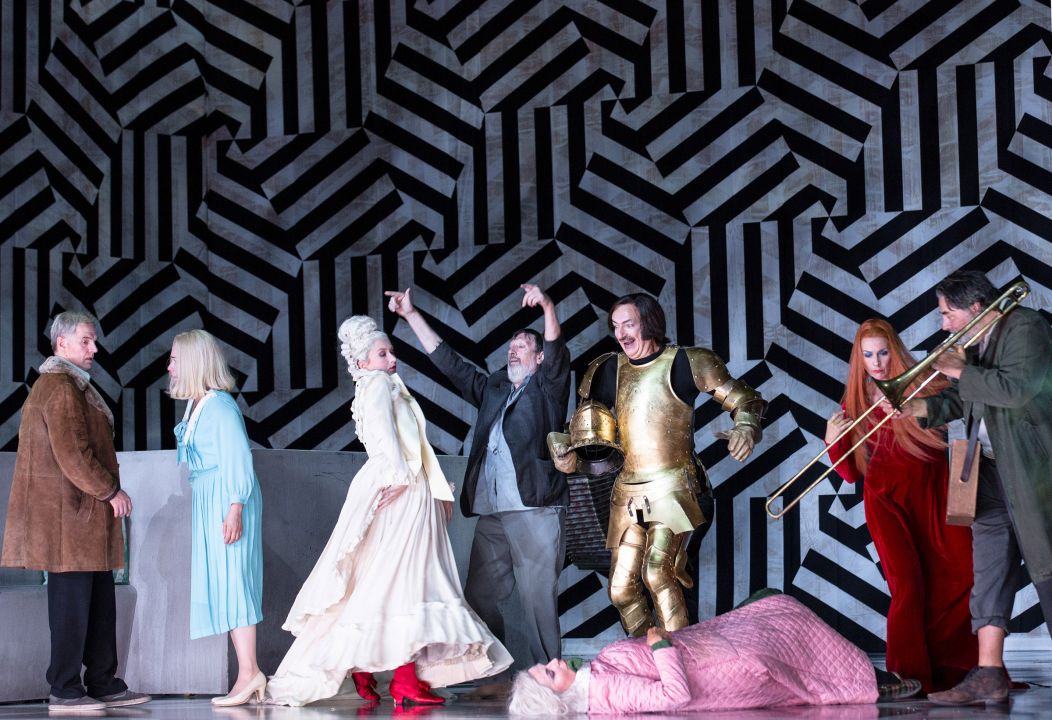
With a wealth of such material already provided by Tchaikovsky for a good director to use purposefully, there is no need then to bring any current conflict - which would certainly have been imminent during rehearsals - into the production. It's enough to perhaps just reference it to avoid any controversy of performing a Russian composer and let the opera deliver its own commentary on it, which it does most powerfully by taking things to their inevitable conclusion. Hermann is afflicted by madness to his 'cause', believing the words of an old woman on a payphone as if they are speaking a secret message to him. It means ruin and death and that is all that is left for Liza too. Dragged to her death by the same delusions of escape that had given her comfort.
Christian Friedländer set designs pitch the production into this ambiguous and divided world, somewhere between brutalism and romantic fantasy. The tenement block is stark enough to capture the romanticised view of the opera's ghost story running up against the harsh reality of ordinary people's lives, the contrasts of riches (or dreams of riches), with the impoverishment of their lives. Using the period, contrasting costumes of the real and the imagined, turning reality into art through the dreams of the secondary characters and chorus, in its own way it creates a visual representation of what opera does when art meets reality.

Conducted by Nathalie Stutzmann it's a strong musical performance, the orchestra delivering the high drama, matching the subtleties of Tchaikovsky's score to the underlying romantic sentiments and mad delusions. The singing performances are also a good fit for the roles, for the attack of the music and the intent of the stage direction. The Russian principals are excellent in this capacity, Dmitry Golovnin as Hermann and Anna Nechaeva as Liza both impassioned in their own ways. Jacques Imbrailo is fine as the Prince as is Anne Sofie von Otter, now at that stage in her career where she has the personality and character to take on the role of the Countess. There is good work also from the supporting roles and the chorus. It's not a classic production but one that is necessarily connected to a view of the times we are living under, a time of madness and a reminder that the only thing we can be sure of is death.
Links: La Monnaie streaming, OperaVision


