Showing posts with label Charlotte Hellekant. Show all posts

Monday, 13 February 2023

Tchaikovsky - The Queen of Spades (Brussels, 2022)


Pyotr Ilyich Tchaikovsky - Pikovaya Dama

La Monnaie-De Munt, Brussels - 2022

Nathalie Stutzmann, David Marton, Dmitry Golovnin, Laurent Naouri, Jacques Imbrailo, Anne Sofie von Otter, Anna Nechaeva, Charlotte Hellekant, Alexander Kravets, Mischa Schelomianski, Maxime Melnik, Justin Hopkins, Mireille Capelle, Emma Posman

OperaVision - 23 September 2022

Although visually it clearly takes place in late Soviet-era USSR, everyone wearing 1970s' costumes in the courtyard exterior and assumed interiors of a Soviet tenement block, it is of course tempting to see something of the current conflict in Ukraine in David Marton's 2022 production of Tchaikovsky's Pikovaya Dama/The Queen of Spades for La Monnaie, the production playing out much at the same time in September 2022 as the Russian invasion was at its height. While the period sets it apart and prevents it from making any ill-fitting and facile commentary on a serious and complex contemporary situation, Tchaikovsky's opera and indeed Pushkin's original ghost story do have something to say about the dangers of myths fuelling nationalistic delusions and war.

That's touched on in the children's chorus of the opening scene which otherwise has apparently little to do with the opera, a scene that would be difficult to imagine playing straight in the current circumstances and an example of how quickly 'innocent' intent can suddenly appear more sinister as times change. With this chorus of schoolboys lining up in a play-acted military march against Russia's enemies, Tchaikovsky could easily be outlawed (and has indeed been in some places) in the current climate where Russian artists and musicians are now viewed with suspicion. Marton however turns this into a more abstract scene, a Russian pianist centre stage, a radio playing the marching song, while a group of mothers listen to the broadcast of their sons with horror for what lies ahead.

It neatly sidesteps any controversy, not that La Monnaie ever work on the basis of playing safe in their productions, but it also sets the tone for what follows. The period and setting emphasise the divide between the rich and the poor, Liza the prize of the Prince that Hermann, hanging out with his chums in the tenement block, gambling, spending his money on black market goods, cannot hope to win. He knows he is a loser, not just in cards but in the game of life, and he feels that despair deeply, in the way that only the tragic figures of Russian literature can. And in a way that only a composer like Tchaikovsky, it his own troubled personal life, can put into music - as demonstrated in Stefan Herheim's 2016 production of this opera.

A creative director can of course delve into many different layers of this work, as Hans Neuenfels also did at Salzburg, using the children's march as a means of emphasising the strict rules of society that Hermann feels he has the right to place himself outside. What gives him the confidence to follow his own path in Marton's production is, like the empowerment of nationalistic exceptionalism expressed in the march, the lie of the myth of the Countess and the three cards that he chooses to believe in. He buys into it, but also buys a gun from a black market dealer to give him a little more power and influence. 

Marton of course doesn't keep it as simple as that and recognises the complexity of Tchaikovsky's music and the fact that art, opera and music have their part to play in exposing or examining the workings of the human mind, and indeed inspiring to go to war. Throughout the opera we see a man writing in a book, a libretto perhaps, and a pianist at the centre of the scene, Marton resisting however the temptation to go down Herheim's use of a Tchaikovsky doppelganger (or many of them, reflecting various sides of the composer). The two come together at the conclusion of the opera to reflect what they have experienced in the preceding episodes.

But art has other means and uses, particularly for ordinary people in the impoverished circumstances depicted in this era and this is also reflected in the setting. While the men are gambling, black market dealing or finding other ways of escape through alcohol, the women are seen looking to escape their surroundings, reading books, gazing into a glass of spirits, trying to catch a radio signal from the outside world. A young girl gazes at a globe, and Polina sings a melancholic song that observes: "What did I find in those enchanting dreams? A grave." Such scenes, as well as Tchaikovsky's pastorale and the arrival of Catherine the Great would feel out of place in this context, a divertissement in the middle of the near-contemporary realism depicted here, but it actually serves as another illusion to keep the peasants dreaming.
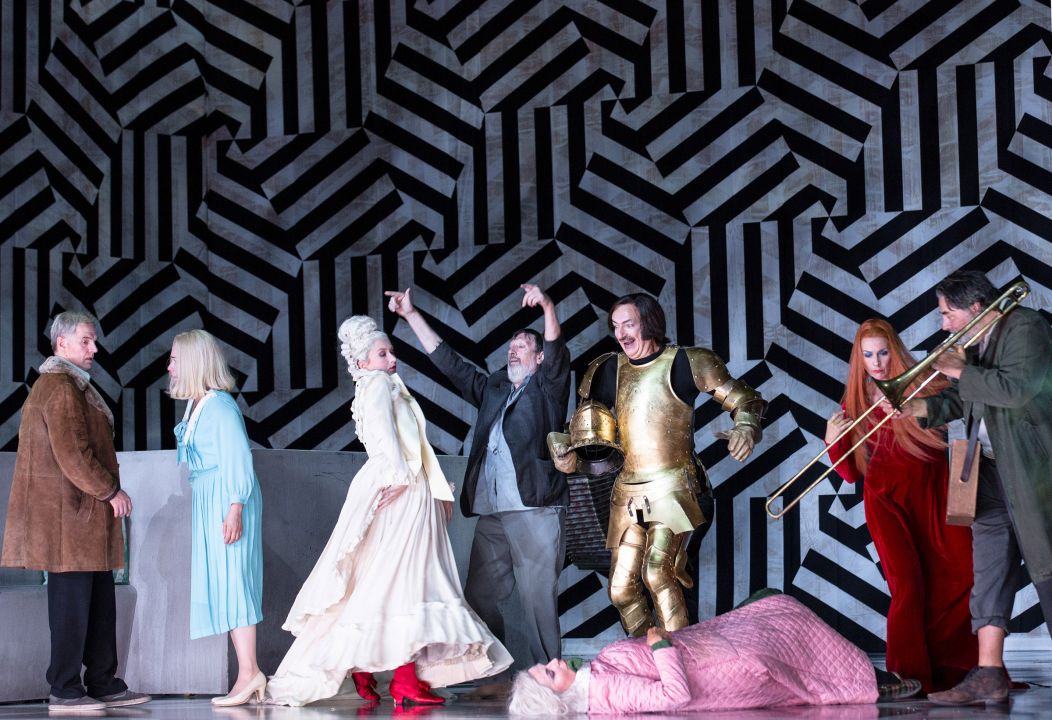
With a wealth of such material already provided by Tchaikovsky for a good director to use purposefully, there is no need then to bring any current conflict - which would certainly have been imminent during rehearsals - into the production. It's enough to perhaps just reference it to avoid any controversy of performing a Russian composer and let the opera deliver its own commentary on it, which it does most powerfully by taking things to their inevitable conclusion. Hermann is afflicted by madness to his 'cause', believing the words of an old woman on a payphone as if they are speaking a secret message to him. It means ruin and death and that is all that is left for Liza too. Dragged to her death by the same delusions of escape that had given her comfort.

Christian Friedländer set designs pitch the production into this ambiguous and divided world, somewhere between brutalism and romantic fantasy. The tenement block is stark enough to capture the romanticised view of the opera's ghost story running up against the harsh reality of ordinary people's lives, the contrasts of riches (or dreams of riches), with the impoverishment of their lives. Using the period, contrasting costumes of the real and the imagined, turning reality into art through the dreams of the secondary characters and chorus, in its own way it creates a visual representation of what opera does when art meets reality.

Conducted by Nathalie Stutzmann it's a strong musical performance, the orchestra delivering the high drama, matching the subtleties of Tchaikovsky's score to the underlying romantic sentiments and mad delusions. The singing performances are also a good fit for the roles, for the attack of the music and the intent of the stage direction. The Russian principals are excellent in this capacity, Dmitry Golovnin as Hermann and Anna Nechaeva as Liza both impassioned in their own ways. Jacques Imbrailo is fine as the Prince as is Anne Sofie von Otter, now at that stage in her career where she has the personality and character to take on the role of the Countess. There is good work also from the supporting roles and the chorus. It's not a classic production but one that is necessarily connected to a view of the times we are living under, a time of madness and a reminder that the only thing we can be sure of is death.


Links: La Monnaie streaming, OperaVision

Monday, 5 June 2017

Hosokawa - Matsukaze (Brussels, 2017)


Toshio Hosokawa - Matsukaze

La Monnaie-De Munt, Brussels - 2017

Bassem Akiki, Sasha Waltz, Barbara Hannigan, Charlotte Hellekant, Frode Olsen, Kai-Uwe Fahnert

ARTE Concert - March 2017

Using music as a means of bringing out or fusing the drama with another more spiritual dimension is I imagine is something that most opera composers attempt to do, but based on the few works that I've heard from him, it seems to me that Toshio Hosokawa manages to do this rather better than most contemporary composers. It's perhaps because Hosokawa shares an affinity with traditional Japanese Nôh drama, an aspect that was alluded to in Hosokawa's most recent opera, Stilles Meer, but which is even more apparent in direct adaptation in his earlier 2011 opera Matsukaze.

Still, it's not easy to translate expression of the stylised movements and gestures from Nôh to the western form of lyric drama, and it usually requires other techniques and instruments to bring out a sense of the other. Adapting two Nôh dramas in her 2016 opera Only The Sound Remains, for example, Kaija Saariaho made effective use of the otherworldly sounds of the Finnish kantele harp. Hosokawa often uses recordings of sounds of wind, rain and waves as well as other instruments to evoke nature, but he also makes effective use of other Nôh elements not commonly used in opera to such an extent: movement and dance.

And to that end, Hosokawa has dance choreographer Sasha Waltz as an effective collaborator and in La Monnaie an opera company willing to explore such new collaborations and extend the range modern opera by commissioning such experimental works. Musically, theatrically, dramatically, in terms of performance and yes perhaps even spiritually, Matsukaze is one of the most successful new productions of contemporary opera and its 2011 production revived here for La Monnaie's 2016-17 season demonstrates this beyond any question.


As with Stilles Meer, Hosokawa takes time to establish a sense of mood and place that is outside of the common experience and the common opera tradition. To the sound of wind through trees and the distant sound of the sea, grey and white clad figures spin, swirl, roll and interweave like crashing waves, crosswinds or perhaps invisible spirits. Into this space walks a priest (Frode Olsen), again singing in a manner not typical of the western tradition, but more like a ritual chant or prayer. Hosokawa paints the scene of this introduction with a flurry of percussion, shimmering strings and whispering flutes that gasp and blow.

In an adaptation of the original 14th century Nôh drama, Matsukaze relates the story of two women, Matsukaze (Wind in the Pines) and her sister Marasame (Autumn Rain), whose names the priest sees carved in a memorial on a pine tree. In a dream, the ghosts of the sisters tell their tale, how they became the lovers of Yukihara, a courtier exiled to Suma for three years. Soon after his departure, the women learned of his death and died from grief. Unable to let go of their earthly longing however, they are condemned to remain tied to the world of mortals.

Although the question of abandoning earthly attachments in order to pass over to another state of is an important aspect of the Buddhist doctrine, there doesn't appear to be any deeper message or moral to be drawn from Matsukaze than this. As in the original Nôh drama however, the true meaning or value of the work is in the ritual and the expression of the drama in performance, and it's here that Hosokawa's music conducted by Bassem Akiki, its use of sounds and silence, the dance moves of Sasha Waltz and the set designs of Pia Maier Schriever and Chiharu Shiota all create an effective environment for Barbara Hannigan and Charlotte Hellekant to struggle to cast off those powerful human emotions.

The darkened stage following the priest's discovery of the memorial to the women related to him by a fisherman, opens up (to the rippling of a stream) to reveal a webbed background of black threads, representing the seaweed that the women gathered, as well as a barrier that separates the spirit world from the world of mortals (not unlike the curtains and barriers in Peter Sellars' production of Saariaho's Only the Sound Remains). Scurrying high up in the tangle of the netting are Matsukaze and Marasame, who descend - their white robes turning to black robes - to re-enact the story of their own entanglement with Yukihara in the mortal domain that they have not yet escaped.


The production, like the original Nôh drama, uses a variety of means to relate the story and find other ways to delve beneath the surface and represent the less tangible emotions that are in conflict. Much of that in the opera is taken up by the dancers, some of whose movements and roles are somewhat abstract and difficult to define. One figure with his upper face and eyes masked could be 'blind desire'. The use of props are limited, but a hat left behind by Yukihara is used as a representation of Matsukaze's emotional attachment to the material world, which is also represented in the latter part of the production as a large boxed frame. Within and without this the dancers also shift and gather to form the pine tree that is a representation of Matsukaze's love. Her sister Marasame is able to resist being wound up into the tree and consequently succeeds in eventually passing over to the other side.

The role of the singers then is somewhat unusual as in addition to the considerable singing challenges and differences that define the two sisters, Barbara Hannigan and Charlotte Hellekant also have to move, interact and dance with these abstractions, fluidly moving from one state to another. Hosokawa's score, conducted by Bassem Akiki, also works fluidly with Sasha Waltz's choreography to give the simple tale of Matsukaze's fate a sense of momentum and urgency. Matsukaze's ghost would appear to be doomed to remain unable to depart entirely from the physical plane, but Hosokawa and Waltz suggest a more peaceful if unclear resolution as an older woman, dressed in white, moves slowly across the stage as all the other elements fall away into a silence broken only by the rippling of water.

Links: La Monnaie-De Munt

Tuesday, 10 January 2017

Strauss - Capriccio (La Monnaie, 2016)


Richard Strauss - Capriccio

La Monnaie-De Munt, Brussels - 2016

Lothar Koenigs, David Marton, Sally Matthews, Dietrich Henschel, Edgaras Montvidas, Lauri Vasar, Kristinn Sigmundsson, Charlotte Hellekant, François Piolino, Elena Galitskaya, Dmirty Ivanchey, Christian Oldenburg

ARTE Concert - November 2016


"Primo le parole, dopo la musica" or is it vice-versa? There's obviously no definitive answer to the question of whether the words or the music are more important in opera. Even precedence is very much down to the practicalities and working methods of the creators and dependant upon the individual preferences of the listener. So on paper at least an opera about a composer and a poet, Flamand and Olivier, debating the subject with a Countess at a private concert soirée doesn't hold out much promise as a rivetting subject for an opera. And yet, Capriccio itself is a work of art that proves that opera can transcend such debates and distinctions.

There's a lot of truth then in what the boorish theatre director La Roche says; on paper both words and score are lifeless. It's a stage production that puts flesh and blood into an opera, that allows it to live and breathe, to reach out and touch the heart of an audience. Of course, even that distinction is academic if the work itself isn't of sufficient quality, insight and humanity, but Strauss's abilities and his work within opera are among the highest the artform has ever seen. Capriccio, his final work, might sound trivial and self-regarding, but it's a fitting testament that still has something important to say on the nature of people and the important role music and art plays in their lives.

Capriccio is indeed a masterpiece from a great composer but, in the spirit of the work itself, even Richard Strauss wouldn't be the opera genius he is without the collaboration of some great writers. His finest works are unquestionably those written by Hugo von Hofmannsthal, but Stefan Zweig and Joseph Gregor clearly also contributed the ideas and texts that would inspire Strauss to greatness in Capriccio. The writers are important, but so too presumably is the audience those works were written for and the artists who would perform them. And life itself. The genius of Capriccio is that it is there in this exquisite little work which might seem frivilous, but in reality touches on some fundamental questions about art and its relation to life.


So it is always a risk, but it would be a bit of a crime if a production of Capriccio only managed to come over as trivial and self-important. The words and the music are not enough - although they are a great place to start and Lothar Koenigs certainly brings out the luminous beauty of the orchestral colours - but Capriccio does need attention paid to its characters and their personalities, and that rests on the ability of the director and the performers to bring it to life. Fortunately that's handled very well indeed in David Marton's direction of the work for La Monnaie, and it's also very evident in the singing, with Sally Matthews in particular finding all the beauty and anguish of life in the words and music written for the Countess.

Marton's production does well to strike a balance between the intimacy of the work (that has a basis in the small chamber orchestra performance that opens the opera) and its expansiveness that takes in all the sentiments that the work touches on in passing. There's no avoiding the self-referential nature of the work (which is an opera about a group of people discussing opera and making an opera about themselves discussing opera), so it's not surprising that the set consists of a stage on the stage in a side view of a theatre. A small private theatre obviously that explores the inner workings of the human heart and human interaction as much as it does the craft that goes into writing, directing and performing a piece of music theatre.

It's not just a tussle for artistic recognition and it's not even a tussle between two men trying to seek the affections the Countess; there are other parties involved that have a role to play, however small it might seem. It's not always easy to work out who each of them are at first, or where they are coming from, but Strauss gives them all consideration and blends them into the little world of Capriccio's complications. The prompter, for example, might not seem to be all that vital a role, but without him, the whole enterprise might indeed fail. The Major-domo, the Haushofmeister, also looks on here, clearly in love with the Countess. He might be vital to the smooth running of the household, but he knows he can never be a solution to the conflicts in her heart.

This master/servant role as a metaphor for the impossibility of the mastery of the heart is a device that has been used for a similar effect between the Marschallin and her servant in some productions of Der Rosenkavalier. It's possible to see Madeline, the Countess of Capriccio, as an extension of the thoughts and sentiments that plagued Marschallin, a recap if you like to summarise such themes in this comprehensive work. Marten also uses the young dancer here, showing her in three ages from child to young woman to old lady, to touch on those considerations of the passing of time as it applies to the hard choices that the Countess has to make. Ostensibly that's about how she wants the opera to end, but also evidently it's about where she wants her life to go, knowing that the decisions she makes now will determine the rest of her life.


The successful direction of Capriccio is all about bringing out such undercurrents. What takes place on the surface of Capriccio, in all the discussions of art and opera, is just a metaphor for life. It's what goes on beneath that is just as important; the personalities and the interpretation of them. It would be a shame to miss out on the applying some personality to the richness of the sumptuous music that Strauss has composed for even the most seemingly minor of characters, but it doesn't mean that there have to be any big revelations or deep psychological underpinning. The big things are already there and Marten and the performers concentrate on the little moments and the finer detail.

There is always the danger of the Countess appearing detached, too caught up in the technicalities of the musical debate and her personal love dilemma. Sally Matthews isn't the most expressive actress but her singing is beautiful here, carrying the essential warmth of the Countess and a wider sense of her conflict as being one that applies to life in general. It helps that the other roles are also well defined and sung, with Edgaras Montvidas in particular wonderfully lyrical and charming as Flamand, and Lauri Vasar posing a credible threat as his rival Olivier. Kristinn Sigmundsson is a fine La Roche. I still find it hard to really grasp what the role of the Count brings to the opera, but Dietrich Henschel sings it well alongside Charlotte Hellekant's Clarion. All the performances really count here however in contributing to the rich fabric of the work.


Links: La Monnaie, ARTE Concert

Monday, 26 May 2014

Boesmans - Au Monde (La Monnaie, 2014 - Webcast)


Philippe Boesmans - Au Monde

La Monnaie - De Munt, Brussels 2014

Joël Pommerat, Patrick Davin, Frode Olsen, Werner Van Mechelen, Stéphane Degout, Charlotte Hellekant, Patricia Petibon, Fflur Wyn, Yann Beuron, Ruth Olaizola

La Monnaie, ARTE Concert - Internet Streaming, April 2014

La Monnaie's bringing together of composer Philippe Boesmans and playwright Joël Pommerat for a newly commissioned opera is an intriguing one and in many ways, for better or worse, Au Monde lives up to whatever expectations one might have of both of the Belgian creators. That's not to say that the result is entirely predictable. There's no doubt that there is a true collaboration here that manages to draw something new and unexpected out of both contributors.

Musically, Au Monde is quite different from the serialism of Reigen, my only previous encounter with Boesmans, but the Belgian composer has clearly worked in a variety of styles in opera with adaptations of Shakespeare (Wintermärchen) and Strindberg (Julie), as well as reinterpreting Monteverdi's L'Incoronazione di Poppea (La Passion de Gilles). For his part Joël Pommerat previously collaborated with Oscar Bianchi on an adaptation of his play 'Grace a mes yeux' (Thanks to My Eyes), a work that shared characteristics with Maeterlinck and Debussy. There's a lot of room here then for both creators to find and share common ground in Au Monde.


It's clear that Au Monde comes from the same source as Thanks to my Eyes, the work not so much a straightforward drama or character piece as an exploration of archetypal family figures in conflict with themselves and in a state of suspended tension with one another. If Boesmans' music is more melodic and lyrical here, it's more closely related to the particular colours, sonorities of the characters and the rhythms of the dialogues and relationships between them in a way that - particularly in the intonations of the French language - can't help but remind one of Pelléas et Mélisande.

Much as it should, the music and singing voices undoubtedly contribute to filling out the characters and the relationships between them. Or, if the figures and their personalities remain rather difficult to determine, the music at least adds another dimension in place of any recognisable narrative. It's certainly easy to see however that there are tensions between them and where those tensions are coming from. Much of it centres on Ori, the son, and the only one with an actual name in Au Monde.


Ori has just quit a successful career in the military and none of the family know why. He says he needs a period of reflection and has even written a book, but no-one seems particularly interested in reading it. His father is stepping down as the head of the family's successful steel industry business and, with the agreement of the elder son, has Ori in mind to take over the running of affairs. Ori is hesitant about the matter, but there is perhaps something else on his mind...


...like murder? That's where it all gets a little stranger in Au Monde and difficult to define. Three women have recently been murdered in the town. There haven't been any such murders in a while now, but the new murders coincide with Ori's return. It might not be that simple though. Each of the three sisters of the family also have issues. The elder sister is seems to have a never-ending pregnancy and her husband has brought in a foreign woman to care for her needs; the second sister is an actress who can't bear to watch herself on the TV; the youngest sister, who is celebrating her birthday, is actually a lookalike replacement for a daughter who disappeared (called Phèdre), and she inevitably has some identity problems.

Pommerat cites Chekhov's 'Three Sisters' as a reference and notes that the name Ori comes from Orestes, but clearly the family references are a little more complex than that with Racine's 'Phaedra' mentioned and there's perhaps something of 'King Lear' in there as well. Comparisons to Debussy's and Maeterlinck's Pelléas et Mélisande are unavoidable, and a few other more modern surrealist references suggest David Lynch territory. Much of the strangeness, in this respect, seems to derive from the actress second sister, such as the foreign woman singing 'My Way' in a man's voice at certain points (these are noted in the libretto as being "perhaps a dream of the second daughter"). Whether Ori is involved in the murder is very much left open, like much else in this strange mix of genre and artiness.

The transition from theatre to opera undoubtedly involved some cutting back of Pommerat's original work, but this open air of vagueness and mystery is very much a part of the work. It's certainly heightened by Boesmans' score and by the breaking up of the work into 20 short elliptical scenes that seem to hold the characters in a permanent state of suspension or tension with one another. None of this ever seems to amount to anything meaningful than the characters walking around making ominous statements about their position, despite the attempt to insert some murder-mystery into the proceedings and despite the undoubted beauty of Boesmans' musical score.


The writing for the voice too is wonderful and there's an exceptionally strong cast here at La Monnaie to interpret it. Working from an existing play, there is a certain amount of recitative in the dialogue, but Boesmans has managed to fit the voice types well, and not just according to the traditional types for family roles. If the elder sister is an aloof and distant contralto (Charlotte Hellekant - very fine), the drama queen middle sister (Patricia Petibon) is a diva coloratura and the younger sister a high-end soprano (Fflur Wyn). The Second Sister and her character directs most of the drama and mystery, and Petibon is superb in her tecnhique, control and interpretation. Ori is also an mportant figure, albeit with less to sing, but it still needs a French baritone of personality and ability and Stéphane Degout has that.

It's probably not much of a surprise that Pommerat's stage direction tends to be rather straightforwardly theatrical. There's not a great deal of consideration given to the sets, but the long beam of light in the darkness of the rooms and the huis clos atmosphere does suggest an open door to an outside world (au monde) that the characters are fearful or unwilling to move towards. The cold, detached elegance of the characters is perfectly captured however in the lighting and the costumes. Much like Thanks to my Eyes, this all casts an appropriate atmosphere, and it's one into which Patrick Davin weaves the haunting Wagnerian emotional sweep and the intricate Debussian touches of Boesmans' score most effectively.

Links: La Monnaie, ARTE Concert