Showing posts with label Barbara Hannigan. Show all posts

Thursday, 2 January 2020

Abrahamsen - The Snow Queen (Munich, 2019)


Hans Abrahamsen - The Snow Queen (Munich, 2019)

Bayerische Staatsoper, 2019

Cornelius Meister, Andreas Kriegenburg, Barbara Hannigan, Rachael Wilson, Katarina Dalayman, Peter Rose, Caroline Wettergreen, Dean Power, Kevin Conners, Owen Willetts, Thomas Gräßle

Staatsoper.TV - 28 December 2019

There would appear to be two significant works in Hans Abrahamsen's recent output that have led to the creation of his first opera The Snow Queen, and they also give some advance indication of how the work would sound. One is the musical meditation on the qualities, properties, texture and character of snow, Schnee, the other is the popular success of Abrahamsen's Ophelia song-cycle Let Me Tell You, with Barbara Hannigan adding her light, agile soprano to the composer's delicate compositions and arrangements.

Those two major works are interconnected within the narrative of Hans Christian Andersen's fairy tale The Snow Queen. Like all fairy tales, there is a darker edge that lies beneath the surface which has been softened over time and narration and director Andreas Kriegenburg isn't wrong in detecting an undercurrent of what we would now recognise as mental illness in the story, one exacerbated by a sense of loss and loneliness. Unfortunately, the libretto for the work remains superficial and never delves into the depths that Abrahamsen and Kriegenburg attempt to explore in the music in the new
Bavarian State Opera production of this English language version of the opera following Snedronningen's premiere in Denmark in October 2019.


Essentially the narrative of The Snow Queen involves Gerda (Barbara Hannigan) trying to rescue her brother Kay from the clutches of the Snow Queen. Their grandmother has related a story of a magic mirror created by the devil that makes beautiful things appear ugly. The mirror has shattered into thousands of pieces and shards have pierced the eye and heart of Kay, who now longer recognises the beauty in the world and has fallen into a deep depression or despair.

While still seeking to retain some of the qualities of this inner snow world that combines beauty with coldness and bleakness of winter, Kriegenburg also expresses the fairy-tale world in terms of mental illness, Kay not literally abducted by the Snow Queen, but seemingly institutionalised. His sister Gerda is not far off a state of mental instability herself. She wants to help Kay find himself and does so through a kind of dream fantasy, encountering an old woman in a garden where the nurses have faces of flowers (and later reappear as angels), as well as a Castle Crow and a Forest Crow who lead her to the Ice Palace of the Snow Queen.
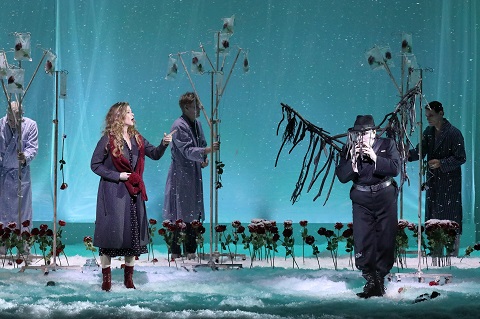


In theory, Kriegenberg's approach should be a good way of making the nature of mental illness relatable at the same time as fulfilling what appears to be a Bayerische Staatsoper tradition of finding/creating seasonal works beyond the ever popular Hansel and Gretel. In reality it never seems to weave a magical spell of enchantment, and in large part it's because the libretto really never lives up to the mood or emotional undercurrents of chilly despair that is certainly there in Abrahamsen's delicate complex flurries of music. The libretto is mostly based around Gerda's repetitive search for Kay - 'Where is Kay? I have to find Kay', even though he is physically present in the not terribly original setting of a mental institution with nurses and patients taking the roles of fairy tale characters.

The libretto moreover is very wordy without ever saying anything meaningful, the English parlando never particularly musical or scanning well to fit with the musical arrangements. It does develop into a flow, and there are some beautiful passages notably around the end of Act II before the interval, with a combined trio of Gerda, the King and Queen backed by a chorus. Unable to draw any deeper meaning out of the libretto, or express it through the production design. Barbara Hannigan is of course as impressive as ever and bass Peter Rose an interesting choice for the voice of the Snow Queen, but it all comes across as very pretty and not much else.


Harald B. Thor's sets combine and highlight the disparity between the fantasy with the real-world well enough, using simple plastic sheet backdrops that have an icy appearance, with shredded plastic giving an impression of light, fluffy snow, creating an artificial winter world that also captures a sense of the austere cold world of the mind in isolation. The use of costumes also makes the narrative easy to follow who are doubles and younger versions of Gerda and Kay, but neither Hannigan's expression, Cornelius Meister's conducting nor Kriegenburg's conception are able to bring any real sense of drama to this beautiful but rather lifeless production.

Links: Bayerische Staatsoper, Staatsoper TV Opera Live

Monday, 28 January 2019

Benjamin - Lessons in Love and Violence (London, 2018)

George Benjamin - Lessons in Love and Violence

Royal Opera House, 2018

George Benjamin, Katie Mitchell, Stéphane Degout, Barbara Hannigan, Gyula Orendt, Peter Hoare, Samuel Boden, Jennifer France, Krisztina Szabó, Andri Björn Róbertsson

Opus Arte - Blu-ray

It's rare for a contemporary opera to quickly become a critical and popular success, although undoubtedly the legacy of Written on Skin will be determined over a longer period, but even as the earlier opera still runs and is given new productions worldwide, the pressure on George Benjamin and Martin Crimp to follow it up must have been considerable. I think it's fair to say that the response towards Lessons in Love and Violence has been cautiously positive, but I suspect its qualities will be more fully recognised in the longer term and it may even stand the test of time as another deeply thoughtful work from what is looking to be a formidable creative team.

Deeply thoughtful and considered however can work both ways, and there remains a slight coldness and calculation about the work in its Royal Opera House world premiere. Whether that's down to overworking the finer details of the structure and composition of the work on the part of Benjamin and Crimp, or whether Katie Mitchell's production doesn't do enough to breathe life into the work is a matter of interpretation, but what comes across with repeated viewing (as it did with Written on Skin) is that what initially might have felt like clinical academic coldness is actually a careful refinement of all the elements that are necessary to strip the work down to its bare essentials.


There's life to be put on old bones (which was also essentially the underlying theme of Written on Skin, opera capable of breathing life into an old historical tale like an illuminated manuscript), and in the case of Lessons in Love and Violence, it's Marlowe's Edward II that serves as the source for Martin Crimp. Lessons in Love and Violence is based on the situation (and violence) that ensues when the king's military advisor Mortimer takes offense at the favour and influence that Edward II's lover Gaveston has over the king, causing a scandal that leaves the queen Isabel in an awkward position and the nation's affairs being neglected as it slips into instability and war.

With numerous interviews in the official programme (reproduced in the DVD booklet) and YouTube videos explaining and detailing the process, there may have been too much talk done around the work, too much attention given to the back and forth labouring over structure and presentation and not enough opportunity to let the work itself breathe. Ultimately however, it's in performance that the quality of the work comes alive, although even there the intense 80 minutes without an interval really didn't give you time to breathe or take in much beyond the opera's considerable impact. The opportunity to view Lessons in Love and Violence again on its Blu-ray and DVD release shows however that its qualities are still very much in evidence and the work can certainly speak for itself on its own musical and dramatic terms.

Whether you are aware of the working methods behind the scenes or not, the resultant compactness and concision of Marlowe's drama (even though the opera uses almost nothing of the actual text of Edward II) is plainly evident in the fact that it demands the utmost attention from beginning to end for how the music and the drama operate, intersect and interact. If it reminds you at times of Pelléas et Mélisande, Wozzeck or The Turn of the Screw, it's because Lessons in Love and Violence has the same close connection between its charged drama and the psychological complexity underpinning it that is heightened by the musical and dramatic presentation.


George Benjamin's musical language might be initially difficult - there's no easy melodic line to follow, but rather fragmentary jabs, feints and punches - but the undeniable power and dramatic rightness of the music should be plainly evident. It's not just descriptive underscoring, but music that seeks to get inside the characters and the drama, filling it out, going beyond mere representation to a fuller expression of all the sentiments of love, conflict and violence on display. Whether you are able to keep up with it or not, by the time you arrive at the final sudden fall of the curtain, you will certainly feel emotionally drained from the charged and exhilarating situations that have just taken place. It needs to be followed through in that way, an intense run through of emotions in juxtaposition with one another, without an interval or pause for breath.

Lessons in Love and Violence is cinematic in that respect, achieving its impact more through the language of montage and editing than the typical stop-start operatic structures of arias, duets and choral arrangements (and accordingly, it's given a cinematic widescreen presentation here on its video recording). The work follows its own narrative drive and Katie Mitchell's production reflects that, ensuring that every single scene is pushed to its limits of expression, but even employing slow-motion effects (as with Written on Skin) when deemed necessary. Everything takes place in a single bedroom - modern opulence rather than medieval royal - that is presented from various angles, as is the drama in its reflection of perspective from each of its characters.

The performances of the cast are exceptional. French baritone Stéphane Degout sounds better than ever as the King (he's never mentioned by title as Edward II), bringing a wonderful soaring lyricism to the complexity of his relationships with Queen, lover, court and country. Barbara Hannigan brings a steely edge to Isabel, delivering barbed inflections to the text that rise to shrill heights of imperiousness and ruthlessness. Peter Hoare is terrific as Mortimer and Samuel Boden impressively assertive as he takes command later in the opera. Mitchell's production also takes account of the fact that there are other undercurrents implied and perpetuated by the 'Lessons' in the title with the presence of the king's young son and daughter visible throughout, even in the short filmed instrumental interludes between scenes.


All of this comes together in a way that is rare in opera outside of Pelléas et Mélisande, Wozzeck and The Turn of the Screw, and Lessons in Love and Violence stands up to being measured alongside those masterpieces. It's impossible not to feel the emotional depth and intensity of the work, how it deals with those traditionally operatic big themes, but in a new and vital way. While the sheer impact is undeniable, the richness of the work's construction and musical features are also likely to become more evident with repeated views and listening. As an extension and development upon their collaboration on Written on Skin, Lessons in Love and Violence will surely endure as another important work of modern opera from this creative team.

Released on Blu-ray, Lessons in Love and Violence comes across just as powerfully on screen as it did in live performance. The High Resolution LPCM and DTS HD-Master Audio 5.1 tracks permit the detail and rich textures of the music, conducted by George Benjamin himself, to be fully experienced. The video transfer and editing is superb, presenting the 'film' in 'Cinemascope' widescreen, harnessing all the power of the direction and the effectiveness of Vicki Mortimer's production design, the camerawork also revealing the quality of the dramatic performances of the impressive exceptional cast. There's a short 5-minute 'Introduction' to the opera and a Cast Gallery in the extras, and Oliver Mears interviews Benjamin and Crimp in the enclosed booklet.

Links: Royal Opera House

Thursday, 7 June 2018

Benjamin - Lessons in Love and Violence (London, 2018)


George Benjamin - Lessons in Love and Violence 

Royal Opera House - London, 2018

George Benjamin, Katie Mitchell, Stéphane Degout, Barbara Hannigan, Gyula Orendt, Peter Hoare, Samuel Boden, Jennifer France, Krisztina Szabó, Andri Björn Róbertsson

Royal Opera House, Covent Garden - 26 May 2018 

I think it's fair to say that George Benjamin and Martin Crimp have paid more attention to the structure than the plot of their latest opera, and judging by the interviews with both of them in the Royal Opera House programme for its world premiere they'd probably be the first to admit it. That's not to say that there is anything wrong with that in an opera where the abstraction of music and its construction have an important part to play in addition to the dramatic narrative. As it happens however, Lessons in Love and Violence is not only brilliantly structured, it also seem to achieve exactly what it sets out to achieve, and perhaps more than you might expect from the title.

Maybe that kind of tight focus without any unnecessary over-elaboration is all we need in a situation, and certainly Benjamin's previous collaboration with playwright Martin Crimp, Written on Skin, is just as tightly and effectively delineated. But there might also be something more that we can derive from the artistry of the composer's musical interpretation of the text, from Katie Mitchell's direction and from the singing performances themselves. Certainly every element of the work has had the utmost attention, thought, precision and talent applied to its component parts, and in the combination of them raise the work to much more than the sum of them.


The lesson in love and violence that Benjamin and Crimp (and Mitchell and Degout and Hannigan et al) give us - or rather the lesson that they show us being passed on from one generation to the next - is thematically similar to Written on Skin and likewise based on a historical event and an old text, but reflected to some extent through a modern-day perspective. Drawn from, or perhaps more inspired by Marlowe's play 'Edward II', Lessons in Love and Violence is based on the situation (and violence) that ensues when the king's military advisor Mortimer takes offense at the favour and influence that Edward II's lover Gaveston has over the king, over the position it leaves the queen Isabel in, for the scandal it is causing and the harm that is doing to a nation slipping into instability and civil war.

Divided into seven scenes, running to only 90 minutes without an interval, the drama and phrasing of the dialogue is certainly mannered and not particularly naturalistic, but the focus is more on mood than exposition, on the accumulation of slights and conflicts, on personality and behaviour, all of it leading from love to acts of cruelty and barbarism. Watching its delivery and trajectory, it's easy to think that the work is rather laboured in terms of being meticulously thought out and almost, some might say, too academic an exercise in putting a situational drama to music. That might be the case but for the fact that in performance it really doesn't show.

All you see is a drama of remarkable concision in its concentration of musical and dramatic forces towards those essential themes, the work breathing sensual fire and menace. Crimp's phrasing is intense, direct and unadorned, repeating phrases, overlapping dialogues. Benjamin's score matches the fluctuations of mood and dynamic, dreamily sensual one moment, slow and sinister the next, harsh and dissonant the next. Combined they provide not so much a history lesson as a lesson in how love is viewed as weakness and how violence permits one to achieve personal and political ends. The lesson is well learned by the young king who observes the machinations of Mortimer and Isabel, and the result is that the violence is turned back on them. At the same time however, the underlying story, character and personalities revealed by the music, the direction and the singing ensure that this is never purely considered in an abstract or academic manner but closely related to human emotions and behaviours which can then be applied in a wider context.


Which is what Katie Mitchell's contribution brings to the work in collaboration with set and costume designer Vicki Mortimer, using some of their familiar traits. The setting is relatively modern-day, removing the subject from being tied to a historical period drama. The characters sometimes move in slow motion to enhance action or freeze the surrounding drama to bring focus to the singer, but the mood and rhythms are always fully attuned to the score and the text. There is also not unexpectedly a strong feminist vision the Mitchell brings to the work that is not necessarily explicit in the drama. Although it's the king's young son who brings to an end (or perpetuates) the cycle of violence at the conclusion of the opera with the execution of Mortimer, it's his young sister (a non-singing role) who wields the gun here - a turn of events that puts you in mind of Mitchell's work on the Purcell derived opera Miranda.

Hand-picked for the roles, the cast is simply superb and it's really hard to imagine any better singers fulfilling the roles, complementing each other and striking exciting contrasts. Singing impeccably in English, the French baritone Stéphane Degout sounds better than ever as the King (he's never mentioned by title as Edward II), striking out away from being the go-to Pelléas, but still bringing a wonderful soaring lyricism to another role that flirts with the danger in his relationship with Gyula Orendt's Gaveston. Barbara Hannigan has also recently sang in Pelléas et Mélisande, but there's a rather more steely edge to her character as the queen Isabel, delivering barbed inflections to the text that rise of course to shrill heights of imperiousness and ruthlessness. Peter Hoare is terrific as Mortimer, and Samuel Boden impressively assertive as he takes command later in the opera.

I mention Pelléas et Mélisande because it did come to mind now and again watching Lessons in Love and Violence. Not that it sounds at all like Debussy's masterpiece, but it is similarly structured into distinct intense dream-like scenes with quite beautiful instrumental passages between them. There's a darker outlook here however that is also reminiscent of Berg's Wozzeck, another precisely controlled and intense work. Benjamin however very much has his own voice, and it's one that clearly works tremendously well in collaboration with Martin Crimp. Their previous work Written in Skin was deservedly hailed as a modern masterpiece soon after its initial run and Lessons in Love and Violence is every bit its equal, on an initial viewing perhaps an even more brilliant a work in its concept and execution.


Links: Royal Opera House

Monday, 14 August 2017

Dean - Hamlet (Glyndebourne, 2017)


Brett Dean - Hamlet

Glyndebourne 2017

Neil Armfield, Vladimir Jurowski, Allan Clayton, Barbara Hannigan, Sarah Connolly, Rod Gilfry, John Tomlinson, Kim Begley, David Butt Philip, Jacques Imbrailo, Rupert Enticknap, Christopher Lowrey

Medici - 6th July 2017

The creation of a new opera based on 'Hamlet' is no minor event in the opera calendar and with all eyes on Glyndebourne and a streamed live performance of the new works, there must be considerable pressure to do this Shakespeare work right and make an impact. All credit to the creators and performers involved then, since Brett Dean's Hamlet proves to be a not only a very good adaptation of Shakespeare but a strong operatic drama in its own right.

The challenge with making an opera out of 'Hamlet' would I imagine be much the same as any other many attempts to adapt Shakespeare, only more so. It involves keeping the essence and tone of the work intact, while having to make drastic cuts, and 'Hamlet' is one of Shakespeare's longest, most complex and surely difficult plays to work with, involving such difficult choices even for the dramatic stage.

As with Ambroise Thomas's Hamlet, it's essential to keep key scenes and speeches, but that alone is not enough - certainly not in the case of Thomas. Brett Dean and his librettist Matthew Jocelyn however have one major advantage over most other opera adaptations of Shakespeare in that they can retain much of the original English text and the rich poetry of the original. Dean's Hamlet then is not exactly word-for-word, but often close to the original, paying particularly attention to the delivery of the play's most famous and important lines.


The other critical factor in making it work as a dramatic piece which can't be underestimated (and again something that applies equally to any performance of the stage play), is finding capable performers with the ability to breathe life and personality into the characters. With an extraordinarily strong cast that includes Allan Clayton, Barbara HanniganRod Gilfry, Sarah Connolly and John Tomlinson, Glyndebourne's world premiere performances certainly have the strongest assembly of singers possible for these roles.

Allan Clayton gives it everything as Hamlet, but crucially finds that essential need to make the Prince's wilful madness sympathetic and not just morbidly obsessive or a raging madman. To do that, you also have to make Claudius and Gertrude convincing and - critically - establish those connections and contrasts of outlook in their interaction. This is something that is brought out not only through the medium of Ophelia (played with agonising sincerity and determination by the outstanding Barbara Hannigan who brings the mad scene back into modern opera in a spectacular fashion) and her father Polonious, but also by the supporting characters (in the fullest sense of supporting and character) by Horatio, by Laertes and even by Rosencrantz and Guildenstern.

Essentially then, there are no 'supporting characters' as such, as its the interaction between them all that creates a complex situation of conflicting purposes and personalities. And the Glyndebourne casts it as such with Rod Gilfry and Sarah Connolly stamping their personality all over Claudius and Gertrud with tremendous singing performances, but also with the likes of Jacques Imbrailo singing Horatio, Kim Begley as Polonious and John Tomlinson singing the ghost of Hamlet's father, one of the players and the gravedigger. All of these figures could easily be side-lined by the need to cut and condense, but it's to the credit of the opera that there is recognition that they are not just there to provide colour, but have a vital dramatic role to play in the work.

The question remains however whether Shakespeare gains anything from being adapted to the opera stage, and perhaps it never really does. The real question however is whether - again like any stage production of the play - it serves the work and can bring a certain character of its own to bear on a great work. Musically, Dean's music rarely calls attention to itself, and certainly doesn't over-assert itself over the inherent force of the drama and the language, but rather it controls mood and pacing, hinting at deeper tensions and stirring trouble, bringing some dramatic emphasis where necessary. It does well in the manner that the music and repetition can highlight certain words and phrases, overlaying them in a way that traditional theatre cannot to bring opposing views into even starker contrast.


Brett Dean's Hamlet can then be quite difficult to follow in a single viewing, even for those familiar with the play. Actually, familiarity with 'Hamlet' can even make things more difficult, since you find yourself looking for dramatic cuts and variances, looking for interpretation of familiar themes and considering how it measures up to the original. That can lead to the music not being given the same due attention for the role it plays that the singing performances receive, but together there is no question that Dean's Hamlet grips and holds attention and relates the story of Hamlet, Prince of Denmark with considerable fidelity as a good opera drama, as well as having something of its own to contribute to its telling. The finale, as good a measure of a 'Hamlet' as any other scene, is outstandingly staged and musically set. All the more for having Rosencrantz and Guildenstern die an on-stage death at this point along with almost everyone else.

The stage direction of Neil Armfield and the conducting of Vladimir Jurowski have no small part to play in the success of the endeavour. The set design is all tall panels from a rich mansion that shift and slide to reveal the darkness behind, the opera flowing seamlessly from one scene to the next. The costumes are modern-dress, the nobles wearing suits and formal dresses, the others a little shabbier, with Hamlet and Ophelia's descents into madness (whether feigned or real) reflected in the increasing disarray of their outfits. Everyone is pale pansticked white-faced. It's a thoroughly nightmarish 'Hamlet' world. Jurowski handles the complexities and lovely idiosyncrasies of the musical arrangements well, the score and the performances allowing the qualities of the libretto and the singing the fullest expression.

Links: Glyndebourne, Medici

Monday, 5 June 2017

Hosokawa - Matsukaze (Brussels, 2017)


Toshio Hosokawa - Matsukaze

La Monnaie-De Munt, Brussels - 2017

Bassem Akiki, Sasha Waltz, Barbara Hannigan, Charlotte Hellekant, Frode Olsen, Kai-Uwe Fahnert

ARTE Concert - March 2017

Using music as a means of bringing out or fusing the drama with another more spiritual dimension is I imagine is something that most opera composers attempt to do, but based on the few works that I've heard from him, it seems to me that Toshio Hosokawa manages to do this rather better than most contemporary composers. It's perhaps because Hosokawa shares an affinity with traditional Japanese Nôh drama, an aspect that was alluded to in Hosokawa's most recent opera, Stilles Meer, but which is even more apparent in direct adaptation in his earlier 2011 opera Matsukaze.

Still, it's not easy to translate expression of the stylised movements and gestures from Nôh to the western form of lyric drama, and it usually requires other techniques and instruments to bring out a sense of the other. Adapting two Nôh dramas in her 2016 opera Only The Sound Remains, for example, Kaija Saariaho made effective use of the otherworldly sounds of the Finnish kantele harp. Hosokawa often uses recordings of sounds of wind, rain and waves as well as other instruments to evoke nature, but he also makes effective use of other Nôh elements not commonly used in opera to such an extent: movement and dance.

And to that end, Hosokawa has dance choreographer Sasha Waltz as an effective collaborator and in La Monnaie an opera company willing to explore such new collaborations and extend the range modern opera by commissioning such experimental works. Musically, theatrically, dramatically, in terms of performance and yes perhaps even spiritually, Matsukaze is one of the most successful new productions of contemporary opera and its 2011 production revived here for La Monnaie's 2016-17 season demonstrates this beyond any question.


As with Stilles Meer, Hosokawa takes time to establish a sense of mood and place that is outside of the common experience and the common opera tradition. To the sound of wind through trees and the distant sound of the sea, grey and white clad figures spin, swirl, roll and interweave like crashing waves, crosswinds or perhaps invisible spirits. Into this space walks a priest (Frode Olsen), again singing in a manner not typical of the western tradition, but more like a ritual chant or prayer. Hosokawa paints the scene of this introduction with a flurry of percussion, shimmering strings and whispering flutes that gasp and blow.

In an adaptation of the original 14th century Nôh drama, Matsukaze relates the story of two women, Matsukaze (Wind in the Pines) and her sister Marasame (Autumn Rain), whose names the priest sees carved in a memorial on a pine tree. In a dream, the ghosts of the sisters tell their tale, how they became the lovers of Yukihara, a courtier exiled to Suma for three years. Soon after his departure, the women learned of his death and died from grief. Unable to let go of their earthly longing however, they are condemned to remain tied to the world of mortals.

Although the question of abandoning earthly attachments in order to pass over to another state of is an important aspect of the Buddhist doctrine, there doesn't appear to be any deeper message or moral to be drawn from Matsukaze than this. As in the original Nôh drama however, the true meaning or value of the work is in the ritual and the expression of the drama in performance, and it's here that Hosokawa's music conducted by Bassem Akiki, its use of sounds and silence, the dance moves of Sasha Waltz and the set designs of Pia Maier Schriever and Chiharu Shiota all create an effective environment for Barbara Hannigan and Charlotte Hellekant to struggle to cast off those powerful human emotions.

The darkened stage following the priest's discovery of the memorial to the women related to him by a fisherman, opens up (to the rippling of a stream) to reveal a webbed background of black threads, representing the seaweed that the women gathered, as well as a barrier that separates the spirit world from the world of mortals (not unlike the curtains and barriers in Peter Sellars' production of Saariaho's Only the Sound Remains). Scurrying high up in the tangle of the netting are Matsukaze and Marasame, who descend - their white robes turning to black robes - to re-enact the story of their own entanglement with Yukihara in the mortal domain that they have not yet escaped.


The production, like the original Nôh drama, uses a variety of means to relate the story and find other ways to delve beneath the surface and represent the less tangible emotions that are in conflict. Much of that in the opera is taken up by the dancers, some of whose movements and roles are somewhat abstract and difficult to define. One figure with his upper face and eyes masked could be 'blind desire'. The use of props are limited, but a hat left behind by Yukihara is used as a representation of Matsukaze's emotional attachment to the material world, which is also represented in the latter part of the production as a large boxed frame. Within and without this the dancers also shift and gather to form the pine tree that is a representation of Matsukaze's love. Her sister Marasame is able to resist being wound up into the tree and consequently succeeds in eventually passing over to the other side.

The role of the singers then is somewhat unusual as in addition to the considerable singing challenges and differences that define the two sisters, Barbara Hannigan and Charlotte Hellekant also have to move, interact and dance with these abstractions, fluidly moving from one state to another. Hosokawa's score, conducted by Bassem Akiki, also works fluidly with Sasha Waltz's choreography to give the simple tale of Matsukaze's fate a sense of momentum and urgency. Matsukaze's ghost would appear to be doomed to remain unable to depart entirely from the physical plane, but Hosokawa and Waltz suggest a more peaceful if unclear resolution as an older woman, dressed in white, moves slowly across the stage as all the other elements fall away into a silence broken only by the rippling of water.

Links: La Monnaie-De Munt

Saturday, 16 July 2016

Debussy - Pelléas et Mélisande (Aix-en-Provence, 2016)


Claude Debussy - Pelléas et Mélisande

Festival d'Aix-en-Provence, 2016

Esa-Pekka Salonen, Katie Mitchell, Stéphane Degout, Barbara Hannigan, Laurent Naouri, Franz Josef Selig, Sylvie Brunet-Grupposo, Chloé Briot, Thomas Dear

Opera Platform - 7th July 2016

It should come as no surprise that Katie Mitchell and Martin Crimp's vision for Pelléas et Mélisande is far removed from any setting in antiquity, but it is also substantially different from the rather more common abstract dream-world setting of most contemporary productions. The cross-over between dreams and reality nevertheless plays an important part in this production for the 2016 Aix-en-Provence festival.

There are no towers then, no fountain, no sea, no caverns or large rocks, few of the symbolist features that might appear to be critical to Maurice Maeterlinck's original drama. Adherence to these ethereal and symbolic elements does however tend to leave interpretation open-ended, and that is something that director Katie Mitchell and dramatist Martin Crimp seem to want to avoid. They have a very specific reading of Pelléas et Mélisande and, knowing Katie Mitchell's work, that is unsurprisingly a feminist reading, but it's also a convincing one that accounts for the nature and the quality of the piece: Mélisande is a woman in an unhappy marriage.


The opening scene seems to be critical to the establishment of this reading and the world it is going to take place in. Mélisande wanders into an empty bedroom in her wedding dress looking confused. In a scene that seems to encapsulate the past, the present and the future, Mélisande is lost and is "rescued" by Golaud (even though he is lost himself). Her first fearful words to him, when he appears, are pertinent - "Ne me touchez pas, ne me touchez pas!". Thereafter she becomes a victim of forces beyond her ability to control, her sense of identity lost in an unhappy marriage where she becomes nothing more than a pawn, a plaything with no choice or volition of her own.

This description of Mélisande's nature can be heard in the floating impressionistic music that Debussy fits so remarkably to Maeterlinck's play and it's emphasised here in the dreamlike quality of the first scene. The bedroom also doubles as a forest, the undergrowth creeping up the walls as past, present and future all come together, creating a mental prison where Mélisande is psychologically abused and broken down. The impression of being treated like a doll is emphasised during the musical interludes, where Mélisande is attended on by maids in an adjoining room who drop and lift her stiff lifeless body, dressing and undressing her for the next scene.

Lizzie Clachan's sets for Katie Mitchell's usual multi-level, multi-room stage designs are exquisite and well-suited to a work that floats imperceptibly and often without logic between scenes and locations. The mechanics of the scene changes are impressively realised, the box rooms magically slipping into place in an ever changing configuration that matches the mood of the setting even if it never conforms to the work's regular established locations of caverns and towers. The "Blind Man's Well", for example, where Mélisande drops her ring into the pool, is a disused room with a drained swimming pool where branches of trees have broken through its windows.

Such scenes - Mélisande blindly following Pélleas into the room - capture everything about the closed-off, decaying world of Allemonde as an expression of Mélisande's marriage and mental state. Symbolism is everything in Maeterlinck, and the symbolism adopted by Mitchell does everything it ought to do, and that is mainly to unsettle, or at least show an unsettled view of the world from Mélisande's perspective. This goes as far as Mélisande looking on at a double of herself with a distorted or psycho-realistic view of how Golaud treats her. "Je suis malade ici" doesn't just mean that she is wistfully melancholic, here her true state of mind is made apparent.


Which also means that the familiar connecting narrative thread of Pelléas et Mélisande becomes increasingly difficult to follow as the opera progresses. Like many of Mitchell's productions with multi-level parallel scenes (Written on Skin, AlcinaLucia di Lammermoor), there is often more going on and made explicit than needs to be. This results in a lot of comings and goings, scene changes, action taking place in multiple windows at the same time and often with doubles in different timelines.

Martin Crimp's dramatic argument also becomes harder to fathom the longer it goes on, taking increasingly strange dreamlike twists further away from the familiar narrative. Not content with Mélisande being a helpless figure torn between the projected desires and fears of Pelléas and Golaud, Arkel too gets in on the action here in one disturbing scene, and even Yniold is ambiguously sexualised and abused. The stone that is too heavy for him/her to lift has a very definite meaning here beyond the more abstract symbolism it usually carries. It's all a bit Pinteresque.

Despite it all - and notwithstanding the suggestion of a cop-out implication that "it was all a dream" - Mélisande still remains enigmatic, her true desires unknown or ambiguous, which is really how it should be. It makes characterisation difficult, but Barbara Hannigan's fine singing and expression (or lack of expression where appropriate) makes that very interesting to consider. The singing elsewhere in this luxuriously cast production also accounts for it being haunting and full of hidden menace. Stéphane Degout is an experienced Pelléas (reportedly his last time singing the role) and Laurent Naouri a fine Golaud, but viewed from Mélisande's perspective it's hard to really grasp their true nature here. Esa-Pekka Salonen gives us a gorgeous reading of Debussy's wondrous score.

Links: Festival d'Aix-en-Provence, Opera Platform

Sunday, 25 January 2015

Mozart - Don Giovanni (La Monnaie, 2014 - Webcast)


Wolfgang Amadeus Mozart - Don Giovanni

La Monnaie - De Munt, 2014

Ludovic Morlot, Krzysztof Warlikowski, Jean-Sébastien Bou, Sir Willard White, Barbara Hannigan, Topi Lehtipuu, Rinat Shaham, Andreas Wolf, Jean-Luc Ballestra, Julie Mathevet

La Monnaie Internet Streaming - December 2014


What is both delightful and disappointing about Krzysztof Warlikowski's productions is that they can sometimes take away from a work as much as they give to it. In the case of La Monnaie's Don Giovanni for example, Warlikowski makes it feel fresh, modern and relevant to today rather than being merely a cautionary historical adventure story about a licentious noble. On the other hand, Mozart and Da Ponte's work is already perfect in itself, always giving, always revealing new dimensions and ever open to re-evaluation and reinterpretation. How far should you go in modernising a masterpiece if it risks corrupting what is inherently great about it?

Well, the answer is obvious for many people - leave Don Giovanni well alone and out of the hands of these Regietheater directors - but Warlikowsi is definitely onto something here. Don Giovanni's behaviour should shock a modern audience in the manner that it would have shocked an early 19th century audience, or if shock isn't that easy to come by on stage in the 21st century, it could at least aspire to be as edgy, challenging and contemporary as Steve McQueen's 2011 film 'Shame'. Other directors however have managed to find a way of getting this across the relevance of Mozart's Don Giovanni without having to stretch the credibility of the plot the way Warlkowski's does in attempting to fit it to another work in a different artform with different aims.


Warlikowski however isn't particularly concerned with dramatic naturalism, and since he's working in opera, there's no reason why he should be. He's not concerned that his mise-en-scène doesn't entirely match up with the letter of the libretto or that credibility is damaged when characters act out-of-character. It's not really staged with first-time opera goers in mind, the director, rather like Like Stefan Herheim's productions, assuming that the audience is familiar enough with this work to notice any discrepancies and think about why they are there. It's not entirely high-brow post-modernism either for the audience to be self-aware of the dramatic construct or for the characters to be aware of themselves playing roles. The central question at the heart of Don Giovanni is indeed one of innocence, manipulation and playing of roles, and those themes should still be evident to anyone.

Are the personalities of Don Giovanni really as naive as they seem or are they complicit to a greater or lesser degree in Don Giovanni's deception and self-deception? This isn't entirely a new idea, and it's often established in how Donna Anna behaves during the opening scene - is she raped or has she invited the seducer in? Is she aware of his identity or not? - but Warlikowski's production is indeed shocking in the way he presents it. As usual in a Warlikowski production, the tone is established by a movie prelude that sets out his premise. In this case, with a filmed prelude that almost shot-for-shot replicates the opening scene on the subway in Steve McQueen's 'Shame', the director clearly wants us to relate to Don Giovanni not as a heartless libertine, but in the modern context of an ordinary damaged individual whose only escape from himself is through his self-destructive and all-consuming sex-addiction.

We see another movie when the opera starts, and again, taking a scene from 'Shame], it's a soft-porn movie involving Don Giovanni in an orgy with two women. The film is watched off-stage from a box in the La Monnaie theatre by Don Giovanni and Donna Anna (alongside a glum Leporello), with the Commendatore and a female companion in the box opposite. Don Ottavio's early appearance at one point suggests that even he is not entirely an innocent party, but how much each of those involved know about the identity of Don Giovanni and how much they go along with his activities (which are proudly displayed on the screen for all to see, so they at least can't be unaware of his reputation) isn't entirely clear at this stage. Whether he tries to rape Donna Anna in the theatre box or whether she is willingly taking part in a sex game, the Commendatore thinks he's gone too far and suffers the consequences with a bullet through the head.

Well, if you didn't already know Warlikowski's work by reputation, you very quickly find out from this opening that he's not a director to pull any punches. The same uncompromising position is taken throughout, the settings and locations scarcely resembling those in the original, the lurid colourful lighting, strobing and glitterball lighting effects on shining modern surfaces not even the least bit naturalistic. Strange and sometimes semi-naked figures wander around, some of them part of Don Giovanni's retinue and some of them party-goers, others symbols or apparitions, the killing of the Commendatore evidently biting at his conscience and pushing him over the edge, but there is also a young girl with a skipping rope that it would appear to represent innocence. If La Monnaie's production doesn't quite hit all the necessary points, it seems to me however that it's less to do with Warlikowski's unconventional reading (although I'm sure many would dispute that assessment), and more to do with the musical interpretation.


Using a reduced orchestra but not period instruments, this doesn't sound like a familiar Don Giovanni either. The arrangements and instrumentation as conducted by Ludovic Morlot don't carry the dark tone that is required, but the rhythm that is such a part of Mozart isn't there either. Familiar arias can sound quite different here because of this, but that could also be as much to do with the type of singers cast here. It's not necessarily a bad thing to drop many of the mannerisms and conventions, particularly for a production that wants to cast a fresh eye over the work, but I'm not sure that it even supports Warlikowski's vision for the work. Acting is given prominence and that works to the advantage of the director's intentions, but it means we lose the power of the singing interpretation and delivery to get it across.

Some of the performers can make up for this. Barbara Hannigan, for example, is a little light and high in voice for Donna Anna, but she gives the performance everything (she never does anything less) in a wonderfully unhinged version of her character. Although Don Giovanni obviously remains the central figure of the work, it's Donna Anna who is the key to how he is treated in her pursuit of vengeance. Here, that's less for the murder of her father the Commendatore than from a twisted sex game on her behalf, in which she is just as manipulative and dangerous in her actions and relations with those who come into contact with her. Despite his fate here, Don Ottavio is no fool in this production. He knows that the truth is not so simple "How can I believe that a nobleman could be guilty of so black a crime!" and, as sung by Topi Lehtipuu, his "Dalla sua pace" consequently has an undercurrent of suspicion for Donna Anna's state of mind. He knows what he is dealing with and pays the price, much as Don Giovanni does.

There's a similar commitment to the interpretation from Jean-Sébastien Bou's Don Giovanni, and little of the usual swagger. Although the film 'Shame' is used to suggest a modern response to Don Giovanni's 'condition', it's not over-emphasised elsewhere, but left to Bou to give you pause for thought over culpability and the guilt that drives him to madness, and he does it well. Some of the other performances don't get the balance of acting and singing quite as successfully. Rinat Shaham's Donna Elvira makes a stronger impression than most, and although clearly stretched, she sings the role well, but her character is a little more difficult to fathom. Overall, it's definitely a case of taking with one hand and giving with another in La Monnaie's production, and while you don't take from Mozart lightly, there's still much to admire in Warlikowski's approach that makes you think about the sheer wilful perversity of a work that should indeed inspire such a strong reaction.


La Monnaie's Don Giovanni can be viewed streaming until 27 January from the links below.  The next streaming productions from La Monnaie are Handel's ALCINA and TAMERLANO from 18 Feb to 10 March. 

Links: La Monnaie, RTBF Musiq3

Wednesday, 8 January 2014

Benjamin - Written on Skin

George Benjamin - Written on Skin

Royal Opera House, 2012

George Benjamin, Martin Crimp, Katie Mitchell, Christopher Purves, Barbara Hannigan, Bejun Mehta, Victoria Simmonds, Allan Clayton

Opus Arte - Blu-ray

It's hard to judge and define what makes a work of modern opera great when you don't have history and the legacy of the composer to look back on. One traditional indicator is whether the work continues to gain new productions and draw audiences over the next few years, but in the age of recordings and Blu-rays you can judge for yourself whether a work has merit by how much it draws you back to view it again. On that basis, George Benjamin's Written on Skin is undoubtedly one of the best new opera works of recent years, a work that creates a compelling musical and narrative language of its own that draws you into its world and resembles nothing else out there.

The question of events retaining or gaining significance with time is, not by chance, a large part of what Written on Skin is all about. Based on a 13th century work by the troubadour Guillem de Cabestaing ('Le Coeur mangé'), Written on Skin intentionally and very specifically filters a very old story through new eyes and with a modern sensibility. Can a story that is over 700 years old really have meaning to a modern audience? Can we wipe out the intervening years and understand how a medieval audience would have related to the story? Is there really any way of bringing the past back to life? The intention of playwright Martin Crimp and composer George Benjamin is clearly to show not only how storytelling can be made vital but how great art - and specifically opera - can also be transforming, violent and even dangerous.


To take us back however and indicate that we are exploring narrative, Martin Crimp creates a framework around the original medieval story. The opera opens with a team of 21st century angels erasing the time that has intervened between the period of story and the present day - "Fade out the living, snap back the dead to life" and "shatter the printing press" in order to "make each new book a precious object written on skin". The story they (and the composers) recreate is also a story about creation, going back to the very beginning where the old style of belief that has persisted is embodied in the Man. The Protector is a landowner who believes himself to be the centre of the universe, owner of everything he sees (including his wife's body), deserving of his position, one for which the sun has been designed for only one purpose and that is to shine on his land.

The man however wants his achievements to be immortalised and hires a Boy (a part taken by one of the angels) to create an Illuminated book that testifies to his greatness and the rightness of this order. This is a world where it was seen necessary to "Invent a woman... blame her for everything". His wife however doesn't recognise the Boy's depiction of woman and asks him "Can you invent another woman?  A woman who's real?" This new page in the book has unexpected consequences, the woman starting to think for herself, have desires of her own and act of her own accord. This disturbs her husband who, when he discovers (the vanity of the woman can't hide it) that she has been having a sexual liaison with the Boy, kills him and serves his heart up to her to eat.


Inevitably, the framing device of the angels is a very post-modern idea. Recognising that the drama is an artificial construct, the spoken dialogue is even related as if reading from a text, the characters referring to themselves in the third-person and ending sentences with, for example "...says the Boy". Even the fact that the main characters have generic names (Protector, Woman, Boy, Angel 1, Angel 2, Angel 3) is a recognition of this, but significantly, names do come into being with personality, the woman becoming "Agnès". This is particularly a commentary of the power of opera, since few art forms rely on such evident artifice as stage props, music and singing, yet few are as capable of reaching the heart of drama and emotions as this 400 year-old art-form.

The intention then is not to distance the viewer from the original story, but to actually show that despite the passing of time, despite the artifice of staged drama, that the story and the methods employed still have relevance and power. The opera itself is an Illuminated book that immortalises events and puts them into a format that can allow others to viscerally experience the past. That's actually quite an ambitious aim, since if it doesn't engage the viewer or is unable to make the characters come to life then the whole premise falls apart and the work fails. It's a testament then to the strength of the idea and the ability of the creators that the process of creation, the manipulation and playing-out of the story by the "angels", in no way detracts us from the "reality" of the drama recreated in front of your eyes. But then, that's the whole point of opera.


If at times Written on Skin does then feel like a calculated intellectual exercise, it's not a cold one, but one rather that is bursting with ideas, passions and meaning. Much of that is down to the concision of the dramatic setting and the precision of the words used in Martin Crimp's text, but it's brought to life by the equally precise and considered musical score by George Benjamin. It does exactly what the music ought to do flowing behind the words and "illuminating the page", accompanying the emotions, pushing them, but also filling in-between the layers, and in this particular work, short and succinct as it might be, there are many, many layers. Using a variety of ancient, modern and unconventional instruments including a bass viol and a glass harmonica, using discordant jarring modernist sounds and soft beguiling music, Benjamin's score also strives to bring it all together, taking the whole of now and looking back to then.

There's a similar level of concision, complexity and passion in the singing and Benjamin's musical writing allows room for the words to be heard and clarity to allow the voices to express them. It's not about singing beautiful phrases, but finding a voice that dramatically expresses the text and character. You can't ask for better singers in that regard or more fully committed or indeed technically accomplished performances than those given here at Covent Garden (as at the original world premiere in Aix-en-Provence), by Christopher Purves as the Protector, Barbara Hannigan as Agnès and countertenor Bejun Mehta as the Boy. Katie Mitchell's direction makes note of the artifice in Vicki Mortimer's boxed design with angel workshops surrounding the scenes where the drama is played out, but fully recognises the human passions that are played out within it. As with the world premiere in Aix, the composer George Benjamin conducts his own score.

That score is given a beautiful sound stage in the audio tracks on the Blu-ray release. It sounds great in LPCM Stereo, but has a greater depth and ambience in DTS HD-Master Audio 5.1. The image is clear and, with a wider than usual 2.35:1 image (with thin black bars at the top and bottom of the screen), it looks quite cinematic. Overhead cameras with wide angles are occasionally used to present a different perspective on the drama. The extra features on the BD are brief but informative, with a 5-minute Introduction to Written on Skin, a 2-minute interview with George Benjamin and a Cast Gallery. Subtitles are in English, French, German and Japanese only.

Thursday, 15 November 2012

Berg - Lulu


Lulu
Alban Berg - Lulu
La Monnaie-De Munt, Brussels 2012
Paul Daniel, Krzysztof Warlikowski, Barbara Hannigan, Natascha Petrinsky, Frances Bourne, Tom Randle, Dietrich Henschel, Charles Workman, Pavlo Hunka, Ivan Ludlow, Albrecht Kludzuweit, Rúni Brattaberg, Mireille Capelle, Beata Morawska, Benoît De Leersnyder, Gerard Lavalle, Charles Dekeyser, Anna Maistriau, Rosalba Torres Guerrero, Claude Bardouil
La Monnaie Internet Streaming
As a work that it was necessary to subject to some interpolation of the music score on account of its final Act being left largely unfinished by the composer at the time of his death in 1935, there’s a richness to Lulu that leaves it open to infinite rearrangement of its elements. The openness of its subject - the eternal ambiguity that is Lulu, or indeed the eternal ambiguity that is the fate of a woman in the modern world - and the nature of the writing means that even within the two acts that were fully scored by Alban Berg, there is a multiplicity of meaning that can be applied to its themes through the imposition of emphasis on different elements of the work. For Polish director Krzysztof Warlikowski in his 2012 production for La Monnaie-De Munt in Brussels (viewed here via the opera house’s internet streaming service), the principal idea that is emphasised - the one that expresses the inner nature of Lulu before it becomes corrupted by the reality of her circumstances - is that of her childhood ambition to be a successful dancer.
To add further weight to this idea - a valid idea that doesn’t needs any further justification - Warlikowski refers to a little-known biographical detail in Berg’s life, an unacknowledged daughter, Albine, who he fathered with a woman twice his age who worked for the family. Later in life, Albine - a painter and a model - made contact with Berg, looking for a father or a father-figure, but also hoping perhaps to be taken seriously through her association with Berg in her dream of being an artist. For the director, it’s hard not to consider that the nature of this relationship would have found its way into the composition of Lulu, and it’s certainly an interesting detail that adds to the mystery and ambiguity of the work. Tied in with this is the parallel writing, incorporating elements of Lulu that would be used for the scoring of the unfinished third act in 1979 by Friedrich Cerha, of the violin concerto which would become a requiem for the 17 year old daughter of Alma Mahler and architect Walter Gropius. Another less likely reference that Warlikowski seems to drawn upon to express this desire to be a successful artist, the internal pressures that reveal cracks in the female psyche and the requiem “to the memory of an angel”, is Darren Aronofsky’s lurid melodrama ‘Black Swan‘.
The most obvious reference to this is in an extended dance sequence added to the end of the first act, where a dancer in a black tutu (Rosalba Torres Guerrero), stripping down to waist, performs the dance of the dying swan with extraordinary intensity, but there are other rather disturbing references that have a David Lynch quality (particularly with dual-killing at the end of the work of the blonde Lulu and the dark Countess Geschwitz), with dark masked figures always on the stage, in the background and on occasions taking over the roles of other characters who are complicit in her downfall. Young girls in ballet outfits also populate the stage, often within a glass cage - at least one of whom is presumably meant to represent Lulu’s innocence - but others reflect explicit references in the work to the sale into prostitution and the exploitation of women. Most directly however, Lulu herself is frequently dressed in tutus and dancer costumes, moves around en pointe, dancing to her doom.
Barbara Hannigan throws herself fearlessly into the role, but there’s really no other way to play Lulu. There’s a necessary balance that must be struck between a sense of abandon to her fate and the discipline that is required to maintain her sense of self, and playing the role as a dancer works very well with this idea. Hannigan was involved with the dance/opera collaboration in her last role this season at La Monnaie - Pascal Dupasin and Sasha Waltz’s Passion - and she puts the strength, flexibility and stamina demanded in that role to good use here, being metaphorically flung around and twisted, but also physically rolling around, holding dance poses and singing at the same time, while also being in a state of undress in provocative positions. Hannigan’s superb control of her high range and light soprano was perfect for the role of Lulu, and evidently it was tested to its limits here, with additional demands placed on the role by the nature of the dancing, but she was impressively capable throughout. She perhaps doesn’t have the robustness or the experience required for the darker side of her character’s development and downfall in the latter half of the work, but it could also be that the direction and the limitations of the concept (or its expansiveness) didn’t really give her a clear enough focus to work with. Regardless, Hannigan brought her own focus and intensity to the part and, by any standard, this was simply an extraordinary performance of Lulu.
There are many personalities and realities wrapped up within the complex powerplay of characters, in Berg’s extraordinary score and in Friedrich Cerha’s completion of the work that make this a difficult work to grasp entirely, and this production at least tries to capture the whole range of possibilities that this gives rise to within its design. It looks terrific, with a great deal going on in the foreground and the background - almost too much to take in really. Effective use is made of screens and projections, with additional dancers and figures presenting a disturbing freak-show display in a glass cage and a final act that is set in a ballet school dormitory (by way of an underground station) that feels frightening and exploitative. This Lulu was decadent where it ought to be, wild and abandoned, but also precise and intense on the points that matter. With a lavish production filled with ideas and resonances, Lulu’s extremely complex cast of personalities was given additional force through an all-round strong cast. Natascha Petrinsky brought a softer, more vulnerable but strong sensibility to the usually difficult to characterise Countess Geschwitz, Charles Workman was a handsomely voiced and driven Alwa, and Dietrich Henschel suitably and impressively menacing as Dr. Schön and Jack The Ripper.
This production of Lulu is available to view on-line for free for 21 days until 28th November, through the La Monnaie web site. Subtitles are available only in French and Dutch.