Showing posts with label Julian Hubbard. Show all posts

Sunday, 5 November 2023

Wagner - Das Rheingold (Brussels, 2023)


Richard Wagner - Das Rheingold

La Monnaie-De Munt, 2023

Alain Altinoglu, Romeo Castellucci, Gábor Bretz, Andrew Foster-Williams, Julian Hubbard, Nicky Spence, Marie-Nicole Lemieux, Anett Fritsch, Nora Gubisch, Scott Hendricks, Peter Hoare, Ante Jerkunica, Wilhelm Schwinghammer, Eleonore Marguerre, Jelena Kordić, Christel Loetzsch

RTBF Auvio live stream - 31st October 2023

If you've ever watched an opera production directed by Romeo Castellucci, you'll know not to expect anything straightforward or traditionally narrative driven. It's probably better to think of his work as closer to installation or conceptual art than opera performance direction. There are a lot of conservative opera-goers who don't like the idea of that one bit, but the idea of bringing that style and approach with a willingness to extend theatrical techniques to a work like Wagner's Der Ring des Nibelungen is thrilling, and this is surely a work that is more conceptual than it is narrative and worthy of such deeper exploration and consideration.

Depending on your view then, Castellucci actually keeps things relatively simple in the opening work of the new Ring cycle at La Monnaie, although some will surely see this Das Rheingold completely overhauled and distorted beyond recognition. Both things are possible at the same time, but also neither are completely the whole story here. If you want to relate the instances of idiosyncratic imagery as representative symbolism, much of what is seen in this Das Rheingold doesn't necessarily serve any meaningful purpose, but there is no reason it should, unless you believe that Wagner's stage instructions should be followed to the letter, and a lot of people do.

The first thing you see on the stage is a huge spinning metallic ring, which is as simple and direct an image as you can get for an opening of a Ring cycle. This gives way after the opening famous 136 opening bars in E-flat major to the scene of three almost entirely naked gold-painted Rhinemaidens frolicking and writhing together in darkness and gold-lit vapour with dancer doubles in a way that inflames Alberich's (gold) lust. It's as effective a way of getting as close to that primal state of the mythological founding origin of the earth/universe as you can imagine, and Castellucci has some imagination.

Valhalla reverts to the almost clean white minimalist set that is characteristic of Castellucci, but with classical Greek statues and friezes, the gods dressed in black robes and crowns, tiptoeing their way through a sea of naked-looking bodies (another familiar Castellucci trope) in modesty saving flesh-coloured garments; little people crushed by the grandeur of Wotan's vanity or workers exploited for labour by the giants? It's open to whatever interpretation you like. The result however is clear, that there is a price to be paid for this. Rather than make the giants appear larger than life as most productions might, if they bother at all, the director here substitutes the singers of family of gods for children who mime the singing. It's not just a gimmick, but a clever and effective way of showing the reversal of power that their vanity has imposed on them, and similarly they become old and enfeebled played by elderly actors as they realise that they have to obtain the Rhinegold in order to save Freia and her rejuvenating golden apples.

The Niebelheim scene also relatively straightforward again presenting strong contrasts, dark and industrial but not overly decorated, with just one machine that seems to specialise in creating large rings of a diameter of about two metres across. Even the Tarnhelm is a ring that Alberich hangs around his neck, disappearing into dark mists. It's superbly atmospheric with Mime and Alberich marvellously deformed creatures. Alberich's Tarnhelm transformation is created by him peeling off his rubber bodysuit to be captured naked, tortured and smeared in black oil in the empty Castelluccian white space. Scott Hendricks handles this humiliation of Alberich bravely and it is also dramatically effective, transforming this world into something alien but recognisable, the horrors of what occur feeling very real. Another nice touch that adds to this is where Alberich's curse becomes a black smear that the dwarf leaves down one side of Wotan's face and eye.

That's all relatively simple and direct for this director, although of course there are lots of other little eccentric touches; the playful and disrespectful Loge throwing ink bombs at photos of classic cast members of Ring operas in the past wearing winged helmets and breastplates, Fasolt killed by a giant crocodile falling from the sky, Erda a headless statue sitting in lotus position. Does it add up to anything in terms of a concept or commentary? Well you could see the now almost obligatory condemnation of consumerism in a society that is heading towards late capitalism meltdown, but the parallel is not made explicit or over-emphasised as it might have been in the Chereau/Boulez Ring at Bayreuth, or indeed Frank Castorf's more recent cycle there. It's not just decorative either, although it is that too (it looks stunning), but it's too early in the cycle to pin down to one simplistic reading. There will certainly be plenty of other opportunities for the director to build on or diverge from any interpretation placed on the opening chapter.

It's all to little avail of course if you can't bring the requisite musical and singing forces to Das Rheingold, there can be no concerns at all with the La Monnaie production; even if few are familiar or experienced Wagnerians, the casting and singing is impressive right across the board. This is the first time I've seen Gábor Bretz singing Wagner and he makes for a grave, resonant and commanding Wotan. I wouldn't associate Marie-Nicole Lemieux with Wagner either, but she is an excellent Fricka, heartfelt in her fears for what horrors her unfaithful husband has visited upon the gods. It will be interesting to see how she handles the role of the much less forgiving wife in Die Walküre. Anett Fritsch is a superb Freia, and Scott Hendricks very impressive as Alberich. He is not always this reliable, but this is one of the best and most consistent performances I've seen from him. Nicky Spence makes the mischievous playful schoolboyish Loge seem effortless.

Musically, this is also a real treat with Alain Altinoglu conducting the La Monnaie orchestra in the first Ring cycle there in 30 years, and this looks like it will be a memorable one. With not so much an ascent to Valhalla on the rainbow bridge, the gods at the conclusion to this Das Rheingold drop into the pit of the ring, dressed in white like members of a death cult, accepting the course that fate has placed them on. This is everything you want from the start of a Ring cycle; epic and spectacular, visually and emotionally stimulating, with impressive singing and musical direction. To be presented at La Monnaie across two seasons, with Die Walküre to follow in January 2024, Romeo Castellucci delivers a majestic, intriguing Das Rheingold, serving the work in his own particular style and visual language, leaving the way open to explore the further riches of the remaining parts of the tetralogy.


Saturday, 4 March 2023

Wagner - Das Rheingold (London, 2023)


Richard Wagner - The Rhinegold

English National Opera, London - 2023

Martyn Brabbins, Richard Jones, John Relyea, Leigh Melrose, Frederick Ballentine, Madeleine Shaw, John Findon, Christine Rice, Katie Lowe, Julian Hubbard, Blake Denson, Simon Bailey, James Creswell, Eleanor Dennis, Idunnu Münch, Katie Stevenson

The Coliseum, London - 26th February 2023

I wouldn't expect every production of Das Ring des Niebelungen to be as elaborately layered and provocative as a Frank Castorf Ring cycle, as irreverently humanising as a Dmitri Tcherniakov production or as distinctive and gloriously impenetrable as the Achim Freyer Mannheim Ring, but you would like a new production of Das Rheingold to open with at least some new ideas and twists that you could look forward to being developed further down the line. Such expectations however have already been suitably adjusted in view of the fact that Richard Jones's Die Walküre, or The Valkyrie, has already made its appearance at the ENO before the first part of the tetralogy and it didn't seem to offer anything new or promising. The same goes even more so for The Rhinegold which, aside from modern costumes, plays it fairly straight and safe, having nothing much new to add to Wagner Ring mythology, but as with the first/second installment, nonetheless putting it across in an entertaining and enjoyable manner.

What is perhaps more notable about the performance I attended at the Coliseum was the audience that turned out to fill the hall; an audience on average younger than you would often see at opera and it turned out to be also an appreciative one for what Wagner's Das Rheingold has to offer, or at least for Richard Jones's version of what The Rhinegold has to offer. That's all the more interesting since this is the first opera I've seen there since the Arts Council England's shortsighted, misguided and philistine threat to cut and remove funding for the ENO. While the future of this Ring cycle and the company still lies in the balance, it was nonetheless heartening to see this kind of turnout and support for the artform. The ENO's programme brings me, like many others, into London to see productions like this every year and has done for many years in the past, paying for flights, accommodation and meals that contribute to the UK economy, and I hope to continue to be able to do so in the future...

...As I did for The Valkyrie in 2021, and what largely was written then - by me as well as others - holds true to The Rhinegold. As engaging as it was, engaging also to a significant extent with the narrative of Wagner's original stage directions, it didn't have anything new or insightful to say about the work. By the same token, other than perhaps for a few moments, neither did it betray the tone and character of the work. There were certainly a few quirks and some ideas that didn't quite strike the right note in the right place - the sombre contemplative notes of the opera's origin myth flowing into the shimmer of the Rhine were somewhat sacrificed to a semi-comic routine of a naked man dragging a large branch from the world ash tree across the stage that is eventually crafted into Wotan's staff/spear. There is a meaningful point to be made here, the ecological exploitation of the planet setting us on a path to destruction, but the message is somewhat lost in this routine. Elsewhere however the key scenes were at least delivered with appropriate impact, musically, narratively and in the fine singing.

You would think that if you are going to make such an issue of the forging of Wotan's staff - or spear in its eventual form - that it might become a prominent feature or motif throughout, and while it certainly featured and was wielded to such effect, it wasn't to any evident purpose, and certainly not to any purpose that I can recall becoming any clearer in Die Walküre. In fact, the downside of performing the two operas out of order tends to emphasise the disconnect between them, in the overall look and appearance, in the inconsistency of the costume design (Wotan in a purple-blue neat suit here for some reason takes to sporting a bright red puffa jacket in Die Walküre) and set design (the steel shuttered Valhalla becoming more of a log cabin in Die Walküre). Should the ENO's Ring cycle make it to its conclusion (one can only hope, as it is still very much worth it), the idea of each of the constituent parts being distinct from each other is a unique feature (Castorf's aside, even though they were all connected by a very strong and consistent anti-capitalism theme) that should at least keep things interesting.

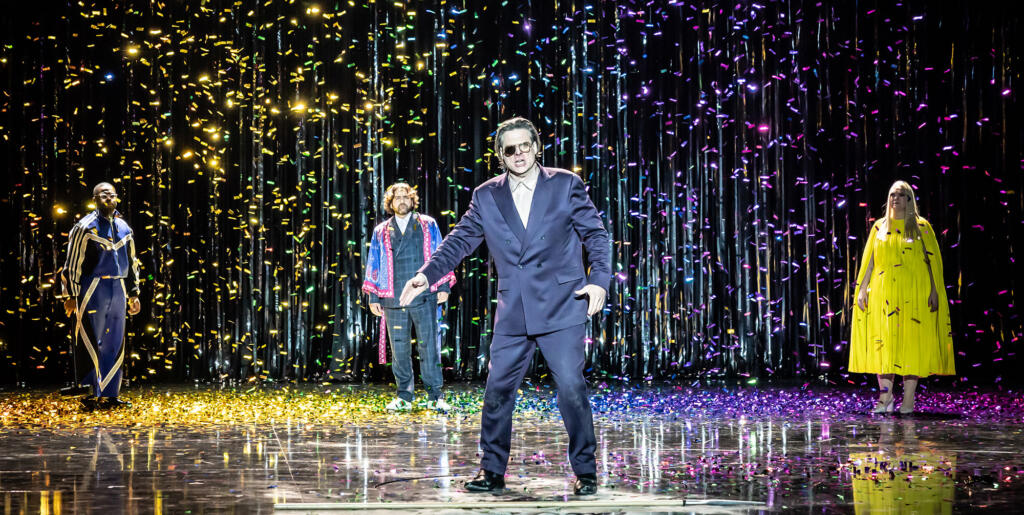
Other than that, Jones didn't give you too much to think about, or at least - like the Rhinemaidens wearing gym gear - nothing worth thinking to hard about to try to see any kind of rhyme or reason behind it (too fit for Alberich to catch? - as I said, you could find reasons if you like, but nothing worth the effort). In terms of look and appearance, the scene of Alberich being bewitched and teased by the Rhinemaidens was, as you would expect, colourful, attractive and slightly camp in a simple basic way, the Rhine represented by a surrounding curtain of glitter, Alberich arising from a hole in an otherwise fairly bare stage (making it all less effective if you are viewing it from a high vantage point in the Gallery). As with The Valkyrie, black clothed 'invisible' figures helped move things around, here permitting Alberich and the Rhinemaidens some swimming and floating movements, which worked well enough.

Aside from the obligatory avoidance of anything in terms of traditional costumes, it was pretty much according to the libretto, or at least to the same intent and purpose. The gold of the Rhine was initially shaped as an child-size baby puppet (manipulated by the black figures), but soon took a more traditional form, again through a series of transitions, from a crumpled sheet to flattened ingots and eventually, believe it or not, to an actual ring of a size that you can fit on your finger. An actual ring, I tell you! I'm not used to such literal fidelity in a modern production of Das Ring des Nibelungen. Nibelheim on the other hand resembled not so much a heavy industry factory as a production line in a bakery, with the dwarfs wearing chef caps. As I said, don't think too much about it...

The majority of Das Rheingold of course takes place in Valhalla and Jones didn't reveal too much of that, the giants presumably withholding the keys to the newly constructed abode of the Gods until they had received the agreed remuneration for their labours (nope, no hint of any commentary approaching Castorf's emphasis on that aspect), so it might well have been the log cabin we see in Die Walkure. The shimmering curtain remains in the surround, and we have conglomerations of white globes on stilts that could be abstract clouds. Again, I wasn't inclined to think to much about it other than it was all pleasant and decorative enough. What matters more is what take place within it.

What takes place within it sticks fairly closely to the original storyline. Aside from Freia being transported on the back of the Giants' work van, the exchange rate for her is indeed measured against the accumulation of trays of Rhine gold ingots to her height - and don't forget to throw that tiny Ring in. That's fine as far as it goes, but essentially what Richard Jones and conductor Martyn Brabbins working together successfully achieve is getting the necessary impact for each of those key moments and scenes. The brutal killing of Fafner by Fasolt (a dummy brought on in an off-stage switch) battered about the head with a gold ingot was particularly forceful. The arrival of Erda (with the Norn as three schoolgirls? Your guess is as good as mine), sung impressively by Christine Rice, also created the necessary gravity and impact, together heralding the tragedy of the curse of the Ring that will (we hope) play out in future installments. The shimmering fall of rainbow glitter for the bridge to Valhalla, and the lockdown against the Rhinemaidens at the conclusion seemed an appropriate way, in Richard Jones terms if nothing else, for everything that came before.

Some moments of levity in the Tarnhelm episode were balanced in this way by the gravity of what the Ring's preliminary evening prologue lays down, and the balance was supported by the characterisation and singing. As noted above, Christine Rice in particular made that small but significant and truly Wagnerian impression as Erda, but there were notable performances also from John Relyea as Wotan, Leigh Melrose as Alberich, and a suitably shifty portrayal of Loge by Frederick Ballentine. Madeleine Shaw's Fricka and Katie Lowe's Freia contributed to the family dynamic alongside the entertaining comic action hero shapes thrown by Julian Hubbard's Froh and Blake Denson's Donner. The giants might not have had much physical stature in this production but I enjoyed Simon Bailey and James Creswell's Fasolt and Fafner.

I can't say that Martyn Brabbins' conducting of the orchestra made a huge impact - maybe I was focussing too much on giving the production and sets design more thought than it merited after all - but neither did I notice anything that felt out of place in pacing, delivery, the surge of leitmotifs or in the whole continuous flow of this marvellous work. Some of the music press appear to have been more generous about this production - whether it's a show of solidarity with the proposed fate of the ENO, I couldn't say, but such sentiments can be excused, as the loss of the ENO in London would be a serious blow for opera lovers, for London, for arts, culture and for tourism. I don't expect Bayreuth at the Coliseum, but who in any other part of the country - certainly not here in Belfast - is going to have the resources to present not only an entertaining and accessible Ring cycle to a diverse audience, but a solid programme of great opera every year? If not in the Coliseum, at least keep the ENO funded and in London. Its loss would be very much regretted and missed by this opera-goer at least.


Links: English National Opera

Friday, 25 February 2022

Britten - The Turn of the Screw (Brussels, 2021)

Benjamin Britten - The Turn of the Screw (Brussels, 2021)

La Monnaie-De Munt, 2021

Ben Glassberg, Andrea Breth, Ed Lyon, Sally Matthews, Henri de Beauffort, Katharina Bierweiler, Carole Wilson, Julian Hubbard, Giselle Allen

La Monnaie Streaming/Opera Vision, April 2021

Britten's chamber opera The Turn of the Screw perfectly captures the mood and character of the chillingly sinister original Henry James story, but just as importantly it captures much of the psychological mystery and ambiguity within the ghostly tale. A director can enhance or emphasise certain elements of that ambiguity, but it shouldn't reveal too much. Britten's perfect score and the wonderful writing for the voice are more than enough to bring out the deeper character and suggestion that lies within it. 

Andrea Breth does that quite well in the 2021 La Monnaie production, placing the emphasis more on the expression of the horror deriving from the inner delusions of the impressionable governess, but it's not without suggesting that there is indeed something to her fears. The opera certainly hints at dark events, at the loss of childhood innocence and the corrupting influence of Peter Quint and Miss Jessel and the harmful legacy they have left over the children.

The first thing that strikes you in the opening scene of this production - as it perhaps should more than any obvious input or emphasis of the director - is the effect of the music and the mood it creates right from the outset. That has as much to do with Britten's score as with the meticulous performance of the La Monnaie orchestra under Ben Glassberg and by the singing of Sally Matthews as the Governess and Ed Lyon as the narrator. Both demonstrate a gorgeous tone with beautiful enunciation, but also delivering the content of the libretto with suggestion of the horror to unfold.

In setting, lighting and colouration, it's doesn't vary too much from convention and expectations, looking very much like every production of The Turn of the Screw looks. Dark, monochrome and austere, with cool lighting and plenty of shadow, but here director Andrea Breth allows several other spectral figures to appear on the stage. Even in the opening scene, Miss Jessel and a particularly demented looking Peter Quint already make an appearance, moving in and even taking over some of the narrator and the Governess's vocal lines, their influence over the whole tone of the work and what goes on in Bly already made evident.

It's also evident that Breth intends to extend that mood out and make visible some of the more hidden and suggestive undercurrents. Rather like the 2012-2016 Northern Ireland Opera production - back when we were fortunate to have an adventurous and ambitious artistic director of opera in Oliver Mears - this production uses panels, sliding doors and hidden rooms to open up the dark recesses of Bly or the Governess - take your pick: it's open for interpretation who is driving the psychosis that is rapidly escalating, or tightening like the turn of a screw.

It comes from a place "where things unspoken of can be', and Raimund Orfeo Voigt's sets shows the unspoken lying in wait everywhere to entrap. You can never remove the undercurrents of sexual repression of the Governess running up against the suggestion of sexual abuse of the children or some dark influence that they have been subjected to at the hands of Quint and Jessel, there is less of that made explicit in this production of the work. It's certainly hinted at, but if the emphasis in this production is principally within the mind of Governess, we can see that she doesn't have sufficient knowledge of such evil to imagine it playing out.

In some ways I even wonder if there is an angle there to be explored in The Turn of the Screw, and whether it is also important to retain adherence to the period in order to bring it out. There does seem to be a generational conflict in the changing times and attitudes, the older generation fearing the new, seeing it as decadent and corrupt, overturning traditional values. The Governess seems to be in-between, not comfortable with the past or the present, fearing for what lies ahead for the future generation. The loss of innocence that may already have happened and she feels powerless to intervene, or it may indeed be her misguided attempts at over-protectiveness that result in the tragic conclusion.

On a more general note, one of the policies I like about La Monnaie - aside from their adventurous programming and choice of directors - is how they retain a few strong performers on their books who are versatile and supremely capable in a number of varied roles and styles. Sally Matthews is just superb here as Governess, firm of voice, secure in range, but also capable of bringing real urgency and personality to a fairly complex character. Andrea Breth also fulfills perfectly the La Monnaie policy of modernising with purpose when it is appropriate to do so. Although this looks period in costume and set design - there are no mobile phones here - it uses modern techniques to extend the themes beyond the period, breaking down walls - quite literally - to work more closely with the music, not just the dramatic content of the libretto.

Musically too, the production is of an exceptionally high standard, as beautiful an account of this Britten work as you could hope for. Evidence of the quality of the performance is clear from the superb sound mixing that La Monnaie have captured for this streamed live recording. Every instrument can be heard, every little detail that adds to the character of the work, the voices rising clear above the orchestration with a natural theatrical sounding resonance. Aside from the already mentioned Ed Lyon and Sally Matthews then there is much to enjoy in the singing of Julian Hubbard as Quint and Giselle Allen - the quintessential Miss Jessel. Carole Wilson likewise is a fine Mrs Grose and there are good performances Henri de Beauffort and Katharina Bierweiler as Miles and Flora.

Links: La Monnaie-De Munt

Saturday, 25 April 2020

Wagner - Parsifal (Palermo, 2020)


Richard Wagner - Parsifal

Teatro Massimo, Palermo - 2020

Omer Meir Wellber, Graham Vick, Tómas Tómasson, Alexei Tanovitski, John Relyea, Thomas Gazheli, Julian Hubbard, Catherine Hunold

ARTE Concert


The unique nature of Parsifal as a Good Friday celebration, as a consecration for the stage of Bayreuth and as a spiritual journey in its own right, means that there are many ways of exploring it in a stage setting. There's no one way that works better than another but the most effective are those that simultaneously tap into and draw on the work for its unique source of power while also bringing something to it. When it comes to Graham Vick you have a director who is capable of doing just that in his own way, which is in a manner that relates it to the world we see around us. That's not so easy with a work that delves into the philosophical and spiritual and areas of religious mysticism, but Parsifal is a work that remains relevant for all time. Somehow Vick and conductor Omer Meir Welber manage to get all those essential qualities together in this January 2020 production at the Teatro Massimo in Palermo, or at least in some places better than other.

You can never tell if it's a good thing with an opera but in the case of Parsifal it's not exactly a disadvantage that you can't immediately see the direction a production is going to take even when a full hour and a half of Act I has elapsed. If it adheres however to the underlying sentiment of the work then it will hold and move you and Vick certainly manages to make you feel viscerally what the opera is all about. It might sound like an excuse but more than anything this is an opera you need to feel before you can understand it. It's no surprise that Vick uses familiar modern military and war imagery for Act 1 as a way of establishing that the world is in the midst of a deep crisis, one that it is badly in need of a saviour, a healing and renewing force. In Act I, more than anything, you can feel the pain. And it's not just Amfortas who is in agony, but Gurnemanz, the knights of the Grail and ultimately Parsifal too who comes to feel their pain and suffering.


The setting of Act I is visually simple and minimalised. There's a sandy-looking floor of chipboard with a canvas screen behind, giving the impression of a contemporary Middle Eastern military base with troops in army uniform and Kundry wearing a burka. Vick doesn't appear to intend to impose any political commentary, he just uses images that you will be familiar with as a way to get through to the idea of pain and feeling compassion. As such, the progression of Act I is straightforward but there are unusual touches that stand out. The first is the very Christ-like image of Amfortas, which isn't anything new he makes the first striking impression here wearing a brutal crown of thorns. Gurnemanz's story of the spear is played out in shadows on the canvas, showing images of war, victory and submission. The procession of troops lining up for the unveiling of the grail is not ineffective for it being a tin cup, as the symbolism of what it stands for is fully felt in Amfortas shedding a blood sacrifice. More than that, the shedding of blood is also endured by the troops/knights who painfully open up cuts on their arms. Set to Wagner's miraculous score, it's an immensely powerful first Act.

I've made no mention of Parsifal in Act I as he is purposely nondescript here, which is no reflection on Julian Hubbard who sings the role well here, but this is not his time, nor space for that matter. He's not even 'Parsifal' yet. That comes in an Act II which when it opens quickly undercuts any sense of Klingsor being an otherworldly agent of evil and instead depicts him as a very human one. He's a rogue soldier in fatigues, smoking a cigar, dropping his trousers to reveal the bloodstain of his emasculation. You might expect the flowermaidens to also be wearing burkas in Vick's contemporary Middle Eastern setting, and indeed that is how we see the chorus, but initially the maidens are semi-clad in underwear only, looking on as Parsifal cuts his way through their men, later coming to him seductively in coloured wraps.


The strangest scene in Act II however is the appearance of Kundry as a head only, buried under the sand, positioned in the same place as the grail buried under the sand in Act I. Establishing the nature of Kundry is vital in any Parsifal and here she is not so much the temptress and seductress as having a surrogate motherly quality, bringing an Oedipal edge to her encounter with Parsifal. An iconic image of Mary Magdalene opening up from the floor hints at another side, and Kundry as a woman of course has many sides and many incarnations, weaving a web of illusion that Parsifal brings crashing down with his newly gained wisdom and the power that such wisdom conveys on him.

Just as you can't expect Parsifal to come to knowledge and understanding without undergoing the whole laborious process of learning, you can't expect to know what direction Vick is pointing towards until you get to the conclusion of this Palermo production. It is of course a variation on the idea of a return to the paradise, a return to lost innocence, but Graham Vick depicts this persuasively as the need to become like a child again, throwing off the artificial constructs of religion, war and racism that have led to a corruption of true nature of humanity, and aspiring to be something better. It's there in the Easter message of healing, of Death and Resurrection, wiping away the sins of mankind. In Act III the salvation is that the Knights are no longer called upon to fight wars and bleed. They no longer have the spiritual nourishment that the Grail once provided, a gift that was used in a corrupted way to sustain nationalistic pride and wage war. Now it is turned towards healing and compassion.


Again, this is something that has to be fully felt in order to be fully understood. Some of the shadowplay imagery in Act III is consequently quite shocking, the result of a world thrown into chaos, where coldness and horror hold sway. Amfortas, as a leader of men is tired of it all, even more unwilling to continue to wage an endless war; reluctant to give sustenance and countenance to its continuance he topples Titurel out of his coffin. In the healing of the wound, Parsifal opens up a new way guided only by love and compassion. That is the Holy Grail.

In order to feel that the production obviously needs rather more than visual references and cues, and fortunately it's a beautiful interpretation in terms of musical and singing performances. Omer Meir Wellber rushes it along a little fast in places, or maybe I've been listening to too many slow versions recently, but there is a deep flow to the performance, completely Wagnerian, and it supports and helps bring out all those undercurrents that Vick hints at in his direction. Catherine Hunold doesn't quite get under the skin of Kundry the way another interpretation might, but she proves to be a fine replacement for Eva Maria Westbroek, providing some lovely lyrical singing in Act II with Parsifal, but she is also able to bring an edge of chilling drama when it's needed.


I've seen Julian Hubbard a number of times - he's a regular in Irish National Opera productions - but I've never seen him take on anything as big as Parsifal. I believe he also was engaged as the understudy before having to take over the main role and he acquits himself exceptionally well, making it look almost too easy, but also essentially human. The other principal roles are all superb. John Relyea is a fine Gurnemanz, his solemn intoning warm and reassuring, his storytelling compelling, his belief unshakable, his joy at the end overwhelming. Tómas Tómasson is wholly enveloped in the painful distraction of Amfortas, and Alexei Tanovitski's Klingsor is one that shows up the weak foundation of his blustering menace in the face of a greater power.  Strong singing and good characterisation all around, the Good Friday message of the Palermo Parsifal hits home exactly the way it should.

Links: Teatro Massimo Palermo, ARTE Concert

Wednesday, 17 April 2019

Korngold - Die tote Stadt (Dublin, 2019)

Erich Wolfgang Korngold - Die tote Stadt

RTÉ National Symphony Orchestra, 2019

Patrik Ringborn, John McKeown, Celine Byrne, Charles Workman, Ben McAteer, Katharine Goeldner, Julian Hubbard, Clare Presland, Susanna Fairbairn, Alan Leech

National Concert Hall, Dublin - 12 April 2019


You don't get many opportunities to see a Korngold opera in Ireland, so when even a concert performance of Die tote Stadt comes up it's an event that can't be missed. In fact, a concert version comes with the additional benefit of putting the orchestra up on the stage with the performers and when you have a master orchestrator like Korngold, even at 23 years old when he composed his most famous opera, you really get a unique chance to experience the intricacy, beauty and power of the work.

Like Debussy's Pelléas et Mélisande or Schreker's Die Gezeichneten, the lush orchestration of Korngold's Die tote Stadt has a dreamy seductive quality that when combined with the nightmarish qualities of a Symbolist-influenced text that has undertones of decay and decadence, creates an atmosphere of gathering unease. In Pelléas et Mélisande there's no musical way out of the nightmare and you remain trapped within it, with Die Gezeichneten the illusion eventually comes crumbling down, revealing the true horror underneath.


With Die tote Stadt ('The Dead City'), Korngold's orchestral crescendos are more ambiguous; in some way they seem to break the illusion, but in others, they just seem to enforce how strong the madness lies within Paul's delusion that his dead wife Marie has been revived, reincarnated or reproduced in some way in the form of Marietta.

That certainly came across forcefully in the performance of the RTÉ National Symphony Orchestra under the baton of the Swedish guest conductor, Patrik Ringborn. Not only did we have the luxury of hearing Die tote Stadt performed in all its glory in concert performance, but the performance was also able to take advantage of the National Concert Hall's pipe organ that emphasise the eerie climactic moments of mad love.

We were also fortunate that Celine Byrne and Julian Hubbard had extended their stay in Dublin after their stint on Madama Butterfly for Irish National Opera a few weeks ago, and having seen thought that both were phenomenal in that, a concert performance of Die tote Stadt was surely going to be a treat. And of course it was.


I hadn't realised how difficult a role Marietta is, or I had forgotten, but Celine Byrne demonstrated the kind of voice needed to not just reach and sustain its tricky heights and German cadences, but how important it is to bring an expressive lyricism to Marietta's predicament and a cool authority to the ghostly spirit and allure of Marie. Whether it's a more challenging role than Madama Butterfly or it's a case of different challenges that depend on voice type I'm no expert, but Byrne grew magnificently into the role, or perhaps it's Marietta who gradually grows and asserts her own personality away from the pull of Paul's dangerous obsession to transform her into a dead woman.

Whether I overlooked it or there was no information on the performers when I booked my ticket for this, I was delighted to find Charles Workman cast in the role of Paul. Workman is one of my favourite tenors in early twentieth-century repertoire of this kind, works like Jenůfa and Die Gezeichneten, and this is a gift of a role for him. With that lyrical voice he could just glide softly and beautifully around such lush orchestration, but he is more than capable of rising above it and against it with expression and force, particularly in the jarring behaviour of Paul. It's marvellous to hear him sing and perform in this context in a concert performance, and particularly when he is a perfect match for Celia Byrne. The duet between Paul and Marietta's (or is she the dead Marie in Paul's dream?) at the end of Act II was one of the highlights of the performance.


Also terrifically impressive in concert performance is Northern Ireland baritone Ben McAteer. His Frank provides a wonderful contrast and balance to the richness of the voices that accompany Korngold's orchestration. There was a wonderful clarity to Julian Hubbard's singing, although that fared better as Victorin from the front of the stage that trying to soar above the orchestra from the back of the choir as Gaston. Katharine Goeldner made Brigitta's role significant, and there was lovely support from Clare Presland, Susanna Fairbairn and Alan Leech as Marietta's lively singing colleagues, all contributing to the richness of the score, the performances and the surreal madness that Die tote Stadt is capable of attaining.


A live stream of this concert was recorded for RTÉ Lyric FM

Links: National Concert Hall

Monday, 1 April 2019

Puccini - Madama Butterfly (Dublin, 2019)


Giacomo Puccini - Madama Butterfly

Irish National Opera, 2019

Timothy Redmond, Ben Barnes, Celine Byrne, Julian Hubbard, Brett Polegato, Doreen Curran, Eamonn Mulhall, John Molloy, Niamh O'Sullivan, Rachel Croash, Brendan Collins, Robert McAllister, Kevin Neville, Cormac Lawlor

Bord Gáis Energy Theatre, Dublin - 28 March 2019


In his programme notes, director Ben Barnes quotes Woody Allen, "People marry and die. Pinkerton does not return" and follows it with the personal observation, "Would that he had never come in the first place". It's by no means a new idea to see Madama Butterfly as a condemnation of American political and cultural imperialism rather than just a romantic tragedy; the marriage of an American sailor to a naive Japanese child bride certainly invites that response to a modern audience. The director's observation however is a bold statement of intent all the same and I hoped to see that developed in the Irish National Opera's new production of Madama Butterfly. Barnes certainly followed through on that idea, not as boldly as he might have, but in an opera as popular as Madama Butterfly, it's perhaps wise not to stray too far from audience expectations.

To be fair, taking Madama Butterfly out of Japan is no minor adjustment. I've seen a lot - and I mean a lot - of Madama Butterflys in my time and quite a few updatings, but none have dared to dispense almost entirely with the pretty Japanese imagery of its Nagasaki setting. I say 'almost' however and that's because an Asian element is still apparent and pretty much essential to the purpose of the clash of both the romantic and cultural ideals. Director Ben Barnes sets the INO production to all intents and purposes in Vietnam in the 1950s/60s and makes a few minor modifications to the surtitles to hide the references to Japan and Nagasaki, even though the libretto remains unchanged.


The pan-Asian set design however doesn't depart too far from what you might expect to see on the stage in a production of Madama Butterfly, but it extends the range of the work considerably from the romantic delusions of one couple in Nagasaki. It also makes it easier to see it in terms of a critical look at American imperialism that essentially views Asians as all the same and ripe for exploitation for their own interests.

It's refreshing then to see characters wearing Chinese pointed bamboo hats and robes instead of kimonos and obis, even though the customs referred to in the libretto remain Japanese and the house still very much the traditional shoji style paper panel screens, but every effort is made to not rest on the standard imagery and ceremonial representations that are all too familiar in productions of Madama Butterfly. Credit should go to Libby Seward who shows great inventiveness in the choreography and colour of Act I, finding the flow and mood of the work perfectly and mirroring it in the arranging of the chorus, in little movements and gestures. It's visually splendid and makes the observations of character much more engaging than Act I usually is, particularly as I say, since the production is not terribly bold here with any overt political commentary.

For the most part then we had to make do with the singing, and when I say 'make do' I really mean just be absolutely floored by the quality of the cast and the beauty of the performances. There was more than enough here in the definition of the characterisation to make up for the lack of any apparent deeper purpose in the production. Celine Byrne, an international star only now getting the opportunity to perform back home in Ireland with the creation of INO last year, was simply stunning. She almost made singing Cio-Cio-San look easy, which is no mean feat, but that doesn't mean she coasted at all either. This was a heartfelt performance with intelligent phrasing and technique that let little insights into Butterfly's character show. Combined with a luxurious timbre, no harshness or strain evident, just a clear ringing rounded delivery, everything you could want from Puccini's tragic heroine is present here in an engaging and masterful performance.


There was no slacking or weaknesses anywhere else; it was as if everyone had to up their game to be on the same level as Celine Byrne. Julian Hubbard was a fine Pinkerton, a little neutral in characterisation, but sometimes it's necessary not to overstate Pinkerton as a 'villain' since he doesn't see himself that way (although it's annoying that audiences still insist on treating him as a pantomime character, booing the villain at the curtain call), but just let the work speak for itself. Brett Polegato was a wonderfully sonorous Sharpless and Doreen Curran's Suzuki was perfectly pitched in voice and character to complement Byrne's Cio-Cio San. There was plenty to 'make do' also in Eamonn Mulhall's Goro, John Molloy's Bonze and in the lovely chorus work. The INO really have an impressive pool of talent to draw upon here.

It's only during the Intermezzo between Act II and Act III that Ben Barnes really lets fly and hits home with the impact that up to then had been left to the singers to deliver. Projections onto the closed shoji screens of Butterfly's house show everyday people's lives in Asia being gradually overturned by American involvement in the East; politicians and soldiers seem oblivious to the reality and inhumanity of what takes place in Vietnam as bombs are dropped and villages are burnt. It's dropped in so suddenly without any prior notice that it's a bit jarring and doesn't fit well with what has come before. A few hints might have integrated this better into the production as a whole, but on the other hand the element of shock is just as effective and it actually doesn't seem heavy-handed (or at least not any more heavy-handed than Puccini's score, should you see it that way), and it opens up the work's dramatic scenes of betrayal and death on a much larger scale than it being just an isolated little incident of romantic tragedy.

I must admit that I sometimes get tired of the idea of going to see another Madama Butterfly, but that only lasts up to the moment that I hear the first few bars of the score and I am immediately gripped and transported by Puccini's genius and his ability to make this intimate little story so momentous. That magic works again under the conducting of Timothy Redmond, the RTÉ Concert Orchestra giving a balanced reading that shows no heavy-handedness either. When you get to the Humming Chorus, you know that the spell is working by how this moment commands absolute reverence on a popular and emotional level in a way that few other pieces of music or opera can achieve. The response at the conclusion of this Irish National Opera production shows that they successfully connected the heart of the work with the hearts of the audience in Dublin.


This production can now be viewed steaming on-line on the RTE Player.


Links: Irish National Opera

Tuesday, 18 September 2018

Offenbach - Tales of Hoffmann (Dublin, 2018)


Jacques Offenbach - Tales of Hoffmann

Irish National Opera, 2018

Andrew Synnott, Tom Creed, Julian Hubbard, Claudia Boyle, Gemma Ní Bhriain, John Molloy, Andrew Gavin, Brendan Collins, Carolyn Holt, Fearghal Curtis, Kevin Neville, Peter O’Reilly, Cormac Lawlor, Robert McAllister

O'Reilly Theatre, Dublin - 14 September 2018

At this rate I could get to like Tales of Hoffmann. Up until fairly recently it's been an opera whose attraction and qualities have mostly eluded me. Part of the problem could be down to the work having been left unfinished, Offenbach dying before his only full opera (as opposed to his numerous operettas) was completed. Subjected to cuts, revisions and additions from sketches left behind by the composer to try to approximate what Offenbach might have had in mind, there's never been any clarity over the intended final shape of the work. But then, I've never been taken with the idea of purpose of the work or find that it has any great insights or truths to reveal.

It's a romance above all, a single troubled one taking shape across four different incarnations, but drawn from stories by the German writer ETA Hoffmann, Offenbach includes Hoffmann as the main character in the work, making a connection between the creator and his creations, the inspiration for them and the suffering an artist has to endure to bring them to life. That's all well and good, but the stories themselves are strange, fantastical and almost hallucinogenic in their obsessions, fuelled by alcohol and tainted with madness, the music likewise somewhat overblown.

There's a lot to work with here and certainly richness in the situations, but a good production should be able to draw it all together, bring some kind of coherence and try to make sense of it all. My experience of Tales of Hoffmann however - until fairly recently - has been that directors similarly tend to go overboard and add another level of complication and distraction. A stripped-down reduced-orchestration production by the English Touring Opera however demonstrated for me that there is much to enjoy in the work, and following a similar policy in their new production, the Irish National Opera have confirmed that impression.


Of course what is true of the approach taken towards Tales of Hoffmann is true of any opera; it can be seen at its best when music, direction and singing all come together in a cohesive production with a strong central theme. The central theme of the varied three related love stories that attest to Hoffmann's unfortunate choice in women is of course his singular love for Stella in all her varied moods and character (and an opera singer to boot!). Offenbach of course makes the connections by having not just Stella in the roles of Olympia, Antonia and Giulietta, but he keeps a thread of adversity in the combined villains of Lindorf's Coppélius, Dr. Miracle, and Dappertutto.

Created as a INO touring production and having to work within the limitations of the O'Reilly Theatre in Dublin, which is not equipped for major scene changes or special effects, director Tom Creed is somewhat limited as far as stage designs go, but in a way this helps consistency and fluency not just between the stories, but with the framing device of Hoffmann the storyteller and the connections the stories have to Stella. The lack of atmosphere in the venue also threatened to work against the efforts of the production which with only a reduced ensemble of seven players felt initially cool and detached, not really engaging with the audience. By the time Claudia Boyle's Olympia took to the stage however, that all changed.

The detached from reality aspect of the stories can still be a problem, but Tom Creed finds suitable modern updates that take some of the old-fashioned eccentricity out of the work. Rather than an automaton or living doll, Creed re-envisions Olympia for this production as a robot AI, Hoffmann dazzled by its brilliance of science but disillusioned by its lack of humanity, immune to the charm of his poetry. In the second story Hoffmann's trust in love is dashed by the inadequacy of medicine to cure Antonia if she sings. Hoffmann is charmed in the third story not by a seductive courtesan who is charged with stealing his reflection, but by a performance artist in the Venice Biennale who attempts to destroy his soul through drug addiction.


Katie Davenport's set designs cleverly provide suitable locations for Creed's updated settings that bring more of a sense of reality to the metaphor, but it still looks magical and just as importantly retains a sense of humour. The consistency and continuity is brilliantly maintained in the three major singing roles, with Claudia Boyle in particular simply outstanding. The ability to sing all the four highly challenging soprano roles is never in doubt, but there's personality and presence there as well, which makes a difference in this opera. Julian Hubbard also sang well but wasn't quite as successful in finding any deeper humanity in his character. The multiple Lindorf villain role posed no difficulties for John Molloy, an expert in this register, but he was perhaps a little too declamatory for the reduced instrumentation. Gemma Ní Bhriain's Nicklausse was exceptional and Andrew Gavin provided good support for Molloy's different incarnations. With fine performances in secondary roles and a fine chorus, the INO clearly have a strong ensemble of singers.

It was in that reduced seven-piece instrumentation, alive to the subtleties of the melodies that I feel that the Irish National Opera's production was truly successful in revealing the qualities of Offenbach's writing for Tales of Hoffmann. Andrew Synnott directing from piano is always strong with this kind of arrangement (his own composition for Dubliners at the 2017 Wexford Festival benefitted from the same treatment). As well as simply being able to appreciate the detail of the instrumentation and quality of the playing, too often lost in larger arrangements, it more than anything else helped bring consistency and cohesion to the work, while still finding plenty of room for colour and expression.


Links: Irish National Opera

Tuesday, 20 March 2018

Dallapiccola - Il Prigioniero / Rihm - Das Gehege (Brussels, 2018)


Luigi Dallapiccola - Il Prigioniero
Wolfgang Rihm - Das Gehege


La Monnaie-De Munt, Brussels - 2018

Franck Ollu, Andrea Breth, Ángeles Blancas Gulín, Georg Nigl, John Graham-Hall, Julian Hubbard, Guillaume Antoine

La Monnaie MM Streaming -  January 2018


The challenges of writing an opera in the serial music form could perhaps be measured by how few actually make it to completion and by the shortness of length of those that are actually finished. Even Schoenberg, the inventor of the twelve-tone dodecaphonic system only completed one short opera in this form, Von Heute auf Morgen, and left his one longer masterpiece Moses und Aron unfinished. Berg likewise left his the troubled Lulu unfinished at the time of his death, while Wozzeck only has twelve-tone elements. There are however other notable extended operas that are largely written in the serial form including Bernd Alois Zimmerman's Die Soldaten and Ernst Krenek's Karl V. As Wozzeck, Lulu and Moses und Aron testify however, while the composition of such complex works presents considerable and sometimes insurmountable challenges, they also bring specialised demands for staging, performance and use of musical resources.

As formidable as they often appear to be however there is nothing limiting about the works in terms of musical expression, and Luigi Dallapiccola's Il Prigioniero finds a terrific range of expression even within the limitations of a 50 minute work set almost entirely within the confines of a prison cell. Just as Schoenberg was able to extend the situation of a biblical story to explore more personal ideas and obsessions, the richness and uniqueness of the musical language available permits Dallapiccola to delve more deeply into the themes that arise for a political prisoner in relation to freedom, political expression, hope and disillusionment, and apply it to greater concerns in the troubled times of the 1940s.


Il Prigioniero opens then with a dramatic soprano voice, the mother of the prisoner, speaking out at the horror of the regime that has led to her son being held and tortured in prison. Dallapiccola follows this cry of despair with a lament from a large chorus, "Lord have mercy on us. Our hope lies in you". It's in this state that we find the prisoner about to give up all hope until a single word changes his outlook and insinuates itself into the mood of the whole piece; "fratello" - brother. The jailer who offers this lifeline to grasp follows it with another word, "spera" - have faith. Finding the door left open, one perhaps more metaphorical than real considering the developments, the prisoner follows the path of hope down the corridor outside his cell.

The chorus fill in again, their lament turned to praise for the light, which brings an "Alleluia" out of the prisoner for freedom, but it's premature and illusory, as the path is one that leads to his execution. The fullness of expression, the use of words, the chorus, as well as the post-romantic sweep of the score in the dynamic between the dark and the light is one that recalls a similar use of these elements in Moses und Aron. It's brought out fully in Dallapiccola's score, given wonderful expression in Franck Ollu's direction at La Monnaie in Brussels, and in the writing for the contrasting voices of Ángeles Blancas Gulín as the mother, Georg Nigl as the prisoner and John Graham-Hall offering hope in the form of the jailer only to take it away as the Grand Inquisitor.

Andrea Breth's direction also tries to give as much expression as can be found in the work, in the darkness, in the cage of a cell, opening it up with light, bringing sudden cuts to black, stripping the stage bare at the conclusion when all hope is gone and opening the back of the stage to a blinding heavenly light that shines out on the emptiness within. It was Andrea Breth who worked with Franck Ollu (and Nigl and Graham-Hall) to similarly striking effect on Wolfgang Rihm's Jakob Lenz at La Monnaie in 2015 and the collaboration reunites to present another Rihm short opera that is paired brilliantly with Dallapiccola's Il Prigioniero.


Although deriving from the other half of the twentieth century, Rihm's Das Gehege (The Enclosure) also has roots in the post-Romantic, in Richard Strauss rather than Schoenberg, although not so much the lush orchestrations of latter-day Strauss as the jagged rupturing of post-Romanticism in the expressionism of Salome and Elektra. In the expression of a woman who has captured an eagle and sets it free only to kill it when she realises that it no longer has the vitality and strength to survive, Das Gehege bears a similar tone of intense dark eroticism, with even a hint of the fantasy world symbolism of Die Frau ohne Schatten.

Breth's direction draws out the Salome-like underlying erotic fascination in a woman who is filled with dark desires and ends up killing the thing she professes to love by having the woman in the cage, the enclosure, joined by a series of men with bird heads and wing attachments in a dance of death. Outbursts of anguished singing are broken up with brief instrumental expressions of lust and fury that are accompanied in the darkness by disorientating strobe lighting that leaves behind a trail of bodies. More than just in the use of the same cage that held the prisoner - the woman likewise a prisoner of fatal unquenchable urges - there are other visual cross-references and correspondences made with Il Prigioniero, notably Georg Nigl playing one of her avian victims and a staircase that offers a descent as much as a way out.

As explosive as the musical expression is, its fractured structure carrying an underlying tug of lyrical romanticism, a considerable amount of responsibility for carrying the force of the whole of Das Gehege lies with the soprano singing the Frau, the only singing role in the opera. Ángeles Blancas Gulín, already showing stamina and ability to meet the highly pitched demands of the mother in Il Prigioniero, gives another impressive performance here that is electrifying and terrifying, striking that balance between being derangedly in thrall to her passions, but tempering any over-intensity with a seductive lyrical tone. She has to do that while climbing the cage, hanging upside down over the shoulder of one of her paramours or sprawled in one shape or another and somehow never falters a note.


Links: La Monnaie,