Showing posts with label Richard Jones. Show all posts

Saturday, 4 March 2023

Wagner - Das Rheingold (London, 2023)


Richard Wagner - The Rhinegold

English National Opera, London - 2023

Martyn Brabbins, Richard Jones, John Relyea, Leigh Melrose, Frederick Ballentine, Madeleine Shaw, John Findon, Christine Rice, Katie Lowe, Julian Hubbard, Blake Denson, Simon Bailey, James Creswell, Eleanor Dennis, Idunnu Münch, Katie Stevenson

The Coliseum, London - 26th February 2023

I wouldn't expect every production of Das Ring des Niebelungen to be as elaborately layered and provocative as a Frank Castorf Ring cycle, as irreverently humanising as a Dmitri Tcherniakov production or as distinctive and gloriously impenetrable as the Achim Freyer Mannheim Ring, but you would like a new production of Das Rheingold to open with at least some new ideas and twists that you could look forward to being developed further down the line. Such expectations however have already been suitably adjusted in view of the fact that Richard Jones's Die Walküre, or The Valkyrie, has already made its appearance at the ENO before the first part of the tetralogy and it didn't seem to offer anything new or promising. The same goes even more so for The Rhinegold which, aside from modern costumes, plays it fairly straight and safe, having nothing much new to add to Wagner Ring mythology, but as with the first/second installment, nonetheless putting it across in an entertaining and enjoyable manner.

What is perhaps more notable about the performance I attended at the Coliseum was the audience that turned out to fill the hall; an audience on average younger than you would often see at opera and it turned out to be also an appreciative one for what Wagner's Das Rheingold has to offer, or at least for Richard Jones's version of what The Rhinegold has to offer. That's all the more interesting since this is the first opera I've seen there since the Arts Council England's shortsighted, misguided and philistine threat to cut and remove funding for the ENO. While the future of this Ring cycle and the company still lies in the balance, it was nonetheless heartening to see this kind of turnout and support for the artform. The ENO's programme brings me, like many others, into London to see productions like this every year and has done for many years in the past, paying for flights, accommodation and meals that contribute to the UK economy, and I hope to continue to be able to do so in the future...

...As I did for The Valkyrie in 2021, and what largely was written then - by me as well as others - holds true to The Rhinegold. As engaging as it was, engaging also to a significant extent with the narrative of Wagner's original stage directions, it didn't have anything new or insightful to say about the work. By the same token, other than perhaps for a few moments, neither did it betray the tone and character of the work. There were certainly a few quirks and some ideas that didn't quite strike the right note in the right place - the sombre contemplative notes of the opera's origin myth flowing into the shimmer of the Rhine were somewhat sacrificed to a semi-comic routine of a naked man dragging a large branch from the world ash tree across the stage that is eventually crafted into Wotan's staff/spear. There is a meaningful point to be made here, the ecological exploitation of the planet setting us on a path to destruction, but the message is somewhat lost in this routine. Elsewhere however the key scenes were at least delivered with appropriate impact, musically, narratively and in the fine singing.

You would think that if you are going to make such an issue of the forging of Wotan's staff - or spear in its eventual form - that it might become a prominent feature or motif throughout, and while it certainly featured and was wielded to such effect, it wasn't to any evident purpose, and certainly not to any purpose that I can recall becoming any clearer in Die Walküre. In fact, the downside of performing the two operas out of order tends to emphasise the disconnect between them, in the overall look and appearance, in the inconsistency of the costume design (Wotan in a purple-blue neat suit here for some reason takes to sporting a bright red puffa jacket in Die Walküre) and set design (the steel shuttered Valhalla becoming more of a log cabin in Die Walküre). Should the ENO's Ring cycle make it to its conclusion (one can only hope, as it is still very much worth it), the idea of each of the constituent parts being distinct from each other is a unique feature (Castorf's aside, even though they were all connected by a very strong and consistent anti-capitalism theme) that should at least keep things interesting.

Other than that, Jones didn't give you too much to think about, or at least - like the Rhinemaidens wearing gym gear - nothing worth thinking to hard about to try to see any kind of rhyme or reason behind it (too fit for Alberich to catch? - as I said, you could find reasons if you like, but nothing worth the effort). In terms of look and appearance, the scene of Alberich being bewitched and teased by the Rhinemaidens was, as you would expect, colourful, attractive and slightly camp in a simple basic way, the Rhine represented by a surrounding curtain of glitter, Alberich arising from a hole in an otherwise fairly bare stage (making it all less effective if you are viewing it from a high vantage point in the Gallery). As with The Valkyrie, black clothed 'invisible' figures helped move things around, here permitting Alberich and the Rhinemaidens some swimming and floating movements, which worked well enough.

Aside from the obligatory avoidance of anything in terms of traditional costumes, it was pretty much according to the libretto, or at least to the same intent and purpose. The gold of the Rhine was initially shaped as an child-size baby puppet (manipulated by the black figures), but soon took a more traditional form, again through a series of transitions, from a crumpled sheet to flattened ingots and eventually, believe it or not, to an actual ring of a size that you can fit on your finger. An actual ring, I tell you! I'm not used to such literal fidelity in a modern production of Das Ring des Nibelungen. Nibelheim on the other hand resembled not so much a heavy industry factory as a production line in a bakery, with the dwarfs wearing chef caps. As I said, don't think too much about it...

The majority of Das Rheingold of course takes place in Valhalla and Jones didn't reveal too much of that, the giants presumably withholding the keys to the newly constructed abode of the Gods until they had received the agreed remuneration for their labours (nope, no hint of any commentary approaching Castorf's emphasis on that aspect), so it might well have been the log cabin we see in Die Walkure. The shimmering curtain remains in the surround, and we have conglomerations of white globes on stilts that could be abstract clouds. Again, I wasn't inclined to think to much about it other than it was all pleasant and decorative enough. What matters more is what take place within it.
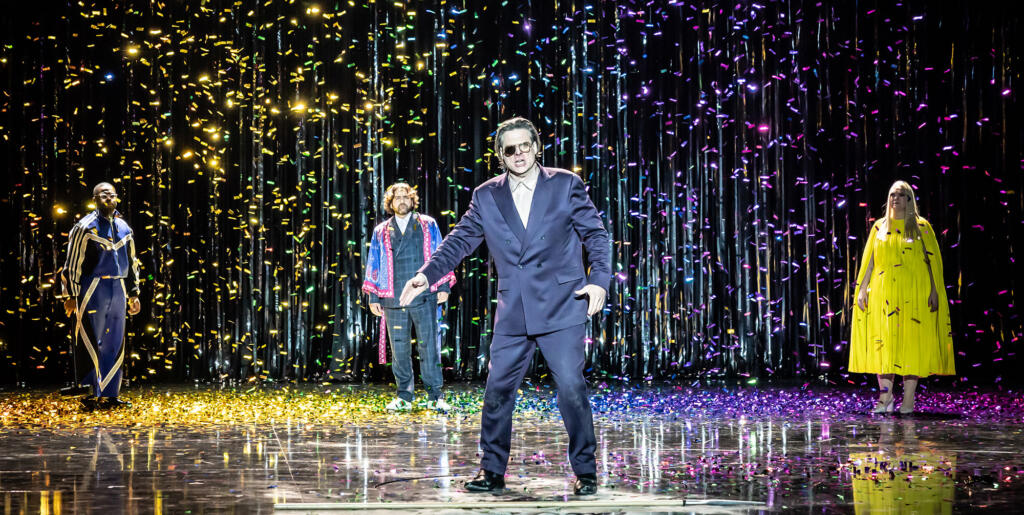
What takes place within it sticks fairly closely to the original storyline. Aside from Freia being transported on the back of the Giants' work van, the exchange rate for her is indeed measured against the accumulation of trays of Rhine gold ingots to her height - and don't forget to throw that tiny Ring in. That's fine as far as it goes, but essentially what Richard Jones and conductor Martyn Brabbins working together successfully achieve is getting the necessary impact for each of those key moments and scenes. The brutal killing of Fafner by Fasolt (a dummy brought on in an off-stage switch) battered about the head with a gold ingot was particularly forceful. The arrival of Erda (with the Norn as three schoolgirls? Your guess is as good as mine), sung impressively by Christine Rice, also created the necessary gravity and impact, together heralding the tragedy of the curse of the Ring that will (we hope) play out in future installments. The shimmering fall of rainbow glitter for the bridge to Valhalla, and the lockdown against the Rhinemaidens at the conclusion seemed an appropriate way, in Richard Jones terms if nothing else, for everything that came before.

Some moments of levity in the Tarnhelm episode were balanced in this way by the gravity of what the Ring's preliminary evening prologue lays down, and the balance was supported by the characterisation and singing. As noted above, Christine Rice in particular made that small but significant and truly Wagnerian impression as Erda, but there were notable performances also from John Relyea as Wotan, Leigh Melrose as Alberich, and a suitably shifty portrayal of Loge by Frederick Ballentine. Madeleine Shaw's Fricka and Katie Lowe's Freia contributed to the family dynamic alongside the entertaining comic action hero shapes thrown by Julian Hubbard's Froh and Blake Denson's Donner. The giants might not have had much physical stature in this production but I enjoyed Simon Bailey and James Creswell's Fasolt and Fafner.

I can't say that Martyn Brabbins' conducting of the orchestra made a huge impact - maybe I was focussing too much on giving the production and sets design more thought than it merited after all - but neither did I notice anything that felt out of place in pacing, delivery, the surge of leitmotifs or in the whole continuous flow of this marvellous work. Some of the music press appear to have been more generous about this production - whether it's a show of solidarity with the proposed fate of the ENO, I couldn't say, but such sentiments can be excused, as the loss of the ENO in London would be a serious blow for opera lovers, for London, for arts, culture and for tourism. I don't expect Bayreuth at the Coliseum, but who in any other part of the country - certainly not here in Belfast - is going to have the resources to present not only an entertaining and accessible Ring cycle to a diverse audience, but a solid programme of great opera every year? If not in the Coliseum, at least keep the ENO funded and in London. Its loss would be very much regretted and missed by this opera-goer at least.


Links: English National Opera

Monday, 29 November 2021

Wagner - Die Walküre (London, 2021)


Richard Wagner - The Valkyrie (London, 2021)

English National Opera, 2021

Martyn Brabbins, Richard Jones, Matthew Rose, Rachel Nicholls, Nicky Spence, Emma Bell, Brindley Sherratt, Susan Bickley, Nadine Benjamin, Mari Wyn Williams, Kamilla Dunstan, Fleur Barron, Jennifer Davis, Idunnu Münch, Claire Barnett-Jones, Katie Stevenson

The Coliseum, London - 19th November 2021

The announcement of a new Ring Cycle at the Coliseum was welcome news for many opera goers and followers of the English National Opera. It was a sign that new Artistic Director Annilese Miskimmon had some creative ideas to revive the fortunes of a company that has recently been going through some difficult times. The news was also greeted however with a certain amount of caution and indeed even trepidation by those who had been to see director Richard Jones's previous Ring for Covent Garden, or indeed any of his productions. There was little here to suggest that Jones would be a natural fit for Wagner.

Still, that doesn't have to be an essential quality and sometimes it's useful to get another perspective where the Der Ring des Nibelungen is concerned. While it's perhaps a little too early to look for any distinctive ideas or themes emerging, some of those concerns do appear to be well-founded in this opening opera of the tetralogy; not least the fact that it's opening with Die Walküre - and following the ENO's dated ideals about English language performances it's of course The Valkerie - commercial imperatives perhaps necessarily superceding artistic considerations.

Those are the least of this production's concerns, although commercial considerations may have also been a factor in the set designs looking a little sparse and the ideas at this stage looking a little thin. One would think that being a co-production with the Metropolitan Opera in New York might have provided a few more resources, but considering the expense poured into the Met's last Ring Cycle - and continuing pandemic related problems -  caution may also have been the watchword there. Whether the concept is fully developed or not, and whether it is expanded on at all before it gets to the Met (it is surely too small scale for the Met), Jones's The Valkyrie looks like a work in progress.

There is always going to be something of a feeling of lack of completeness in any production of Die Walküre, and this Ring cycle hasn't even given us a Das Rheingold (or The Rhinegold) yet, but the problems here go deeper than that. Many of the great set pieces of this opera fell flat, with Act III suffering most in this respect. The horses ridden by the green raincoat wearing Valkyrie looked like the front half of a pantomime horse, the scene only saved by the combined singing strengths of the Valkyrie. Brünnhilde's fate to go out in a blaze of disgrace at the finale was scuppered by the Westminster council's refusal to allow naked flames to be lit on the stage of the Coliseum, but even with it I'm not sure that Jones would have pulled off the kind of spectacle needed.

For Richard Jones however it seems the limitations imposed, or self-imposed, is a chance to focus on the nuts and bolts of the drama, on the characters and the relationships between them. The idea of the cast wearing jeans and T-shirt type casuals is otherwise baffling other than it simply being an attempt not to distract or distance through traditional costumes of heroic mythology. With Wagner's music played for all its dramatic and emotional potential and some fine singing, the attention to character more than concept can pay dividends, and to an extent Jones succeeded in bringing in some tweaks to characterisation, but not on any level that would be considered insightful or revelatory.

The sets can best be described as functional and minimal, aligned to mood. A twisted ash breaking through the roof of Hunding's abode - a surprisingly small cabin rather than any kind of manor - was all that sat on the largely empty stage in Act I, with some shadowy figures hovering around to rotate the set now and again. The second scene of Act II consisted of a row of distorted trees and a few troughs of soil for the performers to run through. Each Act however concluded on a mostly bare stage with the concluding drama of the scene enacted in a circle of light. The dead heroes of the start of Act III were borne up to Valhalla on wires, to allow the Valkyrie their moment and clear the stage for the final non-conflagration.

It all played out fairly conventionally then with just little twists of emphasis on characterisation. Not even twists, just minor tweaks or injections of character and personality. Hunding was shown clearly to be an abusive brute to his wife, which enhanced the dangerous and distasteful side of his character and made his comeuppance feel truly merited. We also got excellent singing and performance to go along with this from Brindley Sherratt. Nicky Spence was labouring under a cold but showed little sign of it in another strong and consistent performance as Siegmund. His refusal to be transported to Valhalla without Sieglinde was heartfelt and absolutely heartbreaking. Emma Bell's also sang wonderfully, even if Jones failed to really get across the bond between her Sieglinde and Spence's Siegmund.

A Ring Cycle wouldn't be a Ring Cycle without some serious mishaps and problems and this one looks like having more than its fair share. Susan Bickley, cast as Fricke, was unable to sing at all, and had to walk through her role while it was sung from the wings by Claire Barnett-Jones, who took this on in addition to her role as the Valkyrie Rossweisse. This worked just fine. Matthew Rose was a capable and very demonstrative Wotan, striding onto the stage in Act II punching the air at the success of his plans in Act I, only to see them dashed soon after. This kind of dynamic set Wotan out as somewhat petulant, but a petulant god is still a fearsome thing, even one dressed as a lumberjack with his log cabin Valhalla.


It will be interesting to see why Giants are needed in the construction of a log cabin when it comes to producing
Das Rheingold, but there were at least some promising hints of what could be done in the highly effective use of some eerily lifelike projections of Alberich during Wotan's recounting of the fateful incidents that set this downfall of the Gods into motion. It's an indication that much more could surely have been done to make this production more menacing and visually interesting.

Sung in English, the translation tried to strike a balance between colloquial and rendering of Wagner's old German poetics, so the delivery was inevitably a little awkward in places, although sung passages were such more successful at sounding closer to the familiar German. The perceived and forced limitations of the production and stage design aside - functional but with little in the way of this director's usual flair - this was however an otherwise enjoyable production of Die Walküre at least as far as musical and singing performances go. Martyn Brabbins's conducting drove the drama along purposefully with impact and emotional charge where required. Far from feeling like a complete opera in itself, the ENO's The Valkyrie at least offers hope that there is room for improvement and development by the time we get to performances of a full cycle.


Links: English National Opera

Wednesday, 26 December 2018

Puccini - La Bohème (London, 2018)

Giacomo Puccini - La Bohème

Royal Opera House, London - 2018

Antonio Pappano, Richard Jones, Michael Fabiano, Nicole Car, Mariusz Kwiecien, Simona Mihai, Florian Sempey, Luca Tittoto, Jeremy White, Wyn Pencarreg, Andrew Macnair, John Morrisey, Thomas Barnard

Opus Arte - Blu-ray

There's no other work of opera that hits you emotionally the way La Bohème does, and that's something you don't want to lose with an inappropriate stage production that sucks the life out of it. The challenge of finding a replacement for John Copley's long-running 40 year old production at the Royal Opera House in Covent Garden then is not without considerable risk, as its production design and tone has become inextricably entwined with the opera and even seared into the consciousness of several generations of opera goers.

Of course it doesn't have to be that way. The genius of Puccini's musical composition and arrangements goes far beyond the mere tugging of heart strings. It's a model of precision that captures a variety of tones and moods, celebrating the spirit of youthful endurance through deprivation and set-backs, of young love and maturity of sentiments, of facing up to changes including the ever-present reality and inevitability of death. It is a serious work, a great work that speaks for itself.


A stage production doesn't really need to do too much to illustrate that any further, and it often seems like Copley's production captured the essence of the work and retained a freshness while Zeffirelli's similarly long-standing production, for example, now looks tired and overwrought. No matter how enduring or suitable the production, La Bohème can always do with a bit of a refresh, even if it's just to take the predictability out of it. And, essentially, that's really all Richard Jones's new production does. Whether it improves on the old production is debatable - although I can't imagine many would think so - but it does highlight new parts of the work that might be lost through over-familiarity.

The locations remain much the same and are instantly recognisable, if a little more minimally stylised in design, which is not surprising since it's a Richard Jones production. The garret in Act I is sparsely furnished, its furnishings presumably gone the same way in earlier occasions as Rodolfo's play - into the furnace to heat the place. Narrow wooden beams bear down on the limited roof-space, a small door leading into it and a skylight above. Its bohemian artist inhabitants do indeed look like scruffy artists in second-hand clothes that may once have been smart, with long hair and unkempt beards. No hipsters here, thank goodness.


Act II is also refreshing for its move away from the traditional French street cafe depiction of Cafe Momus for a rather more obviously upmarket posh restaurant. Once outside of the garret however it also becomes clear that Richard Jones's production has also done away with 1840's Paris Commune setting for a location that is a little more generalised, but certainly evokes the nearby Covent Garden market in some kind of idealised Quality Street box way. It's a little bland, but functional and it doesn't get in the way of the musical performance, which since it's Puccini under Antonio Pappano, means it's in very capable hands, and indeed, Acts I and II are everything they should be; urgently, sweepingly romantic, playful and lyrical.

That also makes up for the lack of imagination shown in the designs for Acts III and IV. Really, Act III is just a stripped-back version of the familiar cold night outside a warm lively tavern scene, with a stage bare but for falling snow and a cardboard-box looking tavern, albeit with Marcello's wall paintings displayed on the outside (which at least shows he can paint, something that the invisible canvas in Act I and his crude stick figure drawings in Act IV don't really get across). The tavern slowly sliding into the background by itself however as the Act progresses just looks weird.


If it still works reasonably well in Act III and on its return to the even more bare garret room (it must have gotten quite cold again) in Act IV it's got a lot to do with Pappano's musical direction but also the performances of the singers. And to be fair Richard Jones's direction of the performances is also good and undoubtedly an important contributing factor to the production still working effectively as a whole. It's not the most adventurous La Bohème, but even La Fura dels Baus didn't feel like they could do much with it and let's not even get into Claus Guth's bohemians in space misfire. Only Stefan Herheim has really been able to bring a completely new approach to in his Den Norske production, deconstructing the opera, exposing its workings and revealing it as the musically impressive and emotionally harrowing masterpiece that we already know it is.

Essentially however La Bohème reinvents itself every time you bring fresh new voices in to reinterpret the work and there's an impressive line-up here. Michael Fabiano's Rodolfo is a revelation. He's a great singer that brings something new and distinctive to a role every time I've seen him, even in the most familiar roles (Alfredo in La Traviata, Don José in Carmen). His Rodolfo is superb; relaxed and confident, charming in humour and persuasive in his romantic intentions towards Mimi; there's a sweetness also in his voice and impeccable delivery that is just irresistible. Nicole Car is perhaps a bit too energetic and full of life as Mimi after her cough and stumble on his doorstep, but just as the music and character develop, so too does the emotional charge between the two of them in the final two acts. The ending is of course devastating.

Links: Royal Opera House

Thursday, 18 June 2015

Strauss - Der Rosenkavalier (Glyndebourne, 2014 - Blu-ray)

Richard Strauss - Der Rosenkavalier

Richard Strauss - Der Rosenkavalier

Glyndebourne, 2014

Robin Ticciati, Richard Jones, Kate Royal, Tara Erraught, Lars Woldt, Teodora Gheorghiu, Michael Kraus, Miranda Keys, Christopher Gillett, Helene Schneiderman, Gwynne Howell, Andrej Dunaev, Robert Wörle, Scott Conner

Opus Arte - Blu-ray


It's unfortunate that the controversy over personal comments made by critics about the casting of Tara Erraught's Octavian tended to overshadow what is actually a very impressive and well-performed Der Rosenkavalier at Glyndebourne 2014. Strauss's opera is about so much more than a singer and a performance. It's a work of extraordinary richness, sophistication and complexity, transcending any traditional view of what opera is about, and it requires careful direction to draw all the various levels of meaning out of it and bring the wonderful contrasts of performance together. Richard Jones directs an elegant production of the opera, beautifully conceived and designed, that at least touches on its multiple delights, even if it doesn't bring anything greatly original to the stage.

It might seem like a trivial concern, but what is immediately striking about the production was the impeccable taste of the interior design that create a loving sense of the period without being slavishly literal. Paul Steinberg's sets for each of the three acts are eye-catchingly colourful and elegant, but minimally dressed in a way that complements without overwhelming the drama, the sentiments and the personalities in the opera. Richard Jones' actual direction of the drama was a little less adventurous, but well-pitched to match the flow between farce and philosophy. Der Rosenkavalier however is so layered and meticulously constructed a work that it doesn't really need any further elaborations or interpretations imposed upon it.

Act I plays out in a pretty much as it is written. There were a few distinctive directorial touches, but they only serve to enhance what is already there in the work. Instead of the usual crude bump and grind that accompanies Strauss' suggestive overture, Jones instead emphasises the erotic charge of Octavian's desire for the more mature woman by showing Marschallin emerging naked from a stylised shower and displaying herself to the bewitched young man. Elsewhere, the first act is mostly played as a straightforward bedroom farce, acted with verve and certainly well-sung, but with no great character or originality.


The suggestions are all there however that there is something of greater depth being explored. A prominent clock alerts the viewer to real-time aspect of Act I, as well as recognising the importance of the passing of time and the ending of an era as a theme, but it doesn't take it much further than this. The subsequent acts however find other subtle means in both set design and the expression of the drama to highlight the conflict between the past, the present and the future. A distinction is drawn between the traditional aristocratic privilege of the past, the rise of the nouveau riche bourgeoisie in the present, and the freedom of youth as the future, unbound by anything but love and free to choose their own destiny.

Within such change is the capacity for both sadness and optimism (with some fun in-between), and the production successfully finds the appropriate tone for each situation. The work itself and the production is at its best in those key moments in each of the three acts. The Marschallin's reverie over time and ageing at the end of Act I is beautifully sung by Kate Royal. It's not despairing, but dignified, the nobility of her sentiments and recognition of the ways of the world allowing her to bring reconciliation at the key moment of Act III in the gorgeous trio. In between it's the Act II meeting of Octavian and Sophie that makes the greatest impression. The encounter (lushly orchestrated) is caught up in a rush of colour and sugar that you could almost swoon with pleasure. That's the impression the moment should evoke and with such an emphasis it determines the overall tone of the production as one where love and beauty are celebrated and the outlook is an optimistic one.

That's about as much of a directorial position as Jones takes on the Glyndebourne production. It's a bit of a designer's doll-house of a set-design and the figures are threatened with being a little dwarfed by the greater scheme of things. That's a risk that is inherently in Strauss and Hofmannsthal's conception of Der Rosenkavalier, and if the characters emerge from it as more meaningfully human, it's on account of the beautiful writing of the score for the drama and for the voice. You won't find the finest interpretation of any of those roles here - at least not in any way that is revelatory - but it's at least very well performed.

The female leads at least are impressive. Royal is suitably elegant and sings with feeling, but doesn't quite capture the melancholy of Marschallin's position. Teodora Gheorghiu is a bright Sophie and forms a good partnership with Tara Erraught's Octavian. It's true that Erraught is more Mariandel than Octavian pretending to be Mariandel in Act III, but a girl playing a boy playing a girl is just one of the complexities of this work that it is difficult to carry off without considerably more experience. The appalling wig and sideburns she wears doesn't help, but in terms of her singing and her ability to carry the central role of Octavian, there is nothing here that was anything less than convincing. Inevitably, with such strong singers in these roles, the trio at the denouement was simply gorgeous in delivery of the singing and its sentiments.


Lars Woldt sings an entertaining and unrepentant Ochs von Lerchenau. A director can permit a little sympathy for the character if he shows some belated good grace in his defeat, but Richard Jones doesn't give him that much. Michael Kraus' Faninal is also well-sung, but a bit dull and doesn't make much of an impression. Musically, however, there is nothing run-of-the-mill about Robin Ticciati's conducting of the London Philharmonic Orchestra. If the concept doesn't inspire any greatness, it at least allows expression of the full beauty of the arrangements, wonderfully controlled by the conductor. For the listener too, this is a Der Rosenkavalier to put aside any examination of the work's cleverness or any distracting controversy surrounding the production and simply revel in its glorious beauty.

Richard Jones' colourful production inevitably looks stunning in High Definition on the Blu-ray. The lighting is well handled, the image perfectly clear and warmly toned. The DTS HD-Master Audio and PCM Stereo tracks can be a little echoing with the use of stagge microphones rather than radio mics, but the quality of the singing and the musical performance is apparent. The extra features include Ticciati talking about taking over at Glyndebourne and working on his first Der Rosenkavalier, the leading ladies interviewed about building their characters and their Act III trio, and Richard Jones talks about the look and design for the production. The BD is region-free, with subtitles in English, French, German, Japanese and Korean.


Links: Glyndebourne

Monday, 18 August 2014

Handel - Ariodante (Aix-en-Provence, 2014 - Webcast)


George Friedrich Handel - Ariodante

Festival d'Aix-en-Provence, 2014 

Andrea Marcon, Richard Jones, Sarah Connolly, Patricia Petibon, Sandrine Piau, Sonia Prina, David Portillo, Luca Tittoto, Christopher Diffey

Culturebox - Live Streaming, July 2014

In an interview in the programme for the Aix-en-Provence production of Ariodante, conductor Andrea Marcon notes the unique character of this work as an Italian opera with French influences and adornments written by a German composer for an English audience. One would think that it would be difficult to reconcile all those different elements, but Handel of course makes it all seem perfectly fluid and natural. It only makes the challenge harder for the conductor and the stage director to make a production of Ariodante run as smoothly for a modern theatre audience.

Andrea Marcon clearly has the measure of the work, and a great love for it, making a strong case for it being the 'perfect' Handel opera in its structure, in the strength of its melodies and arias, and in the consistency of its melancholic tone. His work is made considerably easier, I would say, by the quality of the orchestra and singers he is working with here at the Aix Festival. The Freiburger Barockorchester keep that essential rhythm and tone that is in the piece, while the real musical colour is there in the range and the variety of singing voices. The musical performance is accordingly of the highest order.

For his part, stage director Richard Jones seeks to find a down-to-earth consistency of tone in a work that would appear have so many international influences, and he finds that in the Scottish setting of Ariodante. There's nothing to be gained from going right back to the 8th century period of Antonio Salvi's libretto, based on Ariosto's 'Orlando Furioso', but the Scottish character of the work is important. Jones' references would seem to come from Michael Powell's Scottish islands feature film 'The Edge of the World' (1937), with something of the flavour of 'I Know Where I'm Going' (1945). Jones also cites Lars von Trier's 'Breaking the Waves', which is in indeed much more in line with the dark, melancholic and sometimes cruel tone of Ariodante.


The production design by Ultz gives us a more familiar and essentially timeless character that is modern without being quirkily modernised, far as it is from a royal tale of knights in the age of chivalry. Jones, for better or worse, sees Ariodante as more of a community drama, and as such it has something of the appearance of his Peter Grimes for La Scala. The outdoor Théâtre de l’Archevêché in Aix-en-Provence might also have had some bearing on the choice to have a single multi-purpose set, a cross section of a humble manor with four rooms separated by invisible walls and nominal doors, the dress sense that of island fisherman, fairisle sweaters, tanktops and weatherproofs.

It doesn't quite have the magical, the historical or the regal quality that you might like for this work, but Jones is able to differentiate between the social status and class differences of the characters. The king is more of a laird, but still the most important figure in the community, commanding respect. Polinesso is a firebrand preacher, which doesn't really seem to fit with his position as the Duke of Albany, but it does give him a role where he is capable of manipulating and influencing the local island people, stirring them up and using them for his own purposes. For the most part, it works reasonably well, with there being little that detracts from the drama or its musical flavour.

The best touch is the use of puppet storytelling. Imaginatively and impressively staged, they succeed in lifting the production at precisely those right moments at the finale of each act. It's challenging enough to make the choral arrangements and French ballets fit in with the drama, but they are well choreographed here as a traditional dance-hall céilidh. The end-of act puppet shows however give us a bit more of an extension beyond the life on the stage, Act I imagining married life for Ariodante and Ginerva, Act II creating a nightmarish vision of Ginerva's downfall, Act III reinstating the hoped for return to the vision of Act I. In Jones' production however, there's a recognition that there's no going back after what has happened, that Ginerva's life lies out beyond the island and that Act II nightmare descent into pole-dancing and prostitution might still be a possibility.


Despite its short run on its London opening in 1735, which is not necessarily a reflection on the quality of the work, there is merit to the claim of Ariodante being a perfect Handel opera. There are other contenders that can claim to be Handel's best work - Giulio Cesare for example having a greater variety of moods, melodies and action. Coming just around the time that Handel was starting to switch over to oratorio writing but not quite jaded by the opera format (as can possibly be seen in Deidamia), Ariodante can certainly be said to demonstrate all of the composer's brilliance in the art of opera writing. For its perfection to be evident however it really needs the right kind of singers to do it justice, and you can't argue with the quality of the cast that have been brought together for this Aix production.

As Ariodante, you don't get much better than Sarah Connolly in this type of role. I wasn't actually sure the role best suited her voice in places during Act I, but I was totally convinced by her simply magnificent performance of 'Scherza infida' in Act II. In terms of performance and dramatic commitment, Connolly is at her best right now and hard to beat. Patricia Petibon takes on the challenging range and da capo ornamentation of the role of Ginerva, a testing role that she gets through it with verve, personality and strong technique. Her wild red hair is another advantage here in a Scottish opera, but she's also strong in terms of characterisation, her Ginerva not just a put-upon victim. There's no shortage of personality in the role of Polinesso, despite the strange firebrand preacher characterisation in this production. It needs a true contralto and Sonia Prina has everything that is required here, particularly impressive on the lower end of the tessitura and utterly convincing in the masculine role.

The other three leads were no less impressive than the main roles. Sandrine Piau in particular was just outstanding. Dalinda is an interesting character to work with - in the thrall of her passions for Polinesso, she becomes a betrayer to others and is ultimately manipulated and betrayed herself. Piau makes the most of this in her Act II aria 'Se tanto piace al cor', and in her Act III realisation of what she has done. Richard Jones is right to follow this right through to having permanent consequences, particularly when it's as powerfully drawn as it is here by Piau. Despite the opportunities afforded by Handel's writing, there's no vocal grandstanding anywhere here, just pure dramatic expression. Luca Tittoto gave a heartfelt performance as the King of Scotland, his 'Invida sorte avara' aria in particular just superb, and David Portillo's lyrical tenor voice gave Lurcanio a measure of sensitivity rather than simply hotheadedness.

Links: CultureboxFestival d’Aix-en-Provence

Friday, 22 November 2013

Britten - Gloriana

Benjamin Britten - Gloriana

Royal Opera House, London, 2013

Paul Daniel, Richard Jones, Susan Bullock, Toby Spence, Patricia Bardon, Mark Stone, Kate Royal, Jeremy Carpenter, Clive Bayley, Brindley Sherratt

Opus Arte - Blu-ray

Of all the revivals of Benjamin Britten's work in this centenary year of his birth, Gloriana was always going to be one of the more challenging to stage. Composed for the coronation of Queen Elizabeth II, the work's original reception in 1953 was notoriously unfavourable, but although flawed in some respects and rarely performed since, it's clear that Gloriana features some of Britten's most inventive and brilliant writing and that it deserves much more attention. What better time then than the combination of the centenary of Britain's greatest composer, the 60th anniversary of Gloriana and indeed the jubilee of the monarch that it was written for to take a retrospective look at the work?

The Royal Opera House's new production, directed by Richard Jones, tries hard to take into consideration all these aspects of the work and its creation, but it's not entirely successful. The problem is not so much that the director tries to include references to the history of the work itself on top of the 16th century historical action of the work that covers the final years of Queen Elizabeth I. That's actually cleverly implemented, inventively staged and highly relevant in this year when one is more interested in re-evaluating the work of the composer than we are in expecting it to shed any new light on the events that led to the execution of Robert Devereux nearly 500 years ago. The question is whether this is the right work to be examining those issues in this particular way.


The challenge with staging Gloriana was always going to be finding a way that would be respectful to the work and at the same time do justice to its qualities without resorting to restaging the original production and ending up looking like a parody. By setting it in what appears to be a recreation of the Jubilee Hall at the Aldeburgh, with Queen Elizabeth II making an appearance to open the festival, Richard Jones touches on an important part of Britten's support of small amateur productions and performances, on the importance of music to the community and, through its Royal patronage, reaching out to the nation. The post-war period has proven to be a perfect place for examining essentially English qualities (and Jones has used it often before, most notably in the Glyndebourne Falstaff), and relating matters of class, small town attitudes and a village hall community sensibility with courtly historical intrigue and in the presence of the reigning monarch brings out an interesting dynamic that lies at the heart of the work.

It's unfortunate then that, as good an idea as this seems to be on paper, it doesn't actually do anything for the work itself, to judge at least from this recording of the 2013 Royal Opera House production. Part of the problem may indeed be that while the community setting is inappropriate. It might have worked fine for a work like Peter Grimes, which Jones successfully directed for La Scala in Milan, or for some of Britten's more intimate chamber works, but it tends to diminish the grander treatment of Gloriana and Britten's more complex orchestration and musical arrangements for it. Another part of the problem may be that the work itself, fascinating and unique though it might be in Britten's catalogue, never really amounts to more than the sum of its parts.


The production at least attempts to take some of the formal stuffiness out of the subject and address one of the most problematic aspects of the work - a wearisome libretto of archaic dialogue that, to say the least, lacks pithiness (Sample exchange between the Queen and the Earl of Essex - "O heretofore, though ringed with foes" / "What solace more would I disclose"/ "I only bled with arrows of the spring"/ "Better than tears the faithfulness I bring"). If you can get past the baffling libretto, there are some fascinating themes in Gloriana on the nature of being an ageing monarch but also being a woman, of the conflict between duties relating to the greater good of the nation and having one's personal feelings.

There's a wider scope to the work as well, the Queen visiting her subjects by attending an amateur performance of a masque at the Guildhall in Norwich, celebrating the "country largess", the industry of the common people and their faith in the idea of a nation. Britten's choice of music and courtly dances also reference Tudor pieces to celebrate the English heritage with great inventiveness, finding beauty in the simplicity of the musical themes but also using it as a basis to advance and progress on expression and meaning for the present. It's hard to establish however - from this production at least - exactly what Britten was aiming for in Gloriana as an opera. Is it a tragedy or a satire? Is the tone dark or celebratory? Is it a pagent or a "national opera"?

What's clear however is that it's very different from other Britten operas and you can't rely on the familiar themes that you can expect to find in his works. There's a "traitor" here and a forbidden love of sorts, but it hardly relates to Britten's status as an "outsider" or reflect his own difficult relationship as a public figure and as an Englishman. At any rate, it's probably a mistake to try and make Gloriana fit into a "community" opera production as Richard Jones does here. It seems like a great idea and does bring many of the themes of the work down to a relatable level, but it doesn't really connect with the spirit of the work or the music. It's the latter that is the greatest problem, since there is much of great interest in Britten's musical scoring for this work, yet it feels utterly lifeless here.


Sadly, the singing in the main roles isn't able to inject any life or personality into the work either. Gloriana would certainly need a much stronger voice than Susan Bullock in the role of Elizabeth I, even though her character is supposed to reveal a certain weakness and vulnerability. Bullock can hit the high emotional notes well enough, but she's scarcely audible in the half-sung exchanges that have insufficient colour and none of the necessary force. Toby Spence ought to be perfect casting for the high, bright tenor role of Essex, with a sense of youthful vigour that is in contrast to Elizabeth, but even he can't make up for the weaknesses in the presentation and delivery. Kate Royal, Patricia Bardon and Mark Stone are all wonderful and bring rather more character to their roles, but they aren't the kind of roles that can substantially determine or alter the overall quality of the production.

The technical specifications of the Blu-ray release are good, the production looking and sounding great in the High Definition format even if it does feel essentially lifeless. There are two short featurettes on the disc providing an introduction to Gloriana and to Britten's establishment of the Aldeburgh festival. The Blu-ray is region free and subtitles are in English, French, German, Japanese and Korean.

Wednesday, 10 April 2013

Britten - Peter Grimes


 Benjamin Britten - Peter Grimes

Teatro alla Scala, Milan, 2012

Robin Ticciati, Richard Jones, John Graham-Hall, Susan Gritton, Christopher Purves, Felicity Palmer, Ida Falk Winland, Simona Mihai, Peter Hoare, Daniel Okulitah, Catherine Wyn-Rogers, Christopher Gillett, George von Bergen, Stephen Richardson, Francesco Malvuccio

Opus Arte

The main strength of Britten's Peter Grimes, and one of its main themes of course, is its essentially English character.  That is challenged in two ways in this 2012 production of the opera.  One is that it is performed at La Scala in Milan and not at Aldeburgh or somewhere more appropriate with a feeling for the vitally English smalltown seaside location of the work.  The second challenge to the integrity of the work is that the period of the setting is somewhat inevitably updated to the near-present by director Richard Jones.  In the event not only do neither of these choices prove detrimental to the piece, but they actually manage to bring something new and fresh out of the work.  With an opera like Peter Grimes and the sensitive subjects and themes it touches on, that's exactly the kind of challenge and contemporary relevance you want to remind you of the importance of this work in the composer's centenary year.

The principal theme of Peter Grimes is one that underlies much of Britten's work and is evidently one that has significance and meaning for the composer himself - the corruption of innocence.  That theme is developed in a much wider context however here in Britten's first fully orchestrated opera than it is, for example, in The Turn of the Screw or Billy Budd.  At the same time, Peter Grimes itself is a much more intimate and personal case, since it takes in the circumstances of individual identity that is corrupted by the nature of the wider society in which it struggles to exist.  This is a society where money is respected and where what is deemed respectable behaviour is determined by the nasty, narrow-minded parochialism, wagging tongues, gossip and pointing the finger at others.


Sounds familiar, doesn't it?  You don't have to look far beyond the headlines of today's Daily Mail to see that those attitudes persist and are not confined to small English seaside towns.  Based on a poem by George Crabbe called 'The Borough', I'm sure that's exactly what Benjamin Britten wanted to get across.  An unconventional outsider, himself the subject of gossip, rumours and attacks in the press, living at the time in California with his partner Peter Pears as a conscientious objector against the war, this was a subject that was close to the composer's heart.  Britten's approach to the work is consequently all the more daring and challenging for Peter Grimes not in any way being painted as sympathetic character, but he's certainly preferable to the vicious, prejudiced mob who hound him for his inability to behave in any conventional manner.

Who is really to blame for what happens to the fisherman's apprentices?  By today's standards Grimes would hardly meet regulations governing health and safety or child employment legislation and social services would undoubtedly have something to say about allowing children to be in close contact with such an individual.  Ultimately however the pressures placed on Grimes that drive him to make mistakes are those of social acceptance.  He may want to marry Ellen Orford, but he needs to earn enough money to make that alliance worthy in the eyes of the general public and he consequently takes risks that place the young boys in his care in unacceptable levels of danger.  It's the interference and the spreading of gossip by busybodies that create such an environment of instability and uncertainty that things inevitably take a turn for the worst.


There are no easy answers to be found in such a situation and all the complexity of the character of Peter Grimes and his reaction against social norms is there within Britten's score.  And more besides, the composer's own sensibility refracted through Crabbe's drama in an intriguing and personal way.  Britten finds a language for the anti-hero individual set against the mob in Shostakovich's Lady Macbeth of Mtensk and in Berg's Wozzeck, but the expression is entirely Britten's own and its temperament is completely English.  His first traditionally structured and fully orchestrated opera, there's consequently a sweep to Peter Grimes that you don't find in any of Britten's other works, the score weaving in sea-shanties to haunting and sinister effect, creating an evocation of lives being subject to the brutal force of tides - tides of public opinion as much as the sea.  

You might expect that an English orchestra might be more attuned to these rhythms, but the orchestra of La Scala conducted by the young English music director Robin Ticciati give a remarkable account of the work.  There is always the danger of over-emphasis or heavy-handedness within Peter Grimes, but Ticciati directs with quiet reserve, allowing the swells to rise and the rhythms to assert their authority, building towards the tragedy in a manner and with a drive that seems as unstoppable as the outcome is inevitable.  There are no concerns about the singing either, but wisely that's because there's a predominately English/British cast.  John Graham-Hall sings Peter Grimes with the right tone of edgy fragility and steely determined defiance, never seeking to endear him to the audience, but rather plunging right into the dangerous nature of this impassioned but deluded character.  Most impressive of all however is Susan Gritton's Ellen Orford.  It can be possible to underestimate her character, but she is the heart and conscience of the opera and Gritton makes you quite aware of that with her heartwrenching performance.  With a cast that also includes the impeccable Christopher Purves and a fine Auntie in the form of Felicity Palmer this is a most impressive and complete account of the work.

The choice of Richard Jones is also a good one for bringing out the essentially English character of the work, particularly in a modern-day context.  (It's nominally set in the money-loving 1980s, but that makes little or no difference to its contemporary relevance).  All the little details are there without any sense of caricature or parody which can always be a danger with Jones.  You might see football tops and trainers and all the indications of class and profession that are equally an important part of the work, but the telling details are in the gestures and movements.  Whether it's Auntie's "nieces" swaying down the street in their high-heels curling fingers through hair, whether it's figures in the background smoking cigarettes and chewing gum, dancing in Moan Hall or whether it's more ominous rows of the chorus, watching, observing and passing judgement, it's as good a visual representation of the social context of the work as Britten's music.


Stuart Laing's sets also reflect the context well and even if there are a few curious touches here and there, not least of which is the intriguing final image of Ellen that we are left with.  All of this nonetheless gives cause for reflection on the deeper meaning of the work and the ambiguities that lie within it.  There is little sense of a seaside town, although static seagulls are mounted on the walls of the buildings and seem to become increasingly agitated - in a static kind of way - as the work goes on.  The rooms of each of the scenes all seem to be self-contained and "boxed-in", again reflecting the nature of this society.  Some of them even tilt and sway, rocking from side to side in the stormy conditions and according to the general instability of what is going on.  It's by no means a flattering portrait of the English, but then Peter Grimes isn't supposed to be.

The Blu-ray from Opus Arte looks and sounds great in High Definition.  The sound mixes are in PCM Stereo and DTS HD-Master Audio 5.1.  The BD is region-free and subtitles are in English, French, German, Japanese and Korean.  The booklet has an essay that makes good points about the production, particularly relating to the use of movement and dancing in it, and also some interesting observations about Britten learning from Verdi and Strauss.  There's also a good set of interviews on the disc itself and a cast gallery.

Monday, 11 June 2012

Puccini - Il Trittico


Giacomo Puccini - Il Trittico
Royal Opera House, Covent Garden, 2011
Antonio Pappano, Richard Jones, Lucio Gallo, Eva-Maria Westbroek, Aleksandrs Antonenko, Alan Oke, Jeremy White, Ermonela Jaho, Anna Larsson, Irena Mishura, Elena Zilio, Elizabeth Sikora, Ekaterina Siurina, Francesco Demuro, Rebecca Evans, Gwynne Howell
Opus Arte
An essay in the booklet for the Blu-ray release of the Royal Opera House’s 2011 production of Puccini’s Il Trittico remarks that there’s always a temptation to try and find a common theme between the three short operas that the composer wrote to be performed together, but that essentially they were written mainly to complement each other only in so far as the contrast they provide. That still doesn’t stop producers (or those writing about the work) from trying to find connections between them. Antonio Pappano in his introduction here sees the overall theme as deception, which I like, and it’s a useful theme to keep in mind, but although there could be other commonalities found between the works - young love and dreams being stifled or weighed down by events from the past - the main uniting theme is indeed the diversity of the works. Il Trittico will make you laugh and it will make you cry - you can count on that - but, should you want to, there’s a wealth of riches to explore here in Puccini’s masterful scoring and the variety of themes that he covers.
The variety of the subjects and the manner in which they are written and played out however is more than just for the entertainment of the audience (although this is evidently the primary consideration and there is something for everyone here), but it seem to me that they are also purposely diverse in subject matter, tone and treatment in order to give Puccini as much scope as possible to stretch himself and develop into new musical areas that had been opened up in the post-Wagner world of 20th century opera. Even if the romantic melodrama of Il Tabarro or the tragic opera heroine theme of Suor Angelica are familiar areas for Puccini (the comedy of Gianni Schicchi is however another matter entirely), one can see that he is working musically outside the comfort zone of traditional Italian opera arrangements and arias, working within the constraints of the shorter form in order to concentrate on finding the purest expression of the dramatic and emotional content of the works.


Il Tabarro however is far from familiar Puccini. It is certainly a close relation to La Bohème, being set in Paris, concerned with the hopes and dreams of the lower classes looking for love and security in their lives, their romantic lives stifled by their poverty, and it even makes a few minor references to Mimi and the music of La Bohème behind the scenes, but Puccini’s mature musical perspective is quite different, darker and far heavier. Pappano makes reference to the influence of Debussy and impressionism, which is most obviously evident in the opening sounds of the canal dockyard blending into the music itself, creating a perfectly evocative atmosphere for the dark, misty setting, but the music throughout seems to express the underlying social context, the inner lives of the characters and their pasts, as much as it illustrates the dramatic events that occur in the present. There are no major arias, but the sense of their history and their social position as vagabonds, a life that is slowly grinding them down, is expressed in the singing and in the voices, the intensity of the emotion and expression of temperament as important as they actual words they sing, if not even more so. Puccini brings all that out, fully and with considerable depth, fitting it in with the dramatic developments, all within the compressed space of a one-act opera. It’s masterful.
The dark gritty realism extends through to the sets in Richard Jones’s production that recreates the dark Parisian streets at the banks of the Seine as effectively as Puccini’s score. The excellent lighting is particularly instrumental in establishing the mood. The cast too are terrific, able to spark life into these characters and reveal them in all their humanity. Eva-Maria Westbroek in particular is very strong as Giorgetta, with her Wagnerian range that still has a lovely lyricism. Gallo has the reputation of mugging characters, but he’s strong here as the dark and intense Michele. He doesn’t really have the depth of voice or the acting quality to reveal any unexpected qualities, but he sings the role quite well. There are no concerns at all with Aleksandrs Antonenko, who sings powerfully and brings out that extra dimension that Puccini scores in his revealing duet with Westbroek’s Giorgetta. If Il Tabarro is never thought of as the strongest section of Il Trittico, this production presents it as well as it can be done, Pappano in particular directing the orchestra of the Royal Opera House magnificently through the strains and the sweep of Puccini’s score.

If Il Tabarro has a kind of spiritual connection with La Bohème, the fatal tragedy of the romantic heroine of Suor Angelica is aligned closely with the circumstances and the fate of Cio-Cio-San in Madama Butterfly. If there are differences in the plot, and particularly in the cultural background and the individual circumstances of the central figures, at heart however the emotions and what engenders them is similar, and Puccini couches those female sentiments in much the same kind of musical language. There is however considerable maturity in the through composition of the opera and in Puccini’s attempt here not so much to accompany the action as much as describe the otherworldly aspects that drive it. Aware of the wide range of opportunities this offers - even in a short work of this length - Puccini doesn’t focus solely on the complications of Sister Angelica’s situation, but also delves into the inner lives, the playfulness, devotion, contemplation and secret desires of the other nuns, their conflict between earthly being and a search for heavenly grace all contributing to the fullness of the character study of Angelica.
Forced into a convent, having given birth to an illegitimate child that would bring shame to the noble family name that she belongs to, living in hope for some kind of news from the family that has disowned her, the developments when combined with a religious experience could certainly tip the work over into high melodrama, particularly when scored with such feeling by Puccini. I’m sure there are many who feel that this is indeed the case with Suor Angelica, but it’s clear that Puccini is seeking to express a deeper, more complex view of extreme very specific female emotions where a sense of motherhood has been denied, caught up in religious devotion and monastic discipline. That balance also needs to be maintained in the stage presentation, particularly the handling of the dramatic conclusion, and Richard Jones managed to bring out that inner world described in the music well, with subtle but telling touches. More important than anything else however is the performance of Suor Angelica herself, and Ermonela Jaho not only sings it exceptionally well, but she is completely involved in a role that demands acting of concentrated intensity.
Buoso Donati has just died, his family and loved ones surrounding him, but in the third part of Puccini’s Il TritticoGianni Schicchi, this is not the usual tragic opera deathbed scene, and if there are any tears shed by the assembled mourners it’s on account of their being disinherited in the old man’s will, while it’s more likely to be tears of laughter on the part of the audience (and that’s no exaggeration). The comic opera is certainly not a style you would associate with Puccini, but his treatment of the humour in Gianni Schicchi is nothing short of brilliant. Closer to Verdi’s Falstaff than say Donizetti’s clever but broader slapstick, there’s no heavy comic underscoring here (whatever that might entail, I’m not sure), but rather an almost furtive, subtle, insidious expression of the nature this mixed bag of greedy, grasping, backstabbing, moneygrubbers in all their scheming self-importance. It’s dazzling to hear how a composer of Puccini’s experience and maturity handles himself in this unfamiliar register, from the false sobs scored into the opening notes, through the knowing self-parody of heartfelt (yet still justly famous) arias that don’t express ‘Addio del passato’ as much as ‘Addio to the money’, to the frantic jostling for positions of influence of this motley mob and their eventual well-deserved comeuppance.


Richard Jones’s setting for the Royal Opera House production again fits quite admirably, finding its own sense of style without having to adhere to the period. Somehow the slick sixties suits and garish dresses express the tasteless vulgarity of the rich Donati family and their brood, as does the tacky flowered wallpaper Buoso’s over-sized bedroom. There’s no sharp spiv suit either for the scheming lawyer Gianni Schicchi, but a suitably seedy quality nonetheless to his open-shirted swagger, looking as if he’s just been dragged away from a different kind of bar than the one expected for his profession, differentiating his social class from the pretensions of the Donati family. It’s spot-on characterisation, wonderfully played and sung by the cast - Lucio Gallo switching register wonderfully from the very different role of Michele in Il Tabarro. As Antonio Pappano notes however in the introduction, the comedy in Gianni Schicchi relies greatly on the timing, and while this production gets those laughs, when compared to the English Touring Opera’s recent hilarious production that is still fresh in my mind, Jones’s stage direction doesn’t always make the most of the potential that Puccini’s score and the witty situations of the work present.
It’s Antonio Pappano’s contribution to the production as a whole however that proves to be the critical factor in its overall resounding success. All this richness and diversity, the sense of fun and drama, along with the serious musicological insight and consideration of the deeper qualities of the work is borne out in Pappano’s conducting of the orchestra of the Royal Opera House, who give a mesmerising performance. With excellent casting and singing, and an appropriate staging, you really couldn’t ask for more.
Opus Arte however also package the set extremely well. In addition to the impeccable technical presentation on Blu-ray, with a crystal clear High Definition transfer and outstanding HD sound mixes in LPCM stereo and DTS HD-Master Audio 5.1 that reproduce the music and the singing exceptionally well, each of the three hour-long operas are presented separately and given their own optional introduction that briefly sets out the premise and the treatment. An additional Extra Feature follows Lucio Gallo through make-up, warm-up and last-minute preparations with the conductor for his two roles as Michele and Gianni Schicchi. The full-HD Blu-ray is region-free, dual layer BD50, with English, French, German, Spanish and Italian subtitles.