Showing posts with label Luca Tittoto. Show all posts
Monday, 16 September 2019
Mozart - Requiem (Aix, 2019)
Wolfgang Amadeus Mozart - Requiem
Festival d'Aix-en-Provence, 2019
Raphaël Pichon, Romeo Castellucci, Siobhan Stagg, Sara Mingardo, Martin Mitterrutzner, Luca Tittoto, Ensemble Pygmalion
ARTE Concert - 10 July 2019
Romeo Castellucci's directorial projects are becoming less interested in the traditional narrative aspect of opera direction and more concerned with exploring and representing the spiritual side of humanity within the works. Of course, the works in question have to be capable of possessing this quality, and that's certainly the case for the likes of his La Monnaie Parsifal, his Paris Moses und Aron and his Hamburg Matthew's Passion. More recently he has set about exploring this in other less obviously spiritual works, in Salome for Salzburg and Tannhäuser for Munich, but perhaps the most interesting exploration of the spiritual existing with the physical nature of humanity has been in his stunning La Monnaie production of Die Zauberflöte. Mozart is of course fully open to be explored in this area and nowhere more so than in the Requiem.
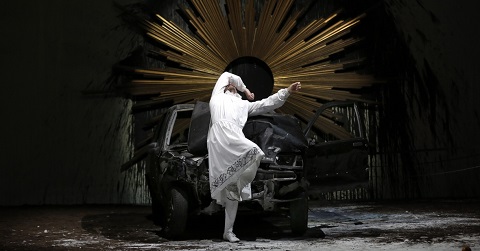
Mozart's Requiem however isn't an opera, and the idea of setting it to a manufactured narrative would evidently be presumptuous, if not actually impossible. For the purposes of this Aix-en-Provence production - an ambitious one in Pierre Audi's first season as artistic director of the festival - Castellucci associates the work with a growing awareness of the temporality of human existence as individuals and as a species, as well as the fleeting impermanence of what our relatively brief presence on the planet leaves behind. The best way of looking at this approach to Requiem is that the director is seeking a way to extend the work far beyond its own confines, showing or at least suggesting connections it makes - musical, spiritual and existential - to the condition of being human and being mortal.
To extend the scope of Requiem further for this purpose, Castellucci makes use of several other Mozart sacred pieces and Masonic hymns in including the Kyrie from the Mass in C Minor, O Gottes Lamm, and opens the theatrical presentation of this work with a Gregorian chant. Essentially, this production of Requiem becomes a ritual of song and dance, celebrating life in the face of the certainty of extinction. It's this theme that dominates as, in typical Castellucci fashion, words are projected to the back of the stage, an 'Atlas of Extinction', that enumerates the extinction of creatures that no longer exist, to extinct plants, disappeared lakes, extinct tribes and races, extinct cities, lost languages, religions, buildings and works of art.
It's a fascinating device that really has an impact in conjunction with the performance and the music, showing that as well as being something sad there's also something beautiful in the contemplation of the awareness that all things come to an end. The catalogue however doesn't restrict itself to known extinctions but gnomically reminds us in its list of "present-day extinctions", of the extinction of I, of the extinction even the of the word I, of wind, water, grass, thought, fish in the sea, time, even the extinction of this music. And ultimately of course, an extinction of this day, the 10th July 2019. Indeed, if there is anything that can testify to the glory of human existence over its relatively short presence on Earth, it's Mozart's Requiem. Eternal rest grant unto them.
On the stage meanwhile, Romeo Castellucci makes use of the Pygmalion Vocal Ensemble to enact ritual dances for Mozart's music, placing quite a different character on the work that you would typically get from a solemn concert performance. Moving ever closer towards performance art or art installations, Castellucci has extras representing all the ages of woman (from old age to birth) splatters the stage and bodies with Holi-like coloured power and honey, with soil, spray painting the backdrops, as the chorus move into formations to put on folk dances, a maypole dance and ritualistic representations of life and death, all the while that Mozart's music plays and the backscreen runs through its seemingly endless catalogue of extinction.
Seen in this context it's extraordinarily beautiful, invigorating, thought-provoking and often very moving; but even so, the question remains about whether it is worthy of Mozart's music. I return to that statement at the start of the presumption or impossibility of staging Mozart's Requiem, or believe that it can be elevated to anything greater than it already is. Given that, yes, Romeo Castellucci creates a presentation that is indeed worthy of the piece as a sincere artistic response to this great work. Like Katie Mitchell's and Raphaël Pichon's attempt to do the same for J.S. Bach at the 2014 Aix Festival (Trauernacht), or indeed like Robert Wilson's reworking of Arvo Pärt's sacred music for Adam's Passion, it is of course the music that must be the heart and soul of the production.
That relies of course principally on the musical direction of Raphaël Pichon, the Ensemble Pygmalion Orchestra and Chorus. Even in the open-air conditions of the theatre of the Théâtre de l’Archevêché in Aix in a theatrical presentation, the performances and the singing of the principals Siobhan Stagg (soprano), Sara Mingardo (alto), Martin Mitterrutzner (tenor) and Luca Tittoto (bass) - not to forget the beautiful acapella Kyrie by boy alto Chadi Lazreq - captures all the glory and solemnity of the work. It's not enhanced by the visual representation, but the busy and sometimes strange imagery of the production design doesn't detract from it either. What it does is prompt you to think about not just death but extinction, and as a mass for the death of everything, Mozart's Requiem couldn't be more fitting.
Links: Festival d'Aix-en-Provence
Wednesday, 26 December 2018
Puccini - La Bohème (London, 2018)
Giacomo Puccini - La Bohème
Royal Opera House, London - 2018
Antonio Pappano, Richard Jones, Michael Fabiano, Nicole Car, Mariusz Kwiecien, Simona Mihai, Florian Sempey, Luca Tittoto, Jeremy White, Wyn Pencarreg, Andrew Macnair, John Morrisey, Thomas Barnard
Opus Arte - Blu-ray
There's no other work of opera that hits you emotionally the way La Bohème does, and that's something you don't want to lose with an inappropriate stage production that sucks the life out of it. The challenge of finding a replacement for John Copley's long-running 40 year old production at the Royal Opera House in Covent Garden then is not without considerable risk, as its production design and tone has become inextricably entwined with the opera and even seared into the consciousness of several generations of opera goers.
Of course it doesn't have to be that way. The genius of Puccini's musical composition and arrangements goes far beyond the mere tugging of heart strings. It's a model of precision that captures a variety of tones and moods, celebrating the spirit of youthful endurance through deprivation and set-backs, of young love and maturity of sentiments, of facing up to changes including the ever-present reality and inevitability of death. It is a serious work, a great work that speaks for itself.
A stage production doesn't really need to do too much to illustrate that any further, and it often seems like Copley's production captured the essence of the work and retained a freshness while Zeffirelli's similarly long-standing production, for example, now looks tired and overwrought. No matter how enduring or suitable the production, La Bohème can always do with a bit of a refresh, even if it's just to take the predictability out of it. And, essentially, that's really all Richard Jones's new production does. Whether it improves on the old production is debatable - although I can't imagine many would think so - but it does highlight new parts of the work that might be lost through over-familiarity.
The locations remain much the same and are instantly recognisable, if a little more minimally stylised in design, which is not surprising since it's a Richard Jones production. The garret in Act I is sparsely furnished, its furnishings presumably gone the same way in earlier occasions as Rodolfo's play - into the furnace to heat the place. Narrow wooden beams bear down on the limited roof-space, a small door leading into it and a skylight above. Its bohemian artist inhabitants do indeed look like scruffy artists in second-hand clothes that may once have been smart, with long hair and unkempt beards. No hipsters here, thank goodness.
Act II is also refreshing for its move away from the traditional French street cafe depiction of Cafe Momus for a rather more obviously upmarket posh restaurant. Once outside of the garret however it also becomes clear that Richard Jones's production has also done away with 1840's Paris Commune setting for a location that is a little more generalised, but certainly evokes the nearby Covent Garden market in some kind of idealised Quality Street box way. It's a little bland, but functional and it doesn't get in the way of the musical performance, which since it's Puccini under Antonio Pappano, means it's in very capable hands, and indeed, Acts I and II are everything they should be; urgently, sweepingly romantic, playful and lyrical.
That also makes up for the lack of imagination shown in the designs for Acts III and IV. Really, Act III is just a stripped-back version of the familiar cold night outside a warm lively tavern scene, with a stage bare but for falling snow and a cardboard-box looking tavern, albeit with Marcello's wall paintings displayed on the outside (which at least shows he can paint, something that the invisible canvas in Act I and his crude stick figure drawings in Act IV don't really get across). The tavern slowly sliding into the background by itself however as the Act progresses just looks weird.
If it still works reasonably well in Act III and on its return to the even more bare garret room (it must have gotten quite cold again) in Act IV it's got a lot to do with Pappano's musical direction but also the performances of the singers. And to be fair Richard Jones's direction of the performances is also good and undoubtedly an important contributing factor to the production still working effectively as a whole. It's not the most adventurous La Bohème, but even La Fura dels Baus didn't feel like they could do much with it and let's not even get into Claus Guth's bohemians in space misfire. Only Stefan Herheim has really been able to bring a completely new approach to in his Den Norske production, deconstructing the opera, exposing its workings and revealing it as the musically impressive and emotionally harrowing masterpiece that we already know it is.
Essentially however La Bohème reinvents itself every time you bring fresh new voices in to reinterpret the work and there's an impressive line-up here. Michael Fabiano's Rodolfo is a revelation. He's a great singer that brings something new and distinctive to a role every time I've seen him, even in the most familiar roles (Alfredo in La Traviata, Don José in Carmen). His Rodolfo is superb; relaxed and confident, charming in humour and persuasive in his romantic intentions towards Mimi; there's a sweetness also in his voice and impeccable delivery that is just irresistible. Nicole Car is perhaps a bit too energetic and full of life as Mimi after her cough and stumble on his doorstep, but just as the music and character develop, so too does the emotional charge between the two of them in the final two acts. The ending is of course devastating.
Links: Royal Opera House
Royal Opera House, London - 2018
Antonio Pappano, Richard Jones, Michael Fabiano, Nicole Car, Mariusz Kwiecien, Simona Mihai, Florian Sempey, Luca Tittoto, Jeremy White, Wyn Pencarreg, Andrew Macnair, John Morrisey, Thomas Barnard
Opus Arte - Blu-ray
There's no other work of opera that hits you emotionally the way La Bohème does, and that's something you don't want to lose with an inappropriate stage production that sucks the life out of it. The challenge of finding a replacement for John Copley's long-running 40 year old production at the Royal Opera House in Covent Garden then is not without considerable risk, as its production design and tone has become inextricably entwined with the opera and even seared into the consciousness of several generations of opera goers.
Of course it doesn't have to be that way. The genius of Puccini's musical composition and arrangements goes far beyond the mere tugging of heart strings. It's a model of precision that captures a variety of tones and moods, celebrating the spirit of youthful endurance through deprivation and set-backs, of young love and maturity of sentiments, of facing up to changes including the ever-present reality and inevitability of death. It is a serious work, a great work that speaks for itself.
A stage production doesn't really need to do too much to illustrate that any further, and it often seems like Copley's production captured the essence of the work and retained a freshness while Zeffirelli's similarly long-standing production, for example, now looks tired and overwrought. No matter how enduring or suitable the production, La Bohème can always do with a bit of a refresh, even if it's just to take the predictability out of it. And, essentially, that's really all Richard Jones's new production does. Whether it improves on the old production is debatable - although I can't imagine many would think so - but it does highlight new parts of the work that might be lost through over-familiarity.
The locations remain much the same and are instantly recognisable, if a little more minimally stylised in design, which is not surprising since it's a Richard Jones production. The garret in Act I is sparsely furnished, its furnishings presumably gone the same way in earlier occasions as Rodolfo's play - into the furnace to heat the place. Narrow wooden beams bear down on the limited roof-space, a small door leading into it and a skylight above. Its bohemian artist inhabitants do indeed look like scruffy artists in second-hand clothes that may once have been smart, with long hair and unkempt beards. No hipsters here, thank goodness.
Act II is also refreshing for its move away from the traditional French street cafe depiction of Cafe Momus for a rather more obviously upmarket posh restaurant. Once outside of the garret however it also becomes clear that Richard Jones's production has also done away with 1840's Paris Commune setting for a location that is a little more generalised, but certainly evokes the nearby Covent Garden market in some kind of idealised Quality Street box way. It's a little bland, but functional and it doesn't get in the way of the musical performance, which since it's Puccini under Antonio Pappano, means it's in very capable hands, and indeed, Acts I and II are everything they should be; urgently, sweepingly romantic, playful and lyrical.
That also makes up for the lack of imagination shown in the designs for Acts III and IV. Really, Act III is just a stripped-back version of the familiar cold night outside a warm lively tavern scene, with a stage bare but for falling snow and a cardboard-box looking tavern, albeit with Marcello's wall paintings displayed on the outside (which at least shows he can paint, something that the invisible canvas in Act I and his crude stick figure drawings in Act IV don't really get across). The tavern slowly sliding into the background by itself however as the Act progresses just looks weird.
If it still works reasonably well in Act III and on its return to the even more bare garret room (it must have gotten quite cold again) in Act IV it's got a lot to do with Pappano's musical direction but also the performances of the singers. And to be fair Richard Jones's direction of the performances is also good and undoubtedly an important contributing factor to the production still working effectively as a whole. It's not the most adventurous La Bohème, but even La Fura dels Baus didn't feel like they could do much with it and let's not even get into Claus Guth's bohemians in space misfire. Only Stefan Herheim has really been able to bring a completely new approach to in his Den Norske production, deconstructing the opera, exposing its workings and revealing it as the musically impressive and emotionally harrowing masterpiece that we already know it is.
Essentially however La Bohème reinvents itself every time you bring fresh new voices in to reinterpret the work and there's an impressive line-up here. Michael Fabiano's Rodolfo is a revelation. He's a great singer that brings something new and distinctive to a role every time I've seen him, even in the most familiar roles (Alfredo in La Traviata, Don José in Carmen). His Rodolfo is superb; relaxed and confident, charming in humour and persuasive in his romantic intentions towards Mimi; there's a sweetness also in his voice and impeccable delivery that is just irresistible. Nicole Car is perhaps a bit too energetic and full of life as Mimi after her cough and stumble on his doorstep, but just as the music and character develop, so too does the emotional charge between the two of them in the final two acts. The ending is of course devastating.
Links: Royal Opera House
Sunday, 16 August 2015
Rossini - Guillaume Tell (Rossini Opera Festival, 2013 - Blu-ray)
Gioachino Rossini - Guillaume Tell
Rossini Opera Festival, Pesaro - 2013
Michele Mariotti, Graham Vick, Nicola Alaimo, Juan Diego Flórez, Marina Rebeka, Simon Orfilia, Amanda Forsythe, Luca Tittoto, Simone Alberghini, Allesandro Luciano, Celso Albelo, Wojtek Gierlach, Veronica Simeoni
Decca - Blu-ray
Rossini's final opera Guillaume Tell is a work of tremendous scale and ambition that even today still requires huge musical, singing and stage resources to do real justice to it. The blending of the Italian opera form that the composer had done so much to define is taken here to a new level with introduction of French opera traditions that practically invent the style of Grand Opera. For its production at Pesaro in 2013 the Rossini Opera Festival invited Graham Vick to take on the challenge of directing the work in a way that would retain its immense power and status, but at the same time present it in a new light. Inevitably with Vick, it becomes almost an entirely new opera.
It take a while to get your bearings here in the specially constructed stage at the Arena Adriatica in Pesaro for the 2013 Guillaume Tell, if you ever even get your bearings at all. You're not exactly in 14th century Switzerland, that's for sure. The opening scene in fact looks like it takes place on a sleek cruise liner, one where the divisions between the rich and the poor voyagers are nonetheless dressed like their counterparts on the Titanic. It at least marks a clear contrast between the Austrian aggressors of the original story and the oppressed people of Guillaume Tell's canton in Switzerland. Soldiers dressed in Austrian uniforms keep an eye on the natives, who look like they are cleaning the decks, while the nobles in their finery brush them aside. It's hard to relate to any of the specifics of the original setting.
The lack of specific location or period is somewhat unsettling. It could just as easily be a large temple, or a posh hotel with exquisite views of the surrounding Alps. Vick doesn't believe however that you can put nature up on the stage, so makes no attempt with the crudely painted backdrops to suggest anything naturalistic. As the clear distinctions between the rich and the poor and the clenched fist on the drop curtain indicate, the director clearly wants to use the stage as a "blank canvas" to make a bold statement on power and oppression, freedom and revolution, one that is bigger than a mythological story of uncertain origin. It's also an approach that corresponds with Rossini's impressive, almost Wagnerian musical efforts to tie mythology to larger questions of nationalism and identity.
Vick's modern Bayreuth-like stylisations might seem out of place in Rossini, but conductor Michele Mariotti also seems to recognise the pre-Wagnerian force and dynamic that is there in the score as well. Act I plays out almost like Der fliegende Holländer, and heard this way, you can really get a sense of how far mature Rossini has come from the bel canto and opera seria constructions/constrictions of his earlier works. There's still a danger in this work of overplaying and being drawn into heavy-handed and obscure symbolism that is out of place with the real intent of the piece. Vick's approach here looks similar to his War and Peace for the Mariinsky, but as Act II of Guillaume Tell here becomes a "workers of the world unite" against slavery and oppression, you have doubts that it's enough to just reductively and abstractly treat the issues here are nothing more than a class struggle.
By Act III however, Vick's sinister imagery starts to really sink into your bones and show how it supports those bigger questions. Arnold and Mathilde's love for each other and the sacrifices they have to make must be more than just a romantic interlude added for variety and convention. Vick's production shows that it relates to wider social issues, to family, to national pride, and even to grander questions of what life means. Act III of course also brings up such matters in a way that - as seen by the recent controversial Covent Garden production - are difficult to handle effectively without overstating or diminishing the intent. There's no rape scene, but the rich Gessler's humiliation of the 'poor' in Vick's production still has an edge of sexual abuse and humiliation that seems to strike the balance somewhat better.
It's an important point to make because it's the key moment where the occupying forces overstep the mark. Tell's defiance and his feat of skill as a bowman further undermines Gessler's credibility and the people start to believe in themselves. Vick's production, as strange and abstract as it often is, never descends into absurdity but remains connected to those very real and significant human emotions, and that makes all the difference. Of equal importance to keeping the potentially overblown drama meaningful is Michele Mariotti's fantastic conducting and the outstanding performance of the orchestra that captures all the detail and sophistication of Rossini's score, driving it forward with tremendous energy.
No less challenging in Guillaume Tell is finding the right singers for a range of challenging roles. Arguably the role of Arnold Melchtal is the most difficult role to cast, and it's a challenge even for as consummate a Rossini tenor as Juan Diego Flórez. Flórez is traditionally better suited to light comedy Rossini, but there is a darkening in his voice occurring now that gives him the opportunity to approach the darker, more dramatic tenor roles. It's still a bit of a stretch, but Flórez does remarkably well. Next to that is Mathilde, and Marina Rebeka is nothing short of phenomenal here, her voice equally strong and projected out across the whole range, the high notes in particular ringing clear and firm. Rebeka pretty much carries the otherwise fairly static Act II, making it much more interesting that it might otherwise be.
There is however not a single weak link in the singing, which in this work is really something. Nicola Alaimo has good presence as Tell, not as strong in projection, but capable of navigating the switch between intimate sensitivity and pride spilling over into furious anger with real conviction. Amanda Forsythe shows how much a strong account of Jemmy can contribute to the work as a whole and Luca Tittoto gives us a fearsome Gessler who nonetheless has more personality than just being an evil villain. Personality is what this production really has going for it, Paul Brown's sets, Vick's direction, a uniformly strong cast and particularly Mariotti's conducting, really exploring the true worth of Guillaume Tell.
The 2013 Rossini Opera Festival production of Guillaume Tell is released on DVD and BD by Decca. The four-hour long work transfers well to the screen. It would seem that considerable work has been done to make the problematic acoustics of the basketball stadium of the Arena Adriatica more suitable for opera performance. The audio tracks here, in uncompressed PCM Stereo and DTS HD-Master Audio 5.1 are astonishingly good, and the bright stage production is filmed well. There is a short extra feature on the disc exploring Graham Vick's production and the challenges of putting it on stage. The Blu-ray is region-free, with subtitles in English, French, German and Korean.
Rossini Opera Festival, Pesaro - 2013
Michele Mariotti, Graham Vick, Nicola Alaimo, Juan Diego Flórez, Marina Rebeka, Simon Orfilia, Amanda Forsythe, Luca Tittoto, Simone Alberghini, Allesandro Luciano, Celso Albelo, Wojtek Gierlach, Veronica Simeoni
Decca - Blu-ray
Rossini's final opera Guillaume Tell is a work of tremendous scale and ambition that even today still requires huge musical, singing and stage resources to do real justice to it. The blending of the Italian opera form that the composer had done so much to define is taken here to a new level with introduction of French opera traditions that practically invent the style of Grand Opera. For its production at Pesaro in 2013 the Rossini Opera Festival invited Graham Vick to take on the challenge of directing the work in a way that would retain its immense power and status, but at the same time present it in a new light. Inevitably with Vick, it becomes almost an entirely new opera.
It take a while to get your bearings here in the specially constructed stage at the Arena Adriatica in Pesaro for the 2013 Guillaume Tell, if you ever even get your bearings at all. You're not exactly in 14th century Switzerland, that's for sure. The opening scene in fact looks like it takes place on a sleek cruise liner, one where the divisions between the rich and the poor voyagers are nonetheless dressed like their counterparts on the Titanic. It at least marks a clear contrast between the Austrian aggressors of the original story and the oppressed people of Guillaume Tell's canton in Switzerland. Soldiers dressed in Austrian uniforms keep an eye on the natives, who look like they are cleaning the decks, while the nobles in their finery brush them aside. It's hard to relate to any of the specifics of the original setting.
The lack of specific location or period is somewhat unsettling. It could just as easily be a large temple, or a posh hotel with exquisite views of the surrounding Alps. Vick doesn't believe however that you can put nature up on the stage, so makes no attempt with the crudely painted backdrops to suggest anything naturalistic. As the clear distinctions between the rich and the poor and the clenched fist on the drop curtain indicate, the director clearly wants to use the stage as a "blank canvas" to make a bold statement on power and oppression, freedom and revolution, one that is bigger than a mythological story of uncertain origin. It's also an approach that corresponds with Rossini's impressive, almost Wagnerian musical efforts to tie mythology to larger questions of nationalism and identity.
Vick's modern Bayreuth-like stylisations might seem out of place in Rossini, but conductor Michele Mariotti also seems to recognise the pre-Wagnerian force and dynamic that is there in the score as well. Act I plays out almost like Der fliegende Holländer, and heard this way, you can really get a sense of how far mature Rossini has come from the bel canto and opera seria constructions/constrictions of his earlier works. There's still a danger in this work of overplaying and being drawn into heavy-handed and obscure symbolism that is out of place with the real intent of the piece. Vick's approach here looks similar to his War and Peace for the Mariinsky, but as Act II of Guillaume Tell here becomes a "workers of the world unite" against slavery and oppression, you have doubts that it's enough to just reductively and abstractly treat the issues here are nothing more than a class struggle.
By Act III however, Vick's sinister imagery starts to really sink into your bones and show how it supports those bigger questions. Arnold and Mathilde's love for each other and the sacrifices they have to make must be more than just a romantic interlude added for variety and convention. Vick's production shows that it relates to wider social issues, to family, to national pride, and even to grander questions of what life means. Act III of course also brings up such matters in a way that - as seen by the recent controversial Covent Garden production - are difficult to handle effectively without overstating or diminishing the intent. There's no rape scene, but the rich Gessler's humiliation of the 'poor' in Vick's production still has an edge of sexual abuse and humiliation that seems to strike the balance somewhat better.
It's an important point to make because it's the key moment where the occupying forces overstep the mark. Tell's defiance and his feat of skill as a bowman further undermines Gessler's credibility and the people start to believe in themselves. Vick's production, as strange and abstract as it often is, never descends into absurdity but remains connected to those very real and significant human emotions, and that makes all the difference. Of equal importance to keeping the potentially overblown drama meaningful is Michele Mariotti's fantastic conducting and the outstanding performance of the orchestra that captures all the detail and sophistication of Rossini's score, driving it forward with tremendous energy.
No less challenging in Guillaume Tell is finding the right singers for a range of challenging roles. Arguably the role of Arnold Melchtal is the most difficult role to cast, and it's a challenge even for as consummate a Rossini tenor as Juan Diego Flórez. Flórez is traditionally better suited to light comedy Rossini, but there is a darkening in his voice occurring now that gives him the opportunity to approach the darker, more dramatic tenor roles. It's still a bit of a stretch, but Flórez does remarkably well. Next to that is Mathilde, and Marina Rebeka is nothing short of phenomenal here, her voice equally strong and projected out across the whole range, the high notes in particular ringing clear and firm. Rebeka pretty much carries the otherwise fairly static Act II, making it much more interesting that it might otherwise be.
There is however not a single weak link in the singing, which in this work is really something. Nicola Alaimo has good presence as Tell, not as strong in projection, but capable of navigating the switch between intimate sensitivity and pride spilling over into furious anger with real conviction. Amanda Forsythe shows how much a strong account of Jemmy can contribute to the work as a whole and Luca Tittoto gives us a fearsome Gessler who nonetheless has more personality than just being an evil villain. Personality is what this production really has going for it, Paul Brown's sets, Vick's direction, a uniformly strong cast and particularly Mariotti's conducting, really exploring the true worth of Guillaume Tell.
The 2013 Rossini Opera Festival production of Guillaume Tell is released on DVD and BD by Decca. The four-hour long work transfers well to the screen. It would seem that considerable work has been done to make the problematic acoustics of the basketball stadium of the Arena Adriatica more suitable for opera performance. The audio tracks here, in uncompressed PCM Stereo and DTS HD-Master Audio 5.1 are astonishingly good, and the bright stage production is filmed well. There is a short extra feature on the disc exploring Graham Vick's production and the challenges of putting it on stage. The Blu-ray is region-free, with subtitles in English, French, German and Korean.
Sunday, 17 May 2015
Charpentier - Médée (Basel, 2015 - Webcast)
Marc-Antoine Charpentier - Médée
Theater Basel, 2015
Andrea Marcon, Nicolas Brieger, Magdalena Kožená, Anders J. Dahlin, Luca Tittoto, Meike Hartmann, Robin Adams, Silke Gäng, Yukie Sato, Jenny Högström, Regina Dahlen, Tiago Pinheiro de Olivieira, Daniel Issa, Ismael Arróniz Gónzales, Santiago Garzon
Culturebox - 21 January 2015
Compared to some other versions of the Medea story, Marc-Antoine Charpentier's musical arrangements and Thomas Corneille's libretto for Médée can seem somewhat dry and formal. Musically it's a little austere, the baroque instrumentation of plucked strings and theorbo not quite as expressive as you might find elsewhere in other versions of the work. Medea however relies on the shock of the climax, and if it takes a little time getting there, Charpentier's conclusion is up there with the best of them.
A lot of course depends on the staging, not that there have been many productions of this work since it was first performed in 1693, and just as much rests on the singer playing the part of Medea. Theater Basel's 2015 production may be updated to a more modern setting, but it retains the simplicity of line of Charpentier's score, and it relies heavily on the casting of Magdalena Kožená to supply all the fire that is needed to bring out the underlying darkness that the score itself barely hints at. And, largely, it succeeds.
The modern setting of Creon's Corinth here has something of the look of a Soviet dictatorship, albeit one that revels in the luxury of its own success and power. Assurance of that power is however, as we discover later, a fatal mistake where Medea is concerned. Creon however believes that an alliance between his daughter Creusa and Jason will consolidate his position, Jason having recently fled Thessaly looking for asylum. Jason is a warrior Creon can use, but it would not be in his interests to have a woman like his wife Medea in Corinth. She's the reason for their taking flight, the people of Thessaly troubled by her sorcery. Medea is therefore "asked to leave" by Creon, and, as we know, she takes terrible revenge for this, and for Jason's betrayal in leaving her and staying behind to marry Creusa.
The mechanics of laying out the history and the relationships between each of the figures isn't the most invigorating, Charpentier placing additional emphasis here on Medea forming an alliance with Oronte, who has been displaced from Creusa's affections by the arrival of Jason in the court of Corinth. There are certainly a few dramatic touches to add some colour, often coming at the end of each of the acts. Director Nicholas Brieger tries to integrate some of these more baroque elements in a different way. Act II, for example, ends with an kind of cabaret show where the Italian singer wears a red wig, seemingly parodying the red-haired Medea, but it doesn't really follow the idea through.
Act III of Médée also ought to end with Medea enacting the familiar scene of her performing her sorcery over a cauldron, preparing the poison for the dress that she will present to Creusa. Charpentier and Corneille's version takes an even more colourful approach to this scene than usual, the stage directions specifying that the robe is "brought by flying demons", with Medea's state of mind given corporeal form in the shape of La Jealousie and La Vengeance, through them forging a direct link to Hell. The demons are there all right in the Basel staging, as are Jealousy and Vengeance, and the force of Medea's passions are all there in Kožená's singing, but it still doesn't quite reach the level of intensity found in Euripides or even Cherubini's opera version of this scene.
Sorcery plays its part most openly in Act IV, where Medea evades Creon's guards and drives him to madness when she turns them into beguiling women, but the implication that comes though most strongly in Corneille's libretto is that Medea's power is not her sorcery or her temperament. It's herself as a woman, and the underestimation of a woman's power by Creon. You're mistaken, she tells Creon in this scene, if you think your laws apply to me - "Souviens-toi, je suis Médée". Charpentier's woman scorned doesn't just condemn Creusa to a painful death in a poisoned robe, and doesn't just destroy Jason and her own children (as horrifying as this is alone), she destroys Creon, leaves his court in flames and pretty much leaves an obliterated Corinth in her wake. Now, that's one heck of a Medea.
If the baroque music isn't quite expressive or discordant enough to get this across in modern terms - though Andrea Marcon and the Basel orchestra certainly find plenty of colour and dynamic in the score - it's abundantly clear in the writing for the mezzo-soprano voice and in the delivery of it by Magdalena Kožená. I haven't heard a lot of Kožená over the last decade, but she demonstrates here that her voice is as powerful as it ever was. It's such a full and richly toned voice, strong and controlled right across the range, and utterly dramatic when it comes to those moments of Medea expressing the full extend of her fury. Anders J. Dahlin's haute-contre doesn't stand a chance against such a force, but his Jason is no wimp either, steely rather, capable of fine expression. There is a fine performance too from Meike Hartmann's Creusa (her death scene almost devastating) and a solid baritone Creon in Luca Tittoto.
Links: Culturebox
Theater Basel, 2015
Andrea Marcon, Nicolas Brieger, Magdalena Kožená, Anders J. Dahlin, Luca Tittoto, Meike Hartmann, Robin Adams, Silke Gäng, Yukie Sato, Jenny Högström, Regina Dahlen, Tiago Pinheiro de Olivieira, Daniel Issa, Ismael Arróniz Gónzales, Santiago Garzon
Culturebox - 21 January 2015
Compared to some other versions of the Medea story, Marc-Antoine Charpentier's musical arrangements and Thomas Corneille's libretto for Médée can seem somewhat dry and formal. Musically it's a little austere, the baroque instrumentation of plucked strings and theorbo not quite as expressive as you might find elsewhere in other versions of the work. Medea however relies on the shock of the climax, and if it takes a little time getting there, Charpentier's conclusion is up there with the best of them.
A lot of course depends on the staging, not that there have been many productions of this work since it was first performed in 1693, and just as much rests on the singer playing the part of Medea. Theater Basel's 2015 production may be updated to a more modern setting, but it retains the simplicity of line of Charpentier's score, and it relies heavily on the casting of Magdalena Kožená to supply all the fire that is needed to bring out the underlying darkness that the score itself barely hints at. And, largely, it succeeds.
The modern setting of Creon's Corinth here has something of the look of a Soviet dictatorship, albeit one that revels in the luxury of its own success and power. Assurance of that power is however, as we discover later, a fatal mistake where Medea is concerned. Creon however believes that an alliance between his daughter Creusa and Jason will consolidate his position, Jason having recently fled Thessaly looking for asylum. Jason is a warrior Creon can use, but it would not be in his interests to have a woman like his wife Medea in Corinth. She's the reason for their taking flight, the people of Thessaly troubled by her sorcery. Medea is therefore "asked to leave" by Creon, and, as we know, she takes terrible revenge for this, and for Jason's betrayal in leaving her and staying behind to marry Creusa.
The mechanics of laying out the history and the relationships between each of the figures isn't the most invigorating, Charpentier placing additional emphasis here on Medea forming an alliance with Oronte, who has been displaced from Creusa's affections by the arrival of Jason in the court of Corinth. There are certainly a few dramatic touches to add some colour, often coming at the end of each of the acts. Director Nicholas Brieger tries to integrate some of these more baroque elements in a different way. Act II, for example, ends with an kind of cabaret show where the Italian singer wears a red wig, seemingly parodying the red-haired Medea, but it doesn't really follow the idea through.
Act III of Médée also ought to end with Medea enacting the familiar scene of her performing her sorcery over a cauldron, preparing the poison for the dress that she will present to Creusa. Charpentier and Corneille's version takes an even more colourful approach to this scene than usual, the stage directions specifying that the robe is "brought by flying demons", with Medea's state of mind given corporeal form in the shape of La Jealousie and La Vengeance, through them forging a direct link to Hell. The demons are there all right in the Basel staging, as are Jealousy and Vengeance, and the force of Medea's passions are all there in Kožená's singing, but it still doesn't quite reach the level of intensity found in Euripides or even Cherubini's opera version of this scene.
Sorcery plays its part most openly in Act IV, where Medea evades Creon's guards and drives him to madness when she turns them into beguiling women, but the implication that comes though most strongly in Corneille's libretto is that Medea's power is not her sorcery or her temperament. It's herself as a woman, and the underestimation of a woman's power by Creon. You're mistaken, she tells Creon in this scene, if you think your laws apply to me - "Souviens-toi, je suis Médée". Charpentier's woman scorned doesn't just condemn Creusa to a painful death in a poisoned robe, and doesn't just destroy Jason and her own children (as horrifying as this is alone), she destroys Creon, leaves his court in flames and pretty much leaves an obliterated Corinth in her wake. Now, that's one heck of a Medea.
If the baroque music isn't quite expressive or discordant enough to get this across in modern terms - though Andrea Marcon and the Basel orchestra certainly find plenty of colour and dynamic in the score - it's abundantly clear in the writing for the mezzo-soprano voice and in the delivery of it by Magdalena Kožená. I haven't heard a lot of Kožená over the last decade, but she demonstrates here that her voice is as powerful as it ever was. It's such a full and richly toned voice, strong and controlled right across the range, and utterly dramatic when it comes to those moments of Medea expressing the full extend of her fury. Anders J. Dahlin's haute-contre doesn't stand a chance against such a force, but his Jason is no wimp either, steely rather, capable of fine expression. There is a fine performance too from Meike Hartmann's Creusa (her death scene almost devastating) and a solid baritone Creon in Luca Tittoto.
Links: Culturebox
Thursday, 24 May 2012
Handel - Ariodante
Georg Friedrich Handel - Ariodante
Theater Basel, 2012
Luca Tittoto, Franziska Gottwald, Maya Boog, Nikolay Borchev, Christiane Bassek, Agata Wilewska, Noel Hernández Lopez
Basel, Switzerland, 17 May 2012
This is obviously very much a personal view, but the best approach to staging Baroque opera seems to be to avoid the traditional approach at all costs. By all means stick to the traditional in terms of singing and period instrumentation - there really isn’t any alternative that works better - but in my experience, if you want to find a way to engage a modern audience and take them through the rather static drama and the rather stiff conventions of the repetitive da capo arias of Baroque opera, it helps if there is some inventiveness and an imaginative approach to the staging. Done straight, it can be difficult to lift or support the emotions that are being expressed at length in the long arias between the few moments of dramatic content - although this obviously depends on the composer and Handel is certainly an exception - but until relatively recently, it was supposed that hardly any Baroque opera, not even Handel, could ever be presented to a modern audience.
Thankfully, through painstaking research, restoration and training in period instruments from Baroque musical experts like William Christie, Jordi Savall, René Jacobs and Christophe Rousset, have proved that these works are of much more than just interest to music historians. Staging these works however is another matter altogether, and it often requires a radical approach. I’m thinking of Doris Dörrie’s Noh-theatre inspired direction of Handel’s Admeto, the Royal Opera House’s 2010 production of Steffani’s Niobe or, as when I last visited the Theater Basel, the WWII updating of Gluck’s Telemaco, but as seen with William Kentridge’s production of Die Zauberflöte, there are also a wider range of tools that can be at service to a director of personal vision and imagination. In my experience - again this is very much a personal viewpoint - it’s surprising just how successful some of the more radical presentations can be in this respect, the more abstract conceptual stage approach tapping into the emotional content over and above the dry recounting of the narrative of the libretto. I don’t think however that I’ve ever seen anything quite as ambitious as director Stefan Pucher and the Theater Basel’s wonderful willingness to experiment with Baroque opera through modern theatrical tools in their extraordinary 2012 production of Handel’s Ariodante.
There’s nothing particularly inspiring about Ariodante’s late-eighth century Scottish setting, but theatre director Stefan Pucher - in his first opera production - clearly recognises that this ancient setting and the opera seria music that accompanies it is so far removed from what we are familiar with as to be practically abstract anyway. What is still relevant is the opera’s human story of love, jealousy, deception and revenge, and that was given utmost consideration. Act I then accordingly provided a tartan overload in the most extravagant of colours and weaves that, if they might not relate to any specific clan, certainly gave each of the figures their own strong definition. The tartan stretched to the brightly lit and visually impressive set designs that seems to create an enhanced 3-D effect through the still images, gothic paintings (by 17th century artist Otto Marseus van Schrieck), slow moving projections and lighting effects on the foreground screens, while the singing platform was set back on a revolving stage within a wide inverted cross. The sets inside were rather minimal, with a few eccentric touches in keeping with the Schrieck imagery such as giant bugs and slugs in an orange room in Act 1, but the frequent refreshing of the set from scene to scene all contributed to keep attention from flagging.
Even this would eventually have become tiresome over the course of the whole opera, but the designers also managed to find a distinct visual look for each of the subsequent two acts, if it was never a look that related naturalistically to any location specified in the libretto. A kick-boxing match standing-in for the battle between Polinesso and Ariodante on the jousting grounds was perhaps the strangest sight in Act III. Showing that there was a complete understanding of the structure of the works however and the necessary impact that was written into the chorus and ballet finales of each of the acts, the director pulled out all the stops at these points, inviting the audience to sing along to ‘Sì godete al vostro amor’ from music sheets handed out to the audience when entering the theatre (a surprisingly invigorating experience), and using filmed outdoor sequences featuring the cast, which was also extremely effective in suggesting the depths of Ginevra’s madness and inner turmoil at the end of Act II. More than just being visually stunning, the whole multimedia experience encompassed the tone and the intent of the music score, as well as drawing in the viewer and involving them fully in the experience. It made the production - the finest I think I’ve seen during the 2011-12 season - absolutely riveting.
Mezzo-soprano Franziska Gottwald demonstrated a breathtaking range and facility for the demanding arias assigned to Ariodante, and was particularly impressive in Act II’s ‘Scherza infida’. Maya Boog however was just as impressive as Ginevra, handling the arias with aplomb, but also acting with genuine emotional and dramatic conviction throughout. There were however no weak elements in the casting which also included Agata Wilewska as Dalinda, Luca Tittoto as the King, Nikolay Borchev as Lurciano and Christiane Bassek as a disturbingly moustachioed, long-haired villain Polinesso, and Noel Hernández Lopez as Odoardo.
Subscribe to:
Posts (Atom)


