Showing posts with label Nicole Car. Show all posts

Thursday, 6 May 2021

Gounod - Faust (Vienna, 2021)


Charles Gounod - Faust

Wiener Staatsoper, 2021

Bertrand de Billy, Frank Castorf, Juan Diego Flórez, Nicole Car, Adam Palka, Étienne Dupuis, Martin Häßler, Kate Lindsey, Monika Bohinec

Wiener Staatsoper Live - 29 April 2021

It doesn't surprise me that some opera lovers would not be too fond of the directorial style of Frank Castorf. He certainly has his own unique approach to opera that is not to everyone's taste. Even if you are open to new ways of presenting opera, there's an awful lot thrown into a Castorf production; some of it obviously related to the work, other elements rather less so. It can be hard work and while you might want to put the effort in for something like Der Ring des Nibelungen, From The House of the Dead or Die Vögel, you might be less inclined to see all the Castorf tricks employed on something as popular as Gounod's Faust.

Opera however is a multi-faceted artform and the best works prove to be adaptable to renovation and reconsideration. Through its very nature Faust should provide not only plenty of entertaining songs, beautiful arias and dramatic situations for singing and dancing, but it should also be able to address other deeper elements in Dr Faustus's search for love, youth and the meaning of life. Entering into a pact with Satan in exchange for such knowledge inevitably brings up questions of morality, religion and war, which means there is plenty for a director like Frank Castorf to get his teeth into.
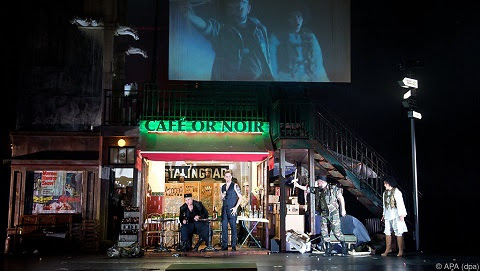

Castorf's approach is seemingly haphazard and random, a bit of a mess frankly on first viewing, particularly if you are looking for all the familiar situations and signposts. I mean, there are signposts up there pointing to Paris locations, but not the kind that help you find a direction through the drama. Rather than view the opera as a continuous narrative or, in the case of Gounod's opera, a series of separate scenes that build up into an overall work, Castorf goes for the holistic approach and puts everything on the stage all at once. And it's not just the sets all on a revolving platform and even piled on top of one another, but characters and separate incidents, unrelated to the main scene, are all shown simultaneously backstage, projected in live camera shots on screens. It's an awful lot to take in all at once.

So there on Aleksandar Denić's revolving set, you can see a condensed Paris, past and future all piled on top of one another, front and behind, interiors opening onto exteriors, with a cafe, a church, a butcher shop, the Folies Bergère, and residential apartments. It's dressed in typical Castorf fashion, with obscure movie posters, a telephone booth, a Coke machine. There's even a metro station recreated, the Stalingrad station, where Kate Lindsey's Siébel comes out wearing a desert combat military uniform, his feet bloodied.


With police and foreign legion soldiers in kepis, one of Castorf's targets here is at least clear enough. Valentin emerges out of the metro and paints the words "Algeria is French" on the wall, while additional texts and commentary point to a less idealistic view of Valentin's military exploits, De Gaulle and France's colonialist history and atrocities. The devil is indeed in the detail and there's no doubting the nature of Mephistopheles here. He's not some smooth businessman or smart-dressed nobleman. He comes complete with demonic accoutrements; hairy goat legs, horse tail and hooves. He's a voodoo practitioner, using live snakes, he's menacing and seductive. 

Having thrown all that onto the stage with not a great deal of rationale provided, there's little evidence either of much character development or direction of the singers. Juan Diego Flórez is allowed to stand and sing arias out directly to the audience in an arm waving concert performance delivery. Nicole Car likewise delivers arias outward, but makes up for this by appearing to be much more emotionally attuned to Marguerite and her sad fate. Here Marguerite is not the naive waif we are accustomed to, but since this is the 21st century (or 20th maybe) she is more worldly wise. She puffs on opium and has a good time, but is not fool enough to trust Faust and takes responsibility for her own mistakes.

Frank Castorf appears to be more in his element when he can abandon the limitations of the libretto and "surreptitiously" film Faust and Marguerite behind the scenes with handheld cameras in manufactured situations. This can be a little bit 'random' particularly when filming and developing the other characters Marthe and Siébel. If there is anything that helps guide you through Castorf's production, something compelling that holds like an anchoring point in all the madness, it's Nicole Car's performance that places Marguerite at the heart of Gounod's opera. It's an outstanding performance which could prove to be her defining role.

Juan Diego Flórez can hit the notes all right but his voice is a little too lightweight for Faust, when it needs more of an Alagna or Kaufmann. He doesn't make the same kind of impression that Car does, but aside from the operatic gesturing to the non-existent audience (the production here filmed during lockdown in an empty theatre), it's not a bad performance. Adam Palka is an excellent Mephistopheles, fully entering into the demonic nature of this version of the character and proving to be menacing in tone and performance. Bertrand de Billy conducted the work with a fullness of melody and drama.

I'm not so sure that Castorf really connects with Gounod's Faust or has anything insightful to say about it, but he certainly gives you plenty of opportunity to reconsider the work and see it in a new light. You can question the validity of that approach since for the most part that has less to do with the actual work than the peripheral action, in the additional behind the scenes projections and twists of characterisation. Whether it works or not, whether it's convincing or not isn't the point. You don't have to agree with his choices, but even that allows you to firm up your own convictions about the work. That, as far as I'm concerned, is certainly better than having nothing to contribute.

Links: Vienna State Opera, Wiener Staatsoper Live

Thursday, 12 November 2020

Tchaikovsky - Eugene Onegin (Vienna, 2020)


Pyotr Ilyich Tchaikovsky - Eugene Onegin


Wiener Staatsoper, 2020

Tomáš Hanus, Dmitri Tcherniakov, Liubov Orfenova, Helene Schneiderman,
Nicole Car, Anna Goryachova, Larissa Diadkova, Andrè Schuen, Bogdan Volkov, Dimitry Ivashchenko, Dan Paul Dumitrescu, Mykola Erdyk, Johanna Mertinz

Staatsoper Live - 31 October 2020

The perspective that the present gives us on the past should be one of age and wisdom looking back on the foolish acts of youth, but all to often the view from a comfortable distance is just as untrustworthy, leading us to look back fondly and nostalgically on times that were actually painfully difficult to live through and, for better or worse, character forming. Perspective and the passing of time is very much at the heart of Tchaikovsky's Eugene Onegin, and that's the focus of Dmitri Tcherniakov's new production for the Vienna State Opera.

Always at his best when directing Russian masterpieces, Dmitri Tcherniakov alerts us to the untrustworthiness of memory and nostalgia right from the outset of this production. There are no peasants and labourers toiling in the fields singing songs that ennoble the nature of working the land. Here in the Vienna production rather we see a large family gathered around a dinner table in a room that is a comforting sea of beige ("a golden dream"), where the guests join in and make fun of Madame Larina's nostalgic reminiscences. The old harvesting songs are also romanticised and sung as a dinner party recital by Tatiana and Olga.

It's a frivolous world, comfortably detached from real world feelings and concerns. Even Lensky's effusive poetry to Olga here seems playful, a fond recognition of the ways of a more innocence age. No doubt the sentiments are genuine, but they are made to look out of place here. Even Madame Larina no longer retains any of the romantic novelistic illusions of her youth. This opening setting proposes diametrically opposed views of the world between the dreamer and the reality, which of course only enforces and emphasises the distance between the impressionable bookish dreamer Tatyana and the aloof, arrogant 'man of the world' Onegin.

Although that delves further into the melancholy of such sentiments expressed in the music than most, it's far from the most original observation to make about Tchaikovsky's masterpiece. The queer interpretation by Krzysztof Warlikowski (Munich 2012), the expansive view of Russian society and culture in Stefan Herheim's production (Amsterdam, 2011), the doubling with dancers in Kasper Holten's production (Royal Opera House, 2013) autumnal moods of light and colour of Robert Carsen (The Met, 2007) all found innovative ways to tap into the many undercurrents that lie within this extraordinary opera. Tcherniakov more recently does seem to rein in indulgences and seem to play a little safer using beige-coloured living-rooms as a way to satirise the middle class, using them as a microcosm of society, but it can still be challenging and appropriate. Here the mood is intensified by the production never leaving the dining room, neither to spend the sleepless night in Tatyana's bedroom, nor even the duel scene.

Evidently then, the more pointed commentary is revealed in other little touches and in the direction of performers, all of them contributing to emphasise the central themes. The utter sincerity of Tatyana's depth of feeling at the conclusion of the letter scene is in heartbreaking contrast to the frivolity of Onegin and all the others around her. It even seems to embody that distinctly paradoxical Russian characteristic of frivolous sincerity and sincere frivolity that lies very much at the heart of the work. Perhaps it's in that character that Tcherniakov dispenses entirely with Monsieur Triquet and instead has Lensky sing the birthday ode to Tatyana (in Russian), the party descending into sheer playful mayhem that is in complete contrast to how Tatyana is feeling. And indeed Lensky.

In this production, it seems that Lensky has an even greater shattering of illusions than Tatyana, or it can certainly seem as such when it is sung and performed with such heartfelt sincerity as it is here by Bogdan Volkov. Lensky's experience proves to be just as critical to the impact and meaning of the work as a whole when it's permitted to be (Warlikowski also for example using the quarrel between him and Onegin as a way of tapping into those deeper sentiments). Here only Tatyana understands how he feels while the others laugh and mock. The duel is no less shocking for taking place in front of all the family and friends in the dining room, reduced to a tussle over a shotgun that accidentally goes off. The impact is every bit as tragic and devastating as it ought to be in the context of this highly charged romantic masterwork.

Considered against Lensky and Tatyana, Onegin is reduced to a mockery in the opera named after him. His return to society in Act III and his self-important tale of his difficult years is met with icy disdain and casual dismissal at the high society function in another elegant dining room, this one a blaze of rich red and formality compared to the easy golden nostalgia of the Larin estate dining room. Onegin finds himself unwelcome, not some tragic romantic figure as he is in Deborah Warner's somewhat misguided 2013 Met production, and certainly not the one he thinks he is. The Russian society here is changed too, now one of ostentatious wealth where outsiders are not made comfortable, detached from their roots and the past.

Tomáš Hanus carried much of Tchaikovsky's romantic melancholy and Russian-ness in his conducting and it was played well; a little bit broad in its sweep I felt, but the music has a lot to cover. Onegin is an inconstant man, difficult to really grasp, particularly when he is played as someone superficial and unsympathetic here. André Schuen never really convinces of any sincerity but that seems to be what Tcherniakov is aiming for here. It's only at the conclusion that he lets go and reveals or becomes aware of his true feelings and expresses everything of the ignominy of a rejected lover. It put one in mind at this time of the level of self-delusion turning to realisation of a populist US President who can't quite believe that he has been rejected by an electorate who used to hang on his every word and tweet. As mentioned earlier, Bogdan Volkov raises Lensky to a new level of importance in this opera with a heartfelt performance that is in complete contrast to Onegin.

The role of Tatyana is a difficult one, needing a singer capable of covering the range of naive youth with a more reflective mature experience. And yet, do we ever really change? Is Tatyana not the same, even after the passing of years? Doesn't she prove to be still capable of making a foolish mistake, still capable of following her heart, following a self-destructive urge and throw caution to the wind. Is she not Russian? No one is immune to such feelings at any age, as Prince Gremlin also testifies in "All men surrender to love's power". Tcherniakov recognises and so does Nicole Car, presenting a consistent vision of the romantic that lies at the heart of anyone who has seen, understood and been moved by the extraordinary beauty and sadness of life through love as its portrayed in Tchaikovsky's Eugene Onegin.

Links: Vienna State Opera, Wiener Staatsoper Live

Friday, 28 June 2019

Mozart - Don Giovanni (Paris, 2019)


Wolfgang Amadeus Mozart - Don Giovanni

L'Opéra National de Paris, 2019

Philippe Jordan, Ivo Van Hove, Étienne Dupuis, Ain Anger, Jacquelyn Wagner, Stanislas de Barbeyrac, Nicole Car, Philippe Sly, Mikhail Timoshenko, Elsa Dreisig

Paris Cinema Live - 21 June 2019


It's not as if Mozart's operas works aren't already clearly progressive works, in their musical qualities as well as in their expression of the injustices and inequalities within society, and as such they always seem to be capable of revealing other aspects and changing facets that reflect the times we are living in. The 'droit de seigneur' of Le Nozze di Figaro can certainly be applied to contemporary situations, showing that Mozart was already there with #MeToo long before its time and there's also something about Don Giovanni that takes in all the complexities of male and female relationships on a deeper and more universal level.

If we can recognise what is universal and true in Mozart's Don Giovanni, it doesn't need a director like Ivo van Hove to bring it out or add anything new to it. Not that you have to, since attempting to fit those works to contemporary morals and attitudes can still be problematic. Sometimes the best thing you can do is let a work speak for itself and the sign of a good director is knowing when to step back and where to intervene and what to highlight to bring to the attention of the audience. Van Hove's setting of his Paris Opera production consequently aims for the universal, blending modern and period characteristics, but feels almost respectful of Mozart in terms of the plotting, not daring to mess with it too much.


Of course in Don Giovanni, certain choices have to be made by any director that have considerable influence on the tone of the work. One of the first choices any director has to make is whether Don Giovanni is a seducer and a lover of women or an aggressor and an abuser. Even within that you have to determine whether he is a victim of his own desires, incapable of being anything but his nature (and whether the women who are drawn to him are not more than creatures of nature too) and thus deserving of some sympathy.

Some productions in the past have suggested that Donna Anna was leading him on, that the killing of the Commendatore is just an accident or self-defence, that his only real crime is arrogance in believing that he is above the laws of nature, that he is in control of them, that there is no harm or consequence to his behaviours, that he is exempt (whether through nobility, vanity or just arrogant superiority) from paying any price for his actions. While it's valid to explore the many possibilities that this fascinating character and the other fascinating characters play in the opera (and they all have an important part to play), there's no real doubt about how Mozart saw Don Giovanni. It's in the original title; a dissolute punished.

Ivo van Hove clearly wants to stick with that line of thinking, and I'm minded to consider the previous Paris Opera production directed by the filmmaker Michael Haneke in relation to this, Haneke making the original title explicit, taking a political spin on the work and making the punishment very much a case of earthly justice of the people deposing a cruel, thoughtless and arrogant leader. Van Hove's choices are less imposing on the work and not so politically minded, but his outlook on it means that the production unquestionably has a darker colour that doesn't permit the usual comic interplay with Leporello. Van Hove's contribution, if it adds up to anything, is in holding to this consistent tone, in getting the performers all working together to bring that character to the fore and making it feel as deep and real and meaningful as Mozart scores it.

What is also noticeable about this production - although really you should already be aware of this - is that the women in Don Giovanni are amazing. Mozart's enlightened thinking was genuinely far ahead of his time. Without having to expressly evoke any contemporary application, it's evident enough to anyone currently witnessing the rise of the #MeToo movement that these are women in Don Giovanni who are here prepared to stand up against their aggressor, not let society say that they are complicit, nor let it make them doubt their own nature. The may have been naive perhaps in their expectations of someone like Don Giovanni, but nothing more than that, and he has gravely abused their nature, their trust and their person.


That comes out well, and it's a director's job to ensure that that it does, so whether you recognise Ivo Van Hove's hand in this (as with his theatrical work his directing of actors is a lot more subtle than his bold and experimental scenic touches suggest), his choices and directions unquestionably strike an accurate and consistent tone. And it's not just in the casting and performance of Don Giovanni, although Étienne Dupuis is outstanding as a serious, calculating and manipulative noble here, his singing and performance striking a superb balance between charming and utterly deadly, but how the other characters respond to him is vitally important.

I've pondered before when considering Le Nozze di Figaro how important the secondary roles are in Mozart's operas, and concluding that if you give due attention to the casting and character of all the roles, there are greater dividends to be found. There's no such thing as a secondary or minor role in Mozart's operas - in the Da Ponte trilogy of works at least - and that the operas achieve their true greatness when all of them are given serious consideration. I don't think Don Giovanni can be anything but great, but when you give those superbly detailed characters (in terms of personality, as well as in the incredible pieces of music that Mozart writes for them), the true genius of the complexity of people's behaviour and their relationships is apparent.

In that respect, this is a great Don Giovanni. Director intervention might appear minimal, but the coaching of the performers to find the real people within those roles, to bring out what Mozart and Da Ponte put there is evident here. Of course, it's consideration of the fate of the women that is just as important, if not more important than Don Giovanni (although Don Giovanni and Leporello must also be taken seriously in how they display another side of human nature), and when you do that, not only do you get heartfelt, fiery performances from Jacquelyn Wagner as Donna Anna and Nicole Car as Donna Elvira, but you get the whole richness of women's sentiments and personality when you take that attention down to Elsa Dreisig's sincere Zerlina. Superb singing from Philippe Sly as Leporello, Stanislas de Barbeyrac as Don Ottavio, Ain Anger as the Commendatore, and Mikhail Timoshenko as Masetto kept a strong consistent tone across all the relationships in the production of this work.


How much the production design contributed to the overall impact of the work is difficult to determine, but it clearly worked well. The whole opera takes place here outside Don Giovanni's imposing grey castle with little of the usual film references that you associate with an Ivo Van Hove production and instead more of an Escher quality, or Duke Bluebeard's Castle in the sense of the maze like entrapment of the castle's staircases, alleys and doorways. Modern suits are mixed with medieval attitudes. It's uniformly grey, but there are flashes of colour there when the director wants to draw attention to aspects of the drama and the music.

There is little also of the director's customary use of projections, Van Hove keeping those tricks in the bag until later for maximum impact. The use and wielding of guns give an extra edge of danger, of threatening masculinity and abuse of power. The effects are saved for the finale, as you might expect in the descent to hell scene. What you might not expect is the superb handling of the necessary final sextet, often cut in darker interpretations of the opera. Here it is necessary to give a sense that this dark masculine world can be healed and it's women, Mozart's women - the clue already revealed in the seemingly throwaway scene between Zerlina and Masetto - who are the healing force in the opera. I expected something a little more radical from this director doing Don Giovanni, but no it didn't need it. Van Hove sees what is important in the opera, in Mozart's outlook, and he nails it.


L'Opera de Paris, Culturebox

Wednesday, 26 December 2018

Puccini - La Bohème (London, 2018)

Giacomo Puccini - La Bohème

Royal Opera House, London - 2018

Antonio Pappano, Richard Jones, Michael Fabiano, Nicole Car, Mariusz Kwiecien, Simona Mihai, Florian Sempey, Luca Tittoto, Jeremy White, Wyn Pencarreg, Andrew Macnair, John Morrisey, Thomas Barnard

Opus Arte - Blu-ray

There's no other work of opera that hits you emotionally the way La Bohème does, and that's something you don't want to lose with an inappropriate stage production that sucks the life out of it. The challenge of finding a replacement for John Copley's long-running 40 year old production at the Royal Opera House in Covent Garden then is not without considerable risk, as its production design and tone has become inextricably entwined with the opera and even seared into the consciousness of several generations of opera goers.

Of course it doesn't have to be that way. The genius of Puccini's musical composition and arrangements goes far beyond the mere tugging of heart strings. It's a model of precision that captures a variety of tones and moods, celebrating the spirit of youthful endurance through deprivation and set-backs, of young love and maturity of sentiments, of facing up to changes including the ever-present reality and inevitability of death. It is a serious work, a great work that speaks for itself.


A stage production doesn't really need to do too much to illustrate that any further, and it often seems like Copley's production captured the essence of the work and retained a freshness while Zeffirelli's similarly long-standing production, for example, now looks tired and overwrought. No matter how enduring or suitable the production, La Bohème can always do with a bit of a refresh, even if it's just to take the predictability out of it. And, essentially, that's really all Richard Jones's new production does. Whether it improves on the old production is debatable - although I can't imagine many would think so - but it does highlight new parts of the work that might be lost through over-familiarity.

The locations remain much the same and are instantly recognisable, if a little more minimally stylised in design, which is not surprising since it's a Richard Jones production. The garret in Act I is sparsely furnished, its furnishings presumably gone the same way in earlier occasions as Rodolfo's play - into the furnace to heat the place. Narrow wooden beams bear down on the limited roof-space, a small door leading into it and a skylight above. Its bohemian artist inhabitants do indeed look like scruffy artists in second-hand clothes that may once have been smart, with long hair and unkempt beards. No hipsters here, thank goodness.


Act II is also refreshing for its move away from the traditional French street cafe depiction of Cafe Momus for a rather more obviously upmarket posh restaurant. Once outside of the garret however it also becomes clear that Richard Jones's production has also done away with 1840's Paris Commune setting for a location that is a little more generalised, but certainly evokes the nearby Covent Garden market in some kind of idealised Quality Street box way. It's a little bland, but functional and it doesn't get in the way of the musical performance, which since it's Puccini under Antonio Pappano, means it's in very capable hands, and indeed, Acts I and II are everything they should be; urgently, sweepingly romantic, playful and lyrical.

That also makes up for the lack of imagination shown in the designs for Acts III and IV. Really, Act III is just a stripped-back version of the familiar cold night outside a warm lively tavern scene, with a stage bare but for falling snow and a cardboard-box looking tavern, albeit with Marcello's wall paintings displayed on the outside (which at least shows he can paint, something that the invisible canvas in Act I and his crude stick figure drawings in Act IV don't really get across). The tavern slowly sliding into the background by itself however as the Act progresses just looks weird.


If it still works reasonably well in Act III and on its return to the even more bare garret room (it must have gotten quite cold again) in Act IV it's got a lot to do with Pappano's musical direction but also the performances of the singers. And to be fair Richard Jones's direction of the performances is also good and undoubtedly an important contributing factor to the production still working effectively as a whole. It's not the most adventurous La Bohème, but even La Fura dels Baus didn't feel like they could do much with it and let's not even get into Claus Guth's bohemians in space misfire. Only Stefan Herheim has really been able to bring a completely new approach to in his Den Norske production, deconstructing the opera, exposing its workings and revealing it as the musically impressive and emotionally harrowing masterpiece that we already know it is.

Essentially however La Bohème reinvents itself every time you bring fresh new voices in to reinterpret the work and there's an impressive line-up here. Michael Fabiano's Rodolfo is a revelation. He's a great singer that brings something new and distinctive to a role every time I've seen him, even in the most familiar roles (Alfredo in La Traviata, Don José in Carmen). His Rodolfo is superb; relaxed and confident, charming in humour and persuasive in his romantic intentions towards Mimi; there's a sweetness also in his voice and impeccable delivery that is just irresistible. Nicole Car is perhaps a bit too energetic and full of life as Mimi after her cough and stumble on his doorstep, but just as the music and character develop, so too does the emotional charge between the two of them in the final two acts. The ending is of course devastating.

Links: Royal Opera House

Friday, 5 January 2018

Puccini - La Bohème (Paris, 2017)


Giacomo Puccini - La Bohème

L’Opéra National de Paris, 2017

Gustavo Dudamel, Claus Guth, Nicole Car, Aida Garifullina, Atalla Ayan, Artur Rucinski, Alessio Arduini, Roberto Tagliavini, Marc Labonnette, Antonel Boldan, Bernard Arrieta, Jain-Hong Zhao, Fernando Velasquez

Culturebox - 12 December 2017

No, no matter how much you try to rationalise it, there could surely be no justification for director Claus Guth reinventing La Bohème as a science-fiction space adventure. As strange as Guth's productions can often be, this one for the Paris Opera was always going to be a bit of a stretch. But you've got to admire Guth's nerve for even attempting something like this at La Bastille, where a large conservative element in the audience don't usually take kindly to such directorial indulgences. I couldn't wait to see what Guth did with this, even if failure and the disapprobation of the Paris audience was likely to be the outcome of such a conceit.

As outrageous as the idea might seem and as outlandish as it indeed looks seeing La Bohème take place on a space station crash-landing on a distant moon, Guth's approach to making it fit actually isn't all that surprising. It's one step removed from 'it was all a dream' brought on by bereavement and deprivation leading to mental breakdown (as Stefan Herheim also basically proposed in his reverse deconstructed Oslo production), and in a futuristic space context that kind of idea tends to play out like Solaris (which has already been adopted to opera in recent years by Detlev Glanert and Dai Fujikura), a work which leaves room for some in-depth consideration of the nature of human relationships.

La Bohème then actually has some suitability for this kind of feverish nightmare outlook. The forced comedy of impoverished artists facing starvation projecting their creative imaginations towards surreal displays can be seen as a distraction from the reality of their circumstances. The 'pretend' feast and acquiring of riches in Act I then results in the surrealism of fantasies of dining at Café Momus and in a parade of life that surrounds the toy seller Parpignol. The charade becomes harder to maintain as the realities hit home on Act III, and in Act IV the playing becomes a grim dance of death.


In such a creative mindset, Marcello's painting of the Red Sea in Act I could just as easily be a vision of the Red Planet, couldn't it? Well, in Guth's production it literally is the view outside the window that faces a small team of astronauts whose ship has broken down, but that's about the only easy transition in the production between a garret in fin de siècle Paris and the cabin of a rocket ship. Elsewhere, like Rodolfo, you're going to have to be a bit imaginative in finding any convincing connection or rationale for the production's extraterrestrial setting, but Guth tries to give us one based on Henry Murger's original stories being viewed by the protagonists as older people reflecting on youth and mortality ...only in an outer space setting evidently.

The captain's log, rolled out on a screen, tells us that the four-man team's mission has gone off course 136 days into their space voyage; their reactors are down, resources are almost exhausted and time is running out for the crew. In an effort to keep their spirits up they let their imaginations run free on an idealised version of a long gone past. Seen largely from the perspective of Rodolfo's disintegrating grasp on reality, it's no surprise that suspended in a state between sleep and waking delirium his mind returns to happier times and he is haunted Solaris Hari-like by visions of his lost love Mimi.

It's absolute nonsense - quite literally, of course, since we are perceiving events through a mind on the edge of complete breakdown. But at the same time that doesn't add or bring anything new to the state of mind of La Bohème's characters living on the margins of society, or to the nature of the relationships of love, friendship and camaraderie that develop between them in their straitened circumstances. Worse, Guth's transposition of it onto another planet in some science-fiction future runs the risk of actually distracting from the sentiments of the work; which is just wrong, even if you think that La Bohème is a sentimental work (which I don't).

The attempt to sustain the idea of course just becomes more and more ludicrous the longer it goes on. By Act III, the pilots have been driven to make a forced landing on a barren planet or moon, and the inevitability of their fate lost in the void of space - and a lack of oxygen to the brain - just pushes their delusions further into absurdity. Yes, you can probably make a connection between Rodolfo in a space suit cut off emotionally from a Mimi who contorts and cavorts in a red dress on an airless dusty moonscape - although you're more likely to think it's a wonder she's only coughing - but you would get that anyway from a traditional production without the added distraction.


Act IV is increasingly desperate, and I don't just mean for Rodolfo. With Schaunard and Colline already dead, their suits running out of air, Rodolfo starts to imagine himself and Marcello as part of some kind of cabaret act on the moon, complete with glittering strip curtain backdrop. Parpignol is still cavorting around as a mime artist (please!), not for the first time being presented as a kind of death-like master-of-ceremonies figure (cf. Herheim again). Full marks to Claus Guth for this effort at provocation - I sometimes feel the Paris audience deserve such baiting - but I don't think La Bohème deserves it.

I also felt curiously unmoved by Gustavo Dudamel's conducting of the score, which highlighted the delicacy of the composition but lacked any real feeling for the work. It floated along pleasantly enough, but never made any emotional connection with the drama, although it's hard to tell how much of that is down to the failings of the stage direction. The singing too felt merely adequate for the most part, Atalla Ayan's Rodolfo a little harsh-sounding and imprecise, but Nicole Car's Mimi certainly stood out, and Aida Garifullina was a sparkling Musetta - not bad for figments of Rodolfo's imagination and memory. I doubt that Guth's space-age production of La Bohème will be considered as imaginative or memorable, but it's unlikely to be forgotten in a hurry.

Links: L’Opéra National de Paris, Culturebox