Carl Maria von Weber - Euryanthe
Theater an der Wien, 2018
Constantin Trinks, Christof Loy, Jacquelyn Wagner, Norman Reinhardt, Theresa Kronthaler, Andrew Foster-Williams, Stefan Cerny, Eva-Maria Neubauer
Naxos - Blu-ray
There are often good reasons why some works remain neglected and rarely performed, but it's at least nice to be able to have the opportunity to hear them and judge for yourself, even if in most cases you have to admit that few are really lost masterpieces. Carl Maria Von Weber's 1823 opera Euryanthe however may genuinely be considered a neglected masterpiece.
Euryanthe is one of those works whose reputation is better known than the work itself, that reputation being that it has some lovely music but is let down by a poor libretto. Considering Weber's importance in the world of German music and his huge influence on Richard Wagner, it's surely a shame that other than Der Freischütz, the composer's operas haven't been given due attention in performance. Christof Loy's production of Euryanthe for the Theater an der Wien however suggests that this is a great work worthy of re-evaluation.
In terms of plot Euryanthe does indeed just appear to adopt another variation on a classic Romantic theme based around challenges against the virtue of innocent women. It's there in Schumann's only opera Genoveva, but the subject can also be seen in Shakespeare's The Rape of Lucretia and Cymbeline. Mozart also took an apparently more light-hearted comic angle on the subject in Così fan tutte, but as several recent productions have demonstrated (Teatro Real 2013, Aix 2016), Mozart and Da Ponte's approach is far more subtle, balanced, darker and nuanced than it might seem. Despite the reputation of its libretto and plot, and the relentless darkness of the treatment, Christof Loy successfully shows that there is similar nuance and sophistication worth exploring in Euryanthe.

Like The Rape of Lucretia there's an underlying context of war having a dehumanising impact on men and influencing how they behave towards women in Euryanthe. At the beginning of the opera Count Adolar is returning from war, disillusioned but revived at the thought of returning to his wife Euryanthe. Having only seen the worst of what man is capable, the one thing that can restore his faith in humanity is the assurance of his wife's purity and fidelity. Count Lysiart however is rather more cynical and bets Adolar that he could seduce Euryanthe. Adolar is outraged and ready to duel Lysiart for this insult to his wife's honour, but has such faith in Euryanthe that, with King Ludwig's intervention, he is prepared to accept the bet to prove the point beyond dispute.
So far there's nothing unusual in a subject like that, it's a stirring situation that gives rise to conflicts of passions and moral dilemmas. There is however a complicating factor here in Eglantine, the daughter of a disgraced noble that Adolar has taken into their home, and her being in love with Adolar adds more than just another level of dramatic conflict. The introduction of a kind of ghost story around the untimely death of Adolar's sister Emma, who killed herself after her betrothed Udo died in battle, is another factor that comes into play, a shameful secret that Eglantine plans to use against Euryanthe in collaboration with Lysiart, but it also relates to Emma and Udo both being victims of war as a destructive force.

All this can seem like the plot has a few too many high-flown Romantic sentiments - the opera is subtitled 'A Great Heroic Romantic Opera' - but Christof Loy's approach to this melodrama is as usual to find the real human feeling in the work. Not unexpectedly that can be found with considerable depth in the music of Carl Maria Von Weber. It might fall back now and again on conventional elements of dramatic villainy, ghostly apparitions and wistful musing of innocents, but only in the same way that Mozart also made use of a similar wide range of means to plunge ever deeper into the darkness of Don Giovanni's soul. Weber's music, conducted her by Constantin Trinks, is beautifully aligned to the mood and the drama of Euryanthe and it's not difficult to see how Wagner would develop on this to an epic scale, particularly evident in a similar confrontation between innocence impugned and villainy given credence in Lohengrin.
Loy seizes on the power of such situations and music applies it to characterisation that can be seen to be much more three-dimensional than its reputation would have you believe. The director never lets the characters emote alone or soliloquise to the audience in an indulgent manner, but rather shows them tapping into the deepest human feelings of love, jealousy, lust and betrayal. And if that means having the object of one's affections present when their spirit - and other parts - are being bared, then so be it. Rather like the spirit of Emma, it makes these emotions present and tangible, generating a highly charged atmosphere.
The stage design is appropriate for the context and, rather than relying on typical Der Freischütz-like Romantic locations of woods, glens and dramatic landscapes, Loy keeps the drama confined to an elegant mansion. The cool minimalism of the rooms only serves to heighten and contrast the surface manners of high society with the barely contained lusts and prejudices simmering beneath. It's not so far away from Loy's more recent take on Schreker's similarly heated drama Die ferne Klang, or indeed his stripping of those emotional charges literally stark naked as with his production of Korngold's Das Wunder der Heliane. Andrew Foster Williams is the unfortunate who has to bear all this time, his "wild impulses of glowing desire" out there for the viewer to see, but spared anything too close up. It certainly makes the idea of intended rape more viscerally real and the subsequent teaming up of Lysiart with Eglantine after this is deliriously demented and utterly convincing.
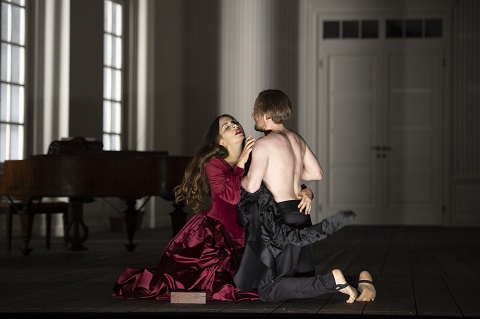
It's the singing too of course that makes this convincing and the principal cast, as well as the chorus, are simply superb. Jacquelyn Wagner has a perfect clean soaring timbre that is perfect for the part of Euryanthe. She's more than just an innocent victim, but the vocal line tells us more than the words alone about her firmness of purpose and her pureness of heart, and Wagner brings out the real human feeling that is scored into the role. Norman Reinhardt shows how Adolar is a prototype Heldentenor, an idealist conflicted between the purity of vision and his response to the baseness of the world.
Theresa Kronthaler and Andrew Foster-Williams bring a chilling edge of menace in roles that are even more villainous and - in this production at least - even more deranged and cruel than Ortrud and Telramund. Looking at the opera this way pointing towards towards Lohengrin, King Ludwig IV is very much a Heinrich der Vogler type of role and it's one that bass Stefan Cerny is not only capable of performing to a Wagnerian level but he also brings some character and personality to make it count within the dramatic development of the plot. Rather than being a forgotten minor work by a respected but neglected composer, Euryanthe turns out to be essential listening for any Wagnerian, a wondrous rediscovery, and Loy's treatment of the work at Theater an der Wien will not disappoint.
The production looks good on the High Definition Blu-ray release from Naxos, although there are some minor niggles. The strong contrasts make whites look a little blown-out, and the image is a little bit shimmery and blurring in movement. Whether that's an authoring issue with the transfer bit-rate I don't know, but it's not too distracting. It doesn't appear that radio mics are used so there's a wider open acoustic theatrical sound here, which means that it also picks up a bit of ambient noise, including creaking floorboards, but the LPCM 2.0 and DTS HD-Master Audio 5.1 mixes still capture the power and the detail of the performance. The BD is all-region compatible, with German, English, French, Japanese and Korean subtitles. The booklet contains a synopsis and an interview with Christof Loy.
Links: Theater an der Wien
Wolfgang Amadeus Mozart - Don Giovanni
L'Opéra National de Paris, 2019
Philippe Jordan, Ivo Van Hove, Étienne Dupuis, Ain Anger, Jacquelyn Wagner, Stanislas de Barbeyrac, Nicole Car, Philippe Sly, Mikhail Timoshenko, Elsa Dreisig
Paris Cinema Live - 21 June 2019
It's not as if Mozart's operas works aren't already clearly progressive works, in their musical qualities as well as in their expression of the injustices and inequalities within society, and as such they always seem to be capable of revealing other aspects and changing facets that reflect the times we are living in. The 'droit de seigneur' of Le Nozze di Figaro can certainly be applied to contemporary situations, showing that Mozart was already there with #MeToo long before its time and there's also something about Don Giovanni that takes in all the complexities of male and female relationships on a deeper and more universal level.
If we can recognise what is universal and true in Mozart's Don Giovanni, it doesn't need a director like Ivo van Hove to bring it out or add anything new to it. Not that you have to, since attempting to fit those works to contemporary morals and attitudes can still be problematic. Sometimes the best thing you can do is let a work speak for itself and the sign of a good director is knowing when to step back and where to intervene and what to highlight to bring to the attention of the audience. Van Hove's setting of his Paris Opera production consequently aims for the universal, blending modern and period characteristics, but feels almost respectful of Mozart in terms of the plotting, not daring to mess with it too much.

Of course in Don Giovanni, certain choices have to be made by any director that have considerable influence on the tone of the work. One of the first choices any director has to make is whether Don Giovanni is a seducer and a lover of women or an aggressor and an abuser. Even within that you have to determine whether he is a victim of his own desires, incapable of being anything but his nature (and whether the women who are drawn to him are not more than creatures of nature too) and thus deserving of some sympathy.
Some productions in the past have suggested that Donna Anna was leading him on, that the killing of the Commendatore is just an accident or self-defence, that his only real crime is arrogance in believing that he is above the laws of nature, that he is in control of them, that there is no harm or consequence to his behaviours, that he is exempt (whether through nobility, vanity or just arrogant superiority) from paying any price for his actions. While it's valid to explore the many possibilities that this fascinating character and the other fascinating characters play in the opera (and they all have an important part to play), there's no real doubt about how Mozart saw Don Giovanni. It's in the original title; a dissolute punished.
Ivo van Hove clearly wants to stick with that line of thinking, and I'm minded to consider the previous Paris Opera production directed by the filmmaker Michael Haneke in relation to this, Haneke making the original title explicit, taking a political spin on the work and making the punishment very much a case of earthly justice of the people deposing a cruel, thoughtless and arrogant leader. Van Hove's choices are less imposing on the work and not so politically minded, but his outlook on it means that the production unquestionably has a darker colour that doesn't permit the usual comic interplay with Leporello. Van Hove's contribution, if it adds up to anything, is in holding to this consistent tone, in getting the performers all working together to bring that character to the fore and making it feel as deep and real and meaningful as Mozart scores it.
What is also noticeable about this production - although really you should already be aware of this - is that the women in Don Giovanni are amazing. Mozart's enlightened thinking was genuinely far ahead of his time. Without having to expressly evoke any contemporary application, it's evident enough to anyone currently witnessing the rise of the #MeToo movement that these are women in Don Giovanni who are here prepared to stand up against their aggressor, not let society say that they are complicit, nor let it make them doubt their own nature. The may have been naive perhaps in their expectations of someone like Don Giovanni, but nothing more than that, and he has gravely abused their nature, their trust and their person.

That comes out well, and it's a director's job to ensure that that it does, so whether you recognise Ivo Van Hove's hand in this (as with his theatrical work his directing of actors is a lot more subtle than his bold and experimental scenic touches suggest), his choices and directions unquestionably strike an accurate and consistent tone. And it's not just in the casting and performance of Don Giovanni, although Étienne Dupuis is outstanding as a serious, calculating and manipulative noble here, his singing and performance striking a superb balance between charming and utterly deadly, but how the other characters respond to him is vitally important.
I've pondered before when considering Le Nozze di Figaro how important the secondary roles are in Mozart's operas, and concluding that if you give due attention to the casting and character of all the roles, there are greater dividends to be found. There's no such thing as a secondary or minor role in Mozart's operas - in the Da Ponte trilogy of works at least - and that the operas achieve their true greatness when all of them are given serious consideration. I don't think Don Giovanni can be anything but great, but when you give those superbly detailed characters (in terms of personality, as well as in the incredible pieces of music that Mozart writes for them), the true genius of the complexity of people's behaviour and their relationships is apparent.
In that respect, this is a great Don Giovanni. Director intervention might appear minimal, but the coaching of the performers to find the real people within those roles, to bring out what Mozart and Da Ponte put there is evident here. Of course, it's consideration of the fate of the women that is just as important, if not more important than Don Giovanni (although Don Giovanni and Leporello must also be taken seriously in how they display another side of human nature), and when you do that, not only do you get heartfelt, fiery performances from Jacquelyn Wagner as Donna Anna and Nicole Car as Donna Elvira, but you get the whole richness of women's sentiments and personality when you take that attention down to Elsa Dreisig's sincere Zerlina. Superb singing from Philippe Sly as Leporello, Stanislas de Barbeyrac as Don Ottavio, Ain Anger as the Commendatore, and Mikhail Timoshenko as Masetto kept a strong consistent tone across all the relationships in the production of this work.

How much the production design contributed to the overall impact of the work is difficult to determine, but it clearly worked well. The whole opera takes place here outside Don Giovanni's imposing grey castle with little of the usual film references that you associate with an Ivo Van Hove production and instead more of an Escher quality, or Duke Bluebeard's Castle in the sense of the maze like entrapment of the castle's staircases, alleys and doorways. Modern suits are mixed with medieval attitudes. It's uniformly grey, but there are flashes of colour there when the director wants to draw attention to aspects of the drama and the music.
There is little also of the director's customary use of projections, Van Hove keeping those tricks in the bag until later for maximum impact. The use and wielding of guns give an extra edge of danger, of threatening masculinity and abuse of power. The effects are saved for the finale, as you might expect in the descent to hell scene. What you might not expect is the superb handling of the necessary final sextet, often cut in darker interpretations of the opera. Here it is necessary to give a sense that this dark masculine world can be healed and it's women, Mozart's women - the clue already revealed in the seemingly throwaway scene between Zerlina and Masetto - who are the healing force in the opera. I expected something a little more radical from this director doing Don Giovanni, but no it didn't need it. Van Hove sees what is important in the opera, in Mozart's outlook, and he nails it.
L'Opera de Paris, Culturebox


