Showing posts with label Stefan Cerny. Show all posts

Wednesday, 30 March 2022

Verdi - Rigoletto (Lyon, 2022)


Giuseppe Verdi - Rigoletto

Opéra de Lyon - 2022

Alexander Joel, Axel Ranisch, Enea Scala, Dalibor Jenis, Nina Minasyan, Stefan Cerny, Agata Schmidt, Daniele Terenzi, Grégoire Mour, Dumitru Madarasan, Roman Chabaranok, Heiko Pinkowksi

Opéra de Lyon - 23rd March 2022

Some people might not like it being played around with and transposed to a more modern period, but the fact is that even Verdi needed to revise Victor Hugo's original setting of Le Roi s'amuse and backdate Rigoletto in order to make it work for his own purposes as an opera. State censorship of course played a part in making things difficult for him, but Verdi was never one for letting that stop him and he certainly made no compromises on what mattered about the subject of Rigoletto; the abuse of power, the dangers of aligning oneself with them, and the strain this places on personal and family life. Those themes are evidently timeless.

Presented as part of their 2022 Festival season alongside the Franz Schreker rarity Irrelohe and the Bach cantatas arranged as Trauernacht, the Lyon production of Rigoletto uses an idea that is familiar to other interpretations, taking it away from the elevated context of kings or dukes behaving badly and putting it in a more relatable modern day context where the power and abuse of it is in the hands of men with money. Here, as with other mafia versions of the opera (see Jonathan Miller's famous production or indeed the Met's Las Vegas version) the Duke is a gangster, but one who presides over the tower block HLMs of Paris or even perhaps the the built-up high rises on the outskirts of suburban Lyon.

There is another level added here in Axel Ranisch's production that attempts to bring it even more into present-day reality; an on-screen movie that shows how anyone - anyone - can relate to the sentiments so powerfully expressed by Verdi in Rigoletto. The movie sequences feature "Hugo", a Verdi fan whose favourite opera is Rigoletto, and, as the overture plays, the projected scenes show him loading up a video cassette performance of an opera. He can identify personally with the plight, the fears and the loss that Rigoletto experiences in his devotion to his family, as he has had difficult experiences with his own, to the extent that he is now about to take his own life.

Most of the new approach to the opera in this production indeed takes place on the screen. Hugo was I believe also meant to be a live presence on the stage as a silent actor - inserting himself into the opera drama - but on the evening I attended Heiko Pinkowksi was indisposed and the two stage and screen stories played out in parallel rather than blended together. It still worked well, particularly effective in a couple of key scenes. The scene where Gilda asks about her mother (Act I, Scene 9 - "Fatte ch'io sappia la madre mia"), a projection shows Hugo's loss of his own wife when pregnant with their daughter. It certainly hits home the reality of what Rigoletto experiences and gives reason for his over-protectiveness of Gilda. It makes it real and it does it perfectly in the context of Verdi's score.

Elsewhere the actual stage production is less creative in its depiction of the excesses of the Duke's behaviour and in the nature of the gang members who follow, aiding and abetting in his crimes. It's a typical depiction of a street mob, a gangland mafia with an arrogant, charismatic boss. Falko Herold's set design however is superb in how effectively it captures the sense of desperation of life in the high rise banlieus. That too feeds into Gilda's hope of escape from the poverty and restrictive circumstances of her situation.

There are actually one or two individual directorial touches that also play neatly into Verdi's feel for the story. Monterone is actually killed in the first Act, and it's his ghost that appears to be being led out to execution in Act II, the bloody apparition emphasising the deep impact that the curse (la maledizione!) has had on Rigoletto's mind. Similarly, Gilda's death scene pushes the idea of self-sacrifice, as Sparfucile holds back when he removes the cloak from the unexpected late-night visitor and recognises Gilda. Or since he hasn't seen her before, he probably hesitates to kill a woman, leaving Gilda to present him with the necessary dead body by killing herself. It's effective but perhaps more so since the underlying sentiments are also mirrored in Hugo's filmed story.

It has to be said that this movie drama no more strives for realism than Verdi's melodrama, but somewhere between the on-stage action and the events played out on the screen, Ranisch's production touches on the essential qualities, the humanity and the emotional force that Verdi brings through in the fantastic score. That is played out in a exemplary fashion by Alexander Joel, standing in on this evening for an indisposed Daniele Rustioni. It's best brought out in performance however by Nina Minasyan's superb Gilda. Holding back a little only in dramatic performance, vocally at least she was outstanding, exhibiting a wonderful purity of voice and a smooth legato that reached up to those high bel canto coloratura notes with precision and often with the requisite emotion.

Enea Scala was also in very fine voice as Il Duca and provided the necessary charisma as well as bringing a bit of additional character to the Duke. The production assisted in this by introducing a Duchess who silently reprimands his actions and indiscretions, but tacitly puts up with them. Scala's delivery of the Duke's arias was excellent, filled with the swagger of one who knows he can get away with it. Dalibor Jenis was a fine Rigoletto, but aside from Leo Nucci, I have seen few who can really bring something special to this role. Stefan Cerny's Sparfucile was also well played. It may be hard to bring anything new to Rigoletto, but there is still life, truth and relevance in the work, and the Lyon production certainly got that across.


Links: Opéra de Lyon

Tuesday, 27 April 2021

Wagner - Parsifal (Vienna, 2021)


Richard Wagner - Parsifal

Wiener Staatsoper, 2021

Philippe Jordan, Kirill Serebrennikov, Jonas Kaufmann, Georg Zeppenfeld, Elīna Garanča, Ludovic Tézier, Wolfgang Koch, Stefan Cerny, Ileana Tonca, Anna Nekhames, Aurora Marthens

ARTE Concert  - 18 April 2021

With its blend of philosophy, religion, mythology, spirituality and humanism, Wagner's Parsifal can be a tough prospect to make sense of on a narrative level, particularly in translating that to a modern audience in recognisable human terms. Not that it needs a coherent narrative. Almost every production I've seen of this masterpiece has found original endless (and sometimes baffling) ways of presenting it, while at the same time everything that it is about is all there in the music. And when I say music, it's not just the notes on the page, the singing or even the interpretation of it but the space and time it occupies in performance. The viewer enters into communion with Parsifal in a way that does not happen quite the same way with any other opera.

High-flown words maybe, but there is truth in this. You could write volumes exploring the work, you could write books alone on productions like Herheim's Bayreuth Parsifal, and yet however the work is dressed up, whatever means are used to explore its themes, it rarely fails to make some kind of impact and it's often a profound one. At heart the theme and message of the work can be said to be relatively simple, but in its simplicity it touches on something vast, the essence of an important aspect of what it means to be human, perhaps the most important. Redemption through Compassion, the understanding of which will put us on the path to our soul's salvation.

Even though there are clear religious and ceremonial overtones in the presentation of these themes in Parsifal's Easter Good Friday message, it certainly doesn't need to be seen through a Christian or religious perspective. Indeed such grave solemnity and reverence in a production can get in the way of letting the music express its deep human qualities. Not to make excuses for the sometimes unclear situations and direction in the current Vienna State Opera production by Kirill Serebrennikov, but even the idea of putting that into a coherent dramatic narrative is ridiculous. Anyone expecting or needing a "story" to get it across is missing the point. Richard Wagner utterly and completely puts it all into musical language, which is even more direct and yet complex in how it manages to achieve that with such incredible impact.

It's difficult to describe convincingly how the Vienna 2021 lockdown production manages to get that across - it would take a long time and a lot of pointless analysis - but it unquestionably does. Serebrennikov's setting certainly looks unlike anything else you might associate with Montsalvat. Here's it's a prison, looking more like Janáček's From The House of the Dead. Gurnemanz is the respected veteran lifer who takes young ones under his wing, shows them the ropes and even does tattoos for them. Unlike any other Gurnemanz, this one even collects packages of contraband drugs from bent wardens for them. He knows they need something else to get them through the misery of their situation, and tells them stories that give hope that some kind of redemption may be possible. Even those living in an eternal hell like the seriously ill Amfortas.

It seems unlikely that the new young man on the cell block is going to be any kind of saviour in this production. Young and foolish, he's forgotten his good upbringing and got into a lot of trouble. Not so innocent, in prison he has even killed a man, a "swan", an albino man with tattoo wings who tried to get close to him naked in the showers and paid the price. Someone however sees his potential; Kundry, a visitor who has been granted permission to photograph inside the prison, gathering images of raw masculinity for a fashion magazine, "Schloss". She however lives within a prison of her own and is seeking a way out, seeing something within this young man that might help her overcome her own demons if they don't swallow him up as well.

Aided by projections, the production plays the long first Act out as if it happens over a number of days, and that works well, in its own way bending time and space, encapsulating the inner world and dreams of the prisoners with the harsh reality of their confinement. The idea of being outside of time in any linear narrative is also put across in the use of flashback, Jonas Kaufmann the older wiser Parsifal looking back with regret on his past mistakes and innocence of his younger self, played by actor Nikolay Sidorenko. If you don't quite understand where it is going however that also turns out to be a good thing, as the whole opera is a process, you need to live through it and experience it in its totality to understand it in any kind of way.

Act II however proves to be pivotal here as it should be but far too often fails to adequately achieve. It opens up some of that in the unlikely setting of the offices of Schloss, a fashion magazine run by the tyrannical Klingsor. The Flowermaidens are fashion journalists, office staff and even cleaning staff, all lusting over the new cover model, which really is no less relatable than having mythical female ciphers float around him. What makes Act II striking is by bringing in what is only alluded to in the original and making it central to the purpose of the work, and that's Parsifal's mother Herzeleide.

Many productions have sought to extend the range of Parsifal far beyond the singing characters - Philipp Stölzl even recreating the crucifixion of Christ in a Deutsche Oper production - and with good reason, as much of what is learned as a process doesn't just extend over a lifetime, but over many lifetimes. The production here finds that the best way of expressing what sparks Parsifal's journey to self-realisation is the image that Kundry evokes of his mother. The director brings not just one but three Herzeleide's to the stage. Parsifal's first true feelings for another person are, appropriately and meaningfully, for his mother. Understanding what she has suffered for him only for him to go off the rails, is a profound revelation. Through this he suddenly realises what Amfortas has been going through, and sets out to find a way of bringing healing to his suffering.

And quite what role Kundry plays in this is also difficult to describe but it's vital, the Flowermaidens likewise presenting him with different aspects of what it means to be a woman, deepening his understanding of his own mother's situation. Somehow the director Serebrennikov - mainly though the medium of an astonishing performance from Elīna Garanča - manages to match up the sense of deep sorrow, regret and loss with a sultry undercurrent that runs through the music in this Act. Act II can often feel disjointed and unfathomable, but at its best it is enigmatic and the key to the work, and the new Vienna production makes the most of it, not least in Philippe Jordan's conducting, pacing and navigation of the dynamics of the score.

Trying to analyse and correlate the production with a predetermined idea of what Parsifal should be and even expecting it to deliver a coherent narrative is however besides the point. It's a metaphor, and it makes no more sense than expecting Wagner's mythology of the Knights of the Holy Grail, the suffering of Amfortas, the killing of a swan, the evil of Klingsor and the revelation in a kiss to make sense on any level of reality that is relatable to our lives. The best that a production can do is perhaps illuminate one aspect of the many themes and ideas expressed in the work and put it into terms that are recognisable to a modern audience. And if you can get across an important message - as this one does about imprisonment of the soul and finding a way to freedom - then it's more than enough. Anyone expecting to make narrative sense of the director's production however is only distracting themselves from the beauty of the sentiments expressed and the performances.

And what performances! It's not just a starry cast with a few experienced and distinguished Wagnerians in key roles, but there are some chances and risks taken in a few of the other casting choices that make it much more interesting and bring a little something extra to the production. Jonas Kaufmann sings the role of Parsifal well, if inevitably a little detached by being doubled with an actor. It's sung in the manner that you may be accustomed to, a manner not to everyone's taste, slightly over-pushed. He can do grave and anguished but personally I felt that he lacks sensitivity for Parsifal, and crucially lacks compassion for the role. Elsewhere however there is little to fault.

As we've come to expect from his other Wagner bass roles, Georg Zeppenfeld is just perfect. Hunding, Heinrich der Vogler and King Marke are one thing, but Gurnemanz is a much more extensive role on another level entirely. If the strain sometimes showed over the four hour running time, there was little evidence of it in his singing, which was faultless throughout, warm and compelling. As mentioned earlier, Elīna Garanča also takes her performance to another level. Kundry does present such opportunities for a singer, and even if this production didn't give her as much of a central role or room for interpretation, Garanča takes it to the level required in her singing and acting performance. I've never seen her sing a role so deeply.

Defining Klingsor as a sleazy office manager abuser of his position and power is more relatable than viewing him simplistically as an evil sorcerer, and Wolfgang Koch is suitably sinister in a typically reliable performance. Ludovic Tézier is one of the world's finest Verdi baritones and that doesn't necessarily translate over to a traditional Amfortas role in Wagner, but it certainly makes for an interesting interpretation. He carries some of the mannerisms of Italian opera across, but nonetheless gives a lyrical, sincere and heartfelt performance here. Avoiding the cliches of the spear healing the wound, he nonetheless finds peace as Parsifal's healing message of love, forgiveness and compassion sees the swan reborn and mankind freed from the pain and prison of their everyday existence to possibility of a better world.

Links: Wiener Staatsoper, ARTE Concert

Friday, 6 March 2020

Weber - Euryanthe (Vienna, 2018)

Carl Maria von Weber - Euryanthe

Theater an der Wien, 2018

Constantin Trinks, Christof Loy, Jacquelyn Wagner, Norman Reinhardt, Theresa Kronthaler, Andrew Foster-Williams, Stefan Cerny, Eva-Maria Neubauer

Naxos - Blu-ray


There are often good reasons why some works remain neglected and rarely performed, but it's at least nice to be able to have the opportunity to hear them and judge for yourself, even if in most cases you have to admit that few are really lost masterpieces. Carl Maria Von Weber's 1823 opera Euryanthe however may genuinely be considered a neglected masterpiece.

Euryanthe is one of those works whose reputation is better known than the work itself, that reputation being that it has some lovely music but is let down by a poor libretto. Considering Weber's importance in the world of German music and his huge influence on Richard Wagner, it's surely a shame that other than Der Freischütz, the composer's operas haven't been given due attention in performance. Christof Loy's production of Euryanthe for the Theater an der Wien however suggests that this is a great work worthy of re-evaluation.


In terms of plot Euryanthe does indeed just appear to adopt another variation on a classic Romantic theme based around challenges against the virtue of innocent women. It's there in Schumann's only opera Genoveva, but the subject can also be seen in Shakespeare's The Rape of Lucretia and Cymbeline. Mozart also took an apparently more light-hearted comic angle on the subject in Così fan tutte, but as several recent productions have demonstrated (Teatro Real 2013, Aix 2016), Mozart and Da Ponte's approach is far more subtle, balanced, darker and nuanced than it might seem. Despite the reputation of its libretto and plot, and the relentless darkness of the treatment, Christof Loy successfully shows that there is similar nuance and sophistication worth exploring in Euryanthe.


Like The Rape of Lucretia there's an underlying context of war having a dehumanising impact on men and influencing how they behave towards women in Euryanthe. At the beginning of the opera Count Adolar is returning from war, disillusioned but revived at the thought of returning to his wife Euryanthe. Having only seen the worst of what man is capable, the one thing that can restore his faith in humanity is the assurance of his wife's purity and fidelity. Count Lysiart however is rather more cynical and bets Adolar that he could seduce Euryanthe. Adolar is outraged and ready to duel Lysiart for this insult to his wife's honour, but has such faith in Euryanthe that, with King Ludwig's intervention, he is prepared to accept the bet to prove the point beyond dispute.

So far there's nothing unusual in a subject like that, it's a stirring situation that gives rise to conflicts of passions and moral dilemmas. There is however a complicating factor here in Eglantine, the daughter of a disgraced noble that Adolar has taken into their home, and her being in love with Adolar adds more than just another level of dramatic conflict. The introduction of a kind of ghost story around the untimely death of Adolar's sister Emma, who killed herself after her betrothed Udo died in battle, is another factor that comes into play, a shameful secret that Eglantine plans to use against Euryanthe in collaboration with Lysiart, but it also relates to Emma and Udo both being victims of war as a destructive force.


All this can seem like the plot has a few too many high-flown Romantic sentiments - the opera is subtitled 'A Great Heroic Romantic Opera' - but Christof Loy's approach to this melodrama is as usual to find the real human feeling in the work. Not unexpectedly that can be found with considerable depth in the music of Carl Maria Von Weber. It might fall back now and again on conventional elements of dramatic villainy, ghostly apparitions and wistful musing of innocents, but only in the same way that Mozart also made use of a similar wide range of means to plunge ever deeper into the darkness of Don Giovanni's soul. Weber's music, conducted her by Constantin Trinks, is beautifully aligned to the mood and the drama of Euryanthe and it's not difficult to see how Wagner would develop on this to an epic scale, particularly evident in a similar confrontation between innocence impugned and villainy given credence in Lohengrin.

Loy seizes on the power of such situations and music applies it to characterisation that can be seen to be much more three-dimensional than its reputation would have you believe. The director never lets the characters emote alone or soliloquise to the audience in an indulgent manner, but rather shows them tapping into the deepest human feelings of love, jealousy, lust and betrayal. And if that means having the object of one's affections present when their spirit - and other parts - are being bared, then so be it. Rather like the spirit of Emma, it makes these emotions present and tangible, generating a highly charged atmosphere.


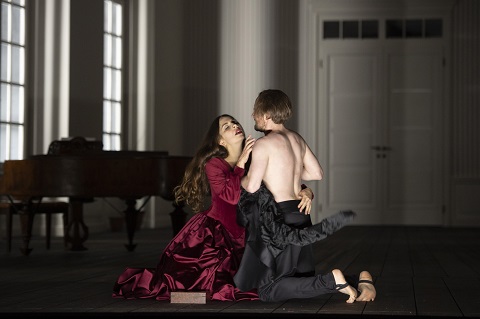
The stage design is appropriate for the context and, rather than relying on typical Der Freischütz-like Romantic locations of woods, glens and dramatic landscapes, Loy keeps the drama confined to an elegant mansion. The cool minimalism of the rooms only serves to heighten and contrast the surface manners of high society with the barely contained lusts and prejudices simmering beneath. It's not so far away from Loy's more recent take on Schreker's similarly heated drama Die ferne Klang, or indeed his stripping of those emotional charges literally stark naked as with his production of Korngold's Das Wunder der Heliane. Andrew Foster Williams is the unfortunate who has to bear all this time, his "wild impulses of glowing desire" out there for the viewer to see, but spared anything too close up. It certainly makes the idea of intended rape more viscerally real and the subsequent teaming up of Lysiart with Eglantine after this is deliriously demented and utterly convincing.


It's the singing too of course that makes this convincing and the principal cast, as well as the chorus, are simply superb. Jacquelyn Wagner has a perfect clean soaring timbre that is perfect for the part of Euryanthe. She's more than just an innocent victim, but the vocal line tells us more than the words alone about her firmness of purpose and her pureness of heart, and Wagner brings out the real human feeling that is scored into the role. Norman Reinhardt shows how Adolar is a prototype Heldentenor, an idealist conflicted between the purity of vision and his response to the baseness of the world.

Theresa Kronthaler and Andrew Foster-Williams bring a chilling edge of menace in roles that are even more villainous and - in this production at least - even more deranged and cruel than Ortrud and Telramund. Looking at the opera this way pointing towards towards Lohengrin, King Ludwig IV is very much a Heinrich der Vogler type of role and it's one that bass Stefan Cerny is not only capable of performing to a Wagnerian level but he also brings some character and personality to make it count within the dramatic development of the plot. Rather than being a forgotten minor work by a respected but neglected composer, Euryanthe turns out to be essential listening for any Wagnerian, a wondrous rediscovery, and Loy's treatment of the work at Theater an der Wien will not disappoint.

The production looks good on the High Definition Blu-ray release from Naxos, although there are some minor niggles. The strong contrasts make whites look a little blown-out, and the image is a little bit shimmery and blurring in movement. Whether that's an authoring issue with the transfer bit-rate I don't know, but it's not too distracting. It doesn't appear that radio mics are used so there's a wider open acoustic theatrical sound here, which means that it also picks up a bit of ambient noise, including creaking floorboards, but the LPCM 2.0 and DTS HD-Master Audio 5.1 mixes still capture the power and the detail of the performance. The BD is all-region compatible, with German, English, French, Japanese and Korean subtitles. The booklet contains a synopsis and an interview with Christof Loy.


Links: Theater an der Wien

Tuesday, 19 June 2012

Cherubini - Koukourgi


Luigi Cherubini - Koukourgi
Stadttheater Klagenfurt, 2010
Peter Marschik, Josef E. Köpplinger, Daniel Prohaska, Çiğdem Soyarslan, Johannes Chum, Daniel Belcher, Peter Edlemann, Leonardo Galeazzi, Stefan Cerny, Alexander Puhrer, Kap-Sung Ahn
Arthaus Musik
Luigi Cherubini is one of the great neglected composers of the Classical age, known now, if at all, for his formal but dramatically near-operatic compositions of Requiems and Coronation Masses as Court Composer during the times of Revolutionary France, but his twenty-five actual operas are mostly unheard of and only a few of them are on rare occasions performed. There is a perception that Cherubini’s music is a little bit academic and conventional, with an impeccable sense of melody, counterpoint and situation every bit as delightful as Haydn, but without the spark of genius or originality of Mozart. There’s some degree of truth in that perception, but at the same time Cherubini is certainly worthy of being considered alongside these two more famous near-contemporary composers, and one need only look to the only one of his operas that is regularly performed, Medea, to see Cherubini’s qualities as an opera composer of genuine merit.
Whether his other works match up to Medea - which is only well-known now because of Maria Callas and for the dramatic opportunities in the singing range that it offers a leading soprano - is rather more difficult to judge due to the rarity of ever seeing one of his operas actually performed. An opéra-comique, Koukourgi is probably not the most representative of Cherubini’s dramatic and classical-based works, but it is certainly one of the rarest. Composed around 1792, Koukourgi - for reasons unknown - was left unfinished and, up until its premiere here at the Stadttheater Klagenfurt in 2010, had never been previously staged. The spoken dialogues are lost, but are not difficult to determine from the progression of the plot and have been rendered in German here for the Klagenfurt audience, although almost certainly not in the form they take here. The overture is taken from Cherubini’s Ifigenia in Aulide (1788) and the finale ‘Viva Amore‘ was an insert composed by Cherubini for a French production of a Paisiello opera.

As for the opera itself, it does tend to confirm the idea of Cherubini’s work being written to suit the conventions of the opéra-comique. It’s a little bit dry and academic in places, with familiar character types and situations, the obligatory thunderstorm and a spectacular march of soldiers, but with no great narrative drive that inspires any impressive musical or singing feats. In its own way however,      Koukourgi is a lovely little example of its type, as light and entertaining as a Haydn opera, but with a modest French buffo character that avoids the excesses of the more florid Italian singing. That character is maintained in the Klagenfurt production, delicately played by the Kärtner Sinfonieorchester as conducted by Peter Marschik, which sets the tone by having Koukourgi play the part of narrator. It is unlikely that the character would have performed this role in the original spoken dialogue for the work, but it works effectively in the context here, making asides and confidences to the audience about the opera itself as well as about his own indolent nature, inviting them to laugh along with him at the rather more serious attitude adopted by the other characters in what doesn’t really amount to a great deal.
Although it is set in China, where the ruler Fohi comes under assault from the invading masses of the Tartars, Koukourgi could be seen as a reflection of the character and spirit of the times in revolutionary France. Set against this backdrop of the struggles of the royals to regain control, there is a romance that could also be seen as a reflection of the differences in class and attitudes. The great warrior Amazan is an orphan who has grown up in the castle and is in love with Zulma, but the ruler Fohi doesn’t consider him an acceptable match for his daughter, preferring Koukourgi, the son of his General Zamti. As the Tartar’s invade, are repulsed and invade again, it’s the Amazan who bravely launches himself into the fray, while the commander of the troops, Koukourgi, refuses to get involved, preferring to eat well, drink and attempt to seduce the repulsed Zulma, giving Amazan only his weakest troops in the hope that he might end up getting killed. Against the odds however, Amazan succeeds and wins the love of Zulma, courage is rewarded, indolence leads to nothing, and love conquers all.


The tone of the production and stage setting is also well fitted to the drama, not striving for any realism or strictly period setting, but being a thoroughly theatrical construct. All the chorus and extras wear grotesque masks, leaving the focus on the main characters with their face-painted Asian designs, but masks also play a part in the backgrounds. The back and forth nature of the off-stage attacks leads to a good running joke has one of the principal troops arrive on the stage at regular intervals with an arrow in his back announcing that the Tartars are invading again, before expiring with a trumpet call. It’s funnier than anything else that is in the actual libretto, but, as is often the case with this type of work, a lot depends on the charm and the delivery of the performers. Daniel Prohaska has a great deal of fun as the irreverent Koukourgi, but finds suitable companions for his cowardly nature in Daniel Belcher’s Sécuro and Peter Edlemann’s Phaor. Çiğdem Soyarslan’s Zulma and Johannes Chum’s Amazan meanwhile play the romantic drama wonderfully straight, Amazan ready to fly off to brave all the Tartar attacks without a moment’s cause for reflection.
Koukourgi is by no means a major discovery, but it’s entertaining in its own right, delightfully staged and performed, and with the scarcity of Cherubini operas available in any form, this is a true rarity that does indeed throw new light on the variety and quality of the composer’s work. It’s only available on DVD - no Blu-ray release - but the specifications are excellent, with a clean, sharp widescreen transfer and good audio mixes in PCM Stereo and Dolby Digital 5.1. The disc is Region-free, NTSC format, with subtitles in French, English, German, Spanish, Italian and Korean.