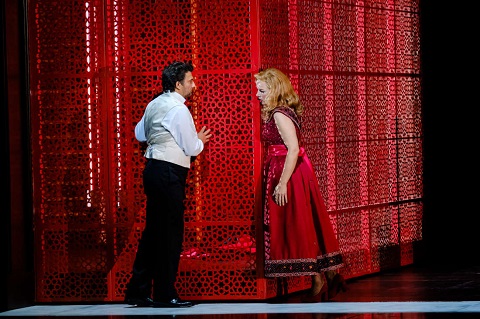
Showing posts with label Ludovic Tézier. Show all posts

Tuesday, 27 April 2021

Wagner - Parsifal (Vienna, 2021)


Richard Wagner - Parsifal

Wiener Staatsoper, 2021

Philippe Jordan, Kirill Serebrennikov, Jonas Kaufmann, Georg Zeppenfeld, Elīna Garanča, Ludovic Tézier, Wolfgang Koch, Stefan Cerny, Ileana Tonca, Anna Nekhames, Aurora Marthens

ARTE Concert  - 18 April 2021

With its blend of philosophy, religion, mythology, spirituality and humanism, Wagner's Parsifal can be a tough prospect to make sense of on a narrative level, particularly in translating that to a modern audience in recognisable human terms. Not that it needs a coherent narrative. Almost every production I've seen of this masterpiece has found original endless (and sometimes baffling) ways of presenting it, while at the same time everything that it is about is all there in the music. And when I say music, it's not just the notes on the page, the singing or even the interpretation of it but the space and time it occupies in performance. The viewer enters into communion with Parsifal in a way that does not happen quite the same way with any other opera.

High-flown words maybe, but there is truth in this. You could write volumes exploring the work, you could write books alone on productions like Herheim's Bayreuth Parsifal, and yet however the work is dressed up, whatever means are used to explore its themes, it rarely fails to make some kind of impact and it's often a profound one. At heart the theme and message of the work can be said to be relatively simple, but in its simplicity it touches on something vast, the essence of an important aspect of what it means to be human, perhaps the most important. Redemption through Compassion, the understanding of which will put us on the path to our soul's salvation.

Even though there are clear religious and ceremonial overtones in the presentation of these themes in Parsifal's Easter Good Friday message, it certainly doesn't need to be seen through a Christian or religious perspective. Indeed such grave solemnity and reverence in a production can get in the way of letting the music express its deep human qualities. Not to make excuses for the sometimes unclear situations and direction in the current Vienna State Opera production by Kirill Serebrennikov, but even the idea of putting that into a coherent dramatic narrative is ridiculous. Anyone expecting or needing a "story" to get it across is missing the point. Richard Wagner utterly and completely puts it all into musical language, which is even more direct and yet complex in how it manages to achieve that with such incredible impact.

It's difficult to describe convincingly how the Vienna 2021 lockdown production manages to get that across - it would take a long time and a lot of pointless analysis - but it unquestionably does. Serebrennikov's setting certainly looks unlike anything else you might associate with Montsalvat. Here's it's a prison, looking more like Janáček's From The House of the Dead. Gurnemanz is the respected veteran lifer who takes young ones under his wing, shows them the ropes and even does tattoos for them. Unlike any other Gurnemanz, this one even collects packages of contraband drugs from bent wardens for them. He knows they need something else to get them through the misery of their situation, and tells them stories that give hope that some kind of redemption may be possible. Even those living in an eternal hell like the seriously ill Amfortas.

It seems unlikely that the new young man on the cell block is going to be any kind of saviour in this production. Young and foolish, he's forgotten his good upbringing and got into a lot of trouble. Not so innocent, in prison he has even killed a man, a "swan", an albino man with tattoo wings who tried to get close to him naked in the showers and paid the price. Someone however sees his potential; Kundry, a visitor who has been granted permission to photograph inside the prison, gathering images of raw masculinity for a fashion magazine, "Schloss". She however lives within a prison of her own and is seeking a way out, seeing something within this young man that might help her overcome her own demons if they don't swallow him up as well.

Aided by projections, the production plays the long first Act out as if it happens over a number of days, and that works well, in its own way bending time and space, encapsulating the inner world and dreams of the prisoners with the harsh reality of their confinement. The idea of being outside of time in any linear narrative is also put across in the use of flashback, Jonas Kaufmann the older wiser Parsifal looking back with regret on his past mistakes and innocence of his younger self, played by actor Nikolay Sidorenko. If you don't quite understand where it is going however that also turns out to be a good thing, as the whole opera is a process, you need to live through it and experience it in its totality to understand it in any kind of way.

Act II however proves to be pivotal here as it should be but far too often fails to adequately achieve. It opens up some of that in the unlikely setting of the offices of Schloss, a fashion magazine run by the tyrannical Klingsor. The Flowermaidens are fashion journalists, office staff and even cleaning staff, all lusting over the new cover model, which really is no less relatable than having mythical female ciphers float around him. What makes Act II striking is by bringing in what is only alluded to in the original and making it central to the purpose of the work, and that's Parsifal's mother Herzeleide.

Many productions have sought to extend the range of Parsifal far beyond the singing characters - Philipp Stölzl even recreating the crucifixion of Christ in a Deutsche Oper production - and with good reason, as much of what is learned as a process doesn't just extend over a lifetime, but over many lifetimes. The production here finds that the best way of expressing what sparks Parsifal's journey to self-realisation is the image that Kundry evokes of his mother. The director brings not just one but three Herzeleide's to the stage. Parsifal's first true feelings for another person are, appropriately and meaningfully, for his mother. Understanding what she has suffered for him only for him to go off the rails, is a profound revelation. Through this he suddenly realises what Amfortas has been going through, and sets out to find a way of bringing healing to his suffering.

And quite what role Kundry plays in this is also difficult to describe but it's vital, the Flowermaidens likewise presenting him with different aspects of what it means to be a woman, deepening his understanding of his own mother's situation. Somehow the director Serebrennikov - mainly though the medium of an astonishing performance from Elīna Garanča - manages to match up the sense of deep sorrow, regret and loss with a sultry undercurrent that runs through the music in this Act. Act II can often feel disjointed and unfathomable, but at its best it is enigmatic and the key to the work, and the new Vienna production makes the most of it, not least in Philippe Jordan's conducting, pacing and navigation of the dynamics of the score.

Trying to analyse and correlate the production with a predetermined idea of what Parsifal should be and even expecting it to deliver a coherent narrative is however besides the point. It's a metaphor, and it makes no more sense than expecting Wagner's mythology of the Knights of the Holy Grail, the suffering of Amfortas, the killing of a swan, the evil of Klingsor and the revelation in a kiss to make sense on any level of reality that is relatable to our lives. The best that a production can do is perhaps illuminate one aspect of the many themes and ideas expressed in the work and put it into terms that are recognisable to a modern audience. And if you can get across an important message - as this one does about imprisonment of the soul and finding a way to freedom - then it's more than enough. Anyone expecting to make narrative sense of the director's production however is only distracting themselves from the beauty of the sentiments expressed and the performances.

And what performances! It's not just a starry cast with a few experienced and distinguished Wagnerians in key roles, but there are some chances and risks taken in a few of the other casting choices that make it much more interesting and bring a little something extra to the production. Jonas Kaufmann sings the role of Parsifal well, if inevitably a little detached by being doubled with an actor. It's sung in the manner that you may be accustomed to, a manner not to everyone's taste, slightly over-pushed. He can do grave and anguished but personally I felt that he lacks sensitivity for Parsifal, and crucially lacks compassion for the role. Elsewhere however there is little to fault.

As we've come to expect from his other Wagner bass roles, Georg Zeppenfeld is just perfect. Hunding, Heinrich der Vogler and King Marke are one thing, but Gurnemanz is a much more extensive role on another level entirely. If the strain sometimes showed over the four hour running time, there was little evidence of it in his singing, which was faultless throughout, warm and compelling. As mentioned earlier, Elīna Garanča also takes her performance to another level. Kundry does present such opportunities for a singer, and even if this production didn't give her as much of a central role or room for interpretation, Garanča takes it to the level required in her singing and acting performance. I've never seen her sing a role so deeply.

Defining Klingsor as a sleazy office manager abuser of his position and power is more relatable than viewing him simplistically as an evil sorcerer, and Wolfgang Koch is suitably sinister in a typically reliable performance. Ludovic Tézier is one of the world's finest Verdi baritones and that doesn't necessarily translate over to a traditional Amfortas role in Wagner, but it certainly makes for an interesting interpretation. He carries some of the mannerisms of Italian opera across, but nonetheless gives a lyrical, sincere and heartfelt performance here. Avoiding the cliches of the spear healing the wound, he nonetheless finds peace as Parsifal's healing message of love, forgiveness and compassion sees the swan reborn and mankind freed from the pain and prison of their everyday existence to possibility of a better world.

Links: Wiener Staatsoper, ARTE Concert

Tuesday, 2 March 2021

Verdi - Aida (Paris, 2021)


Giuseppe Verdi - Aida

Opéra national de Paris, 2021

Michele Mariotti, Lotte de Beer, Ksenia Dudnikova, Sondra Radvanovsky, Jonas Kaufmann, Roberta Mantegna, Ludovic Tézier, Soloman Howard, Dmitry Belosselskiy, Alessandro Liberatore

ARTE Concert - 18 February 2021

It would be a shame to ever get tired of Aida, as it is undoubtedly a supreme work of opera from a great composer reaching the pinnacle of his craft, but I could do without ever seeing another idealised ancient Egyptian setting and ceremonial procession. There's nothing inherently wrong with that it's just I like to see something that makes you think a little deeper about what the opera is about. And from the last few productions I've seen, the opera is surprisingly adaptable to draw out the work's themes, which are far as Verdi is concerned, is a large scale attack on war and religion and the impact of them on individual human lives.

There's a hint in the period and the museum setting of this Paris production that the director Lotte de Beer wants to draw out the issue of colonialism. The opera is updated here - thank goodness - to the Italian Risorgimento, a more meaningful period at least as far as Verdi was concerned. And there's no question that the underlying force of the work lies in such a context. Much as La Traviata gains its true strength from the sense of burning injustice towards women in society, Aida shows that there's a human reality and cost to war. It diminishes the power of the work if it is merely presented as a glamorous grand opera spectacle.

The Paris production opens with Radamès looking at a mummy-like Aida in a display case at a museum as he reflects on conflicted feelings of love for country and fighting for it in a war. The mummy Aida comes to life then as a guiding spirit - or something like that - in his life. Amneris then acts as the other side of this, his conflicted feelings of betrayal of his obligations to his own country. The other underlying themes and sentiments relating to war, religion and colonialism are similarly brought out in other exhibits from other cultures in glass cases. One of the cases contains a skull, the connotations of which are fairly obvious, even as Radamès as newly elected commander in arms anoints it with blood.

Whether you buy into this idea or not, the change of perspective - to say nothing of the beautiful set and costume design - at least serves to make this an attractive and fresh take on an opera whose themes are too often buried in convention and played purely for grand opera spectacle. The centrepiece victory march - often the most problematic for any director wishing to undercut the triumphalism of war - is presented not without some irony as a series of exhibition tableaux of classic paintings put on at the "museum". It references and recreates scenes of Napoleon, the raising of the flag on Iwo Jima, Delacroix's Liberty and other triumphal poses through the ages that could be said to glorify or idealise war.

It's a mark of how good the production is that it hits home effectively not just in the traditional big numbers and famous arias, but in the more human moments that are just as crucial such as the plight of the Ethiopian prisoners and Aida's recognition of her father. What also becomes evident - and Ksenia Dudnikova has much to contribute to this - is the other triumphant victory of Amneris over Aida in gaining the promise of marriage to Radamès. Verdi's ensemble writing for this is astonishing, gathering up all the conflicting desires and combining them with the inhuman treatment of prisoners of war to make this scene as forceful as any other in this work, the work of a complete master.

But why the puppets? This would have been a great production but for the dumb choice of using puppets for Aida and Amonasro. Life size puppets are not uncommon in opera productions, but they are rarely put to any meaningful use. In a Madama Butterfly, you could see some sense of purpose in Cio-Cio San being manipulated and treated like a doll, a plaything. Puppets have been used in Weber's Oberon as an impressive spectacle for a fairy-tale opera, but they can be superfluous to The Magic Flute. Other than to prevent singers 'blacking up' I can't for the life of me understand why Lotte de Beer went with the crude fossilised puppets for Aida. With three operators and Sandra Radvanovsky all on the stage for Aida, it's a terrible distraction. Add another two for Amomasro's half puppet and it over-complicates important direct scenes. Radvanovsky and Tézier don't seem to know whether they should be singing to each other or the puppets, and the camera isn't quite sure who to follow either. Perhaps worse, Jonas Kaufmann even has to endure the embarrassing situation of getting intimate with a puppet, and looks like he is being attacked by a gang.

As a human Aida, Sandra Radvanovsky is good. The high register occasionally pushes her out of comfort zone, thinning out to near inaudibility in some passages, but she brings character and depth of feeling to the work. It's a shame that she has to compete with a puppet and puppet handlers. The Uzbekistan mezzo-soprano Ksenia Dudnikova is just superb as Amneris. She handles the singing requirements more than capably, but just as importantly she captures the weak human side of Amneris as well as her regal imperiousness. Aida is an opera that is there for the taking by an Amneris of sufficient quality - her emotional and musical journey is a fascinating one - and I read somewhere that Verdi even considered calling the opera Amneris at one point. She may not yet be the ideal Amneris but Dudnikova makes her character human and as far as I'm concerned steals the show.

In another time that might have been the case for Jonas Kaufmann, but I have to say he is making less of an impression now with each new performance. Where once he was commanding, he now feels disengaged from the character and looks like he is going through the motions. The voice isn't quite as controlled and stable as it once was either, his diction lacks clarity and despite the loud delivery there's no real strength or volume there. I may be nit-picking and expecting too much because in the moments when he needs to be convincing, he is still very good. Amanasro is not a major role in this opera, but it counts and it's always a joy to hear a great Verdi baritone like Ludovic Tézier, who carries on regardless of the puppet distraction.

Some operas work better with the lack of an audience than others, but it may be something we have to get used to for a while yet. Broadcast live streaming from Paris, conducted by Michele Mariotti, this was as good a performance of Aida as any I've heard. The Paris Opera orchestra sound superb here, and despite the puppets and some weaknesses in the singing - the whole thing is redeemed to a large extent by the musical performance and Ksenia Dudnikova's Amneris - Lotte de Beer's production does succeed in allowing the quality of the opera and the purpose behind it to be brought out, allowing Aida to impress on it's own musical terms rather than as a mere spectacle.

Links: Opéra national de Paris, ARTE Concert

Sunday, 7 April 2019

Verdi - La Forza del Destino (London, 2019)


Giuseppe Verdi - La Forza del Destino

Royal Opera House, London - 2019

Antonio Pappano, Christof Loy, Anna Netrebko, Jonas Kaufmann, Ludovic Tézier, Ferruccio Furlanetto, Alessandro Corbelli, Veronica Simeoni, Robert Lloyd, Roberta Alexander, Michael Mofidian, Carlo Bosi

Royal Opera House Cinema Live - 2 April 2019


Recent experiences have shown me that there's no such thing as a Verdi failure; all of his works, even the earliest works like Alzira, have the potential to be much better than their reputation allows and there are ways also to overcome apparent weaknesses in plotting in those flawed later works like Simon Boccanegra. La Forza del Destino is one of those latter works where the traditional operatic mannerisms of the plot often obscures or weakens the more sophisticated musical arrangements that Verdi was starting to deliver and would later more fully achieve with librettos from Arrigo Boito. With Christof Loy directing, the Royal Opera House's production might not entirely make La Forza del Destino work as a stage drama, but it certainly shows the potential greatness in the work.

Whatever its weaknesses in plotting and structure there's no doubting the ambition Verdi shows in this work. There's not a lot you can do with the sprawling plot, but Loy's production shows that Verdi isn't really that concerned with sticking to the superficial arrangements and conventions of a by-the-numbers romantic melodrama, but is keen to look much deeper at people caught up in forces that are greater then themselves. La Forza del Destino is a work of competing forces, each of the characters carried through their lives by their response to a tragic incident in the past that consumes them and destroys any chance they might have of happiness in the future.


This appears to be really what Verdi wants to express, and yes perhaps it does come at the cost of credibility in plot progression. The central incident comes in the prologue with the death of the Marquis of Calatrava, killed in an unfortunate accident at the family home by Don Alvaro, the South American nobleman who was planning to elope with his daughter Leonora. In the chaos following the incident, Don Alvaro and Leonora are separated (chaos being one of those forces that play a major part in the opera, also bringing them together again), each believing the other dead, while Leonora's brother Don Carlo di Vargas thereafter makes it his life's duty to track down Alvaro and kill him.

The incident affects each of the three main protagonists in different ways, totally disrupting and determining the subsequent direction of their lives. Leonora is overcome with remorse and guilt, but still consumed by her love for Alvaro she decides to
become a hermit and devote herself to the Virgin Mary (an icon that Loy shows during the overture as something that imprinted itself on her subconscious from a very early age). Alvaro pours his energy into the army and becomes a war hero, but fighting, drinking and women are still not enough to blot out the loss of Leonora and the crime of her father's death. Don Carlo is single-minded in his desire for revenge, turning to fortune tellers, hoping that they will give him some satisfaction that his efforts will be rewarded.

The plot that brings their lives back together in a dramatic conclusion is perhaps not so important as understanding these forces that drive them, all of them forces beyond their power to control. Fate, fortune, misfortune, destiny, war, religion, vengeance, oaths and curses; all these things sweep them through their lives, batter them from one shore to another with no safe haven. Primarily however there are three other inescapable forces that determine their destiny; love, family and a rush towards death. Religion too plays an important role in how both Leonora and Alvaro cling to it like a life-raft, hoping that submission to God will give their lives a purpose that has been lost. Loy brings this aspect out much clearer than any other production I've seen of this work, but he also brings out exceptionally well Verdi's scepticism of religion in the figures of Fra Melitone and Padre Guardiano.


La Forza is long and disjointed, covering a lifetime because it takes a lifetime to understand what has been important, what has driven that life, and it's difficult to compress all those competing and conflicting forces into a single dramatic storyline, even one that is three hours long. There have have been brave efforts at making La Forza work convincingly, but it certainly helps when you have a director like Christof Loy on board and - something that appears to be the one indispensable element to the potential success of any of Verdi's challenging works that might not have played so well in the past - a stellar cast as capable as the one assembled for this production at the Royal Opera House.

The visual representation is variable in Christof Loy productions and sometimes minimal with little but nominal adherence to libretto directions but there are two important things you can count on in a Loy project. You always get the full-length opera without cuts, which is rarer than you might think, and you get a deeper delving into the characterisation and themes that recognises that there is more to the musical arrangements than simply underscoring the surface drama. Where the drama tends to sprawl in La Forza del Destino, Loy ensures through some early scene setting that the impact of the killing of the Marquis of Calatrava remains to the forefront of what follows, the key event in the force of destiny that connects Leonora, Alvaro and Carlo.

La Forza is indeed present as a theme throughout the opera and Verdi dresses it in various musical guises. Antonio Pappano manages those wonderfully, attuned to character, allowing it to surge forward at those moments of great emotional turmoil in the lives of each of those who were present in the room where the Marquis died. Loy accordingly shows everything taking place within the same room, a room that none of them can escape, the walls war-torn and crumbling, opening up alcoves of escape in religion, but there is no way out for them. Projections blend the past with the present, the event replayed continuously, but there's more to Loy's involvement than having a hand in the set design.


To carry all this off with any kind of conviction the majority of the work has to be done by the singers, and you really need exceptional performers who can act and sing. Having Anna Netrebko, Jonas Kaufmann and Ludovic Tézier in the principal roles certainly gives this a lot more conviction than it otherwise might. It still remains a bit overwrought, but that's Verdi melodrama for you, and these guys can play it well. Tézier isn't the greatest actor, but he has gravitas and a beautiful soulful delivery and - for me personally - his interpretation of Carlo was the most interesting of the three, but perhaps that's just because we know what to expect from Kaufmann and Netrebko.

Since we expect utter professionalism and stunning delivery, that's not a complaint by any means, and if they do come across as a little too polished that's unavoidable for performers of this stature, and they certainly make up for it here with fully committed and heartfelt characterisation. Kaufmann characteristically launches himself full-force at the work, which is essentially the level that Verdi pitches Alvaro, but I'd like to see Kaufmann dial it down a little once in a while. Anna Netrebko is just Anna Netrebko, which is wonderful, but it's still Anna Netrebko. I wouldn't hold that against her though, as there are few who could sing the role of Leonora as well as this, embodying all the pain that Verdi inflicts on this character across a lifetime of suffering.

And as if that's not enough, the Royal Opera House have the luxury casting of Ferruccio Furlanetto and Alessandro Corbelli as Padre Guardiano and Fra Melitone, presenting two very different faces of the church and between them they open up the other dimensions in the work not often given as much attention. I'm sure that's partly because Loy is working from the full-length uncut version of La Forza del Destino, as these characters rarely feel so well developed, but I've no doubt it's got a lot to do with having great singers in these roles. Corbelli in particular is just marvellous. Keeping the work intact, Loy recognises that the power of La Forza del Destino is in its range and variety, with its choruses, its dancing and carnivals and he puts on a spectacular show. This is Verdi on the big scale, and the Royal Opera House give Loy the biggest canvas to work with.


Links: Royal Opera House

Sunday, 16 December 2018

Verdi - Simon Boccanegra (Paris, 2018)


Giuseppe Verdi - Simon Boccanegra

L'Opéra National de Paris, 2018

Fabio Luisi, Calixto Bieito, Ludovic Tézier, Mika Kares, Maria Agresta, Francesco Demuro, Nicola Alaimo, Mikhail Timoshenko, Cyrille Lovighi, Virginia Leva-Poncet

Paris Opera Cinema Live - 13 December 2018

Verdi's mature period operas have always been problematic, their dramatic plot lines never quite keeping up with the growing maturity and sophistication of the composer's musical writing or compromised by Verdi attempting to rework material to suit French grand opera needs. As far as Simon Boccanegra is concerned, it's another case of rewriting, but rather than revisiting an earlier work first performed in 1857 to suit a new audience 23 years later, Verdi seems to be working to his own musical imperative, drawing deeper on his own experiences of family struggles and his observations of human nature during the upheaval of the Italian Risorgimento.

As a consequence, Simon Boccanegra is quite unlike other Verdi works, seeped in a tone of deep sombre melancholy that only the darkest passages of I due Foscari and Don Carlos can come close to matching. Recognising the failings in Piave's original libretto, Verdi enlisted the services of Arrigo Boito, with whom he would craft his late masterpieces, and Boito does bring a greater poetic touch to the work and human feeling to the sentiments, but the themes remain essentially the same as those consistent throughout Verdi's operas - love versus duty and one's responsibility towards family versus the people and the nation as a whole.


The reworking of the material however leaves the problem of Simon Boccanegra consisting of a patchwork of scenes with leaps in time periods and gaps in the drama, and when staged it just never seems to flow or hold together despite the insistent tone and musical language employed by Verdi. And it really is music on another level, separated by a vast gulf from those early works. The youthful force and drive is still there, but the difference here is that it expresses internalised drama rather than underscoring melodramatic plot developments of war, vengeance, fate, padded out with popular laments, pleas to god, and drinking songs.

It's a little unfair to characterise Verdi in those terms, but it just illustrates how far Verdi's ambitions and ability have moved on from the standard template and from the necessity of writing to meet the expectations of an audience. Some of those problematic dramatic elements remain in Simon Boccanegra of course, and it seems unlikely that a director like Calixto Bieito would really want to or be able to make anything convincing out of them. Somehow however, without denying all the colour, drama, fury and sensitivity that makes up a Verdi opera somehow Bieito lays open Simon Boccanegra in his Paris Opera production in a way that somehow gets to the heart of it. It's an absolutely stunning experience.


Once you get rid of the period accoutrements and costumes of 14th century Genoa, and once you dispense with the distractions of the plot and the near impossibility of making it seem credible, there's room to look for the deeper sentiments at the heart of Simon Boccanegra. Susanne Gschwender's set designs, the stage stripped of everything but the huge skeleton of the hull of a ship that revolves to show us what would appear to be a representation of the mind of Simon Boccanegra, the Doge of Genoa. Seen lying prone on the floor, a position he also takes having been poisoned in Act II, it's tempting to see the fractured narrative and its strange outpourings of emotion and grief as that of a fevered mind of a former corsair viewing it in a heightened state.

And that works well for a narrative as fractured as Simon Boccanegra. Bieito is then able to introduce a vital element that is usually absent from the dramatic presentation of the work but which is ever-present in Verdi's music; Maria. The association of news of the death of Maria at the very moment that he is proclaimed Doge creates a fusion that haunts Boccanegra. It doesn't just cause problems with Maria's father that lead to political plotting and family feuds, but - along with the disappearance of Simon and Maria's daughter - it's also something that has a deep personal impact on him, a melancholic yearning associated with his office that remains with him all his life.

That sentiment is what you can hear when you hear the music that Verdi has composed for the opera, and it's there from the very first note, Fabio Luisi drawing the darkness out of the detail and the silences in the score. It's appropriate then that director Calixto Bieito introduces Maria as a ghostly presence throughout the work, even showing her normally off-stage reported death by having her father drag the dying woman onto the stage to confront the husband who let her down. The image is powerful, and Boccanegra cannot shake it. She haunts the ship of Simon's mind as he himself lies dying, caught up in his own melancholic reflection, sadness and regret.


The risk is that this internalised perspective aligned with Verdi's music could push this further over into high melodrama, but by allowing nothing extraneous to distract - much as Verdi's complete stripping away of any dramatic underscoring or ornamentation does - Bieito's production is able to focus on the sheer depth of feeling a father has for his daughter, for his family, for the regrets that have allowed political events beyond his control impinge on their natural development. It's something that Verdi would very much want to express from a personal viewpoint and Bieito's production permits this much better than any version of Simon Boccanegra I've ever seen before.

There's no effort to clarify the complexity of the plot or the gaps in credibility that come with Simon being reunited with his lost daughter, but there is every ounce of emotion put into expressing such longing and such feelings. If there's one place where the value of Bieito's work as a director shows, it's in his directing of the performers to make all those sentiments come to life. There's no opera theatrics here either in the mannerisms of the delivery of the singing; all of it comes from the heart, which might mean it's not quite naturalistic, but in the context of Verdi's music that is simply perfect, unadorned, unguarded, unredacted pure emotion.

As is ever the challenge with Verdi - even in those roles that aren't created purely to show off the abilities of the lead performers - is getting singers capable of handling the considerable vocal challenges that go along with the advances of characterisation in these later operas. If Maria Agresta couldn't always carry the fullness of sound that is needed, there aren't many who can meet the demands of the extraordinarily challenging range required for Amelia/Maria, but her performance was as intense and heartfelt as it needed to be. Ludovic Tézier continues to develop into one of the best Verdi baritones around and gave a commanding performance here, equally intense, equally heartfelt. When you add in the kind of delivery given by an outstanding Francesco Demuro as Gabriele Adorno and the contrast provided by Nicola Alaimo's Paolo, the results were truly shattering.

Links: Opéra National de Paris, Culturebox

Thursday, 26 October 2017

Verdi - Don Carlos (Paris, 2017)


Giuseppe Verdi - Don Carlos

L'Opéra National de Paris, 2017

Philippe Jordan, Krzysztof Warlikowski, Jonas Kaufmann, Elina Garanča, Sonya Yoncheva, Ludovic Tézier, Dmitry Belosselskiy, Ildar Abdrazakov, Eve-Maud Hubeaux, Julien Dran, Krzysztof Baczyk, Hyun-Jong Roh

Opéra Bastille - 22nd October 2017

For anyone used to the more familiar Italian version, the rarely performed original French version of Verdi's Don Carlo/Don Carlos presented at the Paris Opera could sound rather subdued and lacking the heightened emotional state one expects for this work. Even though we are very much in the domain of the 5-Act grand opera there does however seem to be some merit in adopting a more gentle approach for the French language version. If Philippe Jordan exercises restraint in the Paris Orchestra and Krzysztof Warlikowski reigns in his usual directorial excesses, the premier league cast assembled here are at least capable of finding the necessary dynamic in the contrasts of character.

One need only read and listen to the more gentle flow of the French language libretto, composed in verse and in rhyming couplets, to see that it requires a different approach from the language of the the Italian text, which in Verdi can tend towards bombastic. Don Carlos and indeed Don Carlo should never be bombastic, since the nature of Schiller's treatment of the historical drama is more reflective and interiorised conflict, exuding an air of dark melancholy and sometimes even a bleak outlook on the nature of man.


That tone is established right from the outset in Warlikowsi's production, with Jonas Kaufmann's Carlos wandering onto a bare wood-panelled set in a state of suicidal despair, his bleeding wrists wrapped in bandages. That's not how we usually see the Fontainebleau scene in the 5-Act version of the opera - with Elisabeth already in her wedding dress alongside a white horse - but it appears that the director wants to visualise this vital but usually truncated Act as a fevered dream flashback, combining Carlos's Act II gloomy meditations on death at the tomb of Charles V in the cloister of the Convent of Saint-Just, with his disappointment over the outcome of his expected engagement to Elisabeth.

Aside from a rather more abstract-modern presentation of the scenes in the locations and costumes, Krzysztof Warlikowski and dramaturgist Christian Longchamp don't apply any other real conceptual twists on the subject. The sets are elegant and economic with the space of the Bastille stage, but yet they can be suitably grand when the occasion demands. The auto-da-fé scene for example manages to get a sense of the horror with an overlay of a silent-era film projection of a giant devouring a man. It's simple and impressive, without having to fall back on clichéd imagery or mannerisms (or indeed Warlikowski-isms) that nearly always fails to effectively represent this scene in the opera.

On the other hand, Warlikowski's usual mannerisms are missed here, or at least his ability to bring focus and draw attention to the complex levels of a work like Don Carlos is lacking. The intention is to lay bare the Oedipal and Hamlet-like Shakespearean side of Verdi's reading of Schiller, with all of its character contradictions and relationship complications, but it never really gets to the heart of the work, much less find any way of overcoming the opera's dramatic and structural weaknesses. The inclusion of the indispensable Act I Fontainebleau scene and the exclusion of the dispensable ballet scene go some way towards making the work flow better, and greater emphasis is well placed on the dominant father aspect of the work by focussing on Charles V, but the roles of Rodrigo and Eboli add other dimensions that aren't as fully explored. At least, not in the dramatic context.


In terms of singing it's another matter, and ironically the performances of Posa and Eboli by Ludovic Tézier and Elina Garanča are so good that they balance out (and almost overshadow) the focus of the production on the patriarchal power play by restoring some measure of importance on the work's consideration of love, friendship, jealousy and rejection that their characters provide. The weight of those aspects of the work are almost all expected to be covered here by Philippe II, and Ildar Abdrazakov does give an outstanding performance, but it neglects the riches that can be found in the different nuances provided by Eboli and Rodrigue.

Perhaps however the strength of those performances, in conjunction with Philippe Jordan's subtle handling of musical dynamic, are enough to convey everything that is required. It certainly felt like it. Ludovic Tézier's smooth baritone is full of heartfelt expression that suggests a warm and loyal friendship with Carlos, but with an edge that revealed some of his personal conflict in his duty to the King and his belief in the Flemish cause. His performance of Rodrigue's death scene was loudly applauded and it seemed to me that he deservedly got the longest and most enthusiastic acclaim at the curtain call too. Elina Garanča wasn't far behind him though. With great stage presence and tremendous delivery, her Eboli carried force of conviction and yet tenderness and regret. Her 'O don fatale', summing up her predicament, was pretty much devastating.


That kind of conviction and delivery carried through to the back of the hall to those of us in the cheaper seats, and that was the case also for Ildar Abdrazakov. Without underestimating the greater challenges that the roles of Carlos and Elisabeth carry however, the same can't be said with as much certainty for Jonas Kaufmann and Sonya Yoncheva. Kaufmann's usual strength and force is all there and his delivery impassioned, but he doesn't have the volume to fill a hall the size of the Bastille. The detail of his performance worked much better I found when I subsequently watched scenes from the streamed performance of this Don Carlos on ARTE. Sonya Yoncheva wasn't perfect in her delivery either and felt somewhat detached, but I personally have never heard anyone sing the challenging role of Elisabeth perfectly, and Yoncheva at least is one of the best I can recall.

Such challenges and imperfections are perhaps in the nature of Don Carlos, and may indeed be the very reason for it remaining always such a fascinating work, since Verdi's venture into French grand opera neither fits to the tradition of Meyerbeer, Halévy and Auber, nor is it merely an Italian opera in French guise. Warlikowski and Jordan succeed then in some areas and fail in others, which is perhaps an inevitability with this work. You can't fault a cast as impressive as this either - you really can't do justice to Don Carlos without a cast as stellar as this - and Jordan's French touch does reveal other interesting aspects of the work. With its complicated blend of history, personal drama and the fantastical and that problematic ending that I've only seen Robert Carsen approach in any way half-convincingly (although it required much manipulation in his 2016 Strasbourg production), the perfect or definitive version of Don Carlos still remains elusive.


Links: L'Opéra de Paris, ARTE Concert

Wednesday, 19 April 2017

Massenet - Werther (Vienna, 2017)

Jules Massenet - Werther

Wiener Staatsoper, Vienna - 2017

Frédéric Chaslin, Andrei Serban, Ludovic Tézier, Adrian Eröd, Sophie Koch, Maria Nazarova, Alexandru Moisiuc, Peter Jelosits, Marcus Pelz

Staatsoper Live - 6th April 2017

Andrei Serban productions, or the ones I have seen anyway, are certainly distinctive but hard to associate with any kind of individual style that you might find with other opera-theatre directors. Even though they might seem a little abstract, with stylised modern elements that don't always match the requirements specified in the libretto, Serban's productions nonetheless look good and somehow still often match the tone of the corresponding work fairly well.  They aren't traditional and they aren't particularly challenging or experimental, but they get the work done. That's pretty much how you would sum up Serban's production of Werther for the Vienna State Opera.

Peter Pabst's set designs for the Vienna Werther are in fact perhaps less stylised and more naturalistic than most of Serban's other productions. Providing, that is, that you are happy to accept a huge sprawling tree in the middle of the stage not only in the outdoor scenes, but looming there also in the background of Charlotte's otherwise normal living room and in Werther's little bedsit. No one is likely to be put off by such large symbolism in such a Romantic opera where the emotions and entanglements loom large, and it does give the production a certain character that lifts it above the mundane into the realm of the soul. It's the expression of the soul that is what Werther is really about, and it certainly does that at least in Massenet's score.


That grand gesture seems to be enough for Serban, and it's hard to argue with the effectiveness and style with which the production functions and heightens the overheated situations of the drama. The large tree contrasts strongly with the rather suffocatingly stuffy, austere old-fashioned furnishings, costumes and manners. There's a sense that this ever-present looming tree, the enduring symbol of life, nature and solidity comes to present an intense strain on Charlotte when she tries to resist her own nature. With Werther ever present in her mind, the stuffy conformity of her marriage with Albert rightly feels almost unbearably oppressive to Charlotte by the time we come to Act III.

The Vienna production harnesses much of the force of the deeply suppressed erotic charge that Massenet managed to create in Werther. The idea of composing the opera came to the Massenet after attending a performance of Parsifal and soon after visiting the home of Goethe, where he was struck by a passage of 'The Sorrows of Young Werther'. Inspired by his visit to Bayreuth and the sentiments of Goethe's famous work, these two powerful experiences are forged into a deeply romantic and emotionally charged work that captures perfectly the subject and heightened sentiments of Werther.

It's not Parsifal however but Tristan und Isolde that seems to exert the strongest influence over the opera. If there's little that is directly Wagnerian about the score other than the use of leitmotif and musical themes that surge throughout the whole work, there is something of the doomed lovers situation in Werther and Massenet is no less skilled in swirling those charged situations of repressed and unconsummated Romantic desires around in a potent concoction that can only be resolved in death. If Tristan were the only one who drank the potion and Isolde resisted, he would be Werther; hopelessly melancholic at the impossibility of their union. Death can only follow, and there is even an emotional and musical echo of the Wagner's Liebestod in Charlotte's response to Werther's fatal wounding.

Werther is not so much Wagnerian however as a full-blooded expression of German Romanticism, and the true nature of the force of those sentiments is fully delivered by the orchestra of the Wiener Staatsoper under the baton of Frédéric Chaslin. There's no holding back on the huge sweep of the score, but it neither overplays nor seeks to find some kind of subtle naturalism in the situations. The score should be given this kind of full unmediated expression, and so too should the singing.


I've never been totally sold on the baritone version of Werther, but Ludovic Tézier shows here that it's not so much tenor or baritone that matters as who is singing the role and what they can bring to it. Tézier may not have a tenor's romantic allure, but he has the melancholic aspect of Werther in his demeanour, in the haunted inflections of his voice, and his delivery is superb. Charlotte is a role that Sophie Koch sings often and she is one of the best interpreters of the role. There's a little more strain showing in her voice these days, but everything that is required is there. Her delivery of the tumultuous reflections of Act III, for example - so important to the work as a whole - is outstanding. There are good performances and solid casting right down the line, with Adrian Eröd as Albert and Maria Nazarova as Sophie.

The fate or at least the state that Charlotte is left in at the closing notes of the opera are also all-important, in many ways much the same as with Isolde when Tristan expires. Having Charlotte turn the pistol on herself as some other productions have done could certainly be justified as an expression of where her mind is, even if it could be said to be over-playing the drama. Serban's direction for this scene is a little more even-handed or at least proportionate, but having Albert a bystander to the final scene, stomping off in a huff over what he has witnessed rather than being stunned into shock - surely the more likely reaction - tends to take away from where your sympathies and the emphasis ought to lie. It doesn't quite take away however from what has come before, with Koch and Tézier together generating a passionate and intense climax of real Romantic stupor.

Links: Wiener Staatsoper Live

Monday, 9 May 2016

Verdi - Il Trovatore (Opéra National de Paris, 2016)


Giuseppe Verdi - Il Trovatore 

L'Opéra National de Paris, 2016

Daniele Callegari, Àlex Ollé, Ludovic Tézier, Hui He, Ekaterina Semenchuk, Marcelo Álvarez, Roberto Tagliavini, Marion Lebègue, Oleksiy Palchykov, Constantin Ghircau, Cyrille Lovighi

L'Opéra National de Paris, Bastille - February 2016

When it comes to early Verdi operas it's often the case that the plot doesn't matter quite as much as the passion in which it is presented. There's a balance to be found of course between quite how far to push those passions and where to push them, but when it all comes together the effect is unlike what any other opera composer can achieve. Il Trovatore is one of the most difficult to balance drama and passion, but between the production and the singing, Àlex Ollé's 2016 Paris production proves to be one of the better attempts to harness and unleash the work's unquestionable power.

Àlex Ollé's production goes for a simple set of adaptable black monoliths that can be used for multipurpose application. Looking not unlike the Berlin Holocaust memorial, the pillars rise into and out of the ground at variable heights to represent steps, seats, high towers and trees, flattening when required into gravestones. Disappearing altogether, they also create doorways to hell from which ghostly figures emerge as Azucena relates the story of the burning of her mother for witchcraft.


There's no imposition of any concept here, the abstract designs rather being used simply to serve the playing of the drama while having a strong visual sensibility at the same time. Primarily however, the set design works in conjunction with the lighting to establish a distinctive mood. The dominant mood in Il Trovatore is a sombre one of dark and dire portents and there doesn't appear to be a great deal of variegation within that. Using mirrors and shifts of lighting however, the infinitely configurable set proves surprisingly adaptable to subtle changes of a measured tone that never lets it all spill over into hysterical melodrama.

Despite its propensity towards going over the top with a notoriously wild plot of misfortune and chance, and with highly-charged music to match, Il Trovatore however is itself not terribly dramatic. The characters tend to stand around and relate events in a story to others, emoting and declaiming quite a bit. Ollé's production doesn't really enliven this much or particularly add anything much in the way of character development. I'm not sure that having the Conte di Luna and his troops dressed in Nazi-like uniforms really helps either. Nor does Daniele Callegari's conducting of the Paris orchestra, although the musical performance is good - it just lacks the kind of Verdean fire you might like to find there.

By way of recompense however, the Paris Opera have assembled an excellent cast here. It's not perfect by any means - it's hard to get a uniformly great Verdi cast together - but everyone throws everything into the performances and they balance each other out well, if not always to the expected strengths of Il Trovatore. It's Ludovic Tézier's Conte di Luna and Ekaterina Semenchuk's Azucena who contribute most towards that tone of darkness and danger. Tézier is impressive and wonderfully lyrical in a way that gives the Count a suavely evil character. His breath control and ability to sustain his notes is not only technically impressive, it adds to that character. Semenchuk is a fire-breathing Azucena, again demonstrating marvellous control with a rich timbre.


Without underestimating the challenges of the tenor and soprano roles, Marcelo Álvarez and Hui He aren't quite as note perfect and show the strain of singing these roles a little more, but only a little. Hui He's lovely fullness of voice gives intensity to the role of Leonora, while Álvarez puts more effort into his acting performance than is usually the case, and it makes all the difference. Whether all the elements were perfect or not however, the stage direction that weighs and balances the tricky dynamic of Il Trovatore was clearly effective, with an incredible finale that gives you shivers, as it rightly should. Verdi's unforgettable melodies, some fine singing and an impact like that is all you want from Il Trovatore, and you get it here in Paris.

Links: L'Opéra National de Paris

Wednesday, 27 April 2016

Donizetti - Lucia di Lammermoor (Royal Opera House, 2016)

Gaetano Donizetti - Lucia di Lammermoor

Royal Opera House, 2016

Daniel Oren, Katie Mitchell, Diana Damrau, Charles Castronovo, Ludovic Tézier, Peter Hoare, Rachel Lloyd, Kwangchul Youn, Taylor Stayton

Royal Opera House Cinema Season Live - 25 April 2016

Katie Mitchell's intentions for the new Royal Opera House production of Lucia di Lammermoor and their potential for controversy had been well publicised beforehand. This was going to be a feminist reworking, one that put Lucia at the centre of the drama as a woman taking control over her own destiny, neither a victim nor someone acting at the behest of others, where even the heroine's famous descent into madness would be her own decision.

It's a fine idea and one that you might hope would bring a little more depth to the characterisation mostly abandoned by the librettist Salvadore Cammarano in this adaptation of Walter Scott's novel 'The Bride of Lammermoor'. Unfortunately, while there is some notional resistance in Lucia refusing to marry the wealthy Arturo at the demand of her brother Enrico for the sake of the Ashton family fortune, choosing instead to love Ernesto, the son of an old rival family, this revisionist view runs contrary to what actually happens. Katie Mitchell's version of the work might not entirely succeed in its intentions then, but it does nonetheless have some impact.

It's hard to give any real depth to the opening scenes of Act I however, and the director's "updating" the work from the 18th century to the mid-19th century of Donizetti's time hardly makes a significant difference. Vicki Mortimer's set designs make use of a split-screen technique, meaning that Lucia remains on the stage even during the scenes when there is all-male plotting going on, but this comes into play to more effect later in the opera. Spicing things up with a sex scene between Lucia and Edgardo might not seem like much either, but there are consequences here also that have more of an impact later. The fact that the following Act II fairly simmers with tension means that the production team and the singers have put the necessary work in. And it shows.


It's not the only thing that shows. Lucia, in this version, is pregnant and is seen suffering from morning sickness at the start of Act II. This is undoubtedly the most important detail that Mitchell includes to 'fill out' the characterisation, establishing a greater bond between her and Edgardo and providing a more convincing reason - since she miscarries after her murder of Arturo and loses a lot of blood - for her becoming somewhat unhinged at the turn of events and for her dying so dramatically at the conclusion.

Whether that carries though as convincingly in practice is debatable, but it certainly makes Lucia's Act II scene with Enrico much more intense when there something more real at stake and not just something that could be dismissed as a romantic illusion. The fact that it is sung with tremendous passion by Diana Damrau and Ludovic Tézier in a way that belies any belief that Donizetti's music is repetitive and unsophisticated. Daniel Oren's conducting of the work here, when it's combined with dramatic realism and expert singing, shows just how intensely dramatic it can be.

The rest of this highly-charged Act then falls neatly into place. If Enrico seems to let his enemy get away with rather a lot by gatecrashing Lucia's wedding to Arturo, it's only because it suits his purpose to see Edgardo further destroy the bond between him and Lucia. Mitchell also makes sure that the ghosts have a large part to play in determining the nature of this relationship, and it always helps when they are made physical. Here they are often seen coming between Lucia and Edgardo, the ghosts of the past as terrible family histories that present an insurmountable obstacle to their union. The final touch of the ghost of Lucia's mother pressing the kiss of madness into her forehead works wonderfully.


Despite this, Act III still doesn't seem able to overcome some of the inherent dramatic weaknesses of the bel canto opera, nor really live up to the intentions of Mitchell's revisions. The split-screen might provide greater rationale for the usually off-stage action - allowing the murder of Arturo to be acted out in its full gory detail - but it divides attention and takes away from where the focus of the Wolf's Crag scene (and the music for it) is intended. It doesn't make things easy for the video director capturing this for the cinema screening either, the camera never seeming to know which scene to settle on, but appearing to spare the viewer from some of the more gruesome images of this controversial scene, which kind of works against the intentions of the production.

If the overall impact is nonetheless impressive, it's not because of any "feminist" agenda, but because the characterisation is stronger and fuller than you usually find it in this opera. It's also unquestionably because Diana Damrau brings a lot to the role with an outstanding singing and dramatic performance. It becomes a bit too much to try to make every note of the mad scene coloratura mean something and relate to a recognisable reaction - it still feels like so much yodelling - but it's still a committed performance that has real depth and intensity. By way of contrast, Charles Castronovo avoids the kind of mannerisms that can sometimes sound like an effort to emulate Jonas Kaufmann, and he gives a more grounded lyrical performance. Ludovic Tézier's luxurious rounded tone for Enrico contributes to a well-integrated cast of singing and performance that delivers as much as could be expected from this bel canto work, and even perhaps a little bit more.

Links: Royal Opera House

Tuesday, 10 March 2015

Donizetti - La Favorite (Toulouse, 2014 - Blu-ray)


Gaetano Donizetti - La Favorite

Théâtre du Capitole de Toulouse, 2014

Antonello Allemandi, Vincent Boussard, Kate Aldrich, Yijie Shi, Ludovic Tézier, Giovanni Furlanetto, Alain Gabriel, Marie-Bénédicte Souquet

Opus Arte - Blu-ray

There are any number of Donizetti operas to choose from that deal with similar sentiments, but for sheer overwhelming swooning romanticism, La Favorite - the composer's 1840 four act French Grand Opéra - is hard to beat. Performed in its original French version at the Théâtre du Capitole in Toulouse - it's more often played in the Italian translation when it's played at all - it's given a simply gorgeous production here under the direction of Vincent Boussard that matches the warmth and the sweeping beauty of Donizetti's score and arrangements.

The subject of La Favorite has all the necessary qualities that enable such a deep, romantic treatment. It's an epic romance and an impossible love with a historical context increasing the stakes that involves the king, threatens the very fate of the nation and even has the Pope getting involved. The nature of those sentiments are fully laid out and explored in the first Act. Highlighting the fact that religious matters underlie and add to the complications that arise, Act I takes place in 14th century Spain in the monastery of St James (and to complete the construction Act IV also returns to the monastery), where a young monk, Fernand, has fallen in love with a mysterious woman. Fernand ignores the advice of his Superior Balthazar and prepares to leave his office. If he doesn't act, he knows that he might otherwise never know true happiness. All of this is accompanied by lush arrangements that capture the sweep of the cruel injustice of fate, accompanied by fervent prayers to the heavens. Giuseppe Verdi, take note.


The reason why Fernand's love is an impossible one, is that the enigmatic lady is Léonor, the "favourite", mistress of King Alfonse XI of Castille. This is also an impossible love that threatens the nation, since the King wants to divorce the Queen and thereby risk the displeasure of the Pope. Unaware of the identity of the mysterious woman he has fallen for, Fernand is taken blindfolded after leaving the monastery to meet her secretly on the island of Leon in the second scene of Act I. Warned by Léonor that cruel fate means their love can never be and that he should forget her, Fernand joins Alfonse's army where he distinguishes himself during the battles with the Moorish invaders. Fernand - still unaware of Léonor's identity and position - asks the king for her hand as a reward for his bravery. It's then that Alfonse becomes aware that his mistress has a lover. 

The subject of La Favorite has all the necessary qualities that enable Donizetti to explore familiar subjects in a deeper way with a more romantic treatment. Donizetti had of course already written a number of royal historical intrigues in his Tudor trilogy of Anna Bolena, Maria Stuarda and Roberto Devereux, but the tone of La Favorite is quite different. There's less of the wild contrivance and heightened emotions of bel canto singing here, the French grand opéra giving Donizetti the opportunity to adopt a more sombre tone that explores the fatalistic nature of the drama. The subject and the treatment of it here mean that the opera works almost in abstraction as a study of guilt and betrayal, but the vivid score is tied closely to the drama, which is similarly well-constructed and developed even as it elevates the highly romantic situations and fervent declarations.


Whether it's a reflection of the composer writing specifically for a French audience to a French libretto, or whether it's evidence of a growing maturity in his writing, La Favorite is indeed a more substantial work from Donizetti in this respect. There's a stronger dramatic inclination shown in the writing that is closer to Bellini and it's not hard to see that the work would form a model for many of Verdi's historical romances, even bearing comparison to Don Carlos (not coincidentally also a work written for a French audience) or at least La Forza del Destino. It's also worth noting that Wagner was a fan of La Favorite and transcribed an arrangement of the work for piano, and one also, I believe, for two violins. Echoes of the themes from Donizetti's La Favorite can even be heard in Der fliegende Höllander.

Philippe Boussard's direction of this extraordinarily beautiful production of La Favorite for the Théâtre du Capitole in Toulouse matches the sentiments of the work well, the simple elegance of the designs, costumes and lighting also reflecting the near-abstraction of the themes explored in the work. The sets and the stage are left fairly bare, with only really a few silhouetted arches in the background, yet much is done with light, colour and with elegant costumes designed by Christian Lacroix. With reflective surfaces and shimmering costumes, the stage is awash with crepuscular colours and luminous light. As well as looking terrific, the stage setting gives all the space and ambience required to set the essential mood and character of the piece. The melodrama practically demands that the characters in La Favorite express their feelings as if their lives depended on it, and the cast here sing it much the same way.


Although he doesn't speak the language, Yijie Shi handles Donizetti in French just as well as he does for the Rossini Italian repertoire, his lovely light lyrical tone just perfect for this work. Kate Aldrich gives an intense account of the opera's mezzo-soprano leading role as Léonor, again with good facility for the French language and with great dramatic impact. Ludovic Tézier's baritone is as smooth as ever as Alfonse, sounding very comfortable in the role, even as he exudes the menace or at least the threat to the happiness of the unfortunate couple, but Tézier ensures that there is sympathy too for his regal dilemma. This is just ideal casting. Conducting the Toulouse orchestra, Antonello Allemandi weaves purposefully through the rich and varied moods of the score, with a lightness of touch that belies the force of the dramatic tone.

The Théâtre du Capitole de Toulouse production of La Favorite is released on Blu-ray by Opus Arte, and it is an absolute joy that this splendid production has been recorded so well and presented so impressively in High Definition. Visually, the production is a wash of subtle colouration, and it's handled marvellously in the transfer with terrific detail, clarity and definition in the low-lit scenes. The audio tracks are also fine, allowing you to hear the detail in Donizetti's scoring for this work. The BD includes a 38-minute collection of interviews with the main cast, Allemandi, Boussard and Christian Lacroix. The BD is all-region, subtitles are in English, French, German, Japanese and Korean.