Showing posts with label Elīna Garanča. Show all posts

Saturday, 12 August 2023

Wagner - Parsifal (Bayreuth, 2023)

Richard Wagner - Parsifal

Bayreuther Festspiele, 2023

Pablo Heras-Casado, Jay Scheib, Andreas Schager, Derek Welton, Georg Zeppenfeld, Elīna Garanča, Jordan Shanahan, Tobias Kehrer, Siyabonga Maqungo, Jens-Erik Aasbø, Betsy Horne, Margaret Plummer, Jorge Rodríguez-Norton, Garrie Davislim, Evelin Novak, Camille Schnoor, Julia Grüter, Marie Henriette Reinhold

BR-Klassik livestream - 25th July 2023

There is obviously more than one way to view an opera, particularly so in a work as rich, abstract and enigmatic as Parsifal, but this year's new production by American director Jay Scheib for the 2023 Bayreuther Festspiele actually went as far as delivering a production where the audience watching it could see two different productions playing out at the same time. The was achieved by 'augmented reality', allowing a small proportion of the audience (330 of the almost 2,000 capacity) to see enhanced elements while the majority got the plain vanilla version. As if there could be anything 'vanilla' about Parsifal. While I can't say much about the enhanced version - having watched the non-augmented reality version (or simply 'reality' as most people know it) via a livestream, I have doubts that it could offer anything more than the regular version. And even if that wasn't particularly revelatory, this Parsifal had a few interesting ideas and some fine musical and singing performances.

It's just my opinion of course, but no Wagner opera should be exempt from the kind of restless experimentation, updating, reworking, rethinking, modernisation, whatever you want to call it that Bayreuth often exercises in their stage productions of his works. Some works appear to be more suited to this than others, some are just incoherently thought out, but often they do succeed in inspiring new ways of considering some of the greatest works of opera. Parsifal has less surface narrative than most and is often interpreted in a wide variety of ways, but there are nonetheless deep important spiritual intentions in the work that should not be neglected. But if you can find other ways to tap into this, why not try?

Wagner's music score is more than capable of withstanding any conceptual conceit a stage director throws at it, and it can be just as intriguing hearing what the individual interpretation a conductor can bring to the pace, delivery and detail of the score. If you have that and when you have a good cast, you know the work has everything it needs, and anything else that the stage director decides to focus on is a bonus that you can choose to consider or not. As far as the new Bayreuth production is concerned, the musical under Pablo Heras-Casado is. I've liked others better, but that's just personal preference and as long as the purpose of the music and its relation to the underlying sentiments, philosophy, mood and drama is maintained - which it is here - then that's the basic minimum you can expect. The singing is essential also - you simply can't do Parsifal without strong experienced voices - and looking at the cast here for the roles of Gurnemanz, Parsifal and the Kundry here, there are no worries on that account, but it's supported also by fine performances in the roles of Amfortas, Klingsor, and Titurel. There can be few complaints, if any, on that score.

The deeper message of Parsifal lies in the musical expression, and perhaps even more in the responsiveness of the listener, all of which are more expressive than the relative and deceptive simplicity of the plot outline, which you would think would not allow for any great variance - although many directors have managed to successfully find other creative ways to relate to the underlying tone of the work. One can glance through past reviews here just to see how varied interpretations can be. This long preamble might suggest that I don't have a lot to say about this specific production that I haven't said before and which hasn't been expressed better in other productions - including of course Stefan Herheim's Parsifal at Bayreuth, which I have yet to say anything about - and to some extent it's true that there is not a lot that was inspired about this new version (non-augmented reality version anyway), but it was still good enough to impress.
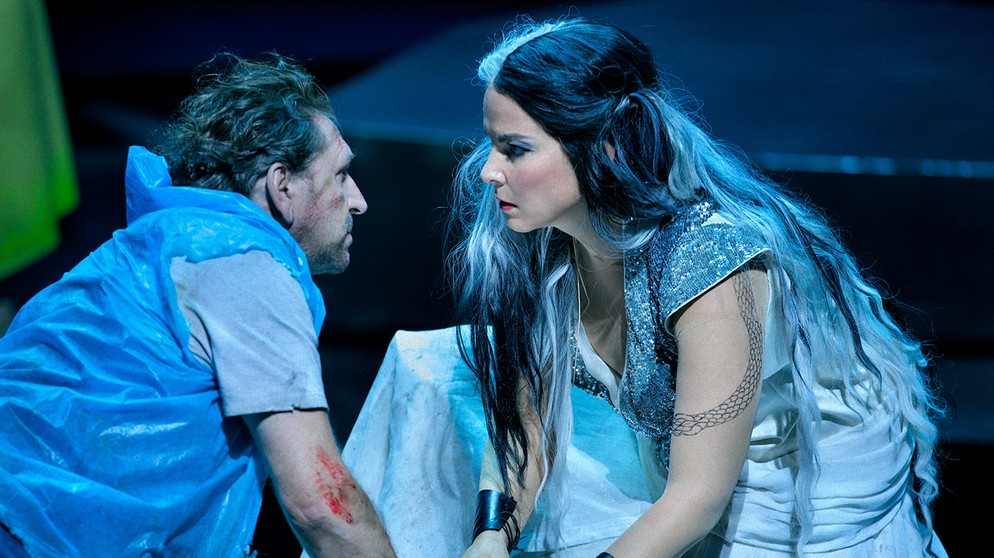
Leaving aside the augmented reality aspect, one way a director can choose to impose or highlight a certain crucial aspect of Parsifal or any opera work, is by the use of additional silent actors. While most of us don't see the visual overlays, we do see at least one 'invisible' figure, a kind of mirror image of Kundry, or simply 'woman'. Gurnemanz upon waking, or in his waking moments, is seen grappling in the embrace of an unknown woman during the prelude. She appears to be a holy woman, judging from the image of a saint or holy figure on the back of her shirt, or perhaps just appears that way to the devout Gurnemanz. She remains in the background in Act I, tending to the unhealing wound of Amfortas and appears elsewhere throughout the work. Is she a mirror image or expansion of Kundry? In a work where the presence of woman outside of Kundry barely makes an impression other than to lead good righteous men into ruin, Kundry's expansive presence can be extended in a work where compassion is important.

And yet, although many other productions make a powerful Kundry central to the whole ethos and philosophy of the work, that aspect is not emphasised as much, or seemingly as central to the other significant spin that the director places on the work, which is in how the Grail and the worship of the Grail is depicted here. The Grail is shown as a large purple-blue crystal, but more than its physical presence, what it important is how it is depicted as something painful, an adherence to old traditions (and religions?), that need to be cast off for mankind to be free from the weight of the past in order to achieve transcendence. This is hinted at in the second Act, where there is a connection established between the Grail and the cavern where Klingsor resides, which is the same shape and colour as the crystal in Act I. This is taken through to Act III which goes as far as Parsifal destroying the 'grail', the crystal thrown to the ground and shattering into pieces.

Although pain and suffering has always been an essential part of Parsifal, the path to enlightenment being essentially a painful journey, it's a significant departure nonetheless to actually destroy the Grail at the conclusion. Yet somehow this doesn't really achieve the redemptive quality of the work that you expect, but there is clearly an effort made to tie it in with the transformative impact that all the principal figures - and even secondary ones - undergo. Personally, while the set design is at least wholly sympathetic to the work, I think the fine singing is key to bringing this together as successfully as it does. Act I at least has all the beauty, agony and magnificence you could hope for and expect, laying the seeds for what it proposed in the subsequent acts. The set is open and spacious, simple and abstract - a pool, a platform/bed/coffin, a high steel pillar and a circle of light that rises to fill the stage with light during the transubstantiation offering (this one very reminiscent of a Catholic mass communion processional), but it's Amfortas's pain and the performance of it from Derek Welton that hits the mark.

Act II is much more exotically coloured and lit than is usual for the garden of the flower-maidens, appearing genuinely enchanted (and I imagine even more so in the AR version) but again, what really brings it to life is the singing. The struggle between Klingsor and Kundry as he exerts his power over her is excellent, mainly on account of the performances and singing of Jordan Shanahan as Klingsor and Elīna Garanča as Kundry. Andreas Schager has a key role to play as Parsifal of course, and does so with characeristic intensity in this act. Building on the view of the Grail that this production takes, poor Sir Ferris exists as here as a blood splattered dummy in the background while Kundry attempts her seduction of Parsifal. Parsifal is moved to rip out his heart out and compare it to a stone, as he reflects on his failing to recognise what has prevented him from understanding Amfortas/The Saviour's suffering for our sins and begin the search for redemption. Schager makes it feel real and is matched by Garanca's expression of Kundry's torment. It's hard not to be won over, even if there is little that is new expressed here.

I can't say I've ever seen a production of Parsifal that matches the description stage directions for Act III as "A pleasant, open spring landscape with a background of gently rising flowery meadows". More often it looks more like a post-apocalyptic landscape. Here indeed the stage is dominated by some monstrous looking rock crushing truck that houses Gurnemanz, and by a crater in the centre of the stage that doesn't look much like a holy spring. The rock crushing extends then to Parsifal's destruction of crystal, ending the worship of the Grail and the ways of the past. This is also the idea emblazoned on the back of the shirts of Kundry and Parsifal, the former saying 'Forget Me', the latter 'Remember Me', the two of them united in the holy spring. Even Gurnemanz embraces his shadow Kundry. It would seem to have little to do with Wagner's idea of redemption, but it is impossible nonetheless not to be moved by the extraordinary beauty and majesty of this work and what it achieves across four hours.

That at least is supported by truly impressive singing performances and an outstanding chorus. Georg Zeppenfeld is his usual solid impressive Gurnemanz, with grave, clear intonation and authority. Andreas Schager sings with such intensity that he inevitably show a little bit of strain. Elīna Garanča makes her debut appearance at Bayreuth, but I've seen her sing the role of Kundry in an ambitious production of Parsifal at Vienna in 2021 (which interestingly doubled the role of Parsifal as they do with Kundry here). She is even more impressive here and takes the curtain call at the premiere of this new production to deservedly thunderous applause. Pablo Heras-Casado is warmly received for a consistent measured performance dramatically attuned to the stage, that nonetheless (although limited to the sound mix on the livestream) I thought sounded a little lacking in detail in places. There was inevitably a mixed reception for the production team, the louder boos trying to drown out what sounded in the main like welcome applause.

This was not a great production though. Depending on your view it fails to make the essential point of the work or you could think that it finds its own roundabout way around to it, but it has moments that are successful and it looks suitably impressive. Like many of the recent Bayreuth productions however it feels like a kind of halfway house between the extreme much-maligned but fascinating excesses of the last decade and a more traditional production that at least touches base with the original stage directions. The new developments like the use of AR here - which I've read about subsequently and it seems genuinely interesting if a little overdone (reminding me of an initial misguided and eventually rejected idea to do something similar in Robert Dornhelm's greenscreen experiments for his film version of La Bohème way back in 2006) - are welcome, showing a willingness to still trying to extend the word, the music, the significance and the legacy of Wagner into the future while at the same time trying not to lose the traditional unadventurous audience who expect something more respectful or reverential.


External links: Bayreuther Festspiele, BR-Klassik

Tuesday, 27 April 2021

Wagner - Parsifal (Vienna, 2021)


Richard Wagner - Parsifal

Wiener Staatsoper, 2021

Philippe Jordan, Kirill Serebrennikov, Jonas Kaufmann, Georg Zeppenfeld, Elīna Garanča, Ludovic Tézier, Wolfgang Koch, Stefan Cerny, Ileana Tonca, Anna Nekhames, Aurora Marthens

ARTE Concert  - 18 April 2021

With its blend of philosophy, religion, mythology, spirituality and humanism, Wagner's Parsifal can be a tough prospect to make sense of on a narrative level, particularly in translating that to a modern audience in recognisable human terms. Not that it needs a coherent narrative. Almost every production I've seen of this masterpiece has found original endless (and sometimes baffling) ways of presenting it, while at the same time everything that it is about is all there in the music. And when I say music, it's not just the notes on the page, the singing or even the interpretation of it but the space and time it occupies in performance. The viewer enters into communion with Parsifal in a way that does not happen quite the same way with any other opera.

High-flown words maybe, but there is truth in this. You could write volumes exploring the work, you could write books alone on productions like Herheim's Bayreuth Parsifal, and yet however the work is dressed up, whatever means are used to explore its themes, it rarely fails to make some kind of impact and it's often a profound one. At heart the theme and message of the work can be said to be relatively simple, but in its simplicity it touches on something vast, the essence of an important aspect of what it means to be human, perhaps the most important. Redemption through Compassion, the understanding of which will put us on the path to our soul's salvation.

Even though there are clear religious and ceremonial overtones in the presentation of these themes in Parsifal's Easter Good Friday message, it certainly doesn't need to be seen through a Christian or religious perspective. Indeed such grave solemnity and reverence in a production can get in the way of letting the music express its deep human qualities. Not to make excuses for the sometimes unclear situations and direction in the current Vienna State Opera production by Kirill Serebrennikov, but even the idea of putting that into a coherent dramatic narrative is ridiculous. Anyone expecting or needing a "story" to get it across is missing the point. Richard Wagner utterly and completely puts it all into musical language, which is even more direct and yet complex in how it manages to achieve that with such incredible impact.

It's difficult to describe convincingly how the Vienna 2021 lockdown production manages to get that across - it would take a long time and a lot of pointless analysis - but it unquestionably does. Serebrennikov's setting certainly looks unlike anything else you might associate with Montsalvat. Here's it's a prison, looking more like Janáček's From The House of the Dead. Gurnemanz is the respected veteran lifer who takes young ones under his wing, shows them the ropes and even does tattoos for them. Unlike any other Gurnemanz, this one even collects packages of contraband drugs from bent wardens for them. He knows they need something else to get them through the misery of their situation, and tells them stories that give hope that some kind of redemption may be possible. Even those living in an eternal hell like the seriously ill Amfortas.

It seems unlikely that the new young man on the cell block is going to be any kind of saviour in this production. Young and foolish, he's forgotten his good upbringing and got into a lot of trouble. Not so innocent, in prison he has even killed a man, a "swan", an albino man with tattoo wings who tried to get close to him naked in the showers and paid the price. Someone however sees his potential; Kundry, a visitor who has been granted permission to photograph inside the prison, gathering images of raw masculinity for a fashion magazine, "Schloss". She however lives within a prison of her own and is seeking a way out, seeing something within this young man that might help her overcome her own demons if they don't swallow him up as well.

Aided by projections, the production plays the long first Act out as if it happens over a number of days, and that works well, in its own way bending time and space, encapsulating the inner world and dreams of the prisoners with the harsh reality of their confinement. The idea of being outside of time in any linear narrative is also put across in the use of flashback, Jonas Kaufmann the older wiser Parsifal looking back with regret on his past mistakes and innocence of his younger self, played by actor Nikolay Sidorenko. If you don't quite understand where it is going however that also turns out to be a good thing, as the whole opera is a process, you need to live through it and experience it in its totality to understand it in any kind of way.

Act II however proves to be pivotal here as it should be but far too often fails to adequately achieve. It opens up some of that in the unlikely setting of the offices of Schloss, a fashion magazine run by the tyrannical Klingsor. The Flowermaidens are fashion journalists, office staff and even cleaning staff, all lusting over the new cover model, which really is no less relatable than having mythical female ciphers float around him. What makes Act II striking is by bringing in what is only alluded to in the original and making it central to the purpose of the work, and that's Parsifal's mother Herzeleide.

Many productions have sought to extend the range of Parsifal far beyond the singing characters - Philipp Stölzl even recreating the crucifixion of Christ in a Deutsche Oper production - and with good reason, as much of what is learned as a process doesn't just extend over a lifetime, but over many lifetimes. The production here finds that the best way of expressing what sparks Parsifal's journey to self-realisation is the image that Kundry evokes of his mother. The director brings not just one but three Herzeleide's to the stage. Parsifal's first true feelings for another person are, appropriately and meaningfully, for his mother. Understanding what she has suffered for him only for him to go off the rails, is a profound revelation. Through this he suddenly realises what Amfortas has been going through, and sets out to find a way of bringing healing to his suffering.

And quite what role Kundry plays in this is also difficult to describe but it's vital, the Flowermaidens likewise presenting him with different aspects of what it means to be a woman, deepening his understanding of his own mother's situation. Somehow the director Serebrennikov - mainly though the medium of an astonishing performance from Elīna Garanča - manages to match up the sense of deep sorrow, regret and loss with a sultry undercurrent that runs through the music in this Act. Act II can often feel disjointed and unfathomable, but at its best it is enigmatic and the key to the work, and the new Vienna production makes the most of it, not least in Philippe Jordan's conducting, pacing and navigation of the dynamics of the score.

Trying to analyse and correlate the production with a predetermined idea of what Parsifal should be and even expecting it to deliver a coherent narrative is however besides the point. It's a metaphor, and it makes no more sense than expecting Wagner's mythology of the Knights of the Holy Grail, the suffering of Amfortas, the killing of a swan, the evil of Klingsor and the revelation in a kiss to make sense on any level of reality that is relatable to our lives. The best that a production can do is perhaps illuminate one aspect of the many themes and ideas expressed in the work and put it into terms that are recognisable to a modern audience. And if you can get across an important message - as this one does about imprisonment of the soul and finding a way to freedom - then it's more than enough. Anyone expecting to make narrative sense of the director's production however is only distracting themselves from the beauty of the sentiments expressed and the performances.

And what performances! It's not just a starry cast with a few experienced and distinguished Wagnerians in key roles, but there are some chances and risks taken in a few of the other casting choices that make it much more interesting and bring a little something extra to the production. Jonas Kaufmann sings the role of Parsifal well, if inevitably a little detached by being doubled with an actor. It's sung in the manner that you may be accustomed to, a manner not to everyone's taste, slightly over-pushed. He can do grave and anguished but personally I felt that he lacks sensitivity for Parsifal, and crucially lacks compassion for the role. Elsewhere however there is little to fault.

As we've come to expect from his other Wagner bass roles, Georg Zeppenfeld is just perfect. Hunding, Heinrich der Vogler and King Marke are one thing, but Gurnemanz is a much more extensive role on another level entirely. If the strain sometimes showed over the four hour running time, there was little evidence of it in his singing, which was faultless throughout, warm and compelling. As mentioned earlier, Elīna Garanča also takes her performance to another level. Kundry does present such opportunities for a singer, and even if this production didn't give her as much of a central role or room for interpretation, Garanča takes it to the level required in her singing and acting performance. I've never seen her sing a role so deeply.

Defining Klingsor as a sleazy office manager abuser of his position and power is more relatable than viewing him simplistically as an evil sorcerer, and Wolfgang Koch is suitably sinister in a typically reliable performance. Ludovic Tézier is one of the world's finest Verdi baritones and that doesn't necessarily translate over to a traditional Amfortas role in Wagner, but it certainly makes for an interesting interpretation. He carries some of the mannerisms of Italian opera across, but nonetheless gives a lyrical, sincere and heartfelt performance here. Avoiding the cliches of the spear healing the wound, he nonetheless finds peace as Parsifal's healing message of love, forgiveness and compassion sees the swan reborn and mankind freed from the pain and prison of their everyday existence to possibility of a better world.

Links: Wiener Staatsoper, ARTE Concert

Friday, 11 November 2016

Donizetti - La Favorite (Munich, 2016)

Gaetano Donizetti - La Favorite

Bayerische Staatsoper, 2016

Karel Mark Chichon, Amélie Niermeyer, Elīna Garanča, Matthew Polenzani, Mariusz Kwiecień, Mika Kares, Joshua Owen Mills, Elsa Benoit

Staatsoper.TV Live - 6th November 2016

On the surface, La Favorite has a melodramatic plot of contrivance, misfortune and happenstance that results in the inevitable tragic ending for the leading lady. It's one that is typical of bel canto opera and Donizetti (Lucia di Lammermoor, Linda di Chamounix, Anna Bolena). La Favorite in fact seems even more over the top than usual, with religion, court intrigue and war heroism all crashing together in a spectacular fashion within the remit of a tragic love triangle. Behind it all however there is the touching and tragic personal story of a woman crushed by huge forces beyond her control, and the Bayerische Staatsoper's 2016 production focuses in on this human element of Donizetti's rich work to brilliant effect.

There is certainly a risk of that human element being lost within the vast scale of the plot and the immense stature of the personalities involved. The human element is principally within the figure of Léonor de Guzman, a woman who is secretly the mistress, the 'favourite', of King Alfonse XI of Castille. Their illicit union however doesn't escape the notice of the Pope, who issues a Papal decree denouncing the king's intention to divorce the Queen and risk placing the nation under threat. The king sees a way out of the problem, agreeing to a marriage between Léonor and Fernand, a captain in his army who has distinguished himself in the nation's wars, but the king has another agenda, having just discovered that Fernand is already Léonor's lover.

Even the history of Léonor's affair with Fernand is shrouded in  romantic intrigue and secrecy; Fernand leaving the monastery of St James where he is a novice monk to follow a mysterious woman he is in love with, Léonor necessarily keeping their meetings hidden from the King. Behind all the huge religious, political and royal intrigues however is a woman who is the victim of all these forces; the mistreated and abused mistress of the king, a fallen woman reviled by the Catholic Church, scorned by the royal court who laugh at her "sordid affair", and eventually abandoned by her lover over his deep sense of "honour". These grand forces might take a literal representation in the libretto, but Donizetti's score has a way of showing how they affect women in the abstract.


Donizetti's music is often underrated and indeed in some works it is rather rudimentary in its rhythms and dramatic effects. Composed for the Paris stage, and presented in that original French version here in Munich, the work is considerably more sophisticated than Donizetti is often given credit for. On the grand scale, the collision of such vast forces looks towards Verdi's Don Carlos, but on the intimate and more personal level, Fernand's rejection of the fallen woman Léonor at the altar is equal in force of sentiment and dramatic impact to Alfredo's repudiation of Violetta in La Traviata. Perhaps even more so, since the royal court also round on Léonor in a mass chorus that proclaims "His revenge is noble indeed", in response to Fernand's act.

The key to not letting such highly charged scenes and lofty personalities overwhelm the human tragedy of Léonor's fate is, evidently, restraint. Donizetti's score suggests bombast, but it invites intimacy and a more nuanced approach. The extravagant bel canto histrionics are not there in La Favorite, nor is there is any mad scene to show off the agility and range of the soprano. Léonor is scored for a mezzo soprano, and the timbre is darker, the role more dramatic, but still lyrical and still extremely challenging. Elīna Garanča is restrained in her gestures, almost holding back too much, but a deeper response to the turns of events is there to be brought out and it can be fully felt in her singing delivery. It's an impressively and yet unshowy performance.

Highlighting Léonor's fate as the core of the opera's greatness is the main element that points to another success for the Bayerische Staatsoper following on from their live broadcast of an impressive Die Meistersinger von Nürnberg last month. It seems like many of the previous directorial excesses of the opera house have been scaled back without losing any of the freshness, modernity and inventiveness of their productions. Amélie Niermeyer's direction pays attention to the tone of the opera, to the narrative drama and to the subtext. There's an attention to detail in the characterisation that avoids the broad brushstrokes that the overly-orchestrated plot would seem to invite.

The attention to detail and to the human side of the work is not just reflected in Léonor, but there is effort made to humanise the other characters too. Most notably - even if its "humanising" on a rather more base level - the director uses the interval music between Act I and II to show us another side to King Alfonse. Sitting beside Léonor while a light display suggests they are watching a lurid TV drama, many facets of Alfonse the man are shown, his arrogance and machismo, his boyish playfulness, his sleazy possessiveness of Léonor, pawing over her, but also his romantic fervour. It's a terrific use of Donizetti's music to develop character without distorting it. It has to be said that Mariusz Kwiecień is quite brilliant in running through this range in a fantastic dumbshow display, and his singing and performance in the more conventional kingly role is equally assured and impressive.


Matthew Polenzani is doing great work on the Munich stage, and he's well cast here as a dramatic lyrical Verdi tenor instead of a more romantic bel canto singer like Juan Diego Flórez or Yijie Shi (who sang the role in Toulouse). His voice is not a big one, but it's expressive and he can do much with a role like Fernand. That said, Fernand is not a figure who comes out of the work with a clear or nuanced position, swayed between love and God, working himself up from monk to warrior, with little opportunity for any real human character to be expressed, but Polenzani does what he can with the arias and is always engaging in voice and in performance.

La Favorite shows what opera at its best can do, elevating the human experience to an epic scale, and reducing epic scale down into relatable human experience. The Munich production sees a woman's life within the context of the unforgiving forces of religion and masculine power, judged by their standards and unable to exert any control over her own life and love. Donizetti's music is masterfully up to the task and the Bayerisches Staatsorchester, directed with force, vigour and sensitivity by Karel Mark Chichon show just how sophisticated Donizetti's writing can be and just how much of an impact his operas can make. This is another outstanding production in what is so far an impressive broadcast season at the Bavarian State Opera House in Munich.

The next live broadcast from Munich is Shostakovich's LADY MACBETH OF MTSENSK on 4th December 2016 at 7pm (C.E.T.), conducted by Kirill Petrenko and directed by Harry Kupfer.


Links: Bayerische Staatsoper, Staatsoper.TV

Wednesday, 22 April 2015

Strauss - Der Rosenkavalier (Vienna, 2015 - Webcast)

Richard Strauss - Der Rosenkavalier

Wiener Staatsoper, 2015

Adam Fischer, Otto Schenk, Martina Serafin, Wolfgang Bankl, Elīna Garanča, Erin Morley, Jochen Schmeckenbecher, Caroline Wenborne, Thomas Ebenstein, Ulrike Helzel

Wiener Staatsoper Live at Home - 12 April 2015

 
There are some things to be said for Otto Schenk's old, traditional, somewhat stuffy, period realistic production of Der Rosenkavalier. Not much admittedly, and it's perhaps unintentional, but Act I at least fully indulges Strauss and Hofmannsthal's qualified nostalgia for an idealised Vienna of the past, a way of life that is on the point of change and never to be regained. And since this production is being played in Vienna itself, that is likely to hold some measure of recognition with the home audience. So it's not a stylised Vienna either, but one that looks and realistically reflects how things might indeed have looked and, to an extent, operated in the olden days.

The Vienna seen in Act I of Der Rosenkavalier, in the bed chamber of the Feldmarschallin, is one where the privilege of nobility permits all manner of abuses. These are presented in a saucy farcical manner by Strauss and Hoffmannsthal - with reference evidently to the music and operetta of the time - but there is a little bit of an edge here that shows attitudes, morals, social gatherings, behaviours and manners that are rather hidebound and out of step with the world we live in today. It's a world that is already starting to change with the arrival of the merchant class of nouveaux riches, seen in the second act. Unintentionally then, Otto Schenk's frumpy, old-fashioned set does reflect a world clinging to a past that is in conflict with social changes.


Particularly in its attitudes towards women. Octavian, a young boy sung by a mezzo-soprano in a trouser role who is to be our optimistic hope for a new future, dresses as a maid in Act I and soon finds out what it's like to be on the receiving end of male attentions. The behaviour of Baron Ochs towards Mariandel is not surprising however, nor are the allusions to servants bearing illegitimate offspring of the nobility without those children having the same rights and privileges, but it's mostly played for laughs in the opera. What makes Der Rosenkavalier a little more pertinent however, is the attitute and contemplation of the situation of the Marschallin. 

Marschallin has enjoyed the privilege of having a prominent position in nobility, but she - "ordered into wedlock straight from the convent" - has never enjoyed the same kind of freedom that men of rank and position hold. Baron Ochs can chase her "maid" around the room, probably "get the money and the young girl" from a rich family that he is engaged to and boast of there being probably more than one other little bastard Lerchenau in the servant's quarters that he doesn't even know about. Marschallin however, as a woman, has to be very careful to hide her illicit although perhaps not entirely guilt-free (abusing her position as a wealthy and beautiful woman?) affair with her young cousin Octavian. "That's the way of the world".


But the Marschallin's contemplative melancholy goes beyond the inequalities in how the sexual behaviour of men and women is perceived. She also feels "the fragility of all temporal things" as only a woman can, and knows time is more cruel to women than to men. But more than just fearing the approach of old age and the diminishment of her charms, there's an awareness - its implications perhaps not entirely grasped - that the times are changing too. "Don't be like all other men!", she warns Octavian, even as she has the premonition that their time together is approaching an end, and that society will leave her kind behind just as Octavian will, sooner or later, leave her for Sophie. He must take advantage of these new opportunities and offer Sophie, and women as a whole, a different world from the one she has known.

All this is laid out in Act I, and there's not much Otto Schenk's production can do to take away from the beauty of what Strauss and Hofmannsthal have created here. It's a scene that carries resonance all the way through the longeurs of Act II and particularly Act III, right up until the moment that the Marschallin reappears and brings all the lovely melancholy of time and change with her once again. The production however has nothing much to contribute to any of this, Act II at the residence of the Faninals scarcely looking any brighter or more modern than Act I, Act III's dark interior of the inn looking exactly as you might expect a den of iniquity to appear, played plainly as a farce without any of the work's satirical tone.


The production values however are high, as you might expect, Octavian in particular cutting a fine figure against this backdrop in his period costume and wig. That's Elīna Garanča, looking terrific if not in the least bit manly, singing the role beautfully. She sings one of the best Octavians I've heard recently, but her movements, performance and delivery are a little stiff, not really seeming to engage with the production or as well with the other characters as you might like. And yet, the performances of each of the other singers Octavian plays off is also outstanding in his or her role. Martina Serafin is a perfect Marschallin, Wolfgang Bankl a well-characterised Ochs auf Lerchenau, but it's Erin Morley's Sophie who really gives the production that freshness and vitality that is unfortunately lacking elsewhere.

Der Rosenkavalier was broadcast from the Vienna State Opera as part of their Live at Home programme. The next broadcast is L'ITALIANA IN ALGERI on the 30th April. May sees Juan Diego Flórez in DON PASQUALE, Plácido Domingo in NABUCCO and the beginning of Sven-Eric Bechtolf's production of DER RING DES NIBELUNGEN, conducted by Simon Rattle. Details of how to view these productions live at home can be found in the links below.


Links: Wiener Staatsoper Live Streaming programmeStaatsoper Live at Home video

Sunday, 22 January 2012

Donizetti - Anna Bolena


BolenaGaetano Donizetti - Anna Bolena
Wiener Staatsoper, Vienna 2011
Evelino Pidò, Eric Génovèse, Anna Netrebko, Elīna Garanča, Ildebrando D’Arcangelo, Francesco Meli, Dan Paul Dumitrescu, Elisabeth Kulman, Peter Jelosits
Deutsche Grammaphon
The first of Donizetti’s operas to be a major international success, Anna Bolena is a tragedia lirica that sets the tone for a number of subsequent works in the same dark, historical vein – Lucrezia Borgia and the two other operas that comprise the composer’s Tudor trilogy, Maria Stuarda and Roberto Devereux. First performed in 1830 and reflecting perhaps the revolutionary spirit of the times – the depiction of Henry VIII here is in marked contrast to that of the merciful Metastasian kings of the past – these works differ considerably in tone from the now mostly forgotten comedy works by Donizetti that preceded them (and indeed from the more popular but considerably better written comic works that followed such as L’Elisir d’Amore and Don Pasquale), but the qualities and the value of Anna Bolena as a key work of the composer itself haven’t always been recognised either. It took an astonishing performance from Maria Callas in her prime in Milan in 1957, in a Luchino Visconti production, to once again bring this particular work to the attention of the opera-going public, and with it a newfound appreciation for Donizetti’s work.
In some ways, with this new production at the Vienna State Opera in 2011, followed by its appearance on the stage at the Met in New York (two different productions but both featuring Anna Netrebko in the title role), Anna Bolena is again proving to be a key work leading to a rediscovery and re-evaluation of Donizetti as being more than just a composer of bel canto, but one capable of developing works with considerable dramatic power and unexpected depth of character. I can’t think of any soprano at the moment who would be capable of drawing new depths in the work in the way Callas did dramatically, but in terms of star-power and personality, as well as having a voice of great substance to match, Anna Netrebko is among the very the best we have for this kind of role. The Vienna production consequently might not be quite such a revelation this time around, but it’s a creditable performance nonetheless that brings out the true qualities of the work, and often it’s even quite exhilaratingly impressive.
Bolena
Everything good that can be learned by the master Rossini is evident here in the disciple’s work, and it’s also possible to see the huge influence that Donizetti’s treatment of historical and romantic intrigues in Anna Bolena would have on Verdi’s mature works, and not just the early ones. I recently noted the use of duets in Donizetti’s late work Linda di Chamounix, but the dramatic and lyrical strengths of Anna Bolena also lie in such ensemble work, creating a fevered intensity to the love duets and to the confrontations between rivals, but creating additional complexity to the arrangements through quartets, quintets and choral work of remarkable power that carry those contradictory emotions and pronouncements. While such moments are hammered home to great effect and underscored by dark menacing tones, Donizetti’s sense of melody is also just as evident here as in the more tender moments and arias. Those elements are superbly brought out by Evelino Pidò and the orchestra of the Wiener Staatsoper, the drive of the musical forces being one of the most impressive aspects of this production (and one, I’m pleased to say, that is audible with remarkable detail and dynamism in the High Definition audio channels of the Blu-ray release).
Since the casting and singing is also of an extraordinarily high quality, it’s disappointing then that the stage direction by Eric Génovèse is so rigidly traditional. There is the merest suggestion of the courtly interiors of Windsor Castle, the same mostly fixed location adapted to a throne-room, a courtyard or a park as required, which at least means that there is a fluidity between scenes even if what takes place in them is largely static. It is of course difficult to stage such bel canto works, which are not terribly active dramatically, but the director here finds no imaginative solution, eye-catching arrangements or sets, leaving the performers to stride up and down the stage in the absence of anything much else to do. The costume design is at least impressive, enough to give the production some sense of dramatic realism, and the stage is brightly lit (perhaps with a few additional spotlights for the TV cameras), or at least the stars are well lit to shine brightly against the rather drab backgrounds.
And “stars” is not an accidental choice of words either, because they were undoubtedly the main attraction of this production, generating a great deal of press interest and commanding incredible prices for ticket sales. In the end, they all certainly live up to and almost justify the hype. Anna Netrebko in particular brings great presence to the role of Anne Boleyn. She’s not always the most convincing in the bel canto repertoire – although as Norina in another recent Donizetti role for the Metropolitan Opera’s Don Pasquale, she was outstanding – and this particular role represents a considerable challenge. It’s not just that Netrebko is following in the footsteps of so many great singers who have taken on the role in the past, from Guiditta Pasta – the original Anna B. – through to Maria Callas and Joan Sutherland, and unlikely to be able to stand up to the comparison, but her performance in this role also in a way represented more of a personal milestone that would consolidate her standing or define her limitations. In the event, her performance here kind of does both, but it must primarily be judged a great success.
Bolena
Netrebko’s performance of Anna Bolena is a mixed one, but such is her own force of personality and tone of voice that comparisons to other singers soon fall by the wayside, allowing her performance in the role to be judged on its own terms. At times she does seem to be absent from the character, her voice not quite capable either of reaching those deeper emotional depths, failing to find any colour or personality in a scene, but at other times – notably in her duet with Elīna Garanča’s Jane Seymour where she identifies her rival, and in her final death scene – she suddenly seems to let fly with superb control and genuine passion (the same mixed qualities incidentally could also be said applied to Donizetti’s writing for this particular work). She’s at least never anything less than compelling and commanding whenever she is on the stage, the viewer captivated by how she is going to deal with any given scene. The other principals are no less impressive, Garanča in particular entering fully into character and rising to the challenges it represents dramatically and vocally, while Ildebrando D’Arcangelo is a solid and convincing Enrico (Henry VIII). Francesco Meli’s Percy is also worthy of mention, genuinely impassioned and of sound vocal ability, if not always in perfect time with the conductor. Elisabeth Kulman also makes a strong impression in the lesser but vital role of Smeton.
The quality of the Blu-ray release of the 2011 Wiener Staatsoper production of Anna Bolena from Deutsche Grammaphon is outstanding. Filmed for the screen by Brian Large, the veteran opera screen director does well to make the most of the limited dramaturgy and stage movements, the strong lighting making this look just marvellous. The audio tracks, LPCM Stereo and DTS HD-Master Audio 5.0, are, as I mentioned earlier, astounding. There such great depth, dynamic and detail audible in the playing of the orchestra, as well as in the singing that you can’t help but be impressed by the performances. In terms of extra features, there are only brief introductions to each of the two acts in German by Elīna Garanča. Subtitles are in Italian, English, German, Spanish and French.