Showing posts with label Jonas Kaufmann. Show all posts

Tuesday, 10 August 2021

Wagner - Tristan und Isolde (Munich, 2021)


Richard Wagner - Tristan und Isolde

Bayerische Staatsoper, 2021

Kirill Petrenko, Krzysztof Warlikowski, Jonas Kaufmann, Mika Kares, Anja Harteros, Wolfgang Koch, Sean Michael Plumb, Okka von der Damerau, Dean Power, Christian Rieger, Manuel Günther

Staatsoper TV Live Stream - 31 July 2021

The final production of Nikolaus Bachler’s exceptional tenure as General Manager of the Bavarian State Opera may not be a perfect send-off, but it's certainly one that typifies his time there. It's a style that is adventurous, takes chances and divides audiences, and putting Krzysztof Warlikowski on Tristan und Isolde is something of a gamble. It's not uncommon to be left confused about what is going on and what the point of a production is, but more often than not, Munich productions manage to find a way to connect with a work in new and interesting ways. Warlikowski production of Tristan und Isolde actually doesn't appear that adventurous or controversial, or at least no more absurd and bizarre than a work with magic love potions, over-fervent raptures and philosophical ideas wrapped up in flowery language.

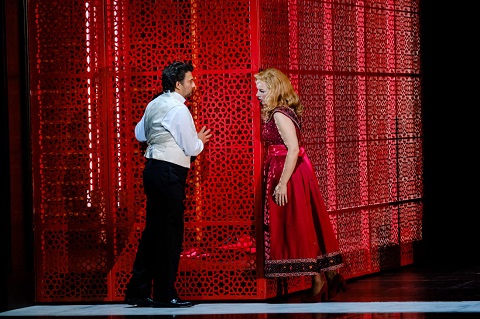
This time it looks - as with his Don Carlos - as if Warlikowski has again run out of ideas when confronted with the big beasts of opera. On one level, Tristan und Isolde takes place mainly within the ordinary surroundings of a wood-panelled 1920s' hotel room, while on another level, projections show an alternate - perhaps heightened emotional or fantasy - playing out of events. On one level it's Christoph Loy and another it's Bill Viola, whose extraordinary art installation screens for the Paris Tristan und Isolde separated the physical or material with projections of the ecstatic spiritual heights that would otherwise be difficult to translate into purely human actions on the stage. And when music and visuals come together, this opera can certainly achieve that level of transcendence.

Warlikowski's lack of any new ideas to separate those states (and connect them) is most evident in Act II. There's a build-up here that is expressed as the secret lovers meet that demands a corresponding gradual increasing intensity of feeling before they almost dissolve in rapture, but where little happens on a dramatic level other than the inevitable release of tension - a false release - with their discovery by Marke. On the stage in this production, there's not a lot going on and little visual sign of such deep feeling as it is expressed in the music. Warlikowski takes it to the other level in the projections that show the lovers physically separate but tantalisingly close, as water rushes out beneath the bed they lie on and submerges them.

The director emphasises this separation of the world we see and the one we feel right from the start, using people dressed as dummies with no distinguishing features to stand in for Tristan and Isolde during the Vorspiel. Its not so much an idealised form as a negation of one, where the physical characteristics don't matter as much as the interior lives. Without wishing to 'body shame' any performers, there's nothing new about that idea, and opera viewers have had to use their imagination to see less than perfect human forms and shapes aspire to an image of sublime godlike perfection ever since opera was invented.

You can take this idea too far - and Warlikowski inevitably does - bringing the dummies back as a doubles for Tristan and Isolde in Act III, populating Kareol with baby Tristans who, for some obscure reason, sit around a table in the wood-panelled room setting that the director also seems to have settled upon for no discernible reason. It takes more than a few odd references and mannerisms however to hold Tristan und Isolde back from reaching its goal, and it does seem to be the case that there's no need to be hasty in judgements; you need to wait and see where this takes us, and if any work repays delayed gratification, it's surely this one.

Warlikowski, for all his mannerisms and lack of any imaginative response to Tristan und Isolde (compared for example to Simon Stone's recent production at the Aix-en Provence festival that I viewed just a week before this), does however bring out one element of the work that hadn't really struck me before. I'm not quite sure how he does it, since there is little that visually alludes to it, but between him and Jonas Kaufmann, it's possible to see the commonalities of themes in Tristan that are developed further in Parsifal. The pain of the wound, the enlightenment through pain to consider one's origins, birth and mother's suffering on the way to achieving an enlightened state. Kaufmann - and very much Harteros too - at least made it feel that there is something deeper behind the pathology of both characters in their conflation of love and death, and it has nothing to do with a magic love potion. Their love-death union is derived from an awareness of human existence and love as a path to attain spiritual bliss that can only be completely fulfilled in the union of death.

Anja Harteros in fact embodies this much better than Kaufmann. She is a fine singer and a superb actress; you can practically see the music and every emotion it provokes flow through her. Her embodiment and communication of a role I find is always unerringly accurate - or makes you believe it so - but her voice isn't always able to match the same heights, particularly in the Wagnerian range. She's good, a true artist, but just not fully up to the demands of Isolde here right across the board. Kaufmann is also very weak, struggling to gain volume over the surge of the orchestra, but he is also simply unconvincing in a role that demands total and utter commitment. Kaufmann and Harteros have been much more convincing as a duo in Verdi, in Otello, in La Forza del destino and in Giordano's Andea Chenier, but most assuredly not in their role debuts as Tristan and Isolde.

There's no question however that both give it their all and Kaufmann is actually quite impressive in the critical Act III. I thought he might hold back from the exceptional demands placed on Tristan in this Act, and holding back is not something you can do in this opera. As committed as his Act III is, and as well as it is delivered, it still seems to lack the underlying conviction, of someone dying and longing to die, but unwilling to do so while his soulmate is still alive and separated from him - on several planes of existence. It's a lack of connection to his character here that I've felt in some of Kaufmann's performances; in some it might not matter so much in some works, but in Don Carlos and in Tristan und Isolde - two of the pinnacles of opera - half-measures and almost-theres are not good enough. 

With neither Kaufmann, Harteros nor Warlikowski being entirely up to the admittedly huge task of Tristan und Isolde, Kirill Petrenko - another person who has a huge impact in making Munich one of the centres of exciting opera in Europe - has his work cut out for him. In the absence of any kind of real stirring of passion on the stage, he has to make the music do most of the work. He doesn't quite manage it and in fact, judging by the sound purely on the live stream performance, it feels like he is trying too hard. He pushes the orchestra to those extremes, trying to conjure up day and night, light and dark, but there is little on the stage to match the intent, and the work often sounds aggressive. He is of course aware of the dynamic and pace and is able to rein it in and slow it down for 'O sink hernieder, Nacht der Liebe' in Act II, before building up the rush of emotions (the preparation of lethal injections, the lovers awash in a hotel room) that is shattered by the arrival of Melot and Marke. If it's fury you want to show, this is the way to play it, but it should be disappointment and resignation, shock and disillusionment. And credit where its due, you can see it in Harteros, if nowhere else.

Think what you will of the singing and the production - and there's good support from Wolfgang Koch and Okka von der Damerau as Kurwenal and Brangäne - but there is nothing else in all opera like the Liebestod and the finale of Tristan und Isolde. It's one of the most sublime expressions of human feeling put into music or indeed any form of art, unparalleled in its capacity to reach deep inside and express something wonderfully mysterious and sublime. Despite the imperfections elsewhere, Kaufmann's final utterance of "...Isolde" and Harteros's soaring Liebestod touch on the work's extraordinary and unmatched core of emotions, the essence of life and death, of striving for a love that surpasses human boundaries and attains something spiritual and sublime. Despite the failings of the production as a whole, this moment as ever is worth waiting for. And if it still achieves its purpose, what has come before and the contributions of the performers must have succeeded on some level.

Tuesday, 27 April 2021

Wagner - Parsifal (Vienna, 2021)


Richard Wagner - Parsifal

Wiener Staatsoper, 2021

Philippe Jordan, Kirill Serebrennikov, Jonas Kaufmann, Georg Zeppenfeld, Elīna Garanča, Ludovic Tézier, Wolfgang Koch, Stefan Cerny, Ileana Tonca, Anna Nekhames, Aurora Marthens

ARTE Concert  - 18 April 2021

With its blend of philosophy, religion, mythology, spirituality and humanism, Wagner's Parsifal can be a tough prospect to make sense of on a narrative level, particularly in translating that to a modern audience in recognisable human terms. Not that it needs a coherent narrative. Almost every production I've seen of this masterpiece has found original endless (and sometimes baffling) ways of presenting it, while at the same time everything that it is about is all there in the music. And when I say music, it's not just the notes on the page, the singing or even the interpretation of it but the space and time it occupies in performance. The viewer enters into communion with Parsifal in a way that does not happen quite the same way with any other opera.

High-flown words maybe, but there is truth in this. You could write volumes exploring the work, you could write books alone on productions like Herheim's Bayreuth Parsifal, and yet however the work is dressed up, whatever means are used to explore its themes, it rarely fails to make some kind of impact and it's often a profound one. At heart the theme and message of the work can be said to be relatively simple, but in its simplicity it touches on something vast, the essence of an important aspect of what it means to be human, perhaps the most important. Redemption through Compassion, the understanding of which will put us on the path to our soul's salvation.

Even though there are clear religious and ceremonial overtones in the presentation of these themes in Parsifal's Easter Good Friday message, it certainly doesn't need to be seen through a Christian or religious perspective. Indeed such grave solemnity and reverence in a production can get in the way of letting the music express its deep human qualities. Not to make excuses for the sometimes unclear situations and direction in the current Vienna State Opera production by Kirill Serebrennikov, but even the idea of putting that into a coherent dramatic narrative is ridiculous. Anyone expecting or needing a "story" to get it across is missing the point. Richard Wagner utterly and completely puts it all into musical language, which is even more direct and yet complex in how it manages to achieve that with such incredible impact.

It's difficult to describe convincingly how the Vienna 2021 lockdown production manages to get that across - it would take a long time and a lot of pointless analysis - but it unquestionably does. Serebrennikov's setting certainly looks unlike anything else you might associate with Montsalvat. Here's it's a prison, looking more like Janáček's From The House of the Dead. Gurnemanz is the respected veteran lifer who takes young ones under his wing, shows them the ropes and even does tattoos for them. Unlike any other Gurnemanz, this one even collects packages of contraband drugs from bent wardens for them. He knows they need something else to get them through the misery of their situation, and tells them stories that give hope that some kind of redemption may be possible. Even those living in an eternal hell like the seriously ill Amfortas.

It seems unlikely that the new young man on the cell block is going to be any kind of saviour in this production. Young and foolish, he's forgotten his good upbringing and got into a lot of trouble. Not so innocent, in prison he has even killed a man, a "swan", an albino man with tattoo wings who tried to get close to him naked in the showers and paid the price. Someone however sees his potential; Kundry, a visitor who has been granted permission to photograph inside the prison, gathering images of raw masculinity for a fashion magazine, "Schloss". She however lives within a prison of her own and is seeking a way out, seeing something within this young man that might help her overcome her own demons if they don't swallow him up as well.

Aided by projections, the production plays the long first Act out as if it happens over a number of days, and that works well, in its own way bending time and space, encapsulating the inner world and dreams of the prisoners with the harsh reality of their confinement. The idea of being outside of time in any linear narrative is also put across in the use of flashback, Jonas Kaufmann the older wiser Parsifal looking back with regret on his past mistakes and innocence of his younger self, played by actor Nikolay Sidorenko. If you don't quite understand where it is going however that also turns out to be a good thing, as the whole opera is a process, you need to live through it and experience it in its totality to understand it in any kind of way.

Act II however proves to be pivotal here as it should be but far too often fails to adequately achieve. It opens up some of that in the unlikely setting of the offices of Schloss, a fashion magazine run by the tyrannical Klingsor. The Flowermaidens are fashion journalists, office staff and even cleaning staff, all lusting over the new cover model, which really is no less relatable than having mythical female ciphers float around him. What makes Act II striking is by bringing in what is only alluded to in the original and making it central to the purpose of the work, and that's Parsifal's mother Herzeleide.

Many productions have sought to extend the range of Parsifal far beyond the singing characters - Philipp Stölzl even recreating the crucifixion of Christ in a Deutsche Oper production - and with good reason, as much of what is learned as a process doesn't just extend over a lifetime, but over many lifetimes. The production here finds that the best way of expressing what sparks Parsifal's journey to self-realisation is the image that Kundry evokes of his mother. The director brings not just one but three Herzeleide's to the stage. Parsifal's first true feelings for another person are, appropriately and meaningfully, for his mother. Understanding what she has suffered for him only for him to go off the rails, is a profound revelation. Through this he suddenly realises what Amfortas has been going through, and sets out to find a way of bringing healing to his suffering.

And quite what role Kundry plays in this is also difficult to describe but it's vital, the Flowermaidens likewise presenting him with different aspects of what it means to be a woman, deepening his understanding of his own mother's situation. Somehow the director Serebrennikov - mainly though the medium of an astonishing performance from Elīna Garanča - manages to match up the sense of deep sorrow, regret and loss with a sultry undercurrent that runs through the music in this Act. Act II can often feel disjointed and unfathomable, but at its best it is enigmatic and the key to the work, and the new Vienna production makes the most of it, not least in Philippe Jordan's conducting, pacing and navigation of the dynamics of the score.

Trying to analyse and correlate the production with a predetermined idea of what Parsifal should be and even expecting it to deliver a coherent narrative is however besides the point. It's a metaphor, and it makes no more sense than expecting Wagner's mythology of the Knights of the Holy Grail, the suffering of Amfortas, the killing of a swan, the evil of Klingsor and the revelation in a kiss to make sense on any level of reality that is relatable to our lives. The best that a production can do is perhaps illuminate one aspect of the many themes and ideas expressed in the work and put it into terms that are recognisable to a modern audience. And if you can get across an important message - as this one does about imprisonment of the soul and finding a way to freedom - then it's more than enough. Anyone expecting to make narrative sense of the director's production however is only distracting themselves from the beauty of the sentiments expressed and the performances.

And what performances! It's not just a starry cast with a few experienced and distinguished Wagnerians in key roles, but there are some chances and risks taken in a few of the other casting choices that make it much more interesting and bring a little something extra to the production. Jonas Kaufmann sings the role of Parsifal well, if inevitably a little detached by being doubled with an actor. It's sung in the manner that you may be accustomed to, a manner not to everyone's taste, slightly over-pushed. He can do grave and anguished but personally I felt that he lacks sensitivity for Parsifal, and crucially lacks compassion for the role. Elsewhere however there is little to fault.

As we've come to expect from his other Wagner bass roles, Georg Zeppenfeld is just perfect. Hunding, Heinrich der Vogler and King Marke are one thing, but Gurnemanz is a much more extensive role on another level entirely. If the strain sometimes showed over the four hour running time, there was little evidence of it in his singing, which was faultless throughout, warm and compelling. As mentioned earlier, Elīna Garanča also takes her performance to another level. Kundry does present such opportunities for a singer, and even if this production didn't give her as much of a central role or room for interpretation, Garanča takes it to the level required in her singing and acting performance. I've never seen her sing a role so deeply.

Defining Klingsor as a sleazy office manager abuser of his position and power is more relatable than viewing him simplistically as an evil sorcerer, and Wolfgang Koch is suitably sinister in a typically reliable performance. Ludovic Tézier is one of the world's finest Verdi baritones and that doesn't necessarily translate over to a traditional Amfortas role in Wagner, but it certainly makes for an interesting interpretation. He carries some of the mannerisms of Italian opera across, but nonetheless gives a lyrical, sincere and heartfelt performance here. Avoiding the cliches of the spear healing the wound, he nonetheless finds peace as Parsifal's healing message of love, forgiveness and compassion sees the swan reborn and mankind freed from the pain and prison of their everyday existence to possibility of a better world.

Links: Wiener Staatsoper, ARTE Concert

Tuesday, 2 March 2021

Verdi - Aida (Paris, 2021)


Giuseppe Verdi - Aida

Opéra national de Paris, 2021

Michele Mariotti, Lotte de Beer, Ksenia Dudnikova, Sondra Radvanovsky, Jonas Kaufmann, Roberta Mantegna, Ludovic Tézier, Soloman Howard, Dmitry Belosselskiy, Alessandro Liberatore

ARTE Concert - 18 February 2021

It would be a shame to ever get tired of Aida, as it is undoubtedly a supreme work of opera from a great composer reaching the pinnacle of his craft, but I could do without ever seeing another idealised ancient Egyptian setting and ceremonial procession. There's nothing inherently wrong with that it's just I like to see something that makes you think a little deeper about what the opera is about. And from the last few productions I've seen, the opera is surprisingly adaptable to draw out the work's themes, which are far as Verdi is concerned, is a large scale attack on war and religion and the impact of them on individual human lives.

There's a hint in the period and the museum setting of this Paris production that the director Lotte de Beer wants to draw out the issue of colonialism. The opera is updated here - thank goodness - to the Italian Risorgimento, a more meaningful period at least as far as Verdi was concerned. And there's no question that the underlying force of the work lies in such a context. Much as La Traviata gains its true strength from the sense of burning injustice towards women in society, Aida shows that there's a human reality and cost to war. It diminishes the power of the work if it is merely presented as a glamorous grand opera spectacle.

The Paris production opens with Radamès looking at a mummy-like Aida in a display case at a museum as he reflects on conflicted feelings of love for country and fighting for it in a war. The mummy Aida comes to life then as a guiding spirit - or something like that - in his life. Amneris then acts as the other side of this, his conflicted feelings of betrayal of his obligations to his own country. The other underlying themes and sentiments relating to war, religion and colonialism are similarly brought out in other exhibits from other cultures in glass cases. One of the cases contains a skull, the connotations of which are fairly obvious, even as Radamès as newly elected commander in arms anoints it with blood.

Whether you buy into this idea or not, the change of perspective - to say nothing of the beautiful set and costume design - at least serves to make this an attractive and fresh take on an opera whose themes are too often buried in convention and played purely for grand opera spectacle. The centrepiece victory march - often the most problematic for any director wishing to undercut the triumphalism of war - is presented not without some irony as a series of exhibition tableaux of classic paintings put on at the "museum". It references and recreates scenes of Napoleon, the raising of the flag on Iwo Jima, Delacroix's Liberty and other triumphal poses through the ages that could be said to glorify or idealise war.

It's a mark of how good the production is that it hits home effectively not just in the traditional big numbers and famous arias, but in the more human moments that are just as crucial such as the plight of the Ethiopian prisoners and Aida's recognition of her father. What also becomes evident - and Ksenia Dudnikova has much to contribute to this - is the other triumphant victory of Amneris over Aida in gaining the promise of marriage to Radamès. Verdi's ensemble writing for this is astonishing, gathering up all the conflicting desires and combining them with the inhuman treatment of prisoners of war to make this scene as forceful as any other in this work, the work of a complete master.

But why the puppets? This would have been a great production but for the dumb choice of using puppets for Aida and Amonasro. Life size puppets are not uncommon in opera productions, but they are rarely put to any meaningful use. In a Madama Butterfly, you could see some sense of purpose in Cio-Cio San being manipulated and treated like a doll, a plaything. Puppets have been used in Weber's Oberon as an impressive spectacle for a fairy-tale opera, but they can be superfluous to The Magic Flute. Other than to prevent singers 'blacking up' I can't for the life of me understand why Lotte de Beer went with the crude fossilised puppets for Aida. With three operators and Sandra Radvanovsky all on the stage for Aida, it's a terrible distraction. Add another two for Amomasro's half puppet and it over-complicates important direct scenes. Radvanovsky and Tézier don't seem to know whether they should be singing to each other or the puppets, and the camera isn't quite sure who to follow either. Perhaps worse, Jonas Kaufmann even has to endure the embarrassing situation of getting intimate with a puppet, and looks like he is being attacked by a gang.

As a human Aida, Sandra Radvanovsky is good. The high register occasionally pushes her out of comfort zone, thinning out to near inaudibility in some passages, but she brings character and depth of feeling to the work. It's a shame that she has to compete with a puppet and puppet handlers. The Uzbekistan mezzo-soprano Ksenia Dudnikova is just superb as Amneris. She handles the singing requirements more than capably, but just as importantly she captures the weak human side of Amneris as well as her regal imperiousness. Aida is an opera that is there for the taking by an Amneris of sufficient quality - her emotional and musical journey is a fascinating one - and I read somewhere that Verdi even considered calling the opera Amneris at one point. She may not yet be the ideal Amneris but Dudnikova makes her character human and as far as I'm concerned steals the show.

In another time that might have been the case for Jonas Kaufmann, but I have to say he is making less of an impression now with each new performance. Where once he was commanding, he now feels disengaged from the character and looks like he is going through the motions. The voice isn't quite as controlled and stable as it once was either, his diction lacks clarity and despite the loud delivery there's no real strength or volume there. I may be nit-picking and expecting too much because in the moments when he needs to be convincing, he is still very good. Amanasro is not a major role in this opera, but it counts and it's always a joy to hear a great Verdi baritone like Ludovic Tézier, who carries on regardless of the puppet distraction.

Some operas work better with the lack of an audience than others, but it may be something we have to get used to for a while yet. Broadcast live streaming from Paris, conducted by Michele Mariotti, this was as good a performance of Aida as any I've heard. The Paris Opera orchestra sound superb here, and despite the puppets and some weaknesses in the singing - the whole thing is redeemed to a large extent by the musical performance and Ksenia Dudnikova's Amneris - Lotte de Beer's production does succeed in allowing the quality of the opera and the purpose behind it to be brought out, allowing Aida to impress on it's own musical terms rather than as a mere spectacle.

Links: Opéra national de Paris, ARTE Concert

Tuesday, 20 October 2020

Verdi - Don Carlos (Vienna, 2020)


Giuseppe Verdi - Don Carlos

Wiener Staatsoper, 2020

Bertrand de Billy, Peter Konwitschny, Vera Nemirova, Michele Pertusi, Jonas Kaufmann, Igor Golovatenko, Roberto Scandiuzzi, Malin Byström, Eve-Maud Hubeaux, Dan Paul Dumitrescu, Virginie Verrez, Robert Bartneck, Johanna Wallroth, Katie La Folle

Vienna State Opera Live - 4th October 2020

Don Carlos, the full Five-Act French version, is probably Verdi's most ambitious work, and if it was never quite a success its flaws only add to its fascination. In the right hands those flaws don't necessarily need to be weaknesses, and like much mid-period Verdi, with judicious cuts, good singers and some creative directorial ideas, the genius of the work is very much in evidence. Unfortunately if you don't have one of those elements, or indeed all of them, you're in for a struggle with this work. With this Vienna State Opera production of the full-length French version of Don Carlos clocking in at 5 hours including intervals, it's a glorious epic nonetheless even if it seems that the director Peter Konwitschny does more to highlight the opera's flaws than find a way to make them work.

Even so, I wouldn't say that the Vienna production is a struggle by any means. It's got a cast that is hard to fault and a conductor and director who should be capable of bringing fire to the work, but rather than seek to mitigate against or even exploit the works flaws, somehow Konwitschny just seems to emphasise them. What is most evidently lacking however is any kind of central idea to give it purpose, drive, energy and momentum. It has moments of excitement, mainly due to Verdi's scoring and the inner fire of the work that still smoulders, but you're left with the feeling that it should be so much more. That however is a not an uncommon feeling to have with Verdi operas of this period.

It's not as if there is any shortage of themes to latch onto in Don Carlos; love versus duty, personal lives and public faces, honour versus betrayal, family, friendship, politics and religion, war and peace, wielding power over a kingdom but having no control over human feelings and emotions. Any one of these can be expanded upon and Verdi provides the means to do so with stirring music that has strong dramatic drive and character definition, even if it's perhaps not always the most subtle. The opening Fontainebleau scene in this version can provide vital context for the love that Don Carlos has for his "mother" that Verdi melodramatically characterises as incestuous, but here it feels long drawn out and emotionally distant, Byström and Kaufmann failing to igniting any genuine passion. 

Subsequent acts show little of interest or imagination, the background is plain, costumes are traditional style, the whole things very monochrome. A tree planted at Fontainebleau remains lit throughout at front of stage, a symbol perhaps of a new life, the potential of a new beginning, one that may be closer to nature, but the tree and idea never really takes root - which may be the intention. There are a few curiously exaggerated nods and winks to the audience, particularly in the dead Charles V disguised as a monk, but there is also a lot of just plain bad acting, particularly on part of Kaufmann. Don Carlos needs control, direction and purpose to find a way through the abundance of themes and personalities, and notwithstanding the strengths of Verdi's score, it just won't work if it doesn't have adequate dramatic conviction to support them.

If there's little evidence of a directorial hand in the first half, the production shows a little more ambition after the interval. Unfortunately those are more in the nature of little touches rather than serving any grand scheme or purpose, as if to give the audience a moment's respite from the heaviness of the melodrama. This is particularly evident in the French version's unfamiliar and rarely performed ballet sequence. Entitled Eboli's Dream, it takes a more modern outlook, updating the setting to a comfortable little mid-twentieth century home. Eboli is a pregnant wife cooking for her husband Carlos when he returns home tired from work, getting ready for a little family dinner party with in-laws, the king and queen. It's played mainly for laughs, Carlos is tired and clumsy, the cooking is inevitably a disaster and they have to order in pizza. It's quite silly, but a welcome change of tone and it's always a treat to have the ballet music included in Verdi's French operas.

What Peter Konwitschny brings out then is not so much the dramatic character as emphasise the dramatic colour of the work, which being a French Verdi opera has all the range and ability of the composer in it. It may not necessarily make the best use of it, and it rather demonstrates that it is hard to match the drama with the music without it appearing very heavy-handed. Colour there certainly is though, even if some of those touches often feel distracting. In the context of a mostly through-composed opera, the Spanish colouration of the music in the friendship of Carlos and Rodrigo (and its maudlin reprises), the Andalusian gypsy music of Eboli's Veil Song and even the ballet, all feel like crowd-pleasing filler playing to convention rather than making any meaningful contribution to the drama. All are enjoyable in their own way and the production at least seeks to include them for that.

Another of those breakaway moments occurs when the opera is taken out into the foyer of the Vienna State Opera for Verdi's big choral auto-da-fé set piece, with an announcer, a film crew and photographers following the action. The heretics, looking like staff of the opera house or formally dressed members of the audience, are rounded up and beaten. Again, this is very much playing to the colour of the piece rather then illustrate it with any meaningful dramatic context. For Act IV's "Elle ne m'aime pas" ("Ella giammai m'amò" in the Italian) it's made clear that Eboli has obviously enjoyed some revenge sex with Philippe having brought Elisabeth's casket to him, only for the king to regret it the next morning. It adds a little more of a frisson to the king's condition, his conscience spiked further by the arrival of the Inquisitor, who is blind and doesn't see Eboli in his room.

If the dramatic conviction of the opera is lacking, there is at least considerable compensation in the musical and singing performances conducted by Bertrand de Billy. Surprisingly however, despite having sung this role capably before (even if I wasn't impressed by the version I attended at the Bastille in 2017)
Jonas Kaufmann appears to be showing further signs of strain. More than any minor issues with the singing, I was more surprised more by his lack of any sense of real engagement with the character of Carlos and his dilemma. You could blame the director (or revival director Vera Nemirova) for that, but either way, the cracks are showing.

Malin Byström is a fabulous singer and you can't underestimate how impressive she is singing a fiendishly difficult role, although ideally a little more force and experience is needed perhaps to really put personality behind Elisabeth. Eve-Maud Hubeaux's Eboli is fabulous, well-sung, showing plenty of personality and character. Michele Pertusi and Igor Golovatenko also give fine performances as Philippe and Rodrigo. No great revelations perhaps but regardless of any minor complaints with the production and performances, the opportunity to hear such an astonishing work performed at this level is always a treat.

Links: Vienna State Opera, Wiener Staatsoper Live

Sunday, 7 April 2019

Verdi - La Forza del Destino (London, 2019)


Giuseppe Verdi - La Forza del Destino

Royal Opera House, London - 2019

Antonio Pappano, Christof Loy, Anna Netrebko, Jonas Kaufmann, Ludovic Tézier, Ferruccio Furlanetto, Alessandro Corbelli, Veronica Simeoni, Robert Lloyd, Roberta Alexander, Michael Mofidian, Carlo Bosi

Royal Opera House Cinema Live - 2 April 2019


Recent experiences have shown me that there's no such thing as a Verdi failure; all of his works, even the earliest works like Alzira, have the potential to be much better than their reputation allows and there are ways also to overcome apparent weaknesses in plotting in those flawed later works like Simon Boccanegra. La Forza del Destino is one of those latter works where the traditional operatic mannerisms of the plot often obscures or weakens the more sophisticated musical arrangements that Verdi was starting to deliver and would later more fully achieve with librettos from Arrigo Boito. With Christof Loy directing, the Royal Opera House's production might not entirely make La Forza del Destino work as a stage drama, but it certainly shows the potential greatness in the work.

Whatever its weaknesses in plotting and structure there's no doubting the ambition Verdi shows in this work. There's not a lot you can do with the sprawling plot, but Loy's production shows that Verdi isn't really that concerned with sticking to the superficial arrangements and conventions of a by-the-numbers romantic melodrama, but is keen to look much deeper at people caught up in forces that are greater then themselves. La Forza del Destino is a work of competing forces, each of the characters carried through their lives by their response to a tragic incident in the past that consumes them and destroys any chance they might have of happiness in the future.


This appears to be really what Verdi wants to express, and yes perhaps it does come at the cost of credibility in plot progression. The central incident comes in the prologue with the death of the Marquis of Calatrava, killed in an unfortunate accident at the family home by Don Alvaro, the South American nobleman who was planning to elope with his daughter Leonora. In the chaos following the incident, Don Alvaro and Leonora are separated (chaos being one of those forces that play a major part in the opera, also bringing them together again), each believing the other dead, while Leonora's brother Don Carlo di Vargas thereafter makes it his life's duty to track down Alvaro and kill him.

The incident affects each of the three main protagonists in different ways, totally disrupting and determining the subsequent direction of their lives. Leonora is overcome with remorse and guilt, but still consumed by her love for Alvaro she decides to
become a hermit and devote herself to the Virgin Mary (an icon that Loy shows during the overture as something that imprinted itself on her subconscious from a very early age). Alvaro pours his energy into the army and becomes a war hero, but fighting, drinking and women are still not enough to blot out the loss of Leonora and the crime of her father's death. Don Carlo is single-minded in his desire for revenge, turning to fortune tellers, hoping that they will give him some satisfaction that his efforts will be rewarded.

The plot that brings their lives back together in a dramatic conclusion is perhaps not so important as understanding these forces that drive them, all of them forces beyond their power to control. Fate, fortune, misfortune, destiny, war, religion, vengeance, oaths and curses; all these things sweep them through their lives, batter them from one shore to another with no safe haven. Primarily however there are three other inescapable forces that determine their destiny; love, family and a rush towards death. Religion too plays an important role in how both Leonora and Alvaro cling to it like a life-raft, hoping that submission to God will give their lives a purpose that has been lost. Loy brings this aspect out much clearer than any other production I've seen of this work, but he also brings out exceptionally well Verdi's scepticism of religion in the figures of Fra Melitone and Padre Guardiano.


La Forza is long and disjointed, covering a lifetime because it takes a lifetime to understand what has been important, what has driven that life, and it's difficult to compress all those competing and conflicting forces into a single dramatic storyline, even one that is three hours long. There have have been brave efforts at making La Forza work convincingly, but it certainly helps when you have a director like Christof Loy on board and - something that appears to be the one indispensable element to the potential success of any of Verdi's challenging works that might not have played so well in the past - a stellar cast as capable as the one assembled for this production at the Royal Opera House.

The visual representation is variable in Christof Loy productions and sometimes minimal with little but nominal adherence to libretto directions but there are two important things you can count on in a Loy project. You always get the full-length opera without cuts, which is rarer than you might think, and you get a deeper delving into the characterisation and themes that recognises that there is more to the musical arrangements than simply underscoring the surface drama. Where the drama tends to sprawl in La Forza del Destino, Loy ensures through some early scene setting that the impact of the killing of the Marquis of Calatrava remains to the forefront of what follows, the key event in the force of destiny that connects Leonora, Alvaro and Carlo.

La Forza is indeed present as a theme throughout the opera and Verdi dresses it in various musical guises. Antonio Pappano manages those wonderfully, attuned to character, allowing it to surge forward at those moments of great emotional turmoil in the lives of each of those who were present in the room where the Marquis died. Loy accordingly shows everything taking place within the same room, a room that none of them can escape, the walls war-torn and crumbling, opening up alcoves of escape in religion, but there is no way out for them. Projections blend the past with the present, the event replayed continuously, but there's more to Loy's involvement than having a hand in the set design.


To carry all this off with any kind of conviction the majority of the work has to be done by the singers, and you really need exceptional performers who can act and sing. Having Anna Netrebko, Jonas Kaufmann and Ludovic Tézier in the principal roles certainly gives this a lot more conviction than it otherwise might. It still remains a bit overwrought, but that's Verdi melodrama for you, and these guys can play it well. Tézier isn't the greatest actor, but he has gravitas and a beautiful soulful delivery and - for me personally - his interpretation of Carlo was the most interesting of the three, but perhaps that's just because we know what to expect from Kaufmann and Netrebko.

Since we expect utter professionalism and stunning delivery, that's not a complaint by any means, and if they do come across as a little too polished that's unavoidable for performers of this stature, and they certainly make up for it here with fully committed and heartfelt characterisation. Kaufmann characteristically launches himself full-force at the work, which is essentially the level that Verdi pitches Alvaro, but I'd like to see Kaufmann dial it down a little once in a while. Anna Netrebko is just Anna Netrebko, which is wonderful, but it's still Anna Netrebko. I wouldn't hold that against her though, as there are few who could sing the role of Leonora as well as this, embodying all the pain that Verdi inflicts on this character across a lifetime of suffering.

And as if that's not enough, the Royal Opera House have the luxury casting of Ferruccio Furlanetto and Alessandro Corbelli as Padre Guardiano and Fra Melitone, presenting two very different faces of the church and between them they open up the other dimensions in the work not often given as much attention. I'm sure that's partly because Loy is working from the full-length uncut version of La Forza del Destino, as these characters rarely feel so well developed, but I've no doubt it's got a lot to do with having great singers in these roles. Corbelli in particular is just marvellous. Keeping the work intact, Loy recognises that the power of La Forza del Destino is in its range and variety, with its choruses, its dancing and carnivals and he puts on a spectacular show. This is Verdi on the big scale, and the Royal Opera House give Loy the biggest canvas to work with.


Links: Royal Opera House

Friday, 7 December 2018

Verdi - Otello (Munich, 2018)


Giuseppe Verdi - Otello

Bayerische Staatsoper, Munich - 2018

Kirill Petrenko, Amélie Niermeyer, Jonas Kaufmann, Anja Harteros, Gerald Finley, Rachael Wilson, Evan Leroy Johnson, Galeano Salas, Bálint Szabó, Milan Siljanov, Markus Suihkonen

Staatsoper.TV - 2 December 2018

While the dramatic qualities of Shakespeare's original play undoubtedly have a lot to do with the development of the nature and the emotional dynamic of the interaction between its characters, Verdi's Otello is the closest the composer would come to dramatic and musical perfection, the opera bringing its own charge and emphasis. There's little that a director can add to this and perhaps the best they can do is try to harness its power or bring a different emphasis without upsetting the balance. Some might seek to justify Jago/Iago's actions - and indeed Verdi's librettist Arrigo Boito invents a whole 'Credo' for him - but Amélie Niermeyer feels that a little more consideration of Desdemona's perspective can bring other elements out of the work. It's a balance that she meets well in her 2018 Munich production, but the real success of the production rests more on the performance of the three exceptional leads.

The opening scene of Otello, for example, is one of Verdi's greatest achievements, the conjuring up of a storm that sets the tone for what follows. Niermeyer of course retains the imagery of the storm as it applies to the narrative, an important introduction to the arrival of the Moor back in Venice, but the director also appropriates the storm as an emotional one by having Desdemona already in place in the scene, indicating that it's her perspective that is going to be considered. There's also a kind of doubling up however, a mirroring in Christian Schmidt's set designs, Desdemona in a white room in her innocence while the dark reality of the world to come without her lies outside.


That's the theory anyway, the 'concept', with the stage also turning a quarter turn each act to gradually reveal the totality. In practice it's not a major imposition and scarcely discernible but Desdemonda's presence is certainly felt more, and the injustice of Jago's plotting and Otello's jealous suspicions consequently come across more effectively. The actual mechanics of the plotting are not neglected either, the presence of the handkerchief as a device, how it changes hands and how it is used against Desdemona, is also emphasised. It even takes on a metaphorical aspect when highlighted this way; as an object of desire, as a symbol of love, of how the purity of that love is mistreated and turned against her, and as such it also has that dual function of innocence and destructiveness.

In its division of darkness versus light, dreams versus reality (as it applies to Desdemona) and reality versus nightmare (as it applies to Otello), the concept is uncomplicated and on a fairly high-level. It is used just to provide a context for the drama to take place within, or rather it describes the emotional context - as it applies to Desdemona mainly - rather than illustrating the dramatic action. Rather more effort is given to directing the singers as actors and knowing how to use talent like Jonas Kaufmann, Anja Harteros and Gerald Finley.

When you've got a singer and actress as skilled as Anja Harteros you want to make the most of it, particularly when she is paired with Jonas Kaufmann, as she has been successfully on a number of occasions. Bringing her Desdemona onto the stage earlier than usual, even just as a silent witness, Harteros is a phenomenal presence. She remains the centre around which the work revolves (and apparently the set too, although I didn't really notice it). She brings an intense emotional realism that is on a par with the dramatic and musical drive of the opera.


Otello also needs to be up to that level or perhaps even beyond it and Jonas Kaufmann is equally as strong a performer in terms of characterisation, interpretation and technique. Yes, he still tends to deliver everything at the top of his voice, but in this case with the nature of the ultra-sensitive Otello and with Verdi's writing of it, it's justified. One possible weakness of the opera version of the work is that we don't perhaps see enough of the tenderness of Otello's love for Desdemona that becomes so twisted, but it is there and Kaufmann also expressed the softer sentiments well, sentiments that are necessarily strong enough to be turned to such horrific ends.

So all you need then is a Jago convincing, capable and callous enough to really stir it up between Harteros's pure Desdemona and Kaufmann's conflicted Otello; do that and you're on fire. The Bayerische Staatsoper have Gerald Finley as Jago, another strong presence more than capable of holding his own against Harteros and Kaufmann. There's no histrionics here, his is not a malevolent force as much as a determined belief in his superiority, boosted by a measure of self-satisfaction and self-regard. It's this kind of detail that makes all the difference, that makes the characterisation convincing, that makes it capable of pushing it to those places that Verdi takes it in his score.

I love watching Kirill Petrenko conduct. Honestly, if this was just a concert performance without the staging and the camera was fixed on Petrenko directing the orchestra, it would be just as dramatically effective. Petrenko enthusiastically throws himself into the opera with complete belief in it, becomes the drama, lives the music, and when he does that inevitably the music lives too. And it's incredible music. You can certainly get jaded with Verdi, with La Traviata and even Rigoletto, but not when you hear Verdi in his mature late period played as well as this. Technically daring in its arrangements, arias, duets, ensembles and choruses all put to the service of the emotional drama and colour of every single scene, Verdi's Otello is every bit as powerful as Shakespeare's Othello can and should be.

Links: Bayerische Staatsoper, Staatsoper.TV

Tuesday, 10 July 2018

Wagner - Parsifal (Munich, 2018)


Richard Wagner - Parsifal

Bayerische Staatsoper, Munich - 2018

Kirill Petrenko, Pierre Audi, Georg Baselitz, Christian Gerhaher, Bálint Szabó, René Pape, Jonas Kaufmann, Wolfgang Koch, Nina Stemme, Kevin Conners, Callum Thorpe, Rachael Wilson, Paula Iancic, Tara Erraught, Manuel Günther, Matthew Grills, Golda Schultz, Selene Zanetti, Noluvuyiso Mpofu

Staatsoper.TV - 08 July 2018

I'm convinced that if I never watched any other opera but Parsifal, I'd still continue to find it an inexhaustible source of wonder, continually offering new insights about life, its purpose and meaning. There aren't many operas that offer as much, particularly from what appears to be so little. Whether it's Wagner's music itself, the director involved in a new production, the conductor, the singers, the staging, it seems that there are infinite ways of exploring this enigmatic work. It seems impossible not to engage with its deeply spiritual content, and each and every new performance and contributor seeming to have something new to bring to it. That's certainly the case with this exceptional 2018 production of Parsifal from the Bayerische Staatsoper.

On a basic narrative level Parsifal seems to be a religious parable or fantasy that bears little connection with real life matters. In Monsalvat, a place outside of space and time, the knights dedicated to a cult of the Holy Grail are falling into despair, their hero Amfortas having been struck by the Holy Spear of Destiny no longer able to endure the pain of performing the ceremony of the unveiling of the the grail that gives strength to its acolytes. They are crying out for someone to resolve the conflict and division in the world since the spear has fallen into the hands of Klingsor. Along comes an innocent fool who doesn't even know his own name. He is moved by what Gurnemanz shows him and determines to do something about it, to learn and understand. That's Act I. In Act II, resisting temptations of the flesh he encounters Kundry, a restless spirit who awakes him to a new awareness not just of the self, but of others. He wrests the spear from Klingsor and, after many years of wandering lost, finds his way to return the lost spear to Monsalvat in Act III.


On another level Parsifal is a story of redemption, the Grail and the Spear symbols of the gifts that God has given which can be used for good or evil. Mankind has taken a wrong step and it needs someone - someone pure who doesn't know the ways of the sinful world - who can heal the divisions and put us back on the right path; a return to innocence through death, rebirth and renewal. Parsifal's journey is not an easy one, the acquiring of learning and knowledge is difficult and painful, but it is through pain and loss that he acquires compassion and, through compassion, purpose. The opera however is not just about Parsifal, but Gurnemanz, Amfortas, Kundry and even Titurel reaching his end, all have their own paths to take towards redemption, resolution, transfiguration and transcendence, but Parsifal is the light that shows them the way.

There are many paths to follow then in Parsifal, and evidently even the above description and reading is greatly simplified. What lifts Parsifal to another level entirely and which can't be put into simple narrative terms is of course Wagner's miraculous music. Noble, dignified, passionate and compassionate, it embodies all the qualities of being human and striving to understand, but there's an abstraction in the flow and blend of melodies and leitmotifs, in the use of instruments and sounds, in the choral and ceremonial aspects of the work that also touches on something deep and spiritual and makes this little fable something more meaningful and endlessly capable of revealing new depths.

So what are we to make of Pierre Audi's new production of Parsifal for the Bavarian State Opera's 2018 summer festival? Well, initially, not a great deal. There's no particular emphasis or vision in display in the first Act, other than the distinctive and unusual set designs by the German artist and sculptor Georg Baselitz. Audi has successfully worked with visual artists before - not so long ago with Anish Kapoor on another production of Parsifal for the Dutch National Opera - and it does succeed in bringing another personal vision of a world that lies between abstraction and reality, a world turned upside down and deflating. Monsalvat appears to be deep in the woods, the knights congregating around a rough hewn structure of stone pillars that come together like a pyramid bundle of sticks sculpture. Kundry is to be found under the skeleton of whatever beast she rode in on. The outdoor-living monks wear heavy robes and tribal paints on their face, stripping down to reveal padded naked suits when Amfortas carries out an act of self-bloodletting within the sacrificial altar of the stone sculpture.


Aside from the eccentricities of the designs - which are nothing more than bringing the style of Georg Baselitz's paintings and designs to life - there's not much in the way of a concept revealed here. It seems to be relying on Kirill Petrenko's conducting of the score to bring out the real depth and mysteries of the work, and that's not necessarily a bad thing. Under Petrenko, this is a performance of extraordinary quality by the Bayerisches Staatsorchester, perfectly paced and balanced to allow the emotional depth at the heart of the work infuse the limited dramatic action, and indeed even the otherwise unspectacular 'time becomes space' and unveiling of the grail 'transubstantiation' scenes.

It's only in Act II of this production that the path, intent and purpose of the work becomes evident. The more I see Parsifal, the more it becomes clear that the key figure in the work, the role that is most rewarding in terms of following the progression from lost to found, from self-interest to care for others, is not Parsifal but Kundry. How successful this is may well be down to the singers involved, and Nina Stemme is just astonishingly good here - one of the greatest performances of this role I've ever heard or witnessed. But the characterisation and understanding of who Kundry is important, and Audi and Stemme seem to have paid particular care and attention to this aspect of the work.

It's significant that Kundry is seen awakening out of a long "sleep of death" at the beginning of all three acts. It's her long-suffering moans we hear clearly in each of these scenes as she is called back into the pain of existence. Wild, untamed and confused, seeking redemption for a kind of 'original sin', she struggles with her own nature, unsure of the path to take, helping to ease the pain of Amfortas in one incarnation, forced to act as an agent of Klingsor in another. Tired of being torn, she wants to believe that there is a chance of rest, that someone will bring her struggle to an end. Like all the others, it can't be done by will alone, but in Act II - according to the very direct imagery of Georg Baselitz - a wall is breached.


Pierre Audi also pays particular attention to Parsifal in this Act and Jonas Kaufmann is very much able to make something of this characterisation and his interaction with Stemme's extraordinary Kundry. In a quite different reading of Wagner's exotic music for the Flowermaidens scene, Parsifal is not seduced, but rather the music seems to exude compassion - not love or lust - that he feels for these poor twisted naked bloody creatures of Klingsor (as Baselitz depicts them in lumpy padding). It's not just compassion though, but fear of compassion, unprepared for what it will take out of him. It's a reaction that for the first time made me think of the Flowermaidens scene not as some false Garden of Eden but rather as something closer to Christ in the Garden of Gethsemane, a religious scene that Wagner would undoubtedly have considered and referenced in relation to compassion, pain and sacrifice.

It's a simply stunning Act II, superlative on every level of execution in concept and performance. Its position as the true pivotal scene in the opera is fully realised here, the single greatest enactment of this Act that I have ever seen. It's not just Stemme, Kaufmann and Koch, it's Audi's direction, Baselitz's simple but meaningful set designs and, essentially, Kirill Petrenko's management of the ebb and flow of Wagner's near miraculous score reaching out and bringing all of this together. When you see it the way it is supposed to be done it's no wonder that Klingsor is so quickly and easily dispatched at the end of the Act. Parsifal has become an unstoppable force that has still to learn to control and come to terms with the knowledge and power he has gained through the medium of Kundry, but at this point he's just burning fire.

By the time we return to an upturned Monsalvat in Act III, it really does feel like a long time has passed, that Parsifal's righteous fire has lost none of its force but Kaufmann's demeanour wields it like a smouldering sun exuding only light and warmth. The tone and intent of this Act remained deeply moving and sincere in its account of redemption, rebirth and a return to innocence but it felt to me that there were understandable signs of tiring in the orchestra and in the performances. It also brought out the one real weak-point in this production, which was Christian Gerhaher's Amfortas. Gerhaher sings one of the most beautiful lyrical Wolframs you will ever hear in Tannhäuser, but he seemed to me ill-suited and lost as Amfortas. Then again, with the focus wholly on how Kundry and Parsifal become the catalyst to change, there is inevitably less attention paid to the other aspects of the work. If Amfortas's pain was at the same level, it would not only present a different balance, it would almost be too much for a viewer to bear in this production.


René Pape's Gurnemanz is also underdeveloped. Pape is left to stand inhabiting his own world, almost invariably poised beatifically with hands clasped in front of himself, focussed on the delivery but visibly wilting under the heat in the theatre as much as under the weight of the role. It has to be said that the delivery is still very good. I have mixed feelings about Jonas Kaufmann's Parsifal. On the one hand he does bring depth and compassion to Parsifal, his singing heartfelt and emotional. On the other hand his range lacks effectiveness as he tires, going from soft and barely audible to full-volume belting at the cost of real emotional feeling. He tries to compensate in his acting and often overcompensates. Without question however he delivers some spine-tingling moments here, particularly in his interaction with Nina Stemme's Kundry. There I'm afraid words are completely inadequate to express the depth of detail, the warmth of tone and expression in Stemme's ability to bring one of the greatest characters in all opera to life. It's just extraordinary and it makes this Parsifal extraordinary as well.

Links: Bayerische Staatsoper, Staatsoper.TV

Thursday, 26 October 2017

Verdi - Don Carlos (Paris, 2017)


Giuseppe Verdi - Don Carlos

L'Opéra National de Paris, 2017

Philippe Jordan, Krzysztof Warlikowski, Jonas Kaufmann, Elina Garanča, Sonya Yoncheva, Ludovic Tézier, Dmitry Belosselskiy, Ildar Abdrazakov, Eve-Maud Hubeaux, Julien Dran, Krzysztof Baczyk, Hyun-Jong Roh

Opéra Bastille - 22nd October 2017

For anyone used to the more familiar Italian version, the rarely performed original French version of Verdi's Don Carlo/Don Carlos presented at the Paris Opera could sound rather subdued and lacking the heightened emotional state one expects for this work. Even though we are very much in the domain of the 5-Act grand opera there does however seem to be some merit in adopting a more gentle approach for the French language version. If Philippe Jordan exercises restraint in the Paris Orchestra and Krzysztof Warlikowski reigns in his usual directorial excesses, the premier league cast assembled here are at least capable of finding the necessary dynamic in the contrasts of character.

One need only read and listen to the more gentle flow of the French language libretto, composed in verse and in rhyming couplets, to see that it requires a different approach from the language of the the Italian text, which in Verdi can tend towards bombastic. Don Carlos and indeed Don Carlo should never be bombastic, since the nature of Schiller's treatment of the historical drama is more reflective and interiorised conflict, exuding an air of dark melancholy and sometimes even a bleak outlook on the nature of man.


That tone is established right from the outset in Warlikowsi's production, with Jonas Kaufmann's Carlos wandering onto a bare wood-panelled set in a state of suicidal despair, his bleeding wrists wrapped in bandages. That's not how we usually see the Fontainebleau scene in the 5-Act version of the opera - with Elisabeth already in her wedding dress alongside a white horse - but it appears that the director wants to visualise this vital but usually truncated Act as a fevered dream flashback, combining Carlos's Act II gloomy meditations on death at the tomb of Charles V in the cloister of the Convent of Saint-Just, with his disappointment over the outcome of his expected engagement to Elisabeth.

Aside from a rather more abstract-modern presentation of the scenes in the locations and costumes, Krzysztof Warlikowski and dramaturgist Christian Longchamp don't apply any other real conceptual twists on the subject. The sets are elegant and economic with the space of the Bastille stage, but yet they can be suitably grand when the occasion demands. The auto-da-fé scene for example manages to get a sense of the horror with an overlay of a silent-era film projection of a giant devouring a man. It's simple and impressive, without having to fall back on clichéd imagery or mannerisms (or indeed Warlikowski-isms) that nearly always fails to effectively represent this scene in the opera.

On the other hand, Warlikowski's usual mannerisms are missed here, or at least his ability to bring focus and draw attention to the complex levels of a work like Don Carlos is lacking. The intention is to lay bare the Oedipal and Hamlet-like Shakespearean side of Verdi's reading of Schiller, with all of its character contradictions and relationship complications, but it never really gets to the heart of the work, much less find any way of overcoming the opera's dramatic and structural weaknesses. The inclusion of the indispensable Act I Fontainebleau scene and the exclusion of the dispensable ballet scene go some way towards making the work flow better, and greater emphasis is well placed on the dominant father aspect of the work by focussing on Charles V, but the roles of Rodrigo and Eboli add other dimensions that aren't as fully explored. At least, not in the dramatic context.


In terms of singing it's another matter, and ironically the performances of Posa and Eboli by Ludovic Tézier and Elina Garanča are so good that they balance out (and almost overshadow) the focus of the production on the patriarchal power play by restoring some measure of importance on the work's consideration of love, friendship, jealousy and rejection that their characters provide. The weight of those aspects of the work are almost all expected to be covered here by Philippe II, and Ildar Abdrazakov does give an outstanding performance, but it neglects the riches that can be found in the different nuances provided by Eboli and Rodrigue.

Perhaps however the strength of those performances, in conjunction with Philippe Jordan's subtle handling of musical dynamic, are enough to convey everything that is required. It certainly felt like it. Ludovic Tézier's smooth baritone is full of heartfelt expression that suggests a warm and loyal friendship with Carlos, but with an edge that revealed some of his personal conflict in his duty to the King and his belief in the Flemish cause. His performance of Rodrigue's death scene was loudly applauded and it seemed to me that he deservedly got the longest and most enthusiastic acclaim at the curtain call too. Elina Garanča wasn't far behind him though. With great stage presence and tremendous delivery, her Eboli carried force of conviction and yet tenderness and regret. Her 'O don fatale', summing up her predicament, was pretty much devastating.


That kind of conviction and delivery carried through to the back of the hall to those of us in the cheaper seats, and that was the case also for Ildar Abdrazakov. Without underestimating the greater challenges that the roles of Carlos and Elisabeth carry however, the same can't be said with as much certainty for Jonas Kaufmann and Sonya Yoncheva. Kaufmann's usual strength and force is all there and his delivery impassioned, but he doesn't have the volume to fill a hall the size of the Bastille. The detail of his performance worked much better I found when I subsequently watched scenes from the streamed performance of this Don Carlos on ARTE. Sonya Yoncheva wasn't perfect in her delivery either and felt somewhat detached, but I personally have never heard anyone sing the challenging role of Elisabeth perfectly, and Yoncheva at least is one of the best I can recall.

Such challenges and imperfections are perhaps in the nature of Don Carlos, and may indeed be the very reason for it remaining always such a fascinating work, since Verdi's venture into French grand opera neither fits to the tradition of Meyerbeer, Halévy and Auber, nor is it merely an Italian opera in French guise. Warlikowski and Jordan succeed then in some areas and fail in others, which is perhaps an inevitability with this work. You can't fault a cast as impressive as this either - you really can't do justice to Don Carlos without a cast as stellar as this - and Jordan's French touch does reveal other interesting aspects of the work. With its complicated blend of history, personal drama and the fantastical and that problematic ending that I've only seen Robert Carsen approach in any way half-convincingly (although it required much manipulation in his 2016 Strasbourg production), the perfect or definitive version of Don Carlos still remains elusive.


Links: L'Opéra de Paris, ARTE Concert