Showing posts with label Bertrand de Billy. Show all posts

Thursday, 6 May 2021

Gounod - Faust (Vienna, 2021)


Charles Gounod - Faust

Wiener Staatsoper, 2021

Bertrand de Billy, Frank Castorf, Juan Diego Flórez, Nicole Car, Adam Palka, Étienne Dupuis, Martin Häßler, Kate Lindsey, Monika Bohinec

Wiener Staatsoper Live - 29 April 2021

It doesn't surprise me that some opera lovers would not be too fond of the directorial style of Frank Castorf. He certainly has his own unique approach to opera that is not to everyone's taste. Even if you are open to new ways of presenting opera, there's an awful lot thrown into a Castorf production; some of it obviously related to the work, other elements rather less so. It can be hard work and while you might want to put the effort in for something like Der Ring des Nibelungen, From The House of the Dead or Die Vögel, you might be less inclined to see all the Castorf tricks employed on something as popular as Gounod's Faust.

Opera however is a multi-faceted artform and the best works prove to be adaptable to renovation and reconsideration. Through its very nature Faust should provide not only plenty of entertaining songs, beautiful arias and dramatic situations for singing and dancing, but it should also be able to address other deeper elements in Dr Faustus's search for love, youth and the meaning of life. Entering into a pact with Satan in exchange for such knowledge inevitably brings up questions of morality, religion and war, which means there is plenty for a director like Frank Castorf to get his teeth into.
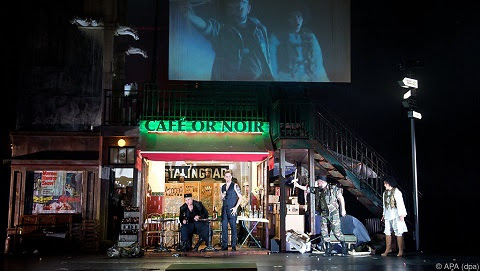

Castorf's approach is seemingly haphazard and random, a bit of a mess frankly on first viewing, particularly if you are looking for all the familiar situations and signposts. I mean, there are signposts up there pointing to Paris locations, but not the kind that help you find a direction through the drama. Rather than view the opera as a continuous narrative or, in the case of Gounod's opera, a series of separate scenes that build up into an overall work, Castorf goes for the holistic approach and puts everything on the stage all at once. And it's not just the sets all on a revolving platform and even piled on top of one another, but characters and separate incidents, unrelated to the main scene, are all shown simultaneously backstage, projected in live camera shots on screens. It's an awful lot to take in all at once.

So there on Aleksandar Denić's revolving set, you can see a condensed Paris, past and future all piled on top of one another, front and behind, interiors opening onto exteriors, with a cafe, a church, a butcher shop, the Folies Bergère, and residential apartments. It's dressed in typical Castorf fashion, with obscure movie posters, a telephone booth, a Coke machine. There's even a metro station recreated, the Stalingrad station, where Kate Lindsey's Siébel comes out wearing a desert combat military uniform, his feet bloodied.


With police and foreign legion soldiers in kepis, one of Castorf's targets here is at least clear enough. Valentin emerges out of the metro and paints the words "Algeria is French" on the wall, while additional texts and commentary point to a less idealistic view of Valentin's military exploits, De Gaulle and France's colonialist history and atrocities. The devil is indeed in the detail and there's no doubting the nature of Mephistopheles here. He's not some smooth businessman or smart-dressed nobleman. He comes complete with demonic accoutrements; hairy goat legs, horse tail and hooves. He's a voodoo practitioner, using live snakes, he's menacing and seductive. 

Having thrown all that onto the stage with not a great deal of rationale provided, there's little evidence either of much character development or direction of the singers. Juan Diego Flórez is allowed to stand and sing arias out directly to the audience in an arm waving concert performance delivery. Nicole Car likewise delivers arias outward, but makes up for this by appearing to be much more emotionally attuned to Marguerite and her sad fate. Here Marguerite is not the naive waif we are accustomed to, but since this is the 21st century (or 20th maybe) she is more worldly wise. She puffs on opium and has a good time, but is not fool enough to trust Faust and takes responsibility for her own mistakes.

Frank Castorf appears to be more in his element when he can abandon the limitations of the libretto and "surreptitiously" film Faust and Marguerite behind the scenes with handheld cameras in manufactured situations. This can be a little bit 'random' particularly when filming and developing the other characters Marthe and Siébel. If there is anything that helps guide you through Castorf's production, something compelling that holds like an anchoring point in all the madness, it's Nicole Car's performance that places Marguerite at the heart of Gounod's opera. It's an outstanding performance which could prove to be her defining role.

Juan Diego Flórez can hit the notes all right but his voice is a little too lightweight for Faust, when it needs more of an Alagna or Kaufmann. He doesn't make the same kind of impression that Car does, but aside from the operatic gesturing to the non-existent audience (the production here filmed during lockdown in an empty theatre), it's not a bad performance. Adam Palka is an excellent Mephistopheles, fully entering into the demonic nature of this version of the character and proving to be menacing in tone and performance. Bertrand de Billy conducted the work with a fullness of melody and drama.

I'm not so sure that Castorf really connects with Gounod's Faust or has anything insightful to say about it, but he certainly gives you plenty of opportunity to reconsider the work and see it in a new light. You can question the validity of that approach since for the most part that has less to do with the actual work than the peripheral action, in the additional behind the scenes projections and twists of characterisation. Whether it works or not, whether it's convincing or not isn't the point. You don't have to agree with his choices, but even that allows you to firm up your own convictions about the work. That, as far as I'm concerned, is certainly better than having nothing to contribute.

Links: Vienna State Opera, Wiener Staatsoper Live

Tuesday, 20 October 2020

Verdi - Don Carlos (Vienna, 2020)


Giuseppe Verdi - Don Carlos

Wiener Staatsoper, 2020

Bertrand de Billy, Peter Konwitschny, Vera Nemirova, Michele Pertusi, Jonas Kaufmann, Igor Golovatenko, Roberto Scandiuzzi, Malin Byström, Eve-Maud Hubeaux, Dan Paul Dumitrescu, Virginie Verrez, Robert Bartneck, Johanna Wallroth, Katie La Folle

Vienna State Opera Live - 4th October 2020

Don Carlos, the full Five-Act French version, is probably Verdi's most ambitious work, and if it was never quite a success its flaws only add to its fascination. In the right hands those flaws don't necessarily need to be weaknesses, and like much mid-period Verdi, with judicious cuts, good singers and some creative directorial ideas, the genius of the work is very much in evidence. Unfortunately if you don't have one of those elements, or indeed all of them, you're in for a struggle with this work. With this Vienna State Opera production of the full-length French version of Don Carlos clocking in at 5 hours including intervals, it's a glorious epic nonetheless even if it seems that the director Peter Konwitschny does more to highlight the opera's flaws than find a way to make them work.

Even so, I wouldn't say that the Vienna production is a struggle by any means. It's got a cast that is hard to fault and a conductor and director who should be capable of bringing fire to the work, but rather than seek to mitigate against or even exploit the works flaws, somehow Konwitschny just seems to emphasise them. What is most evidently lacking however is any kind of central idea to give it purpose, drive, energy and momentum. It has moments of excitement, mainly due to Verdi's scoring and the inner fire of the work that still smoulders, but you're left with the feeling that it should be so much more. That however is a not an uncommon feeling to have with Verdi operas of this period.

It's not as if there is any shortage of themes to latch onto in Don Carlos; love versus duty, personal lives and public faces, honour versus betrayal, family, friendship, politics and religion, war and peace, wielding power over a kingdom but having no control over human feelings and emotions. Any one of these can be expanded upon and Verdi provides the means to do so with stirring music that has strong dramatic drive and character definition, even if it's perhaps not always the most subtle. The opening Fontainebleau scene in this version can provide vital context for the love that Don Carlos has for his "mother" that Verdi melodramatically characterises as incestuous, but here it feels long drawn out and emotionally distant, Byström and Kaufmann failing to igniting any genuine passion. 

Subsequent acts show little of interest or imagination, the background is plain, costumes are traditional style, the whole things very monochrome. A tree planted at Fontainebleau remains lit throughout at front of stage, a symbol perhaps of a new life, the potential of a new beginning, one that may be closer to nature, but the tree and idea never really takes root - which may be the intention. There are a few curiously exaggerated nods and winks to the audience, particularly in the dead Charles V disguised as a monk, but there is also a lot of just plain bad acting, particularly on part of Kaufmann. Don Carlos needs control, direction and purpose to find a way through the abundance of themes and personalities, and notwithstanding the strengths of Verdi's score, it just won't work if it doesn't have adequate dramatic conviction to support them.

If there's little evidence of a directorial hand in the first half, the production shows a little more ambition after the interval. Unfortunately those are more in the nature of little touches rather than serving any grand scheme or purpose, as if to give the audience a moment's respite from the heaviness of the melodrama. This is particularly evident in the French version's unfamiliar and rarely performed ballet sequence. Entitled Eboli's Dream, it takes a more modern outlook, updating the setting to a comfortable little mid-twentieth century home. Eboli is a pregnant wife cooking for her husband Carlos when he returns home tired from work, getting ready for a little family dinner party with in-laws, the king and queen. It's played mainly for laughs, Carlos is tired and clumsy, the cooking is inevitably a disaster and they have to order in pizza. It's quite silly, but a welcome change of tone and it's always a treat to have the ballet music included in Verdi's French operas.

What Peter Konwitschny brings out then is not so much the dramatic character as emphasise the dramatic colour of the work, which being a French Verdi opera has all the range and ability of the composer in it. It may not necessarily make the best use of it, and it rather demonstrates that it is hard to match the drama with the music without it appearing very heavy-handed. Colour there certainly is though, even if some of those touches often feel distracting. In the context of a mostly through-composed opera, the Spanish colouration of the music in the friendship of Carlos and Rodrigo (and its maudlin reprises), the Andalusian gypsy music of Eboli's Veil Song and even the ballet, all feel like crowd-pleasing filler playing to convention rather than making any meaningful contribution to the drama. All are enjoyable in their own way and the production at least seeks to include them for that.

Another of those breakaway moments occurs when the opera is taken out into the foyer of the Vienna State Opera for Verdi's big choral auto-da-fé set piece, with an announcer, a film crew and photographers following the action. The heretics, looking like staff of the opera house or formally dressed members of the audience, are rounded up and beaten. Again, this is very much playing to the colour of the piece rather then illustrate it with any meaningful dramatic context. For Act IV's "Elle ne m'aime pas" ("Ella giammai m'amò" in the Italian) it's made clear that Eboli has obviously enjoyed some revenge sex with Philippe having brought Elisabeth's casket to him, only for the king to regret it the next morning. It adds a little more of a frisson to the king's condition, his conscience spiked further by the arrival of the Inquisitor, who is blind and doesn't see Eboli in his room.

If the dramatic conviction of the opera is lacking, there is at least considerable compensation in the musical and singing performances conducted by Bertrand de Billy. Surprisingly however, despite having sung this role capably before (even if I wasn't impressed by the version I attended at the Bastille in 2017)
Jonas Kaufmann appears to be showing further signs of strain. More than any minor issues with the singing, I was more surprised more by his lack of any sense of real engagement with the character of Carlos and his dilemma. You could blame the director (or revival director Vera Nemirova) for that, but either way, the cracks are showing.

Malin Byström is a fabulous singer and you can't underestimate how impressive she is singing a fiendishly difficult role, although ideally a little more force and experience is needed perhaps to really put personality behind Elisabeth. Eve-Maud Hubeaux's Eboli is fabulous, well-sung, showing plenty of personality and character. Michele Pertusi and Igor Golovatenko also give fine performances as Philippe and Rodrigo. No great revelations perhaps but regardless of any minor complaints with the production and performances, the opportunity to hear such an astonishing work performed at this level is always a treat.

Links: Vienna State Opera, Wiener Staatsoper Live

Friday, 8 July 2016

Halévy - La Juive (Bayerische Staatsoper, 2016)


Fromental Halévy - La Juive

Bayerische Staatsoper, 2016

Bertrand de Billy, Calixto Bieito, Aleksandra Kurzak, Roberto Alagna, John Osborn, Vera-Lotte Böcker, Ain Anger, Johannes Kammler, Tareq Nazmi, Christian Rieger, Peter Lobert

Staatsoper.tv - 27 June 2016

Calixto Bieito's production of Halévy's La Juive for the Bavarian State Opera was roundly and rudely booed at the end of the performance broadcast live from the Munich Summer Opera Festival. I'm sure the Catalan director is well used to that kind of reception, but it's worth examining why of all places it would be so badly received at the Bayerische Staatsoper. The Munich audience are used to all kinds of operatic modernisations and reinterpretations in a theatre where Hans Neuenfels, Krzysztof Warlikowsi and Martin Kušej are very much the 'norm'. Bieito's understated production surely wasn't that inflammatory or disrespectful? Is it possible that just wasn't challenging enough?

Or if not challenging enough, Bieito's production certainly failed in one crucial aspect that will permit most indulgences on the opera stage - it lacked adequate fidelity to the source. Not in terms of adhering to the specifics of the plot; Bieito's production does its best to make the basic elements of the story work in a relatable context, and even gives a fairly outdated work some kind of rationale that might work on the stage. To do so however he has to offload a lot of the grand opéra baggage of the work, which unfortunately proves to be rather more important and integral to the piece as a whole.


Of all the traditions, periods and styles that opera has embraced over the last few hundred years, grand opéra still seems to be the most problematic when it comes to modernisation, contemporary relevance and musical tastes. Bel canto, opera seria and Baroque have all been adapted or made to work on the modern stage on their own terms, but while there have been some notable efforts to revive the works of Meyerbeer, none have really succeeded in developing any further taste for grand opéra. There is no obvious reason why a musical form so rich in melody, diversity, drama and pure entertainment should not appeal to an audience who are still predominately in thrall to the epic visions of Verdi and Wagner, but either we are no longer capable of successfully presenting and singing such works, or else they just don't resonate with a modern audience.

That the romantic part of the plot of La Juive is overblown melodrama with scarcely an ounce of credibility you can take pretty much for granted. Rachel, a young Jewish girl (la juive), loves Samuel, also a son of Israel (Eugene Scribe's compendium of clichés and banalities that passes for a libretto includes every conceivable synonym for Jew). Cruel deception; in reality Samuel is actually called Léopold and is a Christian, and as such he can never be married to a Jewess. Recanting her religion would be an option that might help overcome these divisions and even help calm the religious tensions, but wait... this is grand opera and there are more dire revelations to come since 'Samuel' has neglected to mention that not only is he a Christian, but he is the Prince Léopold and already married to Princess Eudoxie. And without her knowing it, Rachel is a Christian all along, a fact that only comes to light much too late in an unfortunate Il Trovatore-like twist. 

And that's just the romantic drama. Religious intolerance stirs up quite a bit more drama that leads to an inevitably tragic conclusion of huge proportions, and all these elements, revelations and reactions are drawn together into one grand musical set piece after another. The opera even opens with a huge religious festival called by the Council of Constance to celebrate a victory over the Hussites that has prevented a schism in Rome. I have no idea what the religious or historical significance of this is, but to judge by Fromental Halévy's music - a huge choral section over a church organ accompaniment - it's a very big deal indeed and one that a Jewish businessman/blacksmith like Éléazar would have been well advised to avoid.

Halévy's score is not overly emphatic (Verdi is much more bombastic), but every violent thought and action, every shocking revelation is played in a conventional way, so Calixto Bieito's strenuous efforts to underplay the excesses and conventions of grand opéra are understandable. In some respects Bieito's production is not unlike Christof Loy's DNO production of Les Vêpres Siciliennes - a minimalist and modernised staging that lost none of the work's power, and by the same token neither should La Juive. La Juive however is not Les Vêpres Siciliennes and Halévy is not Verdi, but neither is there any of the revisionist spin that Loy needed to apply to the ballet sequence of Les Vêpres Siciliennes in order to make its plot developments a little more palatable to a modern audience.


Up to the interval at least however, the audience seem to go with it, and there is indeed much to enjoy in the revival of this rarely performed work. Not least are the opportunities to hear some great singing which is well catered for here in a strong cast lead by an intense Aleksandra Kurzak as Rachel, with Robert Alagna giving it his all as Éléazar and a gloriously lyrical turn from John Osborn as Léopold. The roles push Kurzak and Alagna to their limits but these are strong performances of great dramatic conviction and they are capably supported by Vera-Lotte Böcker as Eudoxie, Ain Anger as Cardinal Brogni and Johannes Kammler as Ruggiero, the fanatical arm of his forces.

Essentially then, Bieito does manage to convey the drama of La Juive with utmost fidelity. He sidesteps any unnecessary playing on specific religious symbols in favour of a view of the opera as "a requiem for a young woman" set against a backdrop of more generalised fanaticism and intolerance. The reaction of the Munich audience then to the creative team at the curtain call is difficult to ascertain. Perhaps they felt that Bieito failed to successfully provide stage directions commensurate with the overheated drama and music (which having most recently seen what the director does with Turandot would be a first), or perhaps some of the German audience felt that the message of fanaticism and intolerance was too close to home. If so, then the irony of the audience reaction will not be lost on anyone following recent political developments in Europe.

The next Bayerische Staatsoper broadcasts from the 2016 summer festival will be Rameau's Les Indes Galantes on 24th July, conducted by Ivor Bolton with direction and choreography by Sidi Larbi Cherkaoui and Wagner's Die Meistersinger von Nürnberg on 31st July, conducted by Kirill Petrenko in a new production directed by David Bösch

Sunday, 30 September 2012

Donizetti - Lucrezia Borgia

Gaetano Donizetti - Lucrezia Borgia
Bayerische Staatsoper, Munich, 2009 
Bertrand de Billy, Christof Loy, Edita Gruberova, Pavol Breslik, Franco Vassallo, Alice Coote, Bruno Ribeiro, Christian Rieger, Christopher Magiera, Erik Årman, Steven Humes, Emanuele D’Aguanno, Christian van Horn, Elisabeth Haag
EuroArts
I can easily understand why many might not like Christof Loy’s opera stage productions. If I didn’t know better myself, I’d swear that he’s having a laugh with this 2009 production of Donizetti’s Lucrezia Borgia for the Bavarian State Opera. When I say I know better however, that’s taking a superior stance, but rather speaking from experience that no matter how minimally staged, no matter how ludicrous the proposition or inappropriate the costume design, and as far removed as they seem to be from the original stage directions, each of his recent productions that I have seen (Die Entführung aus dem SerailLes Vêpres SiciliennesDie Frau ohne SchattenTheodora) have, without exception, been as powerful a performance of the work in question as any I’ve ever seen. That’s why, despite initial reservations that he surely can’t be serious with this bizarre staging of Lucrezia Borgia, it only takes a few moments of actually listening to the performances to see that, whatever he’s doing, the full power and beauty of the work is all there and coming across.
This Lucrezia Borgia, I have to say, doesn’t look like any bel canto opera production you’ve seen before, but it does look a lot like a typical Christof Loy production - bare minimally decorated stage, everyone wearing dinner jackets, a couple of chairs scattered around. That’s 15th century Venice of the Prologue. The only real distinguishing feature is the distinguished figure of Edita Gruberova as Lucrezia Borgia, wearing a period costume in bold red while everyone else is dressed in black and white and the stage is grey, and the words LUCREZIA BORGIA spelt out in big block letters along the back wall. That’s something at least, meaning that it will allow one letter to be dropped at a significant point in the First Act, even if that’s about as much as a concession as you’ll find here to the stage directions in the libretto. Oh, and Orsini and his men look like public schoolboys, with floppy hair and their trousers rolled-up to just below the knees. What on earth is that all about?
Despite confusion over just what exactly Christof Loy’s intentions could possibly be, and the nagging feeling that he really is displaying nothing but contempt for the work, your ears should tell a different story and you might even begrudgingly admit that somehow - without really being able to put your finger on the reason why - the production does actually work. Lucrezia Borgia is not an easy opera to make work on the stage. The plot line, derived from a work by Victor Hugo and awkwardly adapted for Donizetti by Francesco Maria Piave, is rather ridiculous, weighed down by exposition and unlikely coincidences. If we’re to accept the conflict within Lucrezia over her maternal feelings for Gennaro and her monstrous activities as part of the murderous Borgia family, you have to find some humanity in there, and that’s not easily found within the libretto. Although Donizetti’s scoring can seem a little bit bel canto by numbers, and even with Bertrand de Billy conducting it does tend to plod along in places, there are nonetheless some marvellous opportunities for a singer to bring out that underlying humanity, but really you need a singer like Joan Sutherland to be capable of expressing it. Or Edita Gruberova.
Commanding terrific presence from the moment she appears in her red period dress while all around her speak of youth and modernism, Gruberova - with respect - looks like a relic from the past. And this is perhaps where Christof Loy’s production - created specifically for the Bayerische Staatsoper following Loy and Gruberova’s previous collaboration on Roberto Devereux - comes into its own. Lucrezia Borgia is indeed a relic of the past, the latest in a long line of a dynasty of terror whose crimes have not been forgotten by Orsini and his men, who are at long last speaking out against the tyranny of the Borgias. The challenges of playing the role of Lucrezia Borgia then are not so much in the singing - which, to say the least, is challenge enough - but in making Lucrezia work as a real character. On paper it doesn’t work, the libretto filled with flaws and inconsistencies that are nearly impossible to reconcile within the personality of one person. Is Lucrezia Borgia a monster? Undoubtedly. The libretto and the testimony of Orsini and his colleagues and her revenge upon them make that quite evident even within the opera itself, never mind the historical record. Even her reaction to the insult to the family name that is perpetrated by Gennaro shows that the same heartless monster still resides within, regardless of the sensitivity she has shown earlier. Is she really capable of loving motherly sentiments and compassion or are they just an expression of self-interest in her own family name, of a mother for her son? Making you like the character or sympathise with her is not the issue however, making her come to life is the real challenge, and Edita Gruberova can do that. Not many others can.
Donizetti’s style and the rather static nature of the bel canto repertoire, which involves more standing around and singing than action or drama, is also a relic of the past and, perhaps recognising that, Christof Loy plays up to it. No amount of props and costumes and period detail is going to make Lucrezia Borgia any more convincing as a drama, but creating an environment that gives the necessary space to the actual real strengths of the work - the arias and the coloratura given expression by singers of sufficient stature and quality - and actually highlighting them against the rather drab background, seems to me to be working with the nature, qualities and weaknesses of the opera itself. Yes, some of the directorial choices can seem wilfully bizarre, but the basic simplicity of having the words LUCREZIA BORGIA in capital letters on the backdrop throughout reminds you that this is history and character writ large, played large by Donizetti, and performed the only way it can be performed. It takes singers of sufficient strength of personality and the necessary ability to rise to the heights required to make this grotesque and absurd relic of another age meaningful, comprehensible and even beautiful.
The decision then, following their previous collaboration on the stunning Munich production of Roberto Devereux, to build this new production of Lucrezia Borgia around Gruberova, proves to be a great success, and is perhaps the only way it would work. It might as well say EDITA GRUBEROVA on the backdrop. She is simply mesmerising to watch and to listen to, rising to the challenges that the nature of her character represents and meeting the demanding nature of the arias. In fact, she shows that they are one and the same, that the complex nature of the character can only be expressed though the phrasing and the delivery, with full command and awareness of how one’s own tone of voice can be used towards meeting that objective. Experience, if you like, but it’s more than that. For Lucrezia Borgia to succeed it needs more than just a good technique and experience, it needs a voice of real substance and personality, and Edita Gruberova certainly has that. It helps considerably though if you have a strong Gennaro and Pavol Breslik is one of the finest young tenors around. I don’t think there is sufficient attention paid to making his character “work” within the dramatic context of the opera and to a large extent the other roles - Alice Coote’s Orsini and Franco Vassallo’s Don Alfonso - are similarly sung well, but weakly characterised (there are limits admittedly to what a stage director or performer can do with this libretto), but - as is made clear here - the opera is all about LUCREZIA BORGIA, and this is one production that is worthy of being capitalised.
There is a slight downside to the production choices however in that it doesn’t always come across as effectively as it might on the screen, or indeed in the audio mixing. The use of metal plates for a raised platform causes a fair amount of clatter and rattling, while the boxed empty stage leads to an echoing tone that affects the acoustics of the singing and, it seems, the orchestration. The quality of the singing is evident - and Edita Gruberova doesn’t have too much trouble being heard - but the tone is metallic and far from the warm sound you would expect for a bel canto opera. Within the limitations of the mostly bare stage, Brian Large directs as well as he can for the small screen, taking in the impact of the whole stage with edits that are attuned to the rhythms of the music, but it still never really manages to bring the staging to life. The image quality is strong in the High Definition presentation, the audio tracks - PCM stereo and DTS HD-Master Audio 5.0 - are however rather limited in dynamic range by the acoustics. The Blu-ray also includes a fascinating hour-long documentary ‘The Art of Bel Canto - Edita Gruberova’, charting the career of the Czech-Slovak soprano and her approach to opera. The BD is region-free and subtitles for the main feature are English, German, French, Italian and Spanish.

Sunday, 5 September 2010

Mozart - Don Giovanni

GiovanniWolfgang Amadeus Mozart - Don Giovanni
Haus für Mozart, Salzburg Festspiele, 2008

Wiener Philharmoniker, Bertrand de Billy, Claus Guth, Christopher Maltman, Erwin Schrott, Anatoly Kocherga, Annette Dasch, Matthew Polenzani 

Euroarts
Of all Mozart’s operas, Don Giovanni seems to be the one with themes that make it more open to modern day re-envisioning and reinterpretation. And it’s not so much the subject of the amorous activities of a philandering nobleman that make the opera so timeless as much as the underlying themes of passion, revenge, power and conquest, or - as in this particular production for the 2008 Salzburg Festval - the question of honour.
Accordingly, there’s something of a Godfather feel to the tempestuous Latin passions of love and revenge here that feels perfectly appropriate, the production approaching the opera from a different angle while remaining perfectly true to the strengths of Mozart’s score and the themes of Da Ponte’s wonderful libretto, full of wit and wisdom. It’s certainly more complex and nuanced on the subject of relationships between male and female than their rather more buffa treatment of the subject in Così Fan Tutte. To cite just one example, look at Donna Elvira’s complex feelings for Don Giovanni, expressing hatred, contempt and frustration for Giovanni, but at the same time her actions are fuelled by a deep love and an irrational but no less sincere hope for his redemption.
The staging here is limited entirely to a dark woods setting, but imaginatively deployed on a revolving stage which gives a wonderful three-dimensional quality to the production (well directed for the screen, as ever, by Brian Large). As well observed as the references and updating are - the staging never compromising the integrity of a truly great opera - the performances here are just as nuanced, powerful and dramatic, Christopher Maltman’s near-deranged, wild-eyed obsessive Don Giovanni brilliantly balanced and vocally matched with Erwin Schrott’s amusingly twitchy Leporello. The score is magnificently interpreted, drawing the full darkness and energy out of the opera, as well as bringing out its underlying tenderness and tragedy. In this respect, in addition to strong singing you would expect from all the major roles, Matthew Polenzani gives one of the most sensitive and sympathetic readings of Don Ottavio that I’ve seen for this opera.
The image quality on the Blu-ray - once it takes its time to actually load-up onto the player - is fine, while the orchestration is given a fine presentation in the DTS HD-Master Audio 5.1 mix, centrally located and unshowy on the surrounds, and beautifully toned. The singing initially seems a little echoing in this mix, occasionally overwhelmed by the music, but it’s generally good and seems to improve by the end of the first Act. The PCM Stereo mix gives the singing a better stage, but at the cost of the fine separation of the orchestration.
This is not the most traditional production of Don Giovanni, and it certainly isn’t the best I’ve seen or heard, the limitations of the woods setting losing some of the familiar elements that usually make it work so well as a drama (traditionalists will be disappointed by a bus timetable in place of a register of the Don’s conquests, no masks on the wedding guests, a Burger King take-away for a dinner-party, twigs for the Commendatore’s statue and certainly no flames at the finale), but that’s balanced with a reasonably fresh take on the themes, some strong singing and fine acting that is more naturalistic than the usual operatic gesturing, and a fascinating visual presentation in terms of its design and conceptualisation.

Sunday, 2 May 2010

Puccini - La Bohème (Robert Dornhelm, 2006)

Puccini - La Bohème

Bertrand de Billy, Robert Dornhelm, Rolando Villazón, Anna Netrebko, George von Bergen, Boaz Daniel, Nicole Cabelle, Vitalij Kowaljow, Adrian Eröd, Stéphane Degout,

Axiom Blu-ray

There is no reason, in theory, why it should be any more difficult to bring an opera to the film screen than any other piece of musical theatre. In the case of opera, actually, one would think it should be relatively straightforward – the most popular repertory operas have at least a hundred or two hundred years of conventional productions and experimental stagings behind them, ample time to explore and fine tune the dramatic core of a piece. With opera however, there are however other technical considerations and conceptual decisions that have to be made when adapting it for the screen as a movie as opposed to the more common approach of shooting it as a filmed stage production. At its most successful, in Brian Large’s live TV film version of Tosca or in Joseph Losey’s Don Giovanni, there is a something to be gained from the filming of scenes in the actual locations specified in the libretto (The Roman locations of Castel San Angelo and others in Tosca and the Venetian Palladian constructs of Don Giovanni), that go some way to helping the viewer see past the exaggerated theatrical mannerisms and problematic issue of integrating and syncing the live or recorded singing performances to the dramatic action.

A literal approach may in some cases be the best way of counteracting the heightened emotional realism of conventional opera performances when brought to the screen, but, just as with stage performances of opera, there is room for a more naturalistic or experimental approach when the themes are sufficiently universal and not necessarily tied to the period. Such would perhaps be expected to be the case with Puccini’s La Bohème, which relates a familiar subject that has not dated in the 100 or so years since its writing. It may be set in a Paris of the 1830s, where guards patrol the gates to the city, where starving poets and artists suffer for their art in freezing garrets, and pale heroines die long drawn-out deaths from tuberculosis in the name of love, but essentially the theme is as old as the hills – it’s about the joys and the vicissitudes of love. It’s somewhat surprising then that the film’s director, Robert Dornhelm, with two of the brightest young stars in opera on board for a feature film adaptation of Puccini’s classic tearjerker La Bohème, settles for an approach that remains resolutely stage-bound – not filmed live, on location or during performance, but using opera production values, sets, lighting, costumes, theatrical acting and mannerisms that belong very much to a traditional period staging of the opera.

Naturalism is not the operative word for Dornhelm’s approach to this film version of La Bohème, but then really, naturalism has little to do either with Puccini’s adaptation of Henry Murger’s collection of stories in Scènes de la vie Bohème. Even accepting the notion of love at first sight, the romance that develops here between a seamstress and a poet is rather precipitous (particularly in this film version which takes their introduction a little bit further than usual with a bedroom coda to Act 1) and the structure of the opera is somewhat schematic, the four acts being divided fairly equally into the birth of love, the joy of love, the torment of love and the death of love. What gives this romance conviction in Puccini’s musical scoring is the harmonisation, both vocal and emotional, that exists between the two leads, and the counterbalance to this in the tempestuous relationship between Musetta and Marcello, which brilliantly follows a similar trajectory but practically in reverse. Quite wonderfully, Puccini's score plays on this reversal and counterpoint in the overall structure with the repetition of themes - in one scene making Mimi's theme express the discovery of love, and in another using the same theme to express the end of love, as if they are indeed just flip-sides of the same emotion.

There can be no doubts about the evident chemistry between Netrebko and Villazón, a partnership that has achieved much acclaim and success in recent years, and that is successfully carried across to the screen in this film version of La Bohème. Rolando Villazón’s intensity, enthusiasm and expressiveness is well suited to the overheated emotional content of a Puccini opera and particularly to the role of Rodolfo, but his acting remains very much in the theatrical style. Anna Netrebko’s more demure and reserved performance perhaps fares somewhat better when transferred to the screen, without losing any of her character’s necessary reserves of emotional depth. The character of Mimi, signalled quite clearly from early on as being ready to pop her clogs at any moment, can be somewhat pathetic (in the pathos sense of the word), but Netrebko, as we’ve already seen in her performance of Violetta in La Traviata alongside Villazón again (reviewed here), has the ability to play the doomed heroine who is unlucky in love without sentimentality. Despite the urgent emotional underscoring of Puccini’s music that almost demands a heightened performance to match, she manages to give her character a small sense of dignity and nobility, reacting to her circumstances with quiet passion and internalised desperation. Netrebko’s breakdown scene with Rodolfo in the snow by the tavern in Act 3 in particular is magnificent, her Mimi writhing around like a soul in torment, on the verge of breaking up with her love and close to death, yet driven to keep going by the sheer force of the love that exists between them – one that is fully felt despite the vast ellipses in the storyline between acts. The beautiful heart-rending quartet with Musetta and Marcello that ends this scene is also marvellously performed, another highlight of the production.

As good as all this is in operatic terms, Robert Dornhelm’s filming of La Bohème doesn’t particularly distinguish itself on the screen. While there are one or two distinctive and effective moments, nothing really feels inspired and, at best, the direction can be described as functional, serving the material reasonably well in a traditional staging that feels familiar from countless other productions right down to the lighting, colouration and décor. At worst however, the dissolves, superimpositions and split screens employed are simply a distraction, being particularly overused in Mimi and Rodolfo’s respective introductions in their garret scene ("Chi son? Sono un poeta" and "Si, mi chiamano Mimi"), while the lip-syncing – technically largely unavoidable, though some of it was recorded live – only adds to the lack of naturalism.

Uninspired and uninspiring though this may be, ultimately this production of La Bohème is indeed about the singing and playing of Netrebko and Villazón, and Dornhelm’s production, for all its safe and traditional staging, provides a more than adequate platform for that to be enjoyed by audiences for years to come, and succeeds moreover in wringing out all the emotional charge from what still remains a powerful and moving opera.

Disc
La Bohème is released on Blu-ray in the UK by Axiom Films. The disc is BD50 and the film comes with a 1080/50i encode. Inevitably, this has an impact on the running time, which consequently runs to 109 minutes as opposed to the theatrical running time of 115. Whether this has an impact depends on the original source - it may have been shot at 25fps and slowed down for theatrical release, but I have no information to suggest this is the case. If the image has been speeded up to make it 50i, this could have implications for the accuracy of the audio, but the Blu-ray this may have been pitch corrected to allow for this. Extra features are Standard Definition PAL (576/50i). The disc is All Region.

Video
While the film often looks great, and there are certainly no serious problems with the transfer, the benefits of the High Definition transfer are not always evident on this Blu-ray release. Perhaps on account of the colour timing and the bright lighting that looks more theatrical than naturalistic, contrasts are strong and shadows are exceptionally dark. The transfer does exhibit signs of being somewhat DVNR processed, with haloing also being visible in places, but overall detail and colouration however are good and the image does retains a little grain that keeps it looking like it is from a proper 35mm film negative. Stability and fluidity are relatively good, but some minor flicker may be detected in backgrounds.

Audio
The audio track comes in the form of a fine DTS-HD Master Audio 5.1 mix, with a supplemental Dolby Digital 2.0 track. The handling of the sound is wonderful on the lossless DTS track, the surround distribution enveloping and effective. Vocals remains up front and, in the main, the singing is clear and warmly toned, hitting the high points without any trouble and balancing vocal harmonisation well. I thought I could detect some distracting microphone sounds and noise on the track in one or two places where the recording is less than perfect, but not with any kind of frequency. I detected no such problems with the orchestration, the lossless audio track enabling the instrumentation to achieve a wonderful natural tone, with fine dynamic, particularly in the clear rounded bass tones.

Subtitles
English subtitles only are included. They are optional and in a white font. When spread across two lines, the subtitles lie partly in and partly outside the frame. I wasn’t entirely happy with the translation which is just plain inaccurate in places, and also prone to miss out not insignificant lines. Apparently, the subtitles were supervised personally by the director, so I think this is another area where his decisions are less than effective.

Extras
Interviews are conducted with the director Robert Dornhelm (23:14), with Anna Netrebko (6:00) on the character of Mimi as opposed to Musetta, with Rolando Villazón (5:10) on the film experience and how it differs from opera, with Nicole Cabelle (2:47) on her toning down of Musetta and with Geroge von Bergen on the opera itself and Marcello’s role in it. It’s Dornhelm’s interview which is most revealing, the director admitting that he initially edited the film with numerous green-screen effects and blending (the utterly kitsch results can be seen briefly in the Making Of). He confesses that he has no great feeling for opera, and that in the case of La Bohème he believes that there was no reason to reinvent or modernise, since opera it is a dying artform that belongs in a museum – an incredible and telling admission that I personally couldn’t disagree with more.

The Making of La Bohème (28:31) however is rather good – taking time to interview the cast on their feelings (most of the interview footage is reused here), before getting behind the scenes and eavesdropping in on the rehearsal and filming. Since an opera film production is rather different from a regular film production, this is very interesting indeed. There are also some very funny outtakes at the end, and – of course – footage of Villazón goofing around on the set. Great fun.

The extras are rounded out with a Trailer (1:30) and a Stills Gallery of 21 promo stills. A booklet is also included with the package.

Overall
While there is no substitute for the ambience of a live performance in an opera house, the High Definition image and sound on Axiom’s Blu-ray release of La Bohème is certainly the next best thing and, for most of us, the only real option to see the pairing of Netrebko and Villazón in one of the most dramatic and romantic of operas. Yet again, their collaboration and respective qualities proves to be perfectly matched, and even within the limitations of a filmed performance and Robert Dornhelm’s mostly rather uninspired, traditional staging that plays safe in aiming for the opera fan more than the cinema-goer, there are nonetheless some truly great moments that make it all more than worthwhile.

This review was first published on DVD Times/The Digital Fix in 2006