Showing posts with label Frank Castorf. Show all posts

Thursday, 6 May 2021

Gounod - Faust (Vienna, 2021)


Charles Gounod - Faust

Wiener Staatsoper, 2021

Bertrand de Billy, Frank Castorf, Juan Diego Flórez, Nicole Car, Adam Palka, Étienne Dupuis, Martin Häßler, Kate Lindsey, Monika Bohinec

Wiener Staatsoper Live - 29 April 2021

It doesn't surprise me that some opera lovers would not be too fond of the directorial style of Frank Castorf. He certainly has his own unique approach to opera that is not to everyone's taste. Even if you are open to new ways of presenting opera, there's an awful lot thrown into a Castorf production; some of it obviously related to the work, other elements rather less so. It can be hard work and while you might want to put the effort in for something like Der Ring des Nibelungen, From The House of the Dead or Die Vögel, you might be less inclined to see all the Castorf tricks employed on something as popular as Gounod's Faust.

Opera however is a multi-faceted artform and the best works prove to be adaptable to renovation and reconsideration. Through its very nature Faust should provide not only plenty of entertaining songs, beautiful arias and dramatic situations for singing and dancing, but it should also be able to address other deeper elements in Dr Faustus's search for love, youth and the meaning of life. Entering into a pact with Satan in exchange for such knowledge inevitably brings up questions of morality, religion and war, which means there is plenty for a director like Frank Castorf to get his teeth into.
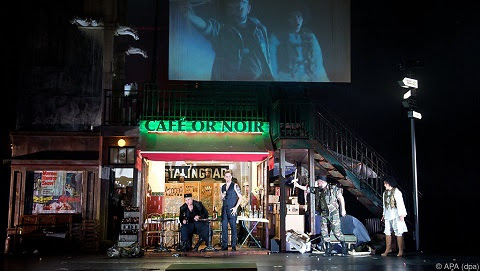

Castorf's approach is seemingly haphazard and random, a bit of a mess frankly on first viewing, particularly if you are looking for all the familiar situations and signposts. I mean, there are signposts up there pointing to Paris locations, but not the kind that help you find a direction through the drama. Rather than view the opera as a continuous narrative or, in the case of Gounod's opera, a series of separate scenes that build up into an overall work, Castorf goes for the holistic approach and puts everything on the stage all at once. And it's not just the sets all on a revolving platform and even piled on top of one another, but characters and separate incidents, unrelated to the main scene, are all shown simultaneously backstage, projected in live camera shots on screens. It's an awful lot to take in all at once.

So there on Aleksandar Denić's revolving set, you can see a condensed Paris, past and future all piled on top of one another, front and behind, interiors opening onto exteriors, with a cafe, a church, a butcher shop, the Folies Bergère, and residential apartments. It's dressed in typical Castorf fashion, with obscure movie posters, a telephone booth, a Coke machine. There's even a metro station recreated, the Stalingrad station, where Kate Lindsey's Siébel comes out wearing a desert combat military uniform, his feet bloodied.


With police and foreign legion soldiers in kepis, one of Castorf's targets here is at least clear enough. Valentin emerges out of the metro and paints the words "Algeria is French" on the wall, while additional texts and commentary point to a less idealistic view of Valentin's military exploits, De Gaulle and France's colonialist history and atrocities. The devil is indeed in the detail and there's no doubting the nature of Mephistopheles here. He's not some smooth businessman or smart-dressed nobleman. He comes complete with demonic accoutrements; hairy goat legs, horse tail and hooves. He's a voodoo practitioner, using live snakes, he's menacing and seductive. 

Having thrown all that onto the stage with not a great deal of rationale provided, there's little evidence either of much character development or direction of the singers. Juan Diego Flórez is allowed to stand and sing arias out directly to the audience in an arm waving concert performance delivery. Nicole Car likewise delivers arias outward, but makes up for this by appearing to be much more emotionally attuned to Marguerite and her sad fate. Here Marguerite is not the naive waif we are accustomed to, but since this is the 21st century (or 20th maybe) she is more worldly wise. She puffs on opium and has a good time, but is not fool enough to trust Faust and takes responsibility for her own mistakes.

Frank Castorf appears to be more in his element when he can abandon the limitations of the libretto and "surreptitiously" film Faust and Marguerite behind the scenes with handheld cameras in manufactured situations. This can be a little bit 'random' particularly when filming and developing the other characters Marthe and Siébel. If there is anything that helps guide you through Castorf's production, something compelling that holds like an anchoring point in all the madness, it's Nicole Car's performance that places Marguerite at the heart of Gounod's opera. It's an outstanding performance which could prove to be her defining role.

Juan Diego Flórez can hit the notes all right but his voice is a little too lightweight for Faust, when it needs more of an Alagna or Kaufmann. He doesn't make the same kind of impression that Car does, but aside from the operatic gesturing to the non-existent audience (the production here filmed during lockdown in an empty theatre), it's not a bad performance. Adam Palka is an excellent Mephistopheles, fully entering into the demonic nature of this version of the character and proving to be menacing in tone and performance. Bertrand de Billy conducted the work with a fullness of melody and drama.

I'm not so sure that Castorf really connects with Gounod's Faust or has anything insightful to say about it, but he certainly gives you plenty of opportunity to reconsider the work and see it in a new light. You can question the validity of that approach since for the most part that has less to do with the actual work than the peripheral action, in the additional behind the scenes projections and twists of characterisation. Whether it works or not, whether it's convincing or not isn't the point. You don't have to agree with his choices, but even that allows you to firm up your own convictions about the work. That, as far as I'm concerned, is certainly better than having nothing to contribute.

Links: Vienna State Opera, Wiener Staatsoper Live

Wednesday, 4 November 2020

Braunfels - Die Vögel (Munich, 2020)


Walter Braunfels - Die Vögel (Munich, 2020)


Bayerische Staatsoper, 2020

Ingo Metzmacher, Frank Castorf, Wolfgang Koch, Charles Workman, Michael Nagy, Caroline Wettergreen, Günter Papendell, Bálint Szabó, Emily Pogorelc, Yajie Zhang, Eliza Boom, Theodore Platt, George Vîrban

Staatsoper TV - 31 October 2020

A previous production I saw of Walter Braunfel's Die Vögel for LA Opera in 2009 kept the work fairly neutral in a magical fairy-tale world, but whether you choose to relate the obvious parable in Aristophanes' tale to any contemporary situation or not, it most certainly has something to say about power, social division and inequality. Directed by Frank Castorf (Bayreuth Ring, From the House of the Dead), I think you could pretty much guess beforehand how this was going to be handled in the Bavarian State Opera production. Or broadly guess at least, since while all the more familiar Castorf imagery, symbolism and references are present, it is of course impossible to imagine all the unusual and strange details that the director will throw in.

There is at the very least a case for delving beneath the surface beauty of Braunfels' musical arrangements and trying to get to the root of what the composer might have wanted to say about the underlying themes in the fairy-tale. Braunfels was one of many German and Austrian composers who suffered under the hands of the Nazis because of his Jewish heritage, but his refusal to write an anthem for the Nazi party wouldn't have gone down well either and Braunfels found his music classified as Entartete ("Degenerate"). It's not difficult to see some concerns about the post-first world war divisions in society and where it might lead to in his 1920 opera Die Vögel (The Birds).

In Braunfels' version of the story by Aristophenes, the division is characterised between two men who both have idealistic names, Ratefreund (Loyal Friend) and Hoffegut (Good Hope), who set out to leave behind the world of men, to escape the confines of bourgeois society and culture, and aspire to artistic greatness. They turn to Hoopoe, the Emperor of the birds who was once human, and propose the building of a grand city in the skies, where the birds can reassert their dominion above humans and even the gods. Inevitably the ideal of such a utopia is weakened by the vanity of assuming such power, and Prometheus is there to warn them of where this is all going to lead.

Braunfels started writing Die Vögel before the First World War, and it's not difficult to imagine that the opera might reflect the concerns that the composer could have had about the changes in society during the period of the writing up to its completion in 1919. Castorf's production attempts to reflect those divisions and the human weaknesses that corrupt the idealism of a utopia in harmony with nature. Hoffegut's hope for emotional fulfilment turns into an obsession for the beauty of the nightingale, while Ratefreund's desire for power higher than Zeus leads both to effectively (in this production at least) become Nazis.

It's impossible not to think of Richard Strauss's lushly orchestrated fantasies Die Frau ohne Schatten or Daphne, both musically as well as in the fairy-tale subject matter of Die Vögel. Braunfels composes some ravishing but not particularly challenging music that is at least persuasive of the possibility of a utopia, with bird trills feeding into the score. The second half goes all-out with Hoffegut's wooing of the Nightingale, the long instrumental ballet music for the wedding between Mister Pigeon and Miss Dove, but it's all brought down to earth (literally) with the arrival of Prometheus, and Castorf is determined not to let the fantasy and musical extravagance overshadow the darker message. If anyone can make Die Vögel just that bit edgier it's undoubtedly Frank Castorf.

Inevitably when it comes to this director, it's very much hit and miss. Nothing is going to be presented literally or as a pure allegorical fantasy as in the LA Opera production, and the imagery and the symbolism don't correlate with underlying themes in any obvious way. What works and what doesn't will depend on your perspective, but there's certainly plenty to take in and work with in the set design. For Act I Alexander Denic provides a familiar Castorf 360 degree rotating three-level platform of makeshift rusting scaffolding, steel staircases and plastic sheeting with a wooden hut at the top. The ground floor likewise looks like a refugee camp with shipping containers, wooden fence and chairs.

As you also often find with Castorf there are handheld cameras projecting close-ups and backstage action up onto screens, the set also decorated with little details that reference consumerist society (a Coca-Cola dispenser) as well as more obscure references to the subject of birds in concert posters for The Eagles and one for The Byrds backed by The Flying Burrito Brothers. Running in a similar free-association way, Act II after the interval features a huge billboard of Alfred Hitchcock's The Birds, with clips from the film showing on an array of satellite dishes as the inevitable horror of this (capitalist?) citadel to man's vanity comes crashing down to earth.

Whether you can make anything clear out of Castorf's production, there's no shortage of ideas and it does look spectacular. The birds' costumes are beautifully extravagant like nightclub showgirls and dancers, with feathers in their hair and plumage on wire harnesses. The arrival of Prometheus amidst the cacophony of life, ideas, references, emotional and political conflict in Castorf's intentionally cluttered stage is extraordinary, capturing the beauty and the ugliness, the mundane and the mysterious, the whole glorious spectacle and the ignominious collapse of it all. Performed in an almost empty theatre, the premiere and final performance of this production before the National Theatre goes into lockdown, certainly lends a strange atmosphere to the piece, where culture is again at the mercy of social upheaval.

The casting and of course the musical performance under Ingo Metzmacher certainly helps contribute to emphasise the contrasts between the lush music and the on-stage furore. I always enjoy Charles Workman's singing and he's very good here as Hoffegut, bringing a suitable little bit of an edge to his usually soft lyrical tenor. It's rather hard for anyone else to be relatable on a human level either - for obvious reasons in this fantasy - but there are songbirds aplenty and excellent performances from Wolfgang Koch as Prometheus, Günter Papendell as Wiedhopf (Hoopoe), Michael Nagy as Ratefreund and Caroline Wettergreen as the Nightingale.

Links: Bayerische Staatsoper, Staatsoper TV

Tuesday, 21 April 2020

Janáček - From the House of the Dead (Munich, 2018)

Leoš Janáček - From the House of the Dead

Bayerische Staatsoper, 2018

Simone Young, Frank Castorf, Peter Rose, Evgeniya Sotnikova, Aleš Briscein, Charles Workman, Bo Skovhus, Christian Rieger, Manuel Günther, Tim Kuypers, Ulrich Reß,

Belair Classiques - Blu-ray


Personally I'll always hold the director Frank Castorf in the highest esteem for his deeply thoughtful Bayreuth Ring that dared to upset many but explored this complex work on numerous levels with increasing but unpredictable precision across all four days of that monumental opera cycle. There's no doubt however that the German theatre director can be hard work, particularly when he tries to condense down many ideas into a much shorter work like From the House of the Dead. Although the actual circumstances of the each of the inmates in a Siberian work camp is hard, the underlying humanistic intent and meaning of Janáček's opera, and indeed Dostoevsky's original work based on his own experiences as a political prisoner, shouldn't be quite so difficult to understand.

And at the most basic level its purpose does come across clearly. From the House of the Dead is a remarkable book and opera that celebrates the diversity of life and the power of humanity to endure the most abject of situations, retain hope and even some twisted sense of brotherhood or community in their shared experience that helps face the hardships that have to be endured. It's not so simple really when you break that down and even in this concise opera Janáček gives voice to the experiences of a number of men, each with very different ways of dealing with the situation they find themselves in, not all of them noble or their stories life-affirming. Janáček's music goes a considerable way to break that down and reassemble these broken people into a common humanity but Frank Castorf obviously isn't going to let Janáček do all the work.


One of the common experiences that all of the men in the Siberian labour camp have is hardship and living constantly in the presence of death. Death is inevitably uppermost in the minds of men struggling to survive intact from the soul-destroying experience of having endured time in this House of the Dead. As a way of showing how this brings about a recognition of one's mortality, Castorf has the inmates dress up as carnival goers wearing macabre suits and masks for a Day of the Dead parade. To contrast this and to provide some light that needs to exist somewhere in all this darkness, the symbolic eagle that is captured and eventually freed is at the same time an eagle and Aljeja, the young Tartar prisoner befriended and mentored by Petrovic, dressed in another colourful carnival costume as a Bird of Paradise.

Like many of the constructions created for his Ring tetralogy, the set is a typical three-dimensional rotating construction of a concentration of a camp, if I may be allowed to describe it that way, closed in and layered upwards with guards and warders up on the upper level, the grimness of the prison camp's concrete and barbed wire below. In a way it's like all humanity at its best and worst is crammed down below, faces scarred, covered in boils and sores, others stained with blood and dirt. There is certainly an expansive look at the variety and diversity of life experiences to be found in the stories that the men tell to stand out and affirm their own sense of identity. There's also a measure of release in expressing their cynical view of the unjust cruel world outside, taking some comfort at the same time in the stories of others' experiences that are worse than their own. Even the way they amuse themselves, fighting, bickering, mistreating prostitutes, putting on an absurd theatrical entertainment, has an air of grim but necessary release from inner demons.


To extend that view and get down and dirty with it Castorf uses another device the viewer might be familiar with from his Bayreuth Ring and that's using video screens with cameramen walking around the stage gathering closeups and behind the scenes incidents. Characters speak silently to the camera with subtitles provided (not always in English), spotlights and searchlights, contribute to the intense situation and there are of course plenty of Castorf's strange touches that connect to or have contemporary associations like an illuminated Pepsi Cola sign and a movie poster of Joseph Losey's 'The Assassination of Trotsky'. What they all mean is anyone's guess, but they all add to an interesting view on an always fascinating work.

Something else that you can always count on in From the House of the Dead is the opportunity to see some fine singers put through their paces in an opera that always remains a challenge and requires exceptional singers, not least because they are sung in Czech. The Bavarian State Opera have engaged an exceptional cast here, all of them very much rising to the challenge that Janáček and Castorf have in store for them. More often a Gremin in Eugene Onegin or Daland in Der fliegende Holländer Peter Rose is a great singer but rarely gets parts as expressive as Petrovic and he makes a great impression here. Charles Workman characteristically throws himself into the madness of Skuratov and Bo Skovhus brings a more menacing edge to Šiškov, but all the variety that you expect to find is there in the excellent casting. Janáček's opera has an uneven rhythmic melodic pulse but Simone Young finds that through-line in the score that captures the different tones and adventurous instrumentation employed by the composer in his final work.


The quality of the picture and sound on the BelAir Blu-ray release is excellent, the image clear and free from any issues, the relatively short work comfortably fitting on a BD25 disc. The detail of the score comes across well on both the lossless PCM stereo and DTS HD Master Audio 5.1 surround audio tracks. There are no extra features on the disc and the booklet only includes a synopsis and tracklist, with no information on the intentions of the production. 

Links: Bayerische Staatsoper

Friday, 12 August 2016

Wagner - Götterdämmerung (Bayreuth, 2016)

Richard Wagner - Götterdämmerung

Bayreuth, 2016

Marek Janowski, Frank Castorf, Stefan Vinke, Markus Eiche, Albert Dohmen, Albert Pesendorfer, Catherine Foster, Allison Oakes, Marina Prudenskaya, Wiebke Lehmkuhl, Stephanie Houtzeel, Christiane Kohl, Alexandra Steiner

Sky Arts - 31 July 2016

You couldn't by any stretch of the imagination ever call Götterdämmerung anti-climatic. As the final part of one of the most ambitious works of opera ever written Götterdämmerung is nothing but climatic on an epic scale, but it can still often feel like a bit of a chore to sit through after the long haul of Siegfried. As controversial and divisive as Frank Castorf's Bayreuth Ring production has been, the prospect of this Götterdämmerung however is an intriguing one. If the finale of Siegfried is anything to go by, you know it certainly won't be climatic in the conventional sense, but it's certain to have many more surprises and insights into the Ring as a whole.

And sure enough, straight from the first scene, the three Norn maidens are not terribly mystical agents of time and wisdom, but Macbeth-like witches dressed like bag-ladies. Back in what seems to be Castorf's East Germany, the Norn ladies cast spells and spin visions at the back lot of a tenement block, just around the corner from Hagen's Gibichung-managed kebab emporium. It's wonderfully sinister and atmospheric at the same time however, as it perhaps can't help but be with Wagner's writing at its most ingenuous and musically creative. Bringing the gods down to earth - established in Das Rheingold as much as in Die Walküre - is again to the fore in Götterdämmerung, as of course is the famous climax that we are heading towards.


It's in this down-to-earth place that we also find Brünnhilde and Siegfried. Traditionally legends perched on a rock surrounded by fire, they are depicted here sitting on a bench outside a mobile home like an ordinary couple. And as far as love, jealousy and betrayal are concerned, they are an ordinary couple, much like Wotan and Fricka in Die Walküre, with the same balance of power, authority and propensity towards infidelity. If they have extraordinary powers of Wagnerian proportions, it's the Tristan und Isolde-like power of love that makes this pair giants. There's no need for mythologising as far as the production is concerned. The audience need to be fully cognisant of the realities involved and danger that can be caused by ordinary people wielding extraordinary power - particularly the power of love - and the kind of devastating damage they are capable of inflicting upon others.

The characterisation of Siegfried established in the previous evening's opera is carried through to its natural conclusion in this regard in this Götterdämmerung. He's still new to these emotions, he's somewhat undeveloped because of his sheltered upbringing, and doesn't have real experience of the world or women. As he demonstrated in Siegfried though with the reforging of Nothung however, he's a fast learner. How many politicians in the world today, people with power 'out of touch with the electorate' display the same characteristics? If there's any one message to take away from Castorf's specific reading of the Ring, it's this; beware of those on whom we confer power believing them to be better than ourselves and capable of wisely exercising such power on our behalf - they are mortal and as prone to human weakness and failings as you or I.

Brünnhilde's outlook is no more mature than Siegfried's in this new relationship. A scene as simple as the disgraced Valkyrie waving the Ring under the nose of her sister Waltraute to make her jealous is amusing, but it ties into the deeper forces that are in action and in conflict with one another. This "pledge of love", this little piece of bling, is her slice of power and to her it is worth "more than the heaven of Valhalla, more than the glory of the gods". All of us will pay the price for such delusions and displays of pride, and by setting this scene to Waltraute's warnings of the approaching crisis, Wagner highlights them all the more forcefully.


As does the director in his management of this and other such scenes and confrontations. True to form, the conclusion indeed fails to 'ignite' in a familiar fashion as Castorf prefers to keep things 'real-world', throwing out more references to oil (the black gold), to East Germany and to the New York Stock Exchange without making any attempt to join it all up in a bombastic or overly simplistic message. To be honest however, while Castorf fully explores Götterdämmerung as much as the other parts of the Ring and presents those ideas in a fashion that is much more fun and diverting than most other representations, a large part of the success of this work, for the still extraordinary force of the conclusion and for the success of the entire production as a whole, has much to do with the quality of the musical and the singing performances.

It was interesting to hear Marek Janowski speaking before the Sky Arts broadcast of the performance and admitting that he pays absolutely no attention to the stage direction. You would think that ideally a successful production of the Ring would need those two elements working hand in hand, but Janowski's own sense of dramaturgy in the music is just fabulous and speaks for itself. The fact that Casforf has a strong sense of dramaturgy too is a bonus, and even if the two views might not coincide, both in their own way connect with the essence of Wagner's intentions. This Götterdämmerung is consequently one heck of a ride.

The singing also holds up to the extreme challenges of the final installment of the Ring cycle. We don't have John Lundgren's superb Wotan as a firm foundation in this work, and Stefan Vinke's Siegfried is perhaps not as big a personality or a voice to replace him, but the tenor manages well nonetheless in a work that has slain many lesser Siegfrieds. Catherine Foster however remains a dramatic and strongly characterised Brünnhilde, one with real personality and tenderness, who remains sympathetic through the dark machinations of the Hagen-plotted Gibichung drama. Her delivery of the final scene, in conjunction with Janowski's conducting and Castorf's direction, is extraordinarily good and intensely moving. Marina Prudenskaya also puts in an intense and touching performance as Waltraude as does Marcus Eiche in a surprisingly sensitive Gunther, but there are no weaknesses in any of the roles here.


Regardless of what you feel about Frank Castorf's production of the Bayreuth Ring, it's one that likely won't be forgotten soon. I would go further and say that it's one that I'm sure will set a new benchmark standard that subsequent cycles will find hard to match. Aside from the sheer spectacle of the sets and the fine musical and singing performances, there is a deep exploration of the work here that applies many of its principal themes to relevant contemporary issues and concerns. A more minimal or 'straight' version that isn't able to offer as thorough an exploration/dissection/deconstruction of the work and doesn't continue to inventively apply its real-world message to the rapidly changing circumstances of our world today will undoubtedly find this a hard act to follow.

Wednesday, 10 August 2016

Wagner - Siegfried (Bayreuth, 2016)


Richard Wagner - Siegfried

Bayreuth, 2016

Marek Janowski, Frank Castorf, Stefan Vinke, Andreas Conrad, John Lundgren, Albert Dohmen, Karl-Heinz Lehner, Nadine Weissmann, Catherine Foster, Ana Durlovski

Sky Arts - 29 July 2016

If there was ever any question around the political content of Frank Castorf's Ring Cycle in the first two evening's works at Bayreuth, the nature of the beast is firmly established as soon as the curtain is drawn back on Aleksandar Denić's extraordinary set design for Siegfried. Mime - the dwarf exploited and disenfranchised by their actions of the gods - is working from his travelling van portable workshop forge that is currently located beneath a Mount Rushmore of Marx, Lenin, Stalin and Mao, a panorama of Socialist/Communist deities who also once had great ideals that proved to be somewhat more flawed in practice.

It's a big, impressive image that hits home as far as the production's overarching theme goes, but it's also an astute observation that updates and proves the validity of the subject that Wagner was really writing about when creating this mythology. (Wagner's head wouldn't be out of place up there either). Just so your focus doesn't stray and let the mythology get in the way of the message however, the young Siegfried's hobby seems not to be so much chasing and catching bears as rounding up socialist intellectuals who read books, fawn over their great leaders and try to keep them on the right path. As for Fafner, well, seen parading around the Alexanderplatz U-bahn flipside of the rotating set with glamorous ladies with shopping bags, obviously he's the great dragon of capitalism that needs to be slain.


Lest you think this is a bit of a stretch and an imposition on Wagner's creation mythology, the well-translated subtitles - much more idiomatic than usual translations of Wagner's archaic use of language - help make those real world concerns a little clearer. When the Wanderer is asked by Mime which race dwells below the Earth, the Niebelungen's relationship with "black Alberich" is described as one where the "magic ring's masterful might" has "subjugated the slaving mass to him". In every respect, in imagery large and detail small however, Castorf's production doesn't just recap on what has already been established in Das Rheingold and Die Walküre or even just follow through, but it seeks to find new ways to extend the themes that are important to the meaning of the work.

It might have been sufficient - in a rare moment of fidelity that is all too rare even in other modern Ring cycles - to depict Nothung as an actual sword in the Azerbaijan setting for Die Walküre, but in the socialist revolution of Communist Mount Rushmore and the Berlin Alexanderplatz of East Germany, nothing but a Kalashnikov Notung will do (although Siegfried does alternate between the symbolic and the literal here) to slay the dragon of capitalism. That's powerful imagery, and a powerful political statement to associate with Wagner's Ring but it is wholly in keeping with Wagner's own political outlook and in keeping with the higher and thus necessarily mythological worldview of the Ring. Castorf's production allows the application of the mythology to be simply applied to contemporary and real-world matters.

Or perhaps it's not so simple. The Ring and Wagner's own personal ideologies are far more complex than that, particularly when you add on references from subsequent historical periods, and Castorf's production consequently has many other obscure references and bizarre details. The forest songbird, for example, has an important part to play here, but her role is difficult to define, as is the 'bear' that appears every now and again (and in different guises throughout the whole cycle). Nascent humanity perhaps, yet to evolve, learning from the (flawed) ways of the gods. The depiction of Erda as a prostitute is strange and certainly controversial, but the characterisation, observation and humour applied to this scene - a drunken Wanderer makes a sentimental late-night call to an old flame - makes it outrageously funny and humanising.

It might be a welcome injection of lightness into what is too often heavy-going for some, but for others it's clearly not what they expect from Siegfried. Castorf deflating of the glorious union of Siegfried and Brünnhilde by having crocodiles invade the stage and get involved in all kinds of antics is clearly not in the spirit of this opera's epic conclusion. There is however reason to be sceptical of it considering how that noble union subsequently falls into decline in Götterdämmerung, but Castorf is keen to emphasise in Siegfried that the flaws in the hero's character are already there. This Siegfried is a little dumb, wild and impetuous. He's not a person who you want to entrust with saving the world, but inevitably it's only a fearless person who would take on such a task, blissfully unaware of the enormity of the undertaking until it all goes badly wrong. America, take note.


That might be the reality, but it's not what many of the Bayreuth audience want to see and their apparent tolerance for Castorf's interpretations seem to have reached their limit in Siegfried, to judge by the audible loud booing that accompanies the ending. Castorf's interpretation however is vindicated or at least well supported by the performances and the singing. Catherine Foster and John Lundgren reprise their Brünnhilde and Wotan/Wanderer roles impressively, Lundgren in particular more reflective and repentant but still formidable in Wotan's earthbound incarnation. Stefan Vinke has a good balance of the lyrical and heroic tenor for Siegfried and is sure of voice here. Ana Durlovski impresses as the songbird, but every single role - from Andreas Conrad's Mime, Albert Dohmen's Alberich, Karl-Heinz Lehner's Fafner and Nadine Weissmann's Erda - are all an absolute delight to listen to and see performing. Unless, of course, you came to Bayreuth expecting something else in Siegfried

Links: Bayreuth Festival

Monday, 8 August 2016

Wagner - Die Walküre (Bayreuth, 2016)

Richard Wagner - Die Walküre

Bayreuth, 2016

Marek Janowski, Frank Castorf, Christopher Ventris, Georg Zeppenfeld, John Lundgren, Heidi Melton, Catherine Foster, Sarah Connolly, Caroline Wenborne, Dara Hobbs, Stephanie Houtzeel, Nadine Weissmann, Christiane Kohl, Mareike Morr, Wiebke Lehmkuhl, Alexandra Petersamer

Sky Arts - 27 July 2016

I often find it the case that once you've seen a concept established in Das Rheingold you wonder whether you really need to sit through another 14 hours in the three Ring operas to have the point hammered home. If you already know how the drama plays out, you can to some extent extrapolate the rest from how Das Rheingold is presented, give or take one or two points and themes that do need to be explored more deeply. You do at least have the wonder of watching those traps laid in Das Rheingold tighten their grip as events take on momentum in Die Walküre. For all its familiarity there's still much to compensate in the composition of this work, but it soon becomes clear in the Bayreuth production that Frank Castorf clearly isn't going to rely on just following through. Within the vast scope of the Ring those other ideas associated with what has been set in motion are also worth exploring outwards.

The theme that Castorf chooses to set Die Walküre is not an obvious one. It extends the Route 66 petrol station location in the USA here to a farmstead in Azerbaijan where Wotan and Brünnhilde are involved in a primitive early means of oil production. Before we are aware of what exactly is being refined here, the first Act where Siegmund stumbles into Hünding's lodge is also located on the same farmstead seemingly on a different plane. The use of the locations, consisting of a barn, stairs to upper levels and a watertower is extended again through the use of screens of a black and white film showing mining operations, with close-ups on some of the interior action, such as Sieglinde preparing Hünding's night-time drink. Conceptually it's certainly a bit of a leap, but dramatically the direction functions well.


Whatever you might make of Castorf's intentions for the sets and locations doesn't really matter on a rational level. The action that takes place within it at least works within the boundaries of the themes and the libretto and brings it to life. It's Marek Janowski's pacy conducting of the music that drives the first Act however, capturing that wonderful blend of danger and romance that arises between brother and sister much more successfully than the performances of Christopher Ventris and Heidi Melton, which are individually fine, paying attention to little glances and touches, but they doesn't really have a lot of evident chemistry, or at least not of the Wagnerian Romantic scale. Musically it also captures the dramatic perfection of this work that is full of undercurrents and foreboding. You can sense all of this even if you don't 'get' the concept.

As with the earlier Das Rheingold however you'll find that there's little time to really let your mind wander into considerations about what it all means or be concerned about individual performance or technique. Perhaps it's because the subtitles translate Wagner's florid and archaic libretto a little more understandably, but I don't think I've been inclined to pay as much attention to the words and what we are being told through all the dramatic conflict and tensions. It works on a purely dramatic level, which is the strong point of Die Walküre, drawing you in and allowing you to consider how brilliantly the dangers and the complications that are to play out have entrapped each of the characters, allowing you to really feel and sympathise with each one of them. You don't have to take Wotan's side or Fricka's here, both have valid claims and the fact that they are irreconcilable really feels tragic.

The person who has the most to lose however by being caught up in the post-Rheingold machinations is Brünnhilde. Siegmund's fate is also incredibly sad and unfortunate, but it's Brünnhilde who ends up carrying the can for the decisions and actions that are taken around his fate, and it will lead to even more tragic consequences down the line. If there's usually any one element that will determine how good any Die Walküre will be as the lynchpin of the entire Ring cycle, it relies heavily on the qualities of its Brünnhilde and in Catherine Foster we have one of the best daughters of Wotan I have seen. The choice of words is deliberate, as Foster really shows how much of the father is in the daughter, fully inhabiting the role and understanding it as being the will of Wotan. Her singing performance is nuanced and impressive in delivery.

That's not to say that any of the other roles in this opera are any less vital to the dramatic function of the work. Much of the dynamic revolves around the father and daughter relationship and John Lundgren gives us a powerful and authoritative Wotan, much more convincing than Iain Patterson in Das Rheingold. This is a very different Wotan however and there's a good case for having a different singer play the two parts. This is a Wotan who is starting to recognise how much he has given away in his desire for power, how his corrupt actions in cheating Alberich of the gold and the ring have set off a series of events that will ultimately destroy him, destroy them all. Lundgren gives a great performance that shows the formidable power of Wotan, one that bears more than a trace of bitterness, anger, regret and fear for what lies ahead.


With a Wotan and a Brünnhilde like that, both completely in tune with the drama and the intent, and with the conductor completely behind it, this Die Walküre is never going to be anything less than impressive. The other performances aren't quite up to the same level, but they are all very good indeed. I particularly liked the passion and the lyricism of Heidi Melton's Sieglinde, and her acting performance was also fully committed. Christopher Ventris was stretched to his limit, but held out and rallied through at the end of the second Act. Sarah Connolly didn't really succeed in placing a distinctive stamp on Fricka and also sounded a little pushed, but she was strong enough to present a credible opposition to Wotan's delusions. Georg Zeppenfeld sounded as accomplished and capable as ever, although his arched-eyebrow 'baddie' act is proving to be rather limited (he plays a similar thuggish King Marke in last year's Tristan und Isolde at Bayreuth).

The combined forces of the singers, the musical performance and the adherence to the dramatic integrity and themes of the work (which is after all everything opera should be about) ensured that this was a compelling Die Walküre in its own right, but Die Walküre is not a stand-alone opera. Castorf's production introduces a number of other talking points, ambiguities, subtexts and uncertainties that feed into the wider mythology of the Ring and its associated themes, but dramatically and emotionally everything comes together impressively in the third Act conclusion in a way that almost makes you long for some way to escape the terrible predicament of what must be inevitable by the time we get to Götterdämmerung.

Links: Bayreuth Festival

Friday, 5 August 2016

Wagner - Das Rheingold (Bayreuth, 2016)

Richard Wagner - Das Rheingold

Bayreuth, 2016

Marek Janowski, Frank Castorf, Iain Paterson, Markus Eiche, Tansel Akzeybek, Roberto Saccà, Sarah Connolly, Caroline Wenborne, Nadine Weissmann, Albert Dohmen, Andreas Conrad, Günther Groissböck, Karl-Heinz Lehner, Alexandra Steiner, Stephanie Houtzeel, Wiebke Lehmkuhl

Sky Arts - 26 July 2016

Frank Castorf's controversial production of Bayreuth's current Ring cycle may look far removed from the traditional mythological settings of Wagner's epic, but in reality it's closer to home and to the intent of the work than you might think. At heart, the central theme of the Ring that purity of intentions in relation to politics and power (if there even is such a thing - now there's mythology for you) is often corrupted by the imperfections of what makes us all human comes as a timely reminder of where we are in the world today and how we've got there. I haven't seen any Ring cycle even remotely as relevant and powerful as this in the last few decades.

Although Castorf sets the Ring's opening prelude music-drama Das Rheingold in a motel on Route 66 in the USA (and subsequent parts are equally global in their locations), a German or European audience would easily recognise the parallels it has to much that has taken place recently in Germany and in Europe in relation to power and politics. It wouldn't happen until long after his death, but Wagner's vision of the fall of the gods and the flawed human forces that replace them would be borne out by later historical developments. Without making any direct reference to a period that is loaded with controversy, Castorf makes a daring parallel that extends the purity of Wagner's idealised dream of a united nation into the corruption of those ideals by Hitler. It's almost as if Wagner could see it coming.

So uncomfortably close to home is that subject that Castorf is forced to bury it in layers, but rather than obscure the intentions of the Ring, the layers instead build upon it and prove its validity. It might be hidden behind a parody of the corruption of the American Dream in Das Rheingold, but such is the strength of Wagner's framework and vision that a German audience might recognise a similar dream closer to home in the reunification of East and West Germany or in the dream of closer European union. Regardless of whichever level you relate to it, Castorf's production is one that cuts through the mythological trappings and makes the subject of power and corruption, gods and humans really meaningful and relevant in a way that hasn't been seen since Patrice Chéreau's production at Bayreuth 40 years ago.


For all the lengthy expounding over 18 hours or so of the Ring cycle, the questions of purity of motive and intention (whether socialist or capitalist) being quickly subverted for the love of power and money is established fairly quickly in Das Rheingold (to such an extent that I've always felt that there are limited returns from the lengthier subsequent works - but maybe that's just me). A small man fed up of toiling in an underground cavern, the dwarf Alberich here wakes up in this production on a sunbed at a motel and is unable to resist the lure of the glamorous Hollywood starlet Rhinemaidens relaxing by the pool. He soon abandons any hope that the rich bathing beauties might slum it with him and instead decides that he can do much more with the vast quantities of gold they possess. Off he runs with it, hoping to turn it into a product that will benefit the workers only to become someone who later exploits them, corrupted by the power of wealth and promise of influence.

Meanwhile, the god Wotan and his wife Fricka (enjoying a threesome with Fricka's sister Freia) are in temporary accommodation at the motel while the builders are in. His dream is about to be realised (a grand statement that testifies to his dream of a making a nation great again through reunification). He's so busy admiring the view of his creation from his hotel room that he has forgotten that it needs to be paid for, and the Giants have arrived as heavies presenting the bill. The threats of the purity of his family being corrupted (Freia) by these thuggish foreigners he has used as cheap labour is more than he can bear. Having been told by Loge of the vast quantities of Rhinegold stolen by Alberich, he's prepared to exploit the Dwarf's weaknesses and appropriate those riches for the greater good (himself). Loge takes pleasure in playing with his lighter to ignite those flames and it's done significantly in the proximity of a petrol station.

Further backed into a corner over how he rules, the 'human' failings, the personal and domestic problems of this god/politician/leader/artist/ industrialist/genius composer all too soon unravel any noble intentions he might once have had. The supposed infallible omnipotence of the gods is coming to an end as all giants - gods or human - are inevitably destroyed by the corruption of office, the trappings of power, the lure of money or just indulgence of personal lusts and drives. Wagner's Ring however is more than just an allegory and has many other elements to highlight and explore - love, honour, family - but even within itself it can be seen to be an equally flawed creation (its composer too) with its inflated self-importance. All of this however reflects the inherent problem in man's ambition to assume power for a personal ideology.


Castorf's production not only deals with those larger themes in an elaborately constructed revolving motel/poolside/petrol station forecourt designed by Aleksandar Denić - one that touches on some big American themes - but it is sensitive to the complexities of Das Rheingold and the Ring, using cameras and screens and other familiar imagery ingeniously to explore and illustrate the text, subtext and nuances of a work that is too often overlooked in favour of Die Walküre. Castorf shows (or convinces me anyway) that Das Rheingold is the key work in the cycle, one that establishes the tone to be followed, one whose roots and leitmotifs will go on to be developed later in other ingenious ways - but the whole heft of the work is already contained in this opening masterpiece. All too often smothered in mythological trappings and the ambition of conductors and directors as a work more concerned with gods than mortals, rarely has the richness of all the qualities of Das Rheingold and its meanings been so openly exposed and laid bare. This is just brilliant.

Its ambitions are matched by the quality of the musical performance under Marek Janowski. It establishes a tone and detail that allows Frank Castorf to make full use of the rich cast of characters, singers and actors who go some way towards bringing Wagner's masterpiece to life and endowing it with personality. I wasn't totally convinced that Iain Paterson has the personality to carry Wotan but he does however create a great double act with Roberto Saccà's brightly lyrical Loge. Sarah Connolly sang well although Fricka seemed to get lost a little in all the goings-on. She should assert herself more convincingly later. Elsewhere all the roles were wonderfully entertaining and fascinating in their characterisation, notably Albert Dohmen's Alberich, Günther Groissböck and Karl-Heinz Lehner's Giants and Markus Eiche's Donner, but even down to the Rhinemaidens all these wonderful creations just breathed life and exuberance and this Bayreuth Das Rheingold was consequently one of rivetting drama full of meaningful portent. 

Links: Bayreuth Festival