Showing posts with label Das Rheingold. Show all posts

Sunday, 9 June 2024

Wagner - Das Rheingold (Zurich, 2024)


Richard Wagner - Das Rheingold

Opernhaus Zürich, 2024

Gianandrea Noseda, Andreas Homoki, Tomasz Konieczny, Christopher Purves, Claudia Mahnke, Matthias Klink, Xiaomeng Zhang, Omer Kobiljak, Kiandra Howarth, Anna Danik, Wolfgang Ablinger-Sperrhacke, David Soar, Brent Michael Smith, Uliana Alexyuk, Niamh O'Sullivan, Siena Licht Miller

Zurich Opera Ring für alle - 18th May 2024

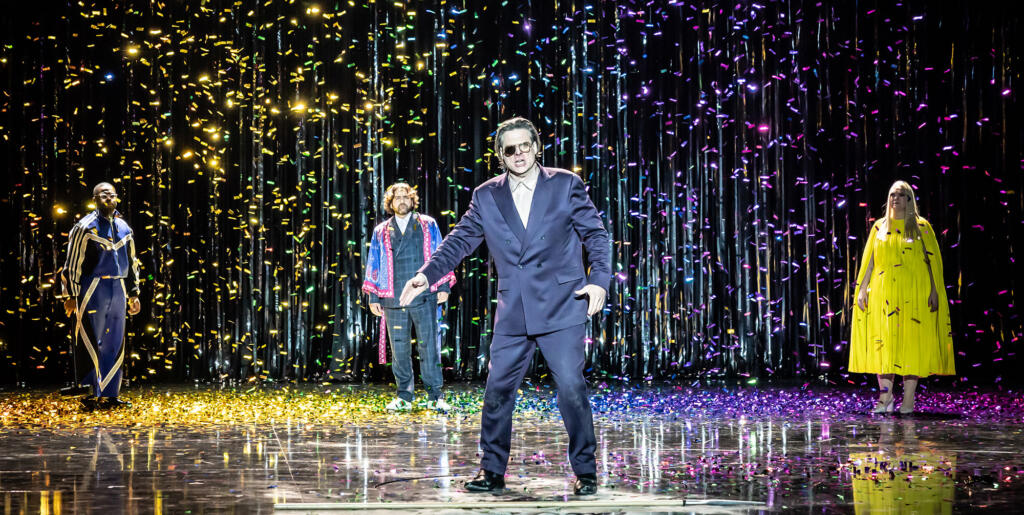
Das Rheingold opens to what is a familiar Zurich opera ‘house’ style, certainly under the direction of Andreas Homoki, as in his Der fliegende Holländer, but also Orphée et Eurydice and I Capuleti e i Montecchi, which is to say it takes place in a revolving set of white walls of elegant rooms. The intent here is at least more readily apparent even if it takes place nowhere near the Rhine, the playful Rhinemaidens skipping through the rooms in white silk pyjamas, all of this appearing to represent an ideal, a freshness, a world as yet untainted. That's all about to change, and Alberich's appearance and presence does feel intrusive and dangerous, Christopher Purves just superb in this scene with the Rhinemaidens and later also in the Niebelheim scene. I'm already seduced by the beauty and relative simplicity of Homoki's approach to Opernhaus Zürich's Das Ring des Nibelungen.

I'm getting ahead of myself of course, always thrilled by the possibilities opened up in the "preliminary evening" of this expansive work and this one looks promising, not trying too hard and risking tripping itself up further down the line as some do when they accumulate symbolism and buckle under the weight of a concept stretched too far to remain coherent. As far as taking this stripped down elegant house idea through just within the span of Das Rhinegold - which is challenge enough - it succeeds marvellously, directing the focus onto the characters and the significant roles they play within the drama and in Wagner's musical telling of it.

Superficial appearances aside, although it contributes to the mood of the whole production, creating a wonderful unity with the lighting, the richness of the musical performance of the Philharmonia Zürich under Gianandrea Noseda and the distinct character that they are attempting to establish from the outset, the real strength here is the stage direction. It's immediately obvious that the singers haven't been left to their own devices, but have been given purposeful direction and given something to work with, bringing life, personality and motivation to the work. There are no 'park and bark' performances here. It makes it fully engaging and entrancing, not to mention that the singing is also uniformly superb. What you have here is the full package, a considered approach that brings this vast enterprise to life with a lightness of touch that is uncommon in this work, but which suits it very well.

Are we seeing or are we likely to see any new angle on the work or any new ideas proposed? Well, it's too early to say for sure, but this doesn't look like a Ring Cycle that is going to run away with wild ambitious concepts. If it doesn't at this stage appear to be proposing anything new, if it is successful even just for finding a core purpose, sticking with it and bringing it out clearly, then along with a solid musical and singing performance, this is really all you need. That's established straightaway with Wotan first appearance, gazing on a landscape painting of his Valhalla within it. The dream of asserting his will and presence within a perfect world of splendour and magnificence; a noble nation with Valhalla at the summit. The lust for power/money is never satisfied, always wanting more, and there is a high price to be paid for that.

The lesson is one that Alberich learns to his cost as well, abandoning any love for his fellow man (or dwarf), exploiting their labour to satisfy his own lust for power. Whether you want to paint this - as others have done - as the Earth paying the price for unregulated capitalism, there are other ways of putting this across. In fact, Das Rheingold is a moral tale on the same level as Tolstoy's novella, 'The Forged Coupon', powerfully adapted for cinema also by Robert Bresson as 'L’argent'. No good ever comes from a false act. In fact, the harm of the original act, the stealing of the Rhinegold in the opening scene, is multiplied in severity all the way through the acts of bad faith employed by Wotan and Loge's deception of Alberich and then Fasolt and Fafner. Handed down to Siegfried, we see how this original act leads to the ultimate collapse of the Gods. Money is the curse, the lust for it by individuals over love for one's brother, enslaving and corrupting, the world ultimately destroyed by it.

There is no cleverness or symbolism employed or required to make this point clear. Rather there is a balance between the literalism of the mythological setting and serving the intent underlying the myth. The set gives this world a feeling of solidity, of a drama played out in the real world (so to speak). The images employed by Wagner just as effective in this context as they are in the original, the Tarnhelm a hood forged out of gold chainmail, Alberich's transformations indeed into a dragon and a frog. The ring here is an actual ring, the misappropriated Rhinegold piles of large solid gold nuggets. In keeping with the late 19th-early 20th century setting of the stately house, Donner and Froh wear blazers and straw hats and wield cricket bats, all of this just adding to the richness, taking nothing away from it. The acting, with this music associated with the actions, just adds to the sense of their being something real and important at stake in this Das Rheingold.

Since the focus is firmly on the drama being brought out of the underlying motivations of the protagonists, it is essential that you have singers of sufficient quality to really bring this out. Personally, aside from the terrific performance already mentioned by Christopher Purves as Alberich really nailing this down from the outset, Claudia Mahnke is an outstanding Fricka and Brent Michael Smith a menacing enough Fafner without having any need of the giant's height. But really, there are any number of performances to enjoy here, including Matthias Klink's entertaining Loge, which he plays like Master of Ceremonies on occasion. It's wonderful that this Zurich Ring Cycle will also have a rare consistency of the performers in the same role all the way though. Personally, I still can't warm to Tomasz Konieczny's Wotan, but it's indisputably an excellent performance. All things considered, when a Das Rheingold is this good, it increases anticipation for how the rest of this Ring Cycle will play out.


External links: Opernhaus ZürichRing für alle Video on Demand

Photos - Monika Rittershaus

Sunday, 5 November 2023

Wagner - Das Rheingold (Brussels, 2023)


Richard Wagner - Das Rheingold

La Monnaie-De Munt, 2023

Alain Altinoglu, Romeo Castellucci, Gábor Bretz, Andrew Foster-Williams, Julian Hubbard, Nicky Spence, Marie-Nicole Lemieux, Anett Fritsch, Nora Gubisch, Scott Hendricks, Peter Hoare, Ante Jerkunica, Wilhelm Schwinghammer, Eleonore Marguerre, Jelena Kordić, Christel Loetzsch

RTBF Auvio live stream - 31st October 2023

If you've ever watched an opera production directed by Romeo Castellucci, you'll know not to expect anything straightforward or traditionally narrative driven. It's probably better to think of his work as closer to installation or conceptual art than opera performance direction. There are a lot of conservative opera-goers who don't like the idea of that one bit, but the idea of bringing that style and approach with a willingness to extend theatrical techniques to a work like Wagner's Der Ring des Nibelungen is thrilling, and this is surely a work that is more conceptual than it is narrative and worthy of such deeper exploration and consideration.

Depending on your view then, Castellucci actually keeps things relatively simple in the opening work of the new Ring cycle at La Monnaie, although some will surely see this Das Rheingold completely overhauled and distorted beyond recognition. Both things are possible at the same time, but also neither are completely the whole story here. If you want to relate the instances of idiosyncratic imagery as representative symbolism, much of what is seen in this Das Rheingold doesn't necessarily serve any meaningful purpose, but there is no reason it should, unless you believe that Wagner's stage instructions should be followed to the letter, and a lot of people do.

The first thing you see on the stage is a huge spinning metallic ring, which is as simple and direct an image as you can get for an opening of a Ring cycle. This gives way after the opening famous 136 opening bars in E-flat major to the scene of three almost entirely naked gold-painted Rhinemaidens frolicking and writhing together in darkness and gold-lit vapour with dancer doubles in a way that inflames Alberich's (gold) lust. It's as effective a way of getting as close to that primal state of the mythological founding origin of the earth/universe as you can imagine, and Castellucci has some imagination.

Valhalla reverts to the almost clean white minimalist set that is characteristic of Castellucci, but with classical Greek statues and friezes, the gods dressed in black robes and crowns, tiptoeing their way through a sea of naked-looking bodies (another familiar Castellucci trope) in modesty saving flesh-coloured garments; little people crushed by the grandeur of Wotan's vanity or workers exploited for labour by the giants? It's open to whatever interpretation you like. The result however is clear, that there is a price to be paid for this. Rather than make the giants appear larger than life as most productions might, if they bother at all, the director here substitutes the singers of family of gods for children who mime the singing. It's not just a gimmick, but a clever and effective way of showing the reversal of power that their vanity has imposed on them, and similarly they become old and enfeebled played by elderly actors as they realise that they have to obtain the Rhinegold in order to save Freia and her rejuvenating golden apples.

The Niebelheim scene also relatively straightforward again presenting strong contrasts, dark and industrial but not overly decorated, with just one machine that seems to specialise in creating large rings of a diameter of about two metres across. Even the Tarnhelm is a ring that Alberich hangs around his neck, disappearing into dark mists. It's superbly atmospheric with Mime and Alberich marvellously deformed creatures. Alberich's Tarnhelm transformation is created by him peeling off his rubber bodysuit to be captured naked, tortured and smeared in black oil in the empty Castelluccian white space. Scott Hendricks handles this humiliation of Alberich bravely and it is also dramatically effective, transforming this world into something alien but recognisable, the horrors of what occur feeling very real. Another nice touch that adds to this is where Alberich's curse becomes a black smear that the dwarf leaves down one side of Wotan's face and eye.

That's all relatively simple and direct for this director, although of course there are lots of other little eccentric touches; the playful and disrespectful Loge throwing ink bombs at photos of classic cast members of Ring operas in the past wearing winged helmets and breastplates, Fasolt killed by a giant crocodile falling from the sky, Erda a headless statue sitting in lotus position. Does it add up to anything in terms of a concept or commentary? Well you could see the now almost obligatory condemnation of consumerism in a society that is heading towards late capitalism meltdown, but the parallel is not made explicit or over-emphasised as it might have been in the Chereau/Boulez Ring at Bayreuth, or indeed Frank Castorf's more recent cycle there. It's not just decorative either, although it is that too (it looks stunning), but it's too early in the cycle to pin down to one simplistic reading. There will certainly be plenty of other opportunities for the director to build on or diverge from any interpretation placed on the opening chapter.

It's all to little avail of course if you can't bring the requisite musical and singing forces to Das Rheingold, there can be no concerns at all with the La Monnaie production; even if few are familiar or experienced Wagnerians, the casting and singing is impressive right across the board. This is the first time I've seen Gábor Bretz singing Wagner and he makes for a grave, resonant and commanding Wotan. I wouldn't associate Marie-Nicole Lemieux with Wagner either, but she is an excellent Fricka, heartfelt in her fears for what horrors her unfaithful husband has visited upon the gods. It will be interesting to see how she handles the role of the much less forgiving wife in Die Walküre. Anett Fritsch is a superb Freia, and Scott Hendricks very impressive as Alberich. He is not always this reliable, but this is one of the best and most consistent performances I've seen from him. Nicky Spence makes the mischievous playful schoolboyish Loge seem effortless.

Musically, this is also a real treat with Alain Altinoglu conducting the La Monnaie orchestra in the first Ring cycle there in 30 years, and this looks like it will be a memorable one. With not so much an ascent to Valhalla on the rainbow bridge, the gods at the conclusion to this Das Rheingold drop into the pit of the ring, dressed in white like members of a death cult, accepting the course that fate has placed them on. This is everything you want from the start of a Ring cycle; epic and spectacular, visually and emotionally stimulating, with impressive singing and musical direction. To be presented at La Monnaie across two seasons, with Die Walküre to follow in January 2024, Romeo Castellucci delivers a majestic, intriguing Das Rheingold, serving the work in his own particular style and visual language, leaving the way open to explore the further riches of the remaining parts of the tetralogy.


Saturday, 4 March 2023

Wagner - Das Rheingold (London, 2023)


Richard Wagner - The Rhinegold

English National Opera, London - 2023

Martyn Brabbins, Richard Jones, John Relyea, Leigh Melrose, Frederick Ballentine, Madeleine Shaw, John Findon, Christine Rice, Katie Lowe, Julian Hubbard, Blake Denson, Simon Bailey, James Creswell, Eleanor Dennis, Idunnu Münch, Katie Stevenson

The Coliseum, London - 26th February 2023

I wouldn't expect every production of Das Ring des Niebelungen to be as elaborately layered and provocative as a Frank Castorf Ring cycle, as irreverently humanising as a Dmitri Tcherniakov production or as distinctive and gloriously impenetrable as the Achim Freyer Mannheim Ring, but you would like a new production of Das Rheingold to open with at least some new ideas and twists that you could look forward to being developed further down the line. Such expectations however have already been suitably adjusted in view of the fact that Richard Jones's Die Walküre, or The Valkyrie, has already made its appearance at the ENO before the first part of the tetralogy and it didn't seem to offer anything new or promising. The same goes even more so for The Rhinegold which, aside from modern costumes, plays it fairly straight and safe, having nothing much new to add to Wagner Ring mythology, but as with the first/second installment, nonetheless putting it across in an entertaining and enjoyable manner.

What is perhaps more notable about the performance I attended at the Coliseum was the audience that turned out to fill the hall; an audience on average younger than you would often see at opera and it turned out to be also an appreciative one for what Wagner's Das Rheingold has to offer, or at least for Richard Jones's version of what The Rhinegold has to offer. That's all the more interesting since this is the first opera I've seen there since the Arts Council England's shortsighted, misguided and philistine threat to cut and remove funding for the ENO. While the future of this Ring cycle and the company still lies in the balance, it was nonetheless heartening to see this kind of turnout and support for the artform. The ENO's programme brings me, like many others, into London to see productions like this every year and has done for many years in the past, paying for flights, accommodation and meals that contribute to the UK economy, and I hope to continue to be able to do so in the future...

...As I did for The Valkyrie in 2021, and what largely was written then - by me as well as others - holds true to The Rhinegold. As engaging as it was, engaging also to a significant extent with the narrative of Wagner's original stage directions, it didn't have anything new or insightful to say about the work. By the same token, other than perhaps for a few moments, neither did it betray the tone and character of the work. There were certainly a few quirks and some ideas that didn't quite strike the right note in the right place - the sombre contemplative notes of the opera's origin myth flowing into the shimmer of the Rhine were somewhat sacrificed to a semi-comic routine of a naked man dragging a large branch from the world ash tree across the stage that is eventually crafted into Wotan's staff/spear. There is a meaningful point to be made here, the ecological exploitation of the planet setting us on a path to destruction, but the message is somewhat lost in this routine. Elsewhere however the key scenes were at least delivered with appropriate impact, musically, narratively and in the fine singing.

You would think that if you are going to make such an issue of the forging of Wotan's staff - or spear in its eventual form - that it might become a prominent feature or motif throughout, and while it certainly featured and was wielded to such effect, it wasn't to any evident purpose, and certainly not to any purpose that I can recall becoming any clearer in Die Walküre. In fact, the downside of performing the two operas out of order tends to emphasise the disconnect between them, in the overall look and appearance, in the inconsistency of the costume design (Wotan in a purple-blue neat suit here for some reason takes to sporting a bright red puffa jacket in Die Walküre) and set design (the steel shuttered Valhalla becoming more of a log cabin in Die Walküre). Should the ENO's Ring cycle make it to its conclusion (one can only hope, as it is still very much worth it), the idea of each of the constituent parts being distinct from each other is a unique feature (Castorf's aside, even though they were all connected by a very strong and consistent anti-capitalism theme) that should at least keep things interesting.

Other than that, Jones didn't give you too much to think about, or at least - like the Rhinemaidens wearing gym gear - nothing worth thinking to hard about to try to see any kind of rhyme or reason behind it (too fit for Alberich to catch? - as I said, you could find reasons if you like, but nothing worth the effort). In terms of look and appearance, the scene of Alberich being bewitched and teased by the Rhinemaidens was, as you would expect, colourful, attractive and slightly camp in a simple basic way, the Rhine represented by a surrounding curtain of glitter, Alberich arising from a hole in an otherwise fairly bare stage (making it all less effective if you are viewing it from a high vantage point in the Gallery). As with The Valkyrie, black clothed 'invisible' figures helped move things around, here permitting Alberich and the Rhinemaidens some swimming and floating movements, which worked well enough.

Aside from the obligatory avoidance of anything in terms of traditional costumes, it was pretty much according to the libretto, or at least to the same intent and purpose. The gold of the Rhine was initially shaped as an child-size baby puppet (manipulated by the black figures), but soon took a more traditional form, again through a series of transitions, from a crumpled sheet to flattened ingots and eventually, believe it or not, to an actual ring of a size that you can fit on your finger. An actual ring, I tell you! I'm not used to such literal fidelity in a modern production of Das Ring des Nibelungen. Nibelheim on the other hand resembled not so much a heavy industry factory as a production line in a bakery, with the dwarfs wearing chef caps. As I said, don't think too much about it...

The majority of Das Rheingold of course takes place in Valhalla and Jones didn't reveal too much of that, the giants presumably withholding the keys to the newly constructed abode of the Gods until they had received the agreed remuneration for their labours (nope, no hint of any commentary approaching Castorf's emphasis on that aspect), so it might well have been the log cabin we see in Die Walkure. The shimmering curtain remains in the surround, and we have conglomerations of white globes on stilts that could be abstract clouds. Again, I wasn't inclined to think to much about it other than it was all pleasant and decorative enough. What matters more is what take place within it.

What takes place within it sticks fairly closely to the original storyline. Aside from Freia being transported on the back of the Giants' work van, the exchange rate for her is indeed measured against the accumulation of trays of Rhine gold ingots to her height - and don't forget to throw that tiny Ring in. That's fine as far as it goes, but essentially what Richard Jones and conductor Martyn Brabbins working together successfully achieve is getting the necessary impact for each of those key moments and scenes. The brutal killing of Fafner by Fasolt (a dummy brought on in an off-stage switch) battered about the head with a gold ingot was particularly forceful. The arrival of Erda (with the Norn as three schoolgirls? Your guess is as good as mine), sung impressively by Christine Rice, also created the necessary gravity and impact, together heralding the tragedy of the curse of the Ring that will (we hope) play out in future installments. The shimmering fall of rainbow glitter for the bridge to Valhalla, and the lockdown against the Rhinemaidens at the conclusion seemed an appropriate way, in Richard Jones terms if nothing else, for everything that came before.

Some moments of levity in the Tarnhelm episode were balanced in this way by the gravity of what the Ring's preliminary evening prologue lays down, and the balance was supported by the characterisation and singing. As noted above, Christine Rice in particular made that small but significant and truly Wagnerian impression as Erda, but there were notable performances also from John Relyea as Wotan, Leigh Melrose as Alberich, and a suitably shifty portrayal of Loge by Frederick Ballentine. Madeleine Shaw's Fricka and Katie Lowe's Freia contributed to the family dynamic alongside the entertaining comic action hero shapes thrown by Julian Hubbard's Froh and Blake Denson's Donner. The giants might not have had much physical stature in this production but I enjoyed Simon Bailey and James Creswell's Fasolt and Fafner.

I can't say that Martyn Brabbins' conducting of the orchestra made a huge impact - maybe I was focussing too much on giving the production and sets design more thought than it merited after all - but neither did I notice anything that felt out of place in pacing, delivery, the surge of leitmotifs or in the whole continuous flow of this marvellous work. Some of the music press appear to have been more generous about this production - whether it's a show of solidarity with the proposed fate of the ENO, I couldn't say, but such sentiments can be excused, as the loss of the ENO in London would be a serious blow for opera lovers, for London, for arts, culture and for tourism. I don't expect Bayreuth at the Coliseum, but who in any other part of the country - certainly not here in Belfast - is going to have the resources to present not only an entertaining and accessible Ring cycle to a diverse audience, but a solid programme of great opera every year? If not in the Coliseum, at least keep the ENO funded and in London. Its loss would be very much regretted and missed by this opera-goer at least.


Links: English National Opera

Wednesday, 28 December 2022

Wagner - Das Rheingold (Berlin, 2022)


Richard Wagner - Das Rheingold

Staatsoper unter den Linden, Berlin - 2022

Christian Thielemann, Dmitri Tcherniakov, Michael Volle, Claudia Mahnke, Vida Miknevičiūtė, Rolando Villazón, Johannes Martin Kränzle, Lauri Vasar, Siyabonga Maqungo, Stephan Rügamer, Mika Kares, Peter Rose, Anna Kissjudit, Evelin Novak, Natalia Skrycka, Anna Lapkovskaja

ARTE Concert - October 2022

Richard Wagner's use of mythology as a means of exploring the German psyche or defining a national identity has been exploited before, notably in Hans Neuenfels' notorious Bayreuth Lohengrin, but Dmitri Tcherniakov has also used many of his productions as a way of psychoanalysing the works in question and the mindsets behind them in productions like Carmen and Les Troyens). Not everyone likes this kind of approach, but for the most part, if not always fully (see his controversial Dialogues des Carmélites), he does so while at least still respecting the deeper intent of the works. His approach to Wagner varies, often overturning expectations, and judging from the opening prologue opera of Wagner's Das Ring des Nibelungen, it looks like following a very familiar pattern and aesthetic. Whether he continues to adhere to the underlying ideas and philosophy behind the work or not remains to be seen, but I suspect that Tcherniakov will find his own meaning in the tetraology as a whole.

Not unexpectedly then, but still finding a way to surprise, the Staatsoper unter den Linden production of Das Rheingold opens in a scientific research centre, a "Stress Laboratory", where Alberich is the subject of an experiment. The dwarf appears to be undergoing something similar to a virtual reality experience, although the period is 1960s or 70s and the method and equipment is cruder, sending signals directly into the brain. Three lab assistants taking notes play the Rhinemaidens to Alberich, which does reflect in its own way how Alberich is being toyed with. Inevitably it all goes horribly wrong.

If the scientific laboratory of the first scene is unusual, the visual appearance of Valhalla at least conforms to the current Tcherniakov aesthetic of plain boardroom oak wall panelling, the stage rotating or sliding between a sequence of boardrooms, offices and a forum-like arrangement of seating that sets this Wotan up in the manner of a businessman. Or, if not a businessman, someone with a great deal of power and influence, although his power is not infinite and he has to rely on a couple of dubious characters who are less giants than 'heavies' (although they are big as well) to help him maintain an suitable home for a man of his ambition. Wotan conducts them into the marble walled boardroom to conclude, or rather renege on their business agreement.

Loge recounts the tale of the folly of Alberich, who forsook a woman's love for the sake of gold, suggesting that there might be a solution to their current predicament to be found there, not realising that the error is about to be compounded. With that as a set-up it does appear that the anti-capitalist sentiments at the heart of Wagner's major work being the key motivating and destructive force behind the fall of the gods. It's definitely not an original viewpoint, and indeed it would be hard to see how this could be developed any further than it already has been with Frank Castorf's expansive take on the subject in the Bayreuth Ring still fresh in the memory (to the horror of some).

While that does seem to be an angle that can't be ignored, it does only seem to feature as a side element, or underlying theme that is already taken as read while Tcherniakov considers on a deeper level the impact, harm and damage that this has on people (in a scientific experimental way). Perhaps. It's too early at this stage to see where it might go, but it is at least wonderful to see the little subtle powerplays and personal conflicts against others' interests play out between all of the characters in this Das Rheingold. It feels much more meaningfully presented than it might if played straight as nothing more than a dispute between immortal beings. The only thing immortal here is the fact that the behaviours seems to be consistent in human nature throughout history.

The scientific exploration or "investigation of human behavioural models in a test group" continues with the deranged Alberich in Niebelheim exerting his power in a petty manner that leads Wotan and Loge to laugh and make fun at him. They have higher ambitions but at the same time he has something that they want, and they are prepared to exploit and cheat him - again an idea that fits in with Castorf's emphasis on the exploitation of the working classes. Whether you think this all comes together into something coherent  as an allegory (even Castorf's ideas were somewhat scattershot), we perhaps don't need to take it literally. If it's just about the curse of the lust for money and power corrupts those who long for it, it makes a point, if somewhat reductively. It's too early to expect it to express much more than that in the prologue to this huge work.

What seems less in doubt in this Berlin Staatsoper Ring is the quality of the musical and singing interpretation. This Das Rhinegold at least has a mighty performance from Michael Volle as Wotan. Johannes Martin Kränzle - who has already made a great impression as Alberich in the previous Berlin Staatsoper Guy Cassiers Ring cycle (also seen in Milan) - definitely has an interesting spin to take on the character in this production. I was also very impressed with Rolando Villazón moving into the Wagner repertoire, bringing a suitably sprightly mischievousness to the role of Loge.

All the roles here seem capably filled and the music direction undertaken by Christian Thielemann following the departure of the indisposed Daniel Barenboim is fine. There is nothing leaps out in either the concept or the performances here however, it's not entirely clear where it's going, but there are some nice touches in the direction, the musical approach and in the characterisation to suggest that it will be interesting to see where this one goes.

Links: Staatsoper unter den Linden, ARTE Concert

Friday, 5 August 2016

Wagner - Das Rheingold (Bayreuth, 2016)

Richard Wagner - Das Rheingold

Bayreuth, 2016

Marek Janowski, Frank Castorf, Iain Paterson, Markus Eiche, Tansel Akzeybek, Roberto Saccà, Sarah Connolly, Caroline Wenborne, Nadine Weissmann, Albert Dohmen, Andreas Conrad, Günther Groissböck, Karl-Heinz Lehner, Alexandra Steiner, Stephanie Houtzeel, Wiebke Lehmkuhl

Sky Arts - 26 July 2016

Frank Castorf's controversial production of Bayreuth's current Ring cycle may look far removed from the traditional mythological settings of Wagner's epic, but in reality it's closer to home and to the intent of the work than you might think. At heart, the central theme of the Ring that purity of intentions in relation to politics and power (if there even is such a thing - now there's mythology for you) is often corrupted by the imperfections of what makes us all human comes as a timely reminder of where we are in the world today and how we've got there. I haven't seen any Ring cycle even remotely as relevant and powerful as this in the last few decades.

Although Castorf sets the Ring's opening prelude music-drama Das Rheingold in a motel on Route 66 in the USA (and subsequent parts are equally global in their locations), a German or European audience would easily recognise the parallels it has to much that has taken place recently in Germany and in Europe in relation to power and politics. It wouldn't happen until long after his death, but Wagner's vision of the fall of the gods and the flawed human forces that replace them would be borne out by later historical developments. Without making any direct reference to a period that is loaded with controversy, Castorf makes a daring parallel that extends the purity of Wagner's idealised dream of a united nation into the corruption of those ideals by Hitler. It's almost as if Wagner could see it coming.

So uncomfortably close to home is that subject that Castorf is forced to bury it in layers, but rather than obscure the intentions of the Ring, the layers instead build upon it and prove its validity. It might be hidden behind a parody of the corruption of the American Dream in Das Rheingold, but such is the strength of Wagner's framework and vision that a German audience might recognise a similar dream closer to home in the reunification of East and West Germany or in the dream of closer European union. Regardless of whichever level you relate to it, Castorf's production is one that cuts through the mythological trappings and makes the subject of power and corruption, gods and humans really meaningful and relevant in a way that hasn't been seen since Patrice Chéreau's production at Bayreuth 40 years ago.


For all the lengthy expounding over 18 hours or so of the Ring cycle, the questions of purity of motive and intention (whether socialist or capitalist) being quickly subverted for the love of power and money is established fairly quickly in Das Rheingold (to such an extent that I've always felt that there are limited returns from the lengthier subsequent works - but maybe that's just me). A small man fed up of toiling in an underground cavern, the dwarf Alberich here wakes up in this production on a sunbed at a motel and is unable to resist the lure of the glamorous Hollywood starlet Rhinemaidens relaxing by the pool. He soon abandons any hope that the rich bathing beauties might slum it with him and instead decides that he can do much more with the vast quantities of gold they possess. Off he runs with it, hoping to turn it into a product that will benefit the workers only to become someone who later exploits them, corrupted by the power of wealth and promise of influence.

Meanwhile, the god Wotan and his wife Fricka (enjoying a threesome with Fricka's sister Freia) are in temporary accommodation at the motel while the builders are in. His dream is about to be realised (a grand statement that testifies to his dream of a making a nation great again through reunification). He's so busy admiring the view of his creation from his hotel room that he has forgotten that it needs to be paid for, and the Giants have arrived as heavies presenting the bill. The threats of the purity of his family being corrupted (Freia) by these thuggish foreigners he has used as cheap labour is more than he can bear. Having been told by Loge of the vast quantities of Rhinegold stolen by Alberich, he's prepared to exploit the Dwarf's weaknesses and appropriate those riches for the greater good (himself). Loge takes pleasure in playing with his lighter to ignite those flames and it's done significantly in the proximity of a petrol station.

Further backed into a corner over how he rules, the 'human' failings, the personal and domestic problems of this god/politician/leader/artist/ industrialist/genius composer all too soon unravel any noble intentions he might once have had. The supposed infallible omnipotence of the gods is coming to an end as all giants - gods or human - are inevitably destroyed by the corruption of office, the trappings of power, the lure of money or just indulgence of personal lusts and drives. Wagner's Ring however is more than just an allegory and has many other elements to highlight and explore - love, honour, family - but even within itself it can be seen to be an equally flawed creation (its composer too) with its inflated self-importance. All of this however reflects the inherent problem in man's ambition to assume power for a personal ideology.


Castorf's production not only deals with those larger themes in an elaborately constructed revolving motel/poolside/petrol station forecourt designed by Aleksandar Denić - one that touches on some big American themes - but it is sensitive to the complexities of Das Rheingold and the Ring, using cameras and screens and other familiar imagery ingeniously to explore and illustrate the text, subtext and nuances of a work that is too often overlooked in favour of Die Walküre. Castorf shows (or convinces me anyway) that Das Rheingold is the key work in the cycle, one that establishes the tone to be followed, one whose roots and leitmotifs will go on to be developed later in other ingenious ways - but the whole heft of the work is already contained in this opening masterpiece. All too often smothered in mythological trappings and the ambition of conductors and directors as a work more concerned with gods than mortals, rarely has the richness of all the qualities of Das Rheingold and its meanings been so openly exposed and laid bare. This is just brilliant.

Its ambitions are matched by the quality of the musical performance under Marek Janowski. It establishes a tone and detail that allows Frank Castorf to make full use of the rich cast of characters, singers and actors who go some way towards bringing Wagner's masterpiece to life and endowing it with personality. I wasn't totally convinced that Iain Paterson has the personality to carry Wotan but he does however create a great double act with Roberto Saccà's brightly lyrical Loge. Sarah Connolly sang well although Fricka seemed to get lost a little in all the goings-on. She should assert herself more convincingly later. Elsewhere all the roles were wonderfully entertaining and fascinating in their characterisation, notably Albert Dohmen's Alberich, Günther Groissböck and Karl-Heinz Lehner's Giants and Markus Eiche's Donner, but even down to the Rhinemaidens all these wonderful creations just breathed life and exuberance and this Bayreuth Das Rheingold was consequently one of rivetting drama full of meaningful portent. 

Links: Bayreuth Festival

Thursday, 29 August 2013

Wagner - Das Rheingold

Richard Wagner - Das Rheingold

Teatro alla Scala, 2010

Daniel Barenboim, Guy Cassiers, René Pape, Johannes Martin Kränzle, Doris Soffel, Kwang Chulyoun, Timo Riihouen, Wolfgang Ablinger-Sperrhacke, Stephan Rügamer, Jan Buchwald, Marco Jentzch, Anna Samuil, Anna Larsson, Aga Mikolaj, Maria Gortsevskaya, Marina Prudenskaya

Arthaus Musik - Blu-ray

The true musical merit and the importance of Das Rheingold is often underestimated or at least overlooked on account of its designation as merely the Prologue to the three parts proper of Wagner's epic Ring saga. For the public certainly it at least sets the tone for the grandeur and the admittedly greater dramatic and musical richness that can be found in the Die Walküre that follows, but I suspect it's treated with no less musical and conceptual rigour by the conductor and the director who embark on any new Ring cycle. Perhaps even more so, since it's important to establish from the outset what distinctive approach is going to be taken, and whether it can settle on the precise balance required that will propel the audience compellingly into this unique musical journey.

The first part of the new Teatro alla Scala Ring, created in 2010, fulfils that remit well, with Daniel Barenboim managing proceedings with precision and drive from the orchestra pit and director Guy Cassiers fulfilling all the requirements to establish a suitable tone that fully supports the work. With the assistance of choreographer Sidi Larbi Cherkaoui, there may even be something of a distinct vision that offers a sense of the shape the subsequent parts of the tetralogy might take. I don't know what Wagner would have made of ballet being incorporated into Das Rheingold, but the Prologue of the Ring - the ultimate expression of the Gesamtkunstwerk - can use a little bit of extra spectacle and stage innovation to draw out those deeper premonitory resonances within the work.


The combination of the music interacting with the staging is at least superb during the opening scene. In the beginning there is nothing, just darkness, then there's the sense of water and life as the Rhinemaidens drift in an out of the shadows in response to the attentions of the Alberich. The sun eventually rises to bath the stage in shimmering gold at the same time as it dawns on the Niebelung goblin that he has something greater within his grasp more covetable than the three bathing beauties. The resonances of the gold, the power that it confers on the person who wields the ring made from it (the "ring" incidentally a shimmering glove here) and the outcome that it eventually holds for the gods is all there in the music and the force of it comes through in Barenboim's meticulous account of the work and in the performance of Johannes Martin Kränzle as Alberich.

It's also there in the background projections and in the contribution of the dancers in this production. In addition to the fine performance of the work on the surface level of the stage direction and the singing, the greater significance of what is being played out here is projected in abstract shimmering colours, textures and shadows on the background and in the movements of the dancers. On a straightforward level that means that there are giant-sized shadow counterparts for the giants Fasolt and Fafner, while the dancers meld together to form the Tarnhelm and its transformations, but the use of lighting, colours and abstract shimmering projections of water, rocks and gold also manage to convey a brooding mythological quality to the locations with premonitions of the dark consequences to the epic events that are about to unfold.


In Das Rheingold the more active roles in determining the direction of the drama are in the likes of Alberich, Loge and Fasolt, and these are indeed the performances that shine here. I wasn't sure that Johannes Martin Kränzle benevolent slightly comical appearance could carry off Alberich, even with the disturbing disfigurement of a "permanent smile" scar at the edges of his mouth, but he not only sings the role well, he also manages to convey the right impression and tone for each scene, from his achieving enlightenment in his renouncing love for power, through his tyranny over Mime, his pride in his invulnerability, to the agony of his loss of the ring to Wotan and Loge. Stephan Rügamer is a sprightly Loge, clever but cautious, a spring in his step and in his voice. Even though small in stature Kwang Chul Youn is nonetheless impressively capable of sounding much larger as the giant Fasolt. The use of shadowplay helps visualise the size and actions of the giants, but it's all there already in Kwang's performance.

The capabilities of Wotan and Fricke aren't tested here to the same extent that they are in Die Walküre, so both René Pape and Doris Soffel were fine if not quite outstanding in these roles. Pape doesn't always appear to be as comfortable or authoritative in the role of Wotan as he probably ought to be, but how well he eventually manages to fulfils the role and whether that uncertainty is part of his character's make-up should become apparent in the subsequent parts of the Ring. The remaining roles were also adequately performed, Timo Riihouen's Fafner in particular working well with Kwang's Fasolt and Anna Larsson making a suitably dramatic entrance and impact as Erda.


A BD25 disc might seem a little tight to cover an opera that is close to three hours long, but I detected no issues at all with the image or the sound. The transfer is stable and clear, handling dark scenes and all the textures and colouration of the background projections without any shimmer or flickering. The audio tracks are LPCM Stereo and DTS HD-Master Audio 5.1. There's no great benefit to the surround mix, which might even be a little bit too echoing even if it is mainly front-speaker based, but the stereo mix is strong, particularly when listened to through headphones. There are no extras on the disc, just an essay in the booklet that seems to have some rather high-flown ideas about the production. Subtitles are in German, English, French, Spanish, Italian and Korean.