Showing posts with label Martyn Brabbins. Show all posts

Saturday, 4 March 2023

Wagner - Das Rheingold (London, 2023)


Richard Wagner - The Rhinegold

English National Opera, London - 2023

Martyn Brabbins, Richard Jones, John Relyea, Leigh Melrose, Frederick Ballentine, Madeleine Shaw, John Findon, Christine Rice, Katie Lowe, Julian Hubbard, Blake Denson, Simon Bailey, James Creswell, Eleanor Dennis, Idunnu Münch, Katie Stevenson

The Coliseum, London - 26th February 2023

I wouldn't expect every production of Das Ring des Niebelungen to be as elaborately layered and provocative as a Frank Castorf Ring cycle, as irreverently humanising as a Dmitri Tcherniakov production or as distinctive and gloriously impenetrable as the Achim Freyer Mannheim Ring, but you would like a new production of Das Rheingold to open with at least some new ideas and twists that you could look forward to being developed further down the line. Such expectations however have already been suitably adjusted in view of the fact that Richard Jones's Die Walküre, or The Valkyrie, has already made its appearance at the ENO before the first part of the tetralogy and it didn't seem to offer anything new or promising. The same goes even more so for The Rhinegold which, aside from modern costumes, plays it fairly straight and safe, having nothing much new to add to Wagner Ring mythology, but as with the first/second installment, nonetheless putting it across in an entertaining and enjoyable manner.

What is perhaps more notable about the performance I attended at the Coliseum was the audience that turned out to fill the hall; an audience on average younger than you would often see at opera and it turned out to be also an appreciative one for what Wagner's Das Rheingold has to offer, or at least for Richard Jones's version of what The Rhinegold has to offer. That's all the more interesting since this is the first opera I've seen there since the Arts Council England's shortsighted, misguided and philistine threat to cut and remove funding for the ENO. While the future of this Ring cycle and the company still lies in the balance, it was nonetheless heartening to see this kind of turnout and support for the artform. The ENO's programme brings me, like many others, into London to see productions like this every year and has done for many years in the past, paying for flights, accommodation and meals that contribute to the UK economy, and I hope to continue to be able to do so in the future...

...As I did for The Valkyrie in 2021, and what largely was written then - by me as well as others - holds true to The Rhinegold. As engaging as it was, engaging also to a significant extent with the narrative of Wagner's original stage directions, it didn't have anything new or insightful to say about the work. By the same token, other than perhaps for a few moments, neither did it betray the tone and character of the work. There were certainly a few quirks and some ideas that didn't quite strike the right note in the right place - the sombre contemplative notes of the opera's origin myth flowing into the shimmer of the Rhine were somewhat sacrificed to a semi-comic routine of a naked man dragging a large branch from the world ash tree across the stage that is eventually crafted into Wotan's staff/spear. There is a meaningful point to be made here, the ecological exploitation of the planet setting us on a path to destruction, but the message is somewhat lost in this routine. Elsewhere however the key scenes were at least delivered with appropriate impact, musically, narratively and in the fine singing.

You would think that if you are going to make such an issue of the forging of Wotan's staff - or spear in its eventual form - that it might become a prominent feature or motif throughout, and while it certainly featured and was wielded to such effect, it wasn't to any evident purpose, and certainly not to any purpose that I can recall becoming any clearer in Die Walküre. In fact, the downside of performing the two operas out of order tends to emphasise the disconnect between them, in the overall look and appearance, in the inconsistency of the costume design (Wotan in a purple-blue neat suit here for some reason takes to sporting a bright red puffa jacket in Die Walküre) and set design (the steel shuttered Valhalla becoming more of a log cabin in Die Walküre). Should the ENO's Ring cycle make it to its conclusion (one can only hope, as it is still very much worth it), the idea of each of the constituent parts being distinct from each other is a unique feature (Castorf's aside, even though they were all connected by a very strong and consistent anti-capitalism theme) that should at least keep things interesting.

Other than that, Jones didn't give you too much to think about, or at least - like the Rhinemaidens wearing gym gear - nothing worth thinking to hard about to try to see any kind of rhyme or reason behind it (too fit for Alberich to catch? - as I said, you could find reasons if you like, but nothing worth the effort). In terms of look and appearance, the scene of Alberich being bewitched and teased by the Rhinemaidens was, as you would expect, colourful, attractive and slightly camp in a simple basic way, the Rhine represented by a surrounding curtain of glitter, Alberich arising from a hole in an otherwise fairly bare stage (making it all less effective if you are viewing it from a high vantage point in the Gallery). As with The Valkyrie, black clothed 'invisible' figures helped move things around, here permitting Alberich and the Rhinemaidens some swimming and floating movements, which worked well enough.

Aside from the obligatory avoidance of anything in terms of traditional costumes, it was pretty much according to the libretto, or at least to the same intent and purpose. The gold of the Rhine was initially shaped as an child-size baby puppet (manipulated by the black figures), but soon took a more traditional form, again through a series of transitions, from a crumpled sheet to flattened ingots and eventually, believe it or not, to an actual ring of a size that you can fit on your finger. An actual ring, I tell you! I'm not used to such literal fidelity in a modern production of Das Ring des Nibelungen. Nibelheim on the other hand resembled not so much a heavy industry factory as a production line in a bakery, with the dwarfs wearing chef caps. As I said, don't think too much about it...

The majority of Das Rheingold of course takes place in Valhalla and Jones didn't reveal too much of that, the giants presumably withholding the keys to the newly constructed abode of the Gods until they had received the agreed remuneration for their labours (nope, no hint of any commentary approaching Castorf's emphasis on that aspect), so it might well have been the log cabin we see in Die Walkure. The shimmering curtain remains in the surround, and we have conglomerations of white globes on stilts that could be abstract clouds. Again, I wasn't inclined to think to much about it other than it was all pleasant and decorative enough. What matters more is what take place within it.
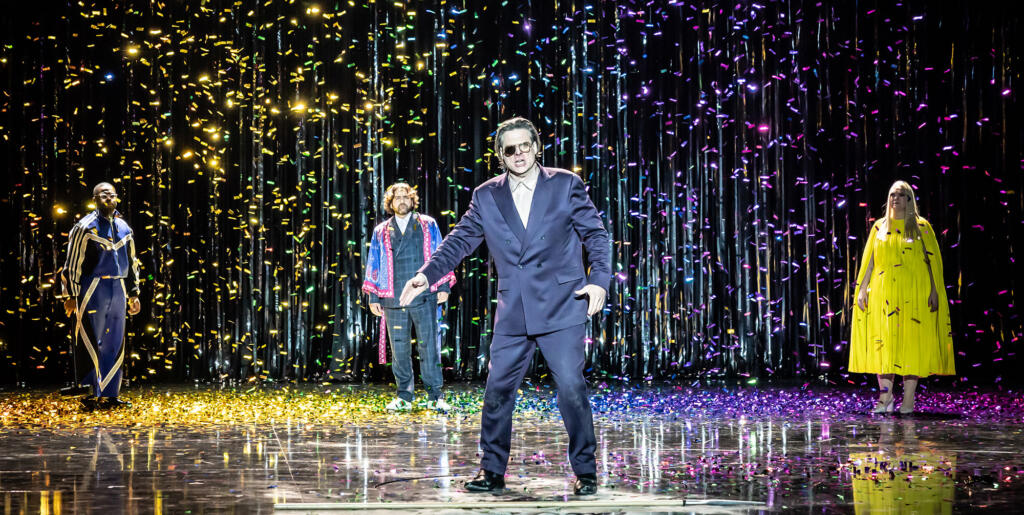
What takes place within it sticks fairly closely to the original storyline. Aside from Freia being transported on the back of the Giants' work van, the exchange rate for her is indeed measured against the accumulation of trays of Rhine gold ingots to her height - and don't forget to throw that tiny Ring in. That's fine as far as it goes, but essentially what Richard Jones and conductor Martyn Brabbins working together successfully achieve is getting the necessary impact for each of those key moments and scenes. The brutal killing of Fafner by Fasolt (a dummy brought on in an off-stage switch) battered about the head with a gold ingot was particularly forceful. The arrival of Erda (with the Norn as three schoolgirls? Your guess is as good as mine), sung impressively by Christine Rice, also created the necessary gravity and impact, together heralding the tragedy of the curse of the Ring that will (we hope) play out in future installments. The shimmering fall of rainbow glitter for the bridge to Valhalla, and the lockdown against the Rhinemaidens at the conclusion seemed an appropriate way, in Richard Jones terms if nothing else, for everything that came before.

Some moments of levity in the Tarnhelm episode were balanced in this way by the gravity of what the Ring's preliminary evening prologue lays down, and the balance was supported by the characterisation and singing. As noted above, Christine Rice in particular made that small but significant and truly Wagnerian impression as Erda, but there were notable performances also from John Relyea as Wotan, Leigh Melrose as Alberich, and a suitably shifty portrayal of Loge by Frederick Ballentine. Madeleine Shaw's Fricka and Katie Lowe's Freia contributed to the family dynamic alongside the entertaining comic action hero shapes thrown by Julian Hubbard's Froh and Blake Denson's Donner. The giants might not have had much physical stature in this production but I enjoyed Simon Bailey and James Creswell's Fasolt and Fafner.

I can't say that Martyn Brabbins' conducting of the orchestra made a huge impact - maybe I was focussing too much on giving the production and sets design more thought than it merited after all - but neither did I notice anything that felt out of place in pacing, delivery, the surge of leitmotifs or in the whole continuous flow of this marvellous work. Some of the music press appear to have been more generous about this production - whether it's a show of solidarity with the proposed fate of the ENO, I couldn't say, but such sentiments can be excused, as the loss of the ENO in London would be a serious blow for opera lovers, for London, for arts, culture and for tourism. I don't expect Bayreuth at the Coliseum, but who in any other part of the country - certainly not here in Belfast - is going to have the resources to present not only an entertaining and accessible Ring cycle to a diverse audience, but a solid programme of great opera every year? If not in the Coliseum, at least keep the ENO funded and in London. Its loss would be very much regretted and missed by this opera-goer at least.


Links: English National Opera

Monday, 29 November 2021

Wagner - Die Walküre (London, 2021)


Richard Wagner - The Valkyrie (London, 2021)

English National Opera, 2021

Martyn Brabbins, Richard Jones, Matthew Rose, Rachel Nicholls, Nicky Spence, Emma Bell, Brindley Sherratt, Susan Bickley, Nadine Benjamin, Mari Wyn Williams, Kamilla Dunstan, Fleur Barron, Jennifer Davis, Idunnu Münch, Claire Barnett-Jones, Katie Stevenson

The Coliseum, London - 19th November 2021

The announcement of a new Ring Cycle at the Coliseum was welcome news for many opera goers and followers of the English National Opera. It was a sign that new Artistic Director Annilese Miskimmon had some creative ideas to revive the fortunes of a company that has recently been going through some difficult times. The news was also greeted however with a certain amount of caution and indeed even trepidation by those who had been to see director Richard Jones's previous Ring for Covent Garden, or indeed any of his productions. There was little here to suggest that Jones would be a natural fit for Wagner.

Still, that doesn't have to be an essential quality and sometimes it's useful to get another perspective where the Der Ring des Nibelungen is concerned. While it's perhaps a little too early to look for any distinctive ideas or themes emerging, some of those concerns do appear to be well-founded in this opening opera of the tetralogy; not least the fact that it's opening with Die Walküre - and following the ENO's dated ideals about English language performances it's of course The Valkerie - commercial imperatives perhaps necessarily superceding artistic considerations.

Those are the least of this production's concerns, although commercial considerations may have also been a factor in the set designs looking a little sparse and the ideas at this stage looking a little thin. One would think that being a co-production with the Metropolitan Opera in New York might have provided a few more resources, but considering the expense poured into the Met's last Ring Cycle - and continuing pandemic related problems -  caution may also have been the watchword there. Whether the concept is fully developed or not, and whether it is expanded on at all before it gets to the Met (it is surely too small scale for the Met), Jones's The Valkyrie looks like a work in progress.

There is always going to be something of a feeling of lack of completeness in any production of Die Walküre, and this Ring cycle hasn't even given us a Das Rheingold (or The Rhinegold) yet, but the problems here go deeper than that. Many of the great set pieces of this opera fell flat, with Act III suffering most in this respect. The horses ridden by the green raincoat wearing Valkyrie looked like the front half of a pantomime horse, the scene only saved by the combined singing strengths of the Valkyrie. Brünnhilde's fate to go out in a blaze of disgrace at the finale was scuppered by the Westminster council's refusal to allow naked flames to be lit on the stage of the Coliseum, but even with it I'm not sure that Jones would have pulled off the kind of spectacle needed.

For Richard Jones however it seems the limitations imposed, or self-imposed, is a chance to focus on the nuts and bolts of the drama, on the characters and the relationships between them. The idea of the cast wearing jeans and T-shirt type casuals is otherwise baffling other than it simply being an attempt not to distract or distance through traditional costumes of heroic mythology. With Wagner's music played for all its dramatic and emotional potential and some fine singing, the attention to character more than concept can pay dividends, and to an extent Jones succeeded in bringing in some tweaks to characterisation, but not on any level that would be considered insightful or revelatory.

The sets can best be described as functional and minimal, aligned to mood. A twisted ash breaking through the roof of Hunding's abode - a surprisingly small cabin rather than any kind of manor - was all that sat on the largely empty stage in Act I, with some shadowy figures hovering around to rotate the set now and again. The second scene of Act II consisted of a row of distorted trees and a few troughs of soil for the performers to run through. Each Act however concluded on a mostly bare stage with the concluding drama of the scene enacted in a circle of light. The dead heroes of the start of Act III were borne up to Valhalla on wires, to allow the Valkyrie their moment and clear the stage for the final non-conflagration.

It all played out fairly conventionally then with just little twists of emphasis on characterisation. Not even twists, just minor tweaks or injections of character and personality. Hunding was shown clearly to be an abusive brute to his wife, which enhanced the dangerous and distasteful side of his character and made his comeuppance feel truly merited. We also got excellent singing and performance to go along with this from Brindley Sherratt. Nicky Spence was labouring under a cold but showed little sign of it in another strong and consistent performance as Siegmund. His refusal to be transported to Valhalla without Sieglinde was heartfelt and absolutely heartbreaking. Emma Bell's also sang wonderfully, even if Jones failed to really get across the bond between her Sieglinde and Spence's Siegmund.

A Ring Cycle wouldn't be a Ring Cycle without some serious mishaps and problems and this one looks like having more than its fair share. Susan Bickley, cast as Fricke, was unable to sing at all, and had to walk through her role while it was sung from the wings by Claire Barnett-Jones, who took this on in addition to her role as the Valkyrie Rossweisse. This worked just fine. Matthew Rose was a capable and very demonstrative Wotan, striding onto the stage in Act II punching the air at the success of his plans in Act I, only to see them dashed soon after. This kind of dynamic set Wotan out as somewhat petulant, but a petulant god is still a fearsome thing, even one dressed as a lumberjack with his log cabin Valhalla.


It will be interesting to see why Giants are needed in the construction of a log cabin when it comes to producing
Das Rheingold, but there were at least some promising hints of what could be done in the highly effective use of some eerily lifelike projections of Alberich during Wotan's recounting of the fateful incidents that set this downfall of the Gods into motion. It's an indication that much more could surely have been done to make this production more menacing and visually interesting.

Sung in English, the translation tried to strike a balance between colloquial and rendering of Wagner's old German poetics, so the delivery was inevitably a little awkward in places, although sung passages were such more successful at sounding closer to the familiar German. The perceived and forced limitations of the production and stage design aside - functional but with little in the way of this director's usual flair - this was however an otherwise enjoyable production of Die Walküre at least as far as musical and singing performances go. Martyn Brabbins's conducting drove the drama along purposefully with impact and emotional charge where required. Far from feeling like a complete opera in itself, the ENO's The Valkyrie at least offers hope that there is room for improvement and development by the time we get to performances of a full cycle.


Links: English National Opera

Thursday, 24 October 2019

Birtwistle - The Mask of Orpheus (London, 2019)


Harrison Birtwistle - The Mask of Orpheus

English National Opera, 2019

Martyn Brabbins, James Henshaw, Daniel Kramer, Peter Hoare, Marta Fontanais-Simmons, James Cleverton, Claron McFadden, Daniel Norman, Claire Barnett-Jones, Simon Bailey, Matthew Smith, Alfa Marks, Leo Hedman

The Coliseum, London - 18th October 2019


The Greek myth of Orpheus and his journey to the Underworld to rescue his dead wife Eurydice has been recounted in opera in many different ways, but essentially the story is simple in its telling and in its meaning. It's about love, loss, life, bereavement, endurance, coming to terms with death as a part of life, a theme that can give rise to and be expressed in the highest orders of artistic creativity. Did I say simple? There is of course nothing simple about those themes, neither individually not when combined. It's even more complicated when you add in, as Harrison Birtwistle does in this account of the myth in The Mask of Orpheus, the vagaries of time, the repetition of memory and the unreliability of myth distorting the truth.


Birtwistle's The Mask of Orpheus is anything but simple, but in comparison to other accounts you have to wonder does it really need to be this complex? This version has three Orpheuses, three Euridices and three Aristeuses, representing the man, the myth, the hero. These splits are further fractured and intertwined through the vagaries of memory, dreams, delusions that result eventually (but by no means clearly) in a coming to terms with reality, or at least with the complexities of reality. The reformist Gluck wouldn't have approved such over-elaboration nor presumably would Monteverdi have countenanced the destruction of the illusion of man aspiring to the gods and coming close to attaining it in the expression of his music.

Musically however, Birtwistle score is just that ambitious and a performance of
The Mask of Orpheus is still a thing of wonder, unlike anything else in opera. At the current ENO production it requires two conductors to manage the vast and unusual arrangement of brass, woodwind and percussion combined with Barry Anderson's IRCAM-derived experimental electronics. It creates an extraordinary sound that fully explores the complexity of situations and moods, the abstraction and repetition, the echo of time and ritual of myth. Peter Zinovieff's libretto is abstract and fragmented, often obscure and unfathomable in vocalised fragments of words. Stockhausen's Licht has nothing on this except length, and even then The Mask of Orpheus is testing at over three and a half hours long.

Inevitably Orpheus's journey in the opera is extremely hard to follow or grasp onto anything concrete. It does however have a very definite form and structure, tri-partite in acts, in its interweaving of three incarnations of the three principal characters. There are three scenes in the first Act and two sets of three allegorical myths interspersed throughout as dance interludes (three 'passing clouds' and three 'allegorical flowers'), but the opera fractures into other directions, Orpheus passing through 17 arches in Act II, Act III divided into eight episodes and an 'Exodos'. The music is just as complex in its composition and form, fractured, episodic, repetitive, interweaving replaying and transforming.


The Mask of Orpheus is evidently an experimental work, an enormous undertaking in an unconventional musical form (with its use of electronics) that Birtwistle hasn't really attempted on this scale anywhere else. Does the experiment yield any great insights into the myth? Should it be possible to grasp some deeper meaning? With the music giving expression, does it even need a narrative? What then should be the role of a director in all this? Should he attempt to make sense of it, to impose a path at least if not a narrative? Paths are important in The Mask of Orpheus and Daniel Kramer's production at least adheres to the unconventional structural path that the opera explores, but it obscures at least distracts when you hope it might illuminate.

Illuminating The Mask of Orpheus is an unenviable challenge admittedly, but Kramer's idea of illuminating doesn't really extend beyond drenching the work in garish day-glo pinks, greens and blues. There's some attempt to encompass the multiple levels of the work up there on the stage, its repetition, its simultaneous echoing of multiple views of past, present, future, myth and reality, but there's also much that is unnecessary. A crass bombardment of colour, projections and quite absurd cabaret or circus-like costumes do little more than fulfil the function of distinguishing one group from another but there's little that appears to connects to the music, to the narrative or themes.


A director like Achim Freyer can get away with that kind of eccentricity in design, but there at least there is an effort towards logic or symbolism even if it can be abstract it the extreme. Here the approach feels completely inappropriate for the subject and the work, over-complicating, making it almost impossible to follow everything that is going on and who is who at any given time. It's not necessarily a case that simplification is required, as it's hard to imagine how you could do that and be true to the structure of the work and music, but the problem seems to be that there appears to be no real feeling for the work or understanding of it in the direction.

The same accusation fortunately can't be levelled at the musical direction. Martyn Brabbins, assisted by James Henshaw, more than met the considerable challenges of this unconventional score and the very high expectations I personally had to hear it performed live. The sound within the Coliseum was incredible, the orchestration opening out the score, creating an enveloping mood that is there within the dynamic of the score and its collision of acoustic and electronic elements. It's been over thirty years since it was performed in full during its original run in 1986 so it's certainly worth taking the opportunity to hear it, and it sounds tremendous in the auditorium of the Coliseum.

While it was hard to follow who was singing what at any stage due to the cut-up and blend nature of the work - not helped at all by the obscure costumes and busy stage - it was clear there were no areas of weakness in the singing either. Peter Hoare as the principal, older Odysseus (The Man) and Claron McFadden as The Oracle of the Dead were identifiable and certainly notable for meeting the singing and performing challenges of the work. For the musical performance alone this was an extraordinary evening at the opera of a rare and exceptional work, but one unfortunately let down by an ill-considered production design and direction of no discernible artistic merit. 


Links: English National Opera

Tuesday, 16 October 2018

Strauss - Salome (London, 2018)


Richard Strauss - Salome

English National Opera, London - 2018

Martyn Brabbins, Adena Jacobs, Allison Cook, David Soar, Michael Colvin, Susan Bickley, Stuart Jackson, Clare Presland, Trevor Eliot Bowes, Ceferina Penny, Simon Shibambu, Ronald Nairne, Daniel Norman, Christopher Turner, Amar Muchhala, Alun Rhys-Jenkins, Jonathan Lemalu, Robert Winslade Anderson, Adam Sullivan

The Coliseum, London - 12 October 2018

The English National Opera has been struggling to establish an identity in recent years (amongst other financial, artistic and personnel problems), so it was interesting to see that the current new season would have a strong female perspective with works that would "explore and examine some of the patriarchal structures, relationships and roles of masculinity within our society." The first production of the season, Richard Strauss's Salome directed by Adena Jacobs, an Australian theatre director working in opera for the first time, might not entirely fulfil the remit, but offers some new outlooks on a surprisingly adaptable text and score.

Oscar Wilde's original play can hardly be seen as a feminist work and hardly presents its female characters in the most flattering light, but it is very much a work that explores sexual desire and power, challenges social attitudes and gives it a very strong female focus. Wilde's concerns would be very much personal ones of course, to do with unspoken and unspeakable lusts and the danger of exposing them to a hypocritical society that is fascinated by but represses such urges, or at least the public expression of them. Coming from a woman, as it does in Salome, is even more challenging and daring.


Given voice through Wilde's decadent poetic reverie and imagery through a woman, Salome can still shock and make an impact 100 years after it was composed and still challenge conventional morality, social inequalities and gender issues, not least in Richard Strauss's extraordinary tone poem score for the work, a score that also pushed the boundaries of musical expression. While Salome's actions are hardly flattering towards the female sex, they have been twisted on one side by exposure to the corruption and vice of the court of Herod, the Tetrarch, and struggle on the other with the condemnation of religious authorities represented by Jokanaan. It's in highlighting how female expression is crushed between such "patriarchal structures" that Jacobs' production is at least partially successful.

Considering that Salome is a one-act opera that takes place in a single location, the production design at least manages to be varied and expressive of more than just the physical location, attempting rather to illustrate the very intense interior drama that takes place in the mind of Salome. Taken on those terms - and Wilde's use of symbolism in his text would certainly tend to lead it in that direction - it might excuse some of the more random and expressionistic touches applied. Herod in particular is rather grotesquely presented in a bathrobe, glittery vest and undershorts and wallows around in the disturbingly large amount of blood spilled by the suicide of Salome's guard and silent admirer Narraboth. As an expression of the corruption and hypocrisy of the court of the Tetrarch, it makes its point.


That's one side of the oppressive force in the society that Salome has been brought up in. The other is the religious moralising of the prophet Jokanaan, whose mystical imagery and phrasing presents an authoritative and attractive alternative, but Salome comes to find it also prohibitive. Disdainful of the earthly treasures promised by Herod, attracted to the condemnation of her despised step-father and his corrupt, vice-ridden world, and aroused by the alluring promises of Jokanaan (something that is very much brought out in the resonant bass register of the role), Salome reacts violently when neither of these patriarchal structures offer her any personal expression or freedom, but rather seek to further enslave her and any like-minded women with their own strong sense of identity and desires.

The imagery that Adena Jacobs uses in the ENO production can be somewhat obvious, but it least it doesn't need to rely on the sometimes obvious symbolism and imagery that Wilde has provided (the moon, blood, ripe fruit). Some of it is more successful than others; the moon inverted into a black hole surrounded by flowers for the concluding scene of Salome with the head of Jokanaan is striking as a visual representation of Salome's dark desire. The backdrop of a woman with a blindfold not so meaningful - blind desire, abused woman kept in the dark or something else, take your choice. Elsewhere the use of live cameras didn't offer anything more to the intensity of the work, one camera affixed to a muzzle over the mouth of Jokanaan, another seemed to be carried by Narraboth watching Salome, but since nothing was shown of the latter, I presume the camera malfunctioned at the performance I attended.

Much, but probably not as much as you think, can rest on the centrepiece of the Dance of the Seven Veils. Here, to be frank, it was a bit of a mess. Salome was presented as a joggers-wearing teenager, the dance performed mostly around the decapitated and spilled guts of a giant pink My Little Pony by a team of twerking backing dancers that you would see for an artist like Beyoncé. Beyoncé may be seen in some circles as the representation of female empowerment, but by others she is nothing more than a money-making product and business woman in a (patriarchal) music industry. If there was any female empowerment done it wasn't here but perhaps more in Salome getting dirty with herself in her earlier encounter with Jokanaan.


Whether Jacobs' production and direction brings anything new out of the work, whether it succeeds in tapping into female desire any more than Wilde and Strauss is debatable, but it was at least someway successful in harnessing the unquestionable power of the work. Far more was done on that front however by Martyn Brabbins conducting of the English National Opera Orchestra, sensitive to the light and shade of the work and its fluid dynamic, a little muddy in places, but breathtakingly thunderous in the impact and punctuation of the thematic motifs that accompany the action.

The musical pleasures were supplemented by some good singing and dramatic performances. Allison Cook wasn't strong all the way across the formidable range of Salome, but her delivery of the high end was chilling and precision powered, particularly in the calling for the head of Jokanaan. David Soar's bass had a persuasive warmth and authoritative allure as Jokanaan (supplemented of course by Strauss's majestic brass fanfares). Michael Colvin has the right kind of fragile seediness as Herod and was perfectly accompanied by Susan Bickley's Herodias. There were fine performances also from Stuart Jackson as Narraboth and Clare Presland's Page. The quality of the singing and the delivery of Strauss's remarkable score went some way to salvaging a rather messy production that nonetheless had some interesting points of character and distinction.

Links: English National Opera