Harrison Birtwistle - The Mask of Orpheus
English National Opera, 2019
Martyn Brabbins, James Henshaw, Daniel Kramer, Peter Hoare, Marta Fontanais-Simmons, James Cleverton, Claron McFadden, Daniel Norman, Claire Barnett-Jones, Simon Bailey, Matthew Smith, Alfa Marks, Leo Hedman
The Coliseum, London - 18th October 2019
The Greek myth of Orpheus and his journey to the Underworld to rescue his dead wife Eurydice has been recounted in opera in many different ways, but essentially the story is simple in its telling and in its meaning. It's about love, loss, life, bereavement, endurance, coming to terms with death as a part of life, a theme that can give rise to and be expressed in the highest orders of artistic creativity. Did I say simple? There is of course nothing simple about those themes, neither individually not when combined. It's even more complicated when you add in, as Harrison Birtwistle does in this account of the myth in The Mask of Orpheus, the vagaries of time, the repetition of memory and the unreliability of myth distorting the truth.

Birtwistle's The Mask of Orpheus is anything but simple, but in comparison to other accounts you have to wonder does it really need to be this complex? This version has three Orpheuses, three Euridices and three Aristeuses, representing the man, the myth, the hero. These splits are further fractured and intertwined through the vagaries of memory, dreams, delusions that result eventually (but by no means clearly) in a coming to terms with reality, or at least with the complexities of reality. The reformist Gluck wouldn't have approved such over-elaboration nor presumably would Monteverdi have countenanced the destruction of the illusion of man aspiring to the gods and coming close to attaining it in the expression of his music.
Musically however, Birtwistle score is just that ambitious and a performance of The Mask of Orpheus is still a thing of wonder, unlike anything else in opera. At the current ENO production it requires two conductors to manage the vast and unusual arrangement of brass, woodwind and percussion combined with Barry Anderson's IRCAM-derived experimental electronics. It creates an extraordinary sound that fully explores the complexity of situations and moods, the abstraction and repetition, the echo of time and ritual of myth. Peter Zinovieff's libretto is abstract and fragmented, often obscure and unfathomable in vocalised fragments of words. Stockhausen's Licht has nothing on this except length, and even then The Mask of Orpheus is testing at over three and a half hours long.
Inevitably Orpheus's journey in the opera is extremely hard to follow or grasp onto anything concrete. It does however have a very definite form and structure, tri-partite in acts, in its interweaving of three incarnations of the three principal characters. There are three scenes in the first Act and two sets of three allegorical myths interspersed throughout as dance interludes (three 'passing clouds' and three 'allegorical flowers'), but the opera fractures into other directions, Orpheus passing through 17 arches in Act II, Act III divided into eight episodes and an 'Exodos'. The music is just as complex in its composition and form, fractured, episodic, repetitive, interweaving replaying and transforming.

The Mask of Orpheus is evidently an experimental work, an enormous undertaking in an unconventional musical form (with its use of electronics) that Birtwistle hasn't really attempted on this scale anywhere else. Does the experiment yield any great insights into the myth? Should it be possible to grasp some deeper meaning? With the music giving expression, does it even need a narrative? What then should be the role of a director in all this? Should he attempt to make sense of it, to impose a path at least if not a narrative? Paths are important in The Mask of Orpheus and Daniel Kramer's production at least adheres to the unconventional structural path that the opera explores, but it obscures at least distracts when you hope it might illuminate.
Illuminating The Mask of Orpheus is an unenviable challenge admittedly, but Kramer's idea of illuminating doesn't really extend beyond drenching the work in garish day-glo pinks, greens and blues. There's some attempt to encompass the multiple levels of the work up there on the stage, its repetition, its simultaneous echoing of multiple views of past, present, future, myth and reality, but there's also much that is unnecessary. A crass bombardment of colour, projections and quite absurd cabaret or circus-like costumes do little more than fulfil the function of distinguishing one group from another but there's little that appears to connects to the music, to the narrative or themes.

A director like Achim Freyer can get away with that kind of eccentricity in design, but there at least there is an effort towards logic or symbolism even if it can be abstract it the extreme. Here the approach feels completely inappropriate for the subject and the work, over-complicating, making it almost impossible to follow everything that is going on and who is who at any given time. It's not necessarily a case that simplification is required, as it's hard to imagine how you could do that and be true to the structure of the work and music, but the problem seems to be that there appears to be no real feeling for the work or understanding of it in the direction.
The same accusation fortunately can't be levelled at the musical direction. Martyn Brabbins, assisted by James Henshaw, more than met the considerable challenges of this unconventional score and the very high expectations I personally had to hear it performed live. The sound within the Coliseum was incredible, the orchestration opening out the score, creating an enveloping mood that is there within the dynamic of the score and its collision of acoustic and electronic elements. It's been over thirty years since it was performed in full during its original run in 1986 so it's certainly worth taking the opportunity to hear it, and it sounds tremendous in the auditorium of the Coliseum.
While it was hard to follow who was singing what at any stage due to the cut-up and blend nature of the work - not helped at all by the obscure costumes and busy stage - it was clear there were no areas of weakness in the singing either. Peter Hoare as the principal, older Odysseus (The Man) and Claron McFadden as The Oracle of the Dead were identifiable and certainly notable for meeting the singing and performing challenges of the work. For the musical performance alone this was an extraordinary evening at the opera of a rare and exceptional work, but one unfortunately let down by an ill-considered production design and direction of no discernible artistic merit.
Links: English National Opera
Michel van der Aa - Sunken Garden
Opéra de Lyon, 2015
Etienne Siebens, Michel van der Aa, Roderick Williams, Katherine Manley, Claron McFadden, Jonathan McGovern, Kate Miller-Heidke
TNP, Lyon - 15 March 2015
One of the benefits of seeing a modern and fairly experimental new opera like Michel van der Aa's Sunken Garden as part of the wider context of Opéra de Lyon's 'Les Jardins Mystérieux' opera mini festival is that it helps put it into context, highlighting and contrasting it with other works on a similar broad theme. Here, Sunken Garden is set alongside Franz Schreker's Die Gezeichneten and Gluck's Orfeo ed Euridice, and surprisingly the comparison does tend to work in its favour.
Having only heard Sunken Garden previously on a BBC Radio 3 broadcast during its premiere performances at the English National Opera in 2013, it didn't really seem to work as a conventional opera. Even more so than other operas, this was however clearly a work where the visual component is just as important as the music. Involving a number of other different disciplines and embracing all kinds of new technology, radio obviously wasn't really the right medium to explore a 3-D film-opera. At its French premiere in the Théâtre National Populaire in the Villeurbanne suburb of Lyon, 'Le jardin englouti' clearly worked well on the stage and received a much more enthusiastic response from what looked like a sold-out performance.
Seen fully-performed, some aspects however, such as David Mitchell's compendium of stock phrases and banal cliches that represent 'the way real people speak', still grated, but these were probably not as evident to a French audience. When viewed in performance, the supernatural elements of the story, built-up through the dialogues of a small cast and with filmed interviews sections, comes across even more so as having the whole look and feel of an average episode of Doctor Who. In the context of the Mysterious Gardens festival however, and particularly having watched an ambitious staging of Orfeo ed Euridice at the Lyon Opera House just the previous night, it encouraged one to think a little more about the content and themes of the work.

If you can get past the banalities of a plot where a meglomaniac evil villain seeks a means of achieving immortality by capturing the souls of others and holding them in a 'sunken garden', essentially it's no more ridiculous an idea than a hunchback dwarf creating a paradise for decadent nobles to indulge their corrupt lusts, or for a musician to journey to Hell in the hope of bringing his beloved wife back from the dead. Regardless of the musical means and the technology used to put this across, similar themes are explored in Sunken Garden, and they do have rather more weight and meaning that could easily be missed in dazzle and colour of the spectacle, although ideally it ought to enhance them.
Sunken Garden is about secret places, the kind of secret place that one wishes they could withdraw to when faced with the horrors or even just the difficulties of everyday life when it gets too much to deal with. Like Orpheus, Toby Kramer is an artist who has suffered loss after the death of his wife, and seeks to find answers or some kind of solace in his work. A multi-media artist, Kramer is pouring his energies into a new project based on the real-life disappearance of a young man, Simon Vines, filming interviews with friends, trying to understand what could have motivated someone to choose to leave a successful life and career behind him, if it was even a choice he made himself. A wealthy donor, the owner of an art gallery, is fascinated by Kramer's work so far, and willing to keep providing him with funds to expand it into a 3-D film.
The longer Kramer works on the project, the stranger the disappearance of Simon Vine appears, the artist discovering documents and footage on a mobile phone that suggests that Vine's former girlfriend Amber Jacquemain has also disappeared. Dealing with his own loss, Kramer's personal involvement in the work deepens, much to the frustration of Zenna Briggs, the representative from the art gallery who is getting impatient with the slow progress of the project. Eventually, Kramer discovers that Simon and Amber have both been abducted, their souls being sucked dry to fuel a sunken garden in another dimension to feed the desire of a villain who wants to be immortal; a person he already knows.

As ludicrous as it might sound, Sunken Garden does in its own way - and really not so different from the ambitions of Alviano Salvago and Orpheus - seek to create a paradise that takes one away and makes one immune from the horrors and tyranny of everyday existence. Ultimately Kramer has to decide whether he wants to cut himself off from the world, initially through his never-ending art project, and then in some manufactured world of technology (seeking solace and escape in technology is a major theme here and the entire raison d'être for all the 3-D technology in the film-opera itself). The realisation that there is a downside to any ambitions to create a paradise outside of the boundaries of natural order is one that Kramer, much like his counterparts in Die Gezeichneten and Orfeo ed Euridice, has to eventually accept and come to terms with, but it's not an easy decision to make.
Visually then, the sunken garden must be an alluring but slightly sinister place, and the impressive 3-D film technology used by Michel van der Aa does that very well, justifying its use as much more than a gimmick. The composer is well-known for his efforts to expand the range of lyric drama and musical expression, and as such it's not so much a question of attempting to progress opera into new directions, as much as making best use of all the resources available now that will allow full expression of the ideas of the subject. Assessing the value of Sunken Garden as a purely musical drama is not really relevant either. It's only one small part of a much more widely-encompassing view of opera as music theatre. On its own the music might not be particularly memorable, but it is eclectic, and doesn't feel constrained to fit old models of expression, using sequencers and sound effects as well as more traditional instrumentation, freely borrowing from a wide range of modern influences (Radiohead being an acknowledged inspiration).
Whether this means that the work has any place in posterity doesn't seem to be foremost in the mind of the composer/director/filmmaker either - although its revival here for Lyon is a good sign. Van der Aa's concern seems to be solely with putting the work across in the most effective way with whatever state-of-the-art means are available now, and it's a highly effective and imaginative stage production. If it is revived in the future, a production doesn't necessarily need to use 3-D or the same pre-recorded filmed performances - two of the singers don't appear in person here - but, much like the reinventions of older works for the modern stage (to again go back to the extraordinary Lyon production of Orfeo ed Euridice), it can be freely reinterpreted using whatever new technology is available. Whatever means is used - whether that's holograms or use of other dimensions (hey, who knows?) - the message about the misuse of technology and its incompatibility with human nature will surely still be relevant.
Links: Opéra de Lyon
Nicholas Lens - Shell Shock
La Monnaie - De Munt, 2014
Koen Kessels, Sidi Larbi Cherkaoui, Claron McFadden, Sara Fulgoni, Gerald Thompson, Ed Lyon, Mark S. Doss, Gabriel Kuti, Eastman, Aimilios Arapoglou, Damien Jalet, Jason Kittelberger, Kazutomi Kozuki, Elias Lazaridis, Johnny Lloyd, Nemo Oeghoede, Shintaro Oue, Guro Nagelhus Schia, Ira Mandela Siobhan, Theo Lally, Gabriel Crozier
La Monnaie Web streaming - November 2014
La Monnaie in Brussels are in my view just about the most consistently impressive opera company in Europe at the moment and at the forefront of presenting opera as a cutting edge artform. Part of the reason for their success is their willingness to involve theatre directors and artists from outside the opera world, who often bring a new and refreshing perspective on the meaning and presentation of very familiar works, but the musical interpretation and the quality of the performers engaged is of a very high standard too. Their commitment to ensuring that opera remains a vital musical and dramatic force is also evident in their commissioning of exciting new creations every season. This year Shell Shock proved to be one of the most impressive new works I've seen for a very long time.
Characteristically, the strength of the work and the key to its success is in how La Monnaie have assembled a strong and imaginative creative team from a variety of disciplines. As some of these collaborators have little or no previous experience of opera, they often have few preconceptions about what opera ought to be. For this work, commissioned to commemorate the 100th anniversary of the beginning of the Great War, the Belgian composer Nicholas Lens (born in Ypres where the memory of the war remains fresh) was been paired with the Australian singer/songwriter and author Nick Cave, while the direction and staging of the work was placed in the hands of Belgian-Moroccan dance choreographer Sidi Larbi Cherkaoui. The result is Shell Shock: A Requiem of War, A Dance Oratorio in Twelve Canti.

Evidently then, Shell Shock is not an opera in the traditional sense. It's part choral oratorio, it's part requiem mass, it's a ballet, it's a song cycle, but opera is a good enough description in how it encompasses and blends together these various musical and dramatic art disciplines. Made up of twelve separate cantos that describe the experience of the war from a variety of viewpoints (Canto of the Colonial Soldier, Canto of the Nurse, Canto of the Deserters, Canto of the Orphans etc.), there is however a strong thematic and even a narrative line that runs through the work, connecting the experiences. Even though there is little narrative dialogue within the canto format, the experiences being typically that of a single person or a group of people in a choral piece, there is nonetheless a vital dialogue established with the other elements. Not only is there a strong connection between the words and the music - as you would expect at the very least - but they form an meaningful dialogue and interact very much with the performers and dancers on the set, and with the various other theatrical stage devices, including the unconventional use of props, and projections.
This is an true operatic collaboration then in every sense of the word, where equal weight is given to each of the disciplines and they are informed, heightened and enhanced by their interaction with one another. Musically, Nicholas Lens draws on a variety of styles to match the content, some of it sounding like Vaughan-Williams in less pastoral more wartime music and, inevitably, closer to Britten's War Requiem. There is also a John Adams-like modern rhythmic quality in how the music is attuned to the sung English text, but without the minimalistic repetition. If it's difficult to pin down, the music nonetheless has a consistency and dramatic quality that works perfectly with the tone established by Nick Cave's texts. Unpretentiously called lyrics, they are indeed songs, Cave working to his strengths as a storyteller, expressing all the anger, exasperation, fear and horror of the conditions experienced by the soldiers, the nurses and the families of those caught up in nightmarish situations.

The connection between the words and the music is a strong combination that makes Shell Shock viable and deeply affecting as a concert piece in its own right, but Sidi Larbi Cherkaoui's choreographed dances, movements and tableaux-like settings for the scenes really take the work to another level. The dances and movements manage to be strikingly beautiful without for a second glorifying the slaughter, without fitting the horror and confusion of the circumstances into any false sense of dramatic action, and without idealising the senselessness of the sacrifice. "War is reprehensible, not the man", is a line from the lengthy Canto of the Deserters section, but the theme is expanded on elsewhere, with lyrical and musical motifs referring to an Angel of Death and Kratos the God of War drawing together common experiences into a larger narrative.
Cherkaoui's dances, with Eastman leading the troupe, are also strikingly illustrative of these themes. It's a ballet of war where soldiers twitch with shell shock or contort as their bodies are disjointed, mutilated and torn apart by bullet fire and crawl over sandbags to form their own pile of corpse sandbags. The use of common objects found on the battlefield is employed imaginatively elsewhere, guns, bayonets and even stretchers flowing with the dancers into configurations that illustrate the stories and give expression beyond the literal. Bed sheets, for example, are used to capture charging soldiers, their faces and hands pressed against the canvas screen in a silent scream at the point of death. In combination with the music and the lyrics, it manages to be visually striking, expressive and horrific scene at the same time. Eugenio Szwarcer's projections and the stage lighting also come together with all the other elements to create further tableaux vivantes, or tableaux mortes if you can put it that way.
The singers are assigned various roles according to the Colonial Soldiers, Deserters, Survivors and Fallen of the Canti, some of them recurring throughout the opera as a whole. Essentially however, they are unnamed in the respect that each of them can fulfill multiple common designations within this war, and are identified only according to their singing role. The casting of a soprano (Claron McFadden), a mezzo-soprano (Sara Fulgoni), a countertenor (Gerald Thompson), a tenor (Ed Lyon) and a bass (Mark S. Doss) is clearly meant to be representative of the whole range of experiences covered here, but the choice of singers for those roles is also just about perfect. That's no coincidence either, several of these singers having worked with Lens before (Claron McFadden notably on Love Is The Only Master I'll Serve), but it's just another example of how La Monnaie strive for perfection on every level while stretching the capabilities of everyone to their limits. The results of this approach are evident to anyone viewing this remarkable work.
Links: La Monnaie, ARTE Concert
Jörg Widmann - Babylon
Bayerische Staatsoper, Munich, 2012
Kent Nagano, Carlus Padrissa, La Fura dels Baus, Claron McFadden, Anna Prohaska, Jussi Myllys, Willard White, Gabriele Schnaut, Kai Wessel, August Zirner
Internet Streaming, 3 November 2012
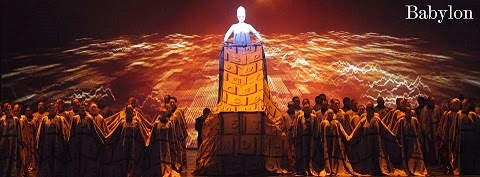
The first opera for the new 2012/13 season of the Bavarian State Opera in Munich was something of a bold statement of intent. A new modern opera receiving its world premiere, Babylon is an almost three-hour long epic with lavish production values that seem to fly in the face of European austerity measures and defy restraints on budgets in the arts. With a libretto written moreover by philosopher Peter Sloterdijk and music composed by Jörg Widmann, the 39 year old student of Hans Werner Henze, it seemed something of an omen that Henze should die mere hours before the opening performance, leaving the way for his protégé to make a mark on modern opera with an important new work. There was consequently a weight of expectation surrounding the opening of Babylon, and with a visually astonishing production from Carlus Padrissa of La Fura dels Baus that was perfectly in accord with the colourful nature of the work, the opera certainly made an impression, even if its impact was inevitably somewhat reduced for those watching it (and experiencing technical difficulties) with its Live Internet Streaming broadcast on the 3rd November.
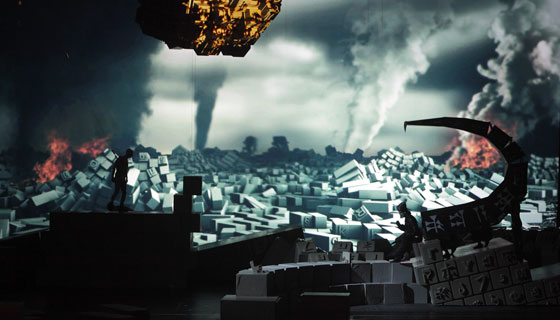
Babylon relates back to Biblical times and ancient Mesopotamian mythology, to human sacrifice practiced by the Babylonians and the repudiation of it by the Jews, to the destruction of the walls of Jericho and the founding of urban civilisation. Central to the work then, with its invocations of the mystical number seven, is the formation of order out of chaos, an order associated with numerology that is reflected in the establishment of the seven days of the week. It's a love story that is both the cause of the chaos that ensues as well as what brings about redemption and order. Widmann's opera opens then with a prologue showing a scene of apocalyptic devastation, a scorpion man walking through the ruins, before the Soul arrives to open up the first of the opera's seven scenes, mourning the loss of Tammu, a Jewish exile living in Babylon who has fallen in love with Inanna, a Babylonian priestess in the Temple of Free Love.

The visions of chaos and destruction continue unabated as Tammu lies with Inanna, and is awoken through love and some herbal induced visions - the seven planets and even the Euphrates itself bearing testimony - to the truth that their world is founded on chaos that the Gods have unleashed upon the universe. (Mozart and Schikaneder's The Magic Flute is obviously drawn from the same sources - Tamino and Pamina recognisably relating to Tammu and Inanna). It's this chaos that the Babylonians hold at bay through human sacrifice, a "truth" that is hidden by Ezekiel in his teachings of the Jewish law and the stories of Noah and the flood. When Tammu is chosen as the next human sacrifice however and is executed by the High Priest following the New Year celebrations, Inanna joins with the Soul in her lament for his loss. Inanna pleads with Death to allow her to journey to the Underworld to bring Tammu back.
Undoubtedly the most striking thing about Babylon is the direction of this vast undertaking by Carlus Padrissa of La Fura dels Baus, with its spectacular production designs by Roland Olbeter. Every element of the ambitious libretto, with all its mystical symbolism, dreams, visions and mythology, is presented in visual terms that aren't merely literal, but connect on an intimate level with the music and the concepts wrapped up within it. In its seven scenes (with a prologue and an epilogue) a Tower of Babel is erected and destroyed, the seven planets appear during Tammu's visions, the River Euphrates is personified as well as represented by a stream of words and letters that flood and overflow, seven phalluses and vulvas appear with seven apes during the New Year celebrations, flaming curtains give way to sudden downpours during the sacrifice of Tammu, and Innana wades through a seething mass of (projected) bodies, discarding seven garments (a dance of the seven veils), as she journeys into the Underworld. The stage is never static, there's an incredible amount going on, with extraordinary detail in background projections, processions, with supernumeraries in all manner of costumes and guises.

Babylon is therefore, opera in its purest sense. The music and singing alone don't stand up on their own, the spectacle alone isn't enough, but the work needs each of the elements of the libretto, the music, the performance and the theatrical presentation to work together and in accord to put across everything that is ambitiously covered in the work. Widmann perhaps takes on too much across its great expanse of scenes and musical styles - cutting suddenly between twelve-tone dodecaphony, jazz, cabaret and Romanticism - to the extent that it can feel episodic and difficult to take in as an integral and consistent work. Babylon however has a solid foundation in its subject, in Kent Nagano's marshalling and conducting of the orchestra of the Bayerische Staatsoper, in Padrissa's impressive command of the visual elements, and in Anna Prohaska's extraordinary performance as Innana that goes beyond singing. Babylon is opera in the purest sense also in that it undoubtedly needs to be experienced in a live theatrical context in order for its full power to be conveyed. On a small screen, viewed via internet streaming, the rich scope, scale and ambition of the work were nonetheless clearly evident.