Showing posts with label La Fura dels Baus. Show all posts

Wednesday, 20 March 2019

Krenek - Karl V (Munich, 2019)


Ernst Krenek - Karl V

Bayerische Staatsoper, 2019

Erik Nielsen, Carlus Padrissa, La Fura dels Baus, Bo Skovhus,,Okka von der Damerau, Gun-Brit Barkmin, Dean Power, Anne Schwanewilms, Janus Torp, Scott MacAllister, Kevin Conners, Wolfgang Ablinger-Sperrhacke, Michael Kraus, Peter Lobert, Mirjam Mesak, Anaïs Mejías, Natalia Kutateladze, Noa Beinart, Mechthild Großmann

Staatsoper.TV - 23 February 2018

Ernst Krenek is one of a small number of composers to compose and actually complete a full opera using the twelve-tone system, a technique that you would think might reduce the musical forces and resources commonly at the disposal of a composer dealing with such a complex historical subject as the life and death of the 16th century Holy Roman Emperor Charles V. One need only look Verdi's Don Carlo, which opens (in some versions) with the death of Charles V and the ascension to the throne of Carlo's father Philip II to see a very different musical and dramatic enactment of the death of the same king.

Like Schoenberg's take on questions of faith and dogma in his only (uncompleted) twelve-tone opera Moses und Aron, the technique however does have a unique ability to explore those issues from an intimate and personal perspective while also considering them in the light of something more vast and infinite. Krenek's Karl V sets about doing just that, the opera taking place on the death bed of the Holy Roman Emperor as he looks back retrospectively on the personal family matters and the childhood experiences that may have had an influence on the actions taken in his more public role.


Karl V is an ambitious work, a difficult work in its subject and musical presentation. Like any work with a historical figure as its subject it inevitably must reduce a life down to a few incidents, but like the best works of this kind - Boris Godunov comes to mind - Karl V somehow captures their importance and power for that period of their lives, but at the same time it reflect them as flawed human beings who ultimately become an irrelevance with death. There's very much a sense in Karl V that Charles is all too aware of that outcome as he lies sick and dying in the monastery of San Jeronimo de Yuste.

The proximity of death focusses the mind to some extent, but the king's illness and his need to justify his actions to his maker also skews his perspective on events. It's far from an impartial, objective or impassive view on the past, but one that, since Karl has believed that he is enacting God's will to unite the world to the faith, is very much the perspective of a self-important, self-pitying, egocentric (or deus-centric if I may coin a word) man faced with his own human weaknesses and mortality. Was this all preordained? What were the signs that set him on this path?


Karl's reflections take in a number of significant events, or events that once appeared significant but now seem to have less or no less importance than his family relationships; and even those have troubling concerns. On his deathbed, he remembers his mother Joanna the Mad, finding an apple in a worm as a child and seeing in it now corruption eating through the heart of the world. That leads him to the Diet of Worms and the rise of Martin Luther, to the defeat of Francis I at the Battle of Pavia, his sister Eleonore's marriage to Francis, as a way of suing for peace, and his enrichment through Pizzaro's plundering of the riches of Central and South America.

"Are these not anecdotes conditioned by the contingent nature of transitory individuals?" his sister accuses. Is that all history amounts to? Krenek's Karl V takes in the complex nature of the individual and their place in history, in the elements of chance, fate and the volition of the individual to effect not change, to make a mark on the world, but without ever being able - up until the last minute of their lives - to know whether they actions were right or how they will be judged by history. That's a tall order, but Krenek bundles those temporal shifts into the musical structure, running line forward and then reverse. Such details might not be obvious to every listener, but - like Schoenberg's Moses und Aron - the form is meaningfully tied to the content.

Like Castellucci's 2015 production of Moses und Aron in Paris, Carlus Padrissa of La Fura dels Baus tries to find an equivalent language to express the intimate and the infinite. Visually it's stunning, as La Fura dels Baus productions usually are, the scale of it incorporating heaven, hell and everything in-between. It captures the ambition of the work and the subject abstractly without being over-elaborate, over-literal or overloading information, and without having to rely too heavily on conventional symbolism other than where it is called for. The worm in the apple that is a globe of the world and Karl's mother Juana with his dead father shown in Pietà pose both attesting to Karl's elevate view of his own importance.


But it's an importance that, notwithstanding its approaching decline into irrelevance through death, is significant and worth reflecting on. Reflections feature heavily with mirrors in the background and even the floor covered in a shallow layer of water. Projections are used, acrobats hang down from the heavens on wires in elaborate formations, every state-of-the-art theatrical effect is employed, but purposefully for a work and a subject that has layers of complexity and ambitions of scope. It's a huge collaborative effort that impresses greatly, from lighting and choreography to the musical direction of Erik Nielsen and the commanding central performance of Bo Skovhus as Karl V. The Munich regular repertory players and the chorus are also impressive, all of it showing due consideration, effort and appreciation for what is clearly a challenging and ambitious opera.

Links: Bayerische Staatsoper, Staatsoper.TV

Monday, 26 December 2016

Puccini - La Bohème (Turin, 2016)

Giacomo Puccini - La Bohème

Teatro Regio Torino, 2016

Gianandrea Noseda, Àlex Ollé, Irina Lungu, Kelebogile Besong, Giorgio Berrugi, Massimo Cavalletti, Benjamin Cho, Gabriele Sagona, Matteo Peirone, Cullen Gandy, Mauro Barra, Davide Motta Fré


Opera Platform - October 2016


La Bohème is one of those works whose former strengths no longer carry as much weight for me as they once might have done. The beautiful arias, the Romantic sweep of Puccini's heart-tugging arrangements and melodies are still beautiful, still emotionally and dramatically effective, but they no longer seem to be where the true heart of the work resides. The gaps in the plot and character that I would have once regarded as its weaknesses on the other hand now seem to be more important to the enduring universality of the work as a whole. Gianandrea Noseda and Àlex Ollé seem to be attempting to address both points and striving for a better balance in the Teatro Regio Torino's 120th anniversary production of the first performance of La Bohème there, but it could also be seen as trying to fix something that doesn't really need to be fixed.

The piecemeal adaptation of Henry Murger's story collection once might have been regarded as a weakness in the structure of the opera. There is little flow between the four distinct acts, each of them having to sum up a 'where they are now' situation, with all the troubles incidents and twists and turns that their lives have taken in-between left to the side. That wouldn't be so bad if the scenes that remain weren't padded out with what often feels like unnecessary colour, weak characterisation and a lot of joking around that isn't all that funny.

Those might seem like weaknesses, but Puccini turns them into virtues, mostly. There's nothing weak about Puccini's musical colouring for the scenes, and if the use and repetition of themes might not always meet the strictest codes of musical and dramatic integrity, they do create a continuity that is necessary to link the four Acts. If a theme is repeated in a different context from its original use, it often serves as a contrast and a 'reminder' of where it originally came from. The horsing around of the budding artists can still be irritating and feel pointless, but it is important to reflect a wider view of the situation that has a major impact on Rodolfo and Mimi. It's not the love story that is important in La Bohème, as much as the work being about how love tragically comes second place to paying the bills.


That's not a very romantic way to look at one of the greatest love stories in opera, but it is a mistake to idealise La Bohème and prettify the abject poverty of the "bohemian life", where the protagonists are fighting on a daily basis to heat their tiny rooms, trying not to starve and striving not to die of some terrible disease. While it's important to reflect this, it is also important to show how life goes on, how friendship and companionship endure and - regardless of the weight you think Puccini applies to this aspect - it's all there in the opera. There may also be huge gaps in Rodolfo and Mimi's relationship, but those gaps just widen the huge gulf between the ideal and the reality and leave space for the listener who has experienced the travails of love to reflect on the truths in their relationship.

It might not be perfect but, as is often the case with Puccini, the imperfections just leave space for consideration, interpretation and playing with the colours. La Bohème however is not a work that demands any reconstructive or deconstructive modernisation. Indeed, were it not for Stefan Herheim's charged Oslo production, you would think that this is one opera that is surely immune to too much directorial intervention. Critically however, Herheim managed to play to the traditional strengths of the opera, deepening its sentiments without resorting to sentimentality and in La Bohème, there's a thin line there that it is easy to cross. The challenge for Àlex Ollé is the same one of reigning in and opening up.

A member of La Fura dels Baus, the Catalan theatre team who are not exactly known for restraint in their productions of elaborate concepts and spectacular technical innovation, Ollé has however been capable of scaling down where there is no need for additional overemphasis. La Bohème very much has its own distinct world, but whether it is set in Belle Époque Paris or a more contemporary updating isn't as relevant as much as showing the relationship between the real world and the lives of the characters. Alfons Flores's set designs for the Teatro Regio Torino production depict a more contemporary world, but it is still recognisably a poor district inhabited by ordinary people.

What Àlex Ollé's direction seems to set out to emphasise - or maybe reflect more than emphasise - is the ordinary and the universal application of this world. It's not a tragic story of love and poverty in olden times, but a familiar one today, where love is unable to overcome the other practicalities of living. The garret room set of Act I and IV then is not a little enclosed space here; it's one room of many, where undoubtedly similar stories are played out. You occasionally see another couple - one set out on a romance at the same time as Rodolfo and Mimi's is ending - but these are incidental details that are not over-complicated or over-emphasised to the detriment of the main story.


With Café Momus sliding in on Act II - and looking like a properly swanky restaurant for a change rather than some dive - there is some effort to keep a sense of flow and continuity, as well as the all-important contrast that Puccini plays upon for effect. Like the rest of the Acts, Act III has a familiar configuration, just slightly updated, retaining what is necessary for the dramatic storytelling, while also trying to keep it relevant, or 'grounded' if you like, in a way it wouldn't be if it were kept period. It's not a realistic depiction of poverty and misery by any means, but it's not smothered in schmaltz either.

If La Bohème doesn't flow dramatically, in the music at least Puccini hits straight at the heart, and in the case of this work he is surely entitled to play to the emotions. Gianandrea Noseda however shows that you can adhere to the melodic, the romantic and the dramatic qualities of the music without ladling on the syrup. If this means that the tear-jerking qualities of the work are underplayed, well that's not necessarily a bad thing unless that's what you want, in which case this could be a little disappointing. I would say a fair proportion of a La Bohème audience would expect a little more emoting in the music and the singing than they get here.

Irina Lungu is a more delicate soprano than the full-cream Mimi we are accustomed to, and while she doesn't always hit the big moments she can bring some wonderful poignancy to something like "Addio, senza rancor". Her duet in this scene with Giorgio Berrugi is one of the high points here, Berrugi very much with a classic bright lyrical Italian tenor that is perfect for Rodolfo. With the combination of Lungu and Berrugi and Puccini's emotional expression at its finest, the conclusion of La Bohème still can't be anything but heart-wrenching, despite the efforts of the creative directors to downplay it slightly. It spared me being left a wreck at the conclusion, but I'm not sure that many would thank them for it, as that surely is the primary effect Puccini sets out to achieve.

Links: Teatro Regio Torino, Opera Platform

Thursday, 29 September 2016

Bellini - Norma (Royal Opera House, 2016)

Vincenzo Bellini - Norma

Royal Opera House, 2016

Àlex Ollé, Antonio Pappano, Sonya Yoncheva, Joseph Calleja, Sonia Ganassi, Brindley Sherratt, David Junghoon Kim, Vlada Borovko

Cinema Season Live - 26 September 2016

What is a director to do with Norma? Like many bel canto operas, it would seem to be going a bit overboard to invest too much historical realism into a plot that is more concerned with the romantic complications and emotional states of its main characters, and the dramatic contrivances don't really lend themselves all that well to it being applied to a contemporary updating. Àlex Ollé, of the Catalan theatre group La Fura dels Baus, is not wrong however when he considers that there are deeper considerations at play here in Norma that pit individuals and human nature against social, religious and political forces.

Proving the point, the dramatic force of Bellini's setting of these issues is brought to life and fully felt in the musical and the stage direction of this highly charged Royal Opera House production, even if Ollé's Spanish Civil War-inspired setting doesn't really establish a convincing new context for the issues it raises. A production of Norma neither loses nor gains much from its ancient setting that pits the Gauls and their druids against the Roman occupying forces, but it is important and relevant in our own times to consider how religion can be used as a tool to motivate individuals towards actions that otherwise would be inconceivable.


What Norma should have is impact, and visually at least set designer Alfons Flores's forest of dramatically lit crucifixes matches the intensity of where the opera is pitched. Religious iconography is evident also in the priestly costumes, the children's choir, hooded processions and a huge swinging thurible solemnly wafting incense around during Norma's 'Casta Diva', and it's associated here with a fascist movement, Brindley Sherratt's Oroveso styled to look very like Generalissimo Franco. It's debatable that the analogy works - a suit-wearing Pollione hardly matches the image of the Romans as being Republican opposition - but the stage setting at least keeps the overarching theme very present throughout, suitably overblown to match the nature of the dramatic representation.

Such grand gestures are to be expected in Norma, and they serve their function well right through to the dreadful choices between following her heart or her duty that the priestess must weigh up in the second Act. The confused narrative of the production's analogy doesn't allow her sacrifice to appear as anything more than a grand gesture, but it certainly felt like it was a hard-reached decision of someone who has been pushed to the limits of what their conscience will endure. It takes a lot more than grand gestures to make that work: it takes some great singing.

Evidently much of that rests on your Norma. In the case of this production, the early withdrawal of Anna Netrebko proved to be a great opportunity for Sonya Yoncheva to show that she is ready to be catapulted to the same level of international stardom, and she rose to the occasion. This was an outstanding performance that felt like something very special indeed. Yoncheva might not be as studiously perfect in this role as Netrebko might have been had her voice not developed in other directions, but it contained every ounce of emotion required to grapple with the depths of the role, qualities that are very much there to be found in the music that Bellini wrote for this part.


Joseph Calleja was also outstanding alongside her as Pollione. Calleja has a classic romantic lyrical tenor voice, but he shows that he can also bring that vital edge of steely determination that is needed for this role. Pollione is not a straightforward character and not one that you can easily sympathise with, but he likewise has chosen to follow his own heart and risk betraying his own people, and he is prepared to suffer the consequences for it as long as innocent people do not suffer for his actions. Calleja's singing and acting performance grasped the nature of his character's grappling with this position and his voice rang out the truth of it.

Between Yoncheva and Calleja you have the makings of a great Norma here, and the production doesn't let them down on any other front. Adalgisa is a vital component who inadvertently sows the discord that leads to the tumultuous conclusion, but she is also the bridge that links up the dramatic and emotional undercurrents. Sonia Ganassi take this up well, but is particularly strong when she has to rise to Yoncheva's level in their Act I duet, 'Sola, furtiva al tempio', the two women's voices blending beautifully. Antonio Pappano's conducting emphasised the more dramatic side of the score while retaining its melodic qualities, the work as a consequence bristling with life and charged with emotion. The Royal Opera House production is everything that a good Norma should be.

Tuesday, 30 September 2014

Verdi - Aida (Verona 2013 - Blu-ray)

Giuseppe Verdi - Aida

Arena di Verona, 2013

Omer Meir Wellber, Carlus Padrissa, Àlex Ollé, La Fura dels Baus, Hui He, Fabio Sartori, Giovanna Casolla, Roberto Tagliavini, Ambroglio Maestri, Adrian Sampetrean, Carlo Bosi, Elena Rossi

Bel Air - Blu-ray

You don't often see a minimally dressed stage for a production of Aida, and you certainly won't be accustomed to see it at a production in the open air Arena di Verona, where Franco Zeffirelli's vast, flamboyant and extravagant staging is normally the house production. Minimalism isn't something you associate either with La Fura dels Baus, but when the camera sweeps over the walls of the ancient Roman arena, there's literally nothing on the stage but two narrow crane scaffolds. In the year when Verona celebrated Verdi's masterpiece with two productions, one a recreation of the original production and one experimental, it would be a surprise if the Catalan team didn't rise to the challenge of the occasion in this venue.

There may be something to be said for taking the focus away from the spectacle and giving more attention to the actual human dilemma in Aida, but if there is, I haven't seen it. The godfather of theatrical minimalism Robert Wilson didn't make a convincing case for it, so it may well be that Verdi's grand conception and the music he writes for Aida does indeed demand big gestures. And an audience expects to be treated to a spectacle in Aida. La Fura dels Baus therefore take a bit of a risk with their approach, but one of their strengths is indeed finding the right scale for a work and the site-specific environment that it is staged in. Their Aida isn't actually minimalist, it just takes advantage of the natural environment. Short of putting on the work beside the Pyramids in Egypt, there's hardly a more suitably ancient setting for Aida than the Roman amphitheatre in Verona.


Nor, despite initial appearances, is the stage entirely bare for the whole performance. Just before the overture, a few extras dressed as old-style archaeologists from the British Museum use local workers to reassemble part of an old temple wall, the implication presumably being that we are going to build up a view of an ancient past. The stage does indeed start to accumulate props as the opera progresses, building up a concept that might not entirely be comprehensible and might take some fantastical leaps of imagination, but it does in a way reflect the pace and the deepening emotional and dramatic building of the drama. In terms of how this culminates in Aida's famous conclusion, there's now a fully-fledged technologically-elaborate La Fura dels Baus set that hits the dramatic high-point with all the force that an audience expects of this work.

For the earlier part of the production then just as the sun is setting, Padrissa and Ollé allow the location to do most of the work for them. The ballets and processions all involve large numbers of supernumeraries walking through the audience with lighted football-sized globes and lining up in the upper tiers at the back of the amphitheatre. It's simple but effective. Things get a little more elaborate (and confusing) when we come to the Triumphal March, which involves an acrobat hanging on a cable (but not singers in this Fura production for a change), with mechanical elephants and camels marched across the stage, as well as troops in scarab buggies and a forklift truck carrying reflective silver cubes. The impression it gives is of a stylised ancient Egypt in the costume design and make-up, but almost a science-fiction version of it.


Almost without noticing it however, the stage gradually accumulates and transforms. Large inflatable Dali-like soft shapes arise in the background, which when lit and projected upon, give a vague impression of sand dunes. The silver cubes meanwhile are assembled into a large concave cross, which gradually descends at the end of the opera to enclose Aida and Radamès in their tomb. Elsewhere, the set designers are able to recreate a stylised Nile riverbank for Act III, complete with water, plastic-backed crocodiles, and waving palm fronds made of the same cables that are even used to create a futuristic dress for Aida. On paper it sounds like a terrible way to stage Aida. There's no attempt to make any commentary on war, imperialism or nationalism in the concept, but it proves nonetheless to be remarkably effective both as a spectacle and as support for the love drama.

As such, the production design doesn't overwhelm the human characters at the heart of Aida, nor does it overwhelm the performers. Thankfully, the singing is also strong enough for there never be any danger of that happening. Hui He is even stronger in the role of Aida here than in the previous version of the role I've heard her sing (Maggio Musicale Fiorentino). Her voice is fuller here (at the cost perhaps of a little clarity of diction), with a soft legato that reaches those high-notes much more smoothly. I didn't see much of an emotional connection to the character in her performance, but it's sung well and clearly gets out there to the arena audience. Fabio Sartori's voice is also big enough if not terribly lyrical and his notes stray a little, but he's just about good enough for Radamès. I most enjoyed Giovanna Casolla's Amneris. She has a firm, commanding voice for the most part and manages to be suitably formidable while demonstrating a human side.


The open-air nature of the Arena di Verona doesn't give the best acoustics to judge the performance of the orchestra, but Omer Meir Wellber conducts the work well through all its dramatic points and show pieces. The visual and audio qualities of the video recording are also restricted somewhat by the venue, which means that the Blu-ray isn't always as clear as it might be as it tries to cope with the changing light conditions. An attempt to capture the full impact of a large-scale La Fura dels Baus production like this is also difficult, but the filming does reasonably well. The Blu-ray is BD25, region-free, with subtitles in Italian, German, French, English and Spanish.

Tuesday, 25 June 2013

Verdi - Un Ballo in Maschera


Giuseppe Verdi - Un Ballo in Maschera

Opera Australia, 2013

Andrea Molino, Alex Ollé, La Fura dels Baus, Diego Torre, Tamar Iveri, José Carbó, Mariana Pentcheva, Taryn Fiebig, Luke Gabbedy, Richard Anderson, Jud Arthur, Andrew Brunsdon, Dean Bassett

Opera Australia Cinema Live, 2013


There's always a moment of doubt about a new production by La Fura dels Baus when you wonder if they are going to pull off a spectacular coup in their vision for a particular work (as in their productions of Ligeti's Le Grand Macabre and Weill's Rise and Fall of the City of Mahagonny, for example) or whether it's going to be a complete fiasco (like their versions of Les Troyens and Die Zauberflöte). There's a moment at the start of the Opera Australia production of Verdi's Un Ballo in Maschera when it looks like they might have taken things a little too far again, but even if there remain a few doubts about the validity of the concept here, the direction unquestionably draws out the full force of Verdi's work.

With La Fura dels Baus' Alex Ollé at the helm here the concept is at least a little more restrained than it might have been in the hands of his colleague Carlus Padrissa. Rather than try to make an opera fit an idea, Alex Ollé is a little more inclined to propose an overall concept and then let the meaning of the work speak for itself through attention to the performance. That was the case with his Tristan und Isolde and, once you get over the initial strangeness of Alfons Flores and Lluc Castells' designs, it proves to be the strength here in a late mid-period Verdi opera that can often be problematic to stage.


It's not however a great stretch to consider the idea of masks as being a central theme of the work, and that indeed is the focus of Alex Ollé's concept. The exposition of this theme, as well as the question of revolution that is inevitably a part of most Verdi works, is laid out during the overture. A screen showing modern projections of war, famine, death and revolution, emphasises those aspects in terms of our own society where there is a marked divide between those in power and the ordinary person on the street. That division is further emphasised through the wearing of masks - literal as well as metaphorical - on the part of King Gustav III and his court, while the ordinary citizens, on the rare occasions we see them, are unmasked and depicted in the style of antiglobalist protesters.


The masks worn by Gustav and the royal court then are not just worn during the Masked Ball in the final act of the opera, but almost throughout the whole work and only very occasionally removed. It's perhaps unfortunate that the flesh coloured masks cover the top of the head and sides of the face and are rather blocky in a way that makes everyone look like the android Kryten in the TV SF-comedy series 'Red Dwarf'. Once you get past this and accept the concept for what it is - that everyone, whether conspirator, friend of the king, or even the king himself must necessarily hide their true face - it's a valid if not particularly deep response to the work.


Barring the costumes (mainly marine blue suits with identifier IDs imprinted on them) and the wearing of masks however, Ollé's direction for the work remains fairly traditional and - up until the final scene at least - sticks closely to the original intentions of the work. There are a few minor touches (references to swords for example) that show the difference between the period setting of the original and the science-fiction like tyrannical dystopia of this production, but there's nothing that takes away from the force of the work. In some cases, such as the horrors of Amelia's midnight expedition to the cemetery showing the real victims of Gustav's reign, the changes actually serve to make the situation more realistic and down to earth.

Applying realism to the setting is exactly what Un Ballo in Maschera needs, and it's refreshing to see the qualities that are undoubtedly there in Verdi's composition not buried behind operatic mannerisms or the theatrical contrivances of the somewhat creaky plot. The benefits of this could be seen in the singing and the acting performances. The most impressive here for me was Tamar Iveri. Amelia is not the easiest role to sing or bring to life, but the Georgian soprano really showed a sense of personality that makes her part in Gustav's downfall credible. Her singing was magnificent throughout, commanding yet sensitive to the characterisation and the situation, never more so than in her spellbinding account of Amelia's Act III aria 'Morrò, ma prima in grazia' - sung significantly with her "human" face revealed from behind the mask seen elsewhere.


Having only previously seen the ludicrous old-fashioned operatic gesticulation of Marcelo Álvarez in two other stage productions of Un Ballo in Maschera, it was refreshing to see Gustav performed here by a fine singer who can also act. Diego Torre brought real dramatic intensity to the king, showing the depth of his love for Amelia as well as his flaws as a ruler in the personal decisions he lets influence them that give his enemies rightful cause to conspire against him. He's no tyrant or romantic fool here, but a real person with human weaknesses and his dilemma is fully felt. As Renato José Carbó started out not so strongly, but gained gravity as the opera progressed, ending up fully embodying the role, which perhaps realistically reflects the development of his character.

As good as each of the singers were in their own right however, the true quality of the work, its dark nature and the conflict of interests between its character, comes out fully in the duets and ensemble pieces. Together, with this kind of singing and intensity of performance, the effect was powerful. Alex Ollé's stage direction played to those strengths, never undercutting the important moments of true drama in the work. And, as I indicated earlier, more than that, he also managed to bring some gravity and realism to the weaker aspects of the plot. It's not clear quite why it's not only Gustav who dies at the end here but all the other guests as well, victims of a gas attack by the conspirators. The fact that they are wearing masks also - gas masks - adds another level to the notion of the masked ball, as well as invoking revolutionary imagery that we have become very familiar with on our televisions recently. And in that respect it's perhaps a more recognisable and realistic result of violent civil war arising out of protests to remove a hated leader.

Thursday, 22 November 2012

Widmann - Babylon


Jörg Widmann - Babylon

Bayerische Staatsoper, Munich, 2012

Kent Nagano, Carlus Padrissa, La Fura dels Baus, Claron McFadden, Anna Prohaska, Jussi Myllys, Willard White, Gabriele Schnaut, Kai Wessel, August Zirner

Internet Streaming, 3 November 2012

The first opera for the new 2012/13 season of the Bavarian State Opera in Munich was something of a bold statement of intent.  A new modern opera receiving its world premiere, Babylon is an almost three-hour long epic with lavish production values that seem to fly in the face of European austerity measures and defy restraints on budgets in the arts.  With a libretto written moreover by philosopher Peter Sloterdijk and music composed by Jörg Widmann, the 39 year old student of Hans Werner Henze, it seemed something of an omen that Henze should die mere hours before the opening performance, leaving the way for his protégé to make a mark on modern opera with an important new work.  There was consequently a weight of expectation surrounding the opening of Babylon, and with a visually astonishing production from Carlus Padrissa of La Fura dels Baus that was perfectly in accord with the colourful nature of the work, the opera certainly made an impression, even if its impact was inevitably somewhat reduced for those watching it (and experiencing technical difficulties) with its Live Internet Streaming broadcast on the 3rd November.

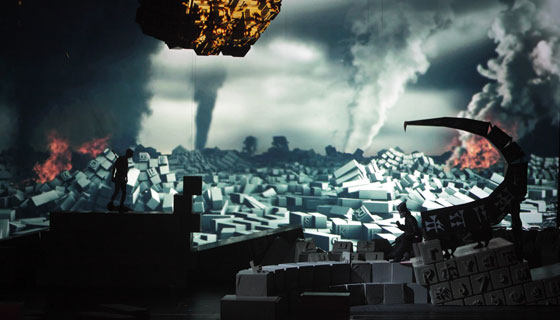
Babylon relates back to Biblical times and ancient Mesopotamian mythology, to human sacrifice practiced by the Babylonians and the repudiation of it by the Jews, to the destruction of the walls of Jericho and the founding of urban civilisation.  Central to the work then, with its invocations of the mystical number seven, is the formation of order out of chaos, an order associated with numerology that is reflected in the establishment of the seven days of the week.  It's a love story that is both the cause of the chaos that ensues as well as what brings about redemption and order.  Widmann's opera opens then with a prologue showing a scene of apocalyptic devastation, a scorpion man walking through the ruins, before the Soul arrives to open up the first of the opera's seven scenes, mourning the loss of Tammu, a Jewish exile living in Babylon who has fallen in love with Inanna, a Babylonian priestess in the Temple of Free Love.


The visions of chaos and destruction continue unabated as Tammu lies with Inanna, and is awoken through love and some herbal induced visions - the seven planets and even the Euphrates itself bearing testimony - to the truth that their world is founded on chaos that the Gods have unleashed upon the universe.  (Mozart and Schikaneder's The Magic Flute is obviously drawn from the same sources - Tamino and Pamina recognisably relating to Tammu and Inanna).  It's this chaos that the Babylonians hold at bay through human sacrifice, a "truth" that is hidden by Ezekiel in his teachings of the Jewish law and the stories of Noah and the flood.  When Tammu is chosen as the next human sacrifice however and is executed by the High Priest following the New Year celebrations, Inanna joins with the Soul in her lament for his loss.  Inanna pleads with Death to allow her to journey to the Underworld to bring Tammu back.

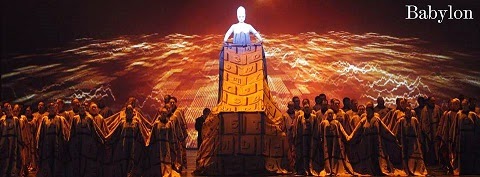
Undoubtedly the most striking thing about Babylon is the direction of this vast undertaking by Carlus Padrissa of La Fura dels Baus, with its spectacular production designs by Roland Olbeter.  Every element of the ambitious libretto, with all its mystical symbolism, dreams, visions and mythology, is presented in visual terms that aren't merely literal, but connect on an intimate level with the music and the concepts wrapped up within it.  In its seven scenes (with a prologue and an epilogue) a Tower of Babel is erected and destroyed, the seven planets appear during Tammu's visions, the River Euphrates is personified as well as represented by a stream of words and letters that flood and overflow, seven phalluses and vulvas appear with seven apes during the New Year celebrations, flaming curtains give way to sudden downpours during the sacrifice of Tammu, and Innana wades through a seething mass of (projected) bodies, discarding seven garments (a dance of the seven veils), as she journeys into the Underworld.  The stage is never static, there's an incredible amount going on, with extraordinary detail in background projections, processions, with supernumeraries in all manner of costumes and guises.


Babylon is therefore, opera in its purest sense.  The music and singing alone don't stand up on their own, the spectacle alone isn't enough, but the work needs each of the elements of the libretto, the music, the performance and the theatrical presentation to work together and in accord to put across everything that is ambitiously covered in the work.  Widmann perhaps takes on too much across its great expanse of scenes and musical styles - cutting suddenly between twelve-tone dodecaphony, jazz, cabaret and Romanticism - to the extent that it can feel episodic and difficult to take in as an integral and consistent work.  Babylon however has a solid foundation in its subject, in Kent Nagano's marshalling and conducting of the orchestra of the Bayerische Staatsoper, in Padrissa's impressive command of the visual elements, and in Anna Prohaska's extraordinary performance as Innana that goes beyond singing.  Babylon is opera in the purest sense also in that it undoubtedly needs to be experienced in a live theatrical context in order for its full power to be conveyed.  On a small screen, viewed via internet streaming, the rich scope, scale and ambition of the work were nonetheless clearly evident.

Friday, 12 October 2012

Gluck - Orfeo ed Euridice


OrfeoChristoph Willibald Gluck - Orfeo ed Euridice
Festival Castell de Peralada, 2011
Gordon Nikolić, Carlus Padrissa, La Fura dels Baus, Anita Rachvelishvili, Maite Alberola, Auxiliadora Toledano, Aline Vincent
Unitel Classica - C-Major
As an avant-garde experimental theatre group, continually expanding their techniques using the modern technology available, La Fura dels Baus don’t exactly do opera in a way that is respectful of tradition. With modern works that are less than respectful of the opera tradition itself - Weill’s anti-opera Rise and Fall of the City of Mahagonny or Ligeti’s anti-antiopera Le Grand Macabre - this can be a good thing, but it’s more questionable when applied to the works of reformist composers who had very specific ideas and theories about the nature of opera as drama. With the grand works of Wagner, on the Ring cycle and even with something like Tristan und Isolde, there is perhaps more scope for a more ambitious conceptual approach, but can the extravagant modern techniques and projections employed by La Fura dels Baus really be appropriate to a work as intimate and intentionally stripped-back to basics as Gluck’s Orfeo ed Euridice?
Orfeo ed Euridice was indeed the first of Gluck’s reformist works, but it would only really be in its later French incarnation Orphée et Eurydice (alongside the composer’s other important French operas Alceste and Iphigenie en Tauride), that many of the mannerisms of the Baroque opera seria were dropped. Gradually, Gluck’s works would forego the use of the harpsichord, ballet music, mechanical stage effects, recitativo secco, extravagant aria da capo singing or indeed any decorative effects that didn’t serve the progression and meaning of the drama alone, but some of these elements still remain in this first version of Orfeo et Euridice, the Vienna version from 1762. Still, it would seem to go against the spirit of a work that only has three principal roles - and the majority of it sung by only one person - to stage it as extravagantly, colourfully and spectacularly as it’s done here, using every technological tool available - projections, computer generated lighting effects, singers hanging from cables above the stage - as well as making every effort to fill the ample outdoor stage of the Castell de Peralada not only with chorus and supernumeraries, but even putting the orchestra up there on the stage as well. This surely wasn’t what Gluck intended.
Well, that depends on whether what is up there on the stage enhances the work or detracts from it, and while Carlus Padrissa goes a little overboard on special effects - he’s rather too fond of hanging singers above the stage from cables for my liking - it seems to me (as someone who holds this work in its varied incarnations in very high regard as one of the greatest works in all of opera) that everything works nonetheless in perfect accord with the music, the singing and the dramatic intent of the original work. There’s no reason why spectacle and dramatic purpose can’t co-exist. While Cupid might swing down a cable to a position above the stage then (a stunt-double is used while Auxiliadora Toledano sings off-stage), it can be seen as appropriate to elevate the messenger of the gods above the mortals below. Perching Orpheus on top of Eurydice’s stone monument could also be seen as being a little over-the-top, but the use of the same block as a tombstone to chart his descent into Hades and his ascent out of it with Eurydice, is also a relatively simple but highly effective image. It’s in the depiction of the dark fiery landscapes of Hades, the assembled masses of Furies, shades and spectres, the serene beauty of the Elysian fields and the visions of the Blessed Spirits however that the director’s vision most impressively rises to the challenges in the score with some inventive techniques, projections and lighting effects that work hand-in-hand with what the music and the drama are telling us.
The orchestra, dressed in unflattering skin-tight body suits sitting in small individual pits on a stage that is tilted towards the audience, play their part in this too. Their position leaves only a diagonal space for the funeral procession of Eurydice in Act I, which makes it look like Padrissa is simply just trying to just fill the stage and keep it visually interesting, but they also get up and move around, playing at the same time, during Act II’s descent of Orpheus into Hades. It may not be what Gluck had in mind exactly when he set about making music serve a purely dramatic function, but one could argue that the music of Orpheus does indeed have a function in fending off the Furies, and highlighting that element in visual terms is a valid technique. It is at least not just some random concept that distracts from the meaning, but is clearly one that comes from paying close intention to the drama itself, and seeking to find the best way of illustrating it. Much like Gluck did when composing the work 250 years ago, La Fura dels Baus’ production represents the same kind of modernisation of stuffy theatricality and musical academicism that the composer was reacting against, showing that opera is capable of being the most invigorating of theatrical experiences.
Whether Gluck’s score really needs all this spectacle, or whether it isn’t more than capable of being perfectly expressive in purely musical and more traditional dramatic terms, is of course debatable. I’d be less inclined to look favourably on this production if the spectacle detracted from the musical and singing performances, or if it was weak in those areas, but fortunately this is a superb account of the 1762 Orfeo ed Euridice. It’s not ideal of course to have the conductor Gordon Nikolić wandering about on the stage, leading as the first violin, and there are some minor lapses in timing when the singers don’t have visual contact with the pit, but for the most part the music, the singing and the drama all come together marvellously to pure dramatic effect to express the full power of this remarkable work. Considering the challenges then, the singers perform admirably. Anita Rachvelishvili carries the burden of the work as Orpheus well, correctly focussing on the delivery of the singing here - which isn’t always easy - and letting the score and the staging carry the dramatic intent and nuance. Maite Alberola is a powerful Eurydice, working well with Rachvelishvili dramatically and musically in their combination of voices. Auxiliadora Toledano has a wonderful brightness of tone that serves well in her role as Cupid and messenger from the Gods.
I’ve been critical of Carlus Padrissa in the past (notably for the misguided concept in the La Fura production of Berlioz’s Les Troyens), but it’s evident here from the scale that this Festival Castell de Peralada production of Orfeo ed Euridice is intended - as it should be - principally for the audience in the theatre. This presents some difficulties for the video director Tiziano Mancini, who is forced to resort to some extreme angle post-production on-stage shots, editing effects and cross-cutting, but by and large, it gets the full impact and the dynamism of the stage production across well on this Blu-ray release. The HD video transfer is superb - colourful and pinpoint clear, with good sound reproduction in PCM stereo and DTS HD-Master Audio 5.1. The BD is all-region playable, with subtitles in Italian, German, English, French, Spanish, Chinese and Korean.

Monday, 10 September 2012

Ligeti - Le Grand Macabre


MacabreGyörgy Ligeti - Le Grand Macabre
Gran Teatre del Liceu, Barcelona, 2011
Michael Boder, Àlex Ollé, La Fura dels Baus, Valentina Carrasco, Werner van Mechelen, Chris Merritt, Frode Olsen, Ning Liang, Barbara Hannigan, Brian Asawa, Inès Moraleda, Ana Puche, Francisco Vas, Simon Butteriss
Arthaus Musik
Although it may be one of the most popular works of contemporary opera, you aren’t going to see too many productions of György Ligeti’s only opera, Le Grand Macabre due to its demanding nature and its limited appeal to a rather specialised opera audience. So when the Liceu in Barcelona (with La Monnaie in Brussels and the ENO in London) decide to put on a rare production of the work and go as far as to make a world premiere video recording of it, you can be thankful that the challenge of finding an appropriate look for the all-important visual representation of this work has been given to La Fura dels Baus, the experimental Catalan production team perhaps most in tune with such an unusual work and capable of relating to its status as an “anti-anti-opera”, which is not quite the same thing, as you might imagine, as just an opera.
Le Grand Macabre most certainly isn’t “just” an opera, but it is one that fully exploits the full range of dramatic, musical and singing opportunities for expression that the medium is capable of. Often dissonant and cacophonic, it’s not however unmusical and indeed is made up of quite expressive musical passages and “quotations” that draw from a wide range of classical influences that demand a certain musical virtuosity, creating a complex soundscape of musical language and sonic textures. The singing in particular is extremely demanding, full of flourishes and vocal gymnastics in near-impossible tessitura. The difference between Le Grand Macabre and this kind of musical expression in other Ligeti compositions lies however in the visual and dramatic nature of opera, which is equally if not even more important for this particular work, and in that respect this extraordinary production, spectacularly imagined and directed by Àlex Ollé of La Fura dels Baus with Valentina Carrasco, enables the viewer to experience the work in its fullest expression.
Based on the play ‘La balade du Grand Macabre‘ by Belgian playwright Michel de Ghelderode, quite what the opera is an expression of however can be rather difficult to determine from the playful wordplay, gross vulgarity and nonsense dialogue that makes up most of its libretto. Like the musical accompaniment however, the tone of the words and the highly expressive delivery of them all serve to add to the sonic picture of its depiction of the imaginary Breughelland, with all the grotesque characterisation and the end-of-times connotations for our own reality that the name suggests. In the midst of all the absurd, lascivious, perverse and violent activity of the characters on the stage however, the main narrative thread is clear enough when Nekrotzar, the Grand Macabre, arrives in Breughelland and announces to Piet the Pot that the end of the world is nigh. The moral, when this prediction is proved to be false, is made clear at the end and delivered in traditional operatic fashion - face fear and it will pass, enjoy life without worrying about death or putting your faith in those who would claim to know better acting as guides and leaders.
All men on earth must perish” - even Piet the Pot knows that, “…but no-one knows the hour“, Nekrotzar, tells him. Àlex Ollé appropriately seems to choose to set the production of the Liceu’s Le Grand Macabre indeed during the few seconds preceding the imminent death of an overweight woman - seen in a short video introduction - who has enjoyed the excesses of a Big Mac-abre junk-food feast and is lunging for that last pizza slice when she suffers a heart attack. A huge model of this woman in her death throes dominates the stage, her face contorted in agony, those final moments and the excess that has clearly been part of her life, drawn out and encapsulated within the surreal and nightmarish situation depicted by Ligeti through the operatic medium. The huge splayed naked body revolves 360-degrees between the four scenes of the two acts and is clambered over and dissected in a disturbing fashion, with a wiggling tongue, detachable nipples and other moveable parts and orifices that the characters delve into and appear from. Costumes too are cleverly designed to suggest body parts, organs and musculature. Technically, with the impressive use of projections, it’s a theatrical tour-de-force by La Fura dels Baus, but more than just spectacle, it’s a brilliant interpretation that adds further levels of resonance and involvement to a work already quite rich in symbolism and suggestion.
I don’t think this work could be performed in any other way than with complete abandonment of any sense of propriety or dignity - and perhaps even comprehension - but it does demand extraordinary discipline on the part of the singers and commitment to the unusual methods of expression that Ligeti resorts to. The English diction isn’t always perfect here with some of the Spanish members of the cast, but it’s hardly the most important consideration. That’s not a problem for Barbara Hannigan, but her challenges lie elsewhere in the vocal exertions that are demanded from her in the roles of Venus and Gepopo, the Chief of Secret Police. She not only handles these with astonishing facility, but also with verve and character, as difficult as the roles must be to play. Similar commitment and flights up and down the vocal range are called for from Chris Merritt as Piet the Pot and Frode Olsen as the Astronomer Astradamors, but really, there isn’t anyone in this cast who doesn’t impress on a number of levels in how they rise to the challenges presented by this work.
Le Grand Macabre is still a rather demanding work that can be loud, vulgar and disorienting in its absurdity and nonsense, not seeming to have anything particularly enlightening to reveal for all the effort that is required to view and listen to it, but this is all undoubtedly an essential part of what the work is about. As an anti-anti-opera, it does seem to work both within the framework and as a reaction to the original anti-opera inclinations of Kurt Weill and Berthold Brecht, exploring similar field of the baseness of human impulses that can be found in Rise and Fall of the City of Mahogonny (also impressively produced by La Fura dels Baus recently at the Liceu and also available on DVD and BD), not in any elevated or theatrical manner, but in a way that revels in and supports the basic (or base) intents that lie at its heart. This production and its performance at the Liceu in Barcelona can hardly be faulted for the imaginativeness of its vision, the boldness of its interpretation and the technical brilliance of its presentation.
Undoubtedly a production that it would be better to experience live in the opera house, Le Grand Macabre nonetheless comes across very well on the small screen. It’s very well filmed to focus on the details of the performance, while keeping you in mind of the larger picture that, in any case, would be hard to ignore. The quality of the High Definition Blu-ray transfer is excellent, the 2-hour work fitting comfortably onto a single-layer BD25 disc, the image quality near-flawless, handling the darkness of the stage lighting well. The audio tracks are a vital aspect of the whole experience and they come across well in both the PCM Stereo and DTS HD-Master Audio 5.1 mixes. The BD also includes a good in-depth conference-style Making Of feature that has all the key players in the stage production discussing the development of the ideas, influences and technical considerations behind the concept, and an interview with Michael Boder on the musical side of things. The BD is all-region, full-HD, with subtitles in Italian, German, French, Spanish, Korean and Catalan.

Saturday, 5 November 2011

Weill - Rise and Fall of the City of Mahagonny

Kurt Weill - Rise and Fall of the City of Mahagonny
Teatro Real Madrid, 2010
Pablo Heras Casado, Alex Ollé, Carlus Padrissa, La Fura dels Baus, Jane Henschel, Donald Kaasch, Willard White, Measha Brueggergosman, Michael König, John Easterlin, Otto Katzameier, Steven Humes
Bel Air Media
When it was originally composed in 1930, Kurt Weill and Bertolt Brecht intended Rise and Fall of the City of Mahagonny (Aufstieg und Fall der Stadt Mahagonny) to be as much a satire of opera and a reaction to the state of the Weimar Republic. Now, when taken alongside such like-minded contemporary works by Hindemith and Berg, it just sounds like great opera – but it still functions as a scathing satire on all the subjects it deals with, particularly the nature of capitalism, on which it still has very relevant points to make.
You can call it music theatre if you like, but Weill’s score for Rise and Fall of the City of Mahagonny is considerably more sophisticated than that, working in a variety of styles to create a deliberate alienating effect, drawing on specific references, creating dissonance and unsettling arrangements, using unexpected plot points to keep the listener engaged and keep them from complacently and unquestioningly accepting operatic conventions. It does all that and it has great tunes as well, the most notable of which, Alabama Song, sung by down-and-out prostitute Jenny Smith (”Oh, show me the way to the next Whisky Bar“), is almost like the flip-side of the Libiamo sung in celebration at the party of La Traviata’s courtesan, Violetta Valéry.
If you need any convincing that Rise and Fall of the City of Mahagonny can aspire to great opera however, this 2010 production at the Teatro Real in Madrid, directed by La Fura dels Baus might be just the ticket. I’m not the biggest fan of La Fura – I’ve seen several of their productions fall well short of the mark – but when they get it right and are working with the right kind of material, they can succeed in a spectacular fashion. Their unconventional approach to opera staging, which could even be considered anti-theatre, certainly has a Brechtian influence, so it’s no surprise to find that that the Catalan group are absolutely perfect for this particular work.
Directed by Alex Ollé and Carlus Padrissa, there are no projections this time – other than the titles of each of the sections (in Spanish here, not translated on the screen) – no elaborate designs, no wire acrobatics or off-the-wall concepts. Everything is tailored directly towards the expression of the ideas in the work, finding the most imaginative and impactful way of putting it across, without relying on stagy conventions. The decision then to have the the trio of Widow Begbick, Fatty and Trinity Moses arrive as if dumped from a refuge collection and set about founding the City of Mahagonny on the edge of a rubbish dump is perfect for the nature of their intentions to make as much money as cheaply as possible by appealing to the lowest nature of their visitors, offering them booze, girls and boxing.
It’s important to get the basic concept in place, but the directors find the right tone for each scene, with many wonderful little touches – from Jimmy’s imagined return sea journey to Alaska with the raised legs of the hookers forming the waves, to his trial taking place in a circus ring – all of which give an additional satirical edge that not works along with the material, showing an understanding of its nature, its playfulness and its bitterness, without feeling the need to over-emphasise or add on any additional commentary. The opera is satirical of all these subjects – from the expectations of the individual to the concept of justice – all within the umbrella of the capitalist system, and it doesn’t need any specific or easy-target anti-American agenda attached for the concept to stand on its own and be applied by the listener to their own experience of the system.
I’m not sure why it was chosen to use the US revision of the original opera, singing it in English and changing Jimmy Mahoney to Jimmy MacIntyre, particularly as there are a few native German speakers in the cast here and others, like Henschel, have a strong footing in German opera. If it’s another attempt at alienation effect to keep the audience guessing, then it works here. Most importantly however, the casting and singing is superb. Jane Henschel is superbly capable in the whole range from singspiel-like dialogue to more conventional opera singing, as well as being a fine actress in the role of Widow Begbick. Jenny Smith is an important piece of casting, and Canadian soprano Measha Brueggergosman makes an incredible impression, oozing sensuality and absolutely electric in her scenes with Michael König’s fine Jimmy MacIntyre. The balance right across the board in the other roles seems perfect, consistently hitting the right note, as do the Chorus of the Teatro Real, who give their all in the scantiest of costumes and in the most… well… indelicate situations. One can’t fault the commitment either of the Madrid orchestra under Pablo Heras Casado.
I don’t know if it’s to do with the encoding, but Bel Air releases often look a little juddery in motion on both my Blu-ray set-ups (most evident here when the Spanish captions move across the screen), and can lack definition in the darker scenes. I haven’t heard anyone else mention any issues with previous releases, so perhaps it’s specific to one’s set-up. Generally however, the image is fine, and even if movements aren’t smooth, I didn’t find it too distracting. The audio tracks, in LPCM Stereo and DTS HD Master Audio 5.1, are both fine, but there’s not much to choose between them. I found the PCM worked better using headphones to keep the sound focussed, and it’s very impressive this way. There are no extra features on the disc, and only a synopsis in the booklet.

Tuesday, 19 July 2011

Berlioz - Les Troyens


TroyensHector Berlioz - Les Troyens
Palau de les Arts Reina Sofia, Valencia, 2009
Valery Gergiev, Carlus Padrissa, La Fura dels Baus, Lance Ryan, Daniela Barcellona, Elisabete Matos, Gabriele Viviani, Giorgio Giuseppini, Stephen Milling, Eric Cutler, Oksana Shilova, Zlata Bulicheva
Unitel Classica - C-Major
In principle, I’m all for the approach and the use of new technology that the experimental Catalan theatre group la Fura dels Baus bring to opera productions. In practice however, I can never get past the dumb ideas that they sometimes base their concepts upon. Although I have avoided it myself, a lot of people like their Valencia Ring cycle, and I can see how their approach to total music theatre would work with Wagner (a recent production of Tristan und Isolde was handled very appropriately) – much as it suits, in principle, the dramatic theatricality of Hector Berlioz (they’ve done La Damnation de Faust in the past). In practice however, I’m afraid it just doesn’t work for me in the case of Les Troyens.
I’ve seen Mozart’s Die Zauberflöte destroyed by la Fura’s “concept” of the split in the hemispheres of the brain that could be seen as marking the divisions between enlightenment and obscurantism in that opera taken to the extreme of putting inflatable brains on the stage with the singers hanging suspended over them – a wooly concept taken over-literally that added nothing to Mozart (I won’t even get into them removing the recitative and replacing it with poems read out by French actors). The same sense of facile concept not thought-through in any meaningful way and taken over-literally applies also to the approach taken in this Fura production of Les Troyens. Thinking of the notion of a Trojan Horse in modern computer technology parlance, they apply the concept to the computer network of ancient Troy being the victim of a computer virus. Seriously.
What genius (that would be Carlus Padrissa) though it would be a great idea to take the metaphor of the Trojan Horse virus back to its source and make it literal? The phrase, “Beware of Greeks or other outside hostile agencies bearing gifts of laptops carrying viruses that may compromise the integrity of your system”, doesn’t really have all that great a ring to it. Even if you were to find this feeble concept worthy of more than a minute’s consideration, there’s little to support it in this staging, which is an impressive spectacle certainly (you are always guaranteed that at least from la Fura dels Baus), but it’s also a complete hotchpotch of ideas and concepts that look a complete mess and don’t come across particularly well on video. There’s little sense of and physical location of Troy in the first part of the opera (presented here in its entirety as originally intended as a 5-act opera, rather than two operas), but I suppose in this version it is supposed to be a virtual world. Quite why the cast are dressed in sports padding, hockey helmets, Tae kwon-do outfits and what looks like Stormtroopers costumes from Star Wars is however anyone’s guess.
Troyens
There are nonetheless impressively staged scenes mixing projections and live action – and inevitably, much wire work, hanging singers and acrobats from cables – which enhances the nightmarish visions of Cassandra and representing the death of Laco’on well in the first half. The idea of designing Carthage as a particle accelerator to represent the idea of a modern technical paradise in the second half of the opera (Acts III to IV) at least carries the concept through, the Trojans spreading their virus before leaving for an ideal (in Mars!) and it looks impressive – but really, does this bring anything meaningful out of the work, or is it just half-baked concepts and Cirque du Soleil spectacle? More often however, the spectacle doesn’t really come to life, failing to find anything meaningful to do in the ballet sequences – a boxing match? a fashion parade of warrior fetish costumes? – and it is actually quite static, particularly when compared to the active, inventive and always impressive production at the Châtelet.
Conducted by Valery Gergiev, the Valencia production at least remains hugely entertaining from a musical viewpoint, although I wouldn’t put it above the John Eliot Gardner version. The singing is mostly of a good standard, particularly the two female leads Elisabete Matos (Cassandra) and Daniela Barcellona (Dido), but again, personally, I prefer the performances of Anna Caterina Antonacci and Susan Graham in the Châtelet production. Gregory Kunde is however certainly a better Aeneas than Lance Ryan here, who I thought delivered everything in a dreary declamatory fashion and in a tone that becomes unpleasantly nasal on the high notes. His poor diction moreover painfully murders the French libretto.
The quality of the Blu-ray itself – the entire opera on a single BD50 disc – is reasonably good, the image as clear as it can be on a dark stage that uses a lot of back and front-screen projections. The audio tracks – PCM stereo and DTS 5.1 HD master audio – are both fine, if there is little to choose between them. Overall, if you don’t think too much about the terrible concept and are able to simply just enjoy the spectacle of the staging, this isn’t a bad version of Les Troyens, and it’s certainly well performed – but there is a much better version out there already on Blu-ray in terms of production values, spectacle and overall quality of the performance.