Showing posts with label Teatro Real Madrid. Show all posts

Monday, 13 October 2025

Donizetti - Maria Stuarda (Madrid, 2024)


Gaetano Donizetti - Maria Stuarda

Teatro Real, Madrid, 2024

José Miguel Pérez-Sierra, David McVicar, Lisette Oropesa, Aigul Akhmetshina, Ismael Jordi, Roberto Tagliavini, Andrzej Filończyk, Elissa Pfaender

ARTE Concert - 20th December 2024

For the little that they reflect reality, there doesn't seem to be any compelling reason to stage a historical opera in period setting and costume… etc. I started the last two reviews of the 2025 productions of Maria Stuarda at Salzburg and Budapest with that opening line and they both proved that point - I thought anyway - exceptionally well. There is indeed no compelling reason to present this opera on the modern stage in a mid-16th century period context: not unless you are a fairly reactionary opera director like David McVicar. Sorry, Sir David McVicar. Even then, I'm not sure what historical value a director can find interesting in an operatic dramatisation of a royal dispute that took place 500 years ago. 'Wolf Hall' this is not.

But on the basis that there are many who love a period drama, one with elaborate opera costumes and sets and yet still get to the emotional heart of a work, David McVicar is your man. If you are going to present a British royal drama in a historical context to a Spanish audience however, you are going to need to provide a little more in the way of background to the rationale and plotting behind Mary, Queen of Scots being arrested, imprisoned and executed in 1587 in a dispute with Elizabeth over the claim to being the rightful Queen of England. This is covered in a brief preface to the synopsis in the programme for the audience at the Teatro Real, but for the purposes of François Roussillon's version recorded for TV and DVD, the key events of the background to Maria Stuarda are detailed in a filmed sequence during the playing of the overture.

Director David McVicar used to be a bit more adventurous in his productions, sticking closely to the original setting and not imposing some grand concept on a work, but he would often mix it up a little - and still does. Even his previous production of Maria Stuarda for the Met in 2013 was a little more stylised than this latest production for the Teatro Real in Madrid a decade later. So while the costumes are fairly authentic to the period and the principal singers are all made up to closely resemble the historical figures they are meant to represent, McVicar tries to ensure that the spectacle at least matches the grand tone of the opera: the regal grandness, that is, of the two central queens who dominate above everything else.

For the introductory scene to the court of Elizabeth then, a huge royal orb hanging over the stage against the backdrop of a carved wall is all that is needed to suggest power and influence. That and a Queen Elizabeth who takes to the stage and dominates everything else through her pronouncements, but traditionally mainly through her vocal delivery. The reliefs on the wall however are all of ears and eyes, "Lower your voice within these walls", The Earl of Leicester tells Talbot when he mentions she-whose-name-must-not-be-spoken in the presence of Elisabeth. The suggestion - a fairly obvious one of course, but worth drawing attention to all the same - is that the Queen had eyes and ears everywhere and the punishment for treason and treachery is severe. This is typical of the McVicar aesthetic, making it feel authentically period, capturing the tone and mood of the situation and making a few bold gestures to that effect.

A bold statement perhaps, but in comparison to the two other productions of Maria Stuarda this year that I have seen, the period glamour in thrall to historical period detail means it is also the least spectacular, the historical detail detracting from the focus of where the real heart of the opera lies. That's a subjective view admittedly, and others might see it differently. Within this there is still room for bold statements and the director feels no obligation to follow directions of the libretto to the letter for each scene. The prison park where Mary is held is a wide platform with a background a huge splash of blood-like red, the overhanging orb of royal authority feeling oppressive here. Red leaves fall and scatter on the ground like spots of blood, anticipating the conclusion rather early, although to what purpose at this stage isn't clear, other than pointing to the inevitability of the conclusion to this dispute.

As with those other productions, and indeed any production of this opera, much rests on the chemistry between the two queens and perhaps Leicester plays an important factor in that as well. But again direction is important, and here we have the opportunity to compare how Lisette Oropesa fares under McVicar's direction as opposed to Ulrich Rasche's at Salzburg. I don't think there is any question that the stylised pacing and supernumerary support of the Salzburg carries more of the personal inner life than the operatic soprano mannerisms Oropesa is left to deliver to the audience here in Madrid, involving a lot of eye rolling and swaying, with hands held out in supplication (I'm reminded of the same in McVicar's direction of Sondra Radvanovsky in the 2022 Met production of Cherubini's Medea.

Other arias are similarly delivered outward, each often turning away from the person they are addressing to sing to themselves, the audience and the camera. McVicar clearly doesn't want to stray too far from convention and the expectations of the Spanish audience at Teatro Real, which sadly no longer has the creative experimentation of Gérard Mortier. (Yes, perhaps a minority view that one). There is definitely something to be said however for the Salzburg production internalising emotions and still delivering powerfully but, to make a cultural generalisation, perhaps the tone adapted is one that plays to the character of the audience. There may be something about meeting the expectations of the Spanish audience, who indeed have their own monarchy and may find the execution of a Catholic Queen by the Protestant ruler historically significant, albeit 500 years ago.

I think it does a disservice to try to treat this opera 'realistically' as a period costume drama. Yes, it can be just as effective as an opera experience, McVicar's handling of mood is excellent and for all that conventionality the scenes are all fully in the character of the high operatic drama. There is clearly more depth that can be explored in the motivations of the characters however than in trying to find some accommodation between historical records, Schiller’s dramatisation and the libretto that Donizetti works from. All you get is opera and opera dramatics, when those contrasting viewpoints, not to mention the contrasting experiences and worldviews of Mary and Elisabeth as rivals - and more than just opera rivals - is a subject worth exploring in more detail, without necessarily having to find any contemporary resonance.

Lisette Oropesa pulls out the regal and human emotional stops in the preghiera impressively in the closing scenes. The Earl of Leicester you can leave aside for any significant personal role in the drama other than being a foil for the enmity that lies between the two women rivals. It's a good tenor role nonetheless and well sung here by Ismael Jordi. Aigul Akhmetshina's Elisabetta doesn't have the same vocal authority that the role and the formidable costume that comes with the position demands, but is a great presence nonetheless and sings well. Again you can make allowances for interpretation and how you want to treat the role as having a degree of vulnerability and insecurity. Personally I felt that the conducting and performance of the score under José Miguel Pérez-Sierra was also a little too smoothly 'Classical', lacking in fire or character. Sadly, in that respect, it was a match for McVicar’s direction. The Madrid audience loved it.


External links: ARTE Concert, Teatro Real

Monday, 26 May 2025

Mozart - Mitridate, re di Ponto (Madrid, 2025)


Wolfgang Amadeus Mozart - Mitridate, re di Ponto

Teatro Real, Madrid, 2025

Ivor Bolton, Claus Guth, Juan Francisco Gatell, Sara Blanch, Elsa Dreisig, Franco Fagioli, Marina Monzó, Juan Sancho, Franko Klisovic

OperaVision - 4th April 2025

There are limits to expression in 18th century opera seria, even for Mozart, who was only 14 years old when he wrote Mitridate, re di Ponto in 1770. Even with the long flowing arias where each of the figures pour out their hearts, it's within the context of generic feelings and expectations, the arias capable of being lifted and inserted seamlessly into other works; which was often the case, and borrowing is still common practice when rediscovering and recreating lost works of early opera. The main action tends to play out off-stage, only referred to in-between in the recitative, and in the case of Mitridate, re di Ponto - based on an Italian language adaptation of Racine's play Mitridate - the context is the war between Pompey's Roman army and King Mitridate of Pontus around 63BC.

Not that you'd get any real sense of that from Mozart's opera or the libretto written by Vittorio Amedeo Cigna-Santi. The events of the war remain in the background, the focus instead on the impact - or opportunity - that the war presents to the main characters of the opera. With King Mitridate believed to have been killed by Pompey, his sons Farnace and Sifare, both from different mothers, seek to consolidate their own position. Farnace, the elder, plans to seek an alliance with Rome, his only use of force being applied to his father's fiancée Aspasia to be his Queen. Sifare is in love with Aspasia, and the feelings are mutual. Mitridate however is not dead, the news of his death a ruse to find out the truth about his sons, and indeed his wife to be.

The plot then is somewhat contrived, but the purpose is indeed to contrive a situation where truth can be brought out into the open, where human feelings can be freely expressed, the war less important really than the personal battles even if it is merely in the context of domestic rivalry, jealousy and assertion of dominance. Essentially though, the opera is primarily an excuse or opportunity to give singers the opportunity to shine and show their range and talent, and there is a challenge - particularly in a modern production - to try to keep those emotional expressions within the realm of true human feelings. That's not easy considering the setting, the plot and the larger than life characters, but of course much depends on the inventiveness of the musical setting and that's perhaps easier to find in Mozart's music.

Mozart's early works of opera seria have languished along with many of his youthful works for this reason. Limited by the conventions of the style, there is little apart from the prodigious talent of the age of the composer to set them apart from other works of the period. Mozart would find ways to place his own stamp on the opera seria format as a mature composer in Idomeneo (1780) and advance it in La Clemenza di Tito (1791), but even the earlier works have echoes of the brilliance of those later works and that can be brought out by a sympathetic production.

Mitridate is not one of those great Mozart operas. Brilliant certainly, incredible as the work of a 14 year old composer, but to really appreciate its qualities, you need more than a static opera seria production, and you really need to pull it out of the historical period, which is little more than a pretext really for the human drama. You won't get a static production from Claus Guth, and you won't get robes and togas or ruined temples. The crux of the drama, needless to say, would be more familiar to a modern audience who has seen Succession. I haven't but I expect most people have, and as such they would immediately recognise the setting and the subsequent battle for wealth and power in Mitridate in the absence of love and respect.

The whole of the opera (or at least half of it) takes place in a modern 'palace', a luxurious mansion. I'm not even sure how much the average person could relate to this Succession-like situation as a common family drama - Guth includes a silent servant who looks on the whole affair disapprovingly - but, as has often been established through the history of opera, everyone is capable of experiencing and indeed denying human feelings. If the incestuous situation played out here between an ancient ruler of a kingdom and his sons and a conspiracy with one of them to side with Romans is not everyone’s experience, the sentiments of love, lust, jealousy, trust, betrayal, repentance and forgiveness are more familiar, and they can indeed lead to tragic outcomes.

That would be very much within the enlightened view of Mozart, certainly more so in his greater works, but Mitridate, re di Ponto gives the young composer an early opportunity to explore those sentiments. At this stage it's very much a male power-play, although the assignment of roles of the sons to alto castrato (Farnace) and soprano castrato (Sifare) makes that a little more ambiguous, certainly when cast now as countertenor and soprano trouser role. Aspasia, the Queen, certainly has little to show in the way of personality in the early stage of the opera other than resisting the aggressive advances of Farnace, seeking help of his brother Sifare, unaware that he has deep feelings for her. Wait until their father gets home. Believed dead after battle with Pompey hence his sons’ rather inappropriate advances on their prospective mother, Mitridate is actually alive and on his way, having faked his death so that he could observe the ambitions of his sons revealed.

While it seems a little shallow of purpose and characterisation, all these roles can be given greater depth with good singers and adequate direction. If you have that, it makes it much easier to see how much Mozart's music contributes to their definition and expression. You can't argue with the likes of countertenor Franco Fagioli as Farnace, and soprano Elsa Dreisig as Sifare. Both singers put a stamp on the personalities of the two sons even within the generic characterisation, and Mozart's musical description can be seen as contributing to that; blustering defiance and lust on the part of Farnace, guilty desire and wary lack of confidence on the part of Sifare. Even the music for Aspasia, as sung superbly here by Sara Blanch, shows the conflict that rages within her over the actions of the sons and the doubts about her feelings for Mitridate. The opera is blessed with such wonderful vocal writing for all the roles, with no bass, baritone or even mezzo-soprano roles. Juan Francisco Gatell fills the typical sweet high Mozartian tenor as Mitridate, Marina Monzó an impressive Ismene, and even the roles of Marzio (Juan Sancho) and Arbate (Franko Klisovic) have something to contribute in terms of range of voice and character. 

While the setting of the opera doesn't call out for any dramatic scene changes, director Claus Guth typically tries to delve a little more deeply the sentiments of the characters and relate them to the psychological impact that the situation has on them. The 'shadow side' of the opera takes place behind the living room in a colander-like environment and it's here that the characters mostly take their interior monologue arias where grapple with their feelings and fears. Mitridate, back from the 'dead', is shown dealing with his own mortality in his first scene with a double and black masked figures, and he struggles in a shadow play struggle with a double of his unfaithful son Farnace lusting after Aspasia. Sifare grapples with his feelings for multiple aspects of Aspasia being stolen by dark figures and Aspasia expresses her conflict between duty and love. Farnace, it appears, doesn't have a conscience; his demons haunt him in the 'real world'.

These elements don't really need such separation or elaboration, but it does at least make the opera a little more interesting visually and shows that the real drama takes place on a purely psychological level. Considering the solipsistic nature of the arias, with there being little direct confrontations or expression in this opera through duets or ensemble pieces - even 'conversations' feel one-sided - there is a good rationale for this. Guth however recognises that there is a gradual overlap between the interior and exterior worlds as the opera comes to a resolution as the characters gradually come to an accommodation with their inner lives and, remembering that this is supposed to be about a war-time situation, recognise the true enemy is Rome for the defiant ensemble finale. 

I haven't heard Ivor Bolton conducting for a while (the last time indeed was Idomeneo in 2019), and here as musical director at the Teatro Real, it's always a treat to hear him conduct works from the Classical and early Classical period with sensitivity and drive. You can easily get a little tired of the opera seria conventions and repetitions, but here Bolton never lets you forget that you are listening to the music of Mozart. If it's not always original, Mozart's music in Mitridate, re di Ponto feels well suited to every situation and does have those flashes of brilliance, rhythmic drive and dramatic intensity, but with a lightness of touch that offers hope for these unfortunate figures to escape from the darkness of their personal torments. Musical direction and stage direction successfully working then working hand-in-hand then with fine singing from the entire cast, this is surely all you want from an early Mozart opera.


External links: Teatro Real, OperaVision

Thursday, 14 July 2022

Prokofiev - The Fiery Angel (Madrid, 2022)


Sergei Prokofiev - The Fiery Angel

Teatro Real de Madrid, 2022

Gustavo Gimeno,Calixto Bieito, Ausrine Stundyte, Leigh Melrose, Dmitry Golovnin, Agnieszka Rehlis, Mika Kares, Nino Surguladze, Dmitry Ulyanov, Josep Fadò, Gerardo Bullón, Ernst Alisch, David Lagares, Estibaliz Martyn, Anna Gomà

ARTE Concert - April 2022

Based on a Symbolist work by Valery Bryusov with autobiographical experiences that were shared to some extent by the composer, Prokofiev's The Fiery Angel is one of the most impressive and original works of opera I've come across. Musically and thematically it is quite unlike anything else in opera and each new production - although they aren't that common - always suggests new ways of looking at it. There have been some interesting perspectives taken on the work in recent years in Munich, Aix and Rome, but the idea of seeing what a director like Calixto Bieito can make of it is always going to be an intriguing proposition. It turns out that the Madrid production of The Fiery Angel doesn't seem to have a whole lot to say that is new, but the opera nonetheless remains fascinating, particularly with Ausrine Stundyte again taking on the mesmerising role of Renata. 

Sure, in some respects you can see Renata as a typical opera heroine abused and mistreated and misunderstood by the men in her life, her behaviour out of step with society around her, but in the case of Renata, there is indeed quite a bit to misunderstand. Not that her state of mind is any excuse for the abuse she endures or indeed the exploitation of her vulnerability, but fundamentally does seem to be the rationale for the irrational here. Because for whatever reason (there are hints and suggestions but nothing is made explicit), Renata is indeed not functioning on a rational level. Whether a victim of childhood abuse or suffering from schizophrenia, she has clearly been scarred by her childhood experiences, experiencing visions of a celestial being appearing in her bedroom, a fiery angel who becomes intimate with her.

This unfortunately sets her up to become a victim to be further exploited by the men she meets. She lets herself be taken in by Count Heinrich, who she believes is the angel Madiel in a corporeal form, and his eventual rejection only deepens her trauma. Even the noble knight, Ruprecht who comes to her aid in her distress, sees a vulnerable woman he can exploit sexually. His behaviours and actions are suspect, but when he is rejected he does at least try to consider his better nature and help, although it seems to be primarily because he is still fascinated by this extraordinary woman. With his assistance, Renata is exploited even further by charlatans and astrologers, as she tries to find a way to Madiel through occultism and mysticism. 

On one level then it is a familiar situation of a woman being exploited and shunned by a conformist society, leading her to seek answers elsewhere, but The Fiery Angel is also a work that seeks to explore the far reaches and complexities of human experience, Renata's journey being one to get in touch with a spiritual dimension or existence of life outside of the common experience. She has a sense of having touched on forbidden knowledge and seeks to press it further. For Ruprecht too, there is even a fascination for the mystery of a woman that Renata represents. She stirs up a riot of feelings that involve lust, compassion, fear, jealousy and possessiveness. Combined, The Fiery Angel is an exploration of human dualism, what it means to be human, a material physical being with a spiritual mind, mortal creatures with aspirations of an eternal afterlife. On an everyday level grappling with this dualism extends to male and female divisions, base instincts and a higher purpose, purity and corruption, subjective and objective realities.

In other productions by Mariusz Treliński at Aix-en-Provence and Emma Dante in Rome, the stage directors have sought ways to bring the otherworldly level of the opera expressed in the music to the fore, whereas Barrie Kosky's Munich production highlighted the comic absurdity. Calixto Bieito takes a surprisingly much more down to earth approach, seeing the opera very much as an opening into the mind of a woman rejected for not conforming to the expectations of society. It's even set (restricted I feel) in a specific period, the 1950s, before a more general liberalisation and a sexual permissive society. Initially we see Renata seeking mystery in the spinning of a bicycle wheel, creating patterns, the bicycle perhaps alluding to a childhood trauma. The set meanwhile consists of a block of compartments that, as occasional projections of Ausrine Stundyte as Renata illustrate, are representative of the idea that we are seeing into her mind.

Those rooms or compartments are mostly bare empty rooms, ready to be filled with horrors, each in their own little world, none of them connecting up to form any coherent view of reality. Significantly, perhaps rejecting any idea of a spiritual realm beyond physical reality, the few rooms that are decorated, the only lights in the darkness, are related to Agrippa von Nettesheim who in this version is less of a sorcerer than a physician, a man of science who is aware that we are still far from having all the answers. Her childhood bedroom, the source of her trauma, is also shown in all its horror. With an older man appearing, there is the suggestion of abuse by her father, who she looks up to. She sees Heinrich, an older man, as a substitute for her father, but inevitably that is a terrible mistake that only deepens her trauma. The tavern scene with Faust and Mephisopheles pushes Renata to her limits, and is quite disturbing in its own way. As she disturbs the community of nuns in Act 5, there are correspondences with Penderecki's opera Die Teufel von Loudun, which also featured Ausrine Stundyte in a recent Munich production.

Prokofiev, in a work long laboured over that he never saw performed in his own lifetime, strives to find similar expression in the music for the tangible and intangible, and it truly is a remarkable endeavour. The music is powerful and dynamic, sweeping between sensual and disorientating, evoking objective and subjective realities. I think its complexities came across better in the Rome production, but that might just be that the recording benefitted from superb High Resolution sound mix on the Blu-ray presentation. Here, conducted by Gustavo Gimeno, the detail isn't all there, nor the same dynamic shifts of tempo and volume.

Where the opera really comes to life however here in this Madrid production is in the singing performances. Once again - a revelation in the same role in Aix-en-Provence - we have a marvellous performance by Ausrine Stundyte. It's a role that has considerable vocal challenges but there are dramatic challenges too that require expression beyond the external, a requirement for Renata to be possessed of a deep and mysterious inner life. Bieito makes it physically challenging too and Stundyte is again impressive. Leigh Melrose is also excellent, his Ruprecht grappling with things beyond his comprehension and his own limited knowledge and experience. He brings that out in a similarly committed physical performance. 

The origins of the work and its Symbolist trappings leave a lot of room for analysis in The Fiery Angel, but it seems like the controversial Catalan director Calixto Bieito uncharacteristically seeks to demystify the work and restrict its possibilities. In his hands it does indeed boil down to familiar opera themes of a woman with unconventional individual behaviours being shunned by a closed society, moulded to conform and eventually destroyed by it. Prokofiev music suggests a wider context, but in that dialectic between the score and stage representation, the opera still works and weaves its fascination. Principally of course its real human level is expressed by the singers, and with prior experience of these roles, Stundyte and Melrose are thoroughly convincing.


Monday, 11 May 2020

Mozart - Idomeneo (Madrid, 2019)

Wolfgang Amadeus Mozart - Idomeneo

Teatro Real, Madrid - 2019

Ivor Bolton, Robert Carsen, Eric Cutler, David Portillo, Anett Fritsch, Eleonora Buratto, Benjamin Hulett, Oliver Johnston, Alexander Tsymbalyuk

Opus Arte - Blu-ray


With every new production, Idomeneo is proving to be one of the most exciting of Mozart's operas, and that's even when measured up against a catalogue of mature works where each and every one is a masterpiece. It's not just the number of productions that are elevating it comfortably into the canon of regularly performed Mozart operas - even if you don't rate it as great Mozart, this early work of youth is still head and shoulders above most opera of its century - but each production seems to find new depths in the work. Not only has Mozart created marvellously drawn, living, breathing people out of these Metastasian opera seria characters, but through them you can already see the enlightened ideas and themes that are there in his mature works. What is also amazing is how a work of Greek antiquity with a late 18th century score can still be so fresh and modern, its themes remaining relevant to the present day.

Robert Carsen certainly emphasises the contemporary relevance of the work right from the outset in the Teatro Real production by hitting you with an image that looks like it is straight off a TV news broadcast; a group of refugees clinging desperately to a wire fence that cages them in. Having suffered in a terrible war and displaced from their homeland, Ilia and the Trojan refugees wonder what harsher fate have the gods in store for them. If it's not exactly a new or original perspective on Idomeneo it's only because there's nothing new in such images repeated throughout history, but they still remain relevant and powerful, a scene repeated with depressing regularity.


Imagine a world where human love and compassion could inspire a leader to assist those less fortunate? Well, Mozart could imagine that the good in mankind would always win out over greed, jealousy and lust, where love triumphs and the dissolute are punished, where goodness its own reward. It's a theme that you can see consistently throughout his opera work right through to La Clemenza di Tito. It's one thing to imagine and believe in that but it's quite another greater thing to make it seem like a genuine possibility in the composition of music that expresses such emotions and intentions.

Robert Carsen knows that it's all there in Mozart's music, and with good singers to interpret it and a conductor sensitive to the rhythm, pace and dynamic of the score, Idomeneo speaks for itself. The Madrid production fares well on all those fronts, but it would be over-simplifying to say that Carsen does no more than throw out a few powerful iconic and emotive images. As with some of his more recent productions (Glanert's Oceane also in 2019) the director uses the full dimensions of the stage with projections of nature, sea and sky, raging seas and stormy skies to create a sense of wide open space in which an opera can truly breathe.

There are some strikingly realistic, powerful images used here. The horrors wreaked on Crete by Neptune's sea monster couldn't be any more devastating than the real life images of war torn Syrian towns used here, and it gives the work added authenticity and a sense of classic timelessness. The very Parsifal-like way the production is concluded is also successful, touching on the deeper truths to be found in mythology, how tyranny can be overthrown, how compassion and innocence will save the world and rebuild it anew.


There's not really enough however to carry the narrative though in an engaging way. There are a few spectacular projection effects that capture a sense of inner conflict and turmoil, but the uniformity of the military uniforms works against a stronger sense of character definition, and by making the people an army it goes against the idea of it being ordinary people suffering at the hands of higher powers. There's too much Duty and not enough Humanity. This is recognised in the conclusion to an extent when, the war ended, the uniforms are shed and the people are able to live as humans once again.

Although the singing is excellent there's also little in the way of character interpretation to give it more context and depth. Sure, it doesn't go for black and white the way other productions might in terms of painting Elettra and Idomeneo as misguided villains and Ilia and Idamante as the great young hope for the future, but there's room for finding nuance and highlighting the differences within those worldviews. Carsen's production looks great and it makes an important contemporary commentary but a work of opera seria like Idomeneo needs a little more focus on making the narrative drive more engaging. Even Mozart's opera seria.

There are moments when it comes together, particularly in Act III. Despite the staging of Idamante and Ilia social distancing amidst a beach full of life jackets, the love declarations of the 'Spiegarti non poss'io' duet between Anett Fritsch and Benjamin Hurlett is sung beautifully and accompanied by delicate playing from the pit. The subsequent quartet with Eric Cutler and
Eleonora Buratto is also superb, underling that the conflict is not an ideological one between tradition and progress, between being tied to a sense of duty and the freedom to make individual choices, but just four people and two sides that find themselves in a difficult and irreconcilable position. Buratto's final aria as Elettra is also marvellous. Ivor Bolton's handling of the very different dramatic and emotional tones is just superb.


What is also evident right from the overture is that Ivor Bolton is returning the work back to its historically informed period instrumentation, using harpsichord and slightly reduced orchestration that gives it a wholly different feel from the more classical sounding Idomeneo of Mozart. There is consequently a lighter spacious sound with extra delicacy and punch as it hits all the points in the dynamic range. Hearing Mozart this way is always a revelation and the score is lively and percussive in drive but opening up to reveal more detail and beauty in the scoring and playing of individual instruments. Bolton himself plays the recitative accompaniment.

The quality of the production comes across well on the Blu-ray release from Opus Arte, presenting a clear image with bold contrasts that helps bring out the impact of the staging. The PCM Stereo and DTS HD-Master Audio 5.1 mixes emphasise the dynamic of the historically informed instrumentation. The surround mix in particular gives a wonderfully spacious soundstage for the orchestration, the harpsichord pinging away throughout. The only extra on the BD is a Cast Gallery but the booklet insert has a tracklist, a synopsis and a brief overview of Robert Carsen's take on the opera. Subtitles are in English, French, German, Japanese and Korean.


Links: Teatro Real

Monday, 6 January 2020

Puccini - Turandot (Madrid, 2018)


Giacomo Puccini - Turandot

Teatro Real Madrid, 2018

Robert Wilson, Nicola Luisotti, Iréne Theorin, Raúl Giménez, Andrea Mastroni, Yolanda Auyanet, Gregory Kunde, Joan Martín-Royo, Vicenç Esteve, Juan Antonio Sanabria, Gerardo Bullón

France TV Culturebox


Robert Wilson's very distinctive and largely homogenous approach to set design isn't suited to every opera. Looking right back to Einstein on the Beach in 1976, it's clear that his style tends to work better with abstraction and ritual movements rather than with drama and narrative, but even working with Puccini or Verdi the effect of his unique style can be simply stunning in its use of light and colour and in its sheer visual splendour.

Not relying on any real-world situation but on a fantasy fairy-tale Turandot would seem better suited to the Wilson style, the opening Act alone of Puccini's opera being itself almost an abstract expression of living in fear and terror. In Turandot, Puccini was pushing his craft as a composer, exploring a new progressive direction for Italian opera, an endeavour that was unfortunately cut short with the death of the composer, Turandot itself remaining unfinished, its promise tantaslisingly unfulfilled.


That character is described well in Wilson's direction of that remarkable Act I of Turandot, the familiar luminous gradations of cobalt blue tending to darker shades, towards purple and shadow. The light of the moon casts an eerie light over the executioner and his next victim and over the people of Peking who live in fear of the terrible reign of Princess Turandot. After that build-up, her appearance on the stage is as striking as only Wilson's visual language can achieve, gliding in high above the stage on a platform, imperious, static, a fiery or bloody red against the cool backgrounds.

Wilson's stagecraft then is at once familiar as it is expressive to meet the specific demands of this particular opera. As well as extending the palette of colours considerably, there is also an expansion of the visual language Wilson traditionally employs, using beams of light that mark out the horizontal earthly boundaries of the stage as well as vertical beams that descend from the heavens and have chaotic branch-like formations. Even Turandot arrives floating on a platform bordered with light.

Wilson continues to use a minimum of stage props - almost none - preferring to use moving block of panels to close down or open up the stage to the emotional undercurrents and dramatic actions. Movement too is reduced to minimal actions and ritualised gestures. Like his production of Madama Butterfly, there's no Orientalism other than in the costumes, which have more of a classical ceremonial aspect than anything traditional. Additional expression however is used for characters, an all-gray Calaf sings 'Nessun Dorma' to a network of tangled roots, Turandot characterised by blazing reds and a giant black moon.


Like Nicola Luisotti's musical interpretation, it places emphasis on the moody qualities and character of the work, its sinister oriental refrains adding an edge of discord to the proceedings. And in many ways, Wilson serves the score best by not competing with it or underlining it, reducing any distraction or interpretation and permitting the extraordinary qualities of that powerful music room to be revealed. There are less of the director's usual eccentricities - even Ping, Pang and Pong are rather restrained here - with the strangest twist being Liù's stylised standing death, walking off-stage to the praises of the people of Peking, making it tragic in its own way.

The singing in this Teatro Real production in Madrid is good considering how challenging a work this is for all the main performers, Turandot an opera that requires Italian lyricism with Wagnerian depth and stamina. Gregory Kunde comes out best, unfailing in his efforts and secure in his 'Nessun dorma'. Iréne Theorin's Turandot doesn't have the fullness of voice across the range, but is suitably commanding and impressive in her account. There are good performances also from Yolanda Auyanet's Liù, Andrea Mastroni's Timur and from the opera's Ping, Pang and Pong.


It may not be the greatest performances you've heard of these roles, but opera is not a singing contest and you have to take live dramatic performance into account, particularly when you're dealing with the very specific constraints of a Robert Wilson production. I don't see it as the most insightful interpretation of Turandot either (the completion of the work still never entirely satisfactory), but Wilson's unique vision certainly does justice to Puccini and Alfano's score, as does the full-blooded musical performance under the direction of Nicola Luisotti, creating a unique dialectic with Wilson extraordinary visual imagery.

Links: Teatro Real

Wednesday, 12 April 2017

Verdi - Otello (Madrid, 2016)

Giuseppe Verdi - Otello

Teatro Real, Madrid - 2016

David Alden, Renato Palumbo, Ermonela Jaho, Gemma Coma-Alabert, Gregory Kunde, Alexey Dolgov, Vicenç Esteve, George Petean, Fernando Radó, Isaac Galán

Opera Platform - 27 September 2016

It doesn't matter how good a composer is and how skilled the adaptation, any opera version of a Shakespeare is necessarily going to lack the finesse and poetry of the original. Among some notable attempts however Verdi's Otello is rightly acknowledged to be among the very best, but even Verdi's musical sophistication and Boito's poetic reworking of the plot and its themes can't translate the full measure of Shakespeare's language. Not that it should have to; Verdi's Otello is a masterpiece in its own right.  Any performance however - whether this story is told as an opera or as a drama - will only as good as the creative artists and the performers involved.

David Alden's production of Otello in Madrid is one such account of the work that demonstrates the musical and dramatic qualities of Verdi's opera and the challenges that exist in delivering them. Alden even attempts to bring a little bit of poetic flair to the stage and there is enough poetry in Verdi's music for there to be room for expressive gestures. It can be quite difficult however to reconcile all the variations of character between Shakespeare and Verdi without a firm sense of purpose, and almost inevitably Alden's production is a little too uneven in its application and inconsistent in what it is trying to draw out of the characters and the situation.

In terms of paying attention to what Verdi is bringing out in the music however, Alden is almost faultless in setting the tone of each scene. It's all about choosing what to illustrate or emphasise. Act I of Otello is a masterful blend of mood, drama and emotion that very quickly - without even time for a traditional overture - establishes character and the range of human emotions and interests that are to come into violent conflict - love, jealousy, ambition and revenge. What is needed to set them into confrontation is an agent of havoc, willing to exploit the weak and the gullible.


The agent in question of course is Iago, and Alden no less than Verdi or Boito recognise that defining his particular mindset and motivations is vital. Boito of course famously goes further even than Shakespeare with the introduction of Iago's 'Credo' of philosophical nihilism. Whether this approach is valid or not, it does at least represent a setting out of a position and Verdi and Boito follow through on it. Alden is less successful, but then it's by no means easy to unpick or adjust emphasis away from this key tenet of the opera.

As far as Act I goes however, everything works wonderfully in the Madrid production. Renato Palumbo drives Verdi's score marvellously with attention to the emotional detail as well as the overall dramatic force of the work. Alden's introduction of a female dancer to stir up the excitable sailors and choreograph the fight scene with shadow boxing movement does seem a little overplayed, but in many ways it captures the sense of Iago's scheming, plotting and attempting to control violent and unpredictable forces. Or at least that's how I read it, but it's not something that is really followed through in the subsequent Acts and scenes.

The mood however is quite different in the subsequent Acts, and if Alden relies more on the conventional stage and lighting techniques, it at least matches the dramatic action well. Act II is dark and sombre, and Act III with the arrival of the Venetian delegation is unexpectedly funereal, picking up on the dark undertones of the underlying tensions that have been created. It looks fabulous, with the seemingly arbitrary early 20th century period of the costumes that appears to be a favourite of the director, at least looking stylish and elegant. Even though all this and the final Act take place within a single set that looks something like a troops barracks on Cyprus, Alden does enough with the opening and closing of the doors and using light and darkness (Desdemona always bathed in light) to ensure that it's versatile enough for every situation.


The second half of Otello perhaps needs a little more direction than this, certainly in terms of who the characters are and how they react to the escalating tensions. There's more reliance on the performers to get this across and, by and large, the cast give strong individual performances that also complement the musical accompaniment. Conducting the Madrid orchestra, Renato Palumbo directs a performance that is full of sound and fury (to mix Verdi-Shakespearean references), finding the subtle nuance within each character, but also allowing the dramatic force of those emotions to assert their dominance once they have been unleashed into conflict with one another.

Much like Don Carlo, Otello can be a tremendously challenging work for singers, but one which can be highly rewarding when it has capable singers who are able to engage with it. It can also be a work that interestingly demonstrates the respective strengths and weaknesses of a singer's voice, and that's the case with the cast assembled here in Madrid. Gregory Kunde is one of the great dramatic Rossinians, capable even in the more testing arena of grand opera. Verdi is another challenge altogether, but Kunde acquits himself well. His Otello is one who is a victim of his own tormented mind, a warrior at war with himself, and Kunde takes the role with his usual commitment and personality. If certainly tested, it's nonetheless a fine performance.

That is also the case with Ermonela Jaho's Desdemona. The Albanian soprano has shown herself capable of tackling challenging roles like Suor Angelica and even Violetta Valery, and even if this exposes a little weakness in the middle range, it's a fully committed performance that again captures the anguish of an unjustly mistreated woman. Whether there should be more to Desdemona than this however, it didn't entirely come across under Alden's direction. Much hinges on the part that the scheming Iago plays in the opera and George Petean's capable performance exuded more calculating confidence than mindless malice. Alden doesn't seem to permit any over-playing of the role, but if that means that the work loses some of its bite, the tragic outcome is no less effective for it.

Links: Opera Platform, Teatro Real

Monday, 6 February 2017

Wagner - Das Liebesverbot (Madrid, 2016)

Richard Wagner - Das Liebesverbot (Madrid)

Teatro Real, Madrid, 2016

Ivor Bolton, Kasper Holten, Christopher Maltman, Peter Lodahl, Ilker Arcayürek, David Alegret, David Jerusalem, Manuela Uhl, María Miró, Ante Jerkunica, Isaac Galan, María Hinojosa, Francisco Vas

Opus Arte - Blu-Ray

Bold, brash, colourful and comic are not adjectives that you'll find applied to a Wagner opera very often, but Das Liebesverbot is most definitely not a typical Wagner opera. Written before the composer had found his own musical voice for the expression of his philosophy of the importance of art and mythology as a foundation for German culture, Wagner's earlier non-canonical work would have been more in the thrall of the Italian bel canto and French grand opéra. Meyerbeer's 5-Act epics would be the model for Wagner's subsequent opera Rienzi, der Letzte der Tribunen, but it's the much lighter touch of Bellini and Donizetti that can be detected in Das Liebesverbot.

Das Liebesverbot is notable also for being based on Shakespeare's comedy 'Measure for Measure'. It's not one of the playwright's more famous dramatic works and it seems to be one less likely to be suited for an operatic treatment. It deals with the Duke of Vienna, who has introduced harsh measures to deal with the growing problem of drunkenness, vice, licentious behaviour and the increasing number of establishments of ill-repute in the city. Going in disguise as a friar, the Duke leaves his deputy Lord Angelo to carry out his orders, wishing to see for himself how the law is implemented. He not only sees the unintended consequences of his laws, but he also sees how they can be misused by corrupt individuals for their own ends.

Like most adaptations of Shakespeare to opera, Das Liebesverbot isn't terribly faithful to the original. Wagner relocates the setting from Vienna to the hedonistic Palermo in Sicily, where the corrupt regime in charge of implementing the strict laws are the Governor Friedrich and his Chief of Police, Brighella. The opera version at least retains the characters central to the drama, if not its main players, as it's the relationship between Claudio and Juliet that is to bring the unintended consequences of the laws. As they are not yet married, Claudio has been arrested and condemned to death, the law effectively a ban on love - Das Liebesverbot. His friend Lucio brings the news to Claudio's sister Isabella, who is a nun in a convent. She goes to plead with the governor for the release of her brother, but Friedrich intends to take advantage of the vulnerable young woman's position and tries to seduce her.


If the drama isn't exactly the type of material you would normally associate with Wagner, there is perhaps some indication of his interest in the subject in how it relates to his anti-authoritarian and libertarian views. Even in this early work, Wagner wrote both the libretto and the music as he would for all his operas, but otherwise there is very little that is recognisably Wagnerian about the subject or the musical treatment. If you can get past the idea that it has something of an academic workshop quality to it, or that it even comes across as a pastiche, Das Liebesverbot is a hugely enjoyable work, masterfully constructed to create a fine musical drama out of a difficult Shakespearean drama. Wagner works with the contrasting and inconstant tones of the drama, filling it with great melodies and racing rhythms, if not any particularly memorable arias.

Rather than try to integrate the work somehow into the Wagner universe, which seems an impossible task, Ivor Bolton and Kasper Holten instead do their best to capture the pace and dynamic of all its colourful scenes and the musical variety purely on its own terms. Visually, Holten's bold, stylised, cartoon-like approach suits the opéra-comique nature of the plot, with rolling platforms keeping things moving across the stage. The director struggles nonetheless to find ways to hold interest through some of Wagner's excesses. The duet of the meeting between Isabella and Claudio at the start of Act II, for example, is unnecessarily long drawn-out without any compensating musical qualities. Even with good direction, using mobile phones and text messages to try and catch the absurdities of the scene, it still drags.

It doesn't help that this scene is followed with another scene - a trio between Isabella, Lucio and Dorella - that likewise feels rather academic in its composition and utterly lifeless in the staging. This scene highlights another problem with the opera - although it's evident from quite early on - and that's finding the right kind of voices to sing it. Regardless of the model it is based on, Das Liebesverbot is not bel canto, and the lighter, lyrical and agile voices that are cast here might sound lovely, but they are frequently overwhelmed by the orchestration and challenged by the length of the scenes. The cast would be more at home in the post-Wagnerian works of Strauss or Schreker, but that doesn't quite work here, suggesting that Das Liebesverbot demands the range of Strauss along with traditional Wagnerian stamina. Within those limitations however Manuela Uhl is certainly pushed but copes well as Isabella, but it's only Christopher Maltman's Friedrich who holds up consistently, albeit to lesser challenges.


The colourful production however comes into its own at the absurd comedy of the finale. A little more convincingly than Shakespeare (but not much), Wagner conceives a fancy dress party as a means of tricking Friedrich into sleeping with his own wife instead of Isabella. There are still problems with this idea of the governor who banned pleasure being invited to a carnival (with the Chief of Police Brighella also being lured into making a fool of himself for good measure), not to mention the strange circumstance of his wife being a nun (María Miró an excellent Mariana), but it's a good excuse to set the revelations and resolutions to vibrant carnival music that bring the whole affair to a lively conclusion. In that respect, Kasper Holten does justice to Das Liebesverbot in a production that should satisfy Wagner completists but, much like finally getting the chance to experience Strauss's Feuersnot or Guntram, you'll probably not be in any great hurry to see it again.

The Teatro Real production of Das Liebesverbot is nicely presented on the Blu-ray release. The image is clear and colourful and the sound mixes present the musical performance well in uncompressed high definition mixes. As often seems to be the case, the mixing tends to favour the orchestral performance, particularly in the DTS HD-Master Audio 5.1 surround track, with the already weak voices further submerged in the centre channel. They come across a little better in the LPCM Stereo, but are still a little low. The only extra feature on the disc is a Cast Gallery, but the circumstances of the composition of the opera and discussion of its content (where more of its inconsistencies and problems are identified) can be found in an essay by Chris Walton in the booklet. A synopsis is also provided. The BD is region-free, with subtitles in English, French, German, Japanese and Korean.

Links: Teatro Real Madrid

Monday, 7 December 2015

Britten - Death in Venice (Teatro Real, 2014 - Webcast)


Benjamin Britten - Death in Venice

Teatro Real, Madrid - 2014

Alejo Pérez, Willy Decker, John Daszak, Leigh Melrose, Tomasz Borczyk, Anthony Roth Costanzo, Duncan Rock, Itxaro Mentxaka, Vicente Ombuena, Antonio Lozano, Damián del Castillo, Nuria García Arrés, Ruth Iniesta

Culturebox - December 2014

While on the surface Death in Venice is about much more than an old man's attraction to a boy's youth and beauty, it is the key to the essential conflict that the aging writer Gustav von Aschenbach struggles with on so many levels. In Death in Venice, the struggle extends to old age meeting youth, beauty confronted by ugliness, art versus mediocrity, fame or obscurity, control over submission and ultimately, of course, life versus death. Venice, a city of contrasts, embodies all of von Aschenbach's fears; a place of incredible beauty and allure that is fading and slowly crumbling into the sea, succumbing inevitably to the forces of nature.

Accordingly, most productions of Britten's Death in Venice tend to emphasise the beauty of Venice (I don't believe you can exaggerate it) without however really considering its dark corrupting side. Like Deborah Warner's acclaimed and successful production for the English National Opera, Willy Decker's production for the Teatro Real in Madrid is visually magnificent, but its clean modern minimalist designs don't seem to be the most natural way of probing beneath the surface to explore the slow decline of Venice alongside that of von Aschenbach, something that the writer seems to anticipate on his way there. 'Ah Serenissima!' '...where water is married to stone', 'what lies in wait for me here, ambiguous Venice?'


As with Warner's production, there are other less obvious ways to create the sense of unease that is evoked in the imagery of the libretto - Aschenbach's journey on a gondola to the Lido compared to crossing the Styx in a black coffin - and in Britten's music. Without intending to be disparaging, since it proves to be largely effective, what Willy Decker brings to the work is a sense of camp, where Aschenbach's desire to hold onto his dignity and reputation is in sharp contrast to the common and vulgar displays he encounters in the city. The first encounter is the most ominous; a kiss planted on him by an old traveller fooling around and having fun, made up to look younger than he really is.

There has to be an attraction there too however and this lively scene along with the handsome costume and set design of the production, can be seen to exert a strong first impression on von Aschenbach as he begins a journey of no return. A seductive rather than a stuffy elegance would be a better way to describe the tone of Decker's production designs. There's a blending of period costumes - the white linen suits and dressed of the holiday makers iconically familiar from Visconti's movie version of Mann's novella - mixed here with immaculate, shiny, minimalist location settings, that does succeed in establishing the kind of contrast and ambiguity that Venice in the opera represents.

That gives the work a freshness here, avoiding cliché or simple representation, while still adhering to the intent of the libretto. "There's a dark side even to perfection", von Aschenbach observes, and he notes the clever thought down in his notebook, always seeking to rationalise instead of feel. But there's an attractive allure to this dark side that the Madrid production captures well, the ornate classical mixing with the clean unadorned modernism, with just a hint of the exotic that is there also in Britten's score. These elements sit a little uneasily side-by-side but, particularly in the way that they are captured in Decker's production, they can also be complementary.

If the production looks terrific and works well enough with the material, it plays a little safe and doesn't entirely manage to achieve the desired impact by the end. Tadzio, for example, is well-characterised as if he could just be an ordinary boy, not one who is flirting on some level with von Aschenbach. The attraction and objectification is entirely on the part of the writer and his imagination, even if his being observed doesn't escape the boy's notice. This is always likely to be the case, but unless you see Tadzio the way Aschenbach does, it's a little harder to 'sympathise' with the confusion that this personification of classical beauty exerts upon him.


There are some good directorial touches that attempt to make this relationship explicit. The playfully dropped red ball is a good visual image for the connection between them, the dancing and choreography kept simplified and expressive, and there's a Punch and Judy show that does give some indication of the state of mind of von Aschenbach in his obsession. The singing is also exceptionally good from John Daszak in the principal role - one that has to be to really carry the work - with good support from Leigh Melrose as the traveller and the other minor parts, but there is never any real sense of how the sequence of events leads to any noticeable decline in Aschenbach.  The musical interpretation conducted by Alejo Pérez doesn't really manage to get the essence of this across either.

Links: Culturebox, Teatro Real

Thursday, 19 June 2014

Offenbach - Les Contes d'Hoffmann (Teatro Real, Madrid 2014 - Webcast)

Jacques Offenbach - Les Contes d'Hoffmann

Teatro Real, Madrid, 2014

Sylvain Cambreling, Christoph Marthaler, Vito Priante, Christoph Homberger, Anne Sofie von Otter, Eric Cutler, Ana Durlovski, Measha Brueggergosman, Altea Garrido, Lani Poulson, Jean-Philippe Lafont, Gerardo Lopez, Tomeu Bibiloni, Isaac Galán

ARTE Concert - 21 May 2014

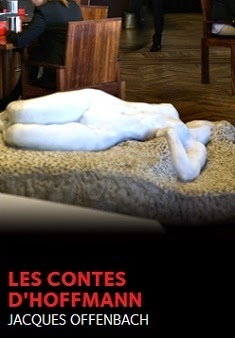
Les Contes d'Hoffmann is an 'opéra fantastique', but there's not much that's fantastical about Christoph Marthaler's version of Offenbach's most ambitious work in this production at the Teatro Real in Madrid. He certainly lets his imagination run riot with the concept, filling the stage with all sorts of antics and goings-on, but nothing really comes together or even seems to relate at all to what the work is about.

I must confess however that I've never been convinced that The Tales of Hoffmann has anything much worth making a fuss about anyway. I love Offenbach's comic operas, the brilliance of the wit, the daring of the satire and the entertaining, dazzling melodies, but the composer's only fully-fledged opera leaves me cold. I can appreciate Offenbach's musical sophistication here and how it's put to the service of the drama, even if it doesn't make a great impression, but I find the plots of Hoffmann's tales convoluted and tedious with little that reveals or provides insight into any genuine human values.


Which is a bit of a problem when the plot that has been drawn from assorted stories of E. T. Hoffmann are all supposed to examine the three great loves of his protagonist's life and the tragedy of their circumstances. As such, I have no objection to a director looking elsewhere for new areas of interest in Les Contes d'Hoffmann, or indeed playing up the fantastical nature of the work. Christoph Marthaler's production - one of the last legacies of the adventurous final term of the late Gérard Mortier at the Teatro Real - unfortunately only takes the work further away from whatever human experience might be found in it, and rather than find magic in it only adds greater confusion to an already convoluted storyline.

Worse than that, Marthaler's direction actually makes a slight but entertaining work feel long and very dull indeed. If you take the time to think about the production, there is actually an underlying theme in the setting, the whole opera with its diverse stories all taking place in a modern centre for the arts. That seems like a good place to unify the theatrical, the dramatic, the artistic and the creative imagination, but instead the stage is rather cluttered with art students sketching a series of nude models who pose and recline, while other characters wander around, fall about and randomly take up positions on the stage, many of them manipulated for some unknown reason by a remote control.


There's an awful lot going on but none of it makes any sense or relates to any familiar view of the work, none of it is interesting or entertaining to watch, and - what must be the bottom line - little of it really serves to enhance the work. If the production fails there's no question where the fault lies then, since the performers really do make the best of what they've been given to work with here. Ann Sophie von Otter, for example, is asked to interpret Hoffmann's Muse and Nicklausse as one and the same - a kind of drunken sprite who dances merrily around as Hoffmann's guide and protector. Von Otter enters fully into the spirit of the role, but the strength of her voice has declined a little in recent years. The singing and interpretation are characteristically warm, delicate and beautiful, but there's no longer any force behind it and she does occasionally become lost in the blend of voices and music.

Eric Cutler also does well within the confines of a character without any real personality who isn't given much to work with by the director either. His singing is clear, flowing and lyrical, but with very little feeling behind it - a problem, as I say, I would associate partly with the nature of the work itself. Vito Priante has one of the richest roles in Les Contes d'Hoffmann, playing the combined roles of Lindorf, Coppelius, Dr Miracle and Dappertutto, but he also fails to make any real impact, playing them all as the same character (which they essentially are) with no costume changes, but he doesn't have the necessary presence or enough character in the voice for the part.


The best thing about Les Contes d'Hoffmann, and certainly the best thing about this production, is the sparkle that the Olympia, Antonia and Giulietta characters bring to the work. More commonly performed by one singer in all the roles - and consequently one of the most challenging soprano roles in all opera - the casting here proved that there's much to be gained from using different voices for the very different demands of each of the parts. Soprano Ana Durlovski impressively sings Olympia as a sad, timid figure rather than a showpiece diva and it's all the better for it, finding the tragic nature of the character in one who, ironically, isn't even human. Equipped with a deeper soprano voice, Measha Brueggergosman took on the roles of Antonia and Giulietta - two sides of the same coin? - and filled them with fire and personality. Her voice didn't always hold firm, but she was particularly impressive in Antonia's duet with Eric Cutler's Hoffmann.

That fire was particularly welcome when there was so much tedium elsewhere. Despite the busyness of Act I, this was mostly a static production with little in the way of effects, little in the way of creative imagination and certainly little that could be described as fantastical. There's a surprising amount of standing around singing and there's not a great deal of life in Sylvain Cambreling's conducting either. Cambreling has a long track record with this work, but in the context of this production the interpretation of the score just felt lifeless and uninspired. This was not a performance, or indeed a production to win over anyone unconvinced about the merits of Offenbach's great unfinished project.

Links: ARTE Concert