Showing posts with label Vito Priante. Show all posts

Wednesday, 25 August 2021

Mozart - Don Giovanni (Salzburg, 2021)


Wolfgang Amadeus Mozart - Don Giovanni

Salzburger Festspiele, 2021

Teodor Currentzis, Romeo Castellucci, Davide Luciano, Mika Kares, Nadezhda Pavlova, Michael Spyres, Federica Lombardi, Vito Priante, David Steffens, Anna Lucia Richter

ARTE Concert - 8th August 2021

There are many facets to Mozart and Da Ponte's trilogy of operas, many facets of human behaviour that can be explored in them, universal traits that provide no easy answers to questions that on the surface can appear - and be played - as comedies but which underneath touch on some very disturbing subtexts. Don Giovanni can be depicted as villain or a victim of his own lusts - someone who loves too much, as someone who just isn't used to taking no for an answer, or in today's view, as a sexual predator and abuser of women. Don Giovanni is always worth a fresh perspective, but - perhaps more controversially (and it isn't often you can say that there is something more controversial in a production than the stage direction of Romeo Castellucci) - Mozart's score is also worth looking at in new ways. 

Teodor Currentzis has been upsetting those who like their Mozart played in the familiar Classical style for quite a while, but he's certainly not the only conductor finding more interesting facets to Mozart using historically informed direction on period instruments and using reduced ensemble orchestration. With Mozart's opera seria works that might be more palatable - and Salzburg have presented interesting Currentzis directed productions of La Clemenza di Tito in 2017 and Idomeneo in 2019 - but Don Giovanni is a different matter altogether. Rather than simply playing it to a way that has become rote and unadventurous over the years, Currentzis again seeks new ways to explore and express the wealth of character that is within Mozart's music. Forcing the listener to really listen to it. Making it feel fresh, shiny and new again. Like a virgin.

There's a theme that a director like Castellucci would certainly seize upon in a work like Don Giovanni, but there are less obvious ways to approach that. And there's maybe an allusion to stripping away the image of the sanctity of Mozart being forced into accepted conventional interpretations in the opening scene of Salzburg's Don Giovanni. In a white temple like setting, workmen strip away the Christian iconography of a church, leaving the elegant bare white edifice to show its basic underlying structure, ready to be built upon anew. A flame burns away any remaining holiness and indeed, the first person seen on the stage is a naked woman (well, it is Castellucci), one presumably no longer a virgin, since she has evidently been seduced/raped by Don Giovanni.

Rather than keep it simple and minimal, Castellucci then bombards the stage with all manner of effects, symbols and supernumeraries. A car crashes down on to the stage, a wheelchair, basketballs, a broken piano. Don Giovanni, Leporello and the Commendatore are dressed in white, while the avenging Donna Anna comes storming on in black with a retinue of Furies that surround and strive to bring Don Giovanni to justice for his crimes against women. It looks like Don Giovanni has juggled too many basketballs this time. The recitative as Don Giovanni and Leporello make their escape is played out with cartoon eyes on a black screen, Donna Anna mourns the crutch of Commendatore, Don Ottavio pours red powder on his arms and punctures a line of basketballs in his promise of securing revenge.

This is evidently not the Don Giovanni you might be familiar with but neither is it inappropriate to the tone of the work and its treatment by Mozart and da Ponte. It might do something different with the visuals and the pace, the use of instruments and emphasis of the music, but it still engages with the themes and the tone of the work. It's not so much Don Giovanni's debauchery and libidinous lifestyle that are condemned here as much as his failure to accept responsibility for and deal with the consequences of his actions. He leaves death and the destruction of lives behind him (something seized upon with a more political slant in Michael Haneke's version), including a suggestion that he has abandoned a pregnant Donna Elvira (Federica Lombardi doubled with a naked pregnant woman), while a child also pursues Don Giovanni on the stage.

The lightness of the treatment and the heaviness of the underlying implications is borne out in the music. Leporello's 'Madamina, il catalogo è questo' has a lovely lightness, the piano weaving in and out of the musicAeterna arrangement, the beauty of the aria contrasted with the sinister note behind the revelations of conquests. Castellucci provides plenty of contrasting imagery, mixing the absurdity with the comedy, with pointed symbolism and contemporary references that include a photocopier. Likewise he brings Michael Spyres's Don Ottavio on wearing a Danish mountaineer outfit (a familiar inscrutable symbol also used in his Moses und Aron) accompanied by a poodle. It looks ridiculous (several characters have a live animal avatar - Masetto a mouse, Don Giovanni a goat) but takes nothing away from the chilling account of Donna Anna on the recognition of her father's murderer, the scene re-enacted as a Greek tragedy.

Which is something that the legend of Don Giovanni could certainly be said to aspire to, it not being entirely out of place with the opera seria reworkings of mythology that preceded Mozart in the earlier part of the 18th century. Just as Mozart brought a contemporary edge to that genre in his progressive music and Da Ponte in the humanisation of the drama while still retaining the otherworldly elements that elevate it to grand drama - so Castellucci brings a corresponding touch of re-interpretation of an epic myth for a modern age while reflecting and respecting the underlying complexity of the work's blend of surrealism, comedy, tragedy, symbolism and instruction on the consequences of moral dissolution. In an expansive gesture that brings 150 women as extras to the stage, Don Giovanni here is held to account for his crime not by a stone statue, but by the women he has wronged. 

Teodor Currentzis seems to be doing his best to submerge as much as possible any of Mozart's familiar melodic embellishments. Whether this is for the sake of upsetting those who like their Mozart played in a conventionally acceptable way, whether it's out of sheer bloody-mindedness to stake out is reputation for being a fearless re-interpreter of Mozart, or whether he finds it appropriate to reevaluate and strip away the varnish of mannerisms that the work has accrued over the years and present a more historically informed account of the score is something the musicologists can argue over. Aligned with the drama an Castellucci's sensibility, the music however doesn't lose a fraction of its distinctive Mozartian qualities of beauty, sensitivity or dramatic flair.

Think what you might also of Romeo Castellucci's contribution, whether it adds any value or provides any new insights but - much like his stunning Die Zauberflöte for La Monnaie - it's certainly original, often spectacular and rarely dull, always surprising with some new idea that puts emphasis on different aspects of the work. It's also not without the occasional bit of flash/bang showmanship, which Mozart wasn't beyond employing himself. Castellucci has become a stylist in white haze, his productions as distinctive now as Robert Wilson's geometric minimalism in blue, and just as visually arresting in their conception, design and execution. This looks simply stunning and impressively choreographed.

It has to be said however, that it's more of an "interesting" production than a great one. Despite the efforts to bring "real people" onto the stage (see Castellucci's rather more successful Die Zauberföte again) and the impressive efforts to pull it all together into a coherent whole, it doesn't always succeed in finding the human warm within the work where it traditionally should. The idea of making Don Giovanni and Leporello look almost identical is another fine idea that makes the identity confusion more realistic, but it also loses something when the two baritones are practically indistinguishable.

Perhaps just as much at fault as the production, the singing didn't quite measure up or compensate for the lack of human warmth in the production. The singing is generally fine, and of a very high standard, as you would expect, but despite good performances from Davide Luciano as Don Giovanni (stripped fully naked at the finale) and Vito Priante as Leporello, and with perhaps the sole exception of a mighty performance from Nadezhda Pavlova as Donna Anna, the production never allowed you to engage with any of the characters of at least sympathise with their dilemma. Overall, this feels like an admirable production with good ideas and visuals, that despite its controversial trappings, plays out nonetheless in a rather run of the mill fashion.

Links: Salzburg Festival, ARTE Concert

Saturday, 28 April 2018

Verdi - Il Corsaro (Valencia, 2018)


Giuseppe Verdi - Il Corsaro

Palau de les Arts Reina Sofia, Valencia, 2018

Fabio Biondi, Nicola Raab, Michael Fabiano, Kristina Mkhitaryan, Oksana Dyka, Vito Priante, Evgeny Stavinsky

OperaVision - 8th April 2018

The quality of early Verdi operas is variable, even by the composers own admission, but some are certainly worthy of occasional revival, even if it's just for curiosity value. A few - very few, maybe only one (Macbeth) - are worthy of being included more often as part of the familiar Verdi canon, others are crude and forgettable (Alzira, Attila), some are flawed but redeemable through a good production and an interesting interpretation (I Due Foscari, Stiffelio, Giovanna d'Arco, Luisa Miller). Il Corsaro probably belongs in the latter category, but its qualities can be enhanced with a good staging and exceptional singing and the 2018 Valencia production goes some way towards demonstrating and achieving that.

It's rare however that you can do anything redeemable with the staging of any early Verdi opera; which in the main consist of romantic melodramas in oppressive wartime situations that don't have much in the way of subtext, nuance or depth. The singing, particularly that of the lead soprano role, can also be extremely challenging far beyond the merits of the piece without really adding to the drama. That's all part of the Verdi DNA however that comes into fruition mid-career, and it can be fascinating to explore the hints already there of the greatness to come if you have a production good enough to tease them out.


The first good sign in the Valencia production is that there's a bit of imagination and style applied to the production design rather than literal slavishness to the libretto's locations. Instead of ship anchored at a Greek island where the chief corsair Corrado is languishing in exile and reduced to piracy, we find ourselves in Act I within the mind of a broken man, sitting at writing desk remembering better times or dreaming of taking part in further exploits. His wife Medora looks on in despair at his downfall and, alarmed at the flask of what may be laudanum he is imbibing, she slips it into her pocket.

Corrado however has other vices and is clearly not adverse to a pipe of opium. In his mind the Ottoman Empire still a threat, so in Act II the bold Byronic adventurer once more visits the exotic East of delights and dangers. There he visits a harem and attracts the attention of Gulnara, the favourite of the Pasha Seid. Seid and his warriors launch into a battle with the corsairs, putting the city and the harem to flame. Corrado rescues Gulnara from the conflagration and is captured while doing so, and earns the mercy of Seid. Until Seid becomes suspicious of Gulnara's feelings for this brave corsair...

There's no need to get to clever with the concept, but there's no need for literal realism either, as combined with Verdi's bombast, the Byronic hero's romantic adventures in the exotic East could seem a little bit over the top. Il Corsaro is tremendous fun, but not particularly memorable and hard for a modern audience to take seriously. Director Nicola Raab doesn't try to get too clever by imposing an unworkable concept on top of what is a fairly straightforward romantic adventure, and without betraying the original spirit of the work she finds a good way of making it a little more 'realistic' or relatable by playing it out as an opium-induced flight of imagination, which as it was originally written by Lord Byron it may well have been.

The production doesn't need a literal depiction that takes it all seriously and literally then. There's more than enough dynamic in the music and the contrasts and colours that lie between East and West, between Christian and Muslim, between men and women. Verdi of course depicts all that in grand brush strokes, all sword and flame, blood and thunder, gods and demons. There's nothing wishy-washy about early Verdi (or middle or late Verdi either, I suppose), and Fabio Biondi's conducting of the Orquestra de la Comunitat Valenciana emphasises the sheer brio with which Verdi attacks the material, where there is also at least some measure of sophistication in the melodies and romantic sentiments.


There's a similar contrast between imagination and reality in George Souglides's production design that shows this flitting between dreams of adventure and the sudden down-to-earth shifts of reality that seep in. Projections of battles and flames are thrown onto a screen that is torn down like a sheet of paper, emphasising that it's all the projection of a troubled mind, allowing it to be taken seriously but not literally. It's a good middle-way to approach early Verdi, giving us spectacle and entertainment and permitting all the spirit of the work to come through without having to look at it ironically or indulgently. That's probably about the best you can hope for in Il Corsaro. 

Well, that and some great singing, as that can make all the difference. The Valencia production gets off to a terrific start, the clever production design and the invigorating score matched by a committed Michael Fabiano in the role of Corrado and Kristina Mkhitaryan as his wife Medora. As he showed in Dmitri Tcherniakov's radical reworking of Carmen for Aix-en-Provence 2017, Fabiano isn't thrown by contradictions between characters who are seen to be role-playing and allows a touch of bewilderment creep into the heroic sincerity of the performance. Mkhitaryan is mightily impressive as Medora, showing a fullness of voice and a deep emotional expression. Medora however is not the principal soprano role, and it's Oksana Dyka who has to struggle with that challenge as Gulnara. Inevitably she is pushed and her pitch wavers occasionally, but it's a valiant effort. Vito Priante sings well but throwing pantomime villain poses he is unable to make much of the role of Seid.

The singing performances and the full-on musical performance under Fabio Biondi carry the work though the dramatic weaknesses of Act III. There's a long scene of Corrado refusing to accept Gulnara's help of escape ("Fly from your prison to freedom, my soul") by manfully accepting his fate only to eventually agree, but as Corrado puffs on his opium pipe, the production does well to try to associate his behaviour as being captive of his addiction or the affliction of his desires and fears. Medora is also saddled with more despairing sentiments that lead up to her suicide and Corrado following, but there's no denying that Verdi provides all the thrills and spills that lead up to this heroic-romantic conclusion, and Biondi hammers it home.

Links: Palau de les Arts Reina Sofia, OperaVision

Saturday, 9 April 2016

Tchaikovsky - Iolanta/The Nutcracker (Paris, 2016 - Webcast)


Pyotr Ilyich Tchaikovsky - Iolanta/The Nutcracker

L'Opéra National de Paris, 2016

Alain Altinoglu, Dmitri Tcherniakov, Alexander Tsymbalyuk, Sonya Yoncheva, Arnold Rutkowski, Andrei Jilihovschi, Vito Priante, Roman Shulakov, Gennady Bezzubenkov, Elena Zaremba, Anna Patalong, Paola Gardina

Culturebox - March 2016

Given their shared history, it's surprising that opera and ballet tend to remain within their respective disciplines and rarely cross-over. There are of course exceptions and one of them is the pairing of Tchaikovsky's short opera Iolanta with the composer's ballet The Nutcracker at its Mariinsky premiere in 1892. It's also notable that combining opera and ballet in the same programme is traditionally something that has been done in French opera from Lully, Rameau and Gluck right through to the extravagant excesses of the Grand Opéra.

So while it is more common nowadays to see Iolanta paired with another short opera by a different composer, it's undoubtedly instructive to see the work paired in the way it was originally intended, and it's appropriate that it should be the Paris Opera who stage the two works in the same programme. Considering the separate paths that both works and disciplines have taken in the meantime however it would still take some radical reworking for it to succeed. Fortunately the Paris Opera have entered a new period of productive experimentation again and, fortunately in this case, they have engaged Dmitri Tcherniakov to come up with a daring approach to the programming that confounds any expectations.

Surprisingly however, at least initially, it looks like Tcherniakov might be going down the same relatively safe route as his La Traviata for La Scala in 2013 (although you can't be safe enough for La Scala). His Iolanta is set in the same sort of drawing room, the decor, lighting and costumes all suggesting period in a way that conforms with the attitudes expressed in the drama, with there being little evidence of his usual modern subversion of the works. The placement of a Christmas tree in the drawing room suggests that Iolanta will blend into The Nutcracker, and indeed it does, but not at all in the way you might expect, the tree even being abandoned before the ballet starts, and the Christmas drawing room scene following it soon after.


The Nutcracker proves to be not so much a continuation of the story of Iolanta as much as an extension of its themes, assuming that you see its story of a young girl who has is cured from blindness as a metaphor for a young woman coming of age. That's certainly how the Metropolitan Opera played the work when it paired Iolanta with Bartók's Duke Bluebeard's Castle, a double-bill that put the emphasis on sexual awakening and liberation. Although successfully staged, it was still a fairly radical and dark exploration of the works' themes and not the most obvious direction you would see Iolanta moving towards. Seen in the context of its pairing with The Nutcracker, the Paris production is a more simple matter of coming of age and self-awareness, but there's nothing at all straightforward in the way Tcherniakov's production sets about it.

If Iolanta was played fairly straight, with perhaps only an additional emotional intensity brought out in the uniformly strong singing and acting performances - with a notably sweeping performance from Sonya Yoncheva - the already notorious opera director really lets loose in his settings for the ballet sequences of The Nutcracker.  It starts out fairly sedately with the cast of Iolanta remaining on the stage, Clara here appearing to be the little sister of Iolanta rather than a straightforward double or mirror role. If the dancing is not the traditional ballet steps, it is initially at least smooth and fluid, the party games and march music involving a kind of musical chairs game and playing with a nutcracker piñata.

That's about as close as this version of the ballet gets to any of its traditional reference points. The movements, choreographed in the first part by Sidi Larbi Cherkaoui, become more frantic and modern with jerking semaphored movements and rhythms as Clara dances with Fritz. Without the familiar ETA Hoffmann story points, it's hard to establish exactly what is going on when a gunshot is fired (by Drosselmeyer?) and the drawing room seems to explode in a ball of fire, leaving Iolana not involved in a war between gingerbread soldiers and grey mice, but in a desolate forest of swirling ashes and snow. Whirling changes of perspective add to the sense of dislocation through projections of the dark woods that are populated by dark shadowy figures with torches.

Act II of the Nutcracker takes us further into unfamiliar territory and strange imagery, with additional dance sequences by two other choreographers, Edouard Lock and Arthur Pita. The shadow of a giant bird circles, an enormous CGI hippo wanders through the woods, but the notion of sexual awakening is suggested by several Claras all dancing with fine young men, with the principal Clara writhing suggestively on the forest floor, abandoning herself to her inner nature. One would think that the traditional sweets and gifts from around the world would suit the purposes of this enlarging of Clara's (and by extension Iolanta's) world, but instead the scene is colourfully filled by huge toys which take us through to the Dance of the Sugar Plum Fairy. The final pas-de-deux is also extraordinary, beautifully choreographed as a succession of Claras dance with the Prince through to old age.


It might not adhere to the original Nutcracker and the connection with Iolanta is tenuous, but it's a beautiful and poignant interpretation that works fully with Tchaikovsky's musical expression. More than just a dream, Clara's experience is a life-long journey that is even more fantastical than the original conception. That's what Tcherniakov does and it doesn't always please opera fans, so I'm sure it will also no doubt horrify some ballet fans more used to the traditional 'Casse-Noisette' that is a perennial favourite at the Paris Opera. It's all the more impressive then that the overall reception to this daring extravaganza has been very positive. It's another promising sign of the new director Stéphane Lissner successfully putting a progressive stamp on the Paris Opera.

Links: Culturebox, L'Opéra National de Paris

Thursday, 19 June 2014

Offenbach - Les Contes d'Hoffmann (Teatro Real, Madrid 2014 - Webcast)

Jacques Offenbach - Les Contes d'Hoffmann

Teatro Real, Madrid, 2014

Sylvain Cambreling, Christoph Marthaler, Vito Priante, Christoph Homberger, Anne Sofie von Otter, Eric Cutler, Ana Durlovski, Measha Brueggergosman, Altea Garrido, Lani Poulson, Jean-Philippe Lafont, Gerardo Lopez, Tomeu Bibiloni, Isaac Galán

ARTE Concert - 21 May 2014

Les Contes d'Hoffmann is an 'opéra fantastique', but there's not much that's fantastical about Christoph Marthaler's version of Offenbach's most ambitious work in this production at the Teatro Real in Madrid. He certainly lets his imagination run riot with the concept, filling the stage with all sorts of antics and goings-on, but nothing really comes together or even seems to relate at all to what the work is about.

I must confess however that I've never been convinced that The Tales of Hoffmann has anything much worth making a fuss about anyway. I love Offenbach's comic operas, the brilliance of the wit, the daring of the satire and the entertaining, dazzling melodies, but the composer's only fully-fledged opera leaves me cold. I can appreciate Offenbach's musical sophistication here and how it's put to the service of the drama, even if it doesn't make a great impression, but I find the plots of Hoffmann's tales convoluted and tedious with little that reveals or provides insight into any genuine human values.


Which is a bit of a problem when the plot that has been drawn from assorted stories of E. T. Hoffmann are all supposed to examine the three great loves of his protagonist's life and the tragedy of their circumstances. As such, I have no objection to a director looking elsewhere for new areas of interest in Les Contes d'Hoffmann, or indeed playing up the fantastical nature of the work. Christoph Marthaler's production - one of the last legacies of the adventurous final term of the late Gérard Mortier at the Teatro Real - unfortunately only takes the work further away from whatever human experience might be found in it, and rather than find magic in it only adds greater confusion to an already convoluted storyline.

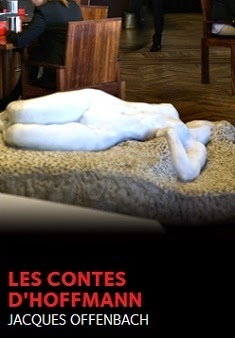
Worse than that, Marthaler's direction actually makes a slight but entertaining work feel long and very dull indeed. If you take the time to think about the production, there is actually an underlying theme in the setting, the whole opera with its diverse stories all taking place in a modern centre for the arts. That seems like a good place to unify the theatrical, the dramatic, the artistic and the creative imagination, but instead the stage is rather cluttered with art students sketching a series of nude models who pose and recline, while other characters wander around, fall about and randomly take up positions on the stage, many of them manipulated for some unknown reason by a remote control.


There's an awful lot going on but none of it makes any sense or relates to any familiar view of the work, none of it is interesting or entertaining to watch, and - what must be the bottom line - little of it really serves to enhance the work. If the production fails there's no question where the fault lies then, since the performers really do make the best of what they've been given to work with here. Ann Sophie von Otter, for example, is asked to interpret Hoffmann's Muse and Nicklausse as one and the same - a kind of drunken sprite who dances merrily around as Hoffmann's guide and protector. Von Otter enters fully into the spirit of the role, but the strength of her voice has declined a little in recent years. The singing and interpretation are characteristically warm, delicate and beautiful, but there's no longer any force behind it and she does occasionally become lost in the blend of voices and music.

Eric Cutler also does well within the confines of a character without any real personality who isn't given much to work with by the director either. His singing is clear, flowing and lyrical, but with very little feeling behind it - a problem, as I say, I would associate partly with the nature of the work itself. Vito Priante has one of the richest roles in Les Contes d'Hoffmann, playing the combined roles of Lindorf, Coppelius, Dr Miracle and Dappertutto, but he also fails to make any real impact, playing them all as the same character (which they essentially are) with no costume changes, but he doesn't have the necessary presence or enough character in the voice for the part.


The best thing about Les Contes d'Hoffmann, and certainly the best thing about this production, is the sparkle that the Olympia, Antonia and Giulietta characters bring to the work. More commonly performed by one singer in all the roles - and consequently one of the most challenging soprano roles in all opera - the casting here proved that there's much to be gained from using different voices for the very different demands of each of the parts. Soprano Ana Durlovski impressively sings Olympia as a sad, timid figure rather than a showpiece diva and it's all the better for it, finding the tragic nature of the character in one who, ironically, isn't even human. Equipped with a deeper soprano voice, Measha Brueggergosman took on the roles of Antonia and Giulietta - two sides of the same coin? - and filled them with fire and personality. Her voice didn't always hold firm, but she was particularly impressive in Antonia's duet with Eric Cutler's Hoffmann.

That fire was particularly welcome when there was so much tedium elsewhere. Despite the busyness of Act I, this was mostly a static production with little in the way of effects, little in the way of creative imagination and certainly little that could be described as fantastical. There's a surprising amount of standing around singing and there's not a great deal of life in Sylvain Cambreling's conducting either. Cambreling has a long track record with this work, but in the context of this production the interpretation of the score just felt lifeless and uninspired. This was not a performance, or indeed a production to win over anyone unconvinced about the merits of Offenbach's great unfinished project.

Links: ARTE Concert

Thursday, 9 May 2013

Mozart - Le nozze di Figaro


Wolfgang Amadeus Mozart - Le nozze di Figaro

Glyndebourne, 2012

Robin Ticciati, Michael Grandage, Sally Matthews, Vito Priante, Andrun Iversen, Lydia Teuscher, Isabel Leonard, Ann Murray, Andrew Shore, Sarah Shafer, Colin Judson, Alan Oke, Nicholas Folwell, Ellie Laugharne, Katie Bray

Opus Arte - Blu-ray

Much like their recent production of Don Giovanni, Glyndebourne's 2012 production of Mozart's Le nozze di Figaro updates the work to the 1960s, finding it to be a period that acts as a good modern equivalent for the changing social attitudes that are to be found in Mozart and Beaumarchais' time.  If it's not quite a perfect fit here, it works well enough for the purposes of Mozart's version of the work, which is less concerned with the social and political climate than the richness of human values that the work expresses.  What is rather more important in Le nozze di Figaro then is how its characters are brought to life, and it's clear from the superb casting here and the fine singing, that this is the principal strength of Glyndebourne's new production.

It's very easy to get complacent about yet another production of The Marriage of Figaro, but one can surely never come away from a performance of this remarkable work with anything but deep admiration and appreciation for the artistry of the work itself.  It's a masterfully constructed dramatic farce that nonetheless makes acute observations about human nature and interaction in relation to those important institutions of love and marriage.  Le nozze di Figaro also has fully fleshed-out characters of real depth of personality and Mozart's incomparable music that gives it another extra dimension, developing themes, connecting them, bringing a whole unity to the work with warmth and compassion.  I doubt that any other composer, past or present, could have achieved what Mozart does with Lorenzo Da Ponte's libretto and Beaumarchais' play.


One can never become complacent about the work itself then, but having been fortunate to have only seen first-rate performances of The Marriage of Figaro, it's easy to think that all the hard work has already been done by Mozart and Da Ponte.  Far from it.  More than anything else, this 2012 Glyndebourne production reminded me that not only are the singing performances vitally important (in what opera are they not?), but that it's a work that is exceptionally demanding not only on one or two principal roles, but that practically every single role has to be carefully considered for the impact and the interaction they have with the other characters.  Will Le nozze di Figaro work with a weak Susanna, Figaro, Almaviva or Countess?  What about those "secondary" characters like Cherubino, Marcellina, Bartolo, Don Basilio and Barbarina?  The work is undoubtedly strong enough to get along without luxury casting in the lesser roles, but imagine how it great it can be with it.

You only need listen to the music that Mozart has written for them to understand that all its roles are lovingly created and have an important part to play in the whole fabric of the work.  That's a lot of roles that it's not only important to get right, but they have to be right with each other.  That's the brilliance of Mozart, and it's one of his greatest advancements on the development of opera as an important dramatic artform.  It's not all about the arias - although even there The Marriage of Figaro has some of the greatest and most popular arias ever written - but the duets and the ensembles also contribute just as much to the work as a whole.  In that respect, Le nozze di Figaro is not only a complete work of undisputed genius, but some 230 years later it's still practically unsurpassed.


You can set the opera in just about any period then and get away with it, even with its references to 'droit de seigneur'.  There have always been sleazy bosses after all, and the 1960s is as good a setting then as any.  The period however is not taken advantage of to any great extent here other than for purposes of style.  In fact, other than showing an exaggerated lack of taste in the clothing styles with flowery wide-collar shirts and big hairdos, there's a curious separation between the characters and the setting which, on the whole, remains for no discernible reason in a country manor in Seville.  That's the original setting of course, but it has no specific 60s context.  If you had dressed the characters here in period costumes, the set - barring the appearance of a sports car during the overture - would have functioned just as well.

As you would expect from a Glyndebourne production however (and this is from the same team that put together the astonishing Billy Budd), the set design by Christopher Oram is impressive in its attention to detail.  The locations are recreated with remarkable realism in the Moorish designs of the architecture, the tiles and the brickwork, and in the the lighting that casts warm orange-brown tones.  The set rotates from one scene to the next fluidly, the lighting finding the perfect mood for each scene, the configurations of the rooms working to the requirements of the drama's comic situations.  The stage direction from Michael Grandage however seems a little detached and on the serious side, never allowing the figures room to abandon themselves to the glorious wealth of warm, funny and touching sentiments expressed in the work.


I think the same thing could be said about Robin Ticciati's conducting.  It's a perfectly good account of the work, but it never reacts to the sentiments or the staging in a way that would bring out its full potential.  Which is a little bit of a pity, because there's an exceptional singing cast here that is more than capable of getting to the heart of Mozart's delightful creations.  Vito Priante is a big-voiced Figaro with the capability of being almost soulful in his delivery, while Lydia Teuscher is a comparatively lovely and delicate Susanna, innocent more than feisty.  Sally Matthews gives us a wonderful melancholic Countess where everything that is essential comes through in the expression of her voice.  Andrun Iversen's Almaviva is more of a blustering buffoon than a sleazy predator, and his voice suits that kind of delivery as well as being well-suited to the Glyndebourne stage.

Proving that the secondary roles can raise this work to even greater heights, particularly when you have a strong Cherubino, Isabel Leonard knocked the socks off the Glyndebourne audience, and you can see why in her sparkling, bright performance with a voice of immense richness.  The character parts of Bartolo, Barberina and Don Basilio were all delightfully played as well, but I was particularly delighted to see Ann Murray still looking and sounding wonderful as Marcellina.  The video recording of the performance is excellent, the colour and the detail all rendered beautifully in the HD-image on the Blu-ray, with fine audio mixes.  There are a couple of short features showing the work put into the props and sets, and interviews with the cast that consider the qualities of Mozart's work itself.  The Opus Arte dual-layer Blu-ray is all-region compatible, with subtitles in English, French, German, Japanese and Korean.