Showing posts with label Opéra National de Paris. Show all posts

Monday, 20 April 2026

Glass - Satyagraha (Paris, 2026)


Philip Glass - Satyagraha

Opéra National de Paris, 2026

Ingo Metzmacher, Bobbi Jene Smith, Or Schraiber, Anthony Roth Costanzo, Ilanah Lobel-Torres, Olivia Boen, Davóne Tines, Amin Ahangaran, Adriana Bignagni Lesca, Deepa Johnny, Nicky Spence, Nicolas Cavallier, Alexander Bozinoff, Lorrin Brubaker, Jeremy Coachman Jonathan Fredrickson, Marion Gautier de Charnacé, Awa Joannais, Héloïse Jocqueviel, Payton Johnson, Rachel McNamee, Mermoz Melchior, Adrien Ouaki, Ido Toledano

Palais Garnier, Paris - 14th April 2026

Satyagraha is a multi-layered work, which is perhaps to state the obvious since that's true of any opera, but I think even more so in the case of Glass’s second opera. There is a noticeable shift away from the more experimental Einstein in the Beach, but Satyagraha still remains unconventional in its format and presentation, using conventional but reduced groups of acoustic instruments (strings and woodwind, no brass or percussion) that almost imitate the rapidly played Philip Glass Ensemble keyboard arpeggios alongside scenes with actual electronic keyboard flourishes. Each one of the work's layers, musical and conceptual, are however necessary and completely true to the nature and intent of the message of the "truth force" (Satyagraha) of non-violent resistance that it intends to put across in this medium; and indeed does so impressively, inspiring some spectacular stage productions over the years. The latest production at the Paris Opéra is no exception.

When I say layered, Satyagraha is layered in its whole conception, since it has complex conflicting ideas it wants to work through. Opera is the ideal medium for that of course, at the same time being flexible enough to allow Glass tremendous scope to innovate and remain true to his own voice. On one level the opera considers the dilemma of the warrior Arjuna in the ancient Hindu scripture the Bhagavad Gita as he is conflicted over his duty to join the battle or follow his own inner voice that rejects violence. On another level, Glass explores the influence of the work as the foundation of Mohandas Gandhi's movement of non-violent resistance through selected scenes from his life and applies it to how that message is taken forward through Rabindranath Tagore, Leo Tolstoy and Martin Luther King Jr. The music and singing provide another accumulative level to the emotional, philosophical and ideal truth force of non-violent resistance as a path to peace and justice, seeking to embody it less in narrative than in a trance-like meditation of the mantra-like delivery of the Sanskrit libretto.

Satyagraha already has these multiple layers built-in, but the stage production provides the opportunity for a creative director to add a few more and, based on past history of productions, such is the nature of the work and its subject that this opera can easily sustain them with overloading or detracting from its essential purpose. The spectacle of Phelim McDermott's production for the English National Opera (which I saw three times in its 2006/07, 2009/10 and 2021/22 seasons) which also transferred to the Metropolitan Opera in New York, adhered relatively closely to the journey of Gandhi in his path to resistance, or at least recognised it as the central focus of the work. In that production Constance De Jong's libretto taken from the Bhagavad Gita and sung in Sanskrit was not subtitled or translated as it was believed (with some merit) that the work and its message could speak for itself.

The new 2026 Paris production directed and choreographed by Bobbi Jene Smith and Or Schraiber would beg to differ and accordingly they take a different course through the work presumably towards the same end. That's somewhat in the spirit of the whole Krishna-Arjuna dialogue in the Bhagavad Gita that underpins the work, in which the eternal struggle between the individual self and the higher Godself is resolved through the imperative of putting aside doubt and just taking action. The directors then choose to ditch the outline structure as it relates to Gandhi and instead explore the Arjuna narrative, in the process even removing the names of the principal singing characters, reducing them to voice types. In this refinement of the work - that nevertheless takes nothing away from it - it becomes more of a spiritual journey and that is enhanced through the focus on movement and dance rather than dramatic action.

The premise of this version is then made relatively simple, taking its lead from the opening scene's dialogue from the Bhagavad Gita between Arjuna and Krishna on the eve of the war between the Kuruvas and the Pandavas royal families. The outcome of Arjuna’s actions become the motivating force through the remainder of the opera in this production to rise above the individual desires and seek a higher purpose and truth. Set in what looks like a kind of assembly hall or rehearsal room with raised platforms and doors to the sides - with Gandhi, Tagore, Tolstoy and King looking on from above - in the first scene of Act I: The Kuru Field of Justice, a soldier in modern military uniform is manipulated into the killing of his fellow man by dark forces, both internal and external. A stage at the back of the hall which remains dark, light occasionally cutting through the mist, suggests that this is a space for an internal, emotional or personal journey. But it's not enough for this to be just a individual struggle to come to terms with one's own personal demons; the man has to reconcile his own belief in truth and justice with the reality of the outside world and bring others along with him to believe in the power of non-violent resistance.

If there is one key phrase in the libretto that might have inspired the directors and choreographers Bobbi Jene Smith and Or Schraiber, it would seem to be the need to become "athletes of the spirit", as this is what is expressed in a production that aspires through movement and dance to match those heights of finding the truth force of Satyagraha achieved in the music and the singing. Glass's flowing rhythmic pulsating score for the opera is ideally suited for this approach, Glass having composed dance sections already for Lucinda Childs' choreography in sections of Einstein on the Beach and going on to create dance pieces for Twyla Tharp's In The Upper Room in 1986. Despite abandoning any traditional opera narrative, the ballet works just as effectively in the hands of Smith and Schraiber, each scene finding fresh ways to express aspects of the man in his internal struggle to reach a higher level, to be a better representative of what man can be in the battle with the corruption of the outside world. Figures then emerge out of the crowds and chorus to join and give strength to the movement.

The new Paris production of Satyagraha succeeds marvellously through its adherence to the spirit and spiritual element of the opera. In the central point of the opera, in Scene 2: Indian Opinion of Act II - Tagore (although the scene is no longer tied to the Gandhi narrative), the dancers step into a joined spiral of simple rhythmic dance steps in one of the most beautiful pieces in the production. It might look simple, but that's the beauty of it; it makes you feel like you want to get up and join them. That's also a quality within the work itself and within the deceptively simple repetitions of Philip Glass's music. In reality it's much more complex than it looks and sounds, in how it takes its time and builds, accumulating weight and meaning in its very structure and indeed movement, much more than just relying on words and narrative.

This is really Philip Glass’s Parsifal; a work that touches deep on what it means to be human and suffer in an imperfect world, but strive to achieve peace and inspire change that will save the world. Living in a time when injustice, inequality, violence and genocidal killing have reached new levels of obscenity, it's not hard to see how that sentiment is now more important than ever. What it also shows us - and which this production's focus and sense of movement highlights even more - is the history of the great names who have resisted through the years, showing that the battle still needs to be fought though the path of non-violent resistance. In that respect this is one modern opera that will endure because it has something that will always be relevant to the times, and it will always be important to remind ourselves of its message. Its form and conception are also key to its promise of longevity, the persuasive music showing how to rebuild and gain force though constant progression, reiteration and gradual change.

The unconventional orchestration and use of instruments - the orchestra essentially having to become an extended Philip Glass Ensemble without the same experience of performing this kind of fast flowing music of repetition and sudden changes - must present considerable challenges. The performance of the Paris orchestra under Ingo Metzmacher however was impressive and indeed persuasive, the delivery firm and seductive as it just washed across the Palais Garnier carrying everyone along with it. The singing likewise was extraordinarily good, as it can't but be in this opera, this time with countertenor Anthony Roth Costanzo coming from Akhnaten in the Glass 'Portrait Trilogy' to the principal (Gandhi) role here. Usually a high tenor part, Costanzo retained the sweetness of the timbre while still incredibly managing to cut through the ensembles and even (vitally) rise above the huge chorus scenes. All the voices and how they come across is important in Satyagraha and it couldn't have been better arranged and directed, all credit to chorus master Ching-Lien Wu. The dance choreography is stunning, but no more or less important than any other element, other than perhaps bringing a robustness that adds another dimension that further enhances the meaning of the work.

I remarked in my review of the Live in HD cinema broadcast of this opera at the Metropolitan Opera in 2011 that it seemed like Glass and this opera were finally receiving belated recognition, but with all nine performances of this new production of Satyagraha at the Paris Opéra selling out months ago (I was only able to pick up a return on the actual day of the performance), it's clear that both this uncompromising work and its composer have achieved a popular status that few could have imagined when it premiered in Rotterdam in 1980. I fully expect that that this production, like the hugely successful Phelim McDermott production, will be revived at some stage and see future new productions, but if you can't wait, a performance of this current run will be broadcast live on the pay-per-view Paris Opera Play (POP) streaming service on the 24th April.


External links: Opéra National de Paris, Paris Opera Play (POP)
Production photographs: Yonathan Kellerman, OnP

Thursday, 17 April 2025

Charpentier - Médée (Paris, 2024)


Marc-Antoine Charpentier - Médée

Opéra National de Paris, 2024

William Christie, David McVicar, Lea Desandre, Reinoud Van Mechelen, Laurent Naouri, Ana Vieira Leite, Gordon Bintner, Emmanuelle de Negri, Élodie Fonnard, Lisandro Abadie, Julie Roset, Mariasole Mainini, Maud Gnidzaz, Juliette Perret, Virginie Thomas, Julia Wischniewski, Alice Gregorio, Bastien Rimondi, Clément Debieuvre, Matthieu Walendzik

ARTE Concert - 3rd and 7th May 2024

Euripides' ancient Greek tragedy of Medea is a sensational tale of sex and violence of love and betrayal that has long inspired theatre and the arts and of course countless opera versions over the centuries, from Francesco Cavalli's Il Giasone in 1649 to Aribert Riemann's Medea in 2010. The most famous opera version, its status defined by Maria Callas, is Luigi Cherubini’s Médée, and that's the version you are most likely to still see performed. With the works of Marc-Antoine Charpentier having their turn in the early opera spotlight, William Christie again being at the forefront of reviving great forgotten works of the early period of classic French 17th century opera, you aren't going to get a better opportunity to experience the quality of his version of Médée than this production on the Paris stage at the Palais Garnier.

With a libretto by French dramatist Thomas Corneille, who composed libretti for Lully's operas, and it being an opera composed during the reign of Louis XIV, you might have some expectations as to how this will play out. If you are thinking rather dry 17th century drama with some longeurs, noble sentiments and classical formality that require some patience and familiarity with the style to appreciate, you'd be partly right, but with Charpentier and French music of this period, you can also expect the flavour of wonderful dance music, choruses and spectacle all fulfilling the dramatic punch of the story. You definitely get that in this opera and it's brought out effectively in a manner that ensures accessibility in Christie's musical direction and in this production directed by David McVicar.

But there is a little scene setting required first of all to establish the situation that is going to lead to Jason's betrayal of his wife Medea and fire such fury in her that she is going to do the unthinkable. The context is their exile from Thessaly driven by the people's fear of Medea's magical powers, and Jason's seeking an alliance that will give them safe haven with King Creon in Corinth. He is prepared to lead a joint Corinthian and Argive army against Thessaly and extend the power of the rule of Creon. Although his daughter Creusa has been promised to Oronte, the Prince of Argos, Creon thinks Jason would make a better husband for the Princess. Jason sees that as an opportunity to secure and elevate his own position, but how will Medea take the news?

Well, I think we all know how that goes, and although the phrase "hell hath no fury like a woman scorned" wasn't around at the time (it being coined just 4 years after Charpentier's opera in 1697 by William Congreve), there is no surer description for what takes place in the final act here. There is however other shades and colours of dramatic action and sentiment that Corneille and Charpentier have to work with before Act V of Médée. Act I starts slowly with Medea expressing misgivings about Jason's mission, Jason himself confessing love for Creusa to his confidant Arcus, but it soon picks up with the armies assembling for the attack against the Thessalonians.

The Paris Opera production sets this version in a more recent and familiar wartime setting, Creon a de Gaulle like figure, Oronte a brash American fighter pilot, Jason of course a naval officer. It works fine, removing it from the Greek classicism and giving it an attractive freshness and colour on the Palais Garnier stage. Dance routines from a small troupe of six male and six female dancers enliven the stage choreography and choral arrangements considerably; they are not overly elaborate, more formation dancing that suits the militaristic look and feel of the setting. The real battle here however is more the one between Jason and Oronte for the favour of Creusa than a concerted fight against the foreign enemy.

That more or less establishes the template for what follows in subsequent acts of Médée; a little bit of accompanied recitative exposition followed by some invigorating music, singing and dancing as the emotional temperature rises. The stage production rises to those moments as well with - it being a David McVicar production - a few surprising twists. A glittering US fighter plane is wheeled on at the end of Act II for a nightclub scene with L’Amour/Cupid appearing as a cabaret act, the whole scene bathed in purple and pink light. Yes, it's a little bit camp, in a McVicar way, but not excessively so. It's a good way to treat the mythological characters that appear in the opera and it seems to fit musically.

The latter is essential really, since musically this production has the complete William Christie attention to detail and above all rhythm. The use of period instruments is invigorating in those dance and choral pieces, with soft flute and plucked theorbo or lute accompanying the expressions of troubled emotions. Authenticity is a matter for the musical director of course and I'm in no position to dispute or approve the choices Christie makes, but he always makes early music that could otherwise sound alien to a modern classical audience feel accessible and beautiful as well as expressive of emotional and dramatic content.

There's a sweetness to the music that is reflected in the singing voices. Yes, that even goes for Lea Desandre as Medea, but the softness of her voice has an underlying steeliness that leaves you in no doubt as to the depths of feeling love and betrayal inspired in her, nor the horrors she is capable of inflicting because of them. Corneille provides adequate motivation, character definition and some poetic beauty in the libretto for Medea. Vowing vengeance in collaboration with Oronte in Act III, she instinctively softens in the face of Jason and believes she can persuade him away from the fatal course he is on. (Jason is also well sung in this scene by Reinoud Van Mechelen, but perhaps lacks the same depth of character). This leads to a beautiful lament "Quel prix de mon amour, quel fruit de mes forfaits" where Desandre shines, pouring out the complexity and depth of Medea's love for Jason. It's a pivotal scene that the outcome depends on and everything about this is convincing for what follows.

What follows is of course all the horrors of hell, and there Desandre is also wonderfully convincing. The early dance rhythms of the period music might not seem best designed for that kind of darkness, but the fury within is there in Desandre and in McVicar's direction of the subsequent acts and scenes with dancers and demons adding emphasis and impact to the intent. It's not a particularly thrilling or insightful production, more typical 'neoclassical' McVicar, but the way it is modernised is enough really to be able to appreciate the true qualities of the work. Under William Christie the work's beauty, its charm, its seductiveness, as well as its edge of menace are all there in a wonderful combination of soft flutes and flurries of plucked and hammered strings.


External links: Opéra National de Paris, ARTE Concert

Thursday, 28 March 2024

Adès - The Exterminating Angel (Paris, 2024)


Thomas Adès - The Exterminating Angel

Opéra National de Paris, 2024

Thomas Adès, Calixto Bieito, Jacquelyn Stucker, Gloria Tronel, Hilary Summers, Claudia Boyle, Christine Rice, Amina Edris, Nicky Spence, Frédéric Antoun, Jarrett Ott, Anthony Roth Costanzo, Filipe Manu, Philippe Sly, Paul Gay, Clive Bayley, Thomas Faulkner, Ilanah Lobel-Torres

Paris Opera Play - 5th March 2024

When it comes to the films of Luis Buñuel, the ideas and sentiment behind them isn't particularly deep or complicated, but it's the surrealist treatment that distinguishes the works. You could possibly break most of them down to the filmmaker rejecting and making fun of the establishment, the bourgeoisie, the church and their perversions, but he does so in a slightly surreal way that gives them an unexpected character, and a very daring one that challenged many sacred cows. Whether it's Catherine Deneuve as a young newlywed housewife who becomes a prostitute at a high-class brothel in order to enact the deepest sexual fantasies that her young husband is unable to fulfil in Belle de Jour, the story of a nun who resists the lecherous advances of her uncle, renounces her vows and gives his estate over to homeless beggars after his death in Viridiana (including a parody of the Last Supper), some of the images and situations in his films are indelible. None more so than The Exterminating Angel.

Again the idea is a simple one where things seem to go wrong at a dinner party organised by Edmundo de Nobile and his wife Lucia after an evening at the opera. They are surprised to find that the servants are not there to collect the coats of the guests, and this initial upset seems to be the catalyst for throwing the evening into turmoil. The scene is repeated as if to suggest that if the servants, the workers, aren't there to look after them, the upper classes don't know what to do or how to function. They drop their coats on the floor and thereafter everything rapidly falls apart. Enrique drops the hors d’oeuvre ragout, and then Pablo the chief wants to go an visit his sick sister. Even though everything has been prepared, Lucia is outraged. She is going to hold these useless servants to account.

The evening and the celebration for Leticia, the opera singer they call "the Valkyrie", never seems to take off and eventually they each decide to leave. This pleases Lucia, as she intends to conduct a little affair when they go, but somehow no-one seems to be able to leave the room. Perhaps the servants aren't there to open the doors for them. Trapped in uncomfortable proximity with each other in a room they are unable to leave, all the little insecurities they have kept hidden rise to the surface and they find themselves forced to enact them. The further the evening progresses and extends into days, the tensions and pretensions intensify and soon turn from petty arguments and affairs to violence and barbarism.

Buñuel's 1962 film is wildly absurd as it is, so imagine how much more the story must be when Thomas Adès and Calixto Bieito put their stamp on the opera version of the work. The essential theme that must carry over is surely to mercilessly rip into the pretensions of the upper classes and have fun in the process. Subtlety isn't essential, the more extreme the better. Adès certainly has fun introducing strange untypical sounds and instruments like the use of the ondes martenot into the buoyant orchestration. It's as richly and creatively scored as you can imagine, and Adès himself has tremendous fun conducting the Paris Orchestra through it. Yet it is not wild, but controlled, the implication being that the guests haven't lost their minds, they are simply being extreme, or perhaps just unrestrained versions of their true selves.

As a dramatic situation, that is inevitably limited. Taking place in one room where everyone seems to be losing their mind for two hours, the point seems to be made very quickly, and it's just a matter of seeing how far they can push this and what the eventual outcome or explanation for the strange event might be. Inevitably, there is no easy answer and there are many ways of looking at the resultant chaos and the ineffective ways they try to deal with it. The image of sheep - which Calixto Bieito manages to introduce in his own way - suggests conformity and inability to think for themselves to the extent that they are unable to leave a room unless everyone else does, or it could have religious connotations, which are certainly treated with scorn by Buñuel. That is also suggested here, even though the opera version does not include Buñuel's horror in the cathedral epilogue.

Given that, the question must be whether The Exterminating Angel gains anything by being an opera. Unquestionably Adès brings something fresh to the work. Making use of a wide variety of musical instruments and arrangements, it's as musically inventive as you would expect from this composer, finding varied expression for each of the characters, and layering them together with great skill. In terms of transferring those ideas to a stage production, this must be a rare case where the plot of the opera itself has an absurd side that even surpasses what Calixto Bieito usually brings to a production. But then we are talking about Luis Buñuel here, one of the original surrealists, and - while it might not seem like it - Bieito is actually more subtle and suggestive here than the original work. It could be just that the Catalan director has found a work that fits with his own sensibility and indeed I actually would be surprised if Buñuel wasn't a major influence.

If there is one slightly different stance or slant that the opera takes, it's maybe taking the opera evening aspect of the story and making a little more of the idea of musical resolution. This is there in the original, I seem to recall, but unsurprisingly perhaps it takes on another meaning when it is seen in the context of an opera itself, the guests seemingly unable to move until the unfinished playing of Paradisi by Blanca on the piano is brought to a conclusion. As if having to acknowledge that, Adès self-references his own music trapping the guests, and scores the opera singer at a higher pitch than the others, in the same range as Ariel in his version of The Tempest. The finale then, rather than follow Buñuel's cathedral ending, has all the surviving guests emerging dazed from the room, confronting their inner selves and suggesting (in my mind anyway) that the audience do likewise. You must wonder what the audience in the expensive seats at the Bastille make of it, and if that's the only intention in bringing The Exterminating Angel to the modern opera stage, it is surely justification enough.

While occasionally it seems like (controlled) chaos on the stage, there are actually many little touches in both the music, the direction and the singing performances to keep things moving along and give the viewer much to think about. Each of the characters have their own hang-ups and ways of dealing with being locked in that reveals another aspect of the society that the original creator wants to expose and mock. The singing alone is striking enough to grab your attention. There is an exceptional cast assembled here, and each have their own distinctive part to play. It's hard to just pick out one or two in a cast that includes great performances from Nicky Spence, Christine Rice, Philippe Sly, Anthony Roth Costanzo, Paul Gay and Clive Bayley, but Jacquelyn Stucker is exceptional as Lucia di Nobile, Claudia Boyle delivers an impressive lament/lullaby late in the opera for Silvia's son Yoli and Gloria Tronel hits those stratospheric heights as the opera singer Leticia.


Monday, 26 February 2024

Bellini - Beatrice di Tenda (Paris, 2024)


Vincenzo Bellini - Beatrice di Tenda

Opéra National de Paris, 2024

Mark Wigglesworth, Peter Sellars, Tamara Wilson, Quinn Kelsey, Theresa Kronthaler, Pene Pati, Amitai Pati, Taesung Lee

Paris Opera Play - 15th February 2024

It surprises me that Beatrice di Tenda isn't a better known opera. Most of Bellini's works are revived on a semi-regular basis and his significance is hardly underestimated as an important figure in the development of Italian opera, but his works don't seem to get the attention they deserve and this one in particular is largely neglected. Why? Perhaps it's a little old fashioned for modern tastes, or perhaps the challenge of this opera is that it needs skilled singers in all the key soprano, tenor and baritone roles. It's telling the title role is defined by recordings made by the likes of Joan Sutherland, Mirella Freni and Edita Gruberova. If it's a case of needing it to be modernised a little or waiting for the right singers to come along, well, then the Paris Opera get it right with this 2024 production directed by Peter Sellars.

That's not all they get right. There's a lot more to successfully producing an opera like this and it really needs commitment, belief and passion on every level, but it also needs to be carefully pitched. Passion is at the core of the opera, but it is also surrounded in coldness and that is identified and brilliantly reflected in how the production design here contrasts with the delicacy of the playing of the exquisite melodies. It's not that the plot has a lot to offer other than romantic drama, as Italian opera thrives on that, but it's how those passions conflict with power that drive the musical drama. Bellini is masterful in his treatment of such material, no less than Verdi, Donizetti or the opera seria of Rossini, but for me the characteristic that sets Bellini apart is not just the passion, not just the sophistication of the writing, but a sense of refinement. That's fully in evidence in this lovely opera, and I think that's what the director Peter Sellars attempts to retain and reflect it in a modern light.


On the face of it the drama has little to distinguish it from many other Italian operas. Based on a historical figure, Beatrice, the Duchess of Milan, is now married to her second husband Filippo Visconti, a union that has given him great power and influence, but they now have very different ideas about how to use their position. Beatrice wishes to support social programmes, while Filippo wields his authority ruthlessly over the people. Beatrice is horrified at the impact that their marriage has inflicted on the people of the nation and considers ending the marriage, which is not easy for a woman to do. Filippo too is being advised to end the marriage, but in order to cling to the power he finds an excuse to have her reputation destroyed by accusing her of conducting an affair with the minstrel Orombello, and tortures the man into a confession.

There are a lot of familiar elements here that can be found in the historical operas of Donizetti, in Anna Bolena and Roberto Devereaux, but Bellini's opera here has a distinct character and it's the duty of director to bring that out. There is an edge to Beatrice di Tenda in a libretto doesn't hold back on the details of the violence inflicted on the people on Orombello or the cruelty of Filippo's regime, and Sellars strives to make that as hard-hitting as possible. The music might sound beautiful but it doesn't soften the darkness at the heart of the work. There is a nobility in confronting such horrors head on, never bowing, and that's what Bellini's music counters. Even Filippo in the end recognises where real power lies. Well, almost. The second concluding act of the opera consequently is extraordinary and enormously powerful. Evidently however, it's how the subject is sung by the performers is perhaps the most vital element contributing to that impact.

Bel canto is all about the singing. It's in the name and it needs to be done well or not done at all. Italian bel canto opera is not a repertoire that I have been following lately however, so few of these performers are familiar to me, but even so I can't remember hearing bel canto sung so well as it's done here. Singers and performers like this are not just there to show off the beauty of their voices, but also bring out the qualities of the music and the form, and in that respect, this is singing of the highest calibre. It's interesting too that it is American singers who shine in the main roles. Tamara Wilson's Beatrice is just phenomenal, her range impressive, her delivery and performance perfectly judged. Hawaiian born baritone Quinn Kelsey is a strong counterweight that makes Filippo a formidable opponent. No less impressive here are Theresa Kronthaler as Agnese and Pene Pati as Orombello. 

Act I consequently is impressive and immersive despite the conventionality of the plotting, while Act II is just off-the-scale brilliant, the increased intensity and emotional drama between the principal characters and their conflicting worldviews reaching almost fever pitch as they hold firmly to their beliefs and inner nature - for good and for ill. As it's Bellini, the chorus also play a large part in the swaying between these opposing positions. Like La Sonnambula, like La Straniera, they provide commentary and reaction, reflecting confusion and the horror of the people observing the troubles of high society - "Nothing escapes our eyes" -  but they have a participatory role here as well, influencing as well as being affected by what occurs. All of this not only underlines the intensity of the operatic drama, but it gives the plot considerably more weight beyond it being merely a historical royal intrigue.


Director Peter Sellars introduces a clean grand set designed by George Tsypin for La Bastille. All of the action and intrigue takes place in the palace gardens, within a low maze of hedges made of mesh steel and tall conical trees. It has a cool elegance. Costumes are modern, smart, elegant befitting the high society. Evidently there is no need to distance the drama by setting it in the original time period of 1418, but I'm not convinced that introducing laptops and mobile phones is really necessary either. When Filippo confronts Beatrice with evidence of what he sees as plotting to Beatrice's outrage as the violation of her personal secrets, he presents her with a laptop computer as evidence. Agnese can be seen later scrolling on her mobile phone doubtlessly checking how many likes she is getting on social media for her actions. It feels a little heavy-handed and doesn't really make any commentary that is worth making a point about. Window cleaners and hedge trimmers are also a distraction that add nothing to the production design.

Sellers, who incredibly has never directed an Italian opera, not even Verdi, does much more than update the production with modern technological devices. He also has some interesting things to say about the opera in an interview shown during the interval of the Paris Opera Play live broadcast of the opera. He makes a strong case for the effectiveness of the work to really touch on the horror of living under a dictatorship, about the fragility of human beings within such a regime and the possibility of them being broken. It's clearly all laid out in the libretto and in how Bellini scores it, making Beatrice di Tenda really quite revolutionary in terms of Italian opera up to that point in 1833, and unquestionably still relevant as a subject today.

Bellini's penultimate opera, I find this a much more interesting work than his more famous final opera I Puritani, but evidently a lot depends on how well individual productions are directed and sung. Sellars direction makes a strong case for the relevance in the work, Mark Wigglesworth conducts the Paris Opera orchestra with fervour, but it's the quality of the singing performances in this Paris Opera production that truly raise Beatrice di Tenda to a level of greatness.


External links: Opéra National de Paris, Paris Opera Play, 

Photos : © Franck Ferville/OnP

Sunday, 14 January 2024

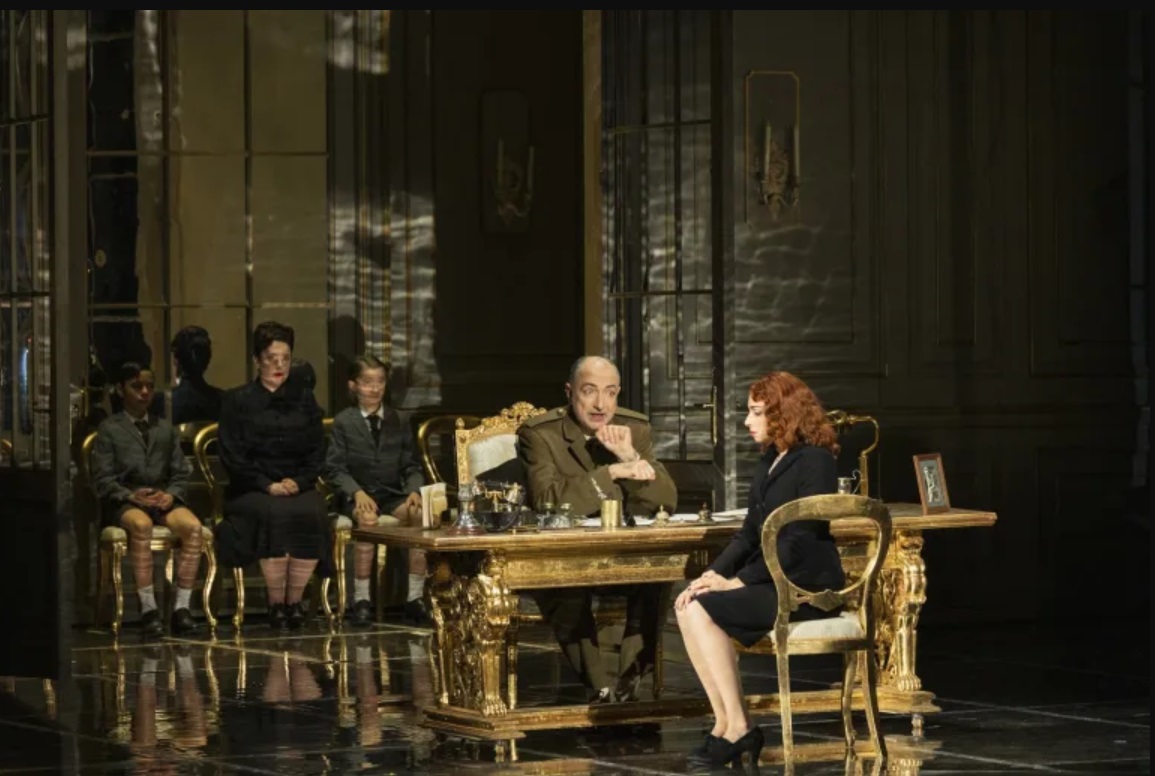
Strauss - Salome (Paris, 2022)

Richard Strauss - Salome

Opéra National de Paris, 2022

Simone Young, Lydia Steier, Elza van den Heever, Iain Paterson, John Daszak, Karita Mattila, Tansel Akzeybek, Katharina Magiera, Matthäus Schmidlechner, Éric Huchet, Maciej Kwaśnikowski, Mathias Vidal, Sava Vemić, Luke Stoker, Yiorgo Ioannou, Dominic Barberi, Bastian Thomas Kohl, Alejandro Baliñas Vieites, Marion Grange

Paris Opera Play - 27th October 2022

There's not a lot of point in comparing one production of an opera with another, or indeed weighing one against another. There are always going to be differences of musical interpretation and evidently different people singing are going to make it sound and play out differently from one production to the next. Depending on the numerous factors involved in live performance, even the same production can differ from one revival to the next, even from one night to the next. It all comes down to personal preferences, and opinions will always vary. When you view two productions of Salome side by side however - one of the most intriguing of all opera works - it's hard not to make direct comparisons. As far as the Paris 2022 production stands against the recent Tcherniakov one at Hamburg, all it confirms is that this extraordinary work is infinitely open to radical ideas and interpretations.

When I reviewed the Hamburg production earlier this month, I suggested that if you go back to the original Oscar Wilde play, the pre-eminent theme of the work is how the darkest human lusts and behaviours can be tolerated as long as they are kept hidden and not spoken about in polite society. Wilde was of course satirising Victorian society and the underlying moral corruption more than retelling a biblical story, but you could certainly see an interpretation of hypocrisy in religion as well. That idea was largely adhered to in the Tcherniakov production, which managed to draw on the dark power of the work while remaining largely bloodless in explicitness. Not so much here in director Lydia Steier's production for the Paris Opera.

One other vital element of Salome is that it it was written with the intention of being shocking, provocative and taboo breaking, and the genius of Richard Strauss is such that he was capable of pushing the accepted conventions of musical language to similarly provide shock and outrage. This is the beauty of the work, or the ugly beauty of the work, if you like. Steier's Paris production definitely tends towards the character of the work to shock and thereby reveal more of the hidden nature of mankind's inherent selfishness and cruelty, rather than dress it up in flowery Symbolist poetry. As far as it applies to Salome in this production, she is not actively involved in the orgy of sex and violence at Herod's party but bored with it, which perhaps suggests a deeper pathology, but I'm not sure this production really gets to what it might be. 

Of course if you have shown Herod indulging in such activities, you can hardly expect him to be shocked when his stepdaughter shows the same tendencies pushed in another direction and thinking of it as 'love'. Herod's hedonistic party is viewed in a high room with wide glass window, showing a slow motion wild drunken orgy where cruel lusts and desires are freely indulged in the beating, murdering and mutilating of slaves. Semi-naked men and women prisoners are brought up from the dungeons, their bloody brutalised and mutilated bodies later carried down the stairs by men in bio-hazard suits to be dumped off into a pit at the side of the stage only to be replaced from the dungeons with a continuous supply of victims.

Very much tending towards darkness, the production uses lighting to soften and darken during Salome's poetic eulogising of the wild beauty of the tortured emaciated caged Jokanaan. It explodes into light when he rejects her advances, although here he seems to be leading her on somewhat (or maybe only in her fevered imagination) before delivering his imprecations, leading her to strike him with a cattle prod. What is critical in the depiction of this scene is capturing its extraordinary dynamic, here more so since the singing of Elza van den Heever and Iain Paterson delivers it so well. It's intense and compelling on every level. Every perversion is permitted, even as far as Salome masturbating over the cover of the cistern as Jokanaan is triumphantly lowered to the climatic music that Strauss composed for this scene.

The production manages to introduce a little lightness or further dynamic into the opera with the outrageous appearance and dress of Herod and Herodias. It does this without altering the grotesque overblown quality of the work, and crucially the quality of the singing is maintained. John Daszak's Herod enters with a feathered headdress, wearing a silk cloak over a see-through top. Sporting a blonde mullet, he looks like a New Romantic video star from the 80s. Herodias is similarly attired, with a dress supported by nipple hooks (Karita Mattila wearing a false boob set). There is something of a blend of 'Girls on Film', 'Wild Boys' and 'Total Eclipse of the Heart' about the look only taken to nightmarish lengths, with plenty of Pete Burns-like characters among the party entourage. Mattila plays up to the part of Herodias marvellously, flirting with the guard, both she and Herod making suggestive use of fruit in a way that Barrie Kosky would be proud of, but it fits with the florid metaphors used by Wilde to such great effect.

In terms of performance, this is one of the most impressive and impactful I can remember, but then it needs to be in order to rise to the challenges set by the production design, stage direction and musical direction. Simone Young's conducting of the Paris orchestra in particular is just outstanding here. It helps that the sound quality on the Paris Opera Play platform is so good. Using headphones, you can hear every little detail and sweep of dynamic orchestration. All of the cast have sufficient force matched with lyricism to deliver the decadent phrases of Lachmann's translation of Wilde's play. It feels like this play was written to be performed in the heightened state of opera, as effective here in Strauss's version as in Antoine Mariotte's Salomé using the original French text. As with Maeterlinck and Debussy in Pelléas et Mélisande, there is something about Symbolist works that seems well-suited to lyrical interpretation.

Whether or not you find the look of the production distasteful - it certainly pushes all the buttons to shock - this is a very well-directed Salome. The characters, their qualities, their flaws are all laid out to see and the singers are given space to express it. There is no confusion about what is going on, the focus is maintained where it needs to be in the marking and choreography. Whether Lydia Steier manages to probe any deeper into the dark psychology of the character of Salome could depend more on how the viewer responds to it. Having watched another Salome recently and found new elements to consider, it might not be fresh enough for me personally this time, but the singing is outstanding and under the musical direction of Simone Young this wonder of the opera repertoire remains as impressive as ever.

They key to how you might respond to the work lies, as it often does, in the depiction and outcome of the Dance of the Seven Veils. There is no oriental exoticism here whatsoever, the 'dance' shown for what it really is. Herod strips, sexually abuses and pleasures himself over a disgusted Salome, who nonetheless allows this to be taken to its brutal conclusion before she is subsequently gang-raped by the rest of the guests stirred up by the night's revelry of violence. Salome here is not gorily glorious (except in her own mind) but reduced to something pitiful, crawling across the floor, while Herod's page takes a gun to the whole rotten lot of them. It's all pretty revolting, but undeniably as dark and brutal as any conventionally staged conclusion of this magnificent opera.


External links: Opéra National de Paris, Paris Opera Play

Saturday, 25 November 2023

Puccini - Turandot (Paris, 2023)


Giacomo Puccini - Turandot

Opéra National de Paris, 2023

Marco Armiliato, Robert Wilson, Iréne Theorin, Brian Jagde, Ermonela Jaho, Carlo Bosi, Mika Kares, Florent Mbia, Maciej Kwaśnikowski, Nicholas Jones, Guilhem Worms, Hyun-Jong Roh, Pranvera Lehnert, Izabella Wnorowska-Pluchart

Paris Opera Play - 13th November 2023

Such is the very distinct character and experience of a Robert Wilson production that you imagine that it can't be suitable for every kind of opera, but it's not such an easy thing to fit that into clear dividing lines, and where the line does fall is of course going to be be subjective. You would think that it would be better suited to more abstract work like Einstein on the Beach, where he first made his mark in the world of opera as co-creator with Philip Glass, or Pelléas et Mélisande and the spiritual content of Arvo Pärt's Adam's Passion but his style also seems to chime with baroque very well (Gluck and Handel), except when it doesn't (Monteverdi). You couldn't see his coolness work with the beautiful warm humanity of Mozart, but who knows? I would love to see him direct a Die Zauberflöte, and could someone commission a Robert Wilson Ring Cycle please?...

I wasn't convinced either by his work on Verdi's Aida, even though it looked stunning on the stage, and I was surprisingly impressed with his take on the high drama of the French version of Il Trovatore, so it's not so clear cut. Puccini is another that it's hard to imagine Robert Wilson being suited, but we have already seen Madama Butterfly and this Turandot (seen previously in Madrid) prove otherwise. In the case of Turandot, now playing in Paris and available to view in a brief window though their Paris Opera Play service, the reasons are worth exploring again, although Puccini's opera, the cast here and the spectacle of a Wilson production are reason enough to watch this again.

Like any good opera production its success relies on how well it works with the score and the intent of the opera. That doesn't necessarily mean that the direction has to be sympathetic towards the original intentions of the work (few if any productions match to the letter or even closely adhere to stage directions nowadays), nor even in matching or working with the tone of the music score. There can be as much of interest in contrasting the heat and passion of a music score with a coolness in the direction as a means to examine the potential of a work and perhaps illustrate an hitherto unexplored aspect of a work. I'm not saying that Wilson does this in the case of Turandot, but he certainly brings an uncommon and you would think counterintuitive approach to Puccini's final unfinished masterpiece.

There actually is a cold menace at the heart of this dark fairytale with its authoritarian regime ruled with cruel laws, and that is reflected in the sinister undercurrents of Puccini's score. Calixto Bieito showed one way of bringing that aspect out in his production, but Wilson shows that there is more than one way, and it is if course in his own very distinctive way. The restricted highly controlled movements of the cast, the darkness of moving black panels blotting out the light at the back of the stage instead of thunderclouds. The situation is not natural, so Wilson doesn't resort to natural phenomena for this. When something of nature does appear, such as a bird a stork making a flight across the sky during the mourning of the latest victim to lose his pale bloodless head, it's in response to the sorrowful warmth of the score. Even the bird's movements however are Wilson stylised.

Where Wilson best serves Turandot is in the epic fantasy of the fairytale, not making it a colourful exotic drama (like Andrei Serban at the ROH), but a colourful spectacle of a different hue nonetheless, working primarily with light. It's a superb match for the huge orchestration, the limited movements providing counterpoint rather than a conventional illustrative decoration. It also has the effect of simply gluing you the visuals, really connecting with them, even if they seem occasionally jarring and disruptive to the tone at times with bizarre comedy characters (not just Ping, Pang and Pong). It's visually stunning and despite the impression of it being static there is always something happening, even if it's just the fading and brightening of the light adjusting the whole appearance of a scene.

Credit to conductor Marco Armiliato for matching the lushness of the score with the intent of stage production, rather than feeling a need to present a cold and clinical reading, which would be a disservice to Wilson and Puccini. It's majestic. There are serious singing challenges in this Puccini opera without having to adopt unnatural posture and deliver gestures in the Robert Wilson fashion. Although rightly celebrated for her Puccini roles as Madama Butterfly and Suor Angelica, Liù appears to be less comfortable range for Ermonela Jaho. Iréne Theorin is also a little bit strained here. She's an excellent powerhouse Wagnerian, somewhat inconsistent, but is gloriously imperious in the final scene confronting Liù and Calaf. Turandot is not a large role but it is a very challenging one. Brian Jagde is a fine Decent Calaf, and soars through 'Nessun dorma'. Carlo Bosi is very capable for the role of the old man Altoum.

Whether Turandot has something deeper political to say about love being the answer that will topple a totalitarian regime is debatable, although in its unfinished form without resolution Calixto Bieito certainly made a convincing case for it being a powerful critique of the crushing boot of fascism, but the inherent power of the work, whether for its depiction of a reign of terror or its belief in the healing power of love, is undeniable. His mannerisms will irritate some but the power of Robert Wilson's distinctive vision for this and for the world of opera can't be denied. His Turandot is spectacular, unlike anything else, capturing the otherworldly quality of Puccini’s fairy tale opera, its power, its majesty, and its beauty as a final unfinished testament from this composer.


External links: Opéra National de Paris, Paris Opera Play

Photo credits: Agathe Poupeney / Opéra national de Paris

Friday, 3 November 2023

Wagner - Lohengrin (Paris, 2023)


Richard Wagner - Lohengrin

Opéra National de Paris, 2023

Alexander Soddy, Kirill Serebrennikov, Kwangchul Youn, Piotr Beczala, Johanni van Oostrum, Wolfgang Koch, Ekaterina Gubanova, Shenyang, Bernard Arrieta, Chae Hoon Baek, Julien Joguet, John Bernard, Joumana El-Amiouni, Caroline Bibas, Yasuko Arita

Paris Opera Play - 24th October 2023

Surely the only impression you can have watching Act 1 of the Paris production of Lohengrin directed by Kirill Serebrennikov, is that Elsa von Brabant has truly lost her mind. About to face trial for the alleged murder of her brother, the heir of Brabant, who she claims was abducted by swans, she spins around in a bare room, scrawling on the wall, while abstract projections and dark nightmarish forces gather around her. The arrival of King Heinrich to oversee the trial doesn't seem to have any mollifying effect as she places a tangled ball of steel wool on his head has a crown. There doesn't seem to be any doubt about her state of mind, although some might be just as likely to think that the director and the Paris Opera has lost its mind with this extreme production of Wagner's early work.

The question however is indeed just how are you supposed to represent what is clearly a legend, the myth of Lohengrin as related to the sentiments underlying Wagner's overarching development of a national mythology, and how to place it on the stage in a way that draws on those underlying themes and meanings. It really doesn't stand up to much scrutiny if enacted as if it were real. Sure, Telramund might believe himself powerful enough that he doesn't even need to provide evidence against Elsa, but you would think he might hesitate and withdraw his accusation when a heavenly figure on a raft drawn by swans makes an appearance. Even the king recognises an emissary from God when he sees it.


Essentially what you have to get, aside from other considerations of Wagner's ideals explored through the work, is that
Lohengrin is clearly a battle between good and evil and you can choose to depict that as a struggle between two representative figures, or if you are a stage director for a major opera house now has a great deal more technology and sophisticated theatrical means at his disposal, you can expand that out to show how evil can pervade society and destroy the good in an individual. Or you can view the battle being raged within the mind of one person, and show that in a representation of true torment. Is that a fair summary of the basic premise? Do you need lab mice to represent that? Well whatever works...

Evidently the Paris production, arguably more extreme and abstract than even the Bayreuth production won't please everyone, with multiple rooms on the stage and bizarre activities taking place in each one of them. It's a very busy production, but it looks stunning and it does force the audience to think about what is really being told in the story. And, more importantly, it does so in a way that doesn't make it feel like an academic exercise - such as perhaps the Hans Neuenfels' mice in lab experiment production - but one that presents the true power of the work. The crucial moment of truth comes with Lohengrin's winning declaration and Elsa's promise to him backed with a chorus that is powerful and deeply touching. You must surely feel what is being presented here, even if it makes little coherent narrative real-world sense (as if Lohengrin ever did).

The real test of course, as suggested above, is in whether the cast and musical performance can convince you that there is such depths and humanity in the work. Few would dispute Wagner's ability to imbue the work with such character and the Paris production clearly intends to honour that with more than just a high production value am-dram period costume drama (no offence Dresden). Conducted by Alexander Soddy, the overture felt a little slow and thinly orchestrated, but as it progressed through Act 1 it was clear that it was a slow-burning build up. The abstract activities on the stage take the same approach, as that gradually coalesces into something huge and overwhelming, as indeed it should considering what is at stake. Even a fight with whirling light-sabres doesn't take away from that. It's just simply epic.

Having left you somewhat overwhelmed and bewildered, there is however evidence of a more prosaic reality going on in the second act, but one that depicts a no less deep struggle. It seems Serebrennikov is operating on a David Lynch-like level without using directly referencing the film director's imagery or style, aside from what at one point looks under lighting like a Twin Peaks Black Lodge red curtain. Elsa, it appears, is indeed a sick young woman. Telramund and Ortrud appear in a drab house where they could be abusive parents or step parents, until we see them don white medical coats to care for her in some kind of medical facility. It turns out to be a military medical facility, with soldiers quarters on one side and patients in the other. Elsa's wig is removed to reveal that she is undergoing some kind of treatment, possibly electro-shock, which might account for her visions of angels and demons.

But it's not so straightforward or easy to chart of course, the two visions of the world blended together, using doubles, dancers and mirror images. The Paris production defines the roles of Telramund and Ortrud in the cast list as as "military psychiatrists", so there is a suggestion that the production is taking in the psychological damage caused by war, which is - and often seems to be - a subject that relates to the what is going on in the world in the present day. Grieving mothers are briefly seen holding pictures of their lost sons before being shunted off. The wedding march at the opening of the third Act is not just the traditional one for Elsa and Lohengrin, but a lineup of weddings for troops about to be sent off to war and likely die there, war brides and grooms photographed before a backdrop of swans.

Previously seen here directing a similarly idiosyncratic production of Parsifal at Vienna in 2021 Kirill Serebrennikov attempts to mirror the wider context of Wagner's world of mythology throughout his works by linking it visually and thematically with his production of Parsifal. It's also clearly intended to have modern day relevance to the world we live in today, not just to make a political statement, but to show that Wagner remains relevant and addresses fundamental human issues. Even in an apparent fantasy work like Lohengrin Serebrennikov seeks to find a way to reconcile the mythological elements with the darker nationalistic and militaristic sides of the opera.

Make of it what you will (I personally thought it was magnificent, building to a hugely emotional and fitting conclusion), but there is little to fault in the casting or the singing. Johanni van Oostrum is clearly one of the most troubled Elsas I've seen but she maintained composure and a purity of tone. I've seen Piotr Beczala sing this role several times now, and he still doesn't disappoint. Along with Klaus Florian Vogt (who is in an alternative cast for this production), the two of them are among the best current tenors in this role, each with their own distinctive sound. There are a few signs of strain in the top notes for both Beczala and van Oostrum, but it's hardly surprising considering the challenges here and both provide solid performances in the main. 

Wolfgang Koch is solid and reliable as Telramund, a role that requires character and Koch definitely brings something of that to it. Kwangchul Youn is another solid Wagnerian in the role of Heinrich a der Vogler, but most impressive of all in this performance is Ekaterina Gubanova as the irredeemable Ortrud. The role of the chorus is vital in this opera and they were outstanding. Alexander Soddy stepped into conduct following the early departure of Gustavo Dudamel, and in the pacing, build-up and delivery of the opera, conveying not only the full force of Wagner's score but putting it fully in service of the extraordinary stage direction, it was an exemplary account.


External links: Opéra National de Paris, Paris Opera Play

Saturday, 21 October 2023

Janáček - The Makropoulos Case (Paris, 2023)


Leoš Janáček - The Makropoulos Case

Opéra National de Paris, 2023

Susanna Mälkki, Krzysztof Warlikowski, Karita Mattila, Pavel Černoch, Nicholas Jones, Ilanah Lobel-Torres, Johan Reuter, Cyrille Dubois, Károly Szemerédy, Peter Bronder 

Paris Opera Play - 13th October 2023

I could think of several reasons why the idea of Krzysztof Warlikowski directing a Janáček opera would be an attractive proposition - attractive enough in my case to start a subscription with Paris Opera Play to watch a livestream broadcast. The science-fiction nature of The Makropoulos Case and its modernity lends itself to wild flights of imagination, and the relatively short running time of the opera means that an adventurous director like Warlikowski doesn't have to strive too hard to make it fit with what will undoubtedly push a concept beyond the limits of what the opera can sustain. And the promotional 'King Kong' images it has to be said show that Warlikowski is going to push his own ideas and distinctive view of opera as far as he can.

He can't help himself with this one, such is the richness of the 'script' and the 'soundtrack' he has to work with that he can indulge his love of classic and iconic movies to the extent that even a short opera like Makropoulos is somehow extended to almost 2 hours. Regardless of what you think of the director's style and techniques, you can hardly argue with is his choice of 'Marilyn Monroe' to represent the superstar fame of the opera's ageless icon Emilia Marty and her tragic situation.

The opening section, that this director often fills with filmed movie footage of his own for his productions, this time uses original classic Hollywood footage of 'Sunset Boulevard' and 'King Kong', neither of which feature Monroe of course, but blending these with documentary footage recounting the string of marriages and the tragedy of a legend, the fall of Marilyn Monroe, they tangentially serve to provide an effective link between her life and The Makropoulos Case. Rather than take place within the offices of the lawyer Kolenaty then, this merges into a kind of on-stage reenactment of the unveiling of bound King Kong to a New York audience. No, definitely not the most obvious of connections to the start of The Makropoulos Case.

And yet, there are plenty of references in the libretto to connect the tragedy of Elina Makropoulos with Marilyn Monroe - "Nothing is eternal. 'Vanitas' …ashes to ashes!" "What can you care about a woman of ill repute who lived 100 years ago?". It might not draw anything new out of the opera, but it certainly provides a fresh way to look at the work, a new way to connect to its themes, since the plot is a fairly convoluted one. Warlikowski's production certainly brings out how women have been objectified by men over the years the harm inflicted on Emilia Marty as a woman who has lived through it and seen it all, been abused and mistreated by men trying to mold her in the image of their fantasies. "See this scar on my neck? Another man tried to kill me. I'm not going to undress to show you all the marks men have left on my body". she tells a besotted Albert Gregor, in thrall to the lure of the glamorous image.

It's a gift of a role for any star soprano who is able to project a similar glamorous allure, and Karita Mattila proves to be a good choice for her ability to inhabit the persona of the enigma that is Emilia Marty; a star, diva, a Norma Desmond. Dressed as Marilyn Monroe in a constantly billowing Seven Year Itch dress is a bit more of a stretch, but this is opera and almost every opera has a singer cast in a role that they don't match physically or in age, and Mattila carries it off surprising well. This is after all an opera where we are dealing with a character who is an ageless 337, so anything goes surely? 'Anything goes surely' being the philosophy of Warlikowski as well you could say. What matters is that she can sing the role and inhabit the role with personality. 

Mattila's voice might be a little weaker now in terms of volume, but she delivers a hugely convincing performance and the personality is definitely all there. Her voice sounded a little muffled in places, but it's hard to judge that from a live web broadcast. She still sings with great control, singing in Czech, which is doubtlessly challenging. As is the role itself, which Warlikowski doesn't make any easier, but there is little room for doubt about her ability there, her performance very impressive, genuinely magnetic and charismatic. All the roles are similarly well-cast and performed with notable performances from Pavel Černoch as Albert 'Bertik' Gregor and Ilanah Lobel-Torres as Krista. As often proves to be the case, 'Maxi' Hauck brings a humorous touch to the opera, sung here by Peter Bronder as an ice-cream salesman during the interval at the theatre/movie theatre where Emilia is appearing in a fully-staged reconstruction of Fay Wray being picked up by Kong.

Set designer Małgorzata Szczęśniak provides an impressive set and staging for this scene, a key scene in the work that succeeds in capturing the wonder, humour and the underlying tragedy of life that - like Jenůfa and The Cunning Little Vixen - lies at the heart of the work. Also, since the work does relate to the nature of the artist taking on many roles, exploring human experience, the nature of aging or remaining ageless, it does relate well also to Sunset Boulevard. Maxi becomes Erich von Stroheim's butler to Emilia's Marilyn Monroe/Norma Desmond, the opera finishing with a swimming pool scene that captures the glamour of the lifestyle and the tragedy to unfold there. Ars longa, vita brevis.

It's all there - glamour, spectacle, consideration of the nature of living and being human - all wrapped up in a marvellous entertainment with glorious music conducted here by Susanna Mälkki. That's The Makropoulos Case and there's no question all the glamour, spectacle and full consideration of what the opera has to tell us about the nature of living is fully what you get in Krzysztof Warlikowski's new production for the Paris Opera.


External Links: Opéra National de Paris, Paris Opera Play