Showing posts with label Brian Jagde. Show all posts

Saturday, 25 November 2023

Puccini - Turandot (Paris, 2023)


Giacomo Puccini - Turandot

Opéra National de Paris, 2023

Marco Armiliato, Robert Wilson, Iréne Theorin, Brian Jagde, Ermonela Jaho, Carlo Bosi, Mika Kares, Florent Mbia, Maciej Kwaśnikowski, Nicholas Jones, Guilhem Worms, Hyun-Jong Roh, Pranvera Lehnert, Izabella Wnorowska-Pluchart

Paris Opera Play - 13th November 2023

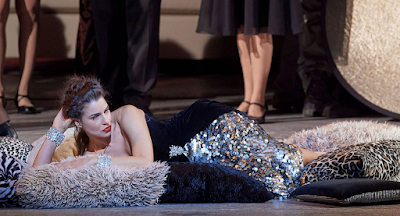
Such is the very distinct character and experience of a Robert Wilson production that you imagine that it can't be suitable for every kind of opera, but it's not such an easy thing to fit that into clear dividing lines, and where the line does fall is of course going to be be subjective. You would think that it would be better suited to more abstract work like Einstein on the Beach, where he first made his mark in the world of opera as co-creator with Philip Glass, or Pelléas et Mélisande and the spiritual content of Arvo Pärt's Adam's Passion but his style also seems to chime with baroque very well (Gluck and Handel), except when it doesn't (Monteverdi). You couldn't see his coolness work with the beautiful warm humanity of Mozart, but who knows? I would love to see him direct a Die Zauberflöte, and could someone commission a Robert Wilson Ring Cycle please?...

I wasn't convinced either by his work on Verdi's Aida, even though it looked stunning on the stage, and I was surprisingly impressed with his take on the high drama of the French version of Il Trovatore, so it's not so clear cut. Puccini is another that it's hard to imagine Robert Wilson being suited, but we have already seen Madama Butterfly and this Turandot (seen previously in Madrid) prove otherwise. In the case of Turandot, now playing in Paris and available to view in a brief window though their Paris Opera Play service, the reasons are worth exploring again, although Puccini's opera, the cast here and the spectacle of a Wilson production are reason enough to watch this again.

Like any good opera production its success relies on how well it works with the score and the intent of the opera. That doesn't necessarily mean that the direction has to be sympathetic towards the original intentions of the work (few if any productions match to the letter or even closely adhere to stage directions nowadays), nor even in matching or working with the tone of the music score. There can be as much of interest in contrasting the heat and passion of a music score with a coolness in the direction as a means to examine the potential of a work and perhaps illustrate an hitherto unexplored aspect of a work. I'm not saying that Wilson does this in the case of Turandot, but he certainly brings an uncommon and you would think counterintuitive approach to Puccini's final unfinished masterpiece.

There actually is a cold menace at the heart of this dark fairytale with its authoritarian regime ruled with cruel laws, and that is reflected in the sinister undercurrents of Puccini's score. Calixto Bieito showed one way of bringing that aspect out in his production, but Wilson shows that there is more than one way, and it is if course in his own very distinctive way. The restricted highly controlled movements of the cast, the darkness of moving black panels blotting out the light at the back of the stage instead of thunderclouds. The situation is not natural, so Wilson doesn't resort to natural phenomena for this. When something of nature does appear, such as a bird a stork making a flight across the sky during the mourning of the latest victim to lose his pale bloodless head, it's in response to the sorrowful warmth of the score. Even the bird's movements however are Wilson stylised.

Where Wilson best serves Turandot is in the epic fantasy of the fairytale, not making it a colourful exotic drama (like Andrei Serban at the ROH), but a colourful spectacle of a different hue nonetheless, working primarily with light. It's a superb match for the huge orchestration, the limited movements providing counterpoint rather than a conventional illustrative decoration. It also has the effect of simply gluing you the visuals, really connecting with them, even if they seem occasionally jarring and disruptive to the tone at times with bizarre comedy characters (not just Ping, Pang and Pong). It's visually stunning and despite the impression of it being static there is always something happening, even if it's just the fading and brightening of the light adjusting the whole appearance of a scene.

Credit to conductor Marco Armiliato for matching the lushness of the score with the intent of stage production, rather than feeling a need to present a cold and clinical reading, which would be a disservice to Wilson and Puccini. It's majestic. There are serious singing challenges in this Puccini opera without having to adopt unnatural posture and deliver gestures in the Robert Wilson fashion. Although rightly celebrated for her Puccini roles as Madama Butterfly and Suor Angelica, Liù appears to be less comfortable range for Ermonela Jaho. Iréne Theorin is also a little bit strained here. She's an excellent powerhouse Wagnerian, somewhat inconsistent, but is gloriously imperious in the final scene confronting Liù and Calaf. Turandot is not a large role but it is a very challenging one. Brian Jagde is a fine Decent Calaf, and soars through 'Nessun dorma'. Carlo Bosi is very capable for the role of the old man Altoum.

Whether Turandot has something deeper political to say about love being the answer that will topple a totalitarian regime is debatable, although in its unfinished form without resolution Calixto Bieito certainly made a convincing case for it being a powerful critique of the crushing boot of fascism, but the inherent power of the work, whether for its depiction of a reign of terror or its belief in the healing power of love, is undeniable. His mannerisms will irritate some but the power of Robert Wilson's distinctive vision for this and for the world of opera can't be denied. His Turandot is spectacular, unlike anything else, capturing the otherworldly quality of Puccini’s fairy tale opera, its power, its majesty, and its beauty as a final unfinished testament from this composer.


External links: Opéra National de Paris, Paris Opera Play

Photo credits: Agathe Poupeney / Opéra national de Paris

Monday, 14 February 2022

Puccini - Manon Lescaut (Vienna, 2022)


Giacomo Puccini - Manon Lescaut

Wiener Staatsoper, Vienna - 2022

Francesco Ivan Ciampa, Robert Carsen, Asmik Grigorian, Boris Pinkhasovich, Brian Jagde, Josh Lovell, Artyom Wasnetsov, Marcus Pelz, Ilja Kazakov

Wiener Staatsoper Live Stream - 7 February 2022

I'm always hopeful that with the right team it might prove to be a revelation, but thus far I've never been totally convinced by Puccini's Manon Lescaut. The composer never seems to fully invest you in the rather disjointed drama or the opera's emotional journey, nor have I yet seen any director make a convincing case for it on the stage. The opera is not without some of the qualities that would become more refined in La Bohème and beyond, but it's just not quite there. If there's a good reason to make a case for Manon Lescaut, it's got to be in the choice of soprano, as Manon has a fine selection of arias to display her range. Vienna at least have that with Asmik Grigorian, and - for me anyway - that's enough of a reason to give Manon Lescaut another airing, even if the opera still proves unconvincing elsewhere.

Rather disappointingly, if not unexpectedly, the usually capable director Robert Carsen isn't able to find anything new to say about the work or indeed able to find any way of making work as a coherent opera. What he does manage to do is modernise the otherwise old-fashioned Belle Époque setting of the pitfalls that face a young woman of her age looking for fulfillment in life and love. Carsen doesn't vary from the idea that she can have either riches or true love in poverty but not both. As a prototype for Mimi, she rejects her brother's plan to either put her in a convent or marry into a profitable but loveless marriage, and runs away with the handsome but poor Des Grieux. She becomes dissatisfied with her choice however, and discovering that love alone is not enough, she is seduced by the big city glamour of Paris and led into a life of dissolution.

It's perhaps not the most enlightened of views of female emancipation - the third act conclusion makes her pay for it is a drastic way - but there is certainly still some truth in the idea of the seduction of glamour. The emphasis in the set design of the Vienna production is very much aligned to a more modern view of that idea. Manon arrives in Act I against the elegant curve of a mall of designer shops, but rejects all that for the penniless Des Grieux who charms her. Act II takes place in a penthouse city apartment and Act III doesn't end up in the Utah desert either, but back again in the no less soulless location of the mall of designer shops.

As we never see her living in poverty in a room with a tiny table in Puccini's version of the opera, (Massenet has a better choice of scenes from L'Abbé Prévost’s original novel 'L’Histoire du chevalier des Grieux et de Manon Lescaut in his verion, Manon) there is none of the kind of contrasts that would contribute to the Puccinian colour of La Bohème, albeit in a single milieu there. Here, the composer tries to enliven and add variety with choruses of onlookers and dancers in Act I, and with maids and hangers-on a kind of bohemian world in Act II, but he doesn't invest in it to the same emotional charge as you find in his greater works.

That inevitably feeds into the performances, with there being 'little room' for Des Grieux to show how he has been likewise seduced only by the glamour of Manon and the romance of running away to Paris. A good singer who is well directed can perhaps bring more to it, but while it is sung well here by tenor Brian Jagde, it lacks that emotional investment. Carsen tries to bring a rather more realistic contemporary view to Manon's relationship with Geronte as one now more familiar between an aspiring female actor and a possessive powerful man who wants to control her. Rather than being arrested by the police at the end of Act II for moral corruption or theft of jewellery then, neither of which are convincing in a modern context to justify transportation to America, Manon is instead brutally raped by Geronte in front of her lover Des Grieux at the end of Act II. That ought to bring more of an emotional charge and sympathy for her fate, but it lacks edge you might expect.

Perhaps that's because the opera still feels incomplete, as if there is a whole act or a few scenes missing. It never flows in any way that you can relate to the characters and what they are going through. Carsen doesn't manage to improve on that with the minimal set changes to the three acts. The curve of the stage remains at the port in Act III where Manon is due to deported. Why the soft furnishings of the previous act remain on the stage I'm not sure. The parade of women lining up to take to the prison ship walk out with handcuffs but look bruised and beaten but still hold themselves like glamorous models on a catwalk being photographed by bystanders and press on one side and Geronte's high society friends on the the other.

I suspect that Robert Carsen is trying to say something about consumerism and the commodification of women, which is at least something even if it doesn't fit all that neatly with the characterisation or musical content. Act IV, which is always the strangest scene of the opera, feeling out of step with what has come before, doesn't take place in the American desert of course, but back again in an empty mall. With mannequins in the windows of the designer shops and abandoned shopping bags and cash littering the ground, it does emphasise to some extent the commodification of women, dehumanised for the use and mistreatment of men who hold all the power.

If that idea has any validity and works to some extent in this production, it's almost entirely down to the emotionally charged music that Puccini has written for the finale and Asmik Grigorian's singing of it here. Her rise to leading roles in major European opera houses and festivals is well merited, displaying a strength and wide range that is capable of singing Wagner, Strauss and Janáček. She has no trouble with Puccini, which certainly has its own challenges particularly in Act IV, and Grigorian is fairly stunning here.

There is a lively spring to the score under the musical direction of Francesco Ivan Ciampa; a simmering fire always there, the romantic sweep of the Intermezzo, a crash of danger as love and romance turn to horror. Being Puccini, it's hard not to get swept away by the crescendos of the final Act, particularly when it is sung well. Boris Pinkhasovich, Brian Jagde and Artyom Wasnetsov give capable performances as Lescaut, Des Grieux and Geronte, but none of the roles have opportunities for much development. To be honest, I think I had already long ago given up on Manon Lescaut as a successful opera and it was only the opportunity to see Asmik Grigorian sing the role that held any interest. She doesn't disappoint, but the opera and the production do, yet again.

Thursday, 6 June 2019

Korngold - Das Wunder der Heliane (Berlin, 2018)

Erich Wolfgang Korngold - Das Wunder der Heliane

Deutsche Oper Berlin, 2018

Marc Albrecht, Christof Loy, Brian Jagde, Sara Jakubiak, Josef Wagner, Okka von der Damerau, Derek Wetton, Burkhard Ulrich

Naxos - Blu-ray


Like many other German and Austrian works that were categorised as 'degenerate' Entartete music by the Nazis in the 1930s, Korngold's early operas have as a consequence been consigned largely to obscurity. That is undoubtedly unfair, as the banning of such works had little to do with any kind of musical discrimination or value judgement and everything to do with whether a composer was of Jewish origin or had Jewish family connections. The neglect and loss of such works and any legacy they might have had could however also have as much to do with them being out of touch with changing musical tastes and the reality of people's lives on the ground.

The near-eradication of such works from music history may not be so much to do with the labelling of such music as degenerate as much as the operas and their themes being rather too 'decadent' in subject matter at a particular juncture in history when the world was about to plunge once again into war. Korngold's operas would certainly fit in with the decadent fantasies that seemed to flourish around this period. With fairy-tale worlds peopled by ambiguous figures and wrapped in lush chromatic orchestration, Richard Strauss, Franz Schreker and Erich Wolfgang Korngold relished delving freely into a dark core of madness and forbidden lusts that had been unleashed post-war in the new century.


If they don't reveal any great psychological insights, works like Die Frau ohne Schatten, Die Gezeichneten and of course Korngold's Die tote Stadt are nonetheless fascinating and exquisitely beautiful works that are very much the product of their (short-lived) time. So too it transpires is Das Wunder der Heliane (Heliane's Miracle), another Korngold masterpiece that has been largely neglected or deemed irrelevant to the development and progress of 20th century opera. Composed in 1927 with a trial at its centre, there's a sense even that Das Wunder der Heliane challenges itself in response to such conflicts, if only within the world of opera. Are you willing, it seems to ask, to sacrifice the beauty of Romance for a harsh, unyielding, joyless life without magic and love in it?

That seems to be the choice open to the Stranger, imprisoned for bringing a message of joy and light to a land where love and laughter are forbidden. The King, a stern and embittered figure who has never even known the love of the Queen, visits the Stranger in his cell to tell him that he will stand trial and face execution for his frivolity. The Queen, Heliane however proves to be more yielding to the Stranger's outlook, offering him her hair, her feet, her mouth and then her nakedness, but not her body. The King, going back to plead with the man to ask him how to win the love of the Queen, is outraged when he discovers her naked with the Stranger.

That's the first highly charged Act of Das Wunder der Heliane, the subsequent two Acts setting these forces against one another, leading to the death of the Stranger in Act II and his 'resurrection' at the miraculous intervention of Heliane, whose goodness and purity allows them to consummate their love in death in the finale of Act III. There doesn't appear to be much Wagner or Schopenhauer influenced philosophical underpinning to this pseudo-mystical Liebestod, just throwing out the idea of beauty, purity, love and light as the true enduring force in the world, even stronger than death.


If there's any way of making a credible case for this idea, it's in how Korngold smothers any philosophical shortcomings with persuasive swathes of strings, harps, 'seraphic voices' and all manner of celestial instrumentation. Who could resist or deny that there is indeed something miraculous and otherworldly in the music at least? If anyone can convince you of the argument of Das Wunder der Heliane, it's Korngold's orchestration at his most extravagant. It's rather like Strauss in this register - full-on, rich and complex, underscoring high emotion with soaring crescendos.

Like Strauss it also places exceptional demands on the singers, who not only have to be capable of the stamina to handle its technical complexities, keeping up with the continuous augmentation of musical emotions, but also rising above it and making it feel like it comes heroically from the heart. I haven't come across American tenor Brian Jagde before, but he is supremely capable of bringing all that to the role of the Stranger, in thrall to love and beauty. The rush of 'pure' lusts inspire him to soar to incredible heights in his Act I scene with Sara Jakubiak's Heliane that culminates in her revealing herself fully to him. The singing with the orchestration and the charge of the chaste eroticism reaches everything that Korngold could wish to achieve in a scene like this.

Christof Loy's direction doesn't try to compete with the charge that is already there, but his directions certainly help bring it about. It's almost impossible to sustain that kind of charge and tie it into further miraculous associations between love and death (although Tristan und Isolde - clearly the major influence on this work - of course proves otherwise), so Loy aims for a more sober set design, setting the drama in a courtroom inspired by Billy Wilder's Witness for the Prosecution, with dark classical wooden panelled walls and no unnecessary adornment or effects. As is often the case with Loy, he seems to give a problematic work the best possible presentation that highlights its strengths and mitigates against any weaknesses, and he does it with some style too.


Korngold's score also demands a certain flair and Marc Albrecht is an experienced conductor in this field. To judge purely on impact, the whole character of Korngold is there, distinct from Wagner, Strauss or Schreker, using unconventional instruments in an idiosyncratic way to achieve similar effects. The demands are not just on the principals then but the whole cast and there are consequently impressive performances from Josef Wagner as the distraught and furious King, Okka von der Damerau as the king's Messenger, Burkhard Ulrich as the Blind Judge and Derek Wetton suitably otherworldly as the Gatekeeper. This is a hugely impressive and revelatory production in every respect of a neglected Korngold rarity.

Recorded live at the Deutsche Oper in Berlin in 2018, Das Wunder der Heliane is given a superb presentation on Blu-ray disc by Naxos. The HD image is good, but evidently the real benefit of the format is in how it gets across the power, complexity and detail of Korngold's majestic score in the high resolution DTS HD-Master Audio 5.1 and LPCM 2.0 soundtracks. The spread of the surround track gives a more immersive experience, while the 2.0 track is more direct and powerful, particularly on headphones. Korngold specialist Brendan G. Carroll provides an introductory essay in the booklet, and also some items from his own archive on the disc, including an 8-minute recording from 1928 of the Act III Zwischenspiel and a picture gallery of rare photographs, posters and images. The BD is all-region compatible and there are subtitles in German, English, French, Japanese and Korean.