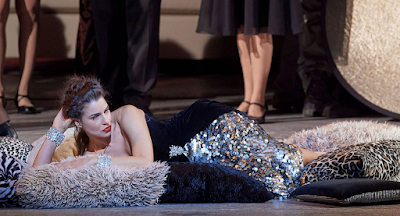
Showing posts with label Asmik Grigorian. Show all posts

Sunday, 8 November 2026

Zemlinsky - Eine florentinische Tragödie, Bartók - Duke Bluebeard's Castle (Vienna, 2026)

Alexander von Zemlinsky - Eine florentinische Tragödie 
Béla Bartók - Duke Bluebeard's Castle

Wiener Staatsoper, 2026

Alain Altinoglu, Vasily Barkhatov, Asmik Grigorian, Florian Boesch, Christopher Maltman

Wiener Staatsoper livestream - 10th October 2026

The scandal surrounding Oscar Wilde's trial, imprisonment and death meant that his name was not spoken about in polite British society at the beginning of the 20th century, but the European attitude towards the writer was clearly very different. Wilde was still popular with the dramatists and composers in Europe, where his work continued to be translated and performed. The most notable adaptation - and still one of the boldest - is of course Richard Strauss's Salome - the composer finding within that play a dark decadence that was in tune with the times. Alexander von Zemlinsky chose a different side of Wilde for his two short operas; Der Zwerg based on the fairy tale 'The Birthday of the Infanta' and Eine florentinische Tragödie from the play 'A Florentine Tragedy'. There is nothing in Wilde's other work quite like Salome, but you can find the same sensibility of dark decadence also permeates his other writing in a way that clearly appealed to European composers interested in developments in modern psychology, human behaviour and new ways of viewing the world at the beginning of the 20th century.

The aspects and the insights that drew Zemlinsky to the tale in relation to human behaviour remain interesting and worth continuing to develop and explore, and that means that there is a subtle but significant change in the relationship between the three characters involved in this Vienna State Opera production of Eine florentinische Tragödie as a domestic drama. Domestic suggests perhaps, dull, common, gritty and real world, but there is no getting away from the fact that the short opera is adapted from an unfinished play by Oscar Wilde, and unlike his more famous satirical plays of Victorian manners, class and society, this work has the same flowing flowery imagery as his Salome. The floweriness of course is just a cover for a deeper expressions of intent than is visible in the surface exchanges.

All the more so in the nature of the dialogue exchanged between the two men when Simone (Christopher Maltman) returns home from his work as a travelling salesman to find another man in his house with his wife Bianca (Asmik Grigorian). In a subtle change, somewhat necessary to remove the class satire and period mannerism of the original, Guido Bardi (Florian Boesch) is not a prince here but a psychologist who is advising Bianca on her marriage difficulties. Using the situation to express himself in a polite subtle manner that nonetheless leaves little doubt about his actual displeasure (this mincing with words is catching), Simone brings out his wares pretending to assume that since the unwelcome guest clearly isn't a relative, he must surely be there to examine his goods (see what I did there?).

Just to emphasise what is being said beneath all the fine expressions, suggestive passive-aggressive behaviour mixed in with salesman patter, Simone whips out his wife's wedding dress and his own wedding tuxedo, alluding (no need to be too subtle) that these are the goods that Guido is really after (just thought I'd make that clear). Just as capable of making his own position clear while dressing it up in fine language, Guido boasts that he is willing to pay double the price, to which Simone makes a counter-offer that suggests that since they are spoiled goods and not worth the price, he will offer him a cut price reduction and a split of any profit. As this rate it is not long before the two men really get to the heart of the matter.

And all this is relished by Zemlinsky. The musical arrangement of Eine florentinische Tragödie is accordingly lush and florid, highlighting the barbs and threats in the undercurrents. Simone is given freedom to express himself in grand declamations and Christopher Maltman, a fine actor and singer, makes the most of that here. Women don't have as much of a place amidst all this macho chest-beating, and as such - despite being the centre of attention - Asmik Grigorian as Bianca has little presence; a plaything bartered between the two men. Their reputation and keeping up appearances is more important than any woman. It's a playful and brilliant work, if not greatly revealing nor as revolutionary as Salome, even if it takes a darker turn in this Vienna production directed by Vasily Barkhatov.

As is often the case two different works are paired, there is however another unexpected resonance introduced when Béla Bartók's Duke Bluebeard's Castle takes over, picking up from where A Florentine Tragedy left off. That sentence on its own is meaningless of course as the two works have little in common and were never meant to work side-by side together. What has been established in this production however is the idea of the psychological drama - or psychodrama in today's parlance - complete with psychiatrist in A Florentine Tradegy; and Duke Bluebeard's Castle is nothing if not a psychological drama. As has often been noted before, the opening of the seven doors of Bluebeard's castle can be seen to clearly represent a horrific delve into the deepest darkest and most unpleasant recesses of the human mind.

Accordingly, having (presumably) play-acted the murder of 'Guido' at the end of A Florentine Tragedy - as the spoken introduction to this opera notes - "The story is old, but did it happen or did it not?" - Judith now picks up the notebook and glasses and starts the therapy session with "Ah, I see seven great shut doorways, Seven doors all barred and bolted". It's time to get into the mind of a serial killer or at least someone who harbours a serious potential for dark violence. Here however there is a difference or ambiguity implied in perception and role as the story takes a Lynchian turn down a Lost Highway of overlapping dreams and reality. And in doing so it causes a need for a reflection on what took place back in A Florentine Tragedy.

The production set design remains the same then, but it needs a little more than that: it needs a touch of gothic horror quality and those do indeed bleed (an apt choice of words) into the luxury apartment-showroom-lounge-psychiatrist's office. With a suitable use of lighting and projections, the production design transforms the set into something much darker, finding interesting parallels and correspondences between the treasures and horrors of Duke Bluebeard's rooms and the workings of a tortured mind with a dark past.

And in doing so, it transforms the nature of the woman, Judith. This is no incautious naive young woman seeking to understand the mysteries of her new husband's shocking and colourful past. As an amateur psychologist, this Judith is prepared to fight to get to the truth - or get him to confront the truth - believing that it is all better out in the open and that healing can come from it. Indeed in a surprising twist, it's not Bluebeard's barred doors of the mind that she seeks to break down as much as her own. He is rather is protective of Judith here, unwilling to send her down a path that it is suggested perhaps once resulted in a nervous breakdown; an event that seems to have led to the breakdown of the marriage. This Bluebeard is someone who tries to keep her from the truth that they have both tried to bury.


Perhaps even more so than more traditional versions - as if there are ever any of those - there is a real sense of trepidation at what Judith is going to discover behind the seventh door, but also a feeling that it delves into the subject far more profoundly and meaningfully. It's clever, but it is also illuminating and truthful of the dark places that the mind can go to, as torturous as any medieval torture room and its victims in a gothic castle. It leads to an unexpectedly touching conclusion, with Alain Altinoglu drawing all the power and dramatic sweep out of the musical arrangements and terrific singing from the three principals, Asmik Grigorian in particular often reduced to wearing underwear, physically, metaphorically and psychologically stripped down.


External links: Wiener Staatsoper, Wiener Stastsoper Live

Wednesday, 9 September 2026

Bizet - Carmen (Salzburg, 2026)


Georges Bizet - Carmen

Salzburger Festspiele, 2026

Teodor Currentzis, Gabriela Carrizo, Asmik Grigorian, Jonathan Tetelman, Kristina Mkhitaryan, Davide Luciano, Iveta Simonyan, Anita Monserrat, Matthias Winckhler, Liviu Holender, Michael Arivony, Mingjie Lei

ARTE Concert - 8th August 2026 

If Carmen can't speak of the world around you today, what is the point of it? That must be the challenge for any director, opera house or festival choosing to present it on the modern stage. Much as some might like to live in the past, there is no room surely for the glamorising of violence and bloodshed, for the murder of gypsy girls, for valiant toreadors or any of the stock cliches that present the work as nothing more than an operatic entertainment. Carmen can be and should be more than this. Any opera worth its salt should be able to continue to resonate and tell us something about love, life, death and humanity. Salzburg, it has to be said, go out on a limb by handing it over to first time opera director and dance choreographer Gabriela Carrizo (Peeping Tom), but there is no question that it results in a viscerally striking and visually arresting account with not even the suggestion of any old-fashioned operatic mannerisms. There is still life, love and humanity in Carmen, and plenty of death too of course.

While the familiar strains of the overture and first scene of this production of Carmen are playing however, instead of humming along and tapping your foot, you're more likely to be focussed on identifying where this adaptation of the opera is taking place. The uniforms of the officers are fairly generic, the landscape is one of smooth rises of angular grey stone, the setting dark, very dark. We are far from the colour and sun of Andalucía. One thing that is clear is that it's a brutal world, for women particularly, so we are at least on familiar ground there. The first scene shows two men dumping a body over the edge of the hill, the next, beating up a vagabond thief in their midst. One of the guards teaches a young boy to use his gun and have some fun shooting his school friends.

The other thing you might note as characteristic of the setting is that they no longer appear to have soap or detergents. Everyone is covered in grime and dust, the uniforms filthy, the children are all grubby and unwashed. Sadly, it looks like they might have recently been putting out wildfires that have devastated the Andalusian landscape in these months; that sunset glow when the workers are leaving the factory might also be the approach of the continuing fires. I'm not sure Carmen is the place for eco awareness and climate change warnings - and that doesn't turn out to be the theme of this production - but at least it isn't mired in the usual cliches. Well, not the usual colourful seductive Carmen scene-setting ones anyway, which I suppose is what is really being avoided here.

Not that 'post-apocalypse' is any more original at the moment, but the aim of this one doesn't appear to be concerned with alerting us to climate change devastation, more 'post morality' maybe, which is certainly another worrying direction humanity seems to be heading in. The people here seem to be living on the edge of a volcano or one where another outbreak of smouldering ash could reignite at any moment. You could certainly apply that description to Bizet's music anyway, and Teodor Currentzis doesn't hold back from the full-on dynamic of the score here at Salzburg, stripping it of any romanticised account of gypsy melodies. This Carmen is loud, fast, aggressive and muscularly masculine, any notion of tenderness is quickly quashed. An almost frenzied seguidilla had some of the well-heeled Salzburg audience audibly booing. I'm guessing this isn't a world they recognise, or are well protected from it. Get over yourselves.

(An aside. Seriously, anyone who boos during an opera performance should be ejected from the theatre for loud disruptive behaviour and spoiling the enjoyment for others more appreciative of the efforts of the creative team. There is no excuse for it in an age where you can spill out your rage on social media now anyway. You wouldn't get away with this at any other theatrical performance or artistic presentation. Would they stand in front of a painting in an art gallery and boo an artist they didn't like? Open a book and boo out loud if wasn't to their liking? It's the height of boorish behaviour and completely unproductive. What specifically did you not like? (Boo!). Did you not like the singing (Boo!). Was there something about the production you found offensive or just not to your particular taste? (Boo!). Did you feel that the orchestration or the stage directions did not confirm sufficiently to the creators' intentions and are you protesting on their behalf? (Boo!). Hmmm. Since we don't seem to be able to clarify your objections from you monosyllabic grunting perhaps we can assume that the problem here is that you feel your fragile masculinity feels threatened by the representation of a strong woman on the stage?)

We don't expect it from Carmen, but even Micaëla’s message from Don José’s sweet mother appears to be a mere fantasy or dream, presaged by harsh electronic drone sounds inserted between the scenes. Extemporised scenes and electronic sounds are not the only changes or additions; there are harsh ringing alarm bell sounds, castanets but even flamenco singing interludes that don't conform to the traditional image we have of Carmen. Every effort in fact is made to move away from the idealised romanticised depiction presented in Bizet's opera and in the music. I'm not sure that it even wants to solely focus on the now commonplace reinterpretation of Carmen as a condemnation of violence against women and femicide: or at least a balance is struck between that and Don José yielding to temptation, to his own violent nature in conflict with the dangerous attraction of the wild side of Carmen where he will throw away his dwindling sense of morality and join in the bacchanal at the end of the world, a world of toxic 'anti-woke' masculinity. And custard pie throwing. A cue for more booing there surely?

Inevitably, the third and fourth acts move even further in a dark direction, as Carmen’s ultimate fate - if it wasn’t already preordained - is announced here not in the cards or the hand of fate but by far more ominous imagery and movement. And sounds, echoed voices, rumbles, drones. It's not a gypsy camp that Micaëla wanders onto, but something truly out of a nightmare; a dark, deepest dark and truly savage place. The contrast of the defenceless young woman and a naked mother just heightens the nature of the masculine world that women venture into: a place where innocence dies. This is something that if you are present in the theatre you must surely feel viscerally, as Currentzis and Kristina Mkhitaryan bring out the gentleness in her soul in contrast to the ugliness of the world around them.

There is definitely something to be said for fresh interpretations, more so here for Asmik Grigorian singing the role of Carmen as a full rich soprano. While you can argue over whether Currentzis going overboard on aggressiveness and volume is suitable or not, Carmen benefits from the intensity of the human expression in the music and the voice. There is a mighty performance here from Jonathan Tetelman as Don José, and Grigorian an outstanding Carmen, both fully invested in their characters, the depth of feeling obvious, as it should be in this most violently passionate of love affairs. Humanising it all is essential, and the production tries to support this, eliminating the glamour, seeking to create or establish an atmosphere more grounded in realism through sound and the dislocated movements of the Peeping Tom dancers, all of which contribute to heightening this.

By the end I genuinely wondered whether I had missed some of the classic set pieces of the opera and whether new scenes and music weren't added, so radical a shift from the traditional Carmen did this new version feel, but no, I don't think so. Yes, there are some interpolations and reinterpretations, but it is wholly Carmen, re-envisioned for the regression and degeneration we see around us in some many aspects of society today. I don't think the opera was ever meant to carry this kind of extra weight, but we are in different times, the world has changed, and how we view it has changed. In that light, you have to consider that Carmen, the strong independent woman, has played some part in the journey to the small gains that have been made for women today, while this production of the opera shows us the danger of what can happen when those hard won freedoms are allowed to be gradually eroded.


External links: ARTE Concert, Salzburger Festspiele

Monday, 7 October 2024

Verdi - Don Carlo (Vienna, 2024)


Giuseppe Verdi - Don Carlo

Wiener Staatsoper, 2024

Philippe Jordan, Kirill Serebrennikov, Joshua Guerrero, Asmik Grigorian, Roberto Tagliavini, Eve-Maud Hubeaux, Étienne Dupuis, Dmitry Ulyanov, Ivo Stanchev, Ilia Staple

ARTE Concert - October 2024

The intent of a director to modernise an opera production, particularly a work based (loosely) on historical sources but often dubiously dramatised for the original audience of its time, should in theory be to make it more relatable to a modern audience less in thrall (in theory) to wealth and power being held by a monarch. Some directors admittedly take that to strange places to impose their own vision and concept, but the intent must be to bring out the essential humanity and tragedy between the private lives of such figures and their public face. Don Carlos is just such a work where those matters are to the forefront and given a remarkable musical treatment full of ambition towards Grand Opéra by Verdi, here stripped back to its essentials in the Milan version, so one would hope that a director would confront those issues head-on.

At the raising of the curtain on the 2024 Vienna production directed by Kirill Serebrennikov, opening in a modern laboratory environment, a single person in the audience can be heard on the live ARTE transmission voicing their disapproval before a single note has been played, not even waiting to see what the director's intentions are, presumably since it doesn't look like it is going to correspond with how he personally feels it should be, showing no regard for what anyone else thinks. It's clearly someone either seeking attention or ignorant about the creative team involved at this production at the Wiener Staatsoper and the nature of opera itself as a modern progressive art form. Probably all of the above. Personally, I find Serebrennikov a director of interest from past productions of Wagner (Parsifal in Vienna, Lohengrin in Paris). And if the lone booer has any sense of shame, he ought to be humiliated at the conclusion that reveals itself as a thoughtful challenge to the fetishisation of the past set against the imperatives of the present.

Serebrennikov's version of Don Carlo is undoubtedly convoluted in its treatment, adding additional levels to an opera already filled with contradictions and contrasts. Using mirror images with actors in authentic period costume doubling for their counterparts in the present day, the director actually manages to present the attraction of the historical costume drama element of the work, while making the romantic and emotional content of the personal drama work on a contemporary human level, furthering and deepening those contrasts and contradictions that fire the drama. Despite the contemporary setting appearing to be of lesser significance than the war and political events within the royal court of King Philip II in the mid-16th century, Serebrennikov also successfully finds a way to make this distant and for many, obscure historical period meaningful and contributing to the turmoil faced by the figures in the opera. 

The laboratory that so appalled at least one member of the Vienna audience is a Costume Research Institute, where scientists are studying historical clothing and recreating the dress of the period of Philip II for their research. Elisabetta, a scientist in the laboratory, is troubled over her betrayal of Carlo by her marriage to his father, the chief director of the Institute, who is a bit of a tyrant. Working in such an environment, the workers, scientists and costume designers at the institute perhaps then see their own lives and troubles reflected in the past, and it's interesting to note when seen in this context how much attention is brought to and importance given in the libretto to dress, appearance and elegance. Rodrigo and Eboli in an early scene even have a moment to discuss the beauty and grace of French women, while projections on a screen above the stage show fetishistic images of the costumes detail and fitting. Combined the opera and this production show that there is limited benefit in trying to understand people in the past through the costumes they wear, that the truth about what went on is more likely to be reflected in how people behave now.

What the production doesn't do then is examine the political and historical conflicts of the 16th century, and I think most of us can live with that. For Carlos, Elisabetta, Philip and indeed Rodrigo and Eboli - and through them - we experience human conflict, their stoicism to contain deep feelings and emotions against a world that puts obstacles in their path, obstacles that don't necessarily need to include the conquest of Flanders. The horror of the war there is compared here to an Asian sweatshop being exploited for cheaply made clothing, the associated environmental catastrophe it entails all for the folly of keeping the human mannequins of the western world in the latest fast fashion. Consumerism as oppression. Carlo just wears a plain T-shirt with a 'Liberta' slogan attached with sticky tape. Rodrigo's states 'Save our Land' and those messages are what is really important and it is given real force here. Mainly thanks to Verdi's score of course, but the scenes and imagery are equally as effective, the auto-da-fé enacted here on climate change activists disrupting the historical fashion show in protest against the destruction the environment. The burning here is the burning of the planet.

To be fair to the lone booer (and the few hesitant followers who later join him at the end of Act III) it's a valid question whether an opera like Don Carlo really needs all this directorial intervention to work effectively, or is the director just using the composer's masterpiece to impose his own views? That's a judgement call, but it can be both. Don Carlos/Don Carlo is a difficult opera to make work effectively, in my experience of seeing many productions of it. With Verdi and this work in particular, the true challenge in presenting the work lies more often in how well you can cast singing roles that are technically and dramatically challenging. It's a factor that is just as essential to overcome any perceived weaknesses or flaws in the production or indeed the opera itself. A weak link can be particularly critical in Don Carlos. Saying that, there is little to fault here in either performance or the director's presentation, which is more nuanced than the brief description I've provided above. The historical models, for example, are dressed up in the first half and stripped back in the second as their true selves are revealed. There are many other touches to make the historical converge with the modern, including biographical notes of the real life figures added in projections, and a context that permits a wider examination of the use and abuse of power.

There are, as I said, no real weak links in the singing either. Indeed the roles of Carlo and Elisabetta are as good as you could expect. Asmik Grigorian sings Elisabetta with her usual conviction and skilled dramatic interpretation. Joshua Guerrero's Carlo is also well-characterised and sung, again with the necessary ability and conviction. Eve-Maud Hubeaux's Princess Eboli is excellent, her confession to Elisabetta in Act III intense and tragic. There are deep emotions stirred on all sides, love and betrayal of friendship valued over position is an important aspect of the opera and this carries weight in all the principal roles. As such Rodrigo’s role is important too and Étienne Dupuis brings that out well in his performance. Only Philip II perhaps suffers from the direction. You don't get a sense that he really has anything grand at stake as he would were he genuinely a King under the yoke of the Catholic church's Inquisition while he is also facing a personal humiliation in his love life in his 'Ella giammai m'amò'. Roberto Tagliavini's singing isn't able to bring out the heaviness of the head that wears the crown.

Don Carlos/Don Carlo, in whatever incarnation, is one of Verdi's greatest works, or at least the one I always find that has real meaty issues as well as intriguing flaws and challenges that have to be creatively confronted by a stage director. It is also, despite the many revisions and versions, musically one of the composer's finest works, through composed but incorporating utterly beautiful melodies (although personally I'm less fond of the Spanish flavours) and wonderful attention and attunement to character detail and expression. It sounds absolutely marvellous here under Philippe Jordan and the Vienna Orchestra. If there were any sceptics left in the audience by the time the devastating conclusion was reached, they were drowned out by the deserved applause for a thoughtful and powerful account of this tremendous opera.


External links: ARTE Concert, Wiener Staatsoper

Monday, 1 January 2024

Strauss - Salome (Hamburg, 2023)


Richard Strauss - Salome

Staatsoper Hamburg, 2023

Kent Nagano, Dmitri Tcherniakov, Asmik Grigorian, Kyle Ketelsen, John Daszak, Violeta Urmana, Oleksiy Palchykov, Jana Kurucová

ARTE Concert - 29th October 2023

Dimitri Tcherniakov's opera productions have tended to look very much alike in recent times, all tending towards contemporary upper middle-class settings, looking rather brown and dull. The interpretation or reinterpretation of the works in question has however never been dull. They may rarely accord accurately with the original stage directions but the director's approach at least finds new ways to consider the meaning of the works and what they say about contemporary society and the place of the individual within it, often from a psychoanalytical perspective. So while Tcherniakov's production of Strauss's Salome for Hamburg looks similar to his recent stage productions, you can imagine he will nonetheless find considerable riches in the psychology or psychopathy of this particular work.

It doesn't take too long to identify the little twists to the stage directions in this production and find them intriguing enough to see where he will take them. It's a dinner party for Herod's birthday and the assembled well-to-do guests are arranged around the table, some slightly outlandishly dressed. Narraboth observing the pale beauty of the princess Salome in the moonlight is not one of the waiters standing around the walls as you might expect, but one of the guests. The princess has made a late sullen appearance at the table in a white puffa jacket and Ren & Stimpy T-shirt, rejecting the welcome of her mother Herodias.

The initial proclamation from Jokanaan then does not come from a deep cistern but from the other end of the table, from man in a brown jacket and jeans, sporting glasses and comb-over (his hair definitely not like clusters of black grapes), smoking a cigar and intoning his grave pronouncements from a book he is reading. He seems out of place here, lost in his own world, bearing perhaps an air of disdain or self-righteousness, but possibly just oblivious to the frivolity of the dinner party. This Jokanaan is not a prisoner, but a guest, respected for his wisdom, but evidently seen as a bit eccentric.

You could also describe Tcherniakov's take on this opening scene as eccentric, but bearing in mind what we already know about how this party is going to play out, it's intriguing enough to wonder how this idea is going to be developed. Well, one aspect of Oscar Wilde's play is about social decadence and illicit lusts that are acceptable as long as they remain hidden under a mask of outward respectability, and this suggested openness of those behaviours provides a good opportunity to expose that. Not that any further enticement is needed as the work itself is still for me one of the most daring, provocative and hauntingly beautiful works of opera ever written. With Kent Nagano conducting, it enthralls from the first notes here, drawing you into a unique and very specific mood that never lets up as it progresses unbroken on a real-time path towards its shocking conclusion. Some fine singing from Oleksiy Palchykov as Narraboth certainly invites you to remain into the fascinating sound world of dark psychopathology.

As powerful as the work remains, what is still a challenge is finding a way to bring out is the shock nature of the work's subversive element of Wilde’s marriage of Symbolist poetic imagery with Biblical subject matter and a decadent high society. Removing the mystical status of Jokanaan, and presumably removing the removing of the head is going to make that harder, even if the conclusion might have lost some shock value now (but not much). One way is how the setting of this production attempts to bring what people really think about each other is brought much more into the open. When Salome complains about the lascivious looks of John Daszak's Herod and her mother's tolerance of his attentions, she does it in front of them and the guests, while they try to laugh it off as Salome just being Salome. It really heightens the sense of murderous intent.

Again however, Tcherniakov seems determined at every stage to undercut the familiar set pieces and find other means of bringing out ...well, whatever it is he is attempting to bring out. The failure of Narraboth to kill himself is neither here nor there, the Tetrarch slipping in blood only figuratively as a joke for the uproar that has developed at his party should dissipate the dark Symbolist imagery, but the tension somehow still remains. Salome's reaction and outburst at Jokanaan's rejection of her advances that plays out alongside this and the theological dispute of the Jews is however very strange. Delving through her old suitcase that her outraged mother - an excellent Violeta Urmana - throws at her feet, she dresses up with white face paint as a kind of a mime artist or Pierrot figure and sinks into shocked silence.

Similarly, Tcherniakov refuses to rely on the familiar explicit eroticism of the Dance of the Seven Veils, but tries to move past that and find another way of bringing out the uncomfortable nature of the relationship between Herod and Salome. Rather than strip off layers of clothing, Salome is almost naked already as Herod lasciviously dresses the drained, disconnected, semi-comatose Salome in a bizarre clown-like outfit. The whole scene remains static as the dance winds up to an anti-climatic conclusion. Salome remains impassive up until the moment that Herod refuses her wish, when she smashes a glass and threatens to take it to her throat. Kyle Ketelsen's Jokanaan it has to be said, also remains impassive, observing dispassionately as she calls for his head.

She may not be permitted to express anything to feed the lascivious illicit desires of Herod during her dance, but elsewhere the singing role is more than expressive enough to bring out everything that needs to be said/unsaid, and Asmik Grigorian is expressive enough in her singing and acting performance at the call for execution and the aftermath for this to remain as charged as it can possibly be. I'm not sure anyone can fully explore the madness of Salome's obsession and her corruption, but it's there in the libretto and the writing for the voice waiting to be brought to life in performance. Grigorian is lyrical and forceful in her delivery, not particularly loud or strong to carry over the massed forces of the orchestra, but it's an impressive and compelling performance nonetheless that really brings out the complexity of this character, her nature, her emotions and reactions.

Tcherniakov and Grigorian take this as far as it can go, although with this director you always have to wonder if he doesn't take it so far into absurdity that he sometimes undoes the good that has been established. There is no moon, no blood, no headless corpse, so you have to look elsewhere to find out what drives these characters. What is it that Salome wants that Jokanaan’s existence denies her? Respect? Attention? Love? Death? Self worth? Whatever you think it is, whether Jokanaan lives or dies, it's beyond a spoiled, over-indulged rich girl to understand or obtain. The seed of a sick brood, she is only capable of wreaking destruction. Much as you miss Wilde's haunting imagery, Grigorian's performance is enough to ensure that the power of this extraordinary work - still one of the finest in the whole opera repertoire - still comes through in the Hamburg production.


External links: Staatsoper Hamburg, ARTE Concert

Monday, 21 August 2023

Verdi - Macbeth (Salzburg, 2023)


Giuseppe Verdi - Macbeth

Salzburger Festspiele, 2023

Philippe Jordan, Krzysztof Warlikowski, Vladislav Sulimsky, Tareq Nazmi, Asmik Grigorian, Caterina Piva, Jonathan Tetelman, Evan LeRoy Johnson, Aleksei Kulagin, Grisha Martirosyan, Hovhannes Karapetyan

ARTE Concert - 29th July 2023

By now, we are probably all familiar enough with Krzysztof Warlikowski's bag of tricks to have some idea of how his opera productions are likely to play out. They are almost always willfully subversive of the stage directions, imposing a period updating on them, usually relating to whatever movie is currently popular or indeed willfully subversive, such as David Lynch or Nicolas Winding Refn. Pasolini's Salò too is often a favourite for opera directors, not just Warlikowski. The question is whether his approach is ideally suited to the tone and themes of the opera or whether it brings anything new out of them, but often it can be surprisingly effective. I'm not convinced that the directness of Verdi works from this kind of overly elaborate approach, even in a work as emotionally complex as Don Carlos, where I felt Warlikowski was lost for ideas. In the case of his Macbeth for Salzburg, it has the disappointing and for this opera the somewhat unfortunate effect of rendering it essentially bloodless.

Ordinarily, failing to live up to Verdi's dark tone for Macbeth would be almost fatal, but there are some compensations here. Up until relatively recently it was a largely neglected Verdi opera, particularly in the UK where it was considered lacking the depth and poetry of Shakespeare, too condensed into little more than the sound and fury of the play. Now it can be recognised for the magnificence of its set pieces and the musical attunement to the work's dramatic power. It's the consummate blood and thunder Verdi opera, one that also provides great roles and arias, notably for Lady Macbeth, and a famous chorus in 'Patria oppressa'. If nothing else, the greatness of those elements remains apparent in the Salzburg production, although muted slightly by the musical and stage direction.

Warlikowski chooses to align this production of Macbeth with Pasolini's film Edipo Re (Oedipus Rex), both in term of its visual look and period inconsistency, as well as using it as a way to delve into the underlying psychology for the murderous couple deriving from their inability to have children. This is hinted at in Shakespeare's drama but never made explicit (although many productions have similarly explored this angle). Lady Macbeth is shown visiting a gynaecologist in similar period costume to the framing 1920's Italy of Pasolini's Oedipus Rex, and being told she will never have children. That film is also referenced explicitly in a clip of a mother breastfeeding her baby. This presumably is the suggestion for Macbeth's murderous campaign against any successor, incited by jealousy and fear of being supplanted at the breast by his or indeed any child. It's an idea certainly, but whether it holds up in terms of Shakespeare or even Verdi's version of Shakespeare is debatable/doubtful.

Krzysztof Warlikowski retains the 1920s imagery for the main part of the production design, giving it also something of the feel of the Godfather or a 1930s' Hollywood gangster movie. Mixing periods, a widescreen television is used for Macbeth's viewing of Edipo Re (setting off his fear of a successor), which could stand in for a projector, although no effort made to make it look so. Live projections and filmed segments are of course used (a still photo from the production shows Pasolini's The Gospel According to St. Matthew is also referenced, but I didn't see this while viewing the production from the online steaming) and this is effective not just for showing behind-the-scenes views like the killing of Duncan, but helping lay the psychological groundwork and set mood. It's a dark mood certainly, but all of the suggestion and explicit explaining avoids a more direct and dangerous bloodletting drama, and the murder scenes of Duncan and Banquo consequently fall rather flat.

I'm not sure what to make of the weird sisters chorus in this production either. A mix of women in dark sunglasses and children wearing sinister masks, they seem to hint at a more radioactive doom for no apparent reason. The banquet scene for the appearance of the ghost of Banquo is more effective, the period used to establish Lady Macbeth like a vampish singer in Hollywood movie night club. Macbeth's breakdown is effective as he reacts to a balloon where he has unconsciously drawn Banquo's face, although its impact on his high society guests less apparent. Serving up a dead child at the climax of breakdown hits the mark however, and this becomes a running theme, with children in masks continually haunting Macbeth.

This leads to an unconventional approach to 'Patria oppressa', which becomes less about a downtrodden and despairing people rising up against the horror that Macbeth has inflicted upon a nation but is tied nonetheless into the obsessive idea of total genocidal destruction through its connection to the murder of Macduff's family. The chorus remaining offstage, replaced by about 20 children of Macduff dressed all in white underwear, who all partake of a drugged drink passed around by their mother to end their lives. Macduff's despair is somewhat heightened then - 'Ah, la paterna mano' suitably heartfelt and expressive in Jonathan Tetelman's delivery - as the bodies of the innocents are laid out. It's certainly effective as such, but some might think this traditional highlight of the opera has been underplayed.

A lot of the impact being dissipated is I feel partly due to the large size of the Grosses Festspielhaus stage. Warlikowski is partly forced to fill the large space with projections and supernumeraries, but Macbeth is an intense intimate drama that doesn't scale up effectively. Or not here in any case. Verdi's music often makes up for such failings, but filling in for an unwell Franz Welser-Möst, Phillippe Jordan's conducting felt a little too slick in places. Although the drive and impact was effective in the key scenes, there was perhaps not enough unbridled passion in it for me, which I think is also the main failing of the direction also. 

One place where there were few such qualms was in the singing. The huge choral forces certainly filled the space in vocal presence and the principals similarly all had the personality and singing ability to make an impression. Asmik Grigorian is superb as Lady Macbeth. Along with recent performances over the last few years, particularly at Salzburg, where she has worked with Warlikowski before on Elektra she is proving to be one of the best dramatic sopranos in the world. She doesn't quite bring the full fireworks you would like for a Lady Macbeth, but I would fault the direction on that point, as her acting and singing delivery can scarcely be faulted. The same could apply to Vladislav Sulimsky's Macbeth. It's a solid performance, the passion and fear are evident when the direction is effective (the banquet scene), less so in others (the assassination of Duncan). Bass Tareq Nazmi's Banco was astonishing in his depth and lyricism. It's unfortunate that Banco is not given a greater role and is killed off too soon, but we at least were able to enjoy an excellent 'Studia il passo, o mio figlio'.

If it was a bit of struggle to connect Warlikowski's ideas, direction and production design to Verdi's opera and at the same time make it fully inhabit the stage, the production gained force as the opera progressed. The downward spiral of Macbeth and Lady Macbeth was well depicted, the murder of Macduff's family during ''Patria oppressa' hit home, as the opera made its way towards its suitably dramatic conclusion. I can't help feel that a little less over-thinking in the direction and the conducting, a smaller scale production and a little more trusting in Verdi's score would have been much more effective.


External linke: Salzburg Festival, ARTE Concert, Photographs - © SF/Bernd Uhlig

Monday, 14 February 2022

Puccini - Manon Lescaut (Vienna, 2022)


Giacomo Puccini - Manon Lescaut

Wiener Staatsoper, Vienna - 2022

Francesco Ivan Ciampa, Robert Carsen, Asmik Grigorian, Boris Pinkhasovich, Brian Jagde, Josh Lovell, Artyom Wasnetsov, Marcus Pelz, Ilja Kazakov

Wiener Staatsoper Live Stream - 7 February 2022

I'm always hopeful that with the right team it might prove to be a revelation, but thus far I've never been totally convinced by Puccini's Manon Lescaut. The composer never seems to fully invest you in the rather disjointed drama or the opera's emotional journey, nor have I yet seen any director make a convincing case for it on the stage. The opera is not without some of the qualities that would become more refined in La Bohème and beyond, but it's just not quite there. If there's a good reason to make a case for Manon Lescaut, it's got to be in the choice of soprano, as Manon has a fine selection of arias to display her range. Vienna at least have that with Asmik Grigorian, and - for me anyway - that's enough of a reason to give Manon Lescaut another airing, even if the opera still proves unconvincing elsewhere.

Rather disappointingly, if not unexpectedly, the usually capable director Robert Carsen isn't able to find anything new to say about the work or indeed able to find any way of making work as a coherent opera. What he does manage to do is modernise the otherwise old-fashioned Belle Époque setting of the pitfalls that face a young woman of her age looking for fulfillment in life and love. Carsen doesn't vary from the idea that she can have either riches or true love in poverty but not both. As a prototype for Mimi, she rejects her brother's plan to either put her in a convent or marry into a profitable but loveless marriage, and runs away with the handsome but poor Des Grieux. She becomes dissatisfied with her choice however, and discovering that love alone is not enough, she is seduced by the big city glamour of Paris and led into a life of dissolution.

It's perhaps not the most enlightened of views of female emancipation - the third act conclusion makes her pay for it is a drastic way - but there is certainly still some truth in the idea of the seduction of glamour. The emphasis in the set design of the Vienna production is very much aligned to a more modern view of that idea. Manon arrives in Act I against the elegant curve of a mall of designer shops, but rejects all that for the penniless Des Grieux who charms her. Act II takes place in a penthouse city apartment and Act III doesn't end up in the Utah desert either, but back again in the no less soulless location of the mall of designer shops.

As we never see her living in poverty in a room with a tiny table in Puccini's version of the opera, (Massenet has a better choice of scenes from L'Abbé Prévost’s original novel 'L’Histoire du chevalier des Grieux et de Manon Lescaut in his verion, Manon) there is none of the kind of contrasts that would contribute to the Puccinian colour of La Bohème, albeit in a single milieu there. Here, the composer tries to enliven and add variety with choruses of onlookers and dancers in Act I, and with maids and hangers-on a kind of bohemian world in Act II, but he doesn't invest in it to the same emotional charge as you find in his greater works.

That inevitably feeds into the performances, with there being 'little room' for Des Grieux to show how he has been likewise seduced only by the glamour of Manon and the romance of running away to Paris. A good singer who is well directed can perhaps bring more to it, but while it is sung well here by tenor Brian Jagde, it lacks that emotional investment. Carsen tries to bring a rather more realistic contemporary view to Manon's relationship with Geronte as one now more familiar between an aspiring female actor and a possessive powerful man who wants to control her. Rather than being arrested by the police at the end of Act II for moral corruption or theft of jewellery then, neither of which are convincing in a modern context to justify transportation to America, Manon is instead brutally raped by Geronte in front of her lover Des Grieux at the end of Act II. That ought to bring more of an emotional charge and sympathy for her fate, but it lacks edge you might expect.

Perhaps that's because the opera still feels incomplete, as if there is a whole act or a few scenes missing. It never flows in any way that you can relate to the characters and what they are going through. Carsen doesn't manage to improve on that with the minimal set changes to the three acts. The curve of the stage remains at the port in Act III where Manon is due to deported. Why the soft furnishings of the previous act remain on the stage I'm not sure. The parade of women lining up to take to the prison ship walk out with handcuffs but look bruised and beaten but still hold themselves like glamorous models on a catwalk being photographed by bystanders and press on one side and Geronte's high society friends on the the other.

I suspect that Robert Carsen is trying to say something about consumerism and the commodification of women, which is at least something even if it doesn't fit all that neatly with the characterisation or musical content. Act IV, which is always the strangest scene of the opera, feeling out of step with what has come before, doesn't take place in the American desert of course, but back again in an empty mall. With mannequins in the windows of the designer shops and abandoned shopping bags and cash littering the ground, it does emphasise to some extent the commodification of women, dehumanised for the use and mistreatment of men who hold all the power.

If that idea has any validity and works to some extent in this production, it's almost entirely down to the emotionally charged music that Puccini has written for the finale and Asmik Grigorian's singing of it here. Her rise to leading roles in major European opera houses and festivals is well merited, displaying a strength and wide range that is capable of singing Wagner, Strauss and Janáček. She has no trouble with Puccini, which certainly has its own challenges particularly in Act IV, and Grigorian is fairly stunning here.

There is a lively spring to the score under the musical direction of Francesco Ivan Ciampa; a simmering fire always there, the romantic sweep of the Intermezzo, a crash of danger as love and romance turn to horror. Being Puccini, it's hard not to get swept away by the crescendos of the final Act, particularly when it is sung well. Boris Pinkhasovich, Brian Jagde and Artyom Wasnetsov give capable performances as Lescaut, Des Grieux and Geronte, but none of the roles have opportunities for much development. To be honest, I think I had already long ago given up on Manon Lescaut as a successful opera and it was only the opportunity to see Asmik Grigorian sing the role that held any interest. She doesn't disappoint, but the opera and the production do, yet again.

Thursday, 27 January 2022

Janáček - Jenůfa (London, 2021)


Leoš Janáček - Jenůfa

Royal Opera House, London - 2021

Henrik Nánási, Claus Guth, Asmik Grigorian, Karita Mattila, Nicky Spence, Saimir Pirgu, Elena Zilio, David Stout, Jeremy White, Helene Schneiderman, Jacquelyn Stucker, Angela Simkin, April Koyejo-Audiger, Yaritza Véliz

OperaVision streaming - October 2021

The thing I love about Jenůfa - an opera that I would personally rate in my favourite top 10 - is its beauty and simplicity. There is nothing that is typically operatic about it or indeed about any Janáček opera. The heroine here is an ordinary person who suffers a terrible everyday misfortune, a mere accident that leaves her scarred, but also uncertainty about to handle a pregnancy outside of marriage. It's so commonplace that it's the kind of dilemma that has probably played out many times, secretly, in the Moravian community she lives. Janáček's genius is in how he expresses the deeper emotional and social undercurrents of that drama and the community.

The music and drama seems simple enough on the surface, but obviously it's a lot more complex in how this work weaves its particular magic. Even more so than just matching the music together with a sympathetic stage direction, the musical arrangements have a particular drive and rhythm that is absolutely essential to the work, as is the necessity of having a cast capable of handling the speech patterns of the Czech singing lines. Staged by Claus Guth with an irresistible cast, the Royal Opera House's production demonstrates a complete understanding of the rhythms and emotions at the heart of the work, the social context as well as the personal conflicts.

Indeed the first thing you notice about Guth's production is the social context for the individual personal dramas that take place there and which are so intertwined within it. Janáček's austere Moravian background is obviously part of that, but more importantly it's getting across the idea of a small enclosed community where everyone knows everyone, word travels fast, particularly when scandal is involved. In such an environment, passions become heated and anything can happen. It's the verismo of Cavalleria Rusticana without the Latin fire and bloodlust thirst for vengeance. Certainly Janáček's music is on a completely different plane of expression from Mascagni.

Michael Levine's sets depict the monochrome simplicity of the life, the closed and rigid attitudes of the community. In Act I, everyone wears plain black everyday traditional costumes, the surrounding, enclosing walls are wooden and there are no doors. Along the back is a row of identical beds where indistinguishable families where everyone lives side by side, the men get up and dressed for work, a row of women peel potatoes at the bottom of the bed. It's a Lars Von Trier Dogville kind of set, with no walls between the houses, all the community ever present on the stage. Everyone has a uniform life, and there is no room for individual expression, or escape.

Claus Guth is particularly good at recognising the patterns that are evoked in the music and finding a new way to represent that. It's not just the emotional patterns but the idea of time and repetition that Janáček enfolds within his music. Guth aligns that to the patterns of community life, of events, memories and stories from the past being repeated and recurring, never forgotten. Kostelnička's warning to Jenůfa of falling for an unworthy man is mirrored with her own experience, failing to heed her own mother's warnings. Alcoholism is inevitably a problem in places like this and you can be sure that the same events have played out many times before. The stage direction emphasises this with each of the couples in the background having baby cradles. It's the cycle of life, without the promise of renewal of The Cunning Little Vixen.

The visual representation becomes a little more heavy-handed in Act II. The beds from Act I are now upturned, the wire bedframes forming a cage around Kostelnička, Jenůfa and the hidden baby that cuts them off from rest of community. Aligned with the score and the vocal expression however, you certainly get a sense of the overwhelming desperation of the situation. In case that's not enough, there is a huge human-sized black raven perched on the house, the set all contrasted light and shadow, Jenůfa awakening from a nightmare of being crushed by a millstone as the weak no good Števa announces to Kostelnička that he is abandoning Jenůfa and the baby. 

Act III is also closely attuned to the mood of the drama, less to the local colour that you sometimes see in a production of this opera. There's a muted feeling to the wedding of Jenůfa and Laca here, everyone still dressed in black, with even the brightly coloured traditional folk costumes having a dark theme to them. It's certainly a contrast to the brightness of Christoph Loy's Deutsche Oper production or the kaleidoscopic colour of Alvis Hermanis's La Monnaie production each of which however have their own vision to offer and enhance the work. The walls still surround them and there is no exit for Jenůfa in her marriage. In fact her world is going to become even more captive by the past when the drowned baby is found in the ice, the lighting bringing a harsher coldness and darkness to the stage.

You can't fault the passion with which the orchestra performs under Hungarian conductor, Henrik Nánási. Just as critical to the deep emotional undercurrents are the singing and dramatic delivery of Jenůfa and Kostelnička and they are in exceptionally good hands here. Karita Mattila shows that she is still a force to be reckoned with, her open guilt and suffering for her actions truly heartfelt in the humanising of the stepmother. As Jenůfa this is another astounding performance from Asmik Grigorian, her star on the rise, the promise already noted and coming to fruition here in her Covent Garden debut. This is no minor role but it mustn't be an operatic star turn either, one that has a sense of humility and yet inner strength and resolve to deal with the trauma. Grigorian has all that and her performance hits home.

This is a deeply felt production of an opera that approaches the emotional depths of its situation and drama with a sense of beauty and compassion for its characters. Only opera can touch on this level, and Jenůfa is one of the best in how it brings to the surface, expresses and communicates the drama of little lives writ large without operatic over-emphasis. That's down to the talent and humanity of a composer like Janáček, but with Mattila on form and Grigorian utterly compelling, Claus Guth's Royal Opera House production respects and enhances everything that is great and original about the work.

Monday, 26 July 2021

Wagner - Der fliegende Holländer (Bayreuth, 2021)


Richard Wagner - Der fliegende Holländer (Bayreuth, 2021)

Bayreuther Festspiele, 2021

Oksana Lyniv, Dmitri Tcherniakov, Georg Zeppenfeld, Asmik Grigorian, Eric Cutler, Marina Prudenskaya, Attilio Glaser, John Lundgren 

BR-Klassik streaming - 25th July 2021

Is it possible to basically undermine the original spirit and intention of a work and yet somehow get closer to a more universal truth? All great art is alive and constantly open to interpretation and speaks to each of us differently, and certainly in the world of modern productions of opera, that idea is often tested to the limit. Dmitri Tcherniakov certainly applies such standards, but so too do the current administration at Bayreuth. As bizarre as some of the spins are put on productions of his work however, Wagner only seems to come out the stronger for it. I'm not saying that Tcherniakov and Bayreuth brings any great new vision to this new 2021 production of Der fliegende Holländer, but Wagner's early working of his ideas for myth and opera certainly don't suffer from the experience of being brought a little more down to earth.

On the surface Tcherniakov's reworking of legend into reality is perhaps not as radical as his take on Der Freischütz at Munich earlier this year, but there is one major spin spelled out during the Vorspiel that does change the complexion of Der fliegende Holländer considerably. It becomes not a tale of tragic, romantic love and exile as a story of revenge, and perhaps madness. All myths of course have some basis in reality and the stories a human emotional dimension, so as presumptuous and misguided as it might seem, Tcherniakov elaborates a rationale for the Dutchman's fate.

During the Vorspiel we see the Dutchman as a child, witnessing and suffering the trauma of seeing his mother involved in an affair with a married man, subsequently ostracised from society and ending up taking her own life. The married man was Daland and, now an older man, Holländer comes back to the town to wreak his revenge on Daland by taking his daughter. It's not enough to just buy her, being far too easy to dazzle the avaricious man with money and jewels, but he needs to win and destroy the heart of his daughter in order to be satisfied that he has avenged his mother. The romantic myth of the Dutchman - which he himself elaborates to Daland's crew in Act I - is just a means to achieve that objective through the power of the story, the myth. So as a concept, it's not entirely detached from Wagner's own ideals and self-promotion.

One other fundamental difference that the director brings to his production of Der fliegende Holländer is that the sea does not feature at all. Nor ships and not even ports really. The opening scene seems to be a lads night out at the bar, taking advantage of the bad weather as an excuse to stay out drinking all night. The odd man at the other end of the bar however looks like trouble. The complete absence of the sea in this opera must be a first, and again it seems something of a deliberate pose. Since it's not really all that relevant to the underlying idea of the work - as much as the sea could be said to feature prominently in the music - the same story could be true of any small town where prejudice against strangers and foreigners exist, where small mindedness holds sway and refuses to recognise greatness, genius and originality. Again, not a million miles away from deeper themes that are consistent through Wagner's work.


In order to bring this tale to a suitable conclusion - one that doesn't rely on any high-flown romantic scenes of supernatural legend and mythology, Tcherniakov employs Mary to greater use than usual, casting her also as the mother of Senta. Although that means it's mostly a silent role outside of her traditional part as the leader of the spinning ladies in Act II, as Daland's apparently long-suffering wife, now witnessing his selling off of their daughter to a stranger, she ends the horror in a dramatic fashion at the conclusion of the opera. Senta's madness and delusion, brought about with what should have been a cautionary tale, comes crashing down to a state of shock as she understands what her mother has gone though.

If you haven't heard of Asmik Grigorian - and really there have been plenty of online and DVD opportunities in major productions to see what she can do - you will certainly hear more of that name after this production. She gives a phenomenal performance as Senta. Her reach and technical ability is outstanding, throwing herself physically into the role and soaring to those great heights of emotional outpouring. Her acting might be a bit overstated for some, but perhaps not, as Senta is by no means a rational person and is driven some kind of madness. Tcherniakov doesn't give her a background as he does the Dutchman, and it might have helped to understand more of her unhappy dysfunctional family background, but that is certainly hinted at, even in Wagner's depiction of Daland willing to sell her to a stranger, and in her unequal relationship with Erik.

Grigorian is undoubtedly the star of the night, but this is by no means a production that rides on one exceptional performance; the other singing performances are of an equally very high standard. Georg Zeppenfeld is as reliable as ever, currently untouchable in almost every Wagner bass role (and seems to be playing every Wagner bass role at Bayreuth). John Lundgren is superb as the dark, dangerous and menacing Dutchman with a real reason to bemoan and seek release from his fate. Eric Cutler is an Erik who makes a real impression and Marina Prudenskaya makes the most of the extended role for Mary.

There's no doubt however who the Bayreuth audience see as the hero and villain of this production and they make their feelings known quite loudly. Grigorian is subjected to a roar of approval, deservedly bringing the house down. The first female conductor at Bayreuth, Oksana Lyniv also met with widespread approval and it is indeed a fiery muscular performance of interval-less run-through version of the opera. Inevitably Tcherniakov divides the audience, accepts that many in the audience will not like what he does, but there is also cheering from those who appreciate his work here. If the production is alive and elicits such a reaction it has surely done something right, even if it doesn't align with preconceived ideas of what Holländer "ought" to be. Once again however, Wagner - even early Wagner - comes out the stronger for it, and isn't that how it ought to be?

Links: Bayreuther Festpiele, BR-Klassik