Showing posts with label Don Carlos. Show all posts

Monday, 7 October 2024

Verdi - Don Carlo (Vienna, 2024)


Giuseppe Verdi - Don Carlo

Wiener Staatsoper, 2024

Philippe Jordan, Kirill Serebrennikov, Joshua Guerrero, Asmik Grigorian, Roberto Tagliavini, Eve-Maud Hubeaux, Étienne Dupuis, Dmitry Ulyanov, Ivo Stanchev, Ilia Staple

ARTE Concert - October 2024

The intent of a director to modernise an opera production, particularly a work based (loosely) on historical sources but often dubiously dramatised for the original audience of its time, should in theory be to make it more relatable to a modern audience less in thrall (in theory) to wealth and power being held by a monarch. Some directors admittedly take that to strange places to impose their own vision and concept, but the intent must be to bring out the essential humanity and tragedy between the private lives of such figures and their public face. Don Carlos is just such a work where those matters are to the forefront and given a remarkable musical treatment full of ambition towards Grand Opéra by Verdi, here stripped back to its essentials in the Milan version, so one would hope that a director would confront those issues head-on.

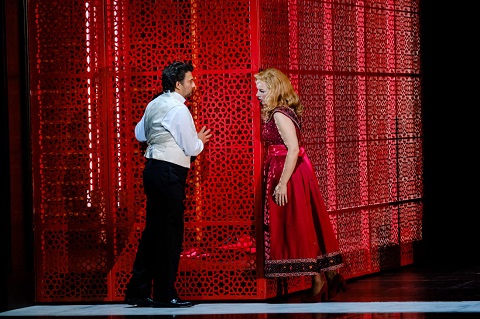
At the raising of the curtain on the 2024 Vienna production directed by Kirill Serebrennikov, opening in a modern laboratory environment, a single person in the audience can be heard on the live ARTE transmission voicing their disapproval before a single note has been played, not even waiting to see what the director's intentions are, presumably since it doesn't look like it is going to correspond with how he personally feels it should be, showing no regard for what anyone else thinks. It's clearly someone either seeking attention or ignorant about the creative team involved at this production at the Wiener Staatsoper and the nature of opera itself as a modern progressive art form. Probably all of the above. Personally, I find Serebrennikov a director of interest from past productions of Wagner (Parsifal in Vienna, Lohengrin in Paris). And if the lone booer has any sense of shame, he ought to be humiliated at the conclusion that reveals itself as a thoughtful challenge to the fetishisation of the past set against the imperatives of the present.

Serebrennikov's version of Don Carlo is undoubtedly convoluted in its treatment, adding additional levels to an opera already filled with contradictions and contrasts. Using mirror images with actors in authentic period costume doubling for their counterparts in the present day, the director actually manages to present the attraction of the historical costume drama element of the work, while making the romantic and emotional content of the personal drama work on a contemporary human level, furthering and deepening those contrasts and contradictions that fire the drama. Despite the contemporary setting appearing to be of lesser significance than the war and political events within the royal court of King Philip II in the mid-16th century, Serebrennikov also successfully finds a way to make this distant and for many, obscure historical period meaningful and contributing to the turmoil faced by the figures in the opera. 

The laboratory that so appalled at least one member of the Vienna audience is a Costume Research Institute, where scientists are studying historical clothing and recreating the dress of the period of Philip II for their research. Elisabetta, a scientist in the laboratory, is troubled over her betrayal of Carlo by her marriage to his father, the chief director of the Institute, who is a bit of a tyrant. Working in such an environment, the workers, scientists and costume designers at the institute perhaps then see their own lives and troubles reflected in the past, and it's interesting to note when seen in this context how much attention is brought to and importance given in the libretto to dress, appearance and elegance. Rodrigo and Eboli in an early scene even have a moment to discuss the beauty and grace of French women, while projections on a screen above the stage show fetishistic images of the costumes detail and fitting. Combined the opera and this production show that there is limited benefit in trying to understand people in the past through the costumes they wear, that the truth about what went on is more likely to be reflected in how people behave now.

What the production doesn't do then is examine the political and historical conflicts of the 16th century, and I think most of us can live with that. For Carlos, Elisabetta, Philip and indeed Rodrigo and Eboli - and through them - we experience human conflict, their stoicism to contain deep feelings and emotions against a world that puts obstacles in their path, obstacles that don't necessarily need to include the conquest of Flanders. The horror of the war there is compared here to an Asian sweatshop being exploited for cheaply made clothing, the associated environmental catastrophe it entails all for the folly of keeping the human mannequins of the western world in the latest fast fashion. Consumerism as oppression. Carlo just wears a plain T-shirt with a 'Liberta' slogan attached with sticky tape. Rodrigo's states 'Save our Land' and those messages are what is really important and it is given real force here. Mainly thanks to Verdi's score of course, but the scenes and imagery are equally as effective, the auto-da-fé enacted here on climate change activists disrupting the historical fashion show in protest against the destruction the environment. The burning here is the burning of the planet.

To be fair to the lone booer (and the few hesitant followers who later join him at the end of Act III) it's a valid question whether an opera like Don Carlo really needs all this directorial intervention to work effectively, or is the director just using the composer's masterpiece to impose his own views? That's a judgement call, but it can be both. Don Carlos/Don Carlo is a difficult opera to make work effectively, in my experience of seeing many productions of it. With Verdi and this work in particular, the true challenge in presenting the work lies more often in how well you can cast singing roles that are technically and dramatically challenging. It's a factor that is just as essential to overcome any perceived weaknesses or flaws in the production or indeed the opera itself. A weak link can be particularly critical in Don Carlos. Saying that, there is little to fault here in either performance or the director's presentation, which is more nuanced than the brief description I've provided above. The historical models, for example, are dressed up in the first half and stripped back in the second as their true selves are revealed. There are many other touches to make the historical converge with the modern, including biographical notes of the real life figures added in projections, and a context that permits a wider examination of the use and abuse of power.

There are, as I said, no real weak links in the singing either. Indeed the roles of Carlo and Elisabetta are as good as you could expect. Asmik Grigorian sings Elisabetta with her usual conviction and skilled dramatic interpretation. Joshua Guerrero's Carlo is also well-characterised and sung, again with the necessary ability and conviction. Eve-Maud Hubeaux's Princess Eboli is excellent, her confession to Elisabetta in Act III intense and tragic. There are deep emotions stirred on all sides, love and betrayal of friendship valued over position is an important aspect of the opera and this carries weight in all the principal roles. As such Rodrigo’s role is important too and Étienne Dupuis brings that out well in his performance. Only Philip II perhaps suffers from the direction. You don't get a sense that he really has anything grand at stake as he would were he genuinely a King under the yoke of the Catholic church's Inquisition while he is also facing a personal humiliation in his love life in his 'Ella giammai m'amò'. Roberto Tagliavini's singing isn't able to bring out the heaviness of the head that wears the crown.

Don Carlos/Don Carlo, in whatever incarnation, is one of Verdi's greatest works, or at least the one I always find that has real meaty issues as well as intriguing flaws and challenges that have to be creatively confronted by a stage director. It is also, despite the many revisions and versions, musically one of the composer's finest works, through composed but incorporating utterly beautiful melodies (although personally I'm less fond of the Spanish flavours) and wonderful attention and attunement to character detail and expression. It sounds absolutely marvellous here under Philippe Jordan and the Vienna Orchestra. If there were any sceptics left in the audience by the time the devastating conclusion was reached, they were drowned out by the deserved applause for a thoughtful and powerful account of this tremendous opera.


External links: ARTE Concert, Wiener Staatsoper

Tuesday, 20 October 2020

Verdi - Don Carlos (Vienna, 2020)


Giuseppe Verdi - Don Carlos

Wiener Staatsoper, 2020

Bertrand de Billy, Peter Konwitschny, Vera Nemirova, Michele Pertusi, Jonas Kaufmann, Igor Golovatenko, Roberto Scandiuzzi, Malin Byström, Eve-Maud Hubeaux, Dan Paul Dumitrescu, Virginie Verrez, Robert Bartneck, Johanna Wallroth, Katie La Folle

Vienna State Opera Live - 4th October 2020

Don Carlos, the full Five-Act French version, is probably Verdi's most ambitious work, and if it was never quite a success its flaws only add to its fascination. In the right hands those flaws don't necessarily need to be weaknesses, and like much mid-period Verdi, with judicious cuts, good singers and some creative directorial ideas, the genius of the work is very much in evidence. Unfortunately if you don't have one of those elements, or indeed all of them, you're in for a struggle with this work. With this Vienna State Opera production of the full-length French version of Don Carlos clocking in at 5 hours including intervals, it's a glorious epic nonetheless even if it seems that the director Peter Konwitschny does more to highlight the opera's flaws than find a way to make them work.

Even so, I wouldn't say that the Vienna production is a struggle by any means. It's got a cast that is hard to fault and a conductor and director who should be capable of bringing fire to the work, but rather than seek to mitigate against or even exploit the works flaws, somehow Konwitschny just seems to emphasise them. What is most evidently lacking however is any kind of central idea to give it purpose, drive, energy and momentum. It has moments of excitement, mainly due to Verdi's scoring and the inner fire of the work that still smoulders, but you're left with the feeling that it should be so much more. That however is a not an uncommon feeling to have with Verdi operas of this period.

It's not as if there is any shortage of themes to latch onto in Don Carlos; love versus duty, personal lives and public faces, honour versus betrayal, family, friendship, politics and religion, war and peace, wielding power over a kingdom but having no control over human feelings and emotions. Any one of these can be expanded upon and Verdi provides the means to do so with stirring music that has strong dramatic drive and character definition, even if it's perhaps not always the most subtle. The opening Fontainebleau scene in this version can provide vital context for the love that Don Carlos has for his "mother" that Verdi melodramatically characterises as incestuous, but here it feels long drawn out and emotionally distant, Byström and Kaufmann failing to igniting any genuine passion. 

Subsequent acts show little of interest or imagination, the background is plain, costumes are traditional style, the whole things very monochrome. A tree planted at Fontainebleau remains lit throughout at front of stage, a symbol perhaps of a new life, the potential of a new beginning, one that may be closer to nature, but the tree and idea never really takes root - which may be the intention. There are a few curiously exaggerated nods and winks to the audience, particularly in the dead Charles V disguised as a monk, but there is also a lot of just plain bad acting, particularly on part of Kaufmann. Don Carlos needs control, direction and purpose to find a way through the abundance of themes and personalities, and notwithstanding the strengths of Verdi's score, it just won't work if it doesn't have adequate dramatic conviction to support them.

If there's little evidence of a directorial hand in the first half, the production shows a little more ambition after the interval. Unfortunately those are more in the nature of little touches rather than serving any grand scheme or purpose, as if to give the audience a moment's respite from the heaviness of the melodrama. This is particularly evident in the French version's unfamiliar and rarely performed ballet sequence. Entitled Eboli's Dream, it takes a more modern outlook, updating the setting to a comfortable little mid-twentieth century home. Eboli is a pregnant wife cooking for her husband Carlos when he returns home tired from work, getting ready for a little family dinner party with in-laws, the king and queen. It's played mainly for laughs, Carlos is tired and clumsy, the cooking is inevitably a disaster and they have to order in pizza. It's quite silly, but a welcome change of tone and it's always a treat to have the ballet music included in Verdi's French operas.

What Peter Konwitschny brings out then is not so much the dramatic character as emphasise the dramatic colour of the work, which being a French Verdi opera has all the range and ability of the composer in it. It may not necessarily make the best use of it, and it rather demonstrates that it is hard to match the drama with the music without it appearing very heavy-handed. Colour there certainly is though, even if some of those touches often feel distracting. In the context of a mostly through-composed opera, the Spanish colouration of the music in the friendship of Carlos and Rodrigo (and its maudlin reprises), the Andalusian gypsy music of Eboli's Veil Song and even the ballet, all feel like crowd-pleasing filler playing to convention rather than making any meaningful contribution to the drama. All are enjoyable in their own way and the production at least seeks to include them for that.

Another of those breakaway moments occurs when the opera is taken out into the foyer of the Vienna State Opera for Verdi's big choral auto-da-fé set piece, with an announcer, a film crew and photographers following the action. The heretics, looking like staff of the opera house or formally dressed members of the audience, are rounded up and beaten. Again, this is very much playing to the colour of the piece rather then illustrate it with any meaningful dramatic context. For Act IV's "Elle ne m'aime pas" ("Ella giammai m'amò" in the Italian) it's made clear that Eboli has obviously enjoyed some revenge sex with Philippe having brought Elisabeth's casket to him, only for the king to regret it the next morning. It adds a little more of a frisson to the king's condition, his conscience spiked further by the arrival of the Inquisitor, who is blind and doesn't see Eboli in his room.

If the dramatic conviction of the opera is lacking, there is at least considerable compensation in the musical and singing performances conducted by Bertrand de Billy. Surprisingly however, despite having sung this role capably before (even if I wasn't impressed by the version I attended at the Bastille in 2017)
Jonas Kaufmann appears to be showing further signs of strain. More than any minor issues with the singing, I was more surprised more by his lack of any sense of real engagement with the character of Carlos and his dilemma. You could blame the director (or revival director Vera Nemirova) for that, but either way, the cracks are showing.

Malin Byström is a fabulous singer and you can't underestimate how impressive she is singing a fiendishly difficult role, although ideally a little more force and experience is needed perhaps to really put personality behind Elisabeth. Eve-Maud Hubeaux's Eboli is fabulous, well-sung, showing plenty of personality and character. Michele Pertusi and Igor Golovatenko also give fine performances as Philippe and Rodrigo. No great revelations perhaps but regardless of any minor complaints with the production and performances, the opportunity to hear such an astonishing work performed at this level is always a treat.

Links: Vienna State Opera, Wiener Staatsoper Live

Thursday, 26 October 2017

Verdi - Don Carlos (Paris, 2017)


Giuseppe Verdi - Don Carlos

L'Opéra National de Paris, 2017

Philippe Jordan, Krzysztof Warlikowski, Jonas Kaufmann, Elina Garanča, Sonya Yoncheva, Ludovic Tézier, Dmitry Belosselskiy, Ildar Abdrazakov, Eve-Maud Hubeaux, Julien Dran, Krzysztof Baczyk, Hyun-Jong Roh

Opéra Bastille - 22nd October 2017

For anyone used to the more familiar Italian version, the rarely performed original French version of Verdi's Don Carlo/Don Carlos presented at the Paris Opera could sound rather subdued and lacking the heightened emotional state one expects for this work. Even though we are very much in the domain of the 5-Act grand opera there does however seem to be some merit in adopting a more gentle approach for the French language version. If Philippe Jordan exercises restraint in the Paris Orchestra and Krzysztof Warlikowski reigns in his usual directorial excesses, the premier league cast assembled here are at least capable of finding the necessary dynamic in the contrasts of character.

One need only read and listen to the more gentle flow of the French language libretto, composed in verse and in rhyming couplets, to see that it requires a different approach from the language of the the Italian text, which in Verdi can tend towards bombastic. Don Carlos and indeed Don Carlo should never be bombastic, since the nature of Schiller's treatment of the historical drama is more reflective and interiorised conflict, exuding an air of dark melancholy and sometimes even a bleak outlook on the nature of man.


That tone is established right from the outset in Warlikowsi's production, with Jonas Kaufmann's Carlos wandering onto a bare wood-panelled set in a state of suicidal despair, his bleeding wrists wrapped in bandages. That's not how we usually see the Fontainebleau scene in the 5-Act version of the opera - with Elisabeth already in her wedding dress alongside a white horse - but it appears that the director wants to visualise this vital but usually truncated Act as a fevered dream flashback, combining Carlos's Act II gloomy meditations on death at the tomb of Charles V in the cloister of the Convent of Saint-Just, with his disappointment over the outcome of his expected engagement to Elisabeth.

Aside from a rather more abstract-modern presentation of the scenes in the locations and costumes, Krzysztof Warlikowski and dramaturgist Christian Longchamp don't apply any other real conceptual twists on the subject. The sets are elegant and economic with the space of the Bastille stage, but yet they can be suitably grand when the occasion demands. The auto-da-fé scene for example manages to get a sense of the horror with an overlay of a silent-era film projection of a giant devouring a man. It's simple and impressive, without having to fall back on clichéd imagery or mannerisms (or indeed Warlikowski-isms) that nearly always fails to effectively represent this scene in the opera.

On the other hand, Warlikowski's usual mannerisms are missed here, or at least his ability to bring focus and draw attention to the complex levels of a work like Don Carlos is lacking. The intention is to lay bare the Oedipal and Hamlet-like Shakespearean side of Verdi's reading of Schiller, with all of its character contradictions and relationship complications, but it never really gets to the heart of the work, much less find any way of overcoming the opera's dramatic and structural weaknesses. The inclusion of the indispensable Act I Fontainebleau scene and the exclusion of the dispensable ballet scene go some way towards making the work flow better, and greater emphasis is well placed on the dominant father aspect of the work by focussing on Charles V, but the roles of Rodrigo and Eboli add other dimensions that aren't as fully explored. At least, not in the dramatic context.


In terms of singing it's another matter, and ironically the performances of Posa and Eboli by Ludovic Tézier and Elina Garanča are so good that they balance out (and almost overshadow) the focus of the production on the patriarchal power play by restoring some measure of importance on the work's consideration of love, friendship, jealousy and rejection that their characters provide. The weight of those aspects of the work are almost all expected to be covered here by Philippe II, and Ildar Abdrazakov does give an outstanding performance, but it neglects the riches that can be found in the different nuances provided by Eboli and Rodrigue.

Perhaps however the strength of those performances, in conjunction with Philippe Jordan's subtle handling of musical dynamic, are enough to convey everything that is required. It certainly felt like it. Ludovic Tézier's smooth baritone is full of heartfelt expression that suggests a warm and loyal friendship with Carlos, but with an edge that revealed some of his personal conflict in his duty to the King and his belief in the Flemish cause. His performance of Rodrigue's death scene was loudly applauded and it seemed to me that he deservedly got the longest and most enthusiastic acclaim at the curtain call too. Elina Garanča wasn't far behind him though. With great stage presence and tremendous delivery, her Eboli carried force of conviction and yet tenderness and regret. Her 'O don fatale', summing up her predicament, was pretty much devastating.


That kind of conviction and delivery carried through to the back of the hall to those of us in the cheaper seats, and that was the case also for Ildar Abdrazakov. Without underestimating the greater challenges that the roles of Carlos and Elisabeth carry however, the same can't be said with as much certainty for Jonas Kaufmann and Sonya Yoncheva. Kaufmann's usual strength and force is all there and his delivery impassioned, but he doesn't have the volume to fill a hall the size of the Bastille. The detail of his performance worked much better I found when I subsequently watched scenes from the streamed performance of this Don Carlos on ARTE. Sonya Yoncheva wasn't perfect in her delivery either and felt somewhat detached, but I personally have never heard anyone sing the challenging role of Elisabeth perfectly, and Yoncheva at least is one of the best I can recall.

Such challenges and imperfections are perhaps in the nature of Don Carlos, and may indeed be the very reason for it remaining always such a fascinating work, since Verdi's venture into French grand opera neither fits to the tradition of Meyerbeer, Halévy and Auber, nor is it merely an Italian opera in French guise. Warlikowski and Jordan succeed then in some areas and fail in others, which is perhaps an inevitability with this work. You can't fault a cast as impressive as this either - you really can't do justice to Don Carlos without a cast as stellar as this - and Jordan's French touch does reveal other interesting aspects of the work. With its complicated blend of history, personal drama and the fantastical and that problematic ending that I've only seen Robert Carsen approach in any way half-convincingly (although it required much manipulation in his 2016 Strasbourg production), the perfect or definitive version of Don Carlos still remains elusive.


Links: L'Opéra de Paris, ARTE Concert

Monday, 8 May 2017

Verdi - Don Carlo (Strasbourg, 2016)


Giuseppe Verdi - Don Carlo

L’Opéra National du Rhin, Strasbourg - 2016

Daniele Callegari, Robert Carsen, Stephen Milling, Andrea Carè, Tassis Christoyannis, Ante Jerkunica, Elza van den Heever, Elena Zhidkova, Patrick Bolleire, Rocío Perez, Camille Tresmontant

Culturebox - November 2016

There are some dark operas in the Verdi catalogue - Macbeth and I due Forscari are certainly there and Simon Boccanegra is no bundle of laughs - but none of them are as bleak and pitiless as Don Carlo. What makes it so is that each of the characters is offered the opportunity of love and friendship, but either happiness is snatched from them or they consciously spurn it and make other choices that they feel are for a greater good. None of those choices work out well, but the fact that it could have been so different is what gives the opera a darker edge that Verdi fills with music of overwhelming melancholy and regret.

OK, we get that Don Carlo is dark, so perhaps we don't need Robert Carsen to emphasise it so heavily in his production of the 4-Act Italian version at L’Opéra National du Rhin, Strasbourg. Carsen's idea is to establish the uneasy alliance between the oppressive political regime of Philip II and the merciless persecution of heretics by the Inquisition of the Catholic Church as a kind of death cult alliance. Everyone is dressed in black, wearing dark suits or soutanes, and the set is a black box. Rather more than just visually darkening the work down however, Carsen has a few other ideas and changes that take this a little further.

It's risky to tamper with individual motivations, inner conflicts and the complex inter-relationships in Don Carlo. They already sit on a delicate balance, so you really don't want to be adding additional levels onto them. Verdi's Don Carlo is based on a work by Friedrich Schiller, but Robert Carsen in his Strasbourg production finds a parallel in the work with another of Verdi's favourite writers: Shakespeare, and specifically in Hamlet. In the version without the Fontainebleau scene, Don Carlo opens with the funeral of a king - Carlo's grandfather Charles V - and we see a brooding young man dressed in black with only a skull for company on the stage, reflecting on mortality, as a ghostly voice seemingly from the dead king, calls out a warning to him.


Using Hamlet as a reference, Carsen in this way establishes the tone and the nature of the work as directly and quickly as possible. Without having recourse to the Fontainebleau scene, Carsen's evocation of Hamlet establishes that the primary reason for Carlo's despair is not the death of Charles V, but a more personal conflict and quasi-incestuous sentiments about his father marrying his new 'mother' Elisabeth, the same woman who had previously been promised to him as a bride in the excised Fontainebleau scene. It's an act of a ruler exercising power in the interest of consolidating that power rather than for the sake of the people, and Carlo's response is the only sane one in such a situation; madness. It leads to Philip having to banish Hamlet-Carlo to a foreign land after he takes up arms against him, and even consider whether he might not be justified in killing his own son.

So, all in all, whether you think all the blackness on the stage is necessary, you have to respect that it is justified by the tone of the work itself. And if Hamlet is used as a reference, it is not a framework that can be imposed on top of Don Carlo. The very idea is absurd and surely unsustainable. Rather, Carsen uses Shakespeare's imagery to draw attention to similar themes in Verdi's Don Carlo, taking it away from the historical and even the personal - the Italian version without the Fontainebleau scene facilitates this - and putting the focus instead on the social and political, on questions of state oppression, on religious fanaticism, and the not insignificant application that this has for today.

Verdi, it's true, wasn't a big fan of religious authoritarianism, so the emphasis in the Opéra National du Rhin production of the state being a theocracy that facilitates the will and the violent means of the church is a relevant one, and it's one that Verdi's dark drama is able to sustain. "Death in my hands can reap a harvest", the Grand Inquisitor tells soutane-robed Philip, and together they represent a formidable force of oppression. The crime of the Flemish delegates when they are brought to the court is not insurrection but heresy for not holding to the faith of their Holy Ruler. The auto-da-fe scene, often so difficult to stage convincingly, is effectively handled by Carson. It's the books of the heretics that are burnt in a conflagration, while the black-robed priests execute the hooded kneeling heretics with pistols.

Carsen consequently brings a strong and meaningful focus to the work. It's not only about state oppression but it's also about crushing personal sentiments for the sake of belief in something greater. It's not just Carlo and Philip who have to struggle with the dilemma of killing someone in their own close family. Elisabeth and Carlo's happiness counts for nothing in the greater scheme of things: even Elisabeth believes that her marriage to Philip as the king is more important. Eboli too belatedly recognises the mistakes she makes. There is perhaps only one beacon of light in Don Carlo where integrity remains unsullied by adversity and ambition, and that's Carlo's friendship with Rodrigo. You think so? Think again.


It's one thing to use Shakespeare's Hamlet as a working template to bring out other elements from Don Carlo, but Robert Carsen's biggest intervention is in his manipulation of the ending and its subversion of the friendship between Carlo and Posa. Posa controversially doesn't die here at the end of Act III while visiting Carlo in prison, but his assassination is faked as part of a plot of the church to overthrow Philip and assume total power with Posa as its figurehead. We're not dealing with history here in Carsen's production, and there's precious little historical accuracy in Schiller or Verdi's version anyway, so that matters little. What matters more is finding a way to making the huge flaw of the ending of Verdi's opera work in a more convincing manner, without undermining the essence of the work and the themes it considers.

At the very least Carsen delivers a shock that is greater than the disembodied voice of Charles V bringing about a deus ex machina. Here Carlo looks on aghast as the uprising falters not at the voice of a ghostly monk, but the voice of the Grand Inquisitor - the people bowing before the far more earthly might of the military arm of the church. But what of the inviolable friendship between Carlo and Posa? Well, it wouldn't be the first time that the sincerity of that friendship has been questioned, and indeed the rousing theme of the two men can sound rather hollow and false in the midst of all the through-composed darkness, so all Carsen is doing is taking this further and pushing the tone of the work towards its natural (as opposed to supernatural) conclusion. At the very least, it can't be faulted for shock impact.

Nor can it be really faulted for musical performance. Daniele Callegari strikes a suitable sombre tone that matches the tinta of the score and the minimal bleakness/blackness of the production, but it never pushes it into heavy overstatement. There's a great deal of light and shade in Verdi's score that belies the melodrama of the situations, and Callegari finds that balance well with the orchestre philharmonique de Strasbourg. As is often the case with such a challenging work, the principal roles pose a few problems to Stephen Milling's Filippo II, for Andrea Carè's Don Carlo and for Elza van den Heever's Elisabetta di Valois, but they still without question get across the essence of the predicament in those confrontational moments that Verdi brilliantly creates. Tassis Christoyannis is an impressive duplicitous Posa, and Ante Jerkunica an imposing Grand Inquisitor. I was most impressed by Elena Zhidkova's Princess Eboli, who delivers a stunning "O don fatale" and manages to gather more sympathy for her predicament and actions than is more often the case.

Links: L’Opéra National du Rhin, Culturebox

Tuesday, 3 March 2015

Verdi - Don Carlo (Vienna, 2015 - Webcast)

Giuseppe Verdi - Don Carlo

Wiener Staatsoper, 2015

Marco Armiliato, Daniele Abbado, Ferruccio Furlanetto, Stefano Secco, Dmitri Hvorostovsky, Maria Pia Piscitelli, Béatrice Uria-Monzon, Eric Halfvarson, Ryan Speedo Green, Margaret Plummer, Jinxu Xiahou, Simina Ivan

Wiener Staatsoper Live at Home - 25 February 2015

 
There's not really any room for half-measures in Verdi's Don Carlo. You're already at a disadvantage when you produce the 4-Act Italian version, losing the whole of the First Act love story at Fontainebleau, which means you have to gain emotional involvement for Don Carlo's romantic inclinations for his step-mother via other means. Verdi's terrific writing and characterisation goes some way to making this work, but it needs very strong singers indeed for both Carlo and Elisabeth to get it fully across. Vienna's 2015 revival of Daniele Abbado's production has that, and even more besides on the singing front. Unfortunately, it's somewhat lacking on the set design and stage direction, and in a work of total opera like Don Carlo, a weakness in any area can undermine the whole.

The fact that this doesn't prove to be the case in Vienna is a testament to just how good the singing and musical performances are here. That's no mean feat in Don Carlo, which has any number of critical roles, each of them with complex personalities that show different sides of that personality depending on the person that they are with at any given time. It doesn't just place demands on individuals, it requires them to interact well in the various relationships and situations with the others around them. Being a father to Carlo, King Philip II shows a different side of his personality from the one that he shows to Elisabeth as a husband, and a different one again from how he interacts with the Grand Inquisitor. As you might expect. It's how those other people relate to the king in those situations depends in turn on their relationships with each other, and that creates a complex web of conflicts between public and private faces, between love and friendship, when those boundaries become blurred by situation and circumstance. This is where the real drama of Don Carlo lies, and Verdi's remarkable writing lays them bare.

In theory then, the decoration of the set should really be neither here nor there. If you can get across the multi-faceted nature of the situations and the characters, and have singers of sufficient skill and experience to do that, you would think that would be enough for Don Carlo. It isn't nearly enough. Usually. A simple stripped-back set might work well for Simon Boccanegra, as in Vienna's recent production (although, as here, it also had the secret weapon of Ferruccio Furlanetto alongside the incomparible Leo Nucci), but the stage direction there was a lot more subtle than it appeared. Don Carlo however is not a work that benefits from a less-is-more approach. Even in its lesser 4-Act version, it's still grand opera, and it should be grand on every level. That doesn't preclude subtlety, but bold flourishes are required in the characterisation as much as in the setting.


The first half of Daniele Abbado's production for Vienna fails to hit those big dramatic points, for all the fine efforts of the cast. The first two acts are very much about the public face, opening with religious rites and funeral, with the added flourish of the ghostly 'Friar' who turns out to be the spirit of Charles V. There are big royal ceremonies, proud displays of friendship and loyalty, stirrings of rebellion and even a showpiece auto-da-fé scene, all of which should give the impression of great political, regal and religious forces. If nothing else, the grandeur of the first half should at least provide a strong contrast to show the more human side in the second half, where personal weaknesses and conflicting interests and murmurs of rebellion cause huge fractures that threaten to expose the weaknesses of those institutions and bring down the whole delicately woven fabric of Philip's reign.

There's very little that impresses about the set in Act I and Act II. It is literally a box, with a bare wooden stage floor and unadorned walls, with no doors, just panels that open to let people in. Occasionally, we get a sense of location, with a skylight opening up, with a slight variation in colouration or lighting that suggests an exterior, but mostly it's a bare stage and basic lighting. Free movement is restricted somewhat by three cables that one presumes will lift to create a new scene at some point. They do so most effectively to create Carlo's prison in the second scene of Act III, but it's a bit much to have them impinge upon the rest of the set for such a short if nonetheless important scene. Most disappointing of all, the auto-da-fé scene falls well short of being impressive, a few figured dropped down onto the floor while a bale is lit behind them. Seen from a lower angle than the camera adopts, it might have been more effective, but probably not much more...

The singing, at the very least, rises superbly to the demands of Verdi's remarkable score, and in one or two cases is even great. I'm referring evidently to Ferrucio Furlanetto, who has performed as Philip in Don Carlo many times, and there are few who can compete with him. The tone and timbre is still wonderful, his control and delivery is impeccable, but more than just technically good or even just consummately professional, he brings real artistry and personality to the character. Eric Halfvarson's Grand Inquisitor is also excellent, and, following on from a great 'Ella giammai m'amo' where the king expresses his private griefs and fears, the duet/duel between these two great forces of Church and State at the start of Act III becomes a real tussle of wills that sets the tone for what is to follow.


If the first half felt weak and let down by the staging, this kind of opening really galvanises the second half, and it doesn't look back. Marco Armiliato manages to raise the orchestra up to a new level along with the dramatic developments, and one or two of the other performers seem to pick up their game as well. And, with Verdi's simply astonishing management of the developing situations, they really need to. Most impressive is Dmitri Hvorostovsky, who gives a typically earnest and intense performance that is exactly what is required for Rodrigo. The challenging role of Elisabeth is handled extremely well by Maria Pia Piscitelli, who gives it dramatic force as well as dealing with the tough singing requirements. Béatrice Uria-Monzon is also a charged Princess Eboli, again perfectly in line with the tone of the work and the strong presentation here.

Don Carlo has a tough time living up to the title role in the opera alongside such personalities, and if Stefano Secco isn't quite up to the same level, he still sings it with unfailing Verdian lyricism across the whole four acts. Carlo is pretty much a constant throughout the opera and, as such, his interaction with each of the other characters is vital to the success of the whole. With Marco Armiliato drawing all that together musically in the second half, and with each of the other characters at full drive, the nature of the interaction and its significance all falls into place to impressive effect. The balance of internal conflict and interaction with the external situation in the second half takes on a force of its own independent from the direction, or at least rendering its weaknesses less of an issue as the opera makes its way to its chilling conclusion.

The Vienna State Opera's Live in HD programme continues in March with live Internet broadcasts of Halévy's LA JUIVE, Bellini's I PURITANI, Massenet's WERTHER, Verdi's LA TRAVIATA and AIDA.  Details on these productions and how to view them can be found in the links below:


Links: Wiener Staatsoper Live Streaming programmeStaatsoper Live at Home video

Sunday, 11 January 2015

Verdi - Don Carlo (Turin, 2013 - Blu-ray)

Giuseppe Verdi - Don Carlo

Teatro Regio di Torino, 2013

Gianandrea Noseda, Hugo de Ana, Ramón Vargas, Svetlana Kasyan, Ildar Abdrazakov, Ludovic Tézier, Daniela Barcellona, Marco Spotti, Sonia Ciani, Luca Casalin

Opus Arte - Blu-ray

The familiar Verdi themes of love versus duty, loyalty and betrayal, the abuse of power versus individual liberty, fathers against sons, all spiced up with a good bit of melodrama are all there in Don Carlo, and taken to even greater heights than in any of composer's previous works or even his subsequent later masterpieces. It was undoubtedly the challenge of taking on all those themes from Friedrich Schiller's drama that attracted Verdi out of semi-retirement, and at this stage late in his career the composer's ability to present a more mature, nuanced account of entwined personal and political ambitions is astonishing. It's as if all the previous works have been pulled together into one great work that bears all the might and brilliance of Verdi at his best.

First presented in Paris in French as a five-act grand opera, the challenging length and nature of the work meant that it would undergo several further revisions, but in whichever version it's presented, Don Carlos or Don Carlo remains one of Verdi's greatest works and one of the most impressive spectacles in all of opera. Each version however also brings with it considerable challenges as far as staging and casting. The 2013 Teatro Regio di Torino production of the 1884 four-act version of the Italian Don Carlo is impressive enough on spectacle and in the manner in which it presents the themes of the work, but the music and singing are not quite up to task here.


The choice of the 1884 version obviously has an impact on the direction the production takes. Gone is the whole of the original Act I, where Carlo first meets and immediately falls in love with his promised bride Elisabeth of Valois in the gardens of Fontainebleau. It's not uncommon for significant prior events to be omitted in an opera (even if the jarring introduction successfully remains in Verdi's previous opera La Forza del Destino), but in this case, the whole tone of Don Carlo is coloured by the exigencies of state that no sooner introduce the happy young couple than tear them apart in order for Carlo's father Philip II to marry Elisabeth himself. Opening with Carlo and Rodrigo shifts the emphasis from love story to brotherhood, family and duty, but with Verdi's ability to tie it into Schiller's mix of politics and religion, this is still highly charged drama.

This tone comes through most successfully in the Turin production, particularly in this version, which opens with a funeral and an apparition rather than the romantic encounter of the five-act version of the work. The monumental size of the sets, the stone pillars, the religious backdrops, the formality and richness of the costume designs, all contribute to a sense of deeply serious intrigue and dark drama, which is how Don Carlo ought to appear. Everything about the production design here gives that impression of grandeur and intensity of purpose that matches Verdi's vision. The stage direction and choreography are good - a little theatrical, but not stagey, it plays to the dramatic nature of the work itself. As a spectacle it's marvellous, looking every inch the ultimate expression of complete opera, which in many ways Don Carlo is.

While the epic scope is all there on the stage, the level of nuance and psychological probing that needs to be expressed through the playing and the singing just doesn't live up to the exceptional demands of Verdi's score here in the Turin production. Don Carlo is a heavy work, it's dark and oppressive, but even so Gianandrea Noseda's management of the pace and tone of the work is quite leaden, never finding the light and shade that is there also. Even within the dark palette of the work, there are deeper undercurrents and themes, complex characterisation and different facets to each of the personalities in their public and private faces, that interplays with one another and impacts upon the outcome of the drama.

To cite just one example at a key point in the opera, the revelation of the nature of his marriage to Elisabeth followed by Philip II's meeting with the Grand Inquisitor contains a wealth of suggestion and implication. Verdi's score switches between the personal and royal, between political and religious in a way that deepens the sentiments and raises the stakes, but it also brings in and makes you aware of the off-stage characters, of the implications this scene will have in determining the fate of both Carlo and Rodrigo and for how it will impact on Elisabeth, not to mention the wider state of the world. There's a lot demanded of all the singers then, but despite the fact that the cast here is an exceptionally good one, it's hard to feel that any of them are right for the roles, or at least the roles as they are defined in this production.


Ildar Abdrazakov comes out best, his singing capable, controlled and authoritative as Philip II. Ramón Vargas' voice however has lost some of the former force and that's needed for Carlo. He's at his best alongside Ludovic Tézier's Rodgrigo, forming the close brotherhood that is at the heart of this version of the opera, but neither performer is able to bring any range or subtlety to the characterisation that is required elsewhere. Elisabeth is much too big a role for Svetlana Kasyan, and - other than her heart-wrenching cry that closes the work so dramatically - her wavering pitch rarely matches the force of the sentiments that are expressed. Even the wonderful Daniela Barcellona is pushed by the excessive demands of this work, but her Pincess Eboli at least hits all the points of the lovestruck woman's rejection turning to jealous fury and then regret, agony and self-loathing. Even if they are unable to get across the full measure of Verdi's brilliance, the Turin production is still impressive, and you are never in doubt that this is one of the greatest creations in all opera.

The production looks stunning in High Definition on the Blu-ray release, the image crystal clear, the sets looking impressive with bold colouration and strong contrasts. The singers are not wearing radio mics so it can be a little echoing, but there's a rich dark tone to the orchestration that is warm and enveloping, with good presence in the DTS HD-Master Audio 5.1 mix. There's a deep low-frequency boom on the surround mix which has most impact during the Grand Inquisitor scene. The only extra feature on the disc is a Cast Gallery, but there's an essay on the creation of the work and a synopsis in the booklet. Subtitles are in English, French, German, Japanese and Korean.

Tuesday, 24 January 2012

Verdi - Don Carlo

Giuseppe Verdi - Don Carlo
Bayerische Staatsoper, Munich 2012
Asher Fisch, Jürgen Rose, René Pape, Jonas Kaufmann, Boaz Daniel, Eric Halfvarson, Steven Humes, Anja Harteros, Anna Smirnova, Laura Tatulescu, Francesco Petrozzi, Evgeniya Sotnikova, Tim Kuypers, Goran Juric, Levente Molnár, Christian Rieger, Christoph Stephinger, Rüdiger Trebes
Live Internet Streaming - 22 January 2012
It’s become popular of late, even more so with the recent 150th anniversary of the reunification of Italy, to view Verdi’s operas less in the historical period of their setting than in the time and the politics of their composition. Dealing with power, religion, the rule of fear and the merciless suppression of revolutionary elements that threaten the prevailing authorities, Don Carlos in particular fits in very well with the complexity of the political situation during the Risorgimento, but then it was undoubtedly meant to. If this production of Verdi’s magnificent 1867 Five-Act Grand Opera for the Bayerische Staatsoper in Munich doesn’t make overt reference to the Italian political situation of the time, it at least fully draws out those elements that Verdi, a prominent figure in the Risorgimento, raises in relation to the exercise of power.
At the time of the opera’s composition in 1866, the unification of Italy was still underway but unresolved with regard to the position of the Papal State in the new nation, and it wouldn’t be until 1871 that Rome finally became part of the new Italy and its capital. The writing of the opera coincides also with the Papal Syllabus of Errors 1864 that resolutely set the Catholic church in opposition to those revolutionary ideals of freedom of speech and religious tolerance, and there is consequently a strong anticlerical stance in Don Carlo that also reflects Verdi’s complex relationship with the Church. The Bayerische Staatsoper production, broadcast live on the internet on the 22nd January 2012, uses the more commonly performed Italian version of the opera that was originally written in French, and judging from the lack of prelude and extended prison scene, it would appear to be the original rather than the revised version of the opera. The production focuses less on the romantic element of the story at the centre of the opera between Don Carlos and Elisabeth – their unexpected love for each other at an arranged marriage of political convenience cruelly dashed by the decision of Carlo’s father Philip II to marry Elisabeth himself – and instead places emphasis on the unjust wielding of power by an old conservative establishment and the denial of liberty that this represents.
The staging, if it is rather stark and dimly lit throughout, reflects Carlo’s deep despair at the turn of events which seems to be less to do with romantic inclinations here than a deeper personal crisis at being rendered powerless to control his own destiny by higher powers, one that he attempts to restore through his subsequent throwing himself into the affairs of the Flemish struggle. Stark it may be, but two elements dominate the set throughout and have an important influence over the whole tone of the production. The first is a huge crucifix that hangs over the setting of all five acts, whether it’s the Forest of Fontainbleau, the Cloister at San Yuste, the bedroom/study of the King or a prison cell, its presence dark and oppressive (like much of the score) rather than comforting, and the second is the image of the Friar/the ghost of Philip’s father, who is not only a brooding ambiguous figure in the opera, but a hooded image of him holding a skull also materialises in the background, usually at the beginning and end of acts, again with religious significance for death and the afterlife.
There is only one point in the opera where neither of these images are present, and that is during the auto-da-fé scene at the end of Act III, but the only brightness there is here is cast by the flames of burning heretics condemned by the Grand Inquisitor, and a garish procession of tableaux vivants depicting Catholic iconography in all its glorious bloody violence. It’s the one scene in the opera that strives to make a big impression and, coming as it does during Verdi’s famous March and Chorus at the Grand Finale of Act III, it’s meant to be a powerful sequence, one where Don Carlo finally rebels and is moved to political activism against the cruelty of the ruling powers. Everything about the production, though it may not be pretty to look at, consequently is completely in service to Verdi’s themes and works to put the emphasis in all the right places. Even the division of the opera with the two hours of first three acts ambitiously played without an interval (the basic setting allowing for this), allows the division between the two halves of the opera to be all the more strikingly contrasted.
This, of course, is a vital aspect of the whole opera, the divisions not just being political, but between love and duty, between the personal and the public faces presented by each of the figures, and by the changing nature of their relationships to one another. This aspect was magnificently drawn out in last season’s production of Don Carlo at the Met, particularly in the fine acting of the principals, but while there is less nuance in the acting in this production, the singing is of a sufficiently high standard to convey everything that is implicit in the libretto and the score. Most impressive is Rene Papé, whose first words in the aria ‘Ella giammai m’amo!(“She never loved me!”), coming as they do directly after the interval, typify that divide in the opera and the characters, the merciless authority that Philip yielded in the first half, now seen in private as a man who may wear a crown and can bend others to his will, but would give it all up to be able to understand and sway the human heart. Pape’s terrific performance makes Philip’s dilemma real – that there is a higher power, albeit in the earthly guise of the Church, that even he must obey – his delivery of the aria revealing the humanity beneath the hard surface that is buckling under the demands of duty in such a way that one can’t help but sympathise with him.
The same conflicts, and the dark fatalism that underlies it, are likewise brilliantly expressed in the main arias of each of the figures, in Eboli’s Act IV ‘O don fatale’, wonderfully delivered by Anna Smirnova; in Elisabeth’s ‘Tu che le vanità conoscesti del mondo’ (“You who knew the vanities of the world, and enjoy in the tomb profound repose”), another strong performance from Anja Harteros, where she concludes that “the heart has one desire: the peace of the grave!”; and in the figures who indeed take that idealism to the grave with them – Rodrigo and Carlo, in the belief that they will find a better place for them in the afterlife. Jonas Kaufmann may seem to make less of an impression here than he usually does, but Carlo indeed is not a leading role that takes centre stage. He’s the catalyst by which we define the divisions and the conflicts within each of the characters, an idealist who himself is defined by and at the mercy of those forces that are greater than himself, whichever direction he turns.
Kaufmann doesn’t seek to make Carlo any more romantic or heroic than he is, remaining within the defined limits of the character, but within that – as written and scored by Verdi – there is a great deal of development that can be seen to reach a peak at the opera’s finale. Here Kaufmann’s powerful delivery and the considered performance of the role shows the true quality of his voice and his ability to suit the demands of a thoughtful and well-performed production of Don Carlo that strikes a perfect balance in every respect to Verdi’s arrangements and their intentions.

Monday, 20 December 2010

Verdi - Don Carlo

Giuseppe Verdi - Don Carlo
The Metropolitan Opera, New York
Yannick Nézet-Séguin, Nicholas Hytner, Marina Poplavskaya, Anna Smirovna, Roberto Alagna, Simon Keenlyside, Ferruccio Furlanetto, Eric Halfvarson
The Met: Live in HD - December 11, 2010
Verdi’s Don Carlo is a great example of how opera has the power not only to transform and heighten reality, but also to evoke and elevate the nature of human emotions and aspirations in a manner that no other artform can match. It’s not that the original historical circumstances of the real-life Don Carlos need a semi-fictionalised dramatisation, being rather interesting in their own right. Elisabeth de Valois was indeed betrothed to the Spanish prince Don Carlos but eventually married to his father King Philip II, a union between the French and Spanish royalty that would lead to the peace treaty of Cateau-Cambrésis in 1559. Where real-life is stranger than fiction is the fact that Elisabeth was actually 13 years old when she married the 32 year-old King, while Don Carlos, aged 14, was a lame, epileptic hunchback with a stutter.
Some creative licence is required then upon the part of the composer and the librettists (Joseph Méry and Camille du Locle), and some suspension of belief is required on the part of the audience to the love-at-first-sight encounter between Carlo and Elisabeth in the forests of Fontainebleau at the beginning of the opera, but it is all towards a greater good and a deeper emotional truth. Of course, it’s not just opera that plays fast and loose with historical accuracy for the sake of drama and art – one need look no further than Shakespeare, or indeed Friedrich Schiller, whose original play is adapted in Verdi’s version of the story of Don Carlo. The encounter between the two young people and the love that briefly inflames them is only the starting point for the great complexity of emotions and conflict that exists between no less than six principal characters, each of them with distinct ambitions and personalities, each of them with different facets to those personalities depending on the person they are dealing with. It is here that opera goes to places that other art forms can’t reach.
It is not common for there to be so many principal characters is an opera and Don Carlo is consequently Verdi’s most complex and sometimes difficult opera – at three and a half-hours long, it is not quite as accessible in its subject, themes or its musicality for example, as the more popular Verdi operas like La Traviata or Aida. Simply listening to Don Carlo on CD isn’t enough to reveal its layers of complexity, and it’s certainly an opera I’ve struggled with in the past for those reasons. Seeing it performed live on stage, undergoing particular interpretations in performance and staging, will bring out the dramatic power of the opera better, revealing how well the dark tones of the music work with the deep brooding performances, but, personally speaking, The Metropolitan Opera’s latest production (a co-production with the ROH, Covent Garden and the Norwegian National Opera and Ballet), broadcast live on December 11, as part of The Met Live in HD’s 2010-11 season to cinema theatres worldwide, was a complete revelation of the opera’s qualities.
What can seem like inconsistencies in the behaviour of the characters and in the performances of the singers, is revealed in this powerful but nuanced production to reflect the multifaceted nature of the characters, their changing moods and temperaments, and the duality of their inner conflicts between duty and their own personal desires. And, my goodness, related to the political turmoil in Europe in the 16th century, taking place between major historical figures and royalty with their duty towards their citizens, and with conflicting political, religious and personal aspirations and ambitions, those are drives on another scale entirely. The sweep that uplifts Don Carlo in his love for Elisabeth at the start of the opera (a relationship that reaches Greek mythological proportions when she becomes his "mother"), only plunges him deeper into despair and to almost dying at the loss of that love in her marriage to his father.
That same dynamic can be seen in each of the character’s own personal struggles, which is impressive enough on this kind of scale, and in so many principal characters, but it is infinitely more complicated when there is interaction between them. A good performance of the opera, mainly in the singing, can bring out subtle nuances of the different levels that the characters are working on, but it also requires strong acting, and that was assuredly in evidence here, particularly on the part of Marina Poplavskaya as Elisabeth, and the most historically complex character of King Philip, marvellously interpreted by Ferruccio Furlanetto. If there were any weaknesses in Poplavskaya’s singing, they were minor and to be expected for a young singer making a name for herself, in a technically difficult role. This was however more than made up for in an impassioned and superbly acted performance that relied heavily on glances and body language as much as in what was said, particularly when the two often contradict one another. Such subtlety can only be conveyed fully when the music is there to support it, and Verdi’s scoring is magnificent in this respect, contributing just as significantly to the definitions of the characters, and that was equally effectively achieved in the orchestration under the direction of Yannick Nézet-Séguin.
Even so, no matter how good the production and the performances, even watching this live in the theatre, you are not going to pick all these qualities up from a seat at the back of the stalls, and it’s here that Opera Live in HD comes into its own, picking up little details in the gestures and expressions of the singers in close-up, emphasising the framing and positioning of the characters in relation to one another on the stage. Nicholas Hytner’s staging is perhaps not as impressive as other Met productions this season, but it succeeds nonetheless in bringing the elements effectively together. One’s appreciation of the efforts put into the production are deepened by the interviews with the cast in the intervals, literally, just as they come off the stage, and even by the behind-the-curtains looks at the stage-hands getting the huge sets into place for the next act. From an eye-catching and ear-splitting opening with Robert Lepage’s Das Rheingold for a new Wagner Ring cycle production, the standard was set a very high level for the Met’s new season of Live in HD broadcasts, and subsequent productions have continued to impress right up to the invigorating and buoyant Don Pasquale last month, but Don Carlo may well top them all.