Showing posts with label Josh Lovell. Show all posts

Monday, 18 April 2022

Berg - Wozzeck (Vienna, 2022)


Alban Berg - Wozzeck

Wiener Staatsoper, Vienna - 2022

Philippe Jordan, Simon Stone, Christian Gerhaher, Sean Panikkar, Jörg Schneider, Dmitry Belosselskiy, Anja Kampe, Josh Lovell, Peter Kellner, Stefan Astakhov, Thomas Ebenstein, Christina Bock

Wierner Staatsoper Live - 31 March 2022

Whether it's the inherent power and meaning of Büchner's original unfinished drama or whether it gains something more from Alban Berg's score, Wozzeck is one of the most powerful and enigmatic statements about the human condition in either form. When it comes to staging it then it almost demands a statement from the director, and Simon Stone is a director with things to say or at least a director with a distinctive vision. His production of Wozzeck for Vienna has some impressive stagecraft and singing, but whether it makes a statement or not, or whether it even needs to, there's no question that the essential qualities of the work are there for all to see.

One thing you can expect from Stone, whether directing opera or drama, is that it's necessary to make it contemporary, something that speaks of now and not of a time in the past. You would certainly expect that when dealing with the themes of Wozzeck, and not unexpectedly, the setting of this production is contemporary (in a gym, in the Underground), minimalist and faithful to the content, letting the work and the music express everything that is essential. Nothing is the different from what you would expect and yet it is at the same time unfamiliar.

The first scene is closest to what you expect to see at the opening of Wozzeck, Franz shaving the Captain, although not as a soldier for his bullying commanding officer, but working apparently at a barbershop. We can presume it doesn't need to be in a military setting for the nature of Franz's belittlement at the hands of others to be meaningful. The scene ends with the throat of the other two customers being slit open by the barbers, creating a feeling of a general sense of the absurdity and hopelessness of life, at least as it is experienced by one man, Franz Wozzeck, but also a premonition perhaps of fate of Marie.

Stone uses a tripartite rotating stage that, for the early part at least, flows continuously in a cycle were one scene flows straight through to the next, despite this being a work made up of distinct scenes that in the unfinished original did not even have a set order. The flow of one scene into the next however captures something of the abstraction of Franz's life, the disconnect between reality and how it appears in his mind, already disturbed by the experiments of the doctor, making it seem even more unreal and disorientating.

The flowing rotation is not even a linear or cyclical approach, Stone collapsing time in the scene of Marie's infidelity with the drum major, showing three versions of the scene at different time points almost simultaneously as Wozzeck puts the pieces together in his mind. The technique was used by Stone also in his remarkable Tristan und Isolde for Aix-en-Provence last year. Here there is a sense that Franz is grasping to restore some kind of sense or order upon the randomness of his life going out of control.

If there is a larger purpose to the rotating and constantly shifting scenes, aside from an incredible sense of stagecraft of Robert Cousins to rapidly change the sets with fluid ease, it is this idea of seeking to impose structure while time and life is moving faster than Wozzek can keep up with it. All his interactions as a soldier, as a father, in a military or family unit seem to be a search for something to grasp onto, guide him and show him the way out of his setbacks and troubles. Marie likewise has the Bible and religion to turn to for order and meaning, but what she reads in it seems to offer no comfort.

Stone's approach is effective then, but it's also open enough that any criticism you might have of the stage setting and his direction within it could also be said to work in its favour. Some might see the plain white walls of basic sets as somewhat cold and sterile - in complete contrast for example to William Kentridge's more elaborate approach (Salzburg, 2017) - but the sterility and emptiness of the white rooms, contrasted with the overgrown scenes of disorder in nature - could also be seen to reflect a world that offers no comfort to Franz. As a statement of futility, the final depiction of the dead body of Franz being lifted on a crane out of a cistern is certainly suitably bleak.

The search for order and the failure to find any comfort in any kind of artificial construct is reflected too in Alban Berg's score. Meticulously and tightly constructed, with historical antecedents, it seems to offer a clearly defined structure, but the atonal, unpredictable progression and enigmatic development hints at the difficulties of comprehending the underlying complexities of a world when we are looking for simplicity. It's a source of constant wonder, but there is nothing comforting in Berg's music.

The Wiener Staatsoper production is conducted by Philippe Jordan and he has a good measure of the detail of Berg as well as the overall impact that it strives to achieve. The opera leaves you dissatisfied that it seems to offer no respite and no sense of resolution. It's an unremittingly bleak view of the human condition and yet at the same time it is beyond impressive that this is capable of being expressed in such musical terms. Simon Stone's production matches that, leaving you feeling that it needs something more, yet impressed at what it has been able to say at the same time.

That inevitably places considerable challenges on the two principal roles, but we have two fine performers here in Christian Gerhaher and Anja Kampe. This seems like an ideal role for Gerhaher and sings it well, bringing character and personality to the role, or humanity maybe, since it's essential to see Wozzeck as such, not as some pitiful figure, but one striving to find a place in a world that seems to be conspiring against him. Anja Kampe is also excellent, not just a foil for Wozzeck but a person in her own right with strength of character, just similarly lost and unfortunately not on a wavelength that can help him.

Links: Wiener Staatsoper, Wiener Staatsoper Live

Monday, 14 February 2022

Puccini - Manon Lescaut (Vienna, 2022)


Giacomo Puccini - Manon Lescaut

Wiener Staatsoper, Vienna - 2022

Francesco Ivan Ciampa, Robert Carsen, Asmik Grigorian, Boris Pinkhasovich, Brian Jagde, Josh Lovell, Artyom Wasnetsov, Marcus Pelz, Ilja Kazakov

Wiener Staatsoper Live Stream - 7 February 2022

I'm always hopeful that with the right team it might prove to be a revelation, but thus far I've never been totally convinced by Puccini's Manon Lescaut. The composer never seems to fully invest you in the rather disjointed drama or the opera's emotional journey, nor have I yet seen any director make a convincing case for it on the stage. The opera is not without some of the qualities that would become more refined in La Bohème and beyond, but it's just not quite there. If there's a good reason to make a case for Manon Lescaut, it's got to be in the choice of soprano, as Manon has a fine selection of arias to display her range. Vienna at least have that with Asmik Grigorian, and - for me anyway - that's enough of a reason to give Manon Lescaut another airing, even if the opera still proves unconvincing elsewhere.

Rather disappointingly, if not unexpectedly, the usually capable director Robert Carsen isn't able to find anything new to say about the work or indeed able to find any way of making work as a coherent opera. What he does manage to do is modernise the otherwise old-fashioned Belle Époque setting of the pitfalls that face a young woman of her age looking for fulfillment in life and love. Carsen doesn't vary from the idea that she can have either riches or true love in poverty but not both. As a prototype for Mimi, she rejects her brother's plan to either put her in a convent or marry into a profitable but loveless marriage, and runs away with the handsome but poor Des Grieux. She becomes dissatisfied with her choice however, and discovering that love alone is not enough, she is seduced by the big city glamour of Paris and led into a life of dissolution.

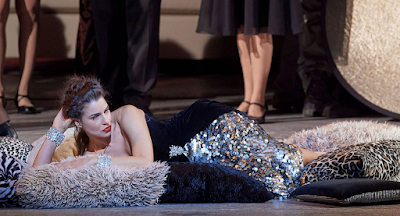
It's perhaps not the most enlightened of views of female emancipation - the third act conclusion makes her pay for it is a drastic way - but there is certainly still some truth in the idea of the seduction of glamour. The emphasis in the set design of the Vienna production is very much aligned to a more modern view of that idea. Manon arrives in Act I against the elegant curve of a mall of designer shops, but rejects all that for the penniless Des Grieux who charms her. Act II takes place in a penthouse city apartment and Act III doesn't end up in the Utah desert either, but back again in the no less soulless location of the mall of designer shops.

As we never see her living in poverty in a room with a tiny table in Puccini's version of the opera, (Massenet has a better choice of scenes from L'Abbé Prévost’s original novel 'L’Histoire du chevalier des Grieux et de Manon Lescaut in his verion, Manon) there is none of the kind of contrasts that would contribute to the Puccinian colour of La Bohème, albeit in a single milieu there. Here, the composer tries to enliven and add variety with choruses of onlookers and dancers in Act I, and with maids and hangers-on a kind of bohemian world in Act II, but he doesn't invest in it to the same emotional charge as you find in his greater works.

That inevitably feeds into the performances, with there being 'little room' for Des Grieux to show how he has been likewise seduced only by the glamour of Manon and the romance of running away to Paris. A good singer who is well directed can perhaps bring more to it, but while it is sung well here by tenor Brian Jagde, it lacks that emotional investment. Carsen tries to bring a rather more realistic contemporary view to Manon's relationship with Geronte as one now more familiar between an aspiring female actor and a possessive powerful man who wants to control her. Rather than being arrested by the police at the end of Act II for moral corruption or theft of jewellery then, neither of which are convincing in a modern context to justify transportation to America, Manon is instead brutally raped by Geronte in front of her lover Des Grieux at the end of Act II. That ought to bring more of an emotional charge and sympathy for her fate, but it lacks edge you might expect.

Perhaps that's because the opera still feels incomplete, as if there is a whole act or a few scenes missing. It never flows in any way that you can relate to the characters and what they are going through. Carsen doesn't manage to improve on that with the minimal set changes to the three acts. The curve of the stage remains at the port in Act III where Manon is due to deported. Why the soft furnishings of the previous act remain on the stage I'm not sure. The parade of women lining up to take to the prison ship walk out with handcuffs but look bruised and beaten but still hold themselves like glamorous models on a catwalk being photographed by bystanders and press on one side and Geronte's high society friends on the the other.

I suspect that Robert Carsen is trying to say something about consumerism and the commodification of women, which is at least something even if it doesn't fit all that neatly with the characterisation or musical content. Act IV, which is always the strangest scene of the opera, feeling out of step with what has come before, doesn't take place in the American desert of course, but back again in an empty mall. With mannequins in the windows of the designer shops and abandoned shopping bags and cash littering the ground, it does emphasise to some extent the commodification of women, dehumanised for the use and mistreatment of men who hold all the power.

If that idea has any validity and works to some extent in this production, it's almost entirely down to the emotionally charged music that Puccini has written for the finale and Asmik Grigorian's singing of it here. Her rise to leading roles in major European opera houses and festivals is well merited, displaying a strength and wide range that is capable of singing Wagner, Strauss and Janáček. She has no trouble with Puccini, which certainly has its own challenges particularly in Act IV, and Grigorian is fairly stunning here.

There is a lively spring to the score under the musical direction of Francesco Ivan Ciampa; a simmering fire always there, the romantic sweep of the Intermezzo, a crash of danger as love and romance turn to horror. Being Puccini, it's hard not to get swept away by the crescendos of the final Act, particularly when it is sung well. Boris Pinkhasovich, Brian Jagde and Artyom Wasnetsov give capable performances as Lescaut, Des Grieux and Geronte, but none of the roles have opportunities for much development. To be honest, I think I had already long ago given up on Manon Lescaut as a successful opera and it was only the opportunity to see Asmik Grigorian sing the role that held any interest. She doesn't disappoint, but the opera and the production do, yet again.

Wednesday, 12 May 2021

Henze - Das verratene Meer (Vienna, 2020)

Hans Werner Henze - Das verratene Meer

Wiener Staatsoper, 2020

Simone Young, Jossi Wieler, Sergio Morabito, Vera-Lotte Böcker, Josh Lovell, Bo Skovhus, Erik Van Heyningen, Kangmin Justin Kim, Stefan Astakhov, Martin Häßler, Jörg Schneider

Wiener Staatsoper Live - 14 December 2020

Yukio Mishima's novella The Sailor Who Fell from Grace with the Sea seems like an unusual work to be adapted to opera, but it's a layered work of unusual psychological complexities that must have been of interest to Hans Werner Henze. Mishima was certainly interested in exploring unusual and taboo behaviours in characters seeking to break out from social restrictions and find an inner sense of order, purpose and meaning. In order to achieve that there is a need for dedication to purity, never showing weakness, seeking to find the spiritual in the physical. That conflict can develop into disillusionment or perhaps even something darker and more dangerous.

Short but densely layered, Henze finds a way in his musical treatment of his 1989 opera Das verratene Meer (The Sea Betrayed) to illustrate and probe those lusts, passions and urges and then attempt to align them with a sense of order that topples over into disorder. There are signs of repression of urges and taboo behaviour in the household of Fusako Kuroda, a widow in the Japanese port of Yokohama, the owner of a clothes shop, who still has sexual urges and seeks out company of sailors. Her 13 year old son Noboru has incestuous thoughts about his mother and spies on her when she undresses at night.

Mrs Kuroda is invited by Ryuji Tsukazaki, the second mate on the freighter Rakuyo Maru which has just come into port, to look around the ship, bringing Noboru with her. Ryuji describes himself as a man of the sea, someone who has a close relationship with the sea that is different from those who live on the land. The sea offered him a sense of excitement exploration and adventures, the sense of something else out there, but it hasn't lived up to its promise. He finds one port very much the same as the other, yet is still drawn towards the sea. When Fusako invites him over to get to know him better however, he sees the possibility of settling down there. 

Noboru isn't sure what to make of this new man in his mother's life. He sees a man conflicted and spies on Ryuji and his mother making love. Lacking a father and fascinated by the sea and adventure he idolises the sailor, wants to ensure that he finds his purpose, a sense of fulfillment, something that proves that there is meaning and order on the world. His friends however are less impressed. Influenced by them Noboru comes to lose faith in the sailor, seeing his infatuation with his mother as a weakness, one that steers him away from his much more important 'pure' relationship with sea.

In some ways the psychology of the work is basic archetypes, a little bit Freudian, but there is definitely an ambiguity to the resulting shock outcome that Mishima and Henze perhaps have different outlooks on. For Mishima its an allegory for the Japanese nation's fall from glory whereas for Hans Werner Henze - without changing a single thing about the work - Das verratene Meer can be seen as something different. Not unlike his version of Der Prinz von Homburg, it undercuts the idealisation of a heroic death, and like Homburg,Henze is undoubtedly drawing on the same personal response to his own country, his father, his experience of the military and his homosexuality.

Henze's music is by no means purely illustrative accompaniment then but seeks to conjoin the drama with the inner forces and the nature of the world. Order is imposed by man and is not only contrary to nature - as the killing of a cat can be said to demonstrate - but it can lead to harmful and dangerous consequences. Inevitably it's tense, driven, dark music that inhabits the same sound world as Benjamin Britten's dark explorations of human conflict and lusts as The Turn of the Screw and Death in Venice, although coming a different musical tradition, that of Alban Berg with a little of the harsh dissonance of Aribert Reimann.

Henze uses a full range of orchestra resources at his disposal to achieve this, with full orchestral blasts as well as reduced instrumentation, punctuated with various percussion sounds. As with the Stuttgart Der Prinz Von Homburg, there is  terrific cast and orchestra here to do justice to the force of Henze's unsettling score, and a sympathetic conductor in Simone Young. The final cymbal claps of the execution of the sailor by the teenage boys coming across not just like killing blows, but like the crashing of waves from the vengeful sea.

Superbly directed by Jossi Wieler and Sergio Morabito for maximum impact of the unsettling qualities of the work, the production sets the opera in the surroundings of a port of bare concrete. That and the presence of railings that signify the presence of the sea through, remain throughout the fourteen scenes that overlap and draw together the mental as well as physical locations of a bunker, a bedroom and the door of the shop. Brutalist ugliness and poetic reverie are in this way combined in the set design as they are in the music. Most impressive - as she was also in the cast for the 2018 Stuttgart Der Prinz von Homburg - is Vera-Lotte Böcker singing the challenging vocal range of Fusako, but there are excellent performances also from Josh Lovell as Noboru and Bo Skovhus as Ryuji.

Links: Wiener Staatsoper, Wiener Staatsoper Live