Showing posts with label Christof Loy. Show all posts

Sunday, 17 August 2025

Charpentier - Louise (Aix-en-Provence, 2025)


Gustave Charpentier - Louise

Festival d'Aix-en-Provence

Giacomo Sagripanti, Christof Loy, Elsa Dreisig, Adam Smith, Nicolas Courjal, Sophie Koch, Marianne Croux, Annick Massis, Grégoire Mour, Carol Garcia, Karolina Bengtsson, Marie-Thérèse Keller, Julie Pasturaud, Marion Vergez-Pascal, Marion Lebègue, Jennifer Courcier. Céleste Pinel, Frédéric Caton, Filipp Varik, Alexander de Jong

La Scène Numérique du Festival d'Aix-en-Provence, 11th July 2025

When you look through any older books written about the history of opera, Gustave Charpentier's Louise is often referred to as one of the standards of the repertoire. Those days are long past and in all my time viewing opera, I don't recall an opportunity to have actually seen it performed. In its day, composed in 1900, it did indeed cause a scandal in France when it was presented at the Opéra-Comique with its bold depiction of female desire and rebellion against family, but that might be considered mild by today's standards and indeed it was out-played in that respect by Richard Strauss's Salome in 1905. Louise fell out of fashion and disappeared with many of the French works of this period by the likes of Massenet and Gounod, becoming the kind of works nostalgically revived usually only - again - at the current Opéra Comique in Paris.

Musically and in terms of its subject rather than chronologically sitting somewhere between Manon (1884) and La Bohème (1895) and maybe even an extension beyond both of them, Louise seems an odd choice for revival at the Aix-en-Provence Festival, but Christof Loy is the kind of director well equipped to examine such a work deep beneath the surface. He has an affinity for strong female characters in opera who find themselves condemned for seeking liberation from the oppression of social mores and conventions (Salome, Francesca da Rimini, Das Wunder der Heliane, Euryanthe, Jenůfa). While Louise may not measure up to some of those works in reputation, Loy's production makes you question why it has been neglected for so long, but without a director with that kind of clear vision and modern outlook, you can also understand why.

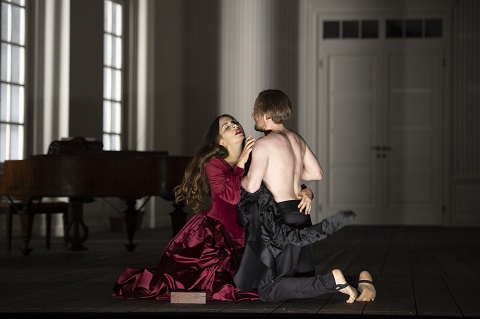
The re-location of the setting of the opera from the Belle Époque Paris to a mental institution department of a hospital in a more recent period however does not exactly strike you as a terribly original idea - off the top of my head I can recall the 2017 Vienna Parsifal directed by Alvis Hermanis and of course, there is Stefan Herheim's version of La Bohème that takes it to another extreme altogether - but it can be an effective distancing technique to cut through any fake operatic glamour that might distract from the reality of the circumstances. And Louise does need - and merits - a more rigorous approach. In the first act Louise sees herself as a Sleeping Beauty dreaming of her Prince, while the boy next door Julien sees her as his Ophelia. These happy scenes - as chaste as they are, relying on stolen glances - are of course a delusion, since Louise has strict parents who keep a tight rein on the young woman. But Charpentier's music and the libretto hint that there is more than that suggested in this situation.

Louise turns away from this restrictive hold on her life and does indeed run away to Paris, seeking to live an independent life and choose who to love. It's not just a dream for Louise, but many young women during this period living in the provinces. "A hellish life here" ("Notre vie d’enfer”), comments one father of three daughters, "Who can blame them for seeking paradise out there?"). Paris of course is that dream, but life there is difficult for Louise, who finds that it is not any easier there for a young woman seeking to live independently. The way that her dreams and illusions are shattered however suggests that the damage is inflicted not just by the sheltered life enforced by her parents, but that there is an element of abuse hinted at in their intimidating behaviour in the original opera that Loy is keen to draw out and make explicit. And apply in a wider context.

In the waiting room of the psychiatric hospital, the vision of Julien is just a warm memory, an allegorical illusion for the promise of the paradise of Paris, and that indeed is the reality that Charpentier depicts. Accompanied by her mother - wonderfully portrayed by Sophie Koch, a great role for her - she is not just over-protective, but overpowering and intimidating. Loy sees this oppressiveness as having a detrimental psychological impact on the young woman. As does her relationship with her father, not just cossetting her like a child, but fondling and caressing in an inappropriate and troubling way. The father is something of a bohemian, believing that money doesn't bring happiness and he thinks that they should all be content with their lot as a close family. You suspect the mother's objection to Julien is that the young man interested in her daughter too closely resembles her husband.

Loy pursues the inevitable consequence of this family background, combining it with the sinister setting of the psychiatric hospital in a way that changes the whole tone of the work, allowing for no real romantic scenes other than those in Louise's head. In this setting, Louise's fate becomes tied to that of Mimi in Henry Murger's original novel Scènes de la vie de Bohème, where the young woman is actually institutionalised - something skipped over in Puccini's opera adaptation. Herheim managed to introduce this stark reality in his adaptation of that opera and Loy likewise chops up the timeline to highlight the injustice and inequality of women and the fate that many would have been subjected to. It lets you know right from the start that there is going to be no happy ending here.

The Paris street scenes then all take on a hallucinatory quality, the patients, doctors and hospital employees taking the roles of the disillusioned lives on the street. The short Act II (presumably shortened by Loy as cuts have been employed for this production) offers some light relief, but it's also brief and carries this darker undercurrent. In the original Louise is in Paris, her colleagues in a stitching factory dreaming of love and suspecting that she has a lover. They sing of the romance of "the voice of Paris". In Loy's version, they are all hospital cleaners (quite a lot for a fairly rundown looking institution) and Louise imagines them making her wedding dress while she is serenaded by a street singer, Julien below the window. The chorus soon turns to threatening as they gang up on her and make fun of her situation.

Louise's continued idealisation of love and freedom in Paris, escaping from her abusive home life, is in reality short-lived as her father’s illness allows her parents to appeal for her return and, true to form, even blame her running away as the reason for his illness. Her return to the place of unhappiness takes on an almost unbearable intensity in Loy’s suggestion of the extent and nature of the abuse, but again it does seem to be a justifiable response to what appears to be hinted at in the original work. Pelléas et Mélisande comes to mind, the father - an absolutely brilliant performance by Nicolas Courjal - sounding Golaud-like with his imprecations to his "p’tite enfant". Louise premiered in 1900, two years before Pelléas et Mélisande, but it seems to have tapped into the same undercurrents, finding another elliptical way of expressing them. The final act and fate of the young woman is almost devastating in the intensity of the emotions and the naturalistic treatment employed here.

Although Loy has found a serious line to follow through the work, you do get the impression that otherwise there might not be a great deal to the opera and that any serious intent would get lost in the conventionality of the operatic arrangements. Nonetheless, musically it's rich and beautifully scored, with a distinct French character; Ravel comes to mind, Massenet of course and, as mentioned, even a little Debussy (but I have to say almost everything that has a shimmery quality and a French spoken rhythm reminds me of Pelléas et Mélisande). For the sake of a modern revival and tighter focus, conductor Giacomo Sagripanti seems to accept that some cuts are necessary, stating that its length is part of the weakness of the opera which tries to take in too much. Do we lose out on the colour of the work? I don't think so. Even with cuts, there is an extravagance still there in the sentiments, the choral pieces and the wild romanticism; the production just puts a different shade on it, one that is suggested to a large extent by the nature of the subject, the female perspective of romantic illusion being crushed by reality.

A lot rides on Elsa Dreisig as Louise and of course she is outstanding, both in her singing and acting. Louise even seems somewhat oppressed vocally in first two acts, but literally finds her voice in Act III, and in that original controversial expression of female sexual pleasure. Loy uses that same sense of oppression and liberation to a slightly different purpose of course, presenting an interesting modern insight into the character, although it's clear that the darker intent is there to a large extent in the actual composition. Done this way, as with Herheim, does force you to look more critically beneath the surface of the glittery first half of the work and see that it is not all lovely and romantic being a young woman running away from abusive parents and finding it difficult to live a life as an independent woman on the streets of Paris. "Cité de joie! cité d'amour!… Protège tes enfants!" ("City of joy, city of love... Protect your children").

The character of Julien might suffer from such a reworking, becoming an ideal, an illusory dream of love and romance, but Adam Smith's singing is superb and makes a great impression. To Louise's claim that "It's Paradise" and "It's a fairy dream”, his character repeatedly tells her that "No, it's life", trying to keep the young woman grounded in the real world that would be normal for anyone except someone who has not been used to such love and acceptance. With those terrific performances from Sophie Koch and Nicolas Courjal distorting that picture as her oppressive parents, Christof Loy succeeds in bringing into the present Charpentier's attempt to introduce naturalism into opera as a "roman musical", a musical novel. It's not a profound work; it has limited drama; but it has a firm basis in reality and in the psychology that still can hold true for many young women today.


External links: ARTE Concert, Festival d'Aix-en-ProvenceLa Scène Numérique du Festival d'Aix-en-Provence

Tuesday, 18 February 2025

Magnard - Guercœur (Strasbourg, 2024)

Albéric Magnard - Guercœur

L'Opéra national du Rhin, 2024

Ingo Metzmacher, Christof Loy, Stéphane Degout, Catherine Hunold, Antoinette Dennefeld, Julien Henric, Eugénie Joneau, Gabrielle Philiponet, Adriana Bignagni Lesca, Marie Lenormand, Alysia Hanshaw, Glen Cunningham, Natalia Bohn, Yannick Bosc, Lucas Bléger, Laurence De Cet, Éric Kaija Guerrier, Dominique Kling, Aleksandra Kubuschok, Caroline Roques, Nicolas Umbdenstock

ARTE Concert - 2, 4 May 2024

For my 999th post on OperaJournal, Albéric Magnard's Guercœur presents a fine opportunity to reflect on the nature of opera and its ability to convey the experience of life and death in a way no other artform can match. The existence of Guercœur itself is almost miraculous, the opera a forgotten and almost lost doorway into the past, one that when revived and staged for the first time since its posthumous premiere in 1931 has been allowed to breathe again. Many such works are forgotten and lost, but the fact that some works survive to make this journey across centuries and speak to us from the past never ceases to be a magical and irresistible experience for me. What is special about Guercœur is that its story and indeed the story of its own existence all combine to illustrate and emphasise that it has something important to tell us that needs to be heard in the present day.

The fact that Guercœur exists at all is, if not miraculous, fortunate to say the least. Composed between 1897 and 1901, the story of a knight who has died and gone to paradise but begs to be allowed to return to the world only to be disappointed by what he finds there, the opera was never fully performed in the composer's lifetime. Magnard was killed in 1914, attempting to protect his home from German soldiers, his property destroyed along with most of his manuscripts, including the opera Guercœur. It was reconstructed from memory and a piano reduction by the composer's friend Joseph Guy Ropartz and presented for the first time in 1931. There are many such stories of composers lives and careers ruined destroyed by war and untimely deaths, but it is the fact that Guercoeur actually concerns itself with similar sentiments, about a warrior who has been ripped away from the world too soon and wants to return there to complete his life's work, that makes this even more fascinating.

It's down to the Opéra national du Rhin in Strasbourg now to revive this work from the dead, putting real flesh and bones, real human sentiments, feelings and expression into something that otherwise exists as nothing more than markings on paper. There is even a sense of that longing to be brought back to life in the opening scene of the opera where, in a place beyond time and space, souls live in ideal blissful contentment, no wants, no desires. Except for one spirit, Guercœur who begs to be given the chance to live again. The Shades of a Virgin, a Woman and a Poet are unable to persuade him otherwise, nor Souffrance (Suffering), so Vérité (Truth) accedes to his request  allowing him to "become again the plaything of human weaknesses, of desire, hatred, shame, doubt and fear".

And those human qualities are what the idealistic Guercœur goes back to face. In the two hours since he has died and been in a place beyond space and time however, two years have passed on Earth and the world is already a very changed place from the one he left. Guercœur's love Giselle is now engaged to his faithful disciple Heurtal and the people that the knight freed from tyranny are already calling for an authoritarian dictator to restore order and make their country great again. Hard to imagine something like that happening today, I know. To Guercœur's horror, his friend and disciple. Heurtal is ready to assume that role of dictator, just as he has assumed Guercoeur’s place as the beloved of Giselle.

On the surface, Guercœur is not the most complex of this kind of Orphic myth or morality tale where someone is given a chance to see life and death from both sides. It's a Wonderful Life and A Christmas Carol reveal otherwise unrealisable truths just as effectively as the myth of Orpheus and Eurydice, a story that has been a cornerstone of the opera world in many forms and varieties over the centuries. The moral can be seen as a simple warning about life being for the living and leaving the dead to their place, but it's the emotional beauty and the human tragedy of the story that is attractive and superbly related in Magnard's opera and self-written libretto. It covers the idealism of the spiritual nature of man and questions of our legacy after death, but it also considers the other side of the equation, the day-to-day reality for most people, how they cope on an individual level as well as part of a society in response to the death of an important and influential figure or in the aftermath of a war where death takes an even greater toll. There is the fear that true peace can only be found in oblivion.

In the way that it contrasts our expressed desire for beauty, freedom, peace and a utopian society with the reality of human weakness for earthly material needs, greed, pride, power and ambition, it could easily be an opera written for today. What is fascinating and makes this even more strangely compelling, is the history of the work and the composer itself, its brush with the finality of death and destruction, its 'calling' to be brought back to life. As mentioned earlier, what is special about opera is that this 'dead' work of notes on a page has been reincarnated here, in an expressive manner that can only be achieved through opera performance when it is produced for the stage. Real people pour their heart and soul into these recreated figures and its the efforts of Ingo Metzmacher, Christof Loy and Stéphane Degout here who raise this work from the dead to bring an important message to the world today.

Conducted by Ingo Metzmacher, the music is drenched in turn of the century post-Wagnerian Late Romanticism, but Magnard's fantastical view of a lost paradise is more than just the extravagant fin de siècle fantasies of Korngold and Schreker (although arguably they also in their own way reflect and confront the reality of the world around them and the philosophical ideas of their time). Guercœur has the same quest for answers to questions on Love and Death and the role of the Artist as some of Wagner’s late works, but it doesn't have the same sense of mythological self-aggrandisement (if I may somewhat unfairly and not entirely accurately characterise Wagner's more nuanced and ambiguous position for the sake of comparison). Although there are recognisable elements and references there, Guercœur belongs more to the French Romanticism of César Franck, but like many composers that followed him in this period, the shadow of Wagner is inescapable. 

Magnard’s own voice however can be heard in this and its primarily in the human rather than the mythological element of the story, the willingness to confront his idealism and humanitarian viewpoint with the truthful reality of the nature of people and society. The opera draws resonance and complexity from how it recognises these issues, and like the period of time that has elapsed in the real world since Guercœur died, the work too has been in a state of suspended animation and needs some form of adjustment, translation or interpretation to reconnect with the new world it finds itself in. In essence, more than a faithful musical or singing performance, that is the principal element that needs to be brought forward into our modern world, and it is the task of the director to 'translate' that into action on the stage for a contemporary audience.

Christof Loy approaches the work with his characteristic attention to detail. Detail in regards to the human experience, that is, reducing the sets and other potential distractions to the bare minimum, never letting the focus drift away from what is essential to make the work feel alive, vital and meaningful. It's not a spectacle, despite the nature of this work seeming to call out for bold contrasts between the otherworldly allegorical and the human reality. Loy treats them equally, a simple plain background - one dark, one light, but seeming to overlap as the set containing really only chairs revolves to slip between one reality and the other. It looks like there has been very little hands-on input, but in truth the power of the work is better expressed by human figures than stage props and Loy is I believe one of the best directors of actors. There are no operatic mannerisms here, you believe in the characters and feel the weight of their predicament.

That goes not just for the extraordinary experience and conflict within Guercœur, a role that is taken with pure heartfelt expression and sincerity by Stéphane Degout, a singer I have admired and rated very highly for a long time, in a perfectly judged performance, but all the roles are perfectly weighted, balanced and aligned with the content, tone and intent of the opera; the 'human' characters as well as the allegorical ones. The conflict of love for one lost and the need to find a reason to live is no less great a dilemma for Giselle, sung with sensitivity and clarity of purpose by Antoinette Dennefeld, and there is even sympathy for Julien Henric's Heurtal, who struggles with the demands placed on him in the role he has inherited. There are choice roles for Catherine Hunold (Vérité), Eugénie Joneau (Bonté), Gabrielle Philiponet (Beauté) and Adriana Bignagni Lesca (Souffrance), all of them with key roles to play in Guercœur coming to an acceptance of his fate.

The opera is also gifted with heavenly choruses that are not only ravishing but necessary to contribute to and support the underlying sentiments and transformation that Guercœur has to undergo, contrasted with the earthly uproar, conflict and violence that he is forced to endure on his return. Loy recognises that the power and true meaning of the work is in its third act credo of Hope for a better future and that it is here that Truth, Beauty and Goodness, with some necessary 'Souffrance', are most needed. There is also an acknowledgement that this is no magical fantasy, that this message needs to go out to all those in witnessing the performance at l'Opéra national du Rhin, and as the cast approach the front of the stage in the lead up to the beautiful conclusion, the camera filming the event takes in that other crucial element for any opera to continue to live and breathe; its audience.


External links: L'Opéra national du Rhin, ARTE Concert

Tuesday, 21 June 2022

Strauss - Salome (Helsinki, 2022)


Richard Strauss - Salome

Finnish National Opera, Helsinki - 2022

Heikki Tuuli, Christof Loy, Vida Miknevičiūtė, Mihails Culpajevs, Nikolai Schukoff, Karin Lovelius, Andrew Foster-Williams, Elli Vallinoja

ARTE Concert - April 2022

There's something very familiar about the look and feel of this staging of Salome at Helsinki, which is not a surprise as it's a case of the typical Christof Loy production of performers in formal dress in a minimal classical white room look that he has been doing now for decades. There can be variations on the theme, sometimes it's more minimal than others, sometimes Loy can veer off and do something a little more elaborate. Here, it's the very minimal approach. Not quite the almost concert performance semi-staging look of Theodora, a little closer to the formal tuxedos and bow ties of Le nozze di Figaro For Salome? You have to ask why.

Well, I've seen enough Christof Loy productions to have made enough excuses for that kind of thing, not that the end results need any justification. One argument you can make is that without the more typical exoticism of period costumes it allows the audience to focus intently on the intense drama, and they don't come much more intense than Strauss's Salome. The Tetrarch's palace here is a curved white room with two wide pillars on either side, a single brown leather chair and a large rock at the centre of the room. The elegance of the palace is contrasted not with the unkempt appearance of a raving prophet in a cistern as much as one wearing nothing at all. It makes a change from Salome divesting herself seven skimpy veils, but unfortunately it's poor Andrew Foster-Williams (Euryanthe) who is again called upon to bare all and leave the audience not knowing where to look.

If the intention is to bring back a little of the shock value of the source material and the extraordinary interpretation of the psychological Symbolist underpinning of it in Strauss's score, well it's clearly not necessary. This is one work that is still bold, powerful and transgressive and needs little - if anything - in the way of added controversy. Jochanaan's imprecations against Herodias are usually bellowed from off-stage, so it's not even necessary to bring him onto the stage as soon as Loy does. Again you can look at this as being more directly confrontational, for the impression his chaste nakedness makes on Salome who only knows the decadent court of Herod. It certainly gives you an opportunity to think about it in this context.

Where Loy is usually more successful is in how he manages through his technique as a director to bring acting and conviction to the fore. In a Symbolist work where naturalism is not required, the stylised responses here are perfectly in keeping and suited to a dramatic art form that specialises in enhanced reality. This is much more effective when Salome attempts to remove her clothing - long before the Dance of the Seven Veils - her wantonness made explicit to a score of courtiers, who are at first angry at her and then stirred up to try to physically assault her. This spirals into a frenzy of motion in perfect concord with Strauss's score. 

The actual Dance of the Seven Veils is - by way of contrast  - obviously undercut. Instead of traditional eroticism it becomes an exercise in flirtation; a three-day exercise in power and control between Herod, Salome and Jochanaan. Inevitably it similarly draws the testosterone-charged courtiers circle around, creating a kind of dream sequence where even Narraboth is brought back to life. Herod claims his prize, thinking he is victor, but it's Salome who believes she is the one with the power now to fulfil her own desires.

Despite the liberties taken there is no doubt that Loy does successfully tap into the dangerous erotic and taboo undercurrents of Salome in a quite powerful way. He takes on a big challenge by not providing the traditional shock of a demented princess writhing in the gore of a decapitated head, choosing instead to give her a fully formally dressed Jochanaan. If it's about the depth of forbidden desires, this is another way to emphasise how the power of her desires is matched by the power of her madness, her delusion as a damaged victim perhaps of sexual abuse. It's all expressed anyway in the singing and the score and Vida Miknevičiūtė, this production's Salome, is just superb.

There is no question that Loy puts Salome firmly at the centre of this production; everything literally revolves around her desires and corrupted upbringing, a creature that has inherited the dark ambition of her mother and the avarice for power of her stepfather. The singing however is just as fine from Nikolai Schukoff as Herod and Karin Lovelius as Herodias. I'm not convinced that Andrew Foster-Williams presents the ideal image of an object of dark desire, or at least, not as Loy chooses to present him here. The contrast that Loy perhaps strives to express between female desire and the male gaze is not really established. I would venture to say however that Loy is perhaps working to a bigger picture of the relations between men, women and desire; some of his other more recent productions (EuryantheCosì fan tutte, Francesca da Rimini, Das Wunder der Heliane) all present different views of the same idea.

Musically this sounded good on the streamed broadcast, but without the benefit of live performance or full uncompressed sound, it's unfair to judge. It's clear enough however that this is still one of the most remarkable scores ever written and with Heikki Tuuli conducting the orchestra of the Finnish National Opera, its force was fully felt. That's where the real power of Salome lies, and often the best a director can do is not to get in the way of that. Loy's stage production might not provide the typical reference points, but he does nonetheless draw out terrific performances that show that this opera is much more than a biblical story, is still relevant to our experience of today and still has the ability to shock and amaze.


Links: Finnish National Opera, ARTE Concert

Thursday, 25 March 2021

Zandonai - Francesca da Rimini (Berlin, 2021)


Riccardo Zandonai - Francesca da Rimini

Deutsche Oper, Berlin - 2021

Carlo Rizzi, Christof Loy, Sara Jakubiak, Alexandra Hutton, Samuel Dale Johnson, Ivan Inverardi, Jonathan Tetelman, Charles Workman, Meechot Marrero, Mané Galoyan, Arianna Manganello, Karis Tucker, Amira Elmadfa, Andrew Dickinson, Dean Murphy, Patrick Cook, Thomas Lehman

takt1.com streaming

Other than being associated with a group of post-Verdi Italian composers at the beginning of the twentieth century, opera verismo is hard to define in musical or thematic terms. There's an element of social realism in works like Puccini’s La Bohème and Mascagni's Cavalleria Rusticana, but it’s more in considering how the real people deal with personal hardships and difficulties than in any social commentary or criticism. Other works, like Alfano’s Cyrano de Bergerac, Cilea's Adriana Lecouvreur or Giordano's Fedora that hardly fit the common idea of verismo. In any case with the enhanced emotional range and the artificial construct of singing one’s troubles, opera hardly seems the ideal way to approach any kind of social realism.

On the other hand, the hard-hitting musical style of verismo, pushing and even perhaps over-extending the emotional content even further than Verdi, perhaps hits on a deeper emotional reality for the troubles of its subject, or perhaps more accurately, it communicates the depth of feeling to an audience. For all the (unjustified) criticism of emotional manipulation and accusations of sentimentality that could be levelled against Puccini, there is no question that he does masterfully express the deep personal dilemmas suffered by his protagonists and communicate it through the medium of music in a way that touches the listener.


It might not have the common people touch of Cavalleria Rusticana, dealing instead with two noble families where an arranged marriage has left a woman in a loveless relationship and unable to be with the person she loves, but Riccardo Zandonai's Francesca da Rimini does nonetheless enter into that realm of enhanced emotional turmoil. Musically, it elaborates and elevates to an extraordinary level (aspiring to Wagner's Tristan und Isolde obviously) the romantic aspect, but sets this against and within the bloodthirsty violence and brutality of the family wars. Whether Zandonai’s opera is successful is debatable, but it has potential that could be realised in a strong theatrical setting. Christoph Loy can usually be relied upon for that, but while he certainly makes Francesca da Rimini 'work', I’m not convinced he finds anything deeper in it.

What is indisputable is that Act I of Francesca da Rimini has one of the greatest build-ups in all opera. Perhaps not quite as prolonged and ultimately sublime as Tristan und Isolde, the origin story of which this opera acknowledges as a model, but it's a good one nonetheless. The arrival of the mysterious Giovanni Malatesta is surrounded in gossip and speculation and, on the part of Francesca at least, some amount of trepidation, as she is to be married to this unknown man. When he finally approaches from the wings, she is told that he's slim, tall, handsome and walks like a king. "You're going to be the happiest woman in the world". And bam! just as described her future husband walks onto the stage and Zandonai accompanies this with the most seductive and romantic of music and heavenly choruses. Albeit with a hint of something awry behind it? Menace? Disappointment? For a trick of bait and switch has been played and it's not Giovanni, but his much better looking brother Paolo il Bello who she sees and immediately falls in love with.

Loy isn't going to let that be a premature climax and ensures that Act II of the opera closes on another dramatic finale that has you gripped to your seats and almost blown away. That effect is of course not achieved in isolation and as usual Loy pays close attention to what the music is telling us and looking for the best way of presenting that. Without swords and doublets, he shows the household of Francesca's Polenta family as thugs in suits, conspiring to trick Francesca into a marriage of convenience. With scattered flowers and a Gothic backdrop in the earlier scenes, there's an air of decadence about it as well, and Loy emphasises the almost ecstatic musical explosion at the violent wars of the conclusion of Act II with the intoxicated Francesca almost revelling in the spilled blood of the Malatesta.

That moment of madness turns into confusion and fear that is extended and developed as she becomes torn between all three Malatesta brothers. The music, and particularly the vocal range, is correspondingly pushed further into heightened expression, which Sara Jakubiak sings superbly in Francesca's confrontation with Smaragdi. If she can appear a little detached and not always have the fullness of voice elsewhere, she does bring a sultry character to Francesca, much as she did previously - in parts fully naked - as the queen in Loy's production of Korngold' s Das Wunder der Heliane. She really shows her ability in the varied tones of the opera's third Act.

Although linking thematically and visually with that previous work at the Deutsche Oper, Christoph Loy here adopts more of the style of the similarly themed feuding family wars of his 2015 production of Bellini's I Capuleti e i Montecchi for Zurich or, taking place confined in a wealthy mansion with a window view, it's more simplified like his production of Carl Maria von Weber's Euryanthe at the Theater an der Wien in 2018. If it doesn't measure up to provide any deeper or broader thematic approach, the little details and correspondences with the music do manage to highlight the dramatic qualities of the work, even if it still doesn't seem to hold together as a whole.

Still, Act IV ramps up the drama and the decadence deliciously as Loy insists on showing Francesca flirting dangerously with the third brother, the psychotic Malatestino, fabulously sung and performed with casual menace by the always impressive Charles Workman. The music continues to be filled with ominous motifs building tension and anger that is going to end in tragedy, and it plays out wonderfully under Carlo Rizzi's musical direction. The role of Paolo has a challenging dramatic range to meet and Jonathan Tetelman does it well, all of which adds to a very successful interpretation of Zandonai's opera. The casting is great, the performances convincing, the music compelling, but it's still hard to feel involved in the circumstances or character of D'Annunzio's drama.

Wednesday, 19 August 2020

Mozart - Così fan tutte (Salzburg, 2020)

Wolfgang Amadeus Mozart - Così Fan Tutte

Salzburger Festspiele, 2020

Joana Mallwitz, Christof Loy, Elsa Dreisig, Marianne Crebassa, Andr
é Schuen, Bogdan Volkov, Lea Desandre, Johannes Martin Kränzle

ARTE Concert - 2 August 2020

It was going to have to be different if the Salzburg Festival was going to go ahead in any form this year, but despite a reduced programme and reduced audience on account of the Covid-19 restrictions and despite a characteristically minimalist stage set for a Christof Loy production, there's nothing in the least socially distant or socially distancing about this reworked version of Mozart's Così fan tutte. In fact the 2020 Salzburg production is a very physical, tightly choreographed, condensed in its cuts and in the precision in which it gets to the heart of Mozart's extraordinary and oft misunderstood opera.

It's appropriate in this case for Così fan tutte and exactly how you want it to be, because despite all its buffo comedy elements, Da Ponte's ludicrous plotting and the libretto's seemingly superficial and clichéd characterisation, the opera is actually deeply insightful in its observations about human nature, about love, relationships, men and women, about holding illusions and facing up to reality. Far from being a light comedy, the libretto is beautifully poetic, the music deeply moving and extraordinarily expressive of a wide range of human emotions and experiences that come from heart and the head. Or it can be if it's allowed to be.

Loy's minimalist 'generic' productions tend to work well with such works, where you don't need to be distracted by the mechanics of the plot, the period or the location, and can focus on the characters and the relationships between them. It may seem obvious but that can be done physically and spacially, the distance or closeness between them the characters measured out in their proximity to one another on the stage, whether they look at each other or not, whether they touch or hold. Fiordiligi and Dorabella here are clearly close friends, comfortably tactile in each other's company. The boys Guglielmo and Ferrando are tactile in a little more rough and tumble way, playfully jostling their master, Don Alfonso, showing more eagerness to impress than feel any real feeling for their girlfriends.

Loy, who in my experience usually works with as full an uncut version of an opera as possible, takes the opportunity of working with conductor Joana Mallwitz not just to compress the opera down for health and safety reasons (reducing the time spent in the hall for the audience, with no interval where they can mingle and spread any virus contagion), but to cut back on the more buffo elements, the dialogues that might be more offensive and sexist to a modern audience. That doesn't have to be the case - Christophe Honoré managed to integrate those potentially objectionable views into a rather more questioning view of Così fan tutte and humanity in his 2016 Aix-en-Provence production - and it does occasionally make the opera feel a little too rushed here, losing a nonetheless important element while not really making the plot or motivations feel any more credible or realistic.

Arguably, the plot was never meant to withstand the scrutiny of realism, but the human emotions and experiences in this remarkable work are nonetheless timelessly truthful and insightful. Christof Loy and Joana Mallwitz necessarily put aside some of the more comic interludes and sacrificing this aspect of the human experience, and instead look for those moments of beauty that is brought out by what is patently and intentionally a fake situation. It's faked or contrived by its creators however precisely to evoke specific emotions in order to understand what is important. It's not hard either to see where those moments of truth and beauty are; you need to look no further than the exquisite arias, more beautiful here than any in the far more famous arias of Don Giovanni, and at least on a par with the finer moments of that other Mozart/Da Ponte masterpiece that is Le Nozze di Figaro.

The compression employed here that requires some measure of suspending disbelief actually heightens the necessity of their being a willingness to believe on the part of both sets of lovers. And what Mozart and Da Ponte achieve is indeed a school for lovers, an education on its joys, anxieties and insecurities, its feelings of deep spiritual awakening and devastating fears of betrayal. It's a bit of a crash course, achieved by sleight of hand over an intense period of a day, where you are never really sure how aware the characters are of the game they are playing or at what point reality takes over and it stops being a game.

Seen that way, the opera is actually employs a post-modernist meta-behavioural effect far ahead of its time, one similar to that achieved by the late filmmaker Abbas Kiarostami in Certified Copy (2010). I don't use this example randomly, since Kiarostami directed Così fan tutte in a production at Aix-en-Provence in 2008 (that I saw subsequently at the Coliseum in 2009), which makes me wonder whether, subconsciously or otherwise, he picked up the idea from Mozart and Da Ponte and expanded on it. You can't think of Così as naturalistic - it's ridiculous and silly, and yet everything about it is beautiful, achingly beautiful and right. It's completely authentic and makes perfect sense on a deep emotional and human level, on "how quickly a heart can change".

It's been a tough year for the arts, but there's a reminder here that we can't afford to lose or fail to nurture the kind of talent that is evident on the stages of Salzburg and mirrored on stages across the world. Like the Salzburg Elektra, the talent here is world class, as good as any classic historical performance of these works, and don't let anyone tell you otherwise. Marianne Crebassa in particular is just outstanding here as Dorabella. Elsa Dreisig brings that dreamy sincere youthful idealism to Flordiligi and there is plenty of youthful enthusiasm in the performances of André Schuen and Bogdan Volkov. Lea Desandre is a bright and entertaining Despina and Johannes Martin Kränzle an ideal Don Alfonso, charmingly mischievous with just a hint of a sinister motive. Much of the secret of making these characters work and come alive is just sheer nerve and enthusiasm, putting cynicism aside and being willing to believe that we can aspire to be better. That's half the battle with the opera as much as in the matters of love it deals with.

August 2020 may have meant a reduced opera programme for Salzburg, with only Elektra and Così fan tutte staged, but the choice of works and their presentation - both premiere performances broadcast live-streaming - showcase everything that is brilliant about opera, about why it is important and why we must find a way to keep it and other performing arts alive through the current crisis. There's a lot we can learn from the arts about dealing with the current times, a lot that Strauss, von Hofmannsthal, Mozart and Da Ponte have to show us. Elektra shows one response to the world, of individuals put through extreme and challenging experiences, mental illness, enforced separation, Così another very different but challenging experience. Both however show that we're only human and capable of making mistakes, but the consequences of not learning from them are too terrible to imagine.

Links: Salzburg Festival, ARTE Concert

Friday, 6 March 2020

Weber - Euryanthe (Vienna, 2018)

Carl Maria von Weber - Euryanthe

Theater an der Wien, 2018

Constantin Trinks, Christof Loy, Jacquelyn Wagner, Norman Reinhardt, Theresa Kronthaler, Andrew Foster-Williams, Stefan Cerny, Eva-Maria Neubauer

Naxos - Blu-ray


There are often good reasons why some works remain neglected and rarely performed, but it's at least nice to be able to have the opportunity to hear them and judge for yourself, even if in most cases you have to admit that few are really lost masterpieces. Carl Maria Von Weber's 1823 opera Euryanthe however may genuinely be considered a neglected masterpiece.

Euryanthe is one of those works whose reputation is better known than the work itself, that reputation being that it has some lovely music but is let down by a poor libretto. Considering Weber's importance in the world of German music and his huge influence on Richard Wagner, it's surely a shame that other than Der Freischütz, the composer's operas haven't been given due attention in performance. Christof Loy's production of Euryanthe for the Theater an der Wien however suggests that this is a great work worthy of re-evaluation.


In terms of plot Euryanthe does indeed just appear to adopt another variation on a classic Romantic theme based around challenges against the virtue of innocent women. It's there in Schumann's only opera Genoveva, but the subject can also be seen in Shakespeare's The Rape of Lucretia and Cymbeline. Mozart also took an apparently more light-hearted comic angle on the subject in Così fan tutte, but as several recent productions have demonstrated (Teatro Real 2013, Aix 2016), Mozart and Da Ponte's approach is far more subtle, balanced, darker and nuanced than it might seem. Despite the reputation of its libretto and plot, and the relentless darkness of the treatment, Christof Loy successfully shows that there is similar nuance and sophistication worth exploring in Euryanthe.


Like The Rape of Lucretia there's an underlying context of war having a dehumanising impact on men and influencing how they behave towards women in Euryanthe. At the beginning of the opera Count Adolar is returning from war, disillusioned but revived at the thought of returning to his wife Euryanthe. Having only seen the worst of what man is capable, the one thing that can restore his faith in humanity is the assurance of his wife's purity and fidelity. Count Lysiart however is rather more cynical and bets Adolar that he could seduce Euryanthe. Adolar is outraged and ready to duel Lysiart for this insult to his wife's honour, but has such faith in Euryanthe that, with King Ludwig's intervention, he is prepared to accept the bet to prove the point beyond dispute.

So far there's nothing unusual in a subject like that, it's a stirring situation that gives rise to conflicts of passions and moral dilemmas. There is however a complicating factor here in Eglantine, the daughter of a disgraced noble that Adolar has taken into their home, and her being in love with Adolar adds more than just another level of dramatic conflict. The introduction of a kind of ghost story around the untimely death of Adolar's sister Emma, who killed herself after her betrothed Udo died in battle, is another factor that comes into play, a shameful secret that Eglantine plans to use against Euryanthe in collaboration with Lysiart, but it also relates to Emma and Udo both being victims of war as a destructive force.


All this can seem like the plot has a few too many high-flown Romantic sentiments - the opera is subtitled 'A Great Heroic Romantic Opera' - but Christof Loy's approach to this melodrama is as usual to find the real human feeling in the work. Not unexpectedly that can be found with considerable depth in the music of Carl Maria Von Weber. It might fall back now and again on conventional elements of dramatic villainy, ghostly apparitions and wistful musing of innocents, but only in the same way that Mozart also made use of a similar wide range of means to plunge ever deeper into the darkness of Don Giovanni's soul. Weber's music, conducted her by Constantin Trinks, is beautifully aligned to the mood and the drama of Euryanthe and it's not difficult to see how Wagner would develop on this to an epic scale, particularly evident in a similar confrontation between innocence impugned and villainy given credence in Lohengrin.

Loy seizes on the power of such situations and music applies it to characterisation that can be seen to be much more three-dimensional than its reputation would have you believe. The director never lets the characters emote alone or soliloquise to the audience in an indulgent manner, but rather shows them tapping into the deepest human feelings of love, jealousy, lust and betrayal. And if that means having the object of one's affections present when their spirit - and other parts - are being bared, then so be it. Rather like the spirit of Emma, it makes these emotions present and tangible, generating a highly charged atmosphere.


The stage design is appropriate for the context and, rather than relying on typical Der Freischütz-like Romantic locations of woods, glens and dramatic landscapes, Loy keeps the drama confined to an elegant mansion. The cool minimalism of the rooms only serves to heighten and contrast the surface manners of high society with the barely contained lusts and prejudices simmering beneath. It's not so far away from Loy's more recent take on Schreker's similarly heated drama Die ferne Klang, or indeed his stripping of those emotional charges literally stark naked as with his production of Korngold's Das Wunder der Heliane. Andrew Foster Williams is the unfortunate who has to bear all this time, his "wild impulses of glowing desire" out there for the viewer to see, but spared anything too close up. It certainly makes the idea of intended rape more viscerally real and the subsequent teaming up of Lysiart with Eglantine after this is deliriously demented and utterly convincing.


It's the singing too of course that makes this convincing and the principal cast, as well as the chorus, are simply superb. Jacquelyn Wagner has a perfect clean soaring timbre that is perfect for the part of Euryanthe. She's more than just an innocent victim, but the vocal line tells us more than the words alone about her firmness of purpose and her pureness of heart, and Wagner brings out the real human feeling that is scored into the role. Norman Reinhardt shows how Adolar is a prototype Heldentenor, an idealist conflicted between the purity of vision and his response to the baseness of the world.

Theresa Kronthaler and Andrew Foster-Williams bring a chilling edge of menace in roles that are even more villainous and - in this production at least - even more deranged and cruel than Ortrud and Telramund. Looking at the opera this way pointing towards towards Lohengrin, King Ludwig IV is very much a Heinrich der Vogler type of role and it's one that bass Stefan Cerny is not only capable of performing to a Wagnerian level but he also brings some character and personality to make it count within the dramatic development of the plot. Rather than being a forgotten minor work by a respected but neglected composer, Euryanthe turns out to be essential listening for any Wagnerian, a wondrous rediscovery, and Loy's treatment of the work at Theater an der Wien will not disappoint.

The production looks good on the High Definition Blu-ray release from Naxos, although there are some minor niggles. The strong contrasts make whites look a little blown-out, and the image is a little bit shimmery and blurring in movement. Whether that's an authoring issue with the transfer bit-rate I don't know, but it's not too distracting. It doesn't appear that radio mics are used so there's a wider open acoustic theatrical sound here, which means that it also picks up a bit of ambient noise, including creaking floorboards, but the LPCM 2.0 and DTS HD-Master Audio 5.1 mixes still capture the power and the detail of the performance. The BD is all-region compatible, with German, English, French, Japanese and Korean subtitles. The booklet contains a synopsis and an interview with Christof Loy.


Links: Theater an der Wien

Wednesday, 12 February 2020

Schreker - Der ferne Klang (Stockholm, 2019)


Franz Schreker - Der ferne Klang

Royal Swedish Opera, 2019

Stefan Blunier, Christof Loy, Agneta Eichenholz, Daniel Johansson, Johan Rydh, Miriam Treichl, Andreas Lundmark, Jeremy Carpenter, Lars Arvidson, Vivianne Holmberg, Marie-Louise Granström, Madeleine Barringer, Ola Eliasson, Klas Hedlund, Daniel Ohlmann

OperaVision - October 2019


Franz Schreker's first breakthrough opera Der ferne Klang in 1912, like much of the composer's work that followed, has the same sense of a flawed utopian ideal that is common in the composer's later "decadent" works like Die Gezeichneten and Irrelohe. It has something in common then with other post-Wagnerian German and Austrian composers of the early twentieth century (most obviously Korngold's Die Tote Stadt or Das Wunder der Heliane) whose work would later be classified by the Nazi's as "Entartete", "degenerate" because of their Jewish connections.

Like those other works by such composers at the turn of the century the influence of Wagner is inescapable, and Der ferne Klang is very much seeped in Wagnerian romanticism both musically and thematically. If it perhaps doesn't have the same sense of purpose or philosophical rigour of Wagner's best work - few do - it is however considerably more than a pale copy or a mere fantasy aligned to the master's style, and in its own way Schreker's works tap into the concerns of their time at the beginning of the 20th century in the desire to find or create a better world.


Certainly the comparisons with Tannhäuser are immediately obvious in the situation of Fritz, a heroic artist with a pure vision, a composer who sets off on a self-imposed pilgrimage searching for "a distant sound", the otherworldly music of harps that he must pursue: "A noble ambition floats before my eyes and I must be free!". To do this means sacrificing his love for Grete, his obsession with the distant sound causing him to fail to recognise the beauty he already has before him in the young woman's love, until of course it is too late.

While Fritz is off in pursuit his elusive ideal the main part of Der ferne Klang is concerned with the fate of Grete. Left in an unhappy family situation, her drunken father Graumann prepared to gamble her away in a game to the landlord of the drinking den to whom he is heavily in debt, she runs away to try and find Fritz. Along the way she falls into the seductive clutches of a glamorous lady and ends up a high class prostitute in a nightclub on an island in Venice where she is adored by the clientele, and in particular pursued by the Count.


To settle matters Greta promises to marry whoever can tell/sing the best story, meaning that Act II of the opera even has its own version of Tannhäuser's singing contest in Wartburg. Rather than it being an occasion to seek to find ennobling truths and dispel false artistry based on received wisdom rather than hard-won experience and innovative ideas, you get the impression that Schreker uses this occasion more as an opportunity to provide a bit of musical variety, colour and cabaret.

In reality however the Count's relentless pursuit of Greta is in a way a similar pursuit for a 'ferne Klang', one that differs from Fritz's vision in that it has a predetermined outcome - winning Greta - and thus is less pure than Fritz's noble and idealistic journey into unknown realms. In a way then the singing contest does serve a similar purpose to that of the one in Tannhäuser. In Der ferne Klang however the nobility of that outcome is less sure, the dream of a paradise uncertain or maybe even an impossible ideal. Does that make striving for truth any less worthy even if it doesn't reveal what we hope it will?

That conclusion, which comes in Act III, is where Christof Loy has to really do the work in this production for the Swedish National Opera. Up until then it all seems a little lacking in this director's usual modern touches and ideas, keeping to a period setting of classical elegance. As ever, Loy is just seeking to reflect what is there in the music, matching the settings and drama to the lush orchestration of Schreker's score. Since Act III opens with a long musical interlude, Loy has more room here to develop and contrast and blend the reality with the dreams.


And since Schreker also provides the opportunity by setting Act III backstage after the performance of Fritz's great masterpiece, Loy takes advantage of exploring how dreams and reality can be brought together in art, in opera. His re-encounter with Grete brings Fritz great disappointment when he is made aware of her degrading circumstances and his renouncement of her at the end of Act II inspires him to the discovery of the 'far off sound' he has been looking for. Since his opera is considered a failure however, there's some ambiguity around whether life informs great art or whether art is at best only a flawed shadow of life. The chances are that, like Fritz, the only way we can judge whether we've taken the right path and grasped what is important is when it's too late to change anything.

If it doesn't make any grand gestures then or bring about any great revelations, Loy's direction very much explores and enhances the value of Schreker's Der ferne Klang. The same can be said very much for Stefan Blunier's conducting of the Swedish National Orchestra which revels in the lush beauty of Schreker's wonderful flowing orchestration. Like Richard Strauss, there's also considerable beauty and challenges in the vocal writing but when it's done right, as it is here with Agneta Eichenholz's Grete and Daniel Johansson's Fritz, both soaring in their self-delusion, shattered in their clash with reality - the effect is ravishing. How wonderful that the Swedish National Opera treat this beautiful neglected work so well.


Links: OperaVision, Swedish National Opera

Thursday, 6 June 2019

Korngold - Das Wunder der Heliane (Berlin, 2018)

Erich Wolfgang Korngold - Das Wunder der Heliane

Deutsche Oper Berlin, 2018

Marc Albrecht, Christof Loy, Brian Jagde, Sara Jakubiak, Josef Wagner, Okka von der Damerau, Derek Wetton, Burkhard Ulrich

Naxos - Blu-ray


Like many other German and Austrian works that were categorised as 'degenerate' Entartete music by the Nazis in the 1930s, Korngold's early operas have as a consequence been consigned largely to obscurity. That is undoubtedly unfair, as the banning of such works had little to do with any kind of musical discrimination or value judgement and everything to do with whether a composer was of Jewish origin or had Jewish family connections. The neglect and loss of such works and any legacy they might have had could however also have as much to do with them being out of touch with changing musical tastes and the reality of people's lives on the ground.

The near-eradication of such works from music history may not be so much to do with the labelling of such music as degenerate as much as the operas and their themes being rather too 'decadent' in subject matter at a particular juncture in history when the world was about to plunge once again into war. Korngold's operas would certainly fit in with the decadent fantasies that seemed to flourish around this period. With fairy-tale worlds peopled by ambiguous figures and wrapped in lush chromatic orchestration, Richard Strauss, Franz Schreker and Erich Wolfgang Korngold relished delving freely into a dark core of madness and forbidden lusts that had been unleashed post-war in the new century.


If they don't reveal any great psychological insights, works like Die Frau ohne Schatten, Die Gezeichneten and of course Korngold's Die tote Stadt are nonetheless fascinating and exquisitely beautiful works that are very much the product of their (short-lived) time. So too it transpires is Das Wunder der Heliane (Heliane's Miracle), another Korngold masterpiece that has been largely neglected or deemed irrelevant to the development and progress of 20th century opera. Composed in 1927 with a trial at its centre, there's a sense even that Das Wunder der Heliane challenges itself in response to such conflicts, if only within the world of opera. Are you willing, it seems to ask, to sacrifice the beauty of Romance for a harsh, unyielding, joyless life without magic and love in it?

That seems to be the choice open to the Stranger, imprisoned for bringing a message of joy and light to a land where love and laughter are forbidden. The King, a stern and embittered figure who has never even known the love of the Queen, visits the Stranger in his cell to tell him that he will stand trial and face execution for his frivolity. The Queen, Heliane however proves to be more yielding to the Stranger's outlook, offering him her hair, her feet, her mouth and then her nakedness, but not her body. The King, going back to plead with the man to ask him how to win the love of the Queen, is outraged when he discovers her naked with the Stranger.

That's the first highly charged Act of Das Wunder der Heliane, the subsequent two Acts setting these forces against one another, leading to the death of the Stranger in Act II and his 'resurrection' at the miraculous intervention of Heliane, whose goodness and purity allows them to consummate their love in death in the finale of Act III. There doesn't appear to be much Wagner or Schopenhauer influenced philosophical underpinning to this pseudo-mystical Liebestod, just throwing out the idea of beauty, purity, love and light as the true enduring force in the world, even stronger than death.


If there's any way of making a credible case for this idea, it's in how Korngold smothers any philosophical shortcomings with persuasive swathes of strings, harps, 'seraphic voices' and all manner of celestial instrumentation. Who could resist or deny that there is indeed something miraculous and otherworldly in the music at least? If anyone can convince you of the argument of Das Wunder der Heliane, it's Korngold's orchestration at his most extravagant. It's rather like Strauss in this register - full-on, rich and complex, underscoring high emotion with soaring crescendos.

Like Strauss it also places exceptional demands on the singers, who not only have to be capable of the stamina to handle its technical complexities, keeping up with the continuous augmentation of musical emotions, but also rising above it and making it feel like it comes heroically from the heart. I haven't come across American tenor Brian Jagde before, but he is supremely capable of bringing all that to the role of the Stranger, in thrall to love and beauty. The rush of 'pure' lusts inspire him to soar to incredible heights in his Act I scene with Sara Jakubiak's Heliane that culminates in her revealing herself fully to him. The singing with the orchestration and the charge of the chaste eroticism reaches everything that Korngold could wish to achieve in a scene like this.

Christof Loy's direction doesn't try to compete with the charge that is already there, but his directions certainly help bring it about. It's almost impossible to sustain that kind of charge and tie it into further miraculous associations between love and death (although Tristan und Isolde - clearly the major influence on this work - of course proves otherwise), so Loy aims for a more sober set design, setting the drama in a courtroom inspired by Billy Wilder's Witness for the Prosecution, with dark classical wooden panelled walls and no unnecessary adornment or effects. As is often the case with Loy, he seems to give a problematic work the best possible presentation that highlights its strengths and mitigates against any weaknesses, and he does it with some style too.


Korngold's score also demands a certain flair and Marc Albrecht is an experienced conductor in this field. To judge purely on impact, the whole character of Korngold is there, distinct from Wagner, Strauss or Schreker, using unconventional instruments in an idiosyncratic way to achieve similar effects. The demands are not just on the principals then but the whole cast and there are consequently impressive performances from Josef Wagner as the distraught and furious King, Okka von der Damerau as the king's Messenger, Burkhard Ulrich as the Blind Judge and Derek Wetton suitably otherworldly as the Gatekeeper. This is a hugely impressive and revelatory production in every respect of a neglected Korngold rarity.

Recorded live at the Deutsche Oper in Berlin in 2018, Das Wunder der Heliane is given a superb presentation on Blu-ray disc by Naxos. The HD image is good, but evidently the real benefit of the format is in how it gets across the power, complexity and detail of Korngold's majestic score in the high resolution DTS HD-Master Audio 5.1 and LPCM 2.0 soundtracks. The spread of the surround track gives a more immersive experience, while the 2.0 track is more direct and powerful, particularly on headphones. Korngold specialist Brendan G. Carroll provides an introductory essay in the booklet, and also some items from his own archive on the disc, including an 8-minute recording from 1928 of the Act III Zwischenspiel and a picture gallery of rare photographs, posters and images. The BD is all-region compatible and there are subtitles in German, English, French, Japanese and Korean.