Showing posts with label Médée. Show all posts

Thursday, 17 April 2025

Charpentier - Médée (Paris, 2024)


Marc-Antoine Charpentier - Médée

Opéra National de Paris, 2024

William Christie, David McVicar, Lea Desandre, Reinoud Van Mechelen, Laurent Naouri, Ana Vieira Leite, Gordon Bintner, Emmanuelle de Negri, Élodie Fonnard, Lisandro Abadie, Julie Roset, Mariasole Mainini, Maud Gnidzaz, Juliette Perret, Virginie Thomas, Julia Wischniewski, Alice Gregorio, Bastien Rimondi, Clément Debieuvre, Matthieu Walendzik

ARTE Concert - 3rd and 7th May 2024

Euripides' ancient Greek tragedy of Medea is a sensational tale of sex and violence of love and betrayal that has long inspired theatre and the arts and of course countless opera versions over the centuries, from Francesco Cavalli's Il Giasone in 1649 to Aribert Riemann's Medea in 2010. The most famous opera version, its status defined by Maria Callas, is Luigi Cherubini’s Médée, and that's the version you are most likely to still see performed. With the works of Marc-Antoine Charpentier having their turn in the early opera spotlight, William Christie again being at the forefront of reviving great forgotten works of the early period of classic French 17th century opera, you aren't going to get a better opportunity to experience the quality of his version of Médée than this production on the Paris stage at the Palais Garnier.

With a libretto by French dramatist Thomas Corneille, who composed libretti for Lully's operas, and it being an opera composed during the reign of Louis XIV, you might have some expectations as to how this will play out. If you are thinking rather dry 17th century drama with some longeurs, noble sentiments and classical formality that require some patience and familiarity with the style to appreciate, you'd be partly right, but with Charpentier and French music of this period, you can also expect the flavour of wonderful dance music, choruses and spectacle all fulfilling the dramatic punch of the story. You definitely get that in this opera and it's brought out effectively in a manner that ensures accessibility in Christie's musical direction and in this production directed by David McVicar.

But there is a little scene setting required first of all to establish the situation that is going to lead to Jason's betrayal of his wife Medea and fire such fury in her that she is going to do the unthinkable. The context is their exile from Thessaly driven by the people's fear of Medea's magical powers, and Jason's seeking an alliance that will give them safe haven with King Creon in Corinth. He is prepared to lead a joint Corinthian and Argive army against Thessaly and extend the power of the rule of Creon. Although his daughter Creusa has been promised to Oronte, the Prince of Argos, Creon thinks Jason would make a better husband for the Princess. Jason sees that as an opportunity to secure and elevate his own position, but how will Medea take the news?

Well, I think we all know how that goes, and although the phrase "hell hath no fury like a woman scorned" wasn't around at the time (it being coined just 4 years after Charpentier's opera in 1697 by William Congreve), there is no surer description for what takes place in the final act here. There is however other shades and colours of dramatic action and sentiment that Corneille and Charpentier have to work with before Act V of Médée. Act I starts slowly with Medea expressing misgivings about Jason's mission, Jason himself confessing love for Creusa to his confidant Arcus, but it soon picks up with the armies assembling for the attack against the Thessalonians.
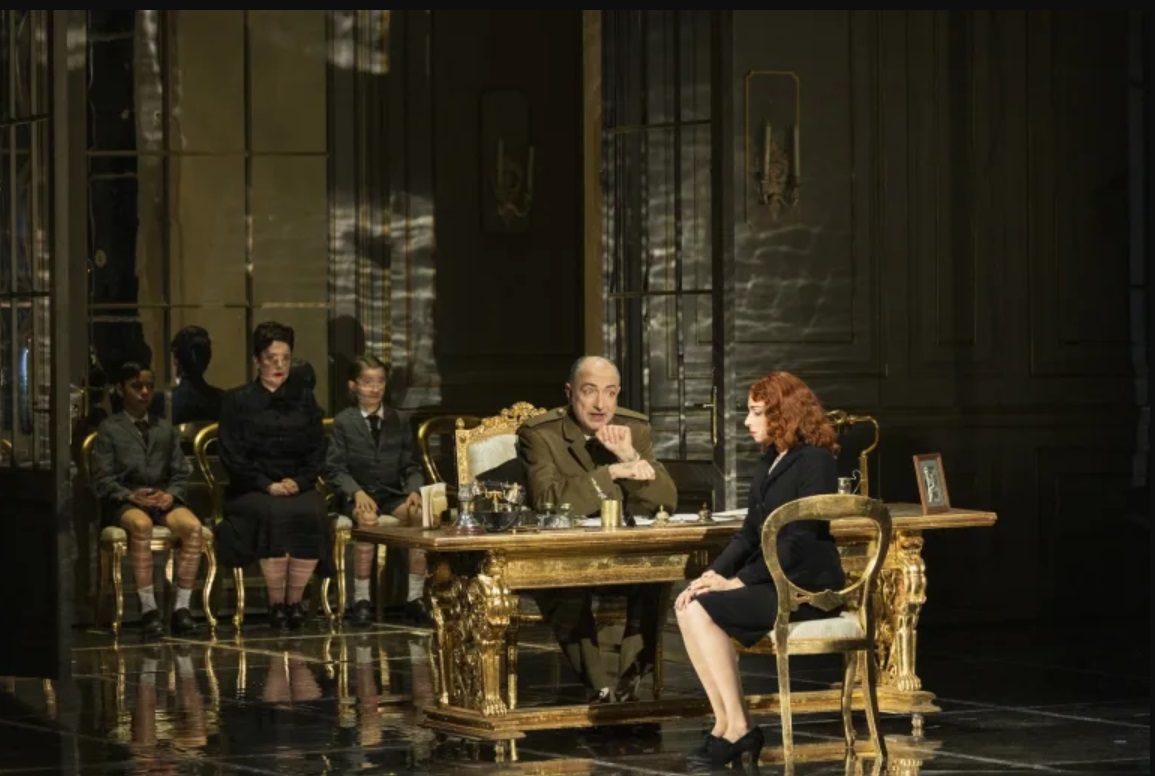
The Paris Opera production sets this version in a more recent and familiar wartime setting, Creon a de Gaulle like figure, Oronte a brash American fighter pilot, Jason of course a naval officer. It works fine, removing it from the Greek classicism and giving it an attractive freshness and colour on the Palais Garnier stage. Dance routines from a small troupe of six male and six female dancers enliven the stage choreography and choral arrangements considerably; they are not overly elaborate, more formation dancing that suits the militaristic look and feel of the setting. The real battle here however is more the one between Jason and Oronte for the favour of Creusa than a concerted fight against the foreign enemy.

That more or less establishes the template for what follows in subsequent acts of Médée; a little bit of accompanied recitative exposition followed by some invigorating music, singing and dancing as the emotional temperature rises. The stage production rises to those moments as well with - it being a David McVicar production - a few surprising twists. A glittering US fighter plane is wheeled on at the end of Act II for a nightclub scene with L’Amour/Cupid appearing as a cabaret act, the whole scene bathed in purple and pink light. Yes, it's a little bit camp, in a McVicar way, but not excessively so. It's a good way to treat the mythological characters that appear in the opera and it seems to fit musically.

The latter is essential really, since musically this production has the complete William Christie attention to detail and above all rhythm. The use of period instruments is invigorating in those dance and choral pieces, with soft flute and plucked theorbo or lute accompanying the expressions of troubled emotions. Authenticity is a matter for the musical director of course and I'm in no position to dispute or approve the choices Christie makes, but he always makes early music that could otherwise sound alien to a modern classical audience feel accessible and beautiful as well as expressive of emotional and dramatic content.

There's a sweetness to the music that is reflected in the singing voices. Yes, that even goes for Lea Desandre as Medea, but the softness of her voice has an underlying steeliness that leaves you in no doubt as to the depths of feeling love and betrayal inspired in her, nor the horrors she is capable of inflicting because of them. Corneille provides adequate motivation, character definition and some poetic beauty in the libretto for Medea. Vowing vengeance in collaboration with Oronte in Act III, she instinctively softens in the face of Jason and believes she can persuade him away from the fatal course he is on. (Jason is also well sung in this scene by Reinoud Van Mechelen, but perhaps lacks the same depth of character). This leads to a beautiful lament "Quel prix de mon amour, quel fruit de mes forfaits" where Desandre shines, pouring out the complexity and depth of Medea's love for Jason. It's a pivotal scene that the outcome depends on and everything about this is convincing for what follows.

What follows is of course all the horrors of hell, and there Desandre is also wonderfully convincing. The early dance rhythms of the period music might not seem best designed for that kind of darkness, but the fury within is there in Desandre and in McVicar's direction of the subsequent acts and scenes with dancers and demons adding emphasis and impact to the intent. It's not a particularly thrilling or insightful production, more typical 'neoclassical' McVicar, but the way it is modernised is enough really to be able to appreciate the true qualities of the work. Under William Christie the work's beauty, its charm, its seductiveness, as well as its edge of menace are all there in a wonderful combination of soft flutes and flurries of plucked and hammered strings.


External links: Opéra National de Paris, ARTE Concert

Saturday, 30 May 2015

Cherubini - Medea (Geneva, 2015 - Webcast)


Luigi Cherubini - Medea

Grand Théâtre de Genève, 2015

Marko Letonja, Christof Loy, Daniel Okulitch, Grazia Doronzio, Andrea Carè, Alexandra Deshorties, Sara Mingardo, Alexander Milev, Johanna Rudström, Magdalena Risberg

ARTE Concert - 24 April 2015

 
I'm not proud of it, but I have to admit that my first thought on seeing the two sulky baseball-capped skate-boarding teenage sons of Medea and Jason racing across the stage in the 2015 Geneva production of Cherubini's version of Medea was - well, I won't be too shocked or distraught when their mother kills those two at the end of this production. A cruel thought maybe, but it's one that is perhaps intended by the director. Almost certainly, since the director here is Christof Loy, and there's little that isn't precisely calculated in a Christof Loy production.

The other thing you can expect from a Christof Loy production is that it will be set in a more modern era. None of this classical stuff, even for the sedate, elegant music of Luigi Cherubini, which is Mozartian with more Classical flourishes. Loy however does indeed take his cue from the music, recognising that there is an edge lying beneath the measured surface of the musical arrangements, if you can cut through the layers of varnish. It might be a myth, but presenting Medea in a modern perspective does just that, forcing you to really consider whether there's a universal, recognisable truth in the characterisation and the situation.

Not everyone like Loy's modernisations and abstractions - and you could question whether it is really necessary in Greek tragedy - but there's no question that his direction and acting instruction makes opera characters fully three-dimensional and human. As such, the creation and playing of Medea herself is a fascinating case study and challenge for any performer. She can be seen and depicted as a monster, but not here. The structure of Cherubini's opera, the music that underscores it, and Christof Loy's direction all go into ensuring that you can sympathise to some degree with Medea, even if you can't justify her actions.


The same attention however needs to be paid to the other characters in order to fully understand Medea and her actions. This is the real trick and it's one that Loy doesn't miss. Despite the impression given at the opening with the children, he doesn't make cheap or easy shortcuts either. You actually feel sorry for Jason as well here for foolishly crossing Medea and betraying her with a marriage alliance with Glauce. If Medea was a sorceress who had indeed bewitched Jason, it would be easy to consider him an injured party, but that's not the case here. Under Loy's direction, taking its cue from Cherubini, Medea is a formidable character, with force of personality and dangerously seductive. Jason's only mistake is in underestimating her as a woman.

Creon too. Loy uses Medea's scenes with Creon to emphasise her particular allure. He sets it up well by showing the King as something of a skirt-chaser, all touchy-feely with his courtiers (or, I don't know, business team or assistants or whatever they are in their smart modern suits). Creon is amenable to the right kind of persuasion then, and this Medea knows it, managing to strip him down in her encounter with him, before he quickly comes to his senses, or takes the opportunity of an interruption to make his escape. He doesn't get off so easy of course.

Even Medea's children aren't as crudely characterised as I make it appear. They are rather just unfortunate bystanders caught in the middle of terrible events that are not of their doing. It's clever directing, allowing you to see the surface impression (which is usually all you get in most productions of Medea), and then reveal a deeper, more human truth. If there's anything monstrous about Medea, it's the situations, it's society, it's the depths of despair that the human heart plummet and it's the extreme actions that one can be driven to in a such a situation that appears to offer no way out.


Cherubini's rich and dramatic score allows for this kind of interpretation in Médée. There's a measure of opera seria expression in the composition, each of the main characters give an opportunity to air their grievances in arias and long scenes, with some Romantic flourishes that elevate and deepen the human elements of the Greek tragedy. This is reflected in the set design, the wood-panelled state-rooms (reminiscent of Loy's Roberto Devereux), giving way (in sliding panels reminiscent of Loy's
Jenůfa) to more expansive vistas of the nature in outside world, to the colour and drama of the kingdom of Corinth.

The structure of the work offers opportunities for expression for all the principals, and the detail here is well presented and sung well also. Glauce's fitting for a wedding dress sets the scene well at the beginning of Act I, Grazia Doronzio expressing her misgivings about Medea and capturing the delicacy of the situation well. In Cherubini's
Médée, even Neris, Medea's maidservant, has her own expression, sympathising with the situation of her mistress, giving a balance to the work. Neris is sung rather well by Sara Mingardo. Daniel Okulitch is a solid if rather young looking Creonte, and Andrea Carè a fine Jason. Loy's production was conceived with Jennifer Larmore in mind, only for the American soprano to be forced to withdraw through illness. Alexandra Deshorties proves a fine late replacement, her Medea sung forcefully enough although her voice is a little thin on the recitative sections. She has plenty of allure and character.

With Deshorties performance and Loy's direction, this does prove to be an interesting Medea - one that is fully fired and clearly motivated by human impulses. Arguably however, Loy humanises this Medea a little too much, and we lose a little of the opera's high drama. I don't know whether it's to do with the use of the Italian version rather than the original French version (this production uses the 1909 Carlo Zangarini version in its 1953 Maria Callas incarnation) or whether it's conducted in line with this characterisation, but Marko Letonja's conducting tones down some of the more extravagant Romantic flourishes and crescendos in Cherubini's score, finding rather a measure of elegance in its swoops and swirls. A little less restraint in the appropriate places might however have made this Geneva production a little more exciting.


Links: ARTE Concert, Grand Théâtre de Genève

Sunday, 17 May 2015

Charpentier - Médée (Basel, 2015 - Webcast)

Marc-Antoine Charpentier - Médée

Theater Basel, 2015

Andrea Marcon, Nicolas Brieger, Magdalena Kožená, Anders J. Dahlin, Luca Tittoto, Meike Hartmann, Robin Adams, Silke Gäng, Yukie Sato, Jenny Högström, Regina Dahlen, Tiago Pinheiro de Olivieira, Daniel Issa, Ismael Arróniz Gónzales, Santiago Garzon

Culturebox - 21 January 2015


Compared to some other versions of the Medea story, Marc-Antoine Charpentier's musical arrangements and Thomas Corneille's libretto for Médée can seem somewhat dry and formal. Musically it's a little austere, the baroque instrumentation of plucked strings and theorbo not quite as expressive as you might find elsewhere in other versions of the work. Medea however relies on the shock of the climax, and if it takes a little time getting there, Charpentier's conclusion is up there with the best of them.

A lot of course depends on the staging, not that there have been many productions of this work since it was first performed in 1693, and just as much rests on the singer playing the part of Medea. Theater Basel's 2015 production may be updated to a more modern setting, but it retains the simplicity of line of Charpentier's score, and it relies heavily on the casting of Magdalena Kožená to supply all the fire that is needed to bring out the underlying darkness that the score itself barely hints at. And, largely, it succeeds.

The modern setting of Creon's Corinth here has something of the look of a Soviet dictatorship, albeit one that revels in the luxury of its own success and power. Assurance of that power is however, as we discover later, a fatal mistake where Medea is concerned. Creon however believes that an alliance between his daughter Creusa and Jason will consolidate his position, Jason having recently fled Thessaly looking for asylum. Jason is a warrior Creon can use, but it would not be in his interests to have a woman like his wife Medea in Corinth. She's the reason for their taking flight, the people of Thessaly troubled by her sorcery. Medea is therefore "asked to leave" by Creon, and, as we know, she takes terrible revenge for this, and for Jason's betrayal in leaving her and staying behind to marry Creusa.


The mechanics of laying out the history and the relationships between each of the figures isn't the most invigorating, Charpentier placing additional emphasis here on Medea forming an alliance with Oronte, who has been displaced from Creusa's affections by the arrival of Jason in the court of Corinth. There are certainly a few dramatic touches to add some colour, often coming at the end of each of the acts. Director Nicholas Brieger tries to integrate some of these more baroque elements in a different way. Act II, for example, ends with an kind of cabaret show where the Italian singer wears a red wig, seemingly parodying the red-haired Medea, but it doesn't really follow the idea through.

Act III of
Médée also ought to end with Medea enacting the familiar scene of her performing her sorcery over a cauldron, preparing the poison for the dress that she will present to Creusa. Charpentier and Corneille's version takes an even more colourful approach to this scene than usual, the stage directions specifying that the robe is "brought by flying demons", with Medea's state of mind given corporeal form in the shape of La Jealousie and La Vengeance, through them forging a direct link to Hell. The demons are there all right in the Basel staging, as are Jealousy and Vengeance, and the force of Medea's passions are all there in Kožená's singing, but it still doesn't quite reach the level of intensity found in Euripides or even Cherubini's opera version of this scene.

Sorcery plays its part most openly in Act IV, where Medea evades Creon's guards and drives him to madness when she turns them into beguiling women, but the implication that comes though most strongly in Corneille's libretto is that Medea's power is not her sorcery or her temperament. It's herself as a woman, and the underestimation of a woman's power by Creon. You're mistaken, she tells Creon in this scene, if you think your laws apply to me - "Souviens-toi, je suis Médée". Charpentier's woman scorned doesn't just condemn Creusa to a painful death in a poisoned robe, and doesn't just destroy Jason and her own children (as horrifying as this is alone), she destroys Creon, leaves his court in flames and pretty much leaves an obliterated Corinth in her wake. Now, that's one heck of a Medea.


If the baroque music isn't quite expressive or discordant enough to get this across in modern terms - though Andrea Marcon and the Basel orchestra certainly find plenty of colour and dynamic in the score - it's abundantly clear in the writing for the mezzo-soprano voice and in the delivery of it by Magdalena Kožená. I haven't heard a lot of Kožená over the last decade, but she demonstrates here that her voice is as powerful as it ever was. It's such a full and richly toned voice, strong and controlled right across the range, and utterly dramatic when it comes to those moments of Medea expressing the full extend of her fury. Anders J. Dahlin's haute-contre doesn't stand a chance against such a force, but his Jason is no wimp either, steely rather, capable of fine expression. There is a fine performance too from Meike Hartmann's Creusa (her death scene almost devastating) and a solid baritone Creon in Luca Tittoto.

Links: Culturebox