Showing posts with label William Christie. Show all posts

Thursday, 17 April 2025

Charpentier - Médée (Paris, 2024)


Marc-Antoine Charpentier - Médée

Opéra National de Paris, 2024

William Christie, David McVicar, Lea Desandre, Reinoud Van Mechelen, Laurent Naouri, Ana Vieira Leite, Gordon Bintner, Emmanuelle de Negri, Élodie Fonnard, Lisandro Abadie, Julie Roset, Mariasole Mainini, Maud Gnidzaz, Juliette Perret, Virginie Thomas, Julia Wischniewski, Alice Gregorio, Bastien Rimondi, Clément Debieuvre, Matthieu Walendzik

ARTE Concert - 3rd and 7th May 2024

Euripides' ancient Greek tragedy of Medea is a sensational tale of sex and violence of love and betrayal that has long inspired theatre and the arts and of course countless opera versions over the centuries, from Francesco Cavalli's Il Giasone in 1649 to Aribert Riemann's Medea in 2010. The most famous opera version, its status defined by Maria Callas, is Luigi Cherubini’s Médée, and that's the version you are most likely to still see performed. With the works of Marc-Antoine Charpentier having their turn in the early opera spotlight, William Christie again being at the forefront of reviving great forgotten works of the early period of classic French 17th century opera, you aren't going to get a better opportunity to experience the quality of his version of Médée than this production on the Paris stage at the Palais Garnier.

With a libretto by French dramatist Thomas Corneille, who composed libretti for Lully's operas, and it being an opera composed during the reign of Louis XIV, you might have some expectations as to how this will play out. If you are thinking rather dry 17th century drama with some longeurs, noble sentiments and classical formality that require some patience and familiarity with the style to appreciate, you'd be partly right, but with Charpentier and French music of this period, you can also expect the flavour of wonderful dance music, choruses and spectacle all fulfilling the dramatic punch of the story. You definitely get that in this opera and it's brought out effectively in a manner that ensures accessibility in Christie's musical direction and in this production directed by David McVicar.

But there is a little scene setting required first of all to establish the situation that is going to lead to Jason's betrayal of his wife Medea and fire such fury in her that she is going to do the unthinkable. The context is their exile from Thessaly driven by the people's fear of Medea's magical powers, and Jason's seeking an alliance that will give them safe haven with King Creon in Corinth. He is prepared to lead a joint Corinthian and Argive army against Thessaly and extend the power of the rule of Creon. Although his daughter Creusa has been promised to Oronte, the Prince of Argos, Creon thinks Jason would make a better husband for the Princess. Jason sees that as an opportunity to secure and elevate his own position, but how will Medea take the news?

Well, I think we all know how that goes, and although the phrase "hell hath no fury like a woman scorned" wasn't around at the time (it being coined just 4 years after Charpentier's opera in 1697 by William Congreve), there is no surer description for what takes place in the final act here. There is however other shades and colours of dramatic action and sentiment that Corneille and Charpentier have to work with before Act V of Médée. Act I starts slowly with Medea expressing misgivings about Jason's mission, Jason himself confessing love for Creusa to his confidant Arcus, but it soon picks up with the armies assembling for the attack against the Thessalonians.
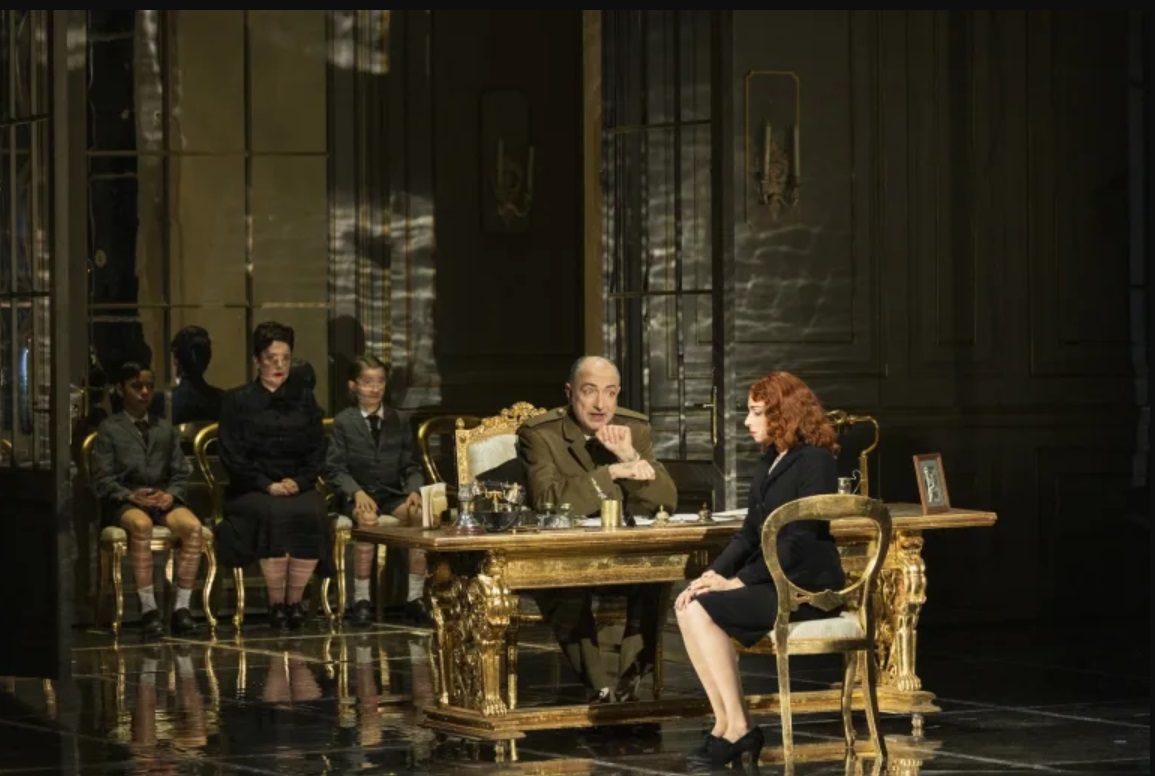
The Paris Opera production sets this version in a more recent and familiar wartime setting, Creon a de Gaulle like figure, Oronte a brash American fighter pilot, Jason of course a naval officer. It works fine, removing it from the Greek classicism and giving it an attractive freshness and colour on the Palais Garnier stage. Dance routines from a small troupe of six male and six female dancers enliven the stage choreography and choral arrangements considerably; they are not overly elaborate, more formation dancing that suits the militaristic look and feel of the setting. The real battle here however is more the one between Jason and Oronte for the favour of Creusa than a concerted fight against the foreign enemy.

That more or less establishes the template for what follows in subsequent acts of Médée; a little bit of accompanied recitative exposition followed by some invigorating music, singing and dancing as the emotional temperature rises. The stage production rises to those moments as well with - it being a David McVicar production - a few surprising twists. A glittering US fighter plane is wheeled on at the end of Act II for a nightclub scene with L’Amour/Cupid appearing as a cabaret act, the whole scene bathed in purple and pink light. Yes, it's a little bit camp, in a McVicar way, but not excessively so. It's a good way to treat the mythological characters that appear in the opera and it seems to fit musically.

The latter is essential really, since musically this production has the complete William Christie attention to detail and above all rhythm. The use of period instruments is invigorating in those dance and choral pieces, with soft flute and plucked theorbo or lute accompanying the expressions of troubled emotions. Authenticity is a matter for the musical director of course and I'm in no position to dispute or approve the choices Christie makes, but he always makes early music that could otherwise sound alien to a modern classical audience feel accessible and beautiful as well as expressive of emotional and dramatic content.

There's a sweetness to the music that is reflected in the singing voices. Yes, that even goes for Lea Desandre as Medea, but the softness of her voice has an underlying steeliness that leaves you in no doubt as to the depths of feeling love and betrayal inspired in her, nor the horrors she is capable of inflicting because of them. Corneille provides adequate motivation, character definition and some poetic beauty in the libretto for Medea. Vowing vengeance in collaboration with Oronte in Act III, she instinctively softens in the face of Jason and believes she can persuade him away from the fatal course he is on. (Jason is also well sung in this scene by Reinoud Van Mechelen, but perhaps lacks the same depth of character). This leads to a beautiful lament "Quel prix de mon amour, quel fruit de mes forfaits" where Desandre shines, pouring out the complexity and depth of Medea's love for Jason. It's a pivotal scene that the outcome depends on and everything about this is convincing for what follows.

What follows is of course all the horrors of hell, and there Desandre is also wonderfully convincing. The early dance rhythms of the period music might not seem best designed for that kind of darkness, but the fury within is there in Desandre and in McVicar's direction of the subsequent acts and scenes with dancers and demons adding emphasis and impact to the intent. It's not a particularly thrilling or insightful production, more typical 'neoclassical' McVicar, but the way it is modernised is enough really to be able to appreciate the true qualities of the work. Under William Christie the work's beauty, its charm, its seductiveness, as well as its edge of menace are all there in a wonderful combination of soft flutes and flurries of plucked and hammered strings.


External links: Opéra National de Paris, ARTE Concert

Tuesday, 25 September 2018

Monteverdi - L'Incoronazione di Poppea (Salzburg, 2018)

Claudio Monteverdi - L'Incoronazione di Poppea

Salzburg Festival, 2018

William Christie, Les Arts Florissants, Jan Lauwers, Sonya Yoncheva, Kate Lindsey, Stéphanie d’Oustrac, Carlo Vistoli, Renato Dolcini, Ana Quintans, Marcel Beekman, Dominique Visse, Lea Desandre, Tamara Banjesevic, Claire Debono, Alessandro Fishe, Davic Webb, Padraic Rowan, Virgile Ancely

Medici.TV - 18 August 2018

The importance of Monteverdi's L'Incoronazione di Poppea in the world of opera lies in its innovation, in extending the boundaries of opera beyond classical myths and bringing real historical figures to the stage. The strength of the work and the reason why it still holds such power almost 400 years later however lies in Monteverdi and librettist Busanello's fearless examination of human nature caught up in a powerplay and tyranny of love. And it's not just the interplay of the central figures competing, gossiping and plotting but the impact that this has on peripheral characters and society as a whole is very much a part of the wider remit of the opera.

Or at least it ought to be. Such is the strength of characterisation and the accumulation of events, plots, murders, suicides and, yes some of the most passionate expressions of love committed to music, that there can be a tendency for the drama to revolve around and turn inwards on the relationship between Nero and Poppea and forget about the devastating impact that their scheming and actions would have on the rest of the world. Directing for the 2018 Salzburg Festival production Jan Lauwers wants to keep that wider context present in the mind and visible, but essentially do it without detracting from the intensity of the musical content of the work.

That would be hard to do and not a wise move to make when you have William Christie conducting Les Arts Florissants, and when you have a cast like the one assembled here, one that combines experienced practitioners of Monteverdi and the Baroque (Stéphanie d’Oustrac, Ana Quintans, Dominique Visse) with a few major stars in the making not often heard in this repertoire (Sonya Yoncheva, Kate Lindsey). It's a tall order for any singer; there are few heroes or noble actions in L'Incoronazione di Poppea, all of them display at the very least meanness, arrogance and self-importance - arguably even Seneca, and certainly the gods of the Prologue.


As such, it's easy to get lost in these characters, and the superb cast make the most of them. Stéphanie d’Oustrac plays a particularly embittered Ottavia and takes it with relish, holding back on grand gestures but putting it all into the voice. Sonya Yoncheva puts everything into her singing and performance, an alluring presence that convincing turns Nero's head, but you don't get the same sense of engagement with her Poppea and I'm not certain she connects with the audience either, which has always been my experience with her at least. Full credit to her however for this ambitious venture out of standard repertoire that she takes well.

Kate Lindsey is a marvellous Nero. It's a stylised performance rather than a naturalistic one, but Nero is and should be seen as a larger than life character, albeit one with deep human feelings and failings. Lindsey navigates between anger and tenderness in a flash as Nero is driven by lust and power. "The heart is a poor counsellor. It hates laws and scorns reason", Seneca tells Nero, who retorts that "Laws are for those who serve". "Those who don't know how to rule gradually lose their power" warns Seneca, incautiously as it turns out, and therein lies the brilliance of what Monteverdi and Busanello observe and achieve in L'Incoronazione di Poppea, daring to put on stage sentiments that had never quite been expressed like this on an early opera stage before.

The challenge is to make the impact of all this visible on the stage and it's too easy to get overpowered by the scandal of powerful people behaving abominably to realise that it has consequences for everyone else. Monteverdi's opera however has many other parallel situations and characters that show that such behaviour is common across all social classes and sexes. Jan Lauwers however not only takes on the challenge of expressing the wild and contradictory facets of larger than life character like Nero or the ambition and ruthless single-mindedness of Poppea, but he extends it out and makes it vivid and real for each of the secondary characters and applicable to the wider world as well.


The quality of the performers in the  supporting roles accounts for the success of this endeavour to some extent - Carlo Vistoli's Ottone, Ana Quintans' Drusilla, Lea Desandre's Amore/Valletto and Marcel Beekman's Nurse all impressive - as does the presence of dancers of BODHI PROJECT and SEAD Salzburg Experimental Academy of Dance, who are given more to do than just the typical interpretative double mirroring of characters. A constant presence in the background, spinning and whirling, they occasionally move forward and interact with the characters, deepening relationships, expressing and visualising those contradictory elements as well as helping force the sense of real relationships between characters who could typically and easily be left to express solitary sentiments in individual arias.

That's extended to keeping other main characters on-stage, such as Poppea wandering past when Ottone is expressing his secret feelings for her, and it also extends to some limited interaction with the musicians who are all there in a shallow pit on the stage. There should be a very definite interaction between the music and the performance, more so in the semi-improvised measures and accompaniment of music that is not fully scored. Interpretation is very much a feature of Monteverdi's operas and there's no right or wrong way, but there certainly ways that bring the music to life better so that they connect with the tone of the drama and communicate it to the audience. There's no doubting the ability of William Christie and Les Arts Florissants to do that exceptionally well here.

It's Jan Lauwers however who manages to most successfully focus all those elements of music, dance, characterisation and expression and push them out beyond the stage. The stage itself is covered with images of classical paintings, a mass of bodies that remind you that this is not just a heated drama of consequence only to a little group of self-interested and self-serving people, but that their actions have consequences out in the wider world. That's a lot to take on, and much more than would normally be considered necessary when you have Monteverdi's music to express and enchant, Jan Lauwers' production for Salzburg, with its fine cast, make this ancient work feel as fresh and modern and relevant as many contemporary works, and perhaps even more so.

Links: Salzburger Festspiele

Friday, 10 April 2015

Campra - Les Fêtes Vénitiennes (Opéra Comique, 2015 - Webcast)

André Campra - Les Fêtes Vénitiennes

Opéra Comique, 2015

William Christie, Robert Carsen, Emmanuelle de Negri, Élodie Fonnard, Rachel Redmond, Emilie Renard, Cyril Auvity, Reinoud Van Mechelen, Marcel Beekman, Marc Mauillon, François Lis, Sean Clayton, Geoffroy Buffière

Culturebox - 30 January 2015

 
So far, André Campra's operas haven't received as much attention as the two French royal court appointed composers on either side of his career, Lully and Rameau. As the person responsible to a large degree for the revival of interest in many of the great forgotten French works those two composers, with academically informed performances on period instruments, it's great to see how William Christie and Les Arts Florissants' interpretation of Campra's most famous and emblematic work compares. Having also directed a number of stage productions of Lully and Rameau for Christie to terrific effect (Armide, Les Boréades, Platée), Robert Carsen's production of Les Fêtes Vénitiennes for the Opéra Comique in Paris combines with Christie's interpretation to present the work in as spectacular and entertaining a way as you might expect.

Lully's beautiful tragédies-lyriques might have been a hard act to follow, but at least as far as Les Fêtes Vénitiennes goes, Campra manages to retain what is good about Lully's work - principally the splendour and the rhythmic pulse of the dance music - without the longeurs that go along with it. There's a Prologue here invoking the Gods that leads to conflict among mortals, but none of the lengthy praises to the Sun God, Louis XIV, that open Lully's tragédies-lyriques. And instead of one long mythological subject drawn out and interspersed at every opportunity with dances and choral pieces, Campra hits upon a more accessible format that would later become known as the opéra-ballet.

It's a format that if it is recognisable at all now, it will be because of Rameau's similarly frivolous portmanteau entertainment of Prologue and Entrées, Les Indes Galantes. The style was perhaps hit upon accidentally by Campra during the first performances of Les Fêtes Vénitiennes in 1710, the work evolving as it was performed, with some new episodes added and old ones dropped, according to their popularity with audiences. The intent is clearly that this is all in the name of entertainment and spectacle, and Les Fêtes Vénitiennes is as lively and entertaining as they come.


In keeping with the spirit of the work, it would be a mistake to over-extend the piece by showing as many of the Entrées as possible, but rather it's more important to try to retain the variety and concision of the original. From the 4 Prologues and 9 Entrées available then, Christie selects one Prologue ('The Triumph of Folly over Reason') and 3 of the Entrées ('The Ball or the Dance Master', 'The Serenades and the Gamblers' and 'The Opera or the Singing Master'). There's a certain amount of cross-over between the four parts - and, of course Carsen and Christie focus on the 'theatrical' theme - but really the only real connection linking the different interchangeable parts of the works is that they all fit within the rather open concept of being based around the celebrations of the Carnival in Venice.

The Prologue opens with a group of modern-day tourists visiting St Mark's Square and being taken with the colourful pageantry of the Carnival, abandoning Reason to the Folly of the festivities, much to the displeasure of the religious orders. This allows the work to then fall back on a stylised imagining (no more authentic I imagine than Campra's original vision) of the exaggerated colour, exotic locations and all the pleasure-seeking and romance associated with Les Fêtes Vénitiennes. In Le Bal, a wealthy prince wants to test the constancy of a young Venetian woman he is in love with, exchanging positions with his Dance Master to see if she truly loves him or is only interested in wealth and position. Les Sérénades features two women, Isabella and Lucile, both of them competing for the love of Léandre, who is really in love with another beauty, Irène. L'Opéra also deals with love affairs, where a group of opera singers love-lives become enmeshed in the opera they are singing.

Most of the Entrées are played out in a fairly straightforward manner here, albeit in highly-stylised sets and wearing boldly-coloured and extravagant costumes. There are a few characteristic twists - Fortune for example dressed (or semi-undressed) as a walking Casino - but they all remain in the spirit of the work and within the context of the Venetian setting. There's some recognition that L'Opéra ou le maître à chanter, with its opera-within-an-opera setting, is a kind of baroque Ariadne auf Naxos and perhaps some parody of Lully's operas is implied, so we get all kinds of theatrical tricks, even dancing sheep. In the main however, the idea is simply to get as much of the entertaining variety that makes the work a delight to watch, with frequent dances, colourful costumes, clever stage craft, choruses, duets and arias.


Some of the pieces take a little longer to get going, the final
L'Opéra Entrée in particular requiring quite a bit of recitative to set up its plot, but in terms of the variety of the selections and their individual make-up, their purpose is clear, their balance of singing, ballet dancing and spectacle all seeking to entertain. Carsen provides the context for that marvellously, but the real test of the work is in the musical performances and the singing, and the production doesn't let us down on those points. William Christie and Les Arts Florissants bring all the inherent vibrancy out of the work and it's simply marvellous to hear on period instruments, Campra's arrangements, particularly the ballet sections, having a popular folk-dance character that sounds closer to Cavalli than the rather more stately regal rhythms of Lully and Rameau.

The singing is also outstanding, many of these singers well-schooled in the Arts Florissants style, with much experience in the music of this period. Some of the familiar names playing multiple roles, as is often the case in such works, are Marc Mauillon, baritone François Lis as Léandre and Emmanuelle de Negri as Reason, Lucile and Lucie, all of them wonderful. Élodie Fonnard also makes a terrific impression in the eye-catching role of Fortune as well as playing Iphise in L'Opéra, and Reinoud Van Mechelen wonderful light lyrical tenor shines out in the countertenor roles of Thémir and Zéphir. With so much talent packed into such variety of scenes and situations, there's never a dull moment here.

Links: Culturebox, L'Opéra Comique

Friday, 15 August 2014

Gluck - Gluck 300 Years (Blu-ray)

Christoph Willibald Gluck - Gluck 300 Years

Alceste - Stuttgart, 2006
Constantinos Carydis, Jossi Wieler, Sergio Morabito, Catherine Naglestad, Donald Kaasch, Bernard Schneider, Catriona Smith, Johan Rydh, Michael Ebbecke

Iphigénie en Tauride - Zurich, 2001
William Christie, Claus Guth, Juliette Galstian, Rodney Gilfry, Deon van der Walt

Orfeo ed Euridice - Royal Opera House, 1991
Hartmut Haenchen, Harry Kupfer, Jochen Kowalski, Gillian Webster, Jeremy Budd

Arthaus Musik - Blu-ray

In terms of content, this release is a fine way to celebrate Gluck's 300th anniversary, collecting what are quite simply three of the greatest works of opera ever written. All three operas are key works of Gluck's reform period, the purest examples of the composer's intentions to reduce extravagant ornamentation and bring opera back to its fundamental purpose as a means of dramatic expression. As such they are all derived from classical Greek dramas, mythological in scope but human in sentiments, profound in their meaning and exquisite in their musical arrangements.

Each of the productions differs in terms of musical performance and stage interpretation, but all are faithful to Gluck's vision of the pure music-drama. Orfeo ed Euridice is performed in its original Italian version, Iphigénie en Tauride in its original French version, Alceste in the 1776 French revision. While the quality of the performances is indisputable, the fact that all three operas are contained on one single BD50 Blu-ray disc might give a clue that quality of the video transfers for this release is far from expected High Definition standards.

Alceste - Stuttgart, 2006
There are a few odd touches in the 2006 recording of Stuttgart's full French edition of Alceste (complete with the concluding six-movement orchestral suite by Gossec), but other than the 20th century setting - some kind of combination of funeral parlour, recording studio and meeting house - there's nothing too unusual attempted in Jossi Wieler and Sergio Morabito's production. There's something oratorio-like about Alceste's grand choruses and funeral marches, with individual dramatic expressions of grief, despair and prayers as Alceste sacrifices herself, Apollo having promised that the dying King Admeto will be spared if someone worthy takes his place. That all comes across exceptionally well here.


Despite the lack of typical dramatic action, all the human drama of Alceste is taken to the limits and wrapped up in the music and the singing. The work is given a magnificent account here in the Stuttgart production conducted by Constantinos Carydis, and the singing gives full expression to the trials of human life held to the cruel and unfathomable whim of the Gods. Catherine Naglestad gives a strong, unmannered performance of dramatic intensity as Alceste, Donald Kaasch is a dignified lyrical Admeto. The chorus work is sublime.  

Iphigénie en Tauride - Zurich, 2001
Musically pared back to its pure emotional core, it's debatable whether Iphigénie en Tauride requires any further stage elaboration, but Claus Guth highlights the psychological depth that underlies the trauma of the characters by picking up on the (pre-)Freudian undercurrents, expressing them in dreams where papier-mâché doubles continually re-enact their nightmares and drive their actions. It's evidently not going to be to everyone's taste, but it is an interesting and valid interpretation of the opera's content, and it does indeed bring out - or perhaps overstate - elements that otherwise might pass by unnoticed.


Under William Christie, the orchestration presents the work in a clear, bright, stripped-back arrangement. It's less full bodied than other recordings I have heard, sounding like a chamber orchestra here presumably using period instruments. Both Juliette Galstian as Iphigenia - restrained, clear and with beautiful diction - and Rodney Gilfry as Orestes, take advantage of the spacious arrangements and sing purely, emotively, without needing to dramatically overstate.

Orfeo ed Euridice - Royal Opera House, 1991
The Royal Opera House's 1991 production of Orfeo ed Euridice from 1991 still stands up pretty well musically and it manages to reveal the aching beauty of the opera, but there are some curious staging elements in Harry Kupfer's direction that never quite add up to a consistent concept. Although fully staged with attention to mood and situation, the chorus are lined-up in rows in an extended orchestra pit in formal dress, and the singers too on occasion lapse into concert performance mode with the music score open before them as if they are in some kind of mentally abstracted state. Doubles are used and Amor speaks to Orfeo through their young child. The dress is contemporary 1990s casual, Orpheus looking like a pub folk singer, but the journey through Hell after the death if Eurydice is no less real and dramatically intense in this version.


The best thing about the performance is the countertenor Orpheus of Jochen Kowalski. There's a beautiful clarity and strength to his voice that reaches those extremes of Orpheus' mental state with tremendous force of expression. Eurydice is passionately delivered by Gillian Webster and Amor is enchantingly sung by Jeremy Budd. Hartmut Haenchen conducts a well-balanced version of the original 1762 Italian version of Orfeo ed Eurydice.

There are some terrific performances here of these great Gluck masterpieces and I was looking forward to seeing them upgraded to HD, but the transfers on this Blu-ray are very disappointing. Basically, it appears that the old DVD masters have just been transferred across to HD format, with all three operas contained on a single BD50 disc. The image and sound are reasonably good, and certainly acceptable for Standard Definition presentation, but on a large screen or projected, none of these will meet High Definition requirements. The image is soft, the transfer exhibits and perhaps even enhances the familiar flaws found in old video transfers. Alceste and Iphigénie en Tauride are 16:9 widescreen, while Orfeo ed Eurydice is 4:3.  Each performance comes with English, French, German, Spanish and Italian subtitles.

You're actually at a slight disadvantage with the BD release. The DVD version of this collection is a box set that collects each of the operas as individually cased DVDs. For convenience or uniformity, the BD release has PCM stereo on all performances, dropping the Dolby Digital 5.1 mix of Iphigénie en Tauride. There is no chapter selection on the Blu-ray, just the option to choose which opera to view, and there is no pop-up menu functionality. You can however find chapter-listings for each of the productions in the enclosed booklet. In addition to the three operas on the Blu-ray there is a "bonus" in the form of an hour-long film "Winds of Change, Winds of Love" by Inger Aby, a dramatised meeting between Gluck and his student Salieri, where the elder master advises on how success in Paris is as capricious and unpredictable as the wind.

It's undoubtedly convenient to have all three operas gathered together on a single BD disc, and the performances of these three great works are all well worth having, but very disappointing that this is not a true High Definition release.

Sunday, 20 July 2014

Rameau - Hippolyte et Aricie (Glyndebourne 2013 - Blu-ray)

Jean-Philippe Rameau - Hippolyte et Aricie

Glyndebourne 2013

William Christie, Jonathan Kent, Ed Lyon, Christiane Karg, Sarah Connolly, Stéphane Degout, Katherine Watson, François Lis, Julie Pasturaud, Samuel Boden, Aimery Lefèvre, Loic Felix, Ana Quintans, Emmanuelle de Negri, Mathias Vidal, Callum Thorpe, Charlotte Beament, Timothy Dickinson

Opus Arte - Blu-ray

On previous experience of this early work of French Baroque opera at a production in Paris a few years ago, Rameau's Hippolyte et Aricie can often feel like a rather dry classical text adapted to the lyric stage by an experienced composer already well-renowned for his academic approach to the musical form. With William Christie leading the Orchestra of the Age of Enlightenment however in this rather more lively production for Glyndebourne, it's evident that the elegant rhythms and melodies of the work can actually be sensitive, expressive, witty, thoughtful and movingly tragic. The scenes in Hippolyte et Aricie moreover also offer opportunities for great spectacle, another vital component of Baroque opera and Glyndebourne is traditionally good at that. The 2013 production does indeed offer considerable spectacle, and if its relevance is not always clear it is at least in tune with the tone and the spirit of the work and the musical interpretation.


Questions about the relevance of Jonathan Kent's staging are sure to arise however in the Prologue. In Hippolyte et Aricie, it's a typically Baroque one that has opposing deities in dispute with one another in a way that is to have a profound affect on ordinary mortals (and some semi-deities) over the course of the subsequent drama. Quite why this takes place inside a giant fridge is hard to fathom and likely to come as a bit of a shock to the bewildered viewer, but there's no question that it fully lives up to the requirement to provide wonderful spectacle. It looks marvellous and is certainly inventive as cauliflower clouds hover over the stage, a lemon slice becomes the sun, and broccoli stalks descend to turn into trees. It's at least appropriate to characterise the icy detachment of the goddess Diana by confining her to the ice-box, while a fiery Cupid, whose influence is to cause such havoc to Diana's followers and worshippers, hatches out of an egg - but what on earth are the gods doing in a fridge in the first place?


Well, in addition to being a classical text, Hippolyte et Aricie is - as this production emphasises in its own very stylised way - very much a domestic drama, a point emphasised when the Three Fates warn Theseus at the end of Act II that he will escape from the Underworld only to find Hell at home. Hell as it happens is depicted cleverly and imaginatively here in Paul Brown's amazing designs as existing at the back of the very same fridge where the gods reside, and if you've ever ventured behind your own kitchen, you'll know how accurate an analogy that is. The Fates' prediction of "domestic Hell" proves to be true for the son of Neptune, who returns to find that his wife Phaedre, believing Theseus dead (usually a requirement for access to the Underworld), has fallen in love with his son Hippolytus. Mythological it might be and inspired by the actions and whims of the immortals, but Cupid has indeed brought disharmony into the formerly very secure, cool and detached "innocent" world of Diana's followers and their blood sacrifices. The fall-out is very real and domestic, Phaedre bemoaning that she is "unable to kill this detestable love" for her stepson.

What's missing of course is harmony between the Gods and, thereby, between ordinary mortals. Neptune appeals to Pluto for the release of Theseus from the Underworld in Act II saying that "the well-being of the universe depends on your common harmony", but the balance has been disturbed by Cupid's intervention, inspiring Hippolytus to love Aricia, in the process incurring Phaedre's jealousy and suppressed feelings for Hippolytus. As an opera, in its structure and in its musical arrangements as well as in its subject, Hippolyte et Aricie also operates very much on this notion of harmony and the balancing of elements, and Rameau - as academic a composer as he might be - makes the case not only structurally and harmonically, but with a sensibility for the beauty of such imperfect human sentiments in the sphere of what makes them aspire to be gods.


William Christie fully explores all the melodic and harmonic richness of what Rameau expresses so brilliantly in the musical arrangements, but also balances this with the requirements of the singing. Spectacle ("le merveilleux") and entertainment ("divertissement") are other factors that count towards this balance and harmony of all the elements, and that's all there too in the gorgeous but dramatically pointless ballet interludes and in the big and smaller details of the production design. The fridge in the Prologue is followed by a more traditional scene in the forests for the followers of Diana that nonetheless reflects the horrors (hanging deer, corpses dragged across the stage, copious blood) of the sacrifices. The Hell behind the fridge meanwhile has dancing flies, infernal devices in the shape of power units, with all sorts of horrible gunk and creatures caught up in the extractor grille.

As well as being visually inventive and thematically attuned to the work, the sets also demonstrate good storytelling technique that is accessible and allows the audience to better engage with a work that what could otherwise appear rather dry and fusty. Some elements however work better than others, so while it's meaningful to have the home of Theseus and Phaedre look like a tastefully-decorated suburban semi-detached (shown in cutaway cross-section in a manner reminiscent of Katie Mitchell's designs for Written on Skin), you miss out on the traditonal spectacle of Neptune's grand entrance by reflecting it through a living-room fish tank. The later acts might not always find imagery as strong the fire and ice of the earlier acts - Act V taking place in a mortuary - but there is some attempt to retain a dramatic narrative in the ballet sequences, and the singing performances too are strong enough to take up the lack of drive in the latter half of the work. 


Several of the best performers seen in the Paris production reprise their roles here to even more dazzling effect, while those that have been changed are often just as fine if not better in the roles. That means we not only have the excellent Stéphane Degout as Theseus, but we also have the simply stunning Sarah Connolly again in the role of Phaedre. In addition to being merely a formidable presence, as she was in Paris, Christie's arrangements and Connolly's performance also manages to elicit some sympathy for her character's predicament. As Hippolytus, Ed Lyons is perfect for the intentions of this production, his voice delicate but also strong enough to be capable of matching and standing up to Connolly/Phaedra. If he was weaker, this wouldn't work half as well. Christiane Karg however just didn't work for me as Aricia. It can be somewhat of a bland role, but Karg didn't really have anything to enliven it here. Ana Quintans was a bright Cupid however, François Lis majestic as Pluto, Neptune and Jupiter, and Katherine Watson an icily aloof Diana.

On Blu-ray, this Hippolyte et Aricie looks and sounds every bit as spectacular as the production itself, with a bold colourful video transfer of the performance and crystal clear sound mixes in LPCM 2.0 and DTS HD-Master Audio 5.1. Aside from the Cast Gallery, there's only one extra feature on the disc, a fifteen-minute making of that covers all aspects of the production, interviewing Christie and Kent, but takes a particular interest into Paul Brown's unusual costume and set designs. The disc is BD50, region-free, with subtitles in English, French, German and Korean.

Saturday, 18 August 2012

Charpentier - David et Jonathas

Marc-Antoine Charpentier - David et Jonathas
Festival d’Aix-en-Provence, 2012
William Christie, Les Arts Florissantes, Andreas Homoki, Pascal Charbonneau, Ana Quintans, Neal Davies, Frédéric Caton, Krešimir Špicer, Dominique Visse, Pierre Bessière
Aix-en-Provence - 11 July 2012
Marc-Antoine Charpentier worked for many years in the shadow of the officially appointed court composer Jean-Baptiste Lully and it seems he has remained in his shadow ever since, largely overlooked even as French Baroque music is being rediscovered in modern times, favouring Lully and his successor Rameau over Charpentier and Campra. There may be genuine musicological reasons for this choice, but judging by this rare performance of Charpentier’s David et Jonathas for the 2012 Aix-en-Provence Festival - the first staged performance of the work in over 300 years - the problem seems to lie with the difficulty of adapting this kind of work for a modern stage, since musically it is rather something of a delight.
First performed in 1688, a year after the death of Lully, David et Jonathas, a “Biblical tragedy in five acts with a prologue” is based on the friendship between David - slayer of Goliath - and Jonathas, the son of King Saul. The difficulty with adapting this work to a stage production is similar to the nature of attempting to stage Handel’s religious oratorios, the libretto by Père François de Paule Bretonneau in this case making it somewhat difficult to grasp a clear dramatic or narrative thread. Essentially however, the main thrust of the work is relatively straightforward, dealing with Saul’s growing mistrust of the shepherd boy David, who he has initially welcomed into his company. David is shown to be a popular hero, the people celebrating his successes in battle, but Saul suspects that he may be using his popularity and his friendship with his son Jonathas as a means to overthrow his rule and replace him as king of Israel.
Another reason why the work may be difficult to follow was that it was originally written to be performed as musical interludes inserted into a performance of the theatrical drama Saul. The Aix production does its best to create some dramatic situations out of this Biblical story, adding flashback scenes during what would have been musical ballet sequences that fill out the background of the historical conflicts, building up the childhoods of David and Jonathas and including other significant incidents such as the death of Saul’s wife, all of which seems to have an impact on destabilising the king’s mind, leading to more wars and a tragic outcome. The Aix production also notionally sets this staging of the opera during the Palestinian Civil War and the Arab-Israeli war of 1948, which may or may not be necessary as a meaningful parallel for the audience - but other than perhaps influencing the costume design, in reality there’s little direct reference made to the origins of the modern political conflict in the region.
The stage design rather places the action within a box of bare wood panelling, sparsely decorated with nothing more than wooden chairs and a long table, giving the impression more of a Quaker community room, or even occasionally looking like something out of a Western. Cleverly designed (I still can’t work out quite how they manage it), the walls and ceilings move to compress the space, open it out or split it into several rooms, blocking and boxing in to create a dramatic focus and tension to the singing. It’s hardly necessary, since the singing itself is more than capable of finding the right dramatic tone, and if anything the staging tends to over-emphasise it and place it at odds with the often delicate elegance of Charpentier’s beautiful musical arrangements and joyous choruses.
More often it’s simply trying to make the opera visually more interesting and dramatic than it might otherwise be. The production sparks into life during those magnificent choral arrangements, celebrating David’s successes in battle, and there are many of those. It’s less successful in providing psychological justification - and even suggestion of sexual attraction in the closeness of the relationship between the two men (notwithstanding the role of Jonathas being performed by a female singer). If the libretto and the flashback scenes don’t really bring this out sufficiently, it is however made impressively real and on occasion genuinely touching through Charpentier’s beautiful use of melody and his use of woodwind instruments - evocatively brought out by William Christie and Les Arts Florissants (who incidentally, take their name from a Charpentier opera) - and through the fine singing performances.
As David, Pascal Charbonneau has a powerful presence and voice, wonderfully expressive in a way that gives genuine character to the role, but it does tend to sound slightly constricted and nasal on those more stretched emotional sections - and this is a tragedy where the despairing cry of ‘Hélas!’ features heavily. I don’t think the actual acoustic of the boxed stage helps though. Elsewhere the singing and dramatic performances were excellent, even if the true quality of Ana Quintans singing only really came through in the very moving final act death scene of Jonathas. Neal Davies sang Saul with force and passion, but the stage direction and imagery used to convey his descent into paranoia suspicion and grief wasn’t always convincing. Still, this is clearly an extremely difficult work to adapt dramatically to the modern stage, but more than worthwhile for the opportunity of seeing this rarity from a neglected composer given full dramatic consideration and performed so well.
This performance of David et Jonathas was recorded at the Aix-en-Provence Festival on 11th July 2012 and viewed via internet streaming. It is currently still available to view on the ARTE WebLive web site or via the ArtsFlo Media site. Some region restrictions might apply.

Tuesday, 31 July 2012

Cavalli - La Didone

Francesco Cavalli - La Didone

Théâtre de Caen, 2011
William Christie, Clément Herve-Léger, Anna Bonitatibus, Kresimir Spicer, Xavier Sabata, Maria Streijffert, Terry Wey, Katherine Watson, Tehila Nini Goldstein, Claire Debono, Joseph Cornwell, Victor Torres, Valerio Contaldo, Mariana Rewerski, Matthias Vidal, Francisco Javier Borda
Opus Arte
Depending on the work, depending on who is playing it and depending on how it is staged, Cavalli’s operas - some of the oldest works in existence - can struggle to hold the attention of a modern audience. They can be long, usually based on classical subjects, consist of long stretches of recitative accompanied principally on harpsichord and lyrone basso continuo with a limited range of period string instruments. There’s little in the works that lends itself to exciting staging in the way of, for example, the French regal entertainments of Lully and Campra, with all their ballet sequences and choral arrangements. There are no such difficulties with this particular work - one of Cavalli’s earliest operas first performed in 1641 - a version of the familiar story of the Fall of Troy and the love story of Dido and Aeneas, and with the production being in the hands of William Christie and his company, Les Arts Florissants, there are no concerns either about the musical interpretation of La Didone, which is staged with dramatic intensity by Clément Herve-Léger.
What makes La Didone rather more accessible than some works of early opera is the libretto by Giovanni Francesco Busenello, the librettist responsible for Monteverdi’s ground-breaking L’Incoronazione di Poppea, an opera that daringly put real characters onto the stage for the first time rather than the gods and heroes of ancient mythology. Even though La Didone is related to the mythological figures of Virgil’s epic Latin poem ‘The Aeneid‘, it benefits nonetheless from Busenello’s wonderful humanising of the characters and indeed the gods. The libretto isn’t made up of the usual vague pronouncements and declarations, but is dramatically and poetically expressive of the range of human emotions and passions that are brought out by this expansive work. In the first half - in the model followed by Berlioz in the now more familiar Les Troyens - the libretto captures the true horror and nature of the experience of war, the destruction of one’s country and with it one’s hopes and dreams. The second half also corresponds with Berlioz’s division, with Aeneas’ arrival in Carthage and with the trials that are brought by love and betrayal, expressed in a variety of ways, through Dido’s love for her dead husband, her rejection of Iarbas, and in her love for Aeneas’ that is curtailed by his sense of duty (to the gods) to abandon her and strike out for Italy.

This wonderfully rich story is brilliantly described in Busenello’s libretto, but if it truly achieves the same kind of expression of human passions that can be found in L’Incoronazione di Poppea, it’s also due to the musical compositions of Cavalli, himself a pupil of Monteverdi. William Christie directs this from the harpsichord and the rhythms and tone are clear, precise and dynamically attuned to the emotional content of the work, emphasising the horror with driving chords and accompanying the delicate laments and love-songs with heartfelt lyricism. Even without a synopsis (there isn’t a detailed one with this DVD/BD release unfortunately), it’s not difficult to follow what is going on thanks to the clear libretto where figures introduce themselves naturally, and due to the musical accompaniment that defines them. This is particularly strong in the tricky first Act, where in addition to gods directing the events, numerous figures wander around the dark ruins of Troy in despair, terrorised by marauding Greeks - Coroebus dying in the arms of Cassandra, Hecuba’s despair for the fate of the women, Aeneas’s wife Creusa murdered and returning as a ghostly figure. Appropriately then, it all looks and sounds like the Hades of Monteverdi’s L’Orfeo supplanted into the hell of a destroyed Troy.
Things actually become a little more confusing in the Carthage sections in this production with the doubling up of roles, when the same singer who played Aeneas’ dead wife Creusa in Act 1 (Tehila Nini Goldstein) turns up in Act 2 as Juno trying to destroy him. Even trickier, Cupid disguises himself as Aeneas’ son Ascanio in Act 2 to bring about the love between Aeneas and Dido, so although it makes for a convincing disguise when both Cupid and Ascanio are played by the same person (Terry Wey), it could be just a little confusing. (The chaptering, available as a pop-up on BD, will however clarify any other confusion over which characters are singing at any time). The fact that it works is down to the strong direction and staging working in perfect accordance with the music and the drama of the libretto. Clément Herve-Léger keeps the sets simple, employing only one or two large and effective symbolic gestures. It’s not period, but other than the inappropriate scaffolding for the down-to-earth gods and Venus lugging a suitcase for her journey to Carthage - an effort to humanise the appearances of the gods in line with the nature of the work and against the tradition of big fanfares and mechanical stage entrances - there are no distracting modern anachronisms.

With the simplicity of the staging and the sparseness of the orchestration, compared to conventional opera, much depends on the quality of the singing here. Populated extensively from Christie’s ‘Jardin des Voix‘ school for new young talent, the singing is exceptional right across the whole cast. Anna Bonitatibus is a clear, powerful and resonant Didone (Dido), and Kresimir Spicer a gentle lyrical Enea (Aeneas), both of them commanding and deeply expressive in the central roles, but the cast - clearly trained for this kind of singing - is made up of youthful voices filled with passion, clarity and a purity of tone that is well suited to early opera (some however - such as Francisco Javier Borda playing both Ilioneo and Mercury - try a little too hard). La Didone is still not without some longeurs for anyone unfamiliar with early opera, but this is certainly one of the more accessible works of this period, treated to a beautiful looking and fresh sounding production from Les Arts Florissants, that brings a much needed vitality to this rare 370 year-old work.
Opus Arte’s Blu-ray release comes with impressive specifications in terms of High Definition image and sound. The period instruments in particular have a wonderful clarity of tone within the natural reverb of the Caen theatre. It sounds a little bright and there’s no low-frequency range at all in the DTS HD-Master Audio 5.1 mix, but it’s distributed well emphasising the fragility of the delicate playing and the strength of the vocal expression. The PCM Stereo mix is also clear and true. The BD is dual-layer BD50, 1080i and all-region compatible, with subtitles in English, French and German only. There are no extra features other than a Cast Gallery and a booklet with an essay on the work which has a brief outline of the story, but there is no detailed synopsis.

Thursday, 5 January 2012

Lully - Atys

Jean-Baptiste Lully - Atys
Opéra Comique, Paris, 2011
William Christie, Les Arts Florissantes, Jean-Marie Villégier, Bernard Richter, Stéphanie d’Oustrac, Emmanuelle di Negri, Nicholas Rivenq, Marc Mouillon, Sophie Daneman, Jaël Azzaretti, Paul Agnew, Cyril Auvity, Bernard Delatré
FRA Musica
In contrast to most of William Christie’s recent productions reviving forgotten gems of early French Baroque opera, this 2011 production of Jean-Baptiste Lully’s 1676 opera Atys for the Opéra Comique in Paris is rather more faithful to the period and tradition of the original work. It may be the case that the works of Lully’s successor Rameau are better suited to a more experimental approach that strives to find a balance between the classicism of the subjects and the modern perspective from which they must inevitably be viewed, but the Les Arts Florissantes’ production of Lully’s Armide directed by Robert Carsen shows that this doesn’t necessarily have to be the case. As a revival of one of Christie’s earliest productions, from 1987, what is fascinating about Jean-Marie Villégier’s production (amply documented in the extra features on this Blu-ray disc), is the careful consideration of how to present works that hadn’t been played anywhere for several hundred years in as faithful a way as possible while still making them relevant and meaningful to a new audience. The fact that a wealthy benefactor was so moved by the original production that he paid for the lavish production to be restaged in 2011 is testament to the fact that the producers got something right, and the reason why a greater audience can share in the enjoyment and beauty of this work in the age of High Definition video.
Inevitably, at this early stage in the revival and presentation of such works, the tendency is to aim towards fidelity to the period and the intentions of the work as closely as possible, but not slavishly so. There are good reasons for this, principally the fact that, even with great amounts of research on the part of Villégier - an expert on the theatre of this period - one can only come up with at best an approximation of how it was originally staged based on the scarce accounts and documentation of the opera’s original performances for the Royal Court of Louis XIV. Secondly, one has to take into consideration the expectations of a modern opera audience to some degree, since Atys itself was written and tailored to the expectations of a contemporary audience, and there’s a huge gulf of history and opera now that lies in-between that cannot be ignored. Any attempt to create authentic props, backdrops and stage effects would consequently only be a representation of a dull and dusty museum piece, making it nothing more than a curiosity of how opera would have looked in Baroque times, but Christie and his collaborators evidently believe that Lully’s Atys (like their revivals of other works from this period) has inherent musical and entertainment value that doesn’t need to be tied to a historical tradition.
Villégier’s production manages very well in this respect, aiming for period authenticity in the set and costume designs, capturing a sense of the elaborate extravagance of the work - in musical as well as in production terms - without going overboard and cluttering the stage with unnecessary props and effects. The costumes are actually those of 17th century nobility, not the robes and tunics of classical antiquity in a pastoral setting that would have been more likely employed for this subject, so the intention is clearly to give a semblance of the opera in its time rather than how it would actually have been staged. In the same vein, there is just one all-purpose grand palatial room used for all three acts, based on an historical etching, which gives sufficient room for the large cast of singers, dancers and chorus to play out the comedy, drama and tragedy of the work, conveying everything that is required through the quality of the musical and vocal presentation. The splendour and the sense of the work is thus preserved, without the need for programme footnotes to explain the tradition or make excuses for peculiarities of the production design.
The prelude in praise of the Sun King Louis XIV in this particular opera is an interesting one then, since it serves to set out the whole tone of the opera and the approach taken towards it. In the prelude, Time and the Seasons are put on hold while Melpomene, the muse of tragedy, begs leave of the king himself to delay the arrival of Spring so that the tale can be told of the tragic loves of Atys and the goddess Cybèle. It’s a very formal proposal, though it’s enlivened by comic touches, and this production accordingly plays out in the same fashion - respectfully, but with a lightness of touch. The theme, as is often the case in Baroque opera, is a romantic and a tragic one - of lovers who are kept apart by the whims of gods and kings. And, as is also often the case, gods and kings are not immune either from the forces of love. Here, Atys has just discovered that his secret love for Sangaride is reciprocal, but, alas, the discovery comes too late, for Sangaride is about to be married to the King of the Phrygians, Celenus. The lovers appeal to the goddess Cybèle, who has just appointed Atys her high priest, not knowing that Cybèle is in love with Atys herself. The results in such works when the lovers are not united with their true partners, are inevitably tragic.
While that sounds like a typically Metastasian kind of situation for a long-winded opera seria, but while Atys does indeed run to some three and a quarter hours with lots of tragic bemoaning of the cruel twists of fate and the unfathomable will of the gods, it is not a typical opera in this respect. There are no long repetitive da capo arias and no extravagant coloratura, practically no recitativo secco either, rather Atys almost holds to the model that Gluck would aspire to in his opera reforms. There is little that really stands out as an aria, but rather, a wonderful continuous flow to the singing which purposefully carries the drama and the inner feelings of the characters forward in an admirably concise and direct fashion. There are no longeurs, despite the length, the opera having a wonderful rhythm and structure of its own, the ariosos varying in pace and being broken up with ballets and the most beautiful choral arrangements. Even little divertissements, such as the prelude and the quite stunning Sleep quartet of Act III (”Dormons, dormons tous“) have a dramatic purpose, Le Sommeil arriving to transport Atys to the realm of Cybèle. All of this serves to make Atys dramatically engaging at the same time as being spellbindingly entertaining.
More than just serving these functions as should any good opera, one is equally struck and impressed by Lully’s musical sensibility, which is brought to life beautifully by William Christie and the orchestra and chorus of Les Arts Florissantes. Despite there being some discussion of research into the instruments played and the composition of the orchestra in the accompanying documentary on disc two of this Blu-ray set, it’s not known how much reconstruction, interpretation and improvisation was involved on the part of Christie, but the results are genuinely impressive. It’s not just the interpretation and performance of the music that are successful however, but rather how every element of the production, direction and choreography falls into place with no jarring elements, creating a consistent and fluid dramatic and musical wholeness. It’s within that perfect setting that the performance of Stéphanie d’Oustrac stands out all the more vividly like a sparkling jewel. Her singing is beautiful, perhaps no more exceptional than the other fine performers in the principal roles, but in her acting, in the rush of emotions that flit across her face and rest in her eyes, she brings that much needed humanity that is essential to prevent the opera being just a dry museum curiosity and instead, as Villégier accurately describes it in the documentary feature, “a catharsis of passions” that is recognisable to any viewer of any age or period. It’s all the more impressive that it is a goddess who displays such passions and, likewise, that those all too recognisable human passions can be found in a work that is almost 350 years old.
It’s remarkable too how such an old work can look and sound so fresh on the impeccable High Definition presentation of the Blu-ray release from FRA Musica. The beautifully lit image captures all the beauty in the detail of the costumes and the production design, the direction for television by Francois Roussillon capturing it all wonderfully as ever, allowing the camera to linger on the expressions of the singers at crucial moments. Nothing is missed. The usual PCM stereo and DTS HD-Master Audio 5.1 tracks are provided and have a similar crystal clarity with fineness of detail. The surround mix in particular on this release makes great use of the additional spacing and separation of instruments. A two-disc set, disc one contains the entire opera, with disc two given over to an interesting 100-minute documentary reuniting most of the creators involved in the original 1987 production recreated here in 2011. Subtitles are in French, English, German, Spanish and Italian. A very impressive set of a production (like Christie’s stunning Les Indes Galantes) that deserves to be retained for posterity.

Thursday, 21 July 2011

Lully - Armide

Jean-Baptiste Lully - Armide
Théâtre des Champs-Elysées, 2008
Les Arts Florissants, William Christie, Robert Carsen, Stéphanie d’Oustrac, Paul Agnew, Laurent Naouri, Claire Debono, Isabelle Druet, Nathan Berg, Marc Mauillon, Marc Callahan, Andrew Torise, Anders J. Dahlin
FRA Musica
It’s difficult to know what balance to strike when putting on a production of a Baroque opera since, in many cases, the works in question are incredibly old and so rarely performed that they are indeed often being introduced for the first time in centuries to a new modern audience. You can’t go too far wrong with a straightforward staging using traditional painted backdrops and period costumes (which I’ve seen on DVD, for example, in productions of Cavalli’s La Calisto, Rameau’s Zoroastre or Landi’s Il Sant’ Alesio). While they would certainly cater to a specialist audience, it’s hard to imagine those kinds of productions reaching a larger audience or even being revived too often. I find however that William Christie, with whatever director he is working with, strikes a much better balance between fidelity to the spirit of the original Baroque opera – using period instruments of course – and making use of modern theatrical techniques that don’t so much revise the work as put it into a context that makes it more accessible to a wider audience. That’s certainly the case when working with the opera director Robert Carsen (Les Boréades), who also manages – whatever period of opera composition he is working in – to align the opera to a unique and workable concept that gets to the essence of the piece and its themes, while also managing to be a remarkable spectacle.
The bridging of the gap between the past and the present is taken quite literally in this 2008 production of Jean-Baptiste Lully’s Armide (1686), the prologue traditionally added to French opera of this time to praise and glorify King Louis XIV set out as if it were a tourist excursion to Versailles, where guides describe the history of the subject. Carsen, with film director François Roussillon, even go as far as filming the entire prologue sequence on location at Versailles, with ballet sequences much like the ones traditionally seen in the intervals of the televised New Year’s Day Concerts from Vienna. It’s a device that certainly uses modern technology to extend the scope of the theatre stage and the historical context – which simply has to be taken into account in any modern representation – setting the scene and location more effectively than any painted backdrop will do. And such techniques help bring the work more to life and set it into context for a modern audience, without altering the intent of the original, then why not?
There on the bed of the King of France then, Paul Agnew falls asleep and, like in a dream, goes back to a stylised past where the story of Armide unfolds. Thereafter, there is less cleverness and a more straightforward operatic staging, but like Carsen and Christie’s work on Rameau’s Les Boréades, it’s a highly stylised, fictional period setting, with elegant courtly uniformity of design and colour schemes to suggest location and mood. It’s utterly beautiful and aesthetically pleasing, making striking use of light and colour, but working also in coordination with the tone, mood and rhythm of the music score. Christie, an American, is a recognised national treasure in France for the work he has done breathing life into the dusty, stuffy academicism of old-fashioned French Baroque opera, works his usual wonders here with Lully. Although it follows the usual conventions of the five-act Baroque opera form, with recitative, aria and ballet sequences, there’s a wonderful flow to the piece, which doesn’t have the usual stop/start rhythms, but a musical coherence and gentleness that is closer to Monteverdi than the later heavier dance rhythms of Rameau.
The content of the opera itself – a mythological story of a noble knight who resists the lure of bewitchment from a dangerous siren (Ulysees, Parsifal) – is nothing special and not particularly dramatic, but it’s given a remarkably beautiful and sensitive treatment by Lully and librettist Philippe Quinault in their consideration of the characters and the emotional journey they undergo. The followers of the sorceress Armide are celebrating her latest victory over her rivals, but she herself is not happy, as she has failed to seduce the knight Renaud, who has remained immune to her charms. Over the course of the five acts, Armide eventually succeeds in her enchantment of Renaud, but falls in love with him – even the all-powerful are subject to sentiments that may render them powerless – and this causes her great emotional distress, torn between hatred and love, between glory and wisdom. These are of course personified in characters (Laurent Naouri is a red dress-wearing Hatred), but the production also attempts to implicate the actual audience themselves into the staging, which is a little gimmicky, but effective nonetheless in achieving its intentions.
As tastefully and as pitch-perfectly as Carsen, Christie and Les Arts Florissants present the work, in complete accord with each other and within the themes, tone and tenor of the original work, the singing brings out the wonderful, beautiful human touch and emotional heart of Lully’s opera work. Stephanie d’Oustrac takes Armide through a deeply emotional journey that culminates in her famous aria at the end of Act III (“Enfin, il est en ma puissance”), but she also harmonises beautifully with Paul Agnew’s wonderful Renaud in their Act V duet (“Armide, vous m’aller quitter”). Anders J. Dahlin also has the lovely aria of the fortunate lover in Act V, who advises all to take advantage of the fleeting years of youth and happiness before they are gone forever (again reminiscent of Monteverdi’s L’Orfeo). It may seem like little more than a ‘divertissement’, glorifying noble sentiments that have the power to enchant (banishing Hatred and inspiring Love), but the proof of these powers is in the enchantment of Lully’s music itself.
There are no complaints with the presentation of the opera on Blu-ray. The image is clear throughout, conveying the stunning colour schemes perfectly, with bold reds standing out against the subdued uniformity of the silver/grey and gold tones. The soundtrack in the usual PCM Stereo and DTS HD-Master Audio 5.1 mixes gives a wonderful, warm stage to the music and the singing. There’s a fine half-hour extra feature ‘Armide at Versailles’, which has Christie and Carson talking about their approach to the production, but also has a superbly informative contribution from Benôit Dratwicki on the fascinating history of the piece, its relevance to its time and its place in the tradition of the French tragédie-lyrique.