Showing posts with label Measha Brueggergosman. Show all posts

Thursday, 19 June 2014

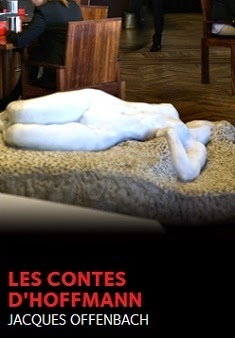
Offenbach - Les Contes d'Hoffmann (Teatro Real, Madrid 2014 - Webcast)

Jacques Offenbach - Les Contes d'Hoffmann

Teatro Real, Madrid, 2014

Sylvain Cambreling, Christoph Marthaler, Vito Priante, Christoph Homberger, Anne Sofie von Otter, Eric Cutler, Ana Durlovski, Measha Brueggergosman, Altea Garrido, Lani Poulson, Jean-Philippe Lafont, Gerardo Lopez, Tomeu Bibiloni, Isaac Galán

ARTE Concert - 21 May 2014

Les Contes d'Hoffmann is an 'opéra fantastique', but there's not much that's fantastical about Christoph Marthaler's version of Offenbach's most ambitious work in this production at the Teatro Real in Madrid. He certainly lets his imagination run riot with the concept, filling the stage with all sorts of antics and goings-on, but nothing really comes together or even seems to relate at all to what the work is about.

I must confess however that I've never been convinced that The Tales of Hoffmann has anything much worth making a fuss about anyway. I love Offenbach's comic operas, the brilliance of the wit, the daring of the satire and the entertaining, dazzling melodies, but the composer's only fully-fledged opera leaves me cold. I can appreciate Offenbach's musical sophistication here and how it's put to the service of the drama, even if it doesn't make a great impression, but I find the plots of Hoffmann's tales convoluted and tedious with little that reveals or provides insight into any genuine human values.


Which is a bit of a problem when the plot that has been drawn from assorted stories of E. T. Hoffmann are all supposed to examine the three great loves of his protagonist's life and the tragedy of their circumstances. As such, I have no objection to a director looking elsewhere for new areas of interest in Les Contes d'Hoffmann, or indeed playing up the fantastical nature of the work. Christoph Marthaler's production - one of the last legacies of the adventurous final term of the late Gérard Mortier at the Teatro Real - unfortunately only takes the work further away from whatever human experience might be found in it, and rather than find magic in it only adds greater confusion to an already convoluted storyline.

Worse than that, Marthaler's direction actually makes a slight but entertaining work feel long and very dull indeed. If you take the time to think about the production, there is actually an underlying theme in the setting, the whole opera with its diverse stories all taking place in a modern centre for the arts. That seems like a good place to unify the theatrical, the dramatic, the artistic and the creative imagination, but instead the stage is rather cluttered with art students sketching a series of nude models who pose and recline, while other characters wander around, fall about and randomly take up positions on the stage, many of them manipulated for some unknown reason by a remote control.


There's an awful lot going on but none of it makes any sense or relates to any familiar view of the work, none of it is interesting or entertaining to watch, and - what must be the bottom line - little of it really serves to enhance the work. If the production fails there's no question where the fault lies then, since the performers really do make the best of what they've been given to work with here. Ann Sophie von Otter, for example, is asked to interpret Hoffmann's Muse and Nicklausse as one and the same - a kind of drunken sprite who dances merrily around as Hoffmann's guide and protector. Von Otter enters fully into the spirit of the role, but the strength of her voice has declined a little in recent years. The singing and interpretation are characteristically warm, delicate and beautiful, but there's no longer any force behind it and she does occasionally become lost in the blend of voices and music.

Eric Cutler also does well within the confines of a character without any real personality who isn't given much to work with by the director either. His singing is clear, flowing and lyrical, but with very little feeling behind it - a problem, as I say, I would associate partly with the nature of the work itself. Vito Priante has one of the richest roles in Les Contes d'Hoffmann, playing the combined roles of Lindorf, Coppelius, Dr Miracle and Dappertutto, but he also fails to make any real impact, playing them all as the same character (which they essentially are) with no costume changes, but he doesn't have the necessary presence or enough character in the voice for the part.


The best thing about Les Contes d'Hoffmann, and certainly the best thing about this production, is the sparkle that the Olympia, Antonia and Giulietta characters bring to the work. More commonly performed by one singer in all the roles - and consequently one of the most challenging soprano roles in all opera - the casting here proved that there's much to be gained from using different voices for the very different demands of each of the parts. Soprano Ana Durlovski impressively sings Olympia as a sad, timid figure rather than a showpiece diva and it's all the better for it, finding the tragic nature of the character in one who, ironically, isn't even human. Equipped with a deeper soprano voice, Measha Brueggergosman took on the roles of Antonia and Giulietta - two sides of the same coin? - and filled them with fire and personality. Her voice didn't always hold firm, but she was particularly impressive in Antonia's duet with Eric Cutler's Hoffmann.

That fire was particularly welcome when there was so much tedium elsewhere. Despite the busyness of Act I, this was mostly a static production with little in the way of effects, little in the way of creative imagination and certainly little that could be described as fantastical. There's a surprising amount of standing around singing and there's not a great deal of life in Sylvain Cambreling's conducting either. Cambreling has a long track record with this work, but in the context of this production the interpretation of the score just felt lifeless and uninspired. This was not a performance, or indeed a production to win over anyone unconvinced about the merits of Offenbach's great unfinished project.

Links: ARTE Concert

Saturday, 5 November 2011

Weill - Rise and Fall of the City of Mahagonny

Kurt Weill - Rise and Fall of the City of Mahagonny
Teatro Real Madrid, 2010
Pablo Heras Casado, Alex Ollé, Carlus Padrissa, La Fura dels Baus, Jane Henschel, Donald Kaasch, Willard White, Measha Brueggergosman, Michael König, John Easterlin, Otto Katzameier, Steven Humes
Bel Air Media
When it was originally composed in 1930, Kurt Weill and Bertolt Brecht intended Rise and Fall of the City of Mahagonny (Aufstieg und Fall der Stadt Mahagonny) to be as much a satire of opera and a reaction to the state of the Weimar Republic. Now, when taken alongside such like-minded contemporary works by Hindemith and Berg, it just sounds like great opera – but it still functions as a scathing satire on all the subjects it deals with, particularly the nature of capitalism, on which it still has very relevant points to make.
You can call it music theatre if you like, but Weill’s score for Rise and Fall of the City of Mahagonny is considerably more sophisticated than that, working in a variety of styles to create a deliberate alienating effect, drawing on specific references, creating dissonance and unsettling arrangements, using unexpected plot points to keep the listener engaged and keep them from complacently and unquestioningly accepting operatic conventions. It does all that and it has great tunes as well, the most notable of which, Alabama Song, sung by down-and-out prostitute Jenny Smith (”Oh, show me the way to the next Whisky Bar“), is almost like the flip-side of the Libiamo sung in celebration at the party of La Traviata’s courtesan, Violetta Valéry.
If you need any convincing that Rise and Fall of the City of Mahagonny can aspire to great opera however, this 2010 production at the Teatro Real in Madrid, directed by La Fura dels Baus might be just the ticket. I’m not the biggest fan of La Fura – I’ve seen several of their productions fall well short of the mark – but when they get it right and are working with the right kind of material, they can succeed in a spectacular fashion. Their unconventional approach to opera staging, which could even be considered anti-theatre, certainly has a Brechtian influence, so it’s no surprise to find that that the Catalan group are absolutely perfect for this particular work.
Directed by Alex Ollé and Carlus Padrissa, there are no projections this time – other than the titles of each of the sections (in Spanish here, not translated on the screen) – no elaborate designs, no wire acrobatics or off-the-wall concepts. Everything is tailored directly towards the expression of the ideas in the work, finding the most imaginative and impactful way of putting it across, without relying on stagy conventions. The decision then to have the the trio of Widow Begbick, Fatty and Trinity Moses arrive as if dumped from a refuge collection and set about founding the City of Mahagonny on the edge of a rubbish dump is perfect for the nature of their intentions to make as much money as cheaply as possible by appealing to the lowest nature of their visitors, offering them booze, girls and boxing.
It’s important to get the basic concept in place, but the directors find the right tone for each scene, with many wonderful little touches – from Jimmy’s imagined return sea journey to Alaska with the raised legs of the hookers forming the waves, to his trial taking place in a circus ring – all of which give an additional satirical edge that not works along with the material, showing an understanding of its nature, its playfulness and its bitterness, without feeling the need to over-emphasise or add on any additional commentary. The opera is satirical of all these subjects – from the expectations of the individual to the concept of justice – all within the umbrella of the capitalist system, and it doesn’t need any specific or easy-target anti-American agenda attached for the concept to stand on its own and be applied by the listener to their own experience of the system.
I’m not sure why it was chosen to use the US revision of the original opera, singing it in English and changing Jimmy Mahoney to Jimmy MacIntyre, particularly as there are a few native German speakers in the cast here and others, like Henschel, have a strong footing in German opera. If it’s another attempt at alienation effect to keep the audience guessing, then it works here. Most importantly however, the casting and singing is superb. Jane Henschel is superbly capable in the whole range from singspiel-like dialogue to more conventional opera singing, as well as being a fine actress in the role of Widow Begbick. Jenny Smith is an important piece of casting, and Canadian soprano Measha Brueggergosman makes an incredible impression, oozing sensuality and absolutely electric in her scenes with Michael König’s fine Jimmy MacIntyre. The balance right across the board in the other roles seems perfect, consistently hitting the right note, as do the Chorus of the Teatro Real, who give their all in the scantiest of costumes and in the most… well… indelicate situations. One can’t fault the commitment either of the Madrid orchestra under Pablo Heras Casado.
I don’t know if it’s to do with the encoding, but Bel Air releases often look a little juddery in motion on both my Blu-ray set-ups (most evident here when the Spanish captions move across the screen), and can lack definition in the darker scenes. I haven’t heard anyone else mention any issues with previous releases, so perhaps it’s specific to one’s set-up. Generally however, the image is fine, and even if movements aren’t smooth, I didn’t find it too distracting. The audio tracks, in LPCM Stereo and DTS HD Master Audio 5.1, are both fine, but there’s not much to choose between them. I found the PCM worked better using headphones to keep the sound focussed, and it’s very impressive this way. There are no extra features on the disc, and only a synopsis in the booklet.