Showing posts with label Katie Lowe. Show all posts

Sunday, 24 March 2024

Wagner - Die Walküre (Brussels, 2024)


Richard Wagner - Die Walküre

La Monnaie-De Munt, 2024

Alain Altinoglu, Romeo Castellucci, Peter Wedd, Nadja Stefanoff, Ante Jerkunica, Gábor Bretz, Marie-Nicole Lemieux, Ingela Brimberg, Karen Vermeiren, Tineke Van Ingelgem, Polly Leech, Lotte Verstaen, Katie Lowe, Marie-Andrée Bouchard-Lesieur, Iris van Wijnen, Christel Loetzsch

RTBF Auvio Streaming - 8th February 2024

It's hard to describe a Romeo Castellucci production in any way that makes logical or narrative sense, especially when you're only half-way though it. That's as far as we have got with his production of Der Ring des Nibelungen cycle at La Monnaie, and at this stage with Das Rheingold presented earlier this season, the most we can say after Die Walküre is that the focus is very much on tone rather than narrative. It's an approach that is designed to avoid the conventional imagery for one that marries spectacle worthy of the status of the mythology with an intent to delve deeper into the emotional and ideological nature of the work as expressed in the music. If there's a work that can sustain many layers it's Wagner's Ring and Castellucci certainly is aiming to bring a unique response and new ideas to this tetralogy of operas.

What those ideas might be however is still hard to define at this stage, but in terms of mood and character and tone it already has made a considerable impact, particularly with the musical direction under the baton of Alain Altinoglu. That tone is set straight away in Die Walküre - as it ought to be - by the opening storm that shows a Siegmund being battered against a screen bearing a faint imprint of a ring/circle by a gushing torrent of water. His predicament is clear. Less clear maybe is the colourful apparel that Hunding's wife presents him with when welcoming him unwittingly into the trap of her home, but a pacing wolf-like black dog and a shifting array of oppressive rooms, cabinets, wardrobes and furniture enclosing the two of them in tight spaces fits perfectly with the threat that this stay presents to the Walsung.

Why Hunding reposes in what looks like a confessional however is anyone's guess, the set transforming from darkness to light, the set turning minimalist with only the confessional, a bed and a fridge shifting around the open space. The sword Nothung is not buried in an ash tree but borne by or perhaps actually buried in Sieglinde. Removed, it is stored in fridge while Siegmund and Sieglinde welcome the sudden arrival of spring by burying each other in flowers and rolling around in blood, enact a baptism or kind of rebirth as brother and sister in blood. The least you can say is that stagecraft is remarkable and holds attention even if it is hard to rationalise, the shifting props and minor adjustments of lighting, smoothly and imperceptibly changing from one scene and mood into another.

If you think Act I was peculiar, Act II despite being again rather minimalist in overall approach has many more eccentric touches, too many to go through every one of them all and you'd be none the wiser even if they were described. What matters is whether it gets across the gravity and import of this lynchpin scene of this opera and debatably the whole tetralogy. What it seems to focus on is the opposition of ideals and philosophies of the opposing forces within Valhalla, or at the very least find visual ways of establishing their character. Fricke enters Valhalla in an extravagant white wedding gown with a troupe of similarly attired followers, fairly shaking with rage at the mockery Siegmund and Sieglinde have made of the sacred sacrament of marriage. She crushes some white doves while Wotan washes the head of a statue of Buddha with milk. Whether you take any deeper meaning from this or not, there is no reason why these gods should behave as ordinary mortals.

For his part, Wotan recounts his folly and his failure to Brünnhilde wearing a red blindfold with dark semi-invisible figures of his entourage waving flags that spell IDIOT behind him. Brünnhilde's steed Grane is seen as nothing more than disembodied skeletal floating lower legs, again operated by invisible extras. Brünnhilde is crushed momentarily beneath its hoof at the weight of Wotan's will and command to the Valkyrie. Act II of course is all about revisiting the past and determining the future, and it can be a little dry, so these visual theatrics can help establish the nature of what transpires, but it's hard to see that these add anything, or really understand their intent. It seems to get even sillier still when Brunhilde gives Siegmund an orange while advising him of his fate on shifting sands, all of Act II delivered in the gravest intonations, before shapeless creatures smother him. Regardess of what you make of it, musically, vocally and in terms of the tone you expect, it delivers the depth of intensity of the Act.

Likewise, Act III fires into the Ride of the Valkyrie with the same full dark intent. These are Valkyrie to truly strike terror into the soul as, dressed in black robes with helmets and shields, they drag the hairless naked bodies of fallen heroes to their final resting place in Valhalla in the enveloping bleak darkness of the stage. The final scene between Wotan and Brünnhilde is completely stripped back to black as a large white screen is lowered and tilted over them, with only a few ominous shadows rippling across on the other side of the veil behind them. There is a brief burst of flame in a circle, the shape of the ring that has become the connecting or defining element between the beginning and end of each of the two operas so far. Nothing else is needed really when Alain Altinoglu conducts the orchestra to bring out every nuance of emotion and sensitivity from the scene.

The La Monnaie Die Walküre is given a very different treatment to the one in Das Rheingold. It's a dark shadow world for the larger part of this opera, the world unformed and unstable, from the shifting furniture of Hunding's abode in Act I, the pacing wolf, the swarming figures that swallow Siegmund, the dark mounts of the Valkyrie that pass by in the background. Individually, these things might not add up to anything meaningful, but collectively they establish a specific mood, finding the necessary balance of darkness and light (admittedly more darkness than light in this work). Like Frank Castorf's extraordinary Bayreuth Ring, Castellucci is clearly not going to be restricted to a single style across this cycle, adapting to the distinct character of each of the works and the opportunities they offer. So far however it lacks the thematic rigour of Castorf's Ring and an overall concept hasn't yet emerged other than this idea of a circle or ring being a key image, which is appropriate but hardly revolutionary.

Some might expect more from Romeo Castellucci on this epic tetralogy, but so far Das Rheingold and Die Walküre have been successful in their own context and who knows whether certain visual leitmotifs might not recur in the next two works (probably not). Certainly the musical direction of Alain Altinoglu provides the necessary heft that you would expect and perhaps the intent is to let the language of the music speak more strongly here, with the visual element supporting that in a more abstract fashion. There are some interesting choices made as far as the casting goes, and I'm all for bringing new voices into the world of Wagner, but not all of them are convincing this time around.

I wasn't too keen on the trills introduced by Nadja Stefanoff's Sieglinde in Act I, but she is excellent in the subsequent acts, looking truly anguished rather than dramatically acting it as seems to be the case with Peter Wedd's Siegmund, a joyless Wehwald. Too many of the performances are operatically earnest, the movements too choreographed to show any real feelings. It seems to afflict Gábor Bretz this time around, his delivery inexpressively intoned with little emotional engagement. There is little sign of resignation you expect from Wotan in Act II or fury in Act III. Marie-Nicole Lemieux is another fine singer who was introduced to to the Wagnerian repertoire in Das Rheingold and her Fricka here is capable, her performance good but perhaps not outstanding or as commanding as you might like. For me, Ingela Brimberg's was the most impressive here, connecting deeply with the different sides of Brünnhilde, but all of the Valkyrie were formidable on a scale commensurate with the mythology of the Ring. Whether we can say that about Castellucci's direction of this Ring cycle remains yet to be seen. 


Saturday, 4 March 2023

Wagner - Das Rheingold (London, 2023)


Richard Wagner - The Rhinegold

English National Opera, London - 2023

Martyn Brabbins, Richard Jones, John Relyea, Leigh Melrose, Frederick Ballentine, Madeleine Shaw, John Findon, Christine Rice, Katie Lowe, Julian Hubbard, Blake Denson, Simon Bailey, James Creswell, Eleanor Dennis, Idunnu Münch, Katie Stevenson

The Coliseum, London - 26th February 2023

I wouldn't expect every production of Das Ring des Niebelungen to be as elaborately layered and provocative as a Frank Castorf Ring cycle, as irreverently humanising as a Dmitri Tcherniakov production or as distinctive and gloriously impenetrable as the Achim Freyer Mannheim Ring, but you would like a new production of Das Rheingold to open with at least some new ideas and twists that you could look forward to being developed further down the line. Such expectations however have already been suitably adjusted in view of the fact that Richard Jones's Die Walküre, or The Valkyrie, has already made its appearance at the ENO before the first part of the tetralogy and it didn't seem to offer anything new or promising. The same goes even more so for The Rhinegold which, aside from modern costumes, plays it fairly straight and safe, having nothing much new to add to Wagner Ring mythology, but as with the first/second installment, nonetheless putting it across in an entertaining and enjoyable manner.

What is perhaps more notable about the performance I attended at the Coliseum was the audience that turned out to fill the hall; an audience on average younger than you would often see at opera and it turned out to be also an appreciative one for what Wagner's Das Rheingold has to offer, or at least for Richard Jones's version of what The Rhinegold has to offer. That's all the more interesting since this is the first opera I've seen there since the Arts Council England's shortsighted, misguided and philistine threat to cut and remove funding for the ENO. While the future of this Ring cycle and the company still lies in the balance, it was nonetheless heartening to see this kind of turnout and support for the artform. The ENO's programme brings me, like many others, into London to see productions like this every year and has done for many years in the past, paying for flights, accommodation and meals that contribute to the UK economy, and I hope to continue to be able to do so in the future...

...As I did for The Valkyrie in 2021, and what largely was written then - by me as well as others - holds true to The Rhinegold. As engaging as it was, engaging also to a significant extent with the narrative of Wagner's original stage directions, it didn't have anything new or insightful to say about the work. By the same token, other than perhaps for a few moments, neither did it betray the tone and character of the work. There were certainly a few quirks and some ideas that didn't quite strike the right note in the right place - the sombre contemplative notes of the opera's origin myth flowing into the shimmer of the Rhine were somewhat sacrificed to a semi-comic routine of a naked man dragging a large branch from the world ash tree across the stage that is eventually crafted into Wotan's staff/spear. There is a meaningful point to be made here, the ecological exploitation of the planet setting us on a path to destruction, but the message is somewhat lost in this routine. Elsewhere however the key scenes were at least delivered with appropriate impact, musically, narratively and in the fine singing.

You would think that if you are going to make such an issue of the forging of Wotan's staff - or spear in its eventual form - that it might become a prominent feature or motif throughout, and while it certainly featured and was wielded to such effect, it wasn't to any evident purpose, and certainly not to any purpose that I can recall becoming any clearer in Die Walküre. In fact, the downside of performing the two operas out of order tends to emphasise the disconnect between them, in the overall look and appearance, in the inconsistency of the costume design (Wotan in a purple-blue neat suit here for some reason takes to sporting a bright red puffa jacket in Die Walküre) and set design (the steel shuttered Valhalla becoming more of a log cabin in Die Walküre). Should the ENO's Ring cycle make it to its conclusion (one can only hope, as it is still very much worth it), the idea of each of the constituent parts being distinct from each other is a unique feature (Castorf's aside, even though they were all connected by a very strong and consistent anti-capitalism theme) that should at least keep things interesting.

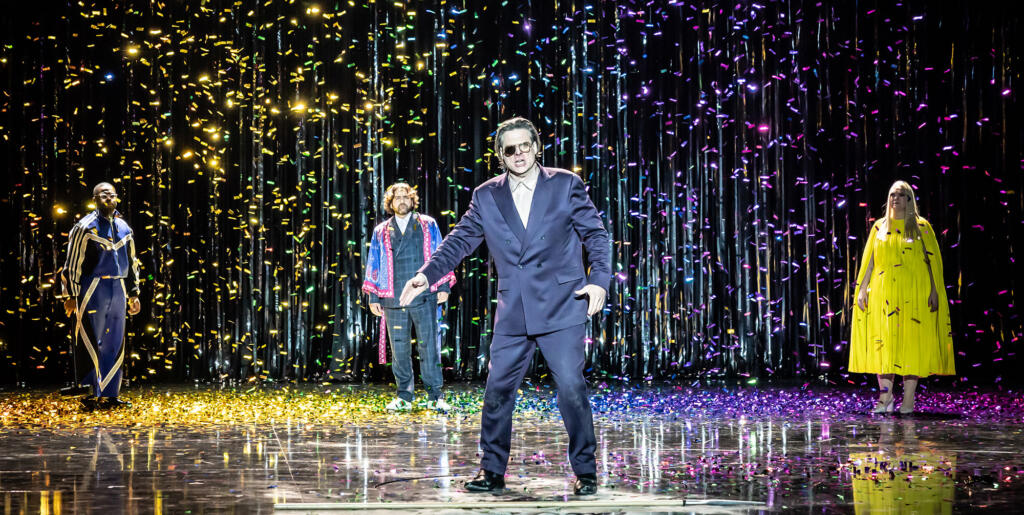
Other than that, Jones didn't give you too much to think about, or at least - like the Rhinemaidens wearing gym gear - nothing worth thinking to hard about to try to see any kind of rhyme or reason behind it (too fit for Alberich to catch? - as I said, you could find reasons if you like, but nothing worth the effort). In terms of look and appearance, the scene of Alberich being bewitched and teased by the Rhinemaidens was, as you would expect, colourful, attractive and slightly camp in a simple basic way, the Rhine represented by a surrounding curtain of glitter, Alberich arising from a hole in an otherwise fairly bare stage (making it all less effective if you are viewing it from a high vantage point in the Gallery). As with The Valkyrie, black clothed 'invisible' figures helped move things around, here permitting Alberich and the Rhinemaidens some swimming and floating movements, which worked well enough.

Aside from the obligatory avoidance of anything in terms of traditional costumes, it was pretty much according to the libretto, or at least to the same intent and purpose. The gold of the Rhine was initially shaped as an child-size baby puppet (manipulated by the black figures), but soon took a more traditional form, again through a series of transitions, from a crumpled sheet to flattened ingots and eventually, believe it or not, to an actual ring of a size that you can fit on your finger. An actual ring, I tell you! I'm not used to such literal fidelity in a modern production of Das Ring des Nibelungen. Nibelheim on the other hand resembled not so much a heavy industry factory as a production line in a bakery, with the dwarfs wearing chef caps. As I said, don't think too much about it...

The majority of Das Rheingold of course takes place in Valhalla and Jones didn't reveal too much of that, the giants presumably withholding the keys to the newly constructed abode of the Gods until they had received the agreed remuneration for their labours (nope, no hint of any commentary approaching Castorf's emphasis on that aspect), so it might well have been the log cabin we see in Die Walkure. The shimmering curtain remains in the surround, and we have conglomerations of white globes on stilts that could be abstract clouds. Again, I wasn't inclined to think to much about it other than it was all pleasant and decorative enough. What matters more is what take place within it.

What takes place within it sticks fairly closely to the original storyline. Aside from Freia being transported on the back of the Giants' work van, the exchange rate for her is indeed measured against the accumulation of trays of Rhine gold ingots to her height - and don't forget to throw that tiny Ring in. That's fine as far as it goes, but essentially what Richard Jones and conductor Martyn Brabbins working together successfully achieve is getting the necessary impact for each of those key moments and scenes. The brutal killing of Fafner by Fasolt (a dummy brought on in an off-stage switch) battered about the head with a gold ingot was particularly forceful. The arrival of Erda (with the Norn as three schoolgirls? Your guess is as good as mine), sung impressively by Christine Rice, also created the necessary gravity and impact, together heralding the tragedy of the curse of the Ring that will (we hope) play out in future installments. The shimmering fall of rainbow glitter for the bridge to Valhalla, and the lockdown against the Rhinemaidens at the conclusion seemed an appropriate way, in Richard Jones terms if nothing else, for everything that came before.

Some moments of levity in the Tarnhelm episode were balanced in this way by the gravity of what the Ring's preliminary evening prologue lays down, and the balance was supported by the characterisation and singing. As noted above, Christine Rice in particular made that small but significant and truly Wagnerian impression as Erda, but there were notable performances also from John Relyea as Wotan, Leigh Melrose as Alberich, and a suitably shifty portrayal of Loge by Frederick Ballentine. Madeleine Shaw's Fricka and Katie Lowe's Freia contributed to the family dynamic alongside the entertaining comic action hero shapes thrown by Julian Hubbard's Froh and Blake Denson's Donner. The giants might not have had much physical stature in this production but I enjoyed Simon Bailey and James Creswell's Fasolt and Fafner.

I can't say that Martyn Brabbins' conducting of the orchestra made a huge impact - maybe I was focussing too much on giving the production and sets design more thought than it merited after all - but neither did I notice anything that felt out of place in pacing, delivery, the surge of leitmotifs or in the whole continuous flow of this marvellous work. Some of the music press appear to have been more generous about this production - whether it's a show of solidarity with the proposed fate of the ENO, I couldn't say, but such sentiments can be excused, as the loss of the ENO in London would be a serious blow for opera lovers, for London, for arts, culture and for tourism. I don't expect Bayreuth at the Coliseum, but who in any other part of the country - certainly not here in Belfast - is going to have the resources to present not only an entertaining and accessible Ring cycle to a diverse audience, but a solid programme of great opera every year? If not in the Coliseum, at least keep the ENO funded and in London. Its loss would be very much regretted and missed by this opera-goer at least.


Links: English National Opera