Showing posts with label David McVicar. Show all posts

Monday, 13 October 2025

Donizetti - Maria Stuarda (Madrid, 2024)


Gaetano Donizetti - Maria Stuarda

Teatro Real, Madrid, 2024

José Miguel Pérez-Sierra, David McVicar, Lisette Oropesa, Aigul Akhmetshina, Ismael Jordi, Roberto Tagliavini, Andrzej Filończyk, Elissa Pfaender

ARTE Concert - 20th December 2024

For the little that they reflect reality, there doesn't seem to be any compelling reason to stage a historical opera in period setting and costume… etc. I started the last two reviews of the 2025 productions of Maria Stuarda at Salzburg and Budapest with that opening line and they both proved that point - I thought anyway - exceptionally well. There is indeed no compelling reason to present this opera on the modern stage in a mid-16th century period context: not unless you are a fairly reactionary opera director like David McVicar. Sorry, Sir David McVicar. Even then, I'm not sure what historical value a director can find interesting in an operatic dramatisation of a royal dispute that took place 500 years ago. 'Wolf Hall' this is not.

But on the basis that there are many who love a period drama, one with elaborate opera costumes and sets and yet still get to the emotional heart of a work, David McVicar is your man. If you are going to present a British royal drama in a historical context to a Spanish audience however, you are going to need to provide a little more in the way of background to the rationale and plotting behind Mary, Queen of Scots being arrested, imprisoned and executed in 1587 in a dispute with Elizabeth over the claim to being the rightful Queen of England. This is covered in a brief preface to the synopsis in the programme for the audience at the Teatro Real, but for the purposes of François Roussillon's version recorded for TV and DVD, the key events of the background to Maria Stuarda are detailed in a filmed sequence during the playing of the overture.

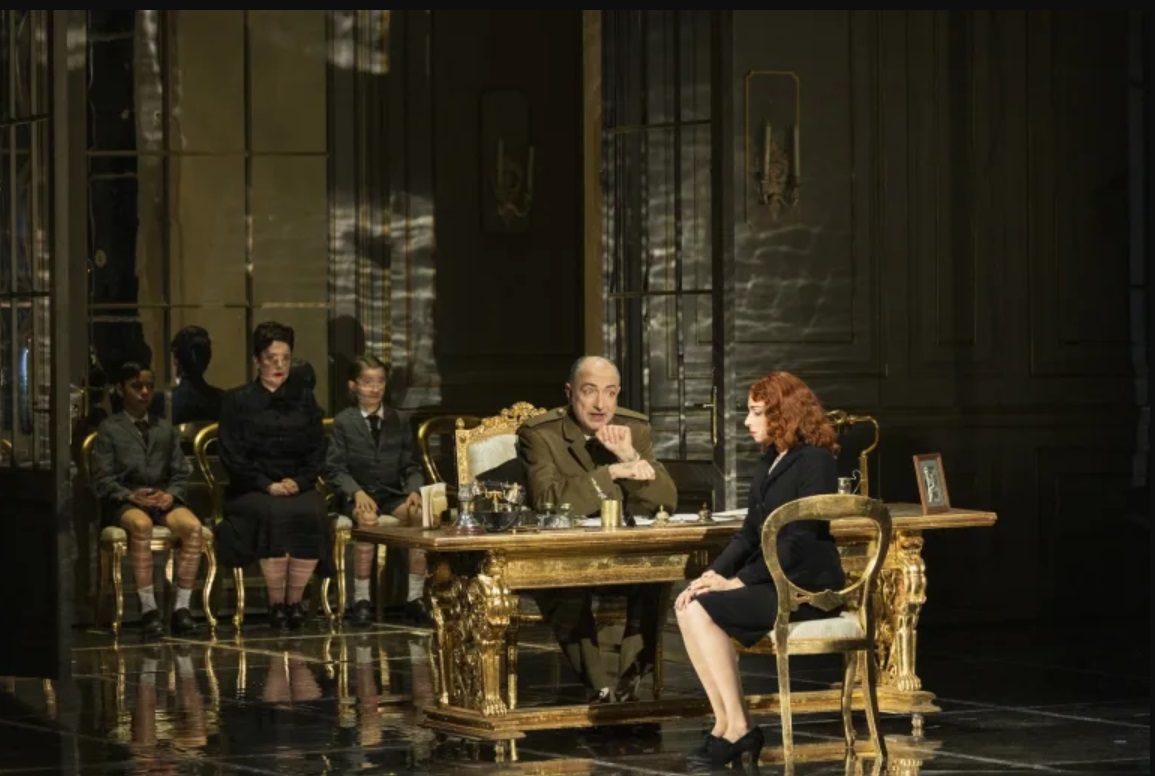
Director David McVicar used to be a bit more adventurous in his productions, sticking closely to the original setting and not imposing some grand concept on a work, but he would often mix it up a little - and still does. Even his previous production of Maria Stuarda for the Met in 2013 was a little more stylised than this latest production for the Teatro Real in Madrid a decade later. So while the costumes are fairly authentic to the period and the principal singers are all made up to closely resemble the historical figures they are meant to represent, McVicar tries to ensure that the spectacle at least matches the grand tone of the opera: the regal grandness, that is, of the two central queens who dominate above everything else.

For the introductory scene to the court of Elizabeth then, a huge royal orb hanging over the stage against the backdrop of a carved wall is all that is needed to suggest power and influence. That and a Queen Elizabeth who takes to the stage and dominates everything else through her pronouncements, but traditionally mainly through her vocal delivery. The reliefs on the wall however are all of ears and eyes, "Lower your voice within these walls", The Earl of Leicester tells Talbot when he mentions she-whose-name-must-not-be-spoken in the presence of Elisabeth. The suggestion - a fairly obvious one of course, but worth drawing attention to all the same - is that the Queen had eyes and ears everywhere and the punishment for treason and treachery is severe. This is typical of the McVicar aesthetic, making it feel authentically period, capturing the tone and mood of the situation and making a few bold gestures to that effect.

A bold statement perhaps, but in comparison to the two other productions of Maria Stuarda this year that I have seen, the period glamour in thrall to historical period detail means it is also the least spectacular, the historical detail detracting from the focus of where the real heart of the opera lies. That's a subjective view admittedly, and others might see it differently. Within this there is still room for bold statements and the director feels no obligation to follow directions of the libretto to the letter for each scene. The prison park where Mary is held is a wide platform with a background a huge splash of blood-like red, the overhanging orb of royal authority feeling oppressive here. Red leaves fall and scatter on the ground like spots of blood, anticipating the conclusion rather early, although to what purpose at this stage isn't clear, other than pointing to the inevitability of the conclusion to this dispute.

As with those other productions, and indeed any production of this opera, much rests on the chemistry between the two queens and perhaps Leicester plays an important factor in that as well. But again direction is important, and here we have the opportunity to compare how Lisette Oropesa fares under McVicar's direction as opposed to Ulrich Rasche's at Salzburg. I don't think there is any question that the stylised pacing and supernumerary support of the Salzburg carries more of the personal inner life than the operatic soprano mannerisms Oropesa is left to deliver to the audience here in Madrid, involving a lot of eye rolling and swaying, with hands held out in supplication (I'm reminded of the same in McVicar's direction of Sondra Radvanovsky in the 2022 Met production of Cherubini's Medea.

Other arias are similarly delivered outward, each often turning away from the person they are addressing to sing to themselves, the audience and the camera. McVicar clearly doesn't want to stray too far from convention and the expectations of the Spanish audience at Teatro Real, which sadly no longer has the creative experimentation of Gérard Mortier. (Yes, perhaps a minority view that one). There is definitely something to be said however for the Salzburg production internalising emotions and still delivering powerfully but, to make a cultural generalisation, perhaps the tone adapted is one that plays to the character of the audience. There may be something about meeting the expectations of the Spanish audience, who indeed have their own monarchy and may find the execution of a Catholic Queen by the Protestant ruler historically significant, albeit 500 years ago.

I think it does a disservice to try to treat this opera 'realistically' as a period costume drama. Yes, it can be just as effective as an opera experience, McVicar's handling of mood is excellent and for all that conventionality the scenes are all fully in the character of the high operatic drama. There is clearly more depth that can be explored in the motivations of the characters however than in trying to find some accommodation between historical records, Schiller’s dramatisation and the libretto that Donizetti works from. All you get is opera and opera dramatics, when those contrasting viewpoints, not to mention the contrasting experiences and worldviews of Mary and Elisabeth as rivals - and more than just opera rivals - is a subject worth exploring in more detail, without necessarily having to find any contemporary resonance.

Lisette Oropesa pulls out the regal and human emotional stops in the preghiera impressively in the closing scenes. The Earl of Leicester you can leave aside for any significant personal role in the drama other than being a foil for the enmity that lies between the two women rivals. It's a good tenor role nonetheless and well sung here by Ismael Jordi. Aigul Akhmetshina's Elisabetta doesn't have the same vocal authority that the role and the formidable costume that comes with the position demands, but is a great presence nonetheless and sings well. Again you can make allowances for interpretation and how you want to treat the role as having a degree of vulnerability and insecurity. Personally I felt that the conducting and performance of the score under José Miguel Pérez-Sierra was also a little too smoothly 'Classical', lacking in fire or character. Sadly, in that respect, it was a match for McVicar’s direction. The Madrid audience loved it.


External links: ARTE Concert, Teatro Real

Thursday, 17 April 2025

Charpentier - Médée (Paris, 2024)


Marc-Antoine Charpentier - Médée

Opéra National de Paris, 2024

William Christie, David McVicar, Lea Desandre, Reinoud Van Mechelen, Laurent Naouri, Ana Vieira Leite, Gordon Bintner, Emmanuelle de Negri, Élodie Fonnard, Lisandro Abadie, Julie Roset, Mariasole Mainini, Maud Gnidzaz, Juliette Perret, Virginie Thomas, Julia Wischniewski, Alice Gregorio, Bastien Rimondi, Clément Debieuvre, Matthieu Walendzik

ARTE Concert - 3rd and 7th May 2024

Euripides' ancient Greek tragedy of Medea is a sensational tale of sex and violence of love and betrayal that has long inspired theatre and the arts and of course countless opera versions over the centuries, from Francesco Cavalli's Il Giasone in 1649 to Aribert Riemann's Medea in 2010. The most famous opera version, its status defined by Maria Callas, is Luigi Cherubini’s Médée, and that's the version you are most likely to still see performed. With the works of Marc-Antoine Charpentier having their turn in the early opera spotlight, William Christie again being at the forefront of reviving great forgotten works of the early period of classic French 17th century opera, you aren't going to get a better opportunity to experience the quality of his version of Médée than this production on the Paris stage at the Palais Garnier.

With a libretto by French dramatist Thomas Corneille, who composed libretti for Lully's operas, and it being an opera composed during the reign of Louis XIV, you might have some expectations as to how this will play out. If you are thinking rather dry 17th century drama with some longeurs, noble sentiments and classical formality that require some patience and familiarity with the style to appreciate, you'd be partly right, but with Charpentier and French music of this period, you can also expect the flavour of wonderful dance music, choruses and spectacle all fulfilling the dramatic punch of the story. You definitely get that in this opera and it's brought out effectively in a manner that ensures accessibility in Christie's musical direction and in this production directed by David McVicar.

But there is a little scene setting required first of all to establish the situation that is going to lead to Jason's betrayal of his wife Medea and fire such fury in her that she is going to do the unthinkable. The context is their exile from Thessaly driven by the people's fear of Medea's magical powers, and Jason's seeking an alliance that will give them safe haven with King Creon in Corinth. He is prepared to lead a joint Corinthian and Argive army against Thessaly and extend the power of the rule of Creon. Although his daughter Creusa has been promised to Oronte, the Prince of Argos, Creon thinks Jason would make a better husband for the Princess. Jason sees that as an opportunity to secure and elevate his own position, but how will Medea take the news?

Well, I think we all know how that goes, and although the phrase "hell hath no fury like a woman scorned" wasn't around at the time (it being coined just 4 years after Charpentier's opera in 1697 by William Congreve), there is no surer description for what takes place in the final act here. There is however other shades and colours of dramatic action and sentiment that Corneille and Charpentier have to work with before Act V of Médée. Act I starts slowly with Medea expressing misgivings about Jason's mission, Jason himself confessing love for Creusa to his confidant Arcus, but it soon picks up with the armies assembling for the attack against the Thessalonians.

The Paris Opera production sets this version in a more recent and familiar wartime setting, Creon a de Gaulle like figure, Oronte a brash American fighter pilot, Jason of course a naval officer. It works fine, removing it from the Greek classicism and giving it an attractive freshness and colour on the Palais Garnier stage. Dance routines from a small troupe of six male and six female dancers enliven the stage choreography and choral arrangements considerably; they are not overly elaborate, more formation dancing that suits the militaristic look and feel of the setting. The real battle here however is more the one between Jason and Oronte for the favour of Creusa than a concerted fight against the foreign enemy.

That more or less establishes the template for what follows in subsequent acts of Médée; a little bit of accompanied recitative exposition followed by some invigorating music, singing and dancing as the emotional temperature rises. The stage production rises to those moments as well with - it being a David McVicar production - a few surprising twists. A glittering US fighter plane is wheeled on at the end of Act II for a nightclub scene with L’Amour/Cupid appearing as a cabaret act, the whole scene bathed in purple and pink light. Yes, it's a little bit camp, in a McVicar way, but not excessively so. It's a good way to treat the mythological characters that appear in the opera and it seems to fit musically.

The latter is essential really, since musically this production has the complete William Christie attention to detail and above all rhythm. The use of period instruments is invigorating in those dance and choral pieces, with soft flute and plucked theorbo or lute accompanying the expressions of troubled emotions. Authenticity is a matter for the musical director of course and I'm in no position to dispute or approve the choices Christie makes, but he always makes early music that could otherwise sound alien to a modern classical audience feel accessible and beautiful as well as expressive of emotional and dramatic content.

There's a sweetness to the music that is reflected in the singing voices. Yes, that even goes for Lea Desandre as Medea, but the softness of her voice has an underlying steeliness that leaves you in no doubt as to the depths of feeling love and betrayal inspired in her, nor the horrors she is capable of inflicting because of them. Corneille provides adequate motivation, character definition and some poetic beauty in the libretto for Medea. Vowing vengeance in collaboration with Oronte in Act III, she instinctively softens in the face of Jason and believes she can persuade him away from the fatal course he is on. (Jason is also well sung in this scene by Reinoud Van Mechelen, but perhaps lacks the same depth of character). This leads to a beautiful lament "Quel prix de mon amour, quel fruit de mes forfaits" where Desandre shines, pouring out the complexity and depth of Medea's love for Jason. It's a pivotal scene that the outcome depends on and everything about this is convincing for what follows.

What follows is of course all the horrors of hell, and there Desandre is also wonderfully convincing. The early dance rhythms of the period music might not seem best designed for that kind of darkness, but the fury within is there in Desandre and in McVicar's direction of the subsequent acts and scenes with dancers and demons adding emphasis and impact to the intent. It's not a particularly thrilling or insightful production, more typical 'neoclassical' McVicar, but the way it is modernised is enough really to be able to appreciate the true qualities of the work. Under William Christie the work's beauty, its charm, its seductiveness, as well as its edge of menace are all there in a wonderful combination of soft flutes and flurries of plucked and hammered strings.


External links: Opéra National de Paris, ARTE Concert

Saturday, 29 October 2022

Cherubini - Medea (New York, 2022)


Luigi Cherubini - Medea

Metropolitan Opera, 2022

Carlo Rizzi, David McVicar, Sondra Radvanovsky, Ekaterina Gubanova, Matthew Polenzani, Janai Brugger, Michele Pertusi, Christopher Job, Brittany Renee, Sarah Larsen, Axel Newville, Magnus Newville

Met Live in HD - 22nd October 2022

Livestreamed opera and opera on DVD are obviously something quite distinct from live opera but the Met live broadcasts with their presenters and backstage interviews during the intervals are something else again. The Metropolitan Opera have of course long been innovators in presenting their opera to the world in live radio and then livestream broadcasts to the cinema, so they're obviously very good at it. They have it down to such a fine art now - with flawless uninterrupted High Definition image and sound - that you do however wonder where the priorities lie; whether the image, presentation and star attractions of big productions take precedence over the actual musical content.

That's maybe just an idle thought, as I have rarely had any doubt about the quality of the performances I have seen streamed from the Met, but the format certainly makes me think differently about how I review such a production. It's not like live opera, or even opera on DVD. I'm sure the primary consideration is a striving for excellence for the audience in the theatre - whether you think they achieve it or nor - but I get the impression that for some productions they do seem to have an eye to how it will look in its cinema broadcast. Those considerations are largely on the camera placements and shots, and Gary Halvarson ensures that the Met Live in HD broadcasts have a very distinctive and impressive look.

Which brings us to the Met production of Luigi Cherubini's Medea. If it merely looked impressive however and didn't also live up to that in performance, you'd have more reason to be critical, but there are few concerns on that front. Throughout the broadcast we were reminded by Joyce DiDonato and Peter Gelb that this was the first time Medea has been performed at the Met, which is incredible, but also welcoming as a sign of the Met striving to expand their range. It's not a minor work by any means, made famous by Maria Callas, but as one of those works belonging to that in-between period between classicism and romanticism, it has perhaps been somewhat left in the shadow of the twin titans of Mozart and Verdi.

Mainly however the stated reason for not performing Medea before now, is that - as a showpiece of Maria Callas demonstrates - it indisputably requires a soprano of tremendous force to deliver it and do justice to the role of Medea. It wasn't until Sondra Radvanovsky suggested that she would love to sing the role that the Met felt it would be worth exploring.

Whether Radvanovsky is good enough to sing it, I have some reservations, but by and large it was a successful account that certainly emphasised and made obvious the attractions of the work. There's no doubting Radvanovsky's comittment to a challenging role, but she didn't totally win me over. There were some weaknesses in her delivery and the strain showed in the demanding third act, but in the moments where it counted, especially in the delivery of the extraordinarily powerful and demanding finale, it was genuinely spine-tingling.

If Sondra Radvanovsky wasn't totally convincing it seemed to me that she was maybe trying too hard. The blame for that falls on director David McVicar who forced her into all kinds of gymnastic writhing on the stage, pacing, ducking, diving, rolling, crawling, stretching. Most of this is completely unnecessary since all the force of the role of Medea is there in the libretto, in the music and in the terrific writing for the voice by Cherubini. All this movement undoubtedly tired Radvanovsky much more than was necessary and clearly affected what is already a challenging vocal performance. That should not happen. It is simply bad direction, and that's the kind of thing that makes me wonder where the priorities in presentation lie.

McVicar's production has its obvious attractions - primarily aesthetic - but it didn't entirely convince on a human emotional level. It looked stunning but was way over the top, going for shock and awe. It didn't adhere to any historical period other than generic operatic past, which works well enough. Classical stone steps lead up to huge tarnished steel doors that resemble stone walls, emphasising just how much Medea is cut off and excluded from the world of Colchis. To make sure you didn't miss a thing in the huge expanse of the Met stage, a huge tilted mirror at the back reflects and expands the area for the drama, permitting the viewer to see the full grandeur of Giasone's wedding to Glaucis' while Medea writhed around in anger, jealousy and rage outside of it.

Halvarson's cinematography captured all this superbly with low angles foregrounding Medea against the beautifully lit backgrounds. Aesthetically it was striking but emotionally it was utterly redundant. With McVicar's stylistic mannerisms and Medea's eye-rolling and writhing around the stage, all amplified by the dramatic camera angles, it overwhelmed the true heart of the musical drama. Act III was the worst offender. Flames flickered earlier than expected, flames of fury presumably since Medea has not yet started to enact her fiery revenge. The gory death of Glauce doesn't need to be shown, nor do the deaths of the children, at least not in the cinematic gore fashion shown here (we had the same problem with Met's Tarantino-meets-Werther). The raging thunderstorms and circles of flame that accompany Medea's final descent into insanity are spectacular, but overly emphatic when you have that vocal finale, which Sondra Radvanovsky delivered superbly.

Musically Carlo Rizzi matched the fireworks on the stage, but I found the busy stage and overacting too much of a distraction, so I can't say say for sure if it really got to grips with Cherubini or whether this was also smothered by McVicar's indulgent production. Matthew Polenzani brought a more sympathetic side to Giasone in a lower tessitura than he is accustomed to. He sang well but didn't make a great overall impression, overshadowed as his character is by the dominance of Medea and by the production. The other roles were well-handled; Ekaterina Gubanova an excellent Neris and Janai Brugger giving a good account of Glauce.

There was a lot to enjoy here, but how much of it was genuine opera and how much was pure stage spectacle is debatable. Even that might not really matter, as spectacle has its place in opera and it was certainly a feature of the opera's original French production in 1797. I enjoy high production values in opera as much as anyone and am certainly in favour of new technology and theatrical techniques being employed, but I was left with the feeling here that as impressive as this was, as much money and effort has been put into impressing you, it just didn't connect on an emotional level. Worse, the production actively hampered the qualities that are there in the opera itself and was detrimental to the delivery of the singing, and that should never happen. 

Monday, 14 January 2019

Cilea - Adriana Lecouvreur (New York, 2019)


Francesco Cilea - Adriana Lecouvreur

Metropolitan Opera, 2019

Gianandrea Noseda, David McVicar, Anna Netrebko, Anita Rachvelishvili, Piotr Beczała, Carlo Bosi, Ambrogio Maestri, Maurizio Muraro

Met Live in HD - 12th January 2019

Personally, I didn't see much in the remainder of the Met's Live in HD series that would get me back to the cinema, although it might be interesting to see how Robert LePage's Die Walküre stands up in revival with a different cast. Cilea's Adriana Lecouvreur isn't an opera I've ever seen performed before, but despite being pleasantly surprised by some other more obscure works from the verismo period, this isn't one I would go out of my way to see. The trailer shown during the screening of Nico Muhly's Marnie however was promising, mainly for the casting. Anna Netrebko alone wouldn't have dragged me in, but as a singer's opera with Anita Rachvelishvili and Piotr Beczała on the bill, chances are you weren't going to see the opera done better than this. In the end, as good as the others were, it would have been worth it for Netrebko alone.

The opera itself I still didn't find wholly convincing or interesting. It's not verismo as such, but then verismo is a very fluid concept that for convenience bands together a group of post-Verdi Italian composers with little in common. In reality each of them was trying in their own way to follow Verdi by injecting or placing a greater emphasis on emotional realism, but only Puccini truly succeeded in establishing his own identity and extending on the Italian opera tradition. Despite there being some intrigue around it being based around real-life events, the romantic love-triangle plot of Adriana Lecouvreur doesn't really lend itself to inspired productions either.


Certainly not when it comes to Sir David McVicar who has certainly earned his place in the establishment with his knighthood by playing it very safe indeed, delivering the kind of stodgy 'authentic' traditional productions that are loved by the rather conservative Met Opera in New York. There's some potential in Adriana Lecouvreur being an actress, a diva on the stage of the Comédie-Française, and you would expect a director like McVicar to be able to make something of that, and indeed, if there's nothing spectacularly dramatic about Adriana Lecouvreur or exceptional about David McVicar's production, it is at least theatrical.

Leaving aside Charles Edwards' overly elaborate and literal sets, which are at least attractive and functional for dramatic purposes with its Comédie-Française theatre stage fitted onto the Met stage, McVicar's emphasis is on the theatrics of the piece, pushing each of the characters to the limits of expression, even permitting a fair amount of scenery chewing. It is after all how the roles are scored by Francesco Cilea, and when you've got a cast as exceptional as this, you're going to let them fly and show how far they can take it. Needless to say Anita Rachvelishvili brought fire to the proceedings and Piotr Beczała his usual earnestness an sophistication, but of course no-one was going to upstage the true diva, Anna Netrebko.


I don't want to indulge in hyperbole or try to judge her by the standards of other great sopranos who have sung this role - particularly as I haven't heard them sing this particular opera - but Netrebko really is something exceptional. I don't think there is any other soprano around at the moment who comes anywhere close in terms of charisma, looks, acting ability, professionalism, technique and the sheer quality of voice - the whole package basically; someone who is capable of taking on an opera as romantic and light as Adriana Lecouvreur in a production as unimaginative as this and transforming it into an event. It's not just that it makes you feel it was worthwhile travelling across town on a precious Saturday evening, but you get the impression that you've witnessed something truly special and unforgettable.

Sometimes I get the impression that despite the easy-going attitude, Netrebko can be a little too studious, over-rehearsed, overly-professional and clinical, failing to really find a human character in what are often larger-than-life roles, but not here. She lived the role of Adriana Lecouvreur in as much as it's a theatrical diva, played in character throughout, with little nuances, grimaces and gestures that brought a human realism, showing real feeling in her acting and her singing, investing it with truth and personality; personality that only someone of Anna Netrebko's stature can bring to this role.


While Netrebko is the centre of attention and where the success of a production of this work will stand or fall, one of the secrets to any great opera production is how all the other elements almost invisibly support it. Yes, that certainly shows a good directorial hand, but the strength of each of the other singers can't be underestimated. Neither Anita Rachvelishvili's Princess of Bouillon as her love rival nor Piotr Beczała as Maurizio, the man caught between these feuding divas, were by any means overshadowed by Netrebko, and both give committed performances with exceptional singing that commanded attention. Ambrogio Maestri and Carlo Bosi contributed to the overall quality of the casting, McVicar pushing all of them as far as far as they could go to show Cilea's work for what it is; which isn't much, I still feel, but I can't imagine I'll see it done better.

There was one other example of Anna Netrebko being the consummate professional here in her response to an unfortunate costume malfunction mishap that occurred during the live performance, which becomes even more of a nightmare when it happens during a live worldwide streamed broadcast. It couldn't have come at a worse time either, during in the final emotional moments of Adriana's death by violets scene (I know, that's Adriana Lecouvreur for you). Helping Adriana up from the floor where she has collapsed after being poisoned by Princess de Bouillon, Ambrogio Maestri's cuff button caught in Netrebko's wig just as she is preparing for her big moment, and in a panic he struggled and tugged to get it out. Not only was Netrebko completely unfazed, she used the moment to energise those soaring final lines for an utterly stunning, show-stopping finale.

Links: Metropolitan Opera
Photos credit: Ken Howard 

Monday, 6 June 2016

Mozart - Die Entführung aus dem Serail (Glyndebourne, 2015)

Wolfgang Amadeus Mozart - Die Entführung aus dem Serail

Glyndebourne, 2015

Robin Ticciati, David McVicar, Sally Matthews, Edgaras Montvidas, Tobias Kehrer, Brenden Gunnell, Franck Saurel, Mari Eriksmoen, Jonas Cradock

Opus Arte - Blu-ray

In a radical new approach to directing opera, David McVicar has moved more towards the idea of respecting the original period and libretto in order to get as close as possible to the composer's intentions. It's radical only in that such fidelity to the source is not currently fashionable in opera productions, but McVicar's contention would be that putting the work above the director's ego is surely paramount. While McVicar may have been a little more flexible with period detail in other opera productions in the past, he has however always seemed to be less inclined to mess about with the original intentions of Mozart operas and you can't really argue with the reasoning behind that that decision.

The great Mozart operas need no updating to assist a modern audience in grasping the universality and humanism that lies within them. By the same token their qualities ensure that they can equally withstand a modern interpretation, but what matters is that the director remains faithful to the meaning and intent of the works, and in that respect 'traditional' works just as well as 'revised'. Whether the same qualities can be found in an old-fashioned Singspiel comedy like Die Entführung aus dem Serail however is more questionable, as is the decision to play it straight with period detail and literalism. It works, of course - it's still Mozart - but whether it presents the work in its best light for a modern audience is debatable.

Evidently it's not possible to stage a work such as this as it was originally intended. The world is a different place, people behave a little differently and they have different ideas of what humour can be derived from western women being held captive in a barbaric Turkish harem. Die Entführung aus dem Serail however is no inconsequential lightweight comedy and Mozart still manages to find the most noble human sentiments in even the most unlikely places and brings it out beautifully in his music. All McVicar's production seeks to do is make it all seem a little more realistic and credible without damaging the integrity of the work.


Or indeed the humour. Realistic and credible is not really essential for a comedy opera and it can in fact be a mistake to take it too seriously. Christof Loy has already established that when you include all or most of the spoken dialogue, you have a very different Die Entführung aus dem Serail from the general perception of the work. McVicar's direction, also retaining most of the spoken text, allows the humour to work alongside this, and undoubtedly that's an important aspect that contributes to the wider human element of the work.

I'm not sure though that there's much to be gained from asking Vicki Mortimer to go into such meticulous detail in researching and building the elaborate sets for this Glyndebourne production. McVicar tweaks the public and private locations from scene to scene to make it more realistic - even if there is still no sense whatsoever of it being in a seraglio - and Mortimer and the crew oblige with impressive stage-craft. For the amount of effort put into this however, it doesn't seem to bring a corresponding increase in value or depth. If however all you gain is a sense of order and elegance as well as a certain delicacy of touch, well then that suits Mozart, and McVicar, as he often does, judges the tone perfectly and matches it on the stage impressively.

Looking like something of a sister production for McVicar's 2013 Die Meistersinger von Nürnberg however, it's a sign of the safer and more traditional side adopted in recent years by Glyndebourne. There are still some daring reworkings in each year's programme, but not here and not with Mozart - at least not since the 2010 'La Dolce Vita' version of Don Giovanni. Die Entführung aus dem Serail has proven its worth in the Mozart operatic canon over the years and it deserves a serious treatment. It gets that here with the Orchestra of the Age of Enlightenment under Robin Ticciati, the period orchestra arrangement enlivening the work with a real kick. There's much to enjoy in the treatment then, just not much that is imaginative or adventurous.

Unfortunately, while the cast is impressive and the singers are all very capable, it's not good enough overall to give the production a bit more of a lift or an edge. Sally Matthews has a powerful range and has impressed many times on the Glyndebourne stage, but her timbre is a little harsh for Mozart. McVicar clearly intends to depict Konstanze as a woman with a little more fire and grit, and you do get a realistic sense of the seriousness of her predicament, but the lyricism and the romantic sensibility isn't there. Her voice seems warmer in the second and third acts, but without a sufficient connection with Edgaras Montvidas' Belmonte, it never really comes together the way you might like.


Montvidas is fine and if he similarly doesn't have the beautiful soaring tone of a typical Mozart tenor or a prototype Tamino he nonetheless gives a good performance as Belmonte. It just doesn't particularly stand out. For Die Entführung to work well however, you really need the comic roles to be well cast, and there at least the singing matched the tone being strived for with Brenden Gunnell a lively and desperate Pedrillo - a role that has Papageno-like potential for stealing the show in this opera - and with Tobias Kehrer excelling as his adversary Osmin. Mari Eriksmoen's voice wasn't always the strongest, but her Blonde was played well.

What continues to be a remarkable discovery however, fully justifying the decision to include as much of the spoken dialogue as possible, is just how important and significant the non-singing role of Pasha Selim is to the whole tone and purpose of the opera. It's one that proves that drama is the beating heart of opera and one that Mozart wasn't afraid to entrust to an actor rather than a singer. Franck Saurel plays the role rather well here, showing the kind of dynamic and emotional investment that Selim brings to the work, deepening the serious questions raised as well as contrasting with and extending the comedy. Proving McVicar's point, given the right environment and fidelity to the intent of Mozart's music and drama, Die Entführung aus dem Serail speaks for itself.

The quality of the HD transfer on Blu-ray is exceptionally good, not least with the detail that can be heard in the DTS HD Master Audio 5.1 and the LPCM Stereo mixes. The BD includes a feature that looks into how the visual look of the production was developed. There's more on this in the booklet, where there is an interview with the set designer Vicki Mortimer. The booklet also contains an essay by Cori Ellison and a synopsis for the opera.


Links: Glyndebourne

Saturday, 10 October 2015

Mozart - Le nozze di Figaro (Royal Opera House, 2015)

Wolfgang Amadeus Mozart - Le nozze di Figaro 

Royal Opera House, 2015

David McVicar, Leah Hausman, Ivor Bolton, Erwin Schrott, Sophie Bevan, Stéphane Degout, Ellie Dehn, Kate Lindsey, Carlo Lepore, Krystian Adam, Louise Winter, Alasdair Elliott, Jeremy White, Robyn Allegra Parton

Royal Opera House Cinema Live - 5 October 2015

David McVicar's production of Le Nozze di Figaro has been in residence at the Royal Opera House since 2006 and, based on its successful 2015 revival broadcast live to cinemas, it's going to be a hard one to evict. Mozart's great masterpiece is by no means immune to reinvention and reinterpretation, but as the efforts to reinvigorate the last couple of productions of Don Giovanni in Covent Garden show (Zambello and Holten), you can't improve on perfection. Mozart's perfection, that is, just to be clear, but McVicar's production for the Royal Opera House isn't too shabby either.

The secret to the success of the production is that it doesn't try to compete with Mozart and Da Ponte. That's a battle you are never going to win. McVicar's production looks like it is merely functional, traditional and period but there's a lot more to it than that. It's true that there's nothing particularly jarring in the set or costume design, (which is actually updated to around 1830, not that you'd notice), and nothing out of place that might distract your attention away from what it important in Le Nozze di Figaro. In no particular order since they are equally important in that they have to work together; the music, the comedy/drama and attention to the detail of the characterisation.

That all sounds pretty obvious, but it's even more important in a work like Le Nozze di Figaro, which relies on fully rounded characterisation of each one of its many individual characters. You can't really have one weaker that the rest as it will have a knock-on effect on how they interact with one another. True, some are more important to get right than others, and it's more noticeable when they have a greater impact on the key moments and scenes and in the main arias. The last thing you want to do however, particularly when you have good singers in these roles, is mess around with the characterisation. The strength of McVicar's production and the main reason it has longevity is in how he establishes those vital aspects of characterisation in such a way that a new cast can slot into it (and a revival director like Leah Housman) with minimal disruption.


So much for characterisation, if one can really just separate it out from all the other elements. The comedy/drama aspect of The Marriage of Figaro however has to integrate and support the personalities and their interaction. Mozart and Da Ponte's collaboration towards this aspect is nothing short of miraculous. It's never any simple, single emotion either in Le Nozze di Figaro, but rather there's always a deeper, sometimes contrasting and sometimes hidden emotion underlying the surface one. Most evidently the contrast is made explicit in the conflict between the characters - one person's joy brings another one disappointment - and that what brings an edge to the comedy and inspires Mozart's dazzling and incredibly intricate ensembles. The conflicting emotions are there however even within an individual at any given moment, and it's there that you find the poignancy in those famous arias.

This is something you just don't mess around with. Mozart's ability here is such that it not only takes opera into a realm far beyond what the constraints of the previous Baroque tradition, but it's a measure of his genius that there are few composers since who can even come close to him in this regard. McVicar's production seems to be fully aware of this and helps bring out the depth of underlying humanity that lies behind every individual character and in every complex scene where they interact. Given that all of them are equally important to the overall balance and effect, you might still think that particular attention needs to be given nonetheless to Figaro and perhaps Susanna, but in practice, from experience, it would appear to be more important to get the characterisation of Count Almaviva right and establish the nature of his relationship with the Countess as the key link upon which all of the others revolve.

Don Giovanni is more open to interpretation - he can be a victim of his desires and uncontrollable impulses, he can be a sleazy seducer, or he can be a vile aggressor (and an infinite degree of nuance in-between) - but, perhaps because of the more overt class issues and because it is more of a comedy, Count Almaviva is less amenable to interpretation. In some ways he has to exhibit all the characteristics of Don Giovanni's personality simultaneously, not leaning too much towards one aspect or the other. He's not a bumbling fool, nor is he as clever and scheming as he would like to think he is either. As the Countess observes at one point, the Count is jealous only out of pride, which gives one clue to rather more complex motivations, but there is also his position to consider. He acts the way he does because he is a noble and, for better or worse, he has to live up to expectations of how a Count should behave. But he also has human feelings too, and feelings for his wife, even if he has forgotten what they once were.


I would certainly give McVicar credit for his direction here in how he makes all these varied aspects apparent in Count Almaviva's interaction with the other characters, but it's also brilliantly interpreted by Stéphane Degout for all the comic potential that lies within these conflicting, frustrating impulses, weighing and judging every gesture, expression and delivery perfectly. Degout's lyrical baritone is also ideal for this role, and, as ever, he is not just note perfect but dynamically expressive for all those diverse traits. The Countess is just as precisely balanced and even more expressive of her vulnerability in this work and in its interpretation here. Ellie Dehn however isn't quite up to the vocal demands that are required to bring it out, at least not in the first half of this performance. Despite possessing a gorgeous timbre and fullness of tone, her 'Porgi Amor' was weak and imprecise. it could have been nerves, as she fared much better after the interval in her 'Dove sono' and her 'Sull'aria' duet with Sophie Bevan. Bevan herself stepped in as Susanna at the last moment for an indisposed Anita Hartig, her bright performance fitting seamlessly into the production.

Erwin Schrott is, as usual, a law unto himself.  He can appear far too casual and relaxed in a role, not really fitting in with the general tone, but his apparently off-hand manner suits Figaro here. By the same token the very relaxed delivery in his singing can appear rather mannered, but it's hard to fault his performance here. Cherubino is a great character, very much the youthful heart of the work, and he should always be a joy.  Maybe not steal the show though, and if the role was written any longer it could well do that with someone like Kate Lindsey performing. As it is, Mozart and Da Ponte know just how much of a good thing to give us, so too does Kate Lindsay who is a complete joy every moment she is on the stage.

With this kind of singing and direction, characterisation as a key to the development, pace and tone of the comedy are all perfectly in place. Even in places where the singing isn't particularly strong, the tight knit production can mitigate against any negative impact that this might otherwise have on the work as a whole. Musical support and integration is no less vital and Ivor Bolton's conducting of the Royal Opera House orchestra has a lightness of touch that doesn't exaggerate or overstate the case. This is as close to perfection as any Le Nozze di Figaro gets, and by extension it's as good as opera gets.

Links: Royal Opera House

Tuesday, 20 January 2015

Wagner - Tristan und Isolde (Wiener Staatsoper, 2015 - Webcast)


Richard Wagner - Tristan und Isolde

Wiener Staatsoper, 2015

Peter Schneider, David McVicar, Iréne Theorin, Peter Seiffert, Albert Dohmen, Tomasz Konieczny, Petra Lang, Gabriel Bermúdez, Carlos Osuna, Il Hong, Jason Bridges

Wiener Staatsoper Live at Home - 18 January 2015

If due attention is paid to the music itself, Tristan und Isolde is a work that can withstand just about any kind of stage production. Even in the case of a particularly outlandish concept - Marthaler's Bayreuth production being one of the strangest I've seen, but Bill Viola's is also unique - the nature of Wagner's music and its thematic core cannot be steered off its course. There's not a whole lot of room for re-interpretation here, but it still needs performers of considerable ability to get across the full impact of a work that was once deemed impossible to play. Musically and in terms of stage direction, the Vienna State Opera's revival of David McVicar's production, plays it closely by the book, giving full consideration to the actual beauty of the composition as an expression of its themes.

Primarily, I find with David McVicar that mood is the most important consideration. He always strives to establish that right from the outset, even if that means straying a little from the period or tradition. That's of vital importance in a work like Tristan und Isolde. Without adding unnecessary layers or jarring anachronisms, McVicar's production of Tristan und Isolde is fairly simple, stripped back and notionally representational, but it recognises the use and the strength of symbolism in the work and finds a way to convey that according to the libretto, the stage directions and the music itself.


Act I is fairly straightforward, the journey clearly on a ship and at sea, even if the ship is skeletal and of a reduced size for a crossing of the Irish Sea. There would appear to be some contradiction between the silver moonlit scene and the blood red moon, but that's not inappropriate in a work that lies well outside the laws of nature and where symbolism is prevalent. The moon with its gravitational forces as a symbol of passion of the flame of love that burns brightly between Tristan and Isolde, is clearly indicated by the ebb and flow of their encounters and their transcendence interruptus, the fire almost extinguishing at Tristan's lowest moment during the false sighting of Isolde's ship on Kareol. It inevitably burns brightest, glowing red, expanding to almost fill the sky, during the Liebestod.

Elsewhere, the predominant mood established by the production is that of darkness, Night being the other expression of the inverted nature of Tristan and Isolde's forbidden love, forbidden in that its fire is too all-consuming. Their love calls out for darkness, for the extinguishing of the day, for the extinguishing of life even. All three acts take place in near-darkness, lit only by the moon and by fires. It's Act II, where Tristan and Isolde attempt to express the nature of their condition and find that the meaning of words is unable to encompass the contradictory nature of that love, that McVicar turns a little more to abstraction, with a pointed tower on a stage of broken steps, crowned by a weaved circle of thorned wire. Whether you read religious significance into this, spirituality or transcendence, it at least represents the beauty and the terrible nature of their forbidden journey.


The simple abstractions and colours of the stage production reflect the majestic beauty and mystery of the score itself. Peter Schneider's handling of the score and direction of the orchestra could hardly be faulted. It was a rousing performance, measured and stirring, finding and presenting the extraordinary romantic surges in the score, holding back and letting the music assert its own power. Occasionally it's a little too cautious, the beginning of the Liebestod for example slowed down to let Irène Theorin take a gradual build-up that doesn't explode into soaring rapture as much as rest on soft and sweetly acceptance. It matches McVicar's directions for this scene, which has the moon swell and fall below the horizon, the rest of the world vanishing as Isolde calmly exits the stage without succumbing/transcending herself in the traditional manner. While he makes a mark there, and in Tristan pulling himself onto Melot's sword, elsewhere the stage directions are very closely followed.

The ideals that Isolde and Tristan represent are almost impossible to embody in flesh-and-blood singers. One of the greatest Isoldes of recent times is the incomparable Waltraud Meier, but since her retirement from that role Irène Theorin is one of only a few serious contenders, and she made a good case for Isolde here in Vienna. It's a stronger or perhaps more controlled performance than the previous Bayreuth one I've seen. Naturalism is not a consideration here, Isolde swinging between being alternately enraged and quickly composed, and Theorin glides between the ebb and flow of these two states with ease, vocally as well as dramatically. It's perhaps not as enraptured and soaring an Isolde as one might like, but that's fitted to the tone of the production here, and having seen her Elektra, she could well be capable of taking the passions in this role to other places.


Peter Seiffert is, alongside Robert Dean Smith, in demand as a Tristan when singers with the capability to sing such a role are thin on the ground in any generation. Neither of those heldentenors is perfect, but the ideal is close to impossible in any case. There are a few slight wobbles from Seiffert, much as when I saw him sing the role in Berlin a few months ago, but not many. It's a fine, committed performance here overall, working well with Theorin in the duets of Act II, strong, firm and expressive in the demanding and exhausting third act. Albert Dohmen's King Marke was smooth with a sorrowful gravity; Tomasz Konieczny's Kurwenal not always perfect but he was enthusiastically warmly received at the curtain call by the Vienna audience; Petra Lang a little stretched as Brangäne, but the ensemble overall was good for this production, fully getting across the necessary impact of this Wagner masterpiece on the screen, and all the more so I imagine in the house itself.

The Wiener Staatsoper's Live at Home in HD season continues in January with productions of SALOME on 23 Jan and THE QUEEN OF SPADES on 28 Jan. February broadcasts include SIMON BOCCANEGRA, TOSCA, ANDREA CHÉNIER and an EDITA GRUBEROVA gala concert. There are details of how to view these productions in the links below.

Links: Wiener Staatsoper Live Streaming programme; Staatsoper Live at Home video

Wednesday, 25 June 2014

Puccini - Madama Butterfly (Scottish Opera 2014 - Belfast)


Giacomo Puccini - Madama Butterfly

Scottish Opera, Belfast 2014

Marco Guidarini, David McVicar, Elaine Kidd, Hye-Youn Lee, Louise Collett, José Ferrero, Marcin Bronikowski, Adrian Thompson, Jonathan May, Catrin Aur, Andrew McTaggart

Grand Opera House, Belfast - 21 June 2014

Revived in 2014, David McVicar's 2000 production of Madama Butterfly for the Scottish Opera proves to be a sensitive working of Puccini's opera. It's perhaps not quite as daring or radical as some of McVicar's later opera interpretations, retaining many of the familiar elements that an audience would expect to see in Madama Butterfly, but there are enough little touches to show that there's been serious attention given to the work and indeed to how it works.

The first thing you notice about the set for Scottish Opera's production is that while you have the familiar low-lying platform and screens for a Japanese house, the set is slightly askew in perspective. What this suggests is obvious, but it's emphasised by the sepia toned quality of the colouring, the deep colouration and the cut of the costumes set against them. This is not a kitsch stylised Madama Butterfly, or one that suggests nostalgia for a period and goes through the motions of playing out the melodrama, but one rather that is striving for a sense of realism for the sensibility of the period, as well viewing it from the perspective of those involved.


Careful attention to Puccini's score does indeed suggest that this approach is validated by the music itself and that it's not as syrupy, sentimental and manipulative as it is reputed. Madama Butterfly is certainly romantic but it's not romanticised; it still has those verismo characteristics in how it follows through realistically on the harsh consequences of such heightened melodrama. McVicar's direction doesn't need any little tricks to manipulate the power of the score itself, choosing rather to introduce a few little "delayed impact" touches that draw back from any heavy-handedness. The director for example tips the hand early in Act II to let the audience know before the traditional revelation that Cio-Cio San has had a child in Pinkerton's absence. The finale too is more sensitive than usual - yes it can be done with sensitivity - with the falling of the knife in her death scene not striking on the note but just before it, letting the actual impact of her death rather than the act itself have the final say.

A similar sense of sensitivity is there throughout. I've seen ballet dancers introduced into Madama Butterfly before (Sferisterio 2009), for example, but I've never realised how ballet-like Puccini's score is in its storytelling. There's no actual dancing in this production, but there are telling little touches that show that the director (or revival director) is actually listening to the score and taking dramatic, emotional and movement cues from the music. Discovering that Butterfly is fifteen, Sharpless observes, "The age for playing" ('L'età dei giuochi'), while Pinkerton boldly claims (in this translation), "Old enough for a wedding dress" ('E dei confetti'). Here the moment is marked with a little skip and twirl of Butterfly in Pinkerton's arms that gives a sense of both the youth of the girl and the romance of the sentiment.


This could have been played as sleazy, but that's judging it by today's standards and not with a sense for the period place or the time. It doesn't make it right of course, but the director knows that this will be borne out by later events and it doesn't need any directorial input to tell the audience how they ought to feel. The twirl is indeed picked up later, an echo of that moment of romance, but with subtle darkening of tone. Joseph Kerman ('Music as Drama') might disagree, but Puccini is a master of using music and melody to tell stories - he just might not do it according to "rules". I admit that it bothers me that the composer uses the same music or hints at the Humming Chorus in an earlier scene where Sharpless delivers Pinkerton's letter when there's really nothing that justifies connecting these two moments. (Don't even ask who is supposed to be singing the Humming Chorus!). It's hardly the correct employment of Wagnerian leitmotif, but Puccini has a wonderful ability to use the same music with subtle variations to tell us different things and make it work.

The strength of the direction here is that it trusts Puccini's music to be strong enough to tell the story in its own way and determine the precise tone. Marco Guidarini's sensitive conducting of the Scottish Opera orchestra does much to achieve that also, and the singing isn't bad either. From the first moment she walks onto the stage it's clear that Hye-Youn Lee is going to be an outstanding Cio-Cio San. Her voice rings high, her control is marvellous, and her characterisation as a young innocent girl is utterly credible in her acting performance as well as in the careful tone, delivery and timbre of her voice. Butterfly needs to be dazzling without seeming to be too commanding or experienced beyond her years, and Hye-Youn Lee gets that absolutely right.


José Ferrero is a little bit harsh on first appearance as Pinkerton, particularly in his scenes with Marcin Bronikowski's fine performance as the US Consul Sharpless, but he settles into the role very well when playing against Lee's Butterfly. With revival director Elaine Kidd behind McVicar's solid and perfectly attuned production and strong performances from the orchestra and singers, Scottish Opera's Madama Butterfly is a perfect demonstration of why this particular work remains one of the greatest and most popular works of lyric stage. When it's performed right, Madama Butterfly is simply as good as dramatic opera gets.

Wednesday, 4 December 2013

Britten - The Rape of Lucretia

Benjamin Britten - The Rape of Lucretia

English National Opera, Aldeburgh Festival 2001

Paul Daniels, David McVicar, John Mark Ainsley, Orla Boylan, Clive Bayley, Leigh Melrose, Christopher Maltman, Sarah Connolly, Catherine Wyn-Rogers, Mary Nelson

Opus Arte - Blu-ray

Although it's come late in the year that also celebrated the work of Verdi and Wagner, the centenary of the birth of Benjamin Britten has done much to consolidate and even raise the reputation of Britain's greatest composer, and in the process highlight some unjustly neglected works. If Richard Jones was unable to salvage the reputation of Gloriana however, it must be hoped that this belated release of David McVicar's 2001 production of The Rape of Lucretia for the English National Opera, recorded by the BBC at the Aldeburgh Festival, will bring this more deserving work to the attention of a wider audience. The Rape of Lucretia is a work of extraordinary intensity and depth that sees Britten at his most distinctive and inspired.

Following the full orchestration of Britten's first opera Peter Grimes, The Rape of Lucretia marks something of a rethinking of approach to opera that would have a significant impact on the style of much of the composer's later dramatic works. There appears to be a more overt religious Christian element here that one sees echoes of in the Canticles and in the Church Parables, but Britten's interest in the subjects of these works would appear to go beyond Christian parable towards less clearly defined and somewhat more ambiguous moral issues. What is most interesting in The Rape of Lucretia however is Britten's approach to the scoring of the work, not only reducing the orchestration to allow the instruments greater individual voices, but also striving to find a unique expression in them that doesn't always adhere to expected conventional dramatic writing.

The subject of The Rape of Lucretia then is a powerful one which, when combined with Britten's musical scoring of it, is almost harrowing in its intensity. All the more so when it's given a strong interpretation and that is certainly the case in this production. On the surface, the plot and the sequence of events that lead up to the event seem to be as direct and straightforward as the title of the work itself. A group of Roman generals have made a drunken bet over the fidelity of their wives and unadvisedly tested it as far as to confirm their own unenlightened views. Junius in particular is bitter about the outcome, remarking to Tarquinius that "Women are all whores by nature" that "Virtue in women is a lack of opportunity" and that they are only chaste when they aren't tempted. He's not beyond recognising the hypocrisy of his position either, noting that "men defend a woman's honour when they would lay siege to it themselves".

There is however one exception to the rule it seems - Lucretia, the virtuous wife of Collatinus. Tarquinius, the "Prince of Rome" however refuses to accept that she is any different from the rest and goes out of his way to prove it. He invites himself into her home, visits her bedroom at night and forces himself upon her. As harrowing an ordeal as this is for Lucretia, what proves to be more despairing and leads to her taking her own life is the reaction of her husband when he learns of what has occurred and the shame of what other people will say about her. On the surface then, the story seems a familiar operatic one - the defilement of the chastity of an innocent woman that one finds throughout bel canto and opera semiseria works (Donizetti's Linda di Chamounix or Rossini's Sigismondo) with the added piety of Schumann's only opera work, the magnificent Genoveva.


Having already written Peter Grimes however, it's not difficult to see in The Rape of Lucretia themes that preoccupy Britten throughout his musical career and even in his personal life relating to the corruption of innocence. Lucretia, for Britten however is about much more than just the defilement of a woman's saintly virtue, but touches on the nature of society and the values that it assigns to men and women. And at the heart of it, there's the question of violence, how it can be seen as acceptable in certain circumstances - the Roman-Etruscan war forms more than a backdrop for the work - or at least excused in the case of it being part of the nature of man. War is a subject of great importance to Britten and The Rape of Lucretia would seem to question whether this is necessarily the case, or whether pacifism isn't truer to the better nature of mankind.

It's commented on specifically by the 'Male Chorus', a single singer who represents one of the more interesting means of expression that Britten makes use of in this opera. The Male Chorus and the Female Chorus are omniscient overseers who are witness to the events, but who exist outside of time and the period in a way that allows them to consider the events from a later 'Christian' perspective. The Male Chorus observes that "For violence is the fear within us all / And tragedy the measurement of man / And hope his brief view of God". It's an important device that allows the composer a wider perspective and a contemporary relevance, and not insignificantly, it's a device that has been used recently in a very similar way by Martin Crimp and George Benjamin in their very contemporary view of the medieval storyline of Written on Skin.

It's Britten's musical arrangements however that are just as innovative, distinctive, modern and relevant. The reduced orchestration highlights the expression of individual instruments and heightens the dramatic tone and tension of the subject. Rarely does the music rely on any conventional signposting that tells you how to react to the drama, but instead it fulfils the primary function of music in opera by exploring below the surface and revealing other depths. It's beautiful and haunting, underpinning the drama in Britten's own developing idiomatic language, but it also expresses convictions that are important to the composer in relation to his own life, views that were out of place with the accepted conventions of prevailing social attitudes of the time.

How much David McVicar's direction contributes to the sheer power and intensity that comes across in this production is hard to judge. The set itself is relatively straightforward, unadorned and more or less period. One directorial choice that goes against the original specifications is in how McVicar involves the Male and Female Chorus more in the action. Not quite interacting with it, but certainly having more of a presence, and this works well, as it is an important feature of the opera. If it's difficult to point to any specific directorial choice that evidently has an impact on the performance, what is clear nonetheless is the McVicar gets the mood exactly right and his direction of the singers and the acting is what ultimately makes this a truly great production.

Which of course means that you need fine singers who can also act in order to do it justice. The cast here is great, although not all of them are in their prime. Sarah Connolly is still terrifically good, it's just that she's an even better singer now. Christopher Maltman too has also matured into a better singer, but he has always been a good actor is performance here is, if anything, just a little too creepy and disturbing. In this work however, that isn't a bad thing at all. John Mark Ainsley is at his best here as the Male Chorus and with Orla Boylan good as his counterpart, the Female Chorus. All the roles really are just terrific and the measure of the success of the production is that it's about as intense, well-sung, painfully well-acted performance of The Rape of Lucretia as you could wish for, a perfect match for Britten's remarkable score, which is revealed in all its brilliance here by Paul Daniels.