Showing posts with label Vincenzo Bellini. Show all posts

Monday, 8 June 2026

Bellini - Norma (Wexford, 2026)

Vincenzo Bellini - Norma

Irish National Opera, 2026

Maurizio Benini, Orpha Phelan, Salome Jicia, Mario Chang, Siobhan Stagg, William Guanbo Su, Aaron O'Hare, Leanne Fitzgerald

O'Reilly Theatre, National Opera House, Wexford - 3rd June 2026

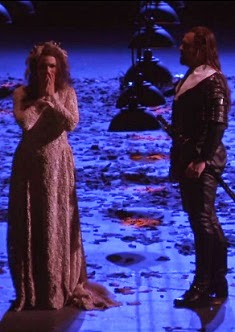
Directing a bel canto opera is always going to be a challenge, but the history and origin of Bellini’s Norma makes it a little more difficult than most. The opera is not short on high emotional drama, but the shape and tone of the work is tied to its composition in 1831 as a star vehicle for the talents of the leading soprano of the time, Giuditta Pasta following on the success of her La sonnambula at La Scala earlier in the same year. Directing Norma for the Irish National Opera, Orpha Phelan however is unable to do little more than update the drama away from its largely static setting of Gaul during the Roman occupation (100-50BC) and make sure it avoids druidic processional mannerisms, but in a work that is dominated by its famous aria 'Casta Diva' and a plot that amounts to little more than a romantic love triangle melodrama, the opera still feels mired in the past and as little more than a star vehicle for the dramatic soprano. Sometimes however that can be more than enough, and that proved to be the case with the INO production, where they were fortunate enough to have an outstanding soprano in the leading role who was more than capable meeting the challenges.

If it's hard to make Norma feel relevant and feel like it has something to say that relates in any meaningful way to contemporary concerns - who doesn't know what it's like to be in a disintegrating love affair with a general from an occupying enemy force? - Bellini's writing for the opera at least makes it feel like the life and death of thousands depend on the outcome of Norma's actions. I'm being facetious of course, but there is a Medea-like dilemma in the work where Norma's children are caught in the crossfire and that is something that is touched upon deeply in the opera, if not quite to the same level of horror as Greek mythology. Orpha Phelan rightly doesn't let the work get bogged down in a historical period that has little relevance to the dramatic action, and instead depicts it in a post-apocalyptic setting to presumably enhance the idea of this being a matter of life, death and survival against overwhelming forces.

The term post-apocalyptic used to mean to mean a future dystopia, but the dull heavy clothing and makeshift living conditions out of ruins and rubble now looks like an all too familiar scene in parts of the Middle East and Eastern Europe. If there is any suggestion of such a comparison, it's not explicitly stated - and perhaps doesn't need to be - but if it is the intent to make it look like something we can relate to more easily and more deeply than ancient Gaul, the production succeeds on that level, even if it doesn't really make any greater statement about the state of contemporary world affairs. There is a nod however to the Roman period where Pollione and Flavio have red tinted Mohican haircuts, which I found a bit silly. 

The setting itself is however the least important part of Norma. I'm no fan of original period settings as they can make the opera seem stuffy and old hat, but I'm not sure that it would have made any difference here, as the real challenge the director faces is that there is not a lot of actual drama or movement in Norma. It's all sung emotional turmoil, and Phelan works with the expression of it in the music and does what she can with it, particularly in the overture which is used to show the pain and the human cost of war (something this director also did in an RNCM production of Owen Wingrave in Manchester last year). I would have loved if the INO had been able to find a way to make the opera feel a little more meaningful and contemporary, but Norma is what it is and you have to work with what you've got. Any attempt to manipulate it into something it is not (see Àlex Ollé's Spanish Civil War production for the Royal Opera House in 2016) risks impacting on the whole fabric of the opera and work against where its real strengths are.

The most that Phelan was able to achieve was to tweak the focus to make Norma a little less victim of betrayal by a man and more taking a determined and principled self-sacrificing stand for the sake of her children. I didn't think this really came across or even that it was needed, but in passing - again never made overly explicit - the underlying Greek tragedy elements of this situation could be seen as having wider implications for the individual and society (not just a woman in a relationship with the wrong man) on opposition to controlling and corrupting figures of authority. If little or any of that came across with any noticeable intent and the production didn't have any new ideas as a concept to sit the drama upon, it was clear nonetheless from the overall impact on the night of the performance in Wexford that it wasn't needed.

Under the musical direction of Maurizio Benini - invited by INO artistic director and principal conductor Fergus Shiel as an authority on bel canto opera - it was a truly thunderous account of Bellini's wonderfully calibrated score, with choruses well-employed throughout to give that punchy impact where the opera needs it. Not that it needed much, as the Georgian soprano Salome Jicia delivered all the emotional impact and volume required at a pitch that struck you fully in the heart. This was a real powerhouse performance, outstanding on every level, completely up to the quite extraordinary challenges of the role. Jicia's voice was strong from the outset ringing out with a passionate force that she maintained throughout and which remarkably even gained emotional depth as the opera progressed.

It's a hugely challenging role, one sung by some of the greatest sopranos in opera history - and there are few enough capable of singing this role effectively today. The delivery of the opera as a whole was perhaps enhanced by the custom designed acoustics of the National Opera House in Wexford. Lesser known and rarely performed bel canto works have been the primary focus of much of the Wexford Festival Opera's 75 year history and the new building, opened in 2008, remains ideal for the performance of works like this. Being more used to seeing opera here during the festival's October dates, the heat in the auditorium on a June evening however was an added challenge for the audience in a pretty much full house for this performance in Wexford.

If I have reservations about the relevance of the opera and the production's dramatic focus, the nondescript but functional production design, I am in no position to argue with Bellini's writing for the voice. And, after all, the principal attraction of Norma is the singing and the Act I aria 'Casta Diva' - you could have heard a pin drop in the reverent silence during Jicia's performance here. The role of Norma is a challenge in itself, but it still needs the strong support that Bellini builds in to give dramatic and emotional depth to the role as more than a singing showcase. It helps then when you have an outstanding team to deliver it and, in addition to Jicia, I was most impressed with the solemn authority that bass William Guanbo Su's Oroveso brought to counter the high melodrama elsewhere. Siobhan Stagg held her own against Jicia's Norma, Mario Chang was a robust Pollione, and Aaron O'Hare as Flavio and Leanne Fitzgerald as Clotildhe rounded out an impressive singing cast.

And really, when you have singing like that, when you have the orchestra playing as it did here under Benini, when you have a well-managed chorus and a director who focuses on the singers making the characterisation feel meaningful and vital, Norma takes on a life of its own and renders any reservations about relevance or dramatic credibility as pretty much irrelevant. It sweeps you towards a finale then that was everything it should be; grandstanding drama, shock revelations, underscored (probably not a suitable word in the circumstances) by the heft of dramatic musical writing and a roaring chorus. You can see why Norma is a popular work, with one of the most famous arias in the whole canon, but also why it's not as frequently performed as it might be. The reason for that is clearly it requires a singer of exceptional ability and all the other elements built around that. The INO production had that with Salome Jicia and they made it count.


External links: Irish National Opera

Monday, 26 February 2024

Bellini - Beatrice di Tenda (Paris, 2024)


Vincenzo Bellini - Beatrice di Tenda

Opéra National de Paris, 2024

Mark Wigglesworth, Peter Sellars, Tamara Wilson, Quinn Kelsey, Theresa Kronthaler, Pene Pati, Amitai Pati, Taesung Lee

Paris Opera Play - 15th February 2024

It surprises me that Beatrice di Tenda isn't a better known opera. Most of Bellini's works are revived on a semi-regular basis and his significance is hardly underestimated as an important figure in the development of Italian opera, but his works don't seem to get the attention they deserve and this one in particular is largely neglected. Why? Perhaps it's a little old fashioned for modern tastes, or perhaps the challenge of this opera is that it needs skilled singers in all the key soprano, tenor and baritone roles. It's telling the title role is defined by recordings made by the likes of Joan Sutherland, Mirella Freni and Edita Gruberova. If it's a case of needing it to be modernised a little or waiting for the right singers to come along, well, then the Paris Opera get it right with this 2024 production directed by Peter Sellars.

That's not all they get right. There's a lot more to successfully producing an opera like this and it really needs commitment, belief and passion on every level, but it also needs to be carefully pitched. Passion is at the core of the opera, but it is also surrounded in coldness and that is identified and brilliantly reflected in how the production design here contrasts with the delicacy of the playing of the exquisite melodies. It's not that the plot has a lot to offer other than romantic drama, as Italian opera thrives on that, but it's how those passions conflict with power that drive the musical drama. Bellini is masterful in his treatment of such material, no less than Verdi, Donizetti or the opera seria of Rossini, but for me the characteristic that sets Bellini apart is not just the passion, not just the sophistication of the writing, but a sense of refinement. That's fully in evidence in this lovely opera, and I think that's what the director Peter Sellars attempts to retain and reflect it in a modern light.


On the face of it the drama has little to distinguish it from many other Italian operas. Based on a historical figure, Beatrice, the Duchess of Milan, is now married to her second husband Filippo Visconti, a union that has given him great power and influence, but they now have very different ideas about how to use their position. Beatrice wishes to support social programmes, while Filippo wields his authority ruthlessly over the people. Beatrice is horrified at the impact that their marriage has inflicted on the people of the nation and considers ending the marriage, which is not easy for a woman to do. Filippo too is being advised to end the marriage, but in order to cling to the power he finds an excuse to have her reputation destroyed by accusing her of conducting an affair with the minstrel Orombello, and tortures the man into a confession.

There are a lot of familiar elements here that can be found in the historical operas of Donizetti, in Anna Bolena and Roberto Devereaux, but Bellini's opera here has a distinct character and it's the duty of director to bring that out. There is an edge to Beatrice di Tenda in a libretto doesn't hold back on the details of the violence inflicted on the people on Orombello or the cruelty of Filippo's regime, and Sellars strives to make that as hard-hitting as possible. The music might sound beautiful but it doesn't soften the darkness at the heart of the work. There is a nobility in confronting such horrors head on, never bowing, and that's what Bellini's music counters. Even Filippo in the end recognises where real power lies. Well, almost. The second concluding act of the opera consequently is extraordinary and enormously powerful. Evidently however, it's how the subject is sung by the performers is perhaps the most vital element contributing to that impact.

Bel canto is all about the singing. It's in the name and it needs to be done well or not done at all. Italian bel canto opera is not a repertoire that I have been following lately however, so few of these performers are familiar to me, but even so I can't remember hearing bel canto sung so well as it's done here. Singers and performers like this are not just there to show off the beauty of their voices, but also bring out the qualities of the music and the form, and in that respect, this is singing of the highest calibre. It's interesting too that it is American singers who shine in the main roles. Tamara Wilson's Beatrice is just phenomenal, her range impressive, her delivery and performance perfectly judged. Hawaiian born baritone Quinn Kelsey is a strong counterweight that makes Filippo a formidable opponent. No less impressive here are Theresa Kronthaler as Agnese and Pene Pati as Orombello. 

Act I consequently is impressive and immersive despite the conventionality of the plotting, while Act II is just off-the-scale brilliant, the increased intensity and emotional drama between the principal characters and their conflicting worldviews reaching almost fever pitch as they hold firmly to their beliefs and inner nature - for good and for ill. As it's Bellini, the chorus also play a large part in the swaying between these opposing positions. Like La Sonnambula, like La Straniera, they provide commentary and reaction, reflecting confusion and the horror of the people observing the troubles of high society - "Nothing escapes our eyes" -  but they have a participatory role here as well, influencing as well as being affected by what occurs. All of this not only underlines the intensity of the operatic drama, but it gives the plot considerably more weight beyond it being merely a historical royal intrigue.


Director Peter Sellars introduces a clean grand set designed by George Tsypin for La Bastille. All of the action and intrigue takes place in the palace gardens, within a low maze of hedges made of mesh steel and tall conical trees. It has a cool elegance. Costumes are modern, smart, elegant befitting the high society. Evidently there is no need to distance the drama by setting it in the original time period of 1418, but I'm not convinced that introducing laptops and mobile phones is really necessary either. When Filippo confronts Beatrice with evidence of what he sees as plotting to Beatrice's outrage as the violation of her personal secrets, he presents her with a laptop computer as evidence. Agnese can be seen later scrolling on her mobile phone doubtlessly checking how many likes she is getting on social media for her actions. It feels a little heavy-handed and doesn't really make any commentary that is worth making a point about. Window cleaners and hedge trimmers are also a distraction that add nothing to the production design.

Sellers, who incredibly has never directed an Italian opera, not even Verdi, does much more than update the production with modern technological devices. He also has some interesting things to say about the opera in an interview shown during the interval of the Paris Opera Play live broadcast of the opera. He makes a strong case for the effectiveness of the work to really touch on the horror of living under a dictatorship, about the fragility of human beings within such a regime and the possibility of them being broken. It's clearly all laid out in the libretto and in how Bellini scores it, making Beatrice di Tenda really quite revolutionary in terms of Italian opera up to that point in 1833, and unquestionably still relevant as a subject today.

Bellini's penultimate opera, I find this a much more interesting work than his more famous final opera I Puritani, but evidently a lot depends on how well individual productions are directed and sung. Sellars direction makes a strong case for the relevance in the work, Mark Wigglesworth conducts the Paris Opera orchestra with fervour, but it's the quality of the singing performances in this Paris Opera production that truly raise Beatrice di Tenda to a level of greatness.


External links: Opéra National de Paris, Paris Opera Play

Photos : © Franck Ferville/OnP

Thursday, 29 September 2016

Bellini - Norma (Royal Opera House, 2016)

Vincenzo Bellini - Norma

Royal Opera House, 2016

Àlex Ollé, Antonio Pappano, Sonya Yoncheva, Joseph Calleja, Sonia Ganassi, Brindley Sherratt, David Junghoon Kim, Vlada Borovko

Cinema Season Live - 26 September 2016

What is a director to do with Norma? Like many bel canto operas, it would seem to be going a bit overboard to invest too much historical realism into a plot that is more concerned with the romantic complications and emotional states of its main characters, and the dramatic contrivances don't really lend themselves all that well to it being applied to a contemporary updating. Àlex Ollé, of the Catalan theatre group La Fura dels Baus, is not wrong however when he considers that there are deeper considerations at play here in Norma that pit individuals and human nature against social, religious and political forces.

Proving the point, the dramatic force of Bellini's setting of these issues is brought to life and fully felt in the musical and the stage direction of this highly charged Royal Opera House production, even if Ollé's Spanish Civil War-inspired setting doesn't really establish a convincing new context for the issues it raises. A production of Norma neither loses nor gains much from its ancient setting that pits the Gauls and their druids against the Roman occupying forces, but it is important and relevant in our own times to consider how religion can be used as a tool to motivate individuals towards actions that otherwise would be inconceivable.


What Norma should have is impact, and visually at least set designer Alfons Flores's forest of dramatically lit crucifixes matches the intensity of where the opera is pitched. Religious iconography is evident also in the priestly costumes, the children's choir, hooded processions and a huge swinging thurible solemnly wafting incense around during Norma's 'Casta Diva', and it's associated here with a fascist movement, Brindley Sherratt's Oroveso styled to look very like Generalissimo Franco. It's debatable that the analogy works - a suit-wearing Pollione hardly matches the image of the Romans as being Republican opposition - but the stage setting at least keeps the overarching theme very present throughout, suitably overblown to match the nature of the dramatic representation.

Such grand gestures are to be expected in Norma, and they serve their function well right through to the dreadful choices between following her heart or her duty that the priestess must weigh up in the second Act. The confused narrative of the production's analogy doesn't allow her sacrifice to appear as anything more than a grand gesture, but it certainly felt like it was a hard-reached decision of someone who has been pushed to the limits of what their conscience will endure. It takes a lot more than grand gestures to make that work: it takes some great singing.

Evidently much of that rests on your Norma. In the case of this production, the early withdrawal of Anna Netrebko proved to be a great opportunity for Sonya Yoncheva to show that she is ready to be catapulted to the same level of international stardom, and she rose to the occasion. This was an outstanding performance that felt like something very special indeed. Yoncheva might not be as studiously perfect in this role as Netrebko might have been had her voice not developed in other directions, but it contained every ounce of emotion required to grapple with the depths of the role, qualities that are very much there to be found in the music that Bellini wrote for this part.


Joseph Calleja was also outstanding alongside her as Pollione. Calleja has a classic romantic lyrical tenor voice, but he shows that he can also bring that vital edge of steely determination that is needed for this role. Pollione is not a straightforward character and not one that you can easily sympathise with, but he likewise has chosen to follow his own heart and risk betraying his own people, and he is prepared to suffer the consequences for it as long as innocent people do not suffer for his actions. Calleja's singing and acting performance grasped the nature of his character's grappling with this position and his voice rang out the truth of it.

Between Yoncheva and Calleja you have the makings of a great Norma here, and the production doesn't let them down on any other front. Adalgisa is a vital component who inadvertently sows the discord that leads to the tumultuous conclusion, but she is also the bridge that links up the dramatic and emotional undercurrents. Sonia Ganassi take this up well, but is particularly strong when she has to rise to Yoncheva's level in their Act I duet, 'Sola, furtiva al tempio', the two women's voices blending beautifully. Antonio Pappano's conducting emphasised the more dramatic side of the score while retaining its melodic qualities, the work as a consequence bristling with life and charged with emotion. The Royal Opera House production is everything that a good Norma should be.

Sunday, 31 July 2016

Bellini - I Capuleti e i Montecchi (Buxton Festival, 2016)

Vincenzo Bellini - I Capuleti e i Montecchi

Buxton Festival 2016

Justin Doyle, Harry Fehr, Luis Gomes, Stephanie Marshall, Sarah-Jane Brandon, Jonathan Best, Julian Tovey

Buxton Festival - 20 July 2016

Opera, if you want to try to pin it down to a popular definition, is an artificial narrative construct given a heightened reality through music and singing. The archetypes that would best fit this definition in the consciousness of the general public are those that go for the heightened emotional jugular - La Traviata, La Bohème - but it's practically the entire raison d'être for the bel canto style of opera. Bellini's work evidently fits the bill, and while Norma and I Puritani might be better known works, it's I Capuleti e i Montecchi that probably best meets the definition of the popular archetype.

Shakespeare would have a lot to do with turning the historical struggle between the political factions of the Guelph and Ghibelline into the two rival households of the Capuleti and Montecchi into what has become the archetype or by-word for the romantic tragedy in Romeo and Juliet, even though Bellini doesn't use Shakespeare as his primary source for I Capuleti e i Montecchi. Just like Shakespeare however, the story gives Bellini everything he needs to make this an operatic drama of the highest order.

Harry Fehr's production of I Capuleti e i Montecchi for the 2016 Buxton Festival would seem to be reaching for all those grand archetypal moments and images that everyone can relate to in Shakespeare's version and in Bellini's operatic interpretation. You have to really, as expecting realism or naturalism in a bel canto opera isn't going to get you anywhere. You do however need to find a balance that creates real insurmountable obstacles that only lifts the love story of Romeo (from the Montecchi family) and Giulietta (from the rival Capuleti family) to a higher romantic reality.


Several recent productions have reached for strong imagery to match those heightened sentiments. Arnaud Bernard brought a grand tableaux to life in a museum in his La Fenice production, and Christof Loy drew on imagery from the Godfather for a successful production in Zurich. Buxton also go for a mix of iconic imagery that strives to match the heightened passions of Bellini's writing, depicting the Capuleti as a military unit in army uniforms and the Montecchi in the dark dress of undercover operatives or even terrorists. It's not so much to make any contemporary allusion as much as find imagery that strikes a note of deep conflict and danger.

Yannis Thavoris's set design don't present a lot of variety to the scenes, and there's precious little traditional Verona here, but the set does capture a sense of the external and the internal reality in a clever way. The Capuleti compound is surrounded by a secure fence topped with barbed-wire that at the same serves as the walls of the bed chamber where Giulietta is kept, the two blending into one. It works on a functional level too, the world outside the wire cage masked by black curtains into which figures emerge and dissolve. It could be a barrier that is meant to protect from threats from the hated Montecchi, but it could just as easily be there to keep Giulietta locked inside.

As seemingly insurmountable as this high fence and the armed protection ought to appear, it's still not enough to keep out Romeo, whose love for Giulietta is such that no barrier will stand in his way. Despite having unintentionally killed Giulietta's brother in a dispute, Romeo is able to come and go much as he pleases in this opera, entering the compound in disguise, as a 'goodwill ambassador' and simply just as the necessity of the plot demands. Such contrivances are fine if there is at least an element of danger present in his incursions, and all the military regalia and security measures give that appearance.


The set, costume design and direction all go some way to establishing the necessary tone for the artificiality of the narrative, but it's the music and singing that really carry the full extent of the heightened emotional reality in I Capuleti e i Montecchi. Justin Doyle's musical direction led the Northern Chamber Orchestra through the rattling dramatic twists and turns, while the dramatic and singing performances of the cast were all terrific. It would serve no useful purpose to compare anyone to Joyce DiDonato in the role of Romeo - that's a whole different order of performance - but Stephanie Marshall carried the mezzo-soprano trouser-role well on her own terms. She hit all the necessary points, matching the raised tensions in the drama, and in a production where there were many stand-offs with pointed guns, that was very dramatic indeed.

Sarah-Jane Brandon was also great as Giulietta, probably the stand-out performance of the evening really. The beautiful but drama-stalling love duets in this opera would have been much duller without her intensity. There were no weak points anywhere in this cast however, with Luis Gomes a bright and fervent Tebaldo and Jonathan Best an imposing and even dangerous presence as Capellio, Giulietta's protective father. Unlike Shakespeare's drama, where the families united in grief for the harm that their feud has wrought, I Capuleti e i Montecchi ends on a note of anger. As the culprit blamed for it all, Capellio got his just desserts in this production a bloody manner that matched the crashing finale that was fully in the spirit of this strong production.

Links: Buxton Festival

Thursday, 16 July 2015

Bellini - I Capuleti e i Montecchi (Zurich, 2015 - Zurich)


Vincenzo Bellini - I Capuleti e i Montecchi

Opernhaus Zürich, 2015

Fabio Luisi, Christof Loy, Alexei Botnarciuc, Olga Kulchynska, Joyce DiDonato, Benjamin Bernheim, Roberto Lorenzi, Gieorgij Puchalski 

Zurich - 5 July 2015

Bellini's I Capuleti e i Montecchi bears little enough relation to Shakespeare's 'Romeo and Juliet' as it is, so it's a bit of a challenge to add another level of distance from the original and still meet expectations. But then the director here for Zurich's new production is Christof Loy, so some deviation and modernisation from the original stage directions is expected, and if anyone can make that work it's Loy. Loy is fortunate - but it can't be a coincidence - to be able to work with great performers in such productions. In the case of I Capuleti e i Montecchi, the team is an exceptional one, and the new production consequently an overwhelming success.

Essentially what is left of Shakespeare's 'Romeo and Juliet' in I Capuleti e i Montecchi (the libretto actually taken from another source) is two rival Italian families teetering on the brink of all-out gang war, and a young couple from the two families who want to get married and live a life without fear of the constant feuds and assassinations. It's 'The Godfather' really, Romeo the Michael Corleone of the family, a young man with progressive ideas refusing to inherit the role as the boss of a murderous mob family, but he is drawn in against his will, unable to escape the blood ties that determine how he must act.


Put like that, it seems obvious to stage I Capuleti e i Montecchi in such a way, but it's not at all obvious that it would work or that Bellini's bel canto music is up to the relocation of a more modern setting. Between Fabio Luisi's musical direction and Loy's dramatic direction of it on the stage, it turns out however that it is more than capable of sustaining just such an interpretation. The mood is well established during the overture, the revolving set showing a series of rooms littered with bodies of gentlemen in suits. Bodies piled up in offices, in anterooms, in bathrooms, in bedrooms. We also see a young child being prepared for a wedding, and later see her as a young woman. As the stage revolves and the scenes flow, we see however that she is clearly traumatised by the carnage. Death is all she has ever known.

The mood is sustained by the dimly lit, sepia toned lighting through the Venetian blinds spilling shadowy lines across the wood-panelled sparsely decorated rooms. The rooms are invariably inhabited by powerful men in dark suits and tuxedos, standing around looking threatening. The tension is such that you feel a fight could break out at any moment and inevitably it does, though mostly off-stage, the set revolving like the sweep of a camera pan to the adjoining room where more bodies litter the floor. Loy also brings in an additional non-singing character to shadow the performers. He/she is an adjutant for Romeo, a go-between that permits the otherwise unlikely frequent incursions that the Montecchi Romeo seems to be able to freely make into Capuletti turf to visit Giulietta's room. This silent sinister figure however also incorporates the musical motif of premonitory death that lies between them.

There's a lot more to making the staging of I Capuleti e i Montecchi work than simply dressing the sets and the characters like it were 'The Godfather' although Alexei Botnarciuc gives a great Brando impersonation as Capellio, the head of the Cappelli family. It's Loy's direction of the singers as actors that makes it work convincingly, his use of the stage as ever impeccable, every single scene and movement contributing to the drama, looking cool and stylish. It's not enough however to turn a Romeo and Juliet story into a Mob film, and Loy doesn't neglect this either. You never at any stage (including the violent opening overture) forget that there are other scarcely any less violent passions involved here between Romeo and Giulietta.


Fabio Luisi recognises this too and his conducting of Philharmonia Zürich was remarkable, fully exploring the moods underlying the melodies. With a view of the orchestra, there were occasions when my attention was drawn away from the stage, just to see how Luisi was vigorously and precisely managing the orchestra to marshal Bellini's musical forces in service of the drama. Any distraction however is short-lived due to the increasing tensions that occur on the stage and by the singing performances that interpret them.

If there was rigour in terms of matching the intensity of the music with the dramatic direction, it was only enhanced by a uniformly impressive cast. Joyce DiDonato is not unexpectedly something of a phenomenon as Romeo, convincing in the trouser role, if not quite comfortable wearing the boots it seems. A few high notes were less than secure, but as a whole, the dramatic nature of the role suited her and she sang and played with real intensity. Olga Kulchynska was more than a capable match as Giulietta, her voice soaring with the high drama. Benjamin Bernheim also made a very strong impression as Tebaldo, his performance warmly received by the audience at the curtain call.

This production is now available to view for free streaming on-line on ARTE Concert.

Links: Festspiele Zürich, ARTE Concert

Friday, 20 March 2015

Bellini - I Puritani (Vienna, 2015 - Webcast)

Vincenzo Bellini - I Puritani

Wiener Staatsoper, 2015

Marco Armiliato, John Dew, Jongmin Park, John Tessier, Carlos Álvarez, Olga Peretyatko, Sorin Coliban, Carlos Osuna, Ilseyar Khayrullova

Wiener Staatsoper Live at Home - 10 March 2015


No-one goes to see Bellini's I Puritani expecting a history lesson. I think you'd find it hard to recognise any realistic treatment or situation between the opposing Puritan and Royalist forces, and certainly not any great depth of insightful characterisation of their lives and motivations. If however you come to see I Puritani for a lesson in how to construct and put across a bel canto opera of a Romantic nature with all the trimmings, well then you're in the right place. The Vienna production of Bellini's final work is given an outstanding interpretation here, with Olga Peretyatko in the leading role showing what the real value of this work can be.

You might not get much of a history lesson, and the plot of I Puritani might appear ludicrous to the casual viewer, but there is - quite literally - method to the madness. I Puritani isn't about the English Civil War, but the setting is as good as any for an epic drama between two opposing forces. And it's not so much a conflict between Roundheads and Cavaliers here, as a war between men and women. This aspect is particularly marked in the Vienna production. In bold strokes certainly, but bold strokes that depict a greater subjective reality.

Essentially, I Puritani must be seen from the perspective of Elvira if it is to engage the audience and make any sense at all. Yes, there's a dramatic plot point that sees the Royalist Arturo risk the delicate alliance that he has established wth the Puritan Parliamentarians, by helping a Royalist prisoner escape. This moreover is not just any prisoner. Arturo has recognised that the captive is the queen herself, Henrietta. Although he is about to be married that day to Elvira, Arturo's loyalty to the queen and his sense of duty is more important. Using the veil from Elvira's wedding gown, he helps the queen escape past the guards, and leaves his bride-to-be in a bit of a state.


In broad strokes then, I Puritani is about the clash of love and duty, but specifically in the different values that that men and women attach to them. Arturo knows that his actions are not excusable, but they are credible in that they are determined by his sense of duty. In his mind, his duty towards his queen must take precedence over any personal consideration - there's no other choice he could have made. Seen in that light, Elvira's response to the masculine view towards duty and honour over private sentiments - the jilted woman disintegrating into full-blown insanity - would seem to be a bit of an over-reaction.

It's vital however to see things from Elvira's perspective. She doesn't know it was Queen Henrietta that Arturo has rescued, but even if she did know, the fact is not really relevant. She's not experiencing events in a political or historical context, but from an emotional one. In her mind, her husband-to-be, the man she loves deeply, has absconded with another woman, a woman who - in the ultimate betrayal - he has helped escape using her wedding veil. The historical background and fact that it is the Queen is relevant only to the audience in terms of scaling the enormity of this betrayal to Elvira's mindset. With the stakes set so high, it's not surprising that she goes mad.

The trick to making such a drama work is to completely draw the audience into that mindset. Bellini is able to score the work to elicit the necessary emotions and go some way to making it credible, but it must work on the stage as well. That means that you need an exceptional singer for Elvira - who is the primary focus and emotional barometer for the work - but you also need it to work in complete conjunction with a sympathetic musical interpretation and good stage direction. You can see that the cast are fully behind those personal dramas. They never appear to be larger-than-life historical figures, but creatures of delicate sensibilities and a firm sense of duty for what is right. It might not tell us much about the period, but it tells us a lot about the depth of human feeling. That's all there in Bellini's musical expression.


The stage itself them doesn't get bogged down in unnecessary historical accuracy either. Simply dressed, mostly dark, with only a few bold touches - huge beheaded statues - Heinz Balthes' sets speak of the conflict and give a sense of the scale that I Puritani works on. Bold colouration - usually associated with Elvira - is used to similar effect, while Olga Peretyatko, appears in the midst of all this in her white wedding dress a vision of perfection. That perfection becomes swallowed up in what is the only real expressionistic gesture in the stage direction. Evidently, that's during the 'mad scene' at the end of Act I, when Elvira's sense of order falls apart and she is caught up in a swirl of violent emotions.

The appropriateness of the stage direction and its ability to follow the mood becomes even more evident in Act II. There's no attempt to force the message home either in the stage direction or in the management of the orchestra. It takes its time and settles into the moment, letting it all just sink in. Sir George's description of the poor mad Elvira is just beautiful; sensitive to her plight, distraught at the cause of it (Arturo), highlighting in its own way the different male and female responses to the events that have occurred. Nothing significant happens in Act II, but between them Giorgio, Riccardo and Elvira make it really feel like it is the heart of the piece, which is what it ought to be.

As good as all this is, what really elevates the production and convincingly takes you into the heart of Elvira's dilemma and madness, is the outstanding performance of Olga Peretyatko. Peretyatko really is up there among the best in the world in some of the most challenging roles in the bel canto repertoire at the moment. Her delivery is confident but sensitive throughout. In the critical mad scene - where you really have to feel Elvira's predicament and her reaction is justified - she is not just technically accomplished to the highest level in her ornamentaion, but retains a wonderful lyricism in that lovely songbird quality that Peretyatko posesses in her voice. Demonstrating incredible control, she never overstretches or tips her performance over into full-blown hysteria.

Peretyatko's comanding central performance is, as demonstrated in Act II, well matched with solid and sensitive performances from Jongmin Park as Sir Giorgio and Carlos Álvarez as Sir Riccardo Forth. John Tessier is a little less steady as Arturo, but he has a bright timbre that is well-suited to the role, even if the high notes are a little beyond his range. It is an extremely difficult role, and not a sympathetic one, but Tessier does well to make his position credible. With such strong casting, good direction by John Dew, and the musical performance in the very capable hands of Marco Armiliato, the Vienna State Opera's production of I Puritani might not have been much of a history lesson, but it was a masterclass of Italian bel canto.


Links: Wiener Staatsoper Live Streaming programmeStaatsoper Live at Home video

Thursday, 19 February 2015

Bellini - I Capuleti e i Montecchi (La Fenice, 2015 - Webcast)


Vincenzo Bellini - I Capuleti e i Montecchi

Teatro La Fenice, Venice, 2015

Omer Meir Wellber, Arnaud Bernard, Jessica Pratt, Sonia Ganassi, Shalva Mukeria, Rubén Amoretti, Luca Dall’Amico

Culturebox Internet Streaming - 18 January 2015


The greatest love story ever written, Bellini's version of 'Romeo and Juliet' is perhaps not the greatest opera ever written, but it was the composer's first great success and is a work that can be seen as clearly leading the way towards La Sonnambula, Norma and I Puritani. As is often the case with the less well-regarded works of bel canto, I Capuleti e i Montecchi can however be transformed into something greater with the right production and the right leading lady. The new production in Venice, bringing the work back to where it was first performed in 1830, is perhaps nothing special, but it's good enough to support a terrific performance from one of the greatest bel canto singers in the world at the moment, the young Australian soprano Jessica Pratt.

There are considerable differences between 'Romeo and Juliet' and I Capuleti e i Montecchi, and most of them can be put down to librettist Felice Romani working not from Shakespeare's original drama but an 1818 Italian version of the drama written by Luigi Scevola, which he had already been adapted for Nicola Vaccai's 1825 opera Giulietta e Romeo. Much is inevitably cut for concision, losing many of the secondary characters and situations, and even a few of the big ones. Before the opera starts, Romeo has already inadvertently killed Juliet's brother in a conflict between the rival families of the Capuleti and the Montecchi, and even the families have been drawn back to their original political divisions of Ghibellines and Guelphs.


None of this is any kind of a hindrance to the essence of the central romantic drama between Romeo and Giulietta, although there are evidently differences in the development of their relationship and in how the tragic events unfold. The rivalry that makes their love impossible is still there between the opposing families or political factions, and that provides opportunities for plenty of tense, dramatic choral pieces. It would help the opera if Romeo and Giulietta can have a few good duets and arias to air their troubles, and those are well catered for in Bellini's fine settings of Romani's libretto. It all culminates in a dramatic scene where Giulietta 'dies' just as she is about to be married against her will to Tebaldo, but there are also opportunities for Romeo and Giulietta to see each other die in a way that can be reflected in emotional outbursts of singing to add even greater emphasis to the tragedy.

Arnaud Bernard's production for La Fenice responds well to the situations and gives the performers the right context to deliver on Bellini's settings, but it doesn't really have anything significant to add to the work. As a co-production with Athens and Verona, it undoubtedly has to work for each venue and can't be too adventurous (not that Verona can't be adventurous if there's still spectacle involved as in their La Fura dels Baus Aida), but really, this I Capuleti e i Montecchi is to all intents and purposes a period production. It uses the now familiar framework of paintings in a gallery coming to life, but unlike say Alvis Hermanis' Il Trovatore, which can be seen to be about storytelling and history, it doesn't seem to have any real conceptual purpose.

Visually however, it looks well and suits the basic dramatic purposes the work. At the start, on the rise of a curtain, the Capuleti come alive and surge out of a large painting that has been stored in the basement or workshop of a museum. If you see it as nothing more than La Fenice bringing an old master out of the archives and Bellini's music still being capable of invigorating it with life, then it makes its point, albeit not a particularly original one. In the main, other than one or two modern gallery art restorers and transportation staff moving things around, and a few freeze-frames of the action settling back into picture poses, the production gets away with just being a period costume drama.


What is perhaps more important as far as direction goes, is that it allows all the drama and romance to work within this concept and it gives the necessary space for Romeo and Juliet to do their stuff. If that's means that their final moments take place on a workshop table in a museum basement rather than on a bier in a period Veronese location then it's really of little consequence. It works just as well because Romeo and Juliet are singing like their very lives depend on it. And in essence, that's the strength of I Capuleti e i Montecchi. It was written to be brought to life by a great soprano and a great mezzo-soprano, which means that it was written, as far as we're concerned, for Jessica Pratt and Sonia Ganassi. And, forsooth, if they don't indeed make it their own...

Jessica Pratt is, quite simply, phenomenal. And that's not the first time I've said that about one of her performances. She excels as a lyric soprano in bel canto roles, and if she doesn't quite have the force for more dramatic roles, she can nonetheless translate the coloratura of a Rossini, Bellini or a Donizetti heroine into a thoroughly dramatic performance. And not just in the high-end coloratura, but with great technical ability and control, she demonstrates that just as much can be expressed with intensity in softer, more intimate scenes. Pratt is a convincing actress too, looking the part in her flowing locks and plunging gowns, even if the demands of this role hardly extend beyond traditional romantic opera heroine swoons and gestures.

Sonia Ganassi doesn't quite have the same glamour in the mezzo-soprano trouser role of Romeo, but she has a vital part to play and proves to be more than capable for the vocal and dramatic challenges of the role, and gives an impressive performance, working well with Jessica Pratt. Those are the roles that really matter here, but there were good performances also from Luca Dall’Amico as Lorenzo (Friar Laurence), Shalva Mukeria as Tebaldo and Rubén Amoretti as Giulietta's father Capellio. Omer Meir Wellber conducted the orchestra of La Fenice with a good balance between the lyrical content and the dramatic edge to Bellini's music.


Links: Culturebox, Teatro La Fenice

Thursday, 11 July 2013

Bellini - La Straniera

Vincenzo Bellini - La Straniera

Opernhaus Zürich, 2013

Fabio Luisi, Christof Loy, Edita Gruberova, Veronica Simeoni, Dario Schmunck,  Franco Vassallo, Benjamin Bernheim, Pavel Daniluk, Reinhard Mayr

Opernhaus Zürich - 2 July 2013

There's really only one reason for the existence of a work like La Straniera. Like most bel canto operas, it's a highly charged drama of limited plot credibility but it gives the lead soprano ample opportunity to demonstrate her singing abilities. There are occasionally other qualities to be found, and with Bellini the music is usually filled with glorious melodies that are a little more attuned to the dramatic content, which is fortunate since the plot of La Straniera needs all the assistance it can get. Fortunately, the production for the 2013 summer festival at the Zurich Opera House had one of the best teams imaginable to get the best out of the work with Fabio Luisi conducting, Christof Loy directing and Edita Gruberova singing the lead role of the mysterious stranger.

In terms of plot, well if you're a member of the chorus playing the townspeople, you're thinking would go along something like this. Who is that mysterious stranger seen moping around town, dressed in black? We've always known she's up to no good and now we have something on her. She's been seen as a threat to the forthcoming marriage of Arturo to Isoletta, and now she's only gone and actually killed Baron Valdeburgo. Let's put her to death! Oh, hold on - here's Arturo and he's claiming it was he who killed the baron. And now here's the baron and he says he's not dead after all. Well, she must still be guilty of something since she's keeping her identity secret. Can we still not just put her to death? Oh wait, she's the Queen! What!?


It takes a lot to make that kind of plot work. It goes without saying that you need a soprano of extraordinary ability to sing the role of Alaide, but you also need a strong singer who can also act and have sufficient personality of her own to lend to the role, and you need a director who can actually give them something to work with. You have all the necessary qualities in Edita Gruberova and Christof Loy. Having worked together in recent years on Donizetti's Roberto Devereux and Lucrezia Borgia to spectacular results, the prospect of them working together on Bellini's opera was to say the least mouthwatering, but not without a certain amount of trepidation as to whether they could pull it off again. Thankfully, after a few initial doubts, they did.

Loy's concept wasn't the clearest, but at least it wasn't one of the minimalist chairs and dinner jackets productions that he's been fond of recently. He could do that and make it work I suspect, but instead he aims for a fairly traditional period setting, with real costumes and backdrops and everything. There are a few quirks inevitably, most of them involving ropes. Is it because there's such a mournful pall of death hanging over the start of the opera? Isoletta concerned about the likelihood of her marriage tomorrow turning into a fiasco because of Arturo's love for 'la straniera'. Is Arturo's impossible situation likely to lead to him hanging himself? Or are the ropes representative of the townspeople, who are just puppets of the suspicious Osburgo? Or does it reflect their mood and their desire to string up the dark evil woman in their midst?


Whatever the purpose of the ropes, Loy nonetheless sets the mood well, contrasting the black mourning clothes and mysterious veil of the stranger with the wedding dress that Isoletta wears in preparation for her wedding. La Straniera's dramatic content turns on the question of whether we going to have a wedding or a wake, and that's well covered. Or a coronation. Bellini nearly gives the game away early on, Auturo having a vision of the mysterious woman wearing a crown and Loy has a little bit of fun by having Gruberova as Alaide walk on stage in the second act wearing her crown before realising that everyone is actually waiting for the bride and slipping off-stage again.

Setting the appropriate mood is one thing, but dramatic conviction is all important and Loy makes that work too. There's no standing around here. Every ounce of emotional charge to be found in the situation, in the score and in the singing is made to count. It's the singing which is paramount however and as in those previous cases of Loy working with Gruberova in the bel canto repertoire, every note and gesture is put in service of making what is a ludicrous plot actually feel like a matter of vast life-or-death importance.


There were a few early concerns over how long Edita Gruberova can continue to carry roles like this, but they too were soon completely banished. There were a few slight wobbles early on and her pitch wasn't quite there in her duet with Dario Schmunck, but when it came to delivering the coloratura in those frequent scenes of great emotional anguish, Gruberova was beyond reproach. I've heard the great Slovak soprano many times but never before live in the theatre, and her voice is simply remarkable. Without microphones and mixing involved, her voice just dominates everything with that distinct timbre that is clear and resonant. She not only carried the singing honours however, but - particularly in the hands of Christof Loy - her acting ability was just as impressive. From the moment she walks on the stage, she is carrying the weight of her character's background and status - regal and mournful - and expressing it in gesture and in every nuance of her vocal coloratura.  

La Straniera may to all intents and purposes be a one woman show, but the supporting elements built around the lead all need to be in place as well and the supporting cast were all very fine. Isoletta only appears at the beginning and the end of the work, but mezzo-soprano Veronica Simeoni ensured that her character's predicament contributed to the setting and made a strong impression. Dario Schmunck was a rather dishevelled-looking Arturo, but supplied all the fire that is necessary to charge the drama. Franco Vassallo's Valdeburgo was well received and rock solid, even if his diction wasn't always the clearest. Even with such reliable support, with Loy's strong dramatic focus and Fabio Luisi working it from the orchestra pit, it's still a challenge for anyone to make the ending of La Straniera work. An air of disbelief at the plot twists inevitably remains here, but just as much admiration for the attempt to carry it off. If Edita Gruberova can't quite do it then no-one can.

Thursday, 30 August 2012

Bellini - I Puritani


PuritaniVincenzo Bellini - I Puritani
De Nederlandse Opera 2009

Mariola Cantarero, John Osborn, Scott Hendricks, Riccardo Zanellato, Fredrika Brillembourg, Daniel Borowski, Gregorio Gonzalez

Opus Arte
Although it’s set during a period of considerable interest in English history - the Interregnum that takes in the conflict between the Cromwell’s Roundheads and Royalists loyal to the Charles I and the Stuarts - the libretto for Bellini’s I Puritani makes little use of the historical circumstances but rather, not surprisingly for an Italian bel canto opera, merely uses it as a backdrop for a story of romantic intrigue. If the libretto follows a well-worn generic line in this respect, I Puritani - Bellini’s last work before his early death - is however rather more interesting musically, having more in common with Verdi than Rossini or Donizetti and showing the composer at his most imaginative and inspired. Despite the weaknesses in the libretto, the opera is not just a situation for a series of arias and cabalettas, but shows rather greater musical attention paid to the characterisation and situation, and it’s particularly notable for its strong chorus work.
It’s fortunate then that there is great emphasis and attention paid to this musical aspect in the De Nederlandse production from 2009, but effort is made in other areas of the production in an attempt to make the work a little stronger and more coherent that it might otherwise be. There’s not a great deal one can do with the limitations of the plot, which amounts to little more than a historical romance, and a not very imaginative one at that. The central conflict at the heart of the work is less that of civil war opposition of ideologies, religion or allegiance to the crown as much as a romantic tussle for the hand of Elvira, the daughter of a prominent puritan clergyman. Her father has bowed to her own wishes to marry her beloved Arturo (Arthur Talbot), despite having promised her to Riccardo (Richard Forth).
Just before they are about to be married however, Arturo - who has royalist sympathies - takes advantage of an opportunity to rescue a prisoner about to be executed when he recognises her to be the queen, Enrichetta (Henrietta). Riccardo lets them escape, happy to see his rival disappear and be labelled a traitor, but Elvira is more devastated by what she sees as a betrayal, since Arturo has absconded with a prisoner who uses her own wedding veil as a disguise to help her escape. In the great operatic tradition, she of course goes mad, and her delusion persists when Arturo returns and tries to explain his actions and reaffirm his love for her, causing her to be responsible for his death.
The historical setting heightening the notions of romantic betrayal to the level of melodrama, replete with obligatory mad scene for the leading diva, I Puritani would seem to designed to fit the standard bel canto template, but Bellini’s score is far more varied and darker in tone than is customary, and the vocal writing isn’t there merely to show off the range of the soprano. Even so, it’s still a difficult opera to make work dramatically, and it does have singing challenges of its own. The apparent weaknesses and insubstantiality of the plot are however given something of a boost here by conductor Guiliano Carella returning to the original Paris score of 1835 and reinstating a number of scenes - some of them quite significant - that fill out the detail in the characterisation, and demonstrate the qualities of Bellini’s writing even further. Assisted by a very strong visual concept of the set designs by Es Devlin and by the stage direction of Francisco Negrin, the De Nederlandse production would be in contention for one of the best productions of this work but for the singing, which is good in most parts, but far from the standard needed to really lift this work to the level that is aspired to here.
Visually, the production design strikes an excellent balance between period (or theatrical period) in the costumes and a more modern conceptual approach to the stage design. Made up of rows of sheets that in Act I create ramparts for the soldiers in one scene before rolling smoothly into another where they show a committee of puritans in rows, there’s a wonderful sense of fluidity and continuity created that establishes the somewhat confusing political context and the drama in the most effective and eye-catching manner possible. Act II and III by contrast are relatively static, but again find strong visual ways to represent both the court that pronounces Arturo’s fate and reflect the horror that has afflicted Elvira’s mind. Conceptually, emphasis is also given to words, the steel sheets marked by bullet-holes and rivets that actually form a Braille background (the words of the Bible, I believe, in Dutch), with projections of words of passion and madness from the libretto projected in the latter scenes.
Despite efforts to make this a dramatically strong presentation, the singing isn’t quite as consistent. Mariola Cantarero is a little high and light for the dramatic range required for Elvira and consequently doesn’t always make the mark. She’s at her best in Act II, in her scenes of mad delusion, delivering a lovely ‘O rendetemi la speme‘, but her acting is limited elsewhere, and her high notes tend towards a screech. John Osborn is a terrific lyrical tenor who I like a lot, and he is excellent here throughout as Arturo, but he seems to me to find the role dramatically limiting and doesn’t really succeed in bringing the character to life. There’s a little more to get your teeth into in the role of Riccardo, but Scott Hendricks has a tendency to chew the scenery, and considering it’s made of steel here, that’s quite a mouthful. He gives it everything of course and sings the role well, but there’s more aggression here than art. The other roles are similarly variable never quite entirely holding it together either dramatically or vocally, although Fredrika Brillembourg is the best here as Enrichetta.
If the main roles don’t stand out as they might, the support they are given by the Chorus of the De Nederlandse Opera is superb, as is the work of the Amsterdam orchestra, who deliver an impassioned performance that is attuned to the dramatic content, directed from the pit by Guiliano Carella who clearly has a lot of love for the work and very specific ideas about how it should be presented. That passion comes through in the extra features on the Blu-ray disc, which look at the rehearsals and consider the variations of the Paris version of I Puritani in interesting detail. The quality of the recording is also of a very high standard, with a clear image and strong, detailed High-Definition audio tracks in PCM Stereo and DTS HD-Master Audio 5.1. The BD is all-region, BD50 dual layer, 1080i full HD, with subtitles in English, French, German and Dutch. The booklet contains an essay on the work and a full synopsis.

Wednesday, 9 November 2011

Bellini - La Sonnambula


SonnambulaVincenzo Bellini - La Sonnambula
Royal Opera House, 2011
Daniel Oren, Marco Arturo Marelli, Andreas Leisner, Celso Albelo, Eglise Gutiérrez, Elena Xanthoudakis, Michele Pertusi, Jihoon Kim, Elizabeth Sikora
Covent Garden, London - 2nd November 2011
It’s tempting to make excuses or a rationale for the limited musical arrangements and the somewhat contrived situation that leads to a melodramatic crisis in Bellini’s La Sonnambula. Updating the period and setting it in an Alpine sanatorium in the 1950s, influenced to some extent by Thomas Mann’s ‘The Magic Mountain‘, director Marco Arturo Marelli attempts to provide some psychological depth to the work, but in reality only confuses the issue further. Like most bel canto opera, it probably just better admitting that the only real reason for its scarcely credible plotline is to provide plenty of opportunities for virtuoso singing, and on that level alone, La Sonnambula – and indeed this production of it – more than justifies its existence.
For some commentators, it’s this simplicity that is in fact the key virtue of Bellini’s approach to the work. Its two act structure is a model of dramatic form, but it also reflects the simple attitudes that exist in its village-life setting in regard to the central issues, where a young woman Amina, is accused of infidelity to her fiancé Elvino on the eve of her wedding, having been found in the bedroom of a recently arrived stranger. Unaware that it’s her habit of sleepwalking that has led to her unfortunate night-time excursion, the opera’s theme then is based around the simple notion of purity as seen through the eyes of smalltown moralists who purport to uphold it yet question it in its sincerest form in Amina.
Judged purely on musical terms, you have to admit that Bellini gets it perfectly right. There’s not too much in the way of ambiguity in the characterisation or in the musical arrangements that underscore this straightforward conflict. Provided, that is, that you have a singer in the role of Amina with the kind of voice that can suggest simplicity and purity wronged and give it an air of authenticity in the ringing high notes and coloratura that express her innermost love for her husband-to-be and the sincerity of her intentions. And when you consider that this is a role for a Callas or a Sutherland, you can understand why it’s not as easy to pull off as it sounds.
Sonnambula
Fortunately, the Royal Opera House had two strong leads in Eglise Gutiérrez and Celso Albelo, both of whom were capable of reaching the extraordinary vocal challenges of the opera, even if they were both a little lacking in the charisma and the acting demands required to give their roles the kind of depth that Marco Arturo Marelli was undoubtedly looking for. There have been some criticisms of Gutiérrez’s Italian diction and the fact that her voice became increasingly thin on the high notes, both of which are true. Normally, I’d be inclined to regard such questions of technique as secondary in importance to the overall characterisation, but in the case of bel canto opera, characterisation is indeed subsidiary to the technique and is all about the singing. There are few enough singers in the history of opera, let alone around today, who are capable of meeting both demands in this kind of work however, so expectations surely need to be adjusted, and personally, I was impressed by how both leads met the challenges presented by this particular opera. No excuses need be made however for Elena Xanthoudakis as Lisa or Michele Pertusi as Count Rodolfo, both dramatically more convincing and dynamic as characters, both singing impressively, with real feeling for the work.
The use of chorus was also brilliantly employed. Choral work is not usually something you associate with bel canto opera – at least not until Verdi found a way of harnessing its possibilities as a means of popular expression – but it’s used here in just such a manner as the voice of public opinion, who watch and comment approvingly or disparagingly on everything that develops. Accordingly, they change with the wind, from “How could she, the faithless wench!” (I’m paraphrasing) and “How can this be anything but what it seems?” to “We always knew she was pure and true”. It’s realistic to the situation, but inevitably feels a little overstated, working contrary to the director’s intentions of giving the piece a realistic psychological or sociological treatment. So too, unfortunately, does the role of Elvino, whose change of heart and preparations to summarily dump Amina on their wedding day and marry Lisa instead is not only questionable, but his lack of faith in Amina is surely unforgivable.
A lot then depends on the dramatic twist to make it all work and fall into place, since it not only precipitates the drama, but also ultimately resolves it. Sleepwalking is an interesting notion that is worth exploring – the sleepwalker acting out unconscious inner thoughts and desires – but Marelli’s staging isn’t really able to do anything with it here in La Sonnambula, or make it any more dramatically convincing. There are no true human characteristics realistically expressed, no great revelations opened up, not even any real sympathy or comprehension shown along the way. Everything is as it appears and purely reactive to outward appearances.
Sonnambula
Which in a way sums up not only La Sonnambula, but this particular production as well. The score and the treatment here are perfectly in touch with its subject, the stage design impressive to look at and well-suited to the drama (if it isn’t able nonetheless to make the most of Amina’s famous perilous sleepwalking scene), and there’s genuine skill and talent evident on every level, but ultimately there’s no great depth to the work and it’s a disservice to the opera, the singers and to the audience to attempt to suggest that there’s anything more to La Sonnambula than is apparent on its enjoyably exquisite but hollow surface. That however, is more than good enough.