Showing posts with label Christoph Willibald Gluck. Show all posts

Friday, 20 December 2024

Gluck - Iphigénie en Aulide/Iphigénie en Tauride (Aix-en-Provence, 2024)


Christoph Willibald Gluck - Iphigénie en Aulide and Iphigénie en Tauride

Festival d'Aix-en-Provence, 2024

Emmanuelle Haïm, Dmitri Tcherniakov, Corinne Winters, Russell Braun, Véronique Gens, Alasdair Kent, Florian Sempey, Stanislas de Barbeyrac, Alexandre Duhamel, Nicolas Cavallier, Soula Parassidis, Lukáš Zeman, Tomasz Kumięga, Timothé Rieu, Daphné Guivarch

ARTE Concert - 11th July 2024

The important and influential reforms that Christoph Willibald Gluck brought to opera seria are still impressive and remain an evident feature in his versions of two connected Greek dramas for the French stage, Iphigénie en Aulide (1774) and Iphigénie en Tauride (1779). If you are used to viewing opera seria - and there have been many opportunities to revisit some of these great works in an authentic form over recent years - Gluck’s concise, minimal compositional form and the dramatic drive of through-composition feels thoroughly modern compared to the old traditional recitative and da capo aria form. And since the Greek dramas still have meaning that tells us about something about human experience in the modern world, so too do they benefit from this being highlighted in a modern production. All the more so when the two works are staged side by side as a single unit by Dmitri Tcherniakov for the 2024 Aix-en-Provence Festival 

Even the manner in which each of the works are presented on the stage allows for a continuous flow of drama that allows those themes to be better connected and explored. The overture for Iphigénie en Aulide shows Agamemnon's nightmare of carrying through his intention to sacrifice his daughter Iphigenia, demanded by the gods to ensure the safe passage of the Greek forces to Troy. Despite his pleas to Calchas, the Gods and even trying to ensure that Iphigenia doesn't arrive in Aulis, his efforts are in vain. The nightmare has a force of its own that will see it carried though by the time we get to the conclusion. The danger of what lies ahead remains as a driving force all the way through the opera, even if it doesn't come to pass that way in the opera, except for this one where it kind of does...

You can feel it even when, led to believe that Achilles who Iphigenia is to be married to has been unfaithful, Clytemnestra immediately pleads with her daughter to leave, but Iphigenia wants to find out the truth. There is an urgency here in the drama, in the music, which you can imagine intensifies as the drama progresses. There is no time for self-indulgent arias that stop the flow so that the tenor, soprano or mezzo-soprano can reflect on their misfortune. The dilemma can be felt, discussions and exchanges must be made (and perhaps there are still some aspects remaining for the seria form) but every scene feels like it is moving the drama forward, that events are happening quickly and there is an immediate need to act. The production bears that out while all the time maintaining an unreal air of regal sang froid, propriety and elegance, again all of which can be heard in the music. And in the voice, with Corrine Winters impressive in the title role.

Gluck's sense of pure musical drama is perhaps still not fully formed in Iphigénie en Aulide, and it is considered the lesser of the two works performed here. It's certainly less frequently staged than Iphigénie en Tauride. I personally don't buy into the idea of lesser Gluck. Lesser is just never a word I would use to describe any Gluck opera. Even his pre-reform works (all too rarely revived, alas) are superb and have their own qualities. It's not even a question of refinement, just that the later works benefit from a greater unity of form and content. It's hard however to see any weakness in Iphigénie en Aulide, particularly when it is well directed, as it is here. The music is beautiful and the sentiments are sincerely expressed without over-emphasis. It's a serious matter, a horrific one, a father about to sacrifice his daughter. You would actually expect there to be more outrage at the situation, but there is that element of knowing their duty, following the will of the gods and Iphigenia's love for her father, so instead it is profound grief that is evident here and expressed beautifully in the music and the singing.

To possibly overstate the relationship between the music and the direction, you could see the same intentions reflected in Elena Zaytseva set showing the house of Agamemnon as a house with transparent walls. It's elegant and stately, but there is nothing that can be kept hidden behind its doors. Tcherniakov takes that consistent worldview approach in most of his productions now, and it's evident here in the gloomy sepia tones, in the corruption of the royal family. The lengths to which they are prepared to go to cannot be overstated, so Tcherniakov puts it up there. The dream played out in the overture is a terrible presentiment and with the uniformity of the stage setting you can feel that tension reach a peak as Iphigenia dresses for wedding and brings herself closer to the terrible fate that awaits her after the celebrations. You see the nightmare unfold and repeat before your eyes.

We are dealing with mythology here so there is or should be no need to align this with any modern reality, although Krzysztof Warlikowski certainly managed to use contemporary themes successfully in his production of Gluck's Alceste. To say it's just mythology however doesn't take away from the human experience that Gluck presents in his version of Racine's tragedy, and it is enough for Tcherniakov to get that across. As well as highlighting the horror faced by Iphigenia, he doesn't neglect the fact that it is also a difficult duty for Agamemnon as a father, taking into account the contradiction between the public and private aspects of a king who needs to appear firm, commanding, brooking no doubt, no argument. Gluck's score bears all the complexity of these competing demands, Russell Braun's Agamemnon bringing this out in a fury out of remorse.

Considering the dramatic drive, there is nonetheless a variety of sentiments expressed. The wonderful dance music for the celebrations for Achilles and Iphigenia's marriage is retained and fits in well, and Achilles has a considerable part to play in the variations of tone and character as a figure caught in the middle of this absurd affair. Achilles is sung brilliantly by Alasdair Kent in the high tenor range, abruptly interrupting the course of events (and even the course of the music), and Véronique Gens is superb as Clytemnestra, inhabiting the role, responding with the dramatic expression of an expectantly grieving mother. That said, the sentiments expressed are limited by the singular drive of the situation towards a horrific notion of sacrifice, which might account for why the work is not more often revived.

As such it's a good idea then to expand the production to pair Iphigénie en Aulide with Iphigénie en Tauride, making this Aix-en-Provence production more of a fuller experience. It's been done before, relatively successfully at the Dutch National Opera. Tcherniakov however has a habit of overturning expectations and killing off figures who don't usually expire at the end of the opera and keeps alive those who traditionally die at the conclusion. At least here you would expect him to keep Iphigenia alive for "Part 2", but, well, that wouldn't be like Tcherniakov to make things easy now, would it? The impact of the family joining in a celebratory dance of death at the conclusion is certainly effective in its own way.

Iphigénie en Tauride is indeed then like a mirror image of Iphigénie en Aulide, Part 2: The Nightmare Continues. And indeed it opens with another nightmare, that of Clytemnestra murdering her husband Agamemnon. It takes place in the same outline of the house, only this time only a framework remains, sometimes neon lit (like Tcherniakov's Lulu), which when dulled down takes the appearance of a cage, a prison. Again, it's the overall tone that is important to the director, to establish the character of the work and make it effective rather than trying to find a way to make the archaic mythology work as a drama. Tcherniakov appropriately then plays Iphigénie en Tauride like it was Strauss’s Elektra, the tone one of the weight of crimes bringing increasing derangement and madness. Which is to be expected also on an island that executes any visitors, including a couple of shipwrecked Greek sailors who arrive there. Orestes too is damaged, deranged, tormented and full of aggression from his experiences.

Another characteristic found in Dmitri Tcherniakov productions is his intention to humanise works, bringing elevated mythological themes down to a level where everyone can relate to what is going on. There are no mystical priestesses in robes here, no high priest, as for example with the Met production. The inhabitants of Tauris look like refugees, like Tcherniakov's Knights of the Holy Grail in his Parsifal, wrapped up in heavy clothing to protect against the elements. The framework of a set becomes more a place of the mind here, an echo or a shadow of Aulis, where Orestes murders his mother in a ghostly recurrent nightmare. With its use of lighting illuminating scenes from the waking nightmare, it strikes a contrast that explores the work from the human experience as well as the deeper level of the psychological impact. As such, it reflects of course Gluck's musical exploration of the tone, mood and intent of the work.

Considering how he left things at the conclusion of Aulide, you can be sure that the director will - and consequently needs to - reinvent what takes place at the conclusion of this work, but it also has an impact elsewhere. Tcherniakov very much underplays the traditional key scene of the revelation of brother and sister. There is a gap of shocked silence, but Iphigenia seems to already know it's Orestes and is just waiting on her brother to finally acknowledge the reality of the tragic family misfortune. And again, it would be wrong to think that it's just Orestes who has suffered. As in Aulide, the goddess Diana (Soula Parassidis) appears at the conclusion as a double of Iphigenia. Quite what you are to make of that and how much psychoanalytical examination you want to subject the work to is up to you, but it's consistent in its reference back to what takes place in Aulis. What is perhaps more worthy of consideration is how this applies to the state of the world today, to current wars where victims become executioners. The horror of that doesn't need to be spelled out.

Whether you like Tcherniakov's work on the operas or not, the intentions are sincere and thought-provoking. What is not questionable however is the quality of these works themselves and the impact they have in this production by the joining the two operas together. The singing in Iphigénie en Tauride relies as much in the impact of the choral work, which was excellent throughout, as it does on Orestes and Iphigenia. Both Florian Sempey and Corrine Winters were fine, but it was certainly more of a challenge for Winters, singing two operas back-to-back and the latter in a lower tessitura than she would normally sing. It felt a little less dynamic as a result, but the direction also called for a muted performance here. The real winner here was Gluck, the music side-by-side, back-to-back and end-to-end doubly glorious under the baton of conductor Emmanuelle Haïm.


External links: ARTE Concert, Festival d'Aix-en-Provence, Aix Festival Digital Stage

Thursday, 30 September 2021

Gluck - Iphigénie en Tauride (Paris, 2021)


Christoph Willibald Gluck - Iphigénie en Tauride

Opéra National de Paris, 2021

Thomas Hengelbrock, Krzysztof Warlikowski, Tara Erraught, Jarrett Ott, Julien Behr, Jean-François Lapointe, Marianne Croux, Jeanne Ireland, Christophe Gay, Agata Buzek

Palais Garnier, Paris - 26 September 2021 

The essence of what is continually great and everlasting in the later works of Christoph Willibald Gluck is that despite the formality of the 18th century musical conventions and the poetic licence of contemporary adaptation, he manages to make the stories and predicaments of the great mythological figures of Greek drama feel completely human. Despite appearing to have a very limited idea for presenting the drama, Polish director Krzysztof Warlikowski's production of Gluck's Iphigénie en Tauride nonetheless similarly strives to find the underlying humanity in his production for the Paris Opera, and perhaps even delve deeper into the mindsets and troubled history of the Atreides family. The success of the production is mainly down to Gluck of course, but Warlikowski knows when to defer to genius.

Essentially, the Orestia deals with the downfall of a great family, a royal family, and assuming that they aren't really lizard people - something I'm prepared to keep an open mind about - even royal families are human too. Hmm. Anyway. Warlikowski has been here before - or rather later - with his Princess Diana influenced production of Alceste, and this production of Iphigénie en Tauride which was first produced in Paris in 2006, opens somewhat obscurely with a title 'Dedicated to Queen Marie Antoinette'. Other than it being about a royal family and it being produced for Paris, I'm not sure what the intention of that is, but it doesn't prove to have any real bearing on the rest of the production.

Warlikowski's setting for Iphigénie en Tauride is, well, it looks very much like most Warlikowski sets designed by Malgorzata Szczesniak, with glass panels, mirrored rooms, a wall of showers on one side and a wall of sinks on the other. Here Tauride is an old people's home where Iphigenia as an old woman in a gold lamé dress looks back at the defining incident in her experience of a troubled family life. Or not so much looks back on it of course as much as relives it, her mind failing, flitting between her current infirmity and mental state in old age and the incident on Tauride that may have helped reduce her to her condition.

This Tauride or old people's home is of course less a physical place than a state of mind, and it's the impact that her experience has on her mind that Warlikowski wants to explore. Within that however, the actual drama plays out much as you would expect, with Orestes and Pylades brought by the priestesses as strangers to be sacrificed at the paranoid King Thoades, who while trying his best not to fall victim to the fate an oracle has decreed for him, inevitably ends up bringing it about.

Warlikowski illustrates a few scenes behind the reflective shield of her mind, showing the now and the past, but it's fragmented and nightmarish in its visualisation and not a narrative illustration. Doubles are used, as they often are in productions of this work  which seems open to such divisions and analysis, (Lukas Hemleb, Geneva 2015), (Claus Guth, Zurich, 2001) More than just use an actor to double Iphigénie past and present, internal and external, the director also doubles or contrasts the past as a mirror of the present. What plays out simultaneously is a kind of shadow nightmare scenario of her experience in Aulide, where it's now Iphigenia the priestess who is to carry out the human sacrifice, with Thoas becoming her surrogate father.

The psychoanalytical approach is quite appropriate, the dysfunctional family issues compounded with Iphigenia's encounter with the stranger who is her brother Orestes, and in Orestes seeing in Iphigenia the image of the mother he has just murdered. It's inevitable then that the familiar influence of the films of David Lynch also plays a part in this Warlikowski production, with scenes and imagery reminiscent of Wild at Heart (another horrific family saga of murder and brutality) and Mulholland Drive (a glamorous life on the surface with hidden horrors surfacing in the moment of death). Mix in a bit of royal scandal and there's plenty to make this visually impressive and troubling while still largely leaving the drama to tell its own tale.

Here, as is often the case, the best a director can do is find a suitable setting for mood and let Gluck's music and the drama speak for itself. Warlikowski does a little more than this, finding a way to bring the audience into the human drama that is playing out in the mind of Iphigenia. There are a few other touches, having the chorus and other players in the Tauride drama placed in the boxes, isolated and pushed off to the sidelines away from the wholly personal interiorised nature of Iphigenia's relationship with the drama. Diana's appearance at the end of Act 4 is appropriately sung from the back of the Palais Garnier up in the gods, all contributing to present as immersive a presence as possible of the drama replaying out in her mind.

Evidently it's Gluck's beautiful music, his attunement to the drama and the understated emotional states that drive the drama forward and it was successfully led from the orchestra under Thomas Hengelbrock. Vocally it was impressive also in the three leading roles. As Iphigenia Tara Erraught was superb, deservedly stepping into major opera house roles like this after a successful career as a repertory singer in Munich. Her musical range is consequently wide and varied, but she can do a leading Mozart role well (The Marriage of Figaro) and is certainly impressive in her French delivery of Gluck. Jarrett Ott was an excellent Orestes and Julien Behr offered strong lyrical support as Pylades.


Tuesday, 16 March 2021

Gluck - Orphée et Eurydice (Zurich, 2021)


Christoph Willibald Gluck - Orphée et Eurydice

Opera Zürich, 2021

Stefano Montanari, Christoph Marthaler, Nadezhda Karyazina, Chiara Skerath, Alice Duport-Percier, Sebastian Zuber, Graham F. Valentine, Bérengère Bodin, Marc Bodnar, Liliana Benini, Raphael Clamer, Bernhard Landau

Live Stream - 14th February 2021

There are some operas that seem to exist on another level, tapping into something indefinable and spiritual - Wagner's Tristan und Isolde or Parsifal, Stockhausen's Licht, Glass's Satyagraha, Mozart's Die Zauberflöte, Debussy's Pelléas et Mélisande - and many composers strive to reach that state through the power of music. Some of the best productions I have seen also strive to achieve that level of abstraction, not being held strictly to the exigencies of dramatic narrative, but finding a way in visual terms to tap into the same miraculous source that the music comes from.

One work that should certainly attain a level of transcendence beyond mortal matters is Gluck's Orfeo, or indeed in the French arrangement by Berlioz as Orphée et Eurydice. I presume that is also what director Christoph Marthaler is trying to do with his Zurich production, because it's hard otherwise to relate it to much that happens conventionally in any telling of the myth of Orpheus. Whether he actually achieves it is less certain, and indeed what he actually achieves is hard to define, but at the very least Marthaler attempts to bring an individual vision to a great opera.


There are essentially only three singers in Gluck's opera as well as a chorus, but it's more than enough to express everything that Gluck wanted to achieve in his stripped-back reformist version of opera. Really it couldn't be improved, although admittedly Berlioz's version, combining the best parts of Gluck's own Italian and French versions, is wonderful. What it doesn't need then is any additional figures or obscuring narrative imposed unless it can in some way support rather than distract from the beauty of the score and the intent of the original opera.

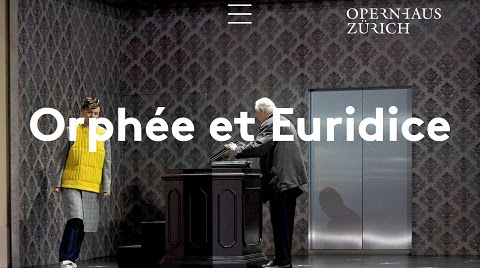
Christoph Marthaler puts several strange figures on the Zurich stage; a man like a caretaker or mortuary attendant (he has that mortuary pallor) shares a space in some indeterminate and likely otherworldly plane of existence with a number of other figures, one of whom - dressed in an ill-fitting bright woolen yellow tank top - we soon discover is Orpheus. The man, after scolding a loudspeaker that a young schoolgirl invisible to him has brought onto the stage for being mysterious, then paces though the rooms passing a funeral urn to shady figures who walk from room to room, into the lift and back again, each exchanging the urn and keeping it out of the reach of Orpheus. Meanwhile another figure makes jerky dance movements as if having a seizure.

What on earth (or heaven, or hell) this has to do with Gluck's opera is anyone's guess, but since the opening scene is Orpheus's lament for the death of Eurydice, we must presume (and it does fit in a way) that we are seeing an expression of the mind-state of Orpheus in a condition of deep bereavement, himself trapped in death's waiting room. I did say anyone's guess and that's mine. A beatific smile/stupid grin appears on the faces of these actors and dancers when one of the figures/abstractions turns out to be Amore/Love, offering Orpheus a way out of the prison of his disturbed state of mind. He has a few more horrors (interruptions, interventions and strange situations with eccentric characters) to face up to first.

I recall that Marthaler did something similar with his 2009 Bayreuth Tristan und Isolde, setting each of the acts on three levels of a descending room (or figures ascending?) as a way of putting them into an emotional space rather than a physical one. It's frankly a bit bonkers and you can hardly say that it's respectful of the work, but respect is overrated and works shouldn't be sacrosanct, not even Orphée et Eurydice. Whether it just throws random ideas out - lost arias, a recital of T.S. Elliott's 'The Hollow Men', pizzas all around - or whether it finds something new to express through the music and the meaning is up to the individual to interpret. Personally, I thought it entertainingly idiosyncratic and intriguingly unresolved, but far from the most spiritual or enlightening of productions.

Whatever you think about Marthaler's contribution, it's still Gluck's Orphée et Eurydice, which means it's still a work of exquisite beauty and delicacy. With its subject of grief, bereavement and the search for peace of mind and for the belief that love can win though times of social distancing and isolation, it's also a work that can have meaning at any time and make a personal connection, not least in these Covid-19 times. Marthaler of course doesn't directly reference the current pandemic, but there's no need to either: the very fact that this production of the opera is even able to take place at all is testament to the power of music and art to soothe and heal the soul in difficult times.

Zurich evidently have to make adjustments in order to put on a live opera performance in February 2021. There are some compromises that have to be made, the orchestra in a separate location, the chorus in another, with even the audience watching it distantly all around the world from a screen, so some disconnect is to be expected. Personally, I didn't find the music as beautiful, soothing and touching as it should be under Stefano Montanari, feeling somewhat disconnected from the stage performance. Whether that's down to the direction, the conducting or the difficulties of performance under current circumstances and blending the elements together is hard to determine, but like the recent Pelléas et Mélisande in Geneva, it feels like there is some vital element missing.

Although the recording and mixing of the live performance in an empty theatre makes it sound a little echoing, it's always a delight nonetheless to hear this work and see its themes explored and challenged. Although it seems like there are more people involved, there are indeed only three singers who carry the whole tormented character of the work and they do so well. Mezzo-soprano Nadezhda Karyazina is a rich lyrical Orpheus, but whether the unusual production played a part in it, I didn't get any sense of real feeling here. Chiara Skerath is not quite so strong vocally, but carried the haunted agnonised aspect of Eurydice better. Musically, I just didn't get the feeling from this that you ought to, and much as I enjoyed Marthaler's eccentric approach, the production didn't really work for me either.

Links: Opernhaus Zurich

Wednesday, 6 March 2019

Gluck - Orfeo ed Euridice (Dún Laoghaire, 2019)


Christoph Willibald Gluck - Orfeo ed Euridice

Irish National Opera, 2019

Peter Whelan, Emma Martin, Sharon Carty, Sarah Power, Emma Nash, Dominica Williams, Fearghal Curtis, Matthew Mannion, Robyn Byrne, Stefaniw Dufresne, Javier Ferrer, Sophia Preidel

The Pavilion Theatre, Dún Laoghaire - 28 February 2019


The absolute wonder of Gluck's Orfeo ed Euridice, the reason for its reputation as one of the greatest works of opera ever composed and the ability of the work to deeply move audiences some 350 years after it was composed, lies undoubtedly in its simplicity. Or rather its apparent simplicity since it relates to deep human feelings that connect us to myth, Gluck's work fully employing all the artistic musical, theatrical and dance elements that are the essence of opera. Refinement rather than simplicity of all those elements and how they work together was at the heart of Gluck's reformist agenda for opera, and it's in adherence to those principals that the Irish National Opera succeed in their beautifully simple but refined production.

Such indeed is the refinement and unadorned beauty of Orfeo ed Euridice and the deeper sentiments that underlie its purpose, that it can sustain all manner of interpretations. It is mythology after all. At the heart of the work is perhaps the rawest and most relatable of human emotions, those connected to love and loss, Orpheus's desire to bring his beloved wife Eurydice back from the dead practically serving as a model for Kübler-Ross's five stages of grief; denial, anger, bargaining, depression and acceptance. Gluck's ability to make those sentiments behind Orpheus's dramatic/symbolic journey vividly real in musical terms lie at the heart of the work.


Unquestionably then, even though La Fura dels Baus have successfully been let loose on the work with their enhanced stage techniques, they recognised nonetheless that it was essential to forge a connection between the music/musicians and the drama. In rather more stripped back conditions, while still presenting a theatrical presentation of extraordinary beauty, director and choreographer Emma Martin likewise, but through entirely different means, succeeds in making the essence of Gluck's timeless musical moods and melodies visible on the stage in the Irish National Opera's production.


First performed last year for the Galway Festival, but taken this year on a wider provincial tour of Ireland, the venues chosen remain (for the most part) small scale, permitting an intimate closeness with the drama and the production. Indeed, my front row seat at the Pavilion Theatre in Dún Laoghaire placed me practically in the 'orchestra pit', sharing a ground level space almost between the orchestra ensemble and 'stage'. Immersive theatre is nothing new, nor indeed is immersive opera, but it's quite another thing to be immersed in the same space that Gluck's Orfeo ed Euridice occupies, particularly one that in every other way strives to make the work's every sentiment tangible.

Stripping back the orchestra to its essential components, Peter Whelan's arrangement and conducting of the Irish Baroque Orchestra permits the beauty of each of the instruments and the part they play in each of the scenes to stand out all the more vividly. Emma Martin's production likewise reduces the vocal ensemble down to the main roles of Orpheus, Eurydice and Amore, with Amore also part of the four-way harmonised voices of the chorus for the Mourners, Furies and Blessed Spirits. Nothing was lost with this reduction, but rather the refinement of Gluck's musical scoring only even more apparent.

Orfeo ed Euridice was of course originally intended to make use of another element of opera that in the subsequent century after its writing tended to not have such a prominent role, and that's dance. Orfeo ed Euridice is written for movement, it's not the static stand-and-sing solitary aria expressions of the requisite numbers and sentiments of baroque opera, nor is it the stop-start division of singing and ballet of the French tragedie-lyrique, but an essential integration of dance into the whole flow and pace of the work. Orfeo ed Euridice indeed has been staged purely as a dance work, but more often opera productions tend to cut the instrumental/dance passages to suit modern tastes.


As a choreographer Emma Martin however knows the value of dance in Orfeo ed Eurydice adding another dimension to the opera and bring those sentiments to life. The INO production accordingly has a four-person troupe of dancers that symmetrically balance and in a way supplement the four-part chorus, flowing and weaving thought the work like the notes of Gluck's score brought to life. They vividly express all those stages of Orpheus's grief, as much as the impassioned singing of
Sharon Carty's Orpheus himself/herself; the anger and the struggle with the Furies (even transforming into a horrifying multi-limbed creature that stalks Orpheus across the stage, wrapping him in his submission to the Blessed Spirits, standing as a barrier between this world and the unreachable other.

The superb flow and choreography extends its mood and reaches outward to take in the stage itself. It doesn't need much in the way of set dressing but everything is purposefully employed, the lighting effective for the mood, the drapes at the back of the stage and the veils wrapped around the figures drawing everything together. It's not just the choreography or even the impressive technical blocking of the singers with the dancers and the sets, it's the direction of every scene to match and express those deeper human sentiments at the heart of the work.

The qualities of the human voice are essential to that purpose and Sharon Carty (Orpheus), Sarah Power (Eurydice) and Emma Nash (Amore) made them soar with love, anger, fear and regret. The essential moral of the mythological take, which was unfortunately lost under the stage requirement of the period to present a happier ending, must also be taken into consideration. Romeo Castellucci managed to address that brilliantly in his living-death element to his production for La Monnaie, and Emma Martin also takes the reality of the nature of bereavement into account here, consigning the happy ending to a kind of postlude that reminds us that after loss, life still goes on.


Links: Irish National Opera

Wednesday, 28 November 2018

Gluck - Orphée et Eurydice (Paris, 2018)


Christoph Willibald Gluck - Orphée et Eurydice

Opéra Comique, Paris - 2018

Raphaël Pichon, Aurélien Bory, Marianne Crebassa, Hélène Gilmette, Lea Desandre

ARTE Concert - October 2018

Gluck's original Italian version of Orfeo ed Euridice may already be considered as close to perfection as an opera can get, but you can't really argue that Hector Berlioz's version of the work doesn't respect and have equal value to the original. Well, you could argue the point that it doesn't entirely respect the reformist instrumental minimalism and that it includes a little ornamentation and extensions to suit the taste of a 19th century French audience, but by and large Orphée et Eurydice retains the essential quality of the music being entirely in service to the drama.

You know that because every scene and every note in Gluck's opera is necessary, heartfelt and powerful in conveying the meaning of the work, and the subjects it deals with are the deepest and most heartfelt of human emotions - love, loss, grief and redemption. Although in the latter case, even Gluck might have compromised the qualities of truth for the sake of narrative requirements and audience expectations, even if it remains a work of supreme beauty. Working with Berlioz's 1859 version, Raphaël Pichon attempts his own slight corrective to the 'happy' ending for the Opéra Comique's production, but the purity of Gluck's intentions remain even in their absence.


Directed by Aurélien Bory, the Paris production adheres to those basic principles in Gluck's musical composition and in how best to express the sentiments that lie behind the work in terms of the stage production that achieves maximum impact from minimal means. Berlioz's extended overture permits a way of showing Orpheus's loss of Eurydice, a simple large mirror over the stage giving an overview of the horror of her death. Eurydice falls to the ground, a hole opens up in the stage, a grave, and Eurydice is sucked down into it, the whole backdrop of Orpheus's world dragged down along with her.

The mirror also works effective for the appearance of Amore to inhabit the real world and also be representative of the metaphorical meaning of her presence. Borne aloft by dancing figures dressed in black, she appears in the mirror to float above the stage, achieving maximum impact with minimal means. Another effective use of stage craft is used to represent the Furies as dancers who are appeased by Orpheus, marking his descent into the underworld.

There's nothing old-fashioned in the costume designs, but nothing obtrusively modern about them either, the work inhabiting the same timeless place as the sentiments it is principally concerned with. With his smart suit and clicked back white hair, Orpheus looks less like a businessman and more like a music impresario, and it's in the voice, the musical qualities of that voice, that Orpheus embodies and expresses those qualities that represent humanity in its purest state, vulnerable and yet capable of striving to overcome adversity.


Musically at least, Raphaël Pichon brings out the beauty of this in Gluck's score, even if Berlioz's instrumentation doesn't quite pack the same edge and directness as it would on Gluck's period instruments. A contralto or mezzo-soprano however can bring great range to Orpheus in the Berlioz edition and Marianne Crebassa has tenderness and depth of expression in Orpheus's song of grief. There's a similar purity of expression that is appropriate for Eurydice and Amore in the singing of Hélène Gilmette and Lea Desandre, the overall impact that this gives to the work just breathtaking.

I'm less convinced that you can get away with correcting the limitations imposed on Gluck to provide a happy ending by simply cutting Amore's gift of returning Eurydice to life. I think that this is something that can be redeemed creatively to some extent in the stage directions, as Romeo Castellucci inventively managed in his production of Orphée et Eurydice for La Monnaie, but ending it prematurely by cutting the final scenes just leaves the opera feeling incomplete. Still, the acceptance of loss and bearing grief is perhaps closer to the truth for everyone, and Gluck certainly provides the necessary sombre reflection in that music that still makes for a thoughtful conclusion in this Opéra Comique production.

Links: Opéra Comique, ARTE Concert

Sunday, 9 September 2018

Gluck - Orfeo ed Euridice (Budapest, 2018)


Christoph Willibald Gluck - Orfeo ed Euridice

NorrlandsOperan, Armel Opera Festival 2018

Olof Boman, Åsa Kalmér, Susanna Levonen, Henriikka Gröndahl, Jeanne Gérard

ARTE Concert - 1 July 2018

You can always find ways of bringing a conceptual or modern-day reworking to the Orpheus myth, but what is more important in any performance of Orfeo ed Euridice is that it responds to the beauty, purity and simplicity of Gluck's reformist agenda for opera. The fact that it can easily sustain both modern conceptual (Romeo Castellucci) and more elaborate theatricality (La Fura dels Baus) and that it even has the flexibility to cast Orfeo as a mezzo-soprano, countertenor or even a bass! (Lyon 2015) is testament not only to the robustness of the framework that supports the opera, but that the principles behind it are also enduring.

It's one of the key works of all opera, one that any composer can look back on and learn from, and many of them did. The same goes for any jaded opera-goer (does such a thing exist?) or even anyone who has over-indulged in Strauss, Puccini and Wagner and wants to return right back to the basics. Whether it's the original Italian version Orfeo ed Euridice, Gluck's even more austere stripped back French version Orphée et Eurydice or even Berlioz's edition of the best of both worlds, it's an opera of exquisite beauty that demonstrates what opera is capable of in its blending of music and drama, in its use of myth and in the Orpheus-like magic of breathing new life into it that performance can bring.

The most important aspect then, and it's one that the Swedish NorrlandsOperan company do very well in their production, is that most basic of opera requirements - bringing the drama and the music together perfectly to highlight its essential purpose. Orfeo ed Eurydice is a work that celebrates love and music in its mythological subject, but it also considers death, grief and new beginnings as a necessary part of human existence.


I don't know if you can find any conceptual reading within the NorrlandsOperan production, performed here at the 2018 Armel Opera Festival, but the tilted mirror looking down on the stage somehow opens up the space while at the same time closing it down. The idea of division is important in Orfeo ed Euridice, most evidently in the demarcation between the living and the dead, and this is as effective a way as any of making that idea visual and ever-present. The main difference or unique point of this particular production is that Orpheus is a woman as well as Eurydice.

It's common enough for a woman to sing the role of Orpheus, the role often better suited to the more robust mezzo-soprano voice than the lyrical countertenor (although both have their own distinct qualities), but in the NorrlandsOperan production there is no attempt to make Orpheus look like a man. There's no need to either and it's not just to a concession to modern notions of diversity in relationships. The perfect simplicity of Orfeo ed Euridice and the myth itself is that the idea of love doesn't need to be defined in male/female terms. It's a human experience common to everyone and a woman is quite capable as a man of feeling the same love, grief and feelings for a loved one that takes Orpheus to such depths and yet rise above them.

Sung by Susanna Levonen and brilliantly directed by Åsa Kalmér, the depth of those feelings are beautifully expressed and never more apparent than in the glorious scene where Orpheus finally discovers Eurydice in Elysium with the Blessed Spirits ('Torna, o bella'). For this scene, as elsewhere, the set is simply dressed, kept down to essentials. A snowy veil lifts away from the floor as the lovers are reunited, the ancient pillars that were standing in Thrace now fallen in the Underworld. It's as simple and effective as that, and as simple and effective as Gluck's wondrous scoring of the opera.


It's given a fine musical reading as well, Olof Boman conducting the Armel orchestra through a full account of the work that includes all the dance pieces. I can't say that the dancing is great, but it's good to have these pieces included, particularly in the epilogue scenes. The chorus - a vital character in this work - is outstanding. Henriikka Gröndahl's Eurydice gives her character an equal footing with Orpheus, which is something you don't always get. It's an impressive performance with purity and sincerity of expression that takes into consideration the extreme suffering and exquisite joy that humans are capable of experiencing. Sung by Jeanne Gérard, Amore also has an extended role to play as a punkish - or perhaps Puck-ish - figure in red who observes the journey of Orpheus and permits a breaking of the usual rules.

Links: Armel Opera Festival, ARTE Concert

Thursday, 7 May 2015

Gluck - Iphigénie en Tauride (Geneva, 2015 - Webcast)


Christoph Willibald Gluck - Iphigénie en Tauride

Grand Théâtre de Genève, 2015

Hartmut Haenchen, Lukas Hemleb, Anna Caterina Antonacci, Bruno Taddia, Steve Davislim, Alexey Tikhomirov, Julienne Walker, Michel de Souza, Mi-Young Kim, Marianne Dellacasagrande, Cristiana Presutti, Wolfgang Barta

ARTE Concert - 4 February 2015

Gluck's musical reforms for opera are still recognised as important to the art form today, as to a certain extent is the primacy of the drama in his subjects. Composed in 1779, Iphigénie en Tauride is rightly regarded as the best example of the application of Gluck's approach to opera as drama. It's not so much that it's about putting plot and action at the centre of the work or applying a fluid through-compositional approach that integrated recitative and reduced the ornamentation of arias. The real innovation that can be seen in Iphigénie en Tauride, above and beyond these other significant reforms, is the psychological depth that the work contains.

So although Iphigénie en Tauride innovatively opens without an overture, plunging us straight into musical evocation of a storm, and even though it is Greek mythology, there's a human element underlying it that might not have been so evident in previous operatic explorations of these classical subjects. That's not a character that is lacking in the works of Handel or in other notable Baroque opera seria composers of course, but in moving away from the individual expressions of emotional turmoil in the ornamented da capo arias, Gluck does find a greater dramatic wholeness that is less academically tied to structure, less interchangeable in generic sentiments, and more willing to explore real personalities and interaction between people.


In Iphigénie en Tauride, the central relationships that draw out the themes of the drama are between Iphigenia and Orestes, and between Orestes and Pylades. The significance of this is most evident in the initial encounter between Iphigenia and Orestes, neither aware of who the other is, each believing the other dead. Without quite taking the musical language as far as Richard Strauss would take it some 150 years later in Elektra, this scene nevertheless explores just as incisively and vividly that same background, the sense of loss, horror and devastation that has visited the house of Agamemnon. Similarly, Orestes' scenes with Pylades explore the theme of friendship which might not be traditionally a strong emotional theme, but here Gluck makes it so and also - since one of them will die for it - makes it tense and dramatic at the same time.

And thereby, makes it human and not just some elaborate ancient tale of violence and revenge out of mythology involving long wars and the will of the gods. Some of the elements of Lukas Hemleb's production for the Grand Théâtre de Genève perhaps emphasise this division (mythology/human drama) and the links between them by using life-size puppet doubles for the characters. Claus Guth used a similar technique in his 2001 Zurich production of Iphigénie en Tauride as a device to psychoanalytically explore those divisions in the personalities of the characters, but Hemleb's intentions appear to be different, extending it to the nature of the drama within the opera itself. In as far as this is relevant to Gluck's treatment, it does undoubtedly emphasise the composer's particular way of exploring the conflict between actions and feelings beyond the traditional opera seria format.

Visually, the production has a strong presentation in Alexander Polzin's set designs that give a distinctive look and feel to each of the three acts without straying too far from its Greek theatre origins. A semi-circle stone amphitheatre in Act I, with most of the chorus all carrying dummies with identical masks, gives that impression of a Greek drama being played out as well as it being a temple, a place where the High Priestess Iphigenia and her followers sacrifice any foreign visitor who unwittingly arrives on the shores of Tauris. Act II closes in on the human drama of the friendship between Orestes and Pylades, by taking place mainly within a small confined space at the back of the temple/amphitheatre set. Act III is mostly empty stage and darkness, but a wider perspective shows the temple hanging above, with stalactites hanging dramatically over the drama that is impressively reaching its conclusion.


The puppets and doubles can be a little over-elaborate and not strictly necessary as an assist to Gluck's already highly evocative musical score. In Act II they can even almost work against the simplicity of the scene, when you not only have Orestes and Pylades in a cramped cell, but two life-sized puppets of them and two handlers as well. Essentially however, the purity of the Greek drama with its morally instructive dimension and the place of humanity within it are well served by the set designs. The singing, fortunately, also plays towards this purity and wholeness of drama and expression, without over-elaboration or unnecessary ornamentation. These are mythical characters and this is Greek drama on a grand scale, but the singing here really gives these larger than life figures a relatable human quality.

In this respect Anna Caterina Antonacci is outstanding as Iphigenia. Her voice holds firm, her characterisation is strong, the sense of trauma she has endured is credible, as is the dilemma she must face. That key scene meeting between Iphigenia and Orestes is played superbly and sung for all the import that is within it. Her brother Orestes here is sung by Bruno Taddia, and sung well, but it's more than a little overacted by comparison. On the other hand, how else are you expected to inhabit someone who is so consumed with guilt over the killing of his own mother Clytemnestra, and still in shock from her murder of her husband and his father Agamemnon? The singing is strong too in the other roles, with Steve Davislim's Pylades establishing a strong connection Orestes. Hartmut Haenchen's conducting of the musical performance was fine, but didn't bring out the vivid colours that are there in Gluck's score.

Links: ARTE ConcertGrand Théâtre de Genève

Monday, 20 April 2015

Gluck - Alceste (Venice, 2015 - Webcast)

Christoph Willibald Gluck - Alceste

Teatro La Fenice, Venice, 2015

Guillaume Tourniaire, Pier Luigi Pizzi, Carmela Remigio, Marlin Miller, Giorgio Misseri, Zuzana Markova, Vincenzo Nizzardo, Armando Gabba

Culturebox - 24 March 2015

 
You could pretty much guess how a Pier Luigi Pizzi production of Alceste is going to look, but just because it's predictable doesn't mean that it can't also be classy and highly effective. So yes, Pizzi's production of the original 1767 Vienna Italian version of Alceste for La Fenice is indeed all robes, neo-Classical pillars and steps and no, there's absolutely no licence taken with the all-important dramatic presentation. The stage might not really amount to much more than a visually impressive, minimally decorated, classically-styled high-impact set, but it impresses every bit as much as the scale of the Greek tragedy that plays out on it.

If there's a concept to the production here, it's on the same grand scale as the mythology. The theme of Alceste is life and death, and the set is accordingly predominately black and white, even the floor a chessboard design, with a few typically bold colours thrown in for additional impact. Within the set, the drama is also played out in a fairly traditional fashion, which in the context of Gluck's opera seria means that there's lots of anguished writhing, outstretched hands and falling to the floor. There's always the danger of the real human sentiments that lie behind the mythology getting lost in all the bold gestures, but the singing can go some way towards making up for it.


It's Carmela Remigio as Alceste who has to take on the burden of keeping this relatively straightforward drama interesting while there is not a great deal happening. Essentially, amid the mourning and lamenting of the citizens of Thessalia, the drama centres solely on Alceste sacrificing herself so that her dying husband, the king Admeto, will be spared by the Gods. For two and a half hours, essentially, we see her preparing for death and then slowly fading away as the Admeto comes to realise the horror of the deal she has made. We get a little more dramatic action in the French revision of Alceste, when Hercules goes down to Hades to bring the queen back, but here, it's a long drawn out decline that is only reprieved at the last minute by the will of Apollo.

Carmela Remigio voice hasn't the fullness of tone that you would normally associate with this kind of opera seria role, but she does succeed in making it feel every bit as tragic and compelling as it ought to be. It is and needs to be a big enough voice to remain dramatic and lyrical and rise above this fully orchestrated version at La Fenice. The Vienna version is more opera seria than stricter reformist revisions made by Gluck in the French, and Guillaume Tourniaire's conducting of the orchestra lacks the kind of edge you get from a period ensemble. There is a harpsichord in there in the accompanied recitative, but it's certainly softened by the strings. It's to the credit of Remigio then that when combined with the attractiveness of the sets, it never becomes too smoothed out or, heaven forbid, soothing.


You can see how far Remigio takes her performance in her farewell to the world aria (or, the first of them, the moment she decides to sacrifice her own life for her husband, because essentially, it's one long lament thereafter), in the aria 'Non vi turbate, no', which brings tears to her eyes. Pizzi's set, making only slight changes for each of the acts and never straying too far from the classical temple setting, helps establish the mood well here. Alceste wanders out into the forest at night in Act II, a blue tint in the lighting matching the tone, a tree with a pile of skulls capturing the matters of life and death that are to be mulled over. In contrast to Act I, Thereafter, Alceste's robes change from flowing white to constricting black, while her neatly tied up hair is loosened and freed.


There's only so much the remainder of the cast can do to add to the atmosphere, her children sobbing in the embrace of Ismene, as well as delivering a heartfelt lament. The other major contribution here however comes from Marlin Miller's wonderful singing and characterisation of Admeto. Again, the voice isn't a typical opera seria voice and ther recitative singing can sometimes seem a little declamatory, but there's a beautiful heartfelt lyricism here too, a regal dignity in how he deals with the situation, a sincerity in his protestations that he couldn't possibly live if it means that his wife must die in his place. Together, Remigio and Miller really highlight the nature and severity of the dilemma faced by the king and the queen.

This is a beautiful interpretation and a handsome production of Alceste at La Fenice. It's not radical by any means, it doesn't quite give you a sense of how revolutionary Gluck's score was, not in this early Italian version anyway, even though it was here that the composer and his librettist Calzabigi laid out their ideas for the reform of opera in its preface, but - as with Orfeo ed Euridice - it shows what two strong central performances can make of such a work with a solid supporting production behind them.

Links: CultureboxTeatro La Fenice

Tuesday, 24 March 2015

Gluck - Orfeo ed Euridice (Lyon, 2015 - Lyon)

Christoph Willibald Gluck - Orfeo ed Euridice

Opéra de Lyon, 2015

Enrico Onofri, David Marton,
Victor von Halem, Christopher Ainslie, Elena Galitskaya

Lyon - 14 March 2015

 
For a work that was intended to be stripped-back of ornamentation according to Gluck's reformist agenda for opera seria, Orfeo ed Euridice is surprisingly amenable to elaboration and interpretation. Whether it has the full resources of La Fura dels Baus behind it, or Castellucci's reaching out beyond the myth to the reality, what matters most is that a production gives focus and emphasis to the all-important dramatic and emotional core of the work. I'm not sure that it matters then the new Lyon production takes a few liberties with a staging that fully supports Gluck's dramatic intentions, but it's in very unconventional territory in its musical choices and interpretation.

Like Castellucci's Orfeo, the key point to be addressed is the ending, which must be reconsidered if one is to convey the truth of the drama and the myth. The happy ending imposed on Gluck's opera isn't convincing and it actually goes against the intentions of the myth by showing that death isn't the end and that there is a possibility of second chances. What there should be is the possibility of reward and redemption for Orpheus or at least some sense of coming to terms with the bereavement of his beloved Eurydice, but it is only in his art, in his music, that he finds the ability to endure and come out stronger from the experience.


David Marton's production for Lyon, part of their 'Les Jardins Mystérieux' opera festival, attempts to address this issue without invalidating the orginal myth or how it plays out in Gluck's opera. As its starting point, it takes inspiration from Virgil and depicts Orpheus as an aged writer who has never recovered from the death of his wife. The house he was building for them remains unfinished, and sitting at his desk tapping at a typewriter, he pours his loss out into his writing (the text projected on-screen behind him derived from a work by Samuel Beckett), as he is haunted by visions of their wedding, her death and the impossibility of ever being able to recapture what has slipped from his grasp. In his tortured prose, the old man attempts to rewrite his idea of a perfect life as it might have been, but it is doomed to fail.

The production takes the very unusual step then of splitting the role of Orpheus into two - an old Orpheus, a writer, and the younger version of his memory who is seen in flashback. As such, the traditional story is played out in a way that bears little relation to the original. Orpheus's journey to the Underworld is one that is undertaken more in writing than in 'reality', the old writer trying to reclaim what he once almost had, still seeing himself as a young man. The idea of not looking back at Eurydice isn't adhered to then, but it's more a case that Eurydice, ever-youthful in death, recoils when she sees past the young image of Orpheus to the reality of him now as an old man. It's only when the old Orpheus himself dies at the end of this production that he is reunited in the afterlife, young again, with Eurydice, the couple sharing a domestic moment with Love (Amor), depicted here as five children.

It's all a bit confusing at first, but in theory the director's concept is sound, and the production does touch on the beautiful poignancy of the work - even more so with its twist on the ending - without betraying the intent of the original. Musically however, this is not how you might be accustomed to hearing Orfeo ed Euridice. Not only do we have two Orpheuses, but one is a bass and the other a countertenor. Scored for a countertenor or mezzo-soprano, I would never have imagined the role being sung by a bass, and I don't quite know musically how they managed to split the role between the extreme range of male voices, but somehow they do it, and it is surprisingly successful. As hinted above in the description of the drama, the role of Amor is also reworked as a small chorus of five boys. This is all very unusual and it can be initially very confusing.

These aren't the only musical liberties taken with the work for the sake of this twist in the dramatic presentation. The music is also slightly 'adapted', and it takes a little while to get used to the unfamiliar interpretation. In one scene, for example, a radio broadcast listened to by the old Orpheus plays a musical response in interplay with the orchestra in the pit. Is this just being clever, or is there a valid reason for it? It may be that memories are stirred by the music on the radio, sparking off a sequence that lies somewhere between memory and imagination - the Elysian fields scene and Dance of the Blessed Spirits, for example, taking the form of a wedding reception. There are likewise a few pauses in order to let some dramatic scene play out or for Orpheus to hammer some more on his typewriter, which is not entirely satisfactory either, breaking up the flow and rhythm of the piece.


On the other hand, Enrico Onofri's interpretation and the actual playing of the orchestra is just beautiful, the opera played with all the dances included, the work allowed to breathe freely in those heavenly melodies, some of the greatest music ever written. There's no rigid Baroque playing here, the music is allowed to be dramatically expressive, putting the solo clarinet player on-stage for relevant Orphic musical expression, and the chorus are just extraordinarily good, lifting those moments of intense dramatic feeling. Consideration in the conducting was given towards the lighter voices of Christopher Ainsley's countertenor and Elena Galitskaya's Eurydice, allowing the beauty of the voices to carry. Victor von Halem's resonant, lyrical Wagnerian bass needed no assistance, and it was simply amazing to hear Orpheus sung in this register.

As slightly troubling as it might have been to hear such sacrosanct material played around with in this way, and as confusing as it might have been dramatically, this was a brave gamble by Enrico Onofri, David Marton and the Opéra de Lyon. I'm not sure that the Lyon audience knew entirely what to make of it all. Victor von Halem rightly received the loudest applause for a touching and beautifully sung performance, even if it wasn't entirely what Gluck had in mind. The contribution of the production team on the other hand wasn't entirely appreciated by a small section of the audience, however it should have been clear that if the worked touched as deeply as it did, establishing the right tone as a contemplative Orfeo ed Euridice, a sad one but never sentimental, it's because of and not despite those unconventional production choices in the music and the staging.


Links: Opéra de Lyon