Showing posts with label Nadezhda Karyazina. Show all posts

Tuesday, 16 March 2021

Gluck - Orphée et Eurydice (Zurich, 2021)


Christoph Willibald Gluck - Orphée et Eurydice

Opera Zürich, 2021

Stefano Montanari, Christoph Marthaler, Nadezhda Karyazina, Chiara Skerath, Alice Duport-Percier, Sebastian Zuber, Graham F. Valentine, Bérengère Bodin, Marc Bodnar, Liliana Benini, Raphael Clamer, Bernhard Landau

Live Stream - 14th February 2021

There are some operas that seem to exist on another level, tapping into something indefinable and spiritual - Wagner's Tristan und Isolde or Parsifal, Stockhausen's Licht, Glass's Satyagraha, Mozart's Die Zauberflöte, Debussy's Pelléas et Mélisande - and many composers strive to reach that state through the power of music. Some of the best productions I have seen also strive to achieve that level of abstraction, not being held strictly to the exigencies of dramatic narrative, but finding a way in visual terms to tap into the same miraculous source that the music comes from.

One work that should certainly attain a level of transcendence beyond mortal matters is Gluck's Orfeo, or indeed in the French arrangement by Berlioz as Orphée et Eurydice. I presume that is also what director Christoph Marthaler is trying to do with his Zurich production, because it's hard otherwise to relate it to much that happens conventionally in any telling of the myth of Orpheus. Whether he actually achieves it is less certain, and indeed what he actually achieves is hard to define, but at the very least Marthaler attempts to bring an individual vision to a great opera.


There are essentially only three singers in Gluck's opera as well as a chorus, but it's more than enough to express everything that Gluck wanted to achieve in his stripped-back reformist version of opera. Really it couldn't be improved, although admittedly Berlioz's version, combining the best parts of Gluck's own Italian and French versions, is wonderful. What it doesn't need then is any additional figures or obscuring narrative imposed unless it can in some way support rather than distract from the beauty of the score and the intent of the original opera.

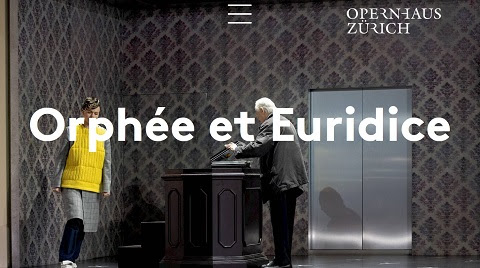
Christoph Marthaler puts several strange figures on the Zurich stage; a man like a caretaker or mortuary attendant (he has that mortuary pallor) shares a space in some indeterminate and likely otherworldly plane of existence with a number of other figures, one of whom - dressed in an ill-fitting bright woolen yellow tank top - we soon discover is Orpheus. The man, after scolding a loudspeaker that a young schoolgirl invisible to him has brought onto the stage for being mysterious, then paces though the rooms passing a funeral urn to shady figures who walk from room to room, into the lift and back again, each exchanging the urn and keeping it out of the reach of Orpheus. Meanwhile another figure makes jerky dance movements as if having a seizure.

What on earth (or heaven, or hell) this has to do with Gluck's opera is anyone's guess, but since the opening scene is Orpheus's lament for the death of Eurydice, we must presume (and it does fit in a way) that we are seeing an expression of the mind-state of Orpheus in a condition of deep bereavement, himself trapped in death's waiting room. I did say anyone's guess and that's mine. A beatific smile/stupid grin appears on the faces of these actors and dancers when one of the figures/abstractions turns out to be Amore/Love, offering Orpheus a way out of the prison of his disturbed state of mind. He has a few more horrors (interruptions, interventions and strange situations with eccentric characters) to face up to first.

I recall that Marthaler did something similar with his 2009 Bayreuth Tristan und Isolde, setting each of the acts on three levels of a descending room (or figures ascending?) as a way of putting them into an emotional space rather than a physical one. It's frankly a bit bonkers and you can hardly say that it's respectful of the work, but respect is overrated and works shouldn't be sacrosanct, not even Orphée et Eurydice. Whether it just throws random ideas out - lost arias, a recital of T.S. Elliott's 'The Hollow Men', pizzas all around - or whether it finds something new to express through the music and the meaning is up to the individual to interpret. Personally, I thought it entertainingly idiosyncratic and intriguingly unresolved, but far from the most spiritual or enlightening of productions.

Whatever you think about Marthaler's contribution, it's still Gluck's Orphée et Eurydice, which means it's still a work of exquisite beauty and delicacy. With its subject of grief, bereavement and the search for peace of mind and for the belief that love can win though times of social distancing and isolation, it's also a work that can have meaning at any time and make a personal connection, not least in these Covid-19 times. Marthaler of course doesn't directly reference the current pandemic, but there's no need to either: the very fact that this production of the opera is even able to take place at all is testament to the power of music and art to soothe and heal the soul in difficult times.

Zurich evidently have to make adjustments in order to put on a live opera performance in February 2021. There are some compromises that have to be made, the orchestra in a separate location, the chorus in another, with even the audience watching it distantly all around the world from a screen, so some disconnect is to be expected. Personally, I didn't find the music as beautiful, soothing and touching as it should be under Stefano Montanari, feeling somewhat disconnected from the stage performance. Whether that's down to the direction, the conducting or the difficulties of performance under current circumstances and blending the elements together is hard to determine, but like the recent Pelléas et Mélisande in Geneva, it feels like there is some vital element missing.

Although the recording and mixing of the live performance in an empty theatre makes it sound a little echoing, it's always a delight nonetheless to hear this work and see its themes explored and challenged. Although it seems like there are more people involved, there are indeed only three singers who carry the whole tormented character of the work and they do so well. Mezzo-soprano Nadezhda Karyazina is a rich lyrical Orpheus, but whether the unusual production played a part in it, I didn't get any sense of real feeling here. Chiara Skerath is not quite so strong vocally, but carried the haunted agnonised aspect of Eurydice better. Musically, I just didn't get the feeling from this that you ought to, and much as I enjoyed Marthaler's eccentric approach, the production didn't really work for me either.

Links: Opernhaus Zurich

Tuesday, 22 September 2020

Nikodijević & Abramović - 7 Deaths of Maria Callas (Munich, 2020)


Marko Nikodijević & Marina Abramović - 7 Deaths of Maria Callas


Bayerische Staatsoper, Munich - 2020

Marina Abramović, Lynsey Peisinger, Yoel Gamzou, Willem Dafoe, Hera Hyesang Park, Selene Zanetti, Leah Hawkins, Kiandra Howarth, Nadezhda Karyazina, Adela Zaharia, Lauren Fagan

Bayerische Staatsoper TV - 5 September 2020


The idea of building an opera around seven stage deaths enacted by Maria Callas in her most famous roles is such an extraordinary idea for an opera that it's likely to provoke two immediate and almost contradictory reactions. On the one hand you might think why did no one think of that before, even from the point of view of a gala performance of great arias. And then you realise why you can't do that. The emotional impact of all those tragic bel canto deaths all gathered together in one opera? And aligning them with the tragic circumstances of Maria Callas's death as well? It's going to be overload surely, emotionally overwrought and too much to take in all in one go?

Well, we are talking about the Serbian conceptual and performance artist Marina Abramović, who often uses her self and her body as a provocative vehicle for her ideas, so she's not exactly one for low-key and understatement. This is a performance artist who for her piece "The Artist is Present" sat silently at a table every day at New York's Museum of Modern Art for nearly three months. Some might even see her as a narcissist and self-publicist who sees herself as something as a work of art, and in the case of her Maria Callas project for the Bayerische Staatsoper in Munich, she has no qualms about identifying closely with an artist in the opera world who was no stranger to making headlines.

In her opera piece, the seven operatic deaths of Maria Callas are enacted in movie sequences (directed by Nabil Elderkin) with Abramović and Willem Dafoe as her lover/killer. Abramović herself is present on the stage, lying silent and unmoving as Maria Callas on her death bed while the film sequences are projected on the walls of her hotel room in Paris, the most famous arias of those works accompanying the extravagant visuals of the re-imagined ways that those characters meet their death. The arias are all sung live by different opera singers who take to the stage like ghosts, none of them however really looking or singing like Callas. Which would be a bit much to ask for really. Abramović however ensures that there is no doubt as to who is the main subject (Callas/herself) and that it's more than just an opera gala of Callas's greatest hits.

In the first of the filmed sequences, Violetta (
Hera Hyesang Park) sings 'Addio del passato' from La Traviata while lying dying of consumption in a bed, nursed and mourned by Willem Dafoe in a dreamscape of coloured mists and clouds. The death of Tosca, to the strains of Selene Zanetti singing 'Vissi d'arte' is enacted as Abramović falling from a New York skyscraper in slow motion to land with a crash on a car roof. She is wrapped in pythons as Desdemona (Leah Hawkins) in Otello, dies while removing her protective suit as Madama Butterfly's Cio-Cio-San (Kiandra Howarth) in a nuclear holocaust wasteland. And so on with Carmen (Nadezhda Karyazina), Adela Zaharia's rendition of the mad scene from Lucia Di Lammermoor and the immolation of Norma (Lauren Fagan) singing 'Casta Diva', all with a twist on the original traditional death scene.

So 7 Deaths of Maria Callas is clearly not an opera in the conventional sense, a cross between opera gala and performance art. Some might see opera as already tending in that direction, particularly if you've seen any of Romeo Castellucci's often even more abstract productions. It might not be quite as high concept as Castellucci, but as you might expect from an artist like Abramović, it's a more deeply personal and distinctive vision where the the artist/director puts herself into the art. It's a work that comes from the heart, in response to Callas and her fame as an opera singer, blending the two in a direct and emotional way. They could hardly be otherwise, the projected mini-movies accompanying the sentiments of these great arias powerful in their visual aesthetic and emotional punch.


It's clearly motivated principally by a love and perhaps even an obsession with Maria Callas, with whom Abramović clearly identifies. It blends the tragedy of Callas's life with that of opera, and that's certainly a subject worthy of an opera. It's surprising indeed that it hasn't been done before as far as I know, although Rufus Wainwright's Prima Donna comes close and Franco Zeffirelli, a personal friend of Callas as well as her director, turned his fantasy about Callas into a movie Callas Forever. Evidently, focussing on the deaths of opera heroines, putting them all together like this dying in graphic and violent circumstances often at the hands of men, fits into Abramović's feminist perspective and invites you to think about the fate of women, but perhaps no more so and no more powerfully than say a full presentation of Madama Butterfly or La Traviata.

It's nearly all classic opera arias that are used for the first hour of the opera, with only recorded drone ambient noise in the interludes accompanying the Abramović voice-over of introductory texts of Callas reflecting on the different ways to die. It's a pasticcio of sorts with only an overture by fellow Serbian composer Marko Nikodijević that is new. It's only in the final third of the work that we really hear new music composed by Nikodijević as the focus for the remainder of the opera turns to Abramović as Callas in her bed in her room in Paris on the day that she dies. Dramatically there's not a lot here to grasp as Callas wills herself to get out of bed, wonders where all her former friends and colleagues have gone now, smashes a vase and leaves the room, taking her final exit. While the voice-over thoughts are distracting and scarcely illuminating, the music itself is a powerful requiem of sorts for Callas.

Is this a work of performance art that relies on the original creator? Abramović is on stage throughout and the focus in the mini movies as the tragic heroine who dies seven times in her greatest operas. Can 7 Deaths of Maria Callas have an independent life (or seven deaths) after these performances? I don't see why not. Yes, the personality of Abramović dominates but only in so far as it is she who is breathing life into the character of Callas here. Callas is big enough a personality not to be subsumed by that and there's no reason why - like any opera singer stepping into shoes that Callas once filled - that someone else can't bring their own reinterpretation of this opera performance piece. The concept is strong enough, the music is strong enough (old and new) and the work is open enough to interpretation for another artist with sufficient personality (and love for Callas and Abramović) to bring something new and personal to this. Whether anyone will want to is another matter, and whether Abramović becomes as enduring an artist as Callas worthy of being revived remains to be seen.

Links: Bayerische Staatsoper TV

Saturday, 28 June 2014

Puccini - Manon Lescaut (Royal Opera House 2014 - Cinema Live)


Giacomo Puccini - Manon Lescaut

Royal Opera House, London - 2014

Antonio Pappano, Jonathan Kent, Kristīne Opolais, Christopher Maltman, Jonas Kaufmann, Maurizio Muraro, Benjamin Hulett, Robert Burt, Nadezhda Karyazina, Luis Gomes, Jeremy White, Jihoon Kim, Nigel Cliffe

Royal Opera House Cinema Live - 24 June 2014

While there isn't much hope for Le Villi and Edgar, there has at least been a concerted effort in recent years to bring another of Puccini's earliest works into the mainstream opera repertoire with numerous productions worldwide of Manon Lescaut. Puccini's first major success, the reasons for Manon Lescaut's neglect are a bit of a mystery. Antonio Pappano makes a strong case for the dramatic quality of the opera, the power of its dramatic score and the beauty of its melodies. The director of the Royal Opera House Kasper Holten suggests that it could be because it needs at least two world-class singers in the main roles, but that's also the case for La Bohème and Tosca. With Pappano conducting then and two major stars - Jonas Kaufmann and Kristine Opolais - in place and on fire for the Royal Opera House's season-closing live cinema broadcast, you would think that this new production would be a revelatory affirmation of the worth of Manon Lescaut, yet by the end of the evening, doubts about the work remain.


It seems obvious then to point the finger of blame - as many critics have been quick to do - at director Jonathan Kent, but while it is indeed difficult to follow where exactly the director is taking the story in the sets for Acts III and IV, the tone and line of the production is firmly on the side of the drama and the emotional journey of the two lovers. It's too easy to blame the production just for being modern - if the opera can't stand up to being placed in a modern context then it might well indeed be an old-fashioned work that has little to offer a modern audience and its relative obscurity is probably merited. Mariuz Treliński had a fair go at it in La Monnaie's 2013 production, so that doesn't seem to be the whole story with Manon Lescaut.

There are certain elements of L'Abbé Prévost’s original novel 'L’Histoire du chevalier des Grieux et de Manon Lescaut' that are perhaps a little out of place. You'd have a bit of trouble trying to force your sister into a convent nowadays, as Lescaut intends to do here with Manon. Accepting instead an offer to selling her off to a old rich man and then into prostitution is a bit of a change of heart for Lescaut and perhaps not that a common experience that many will identify with either. The way that that this separates the young woman from the ability to make her own choices however and love the young man she chooses - the Chevalier des Grieux - has timeless resonance and, most importantly, real conflicts between the heart and material desires. Certainly none of these issues have prevented the subject from reaching modern audiences in Massenet's popular and enduring Manon.


None of it has been any obstacle either for Puccini doing much the same thing in making Mimi's dilemma - again, one that remains tied very much to the times and morals of the period - the successful and heartbreaking heroine of the romantic tragedy of La Bohème. It's clear then that this is not the issue with Manon Lescaut, or at least not the main issue. There are however certain leaps and gaps in Puccini's version of Manon Lescaut that flow less well dramatically than Massenet's version, leaving out a lot of important details. Most critically, Massenet's choice to end the work with the death of Manon at the boarding of her ship as she is being deported to America spares us what amounts to an extended death scene that lasts the entirety of Act IV in Puccini's version where Manon and Des Grieux find themselves for some unexplained reason dying of thirst and starvation in the Utah desert.

There's not an awful lot that a stage director can do to make that fit with the rest of the work. The earlier scenes may take a rather sleazy modern approach to Manon's downfall - the young woman becoming a porn-star performing for a live audience rather than a dancer - but this gives exactly the right impression of how sordid the enterprise is. Glamour is of course part of Manon's ambitions, part of the unresolved conflict that keeps the young woman from simply following her heart, but you ought to make you feel uncomfortable at how she is being exploited and that is done well. The stylised deportation of Manon and the prostitutes along a gaming table and through a poster inscribed 'Naïveté' in Act III, coming out on a crumbling road that twists towards the upper heights of the stage in Act IV (the other side of the poster forming a desert backdrop) is however as baffling as the dramatic development itself, but it at least looks great. It doesn't however in any way undermine or reduce the emotional impact of how the scene is written or how Puccini scores it.


But yet it's hard to imagine that any of this provoking a single wet eye in the house. With Kristine Opolais and Jonas Kaufmann both in superb form throughout belting out the agony of their character's dilemma, Manon coming to regret the path that has left her "sola, perduta, abbandonata"; with Antonio Pappano sensitively wringing every ounce of drama and emotion out Puccini's exquisitely beautiful and heart wrenching score; with the on-screen film direction taking us into cinematic extreme close-up in a way that both Opolais and Kaufmann can sustain dramatically as well as aesthetically; you really ought to be a quivering wreck at the end of Manon Lescaut. If that much effort is put into it however and it fails to make the necessary impact, something is very wrong. Perhaps it's all just too much.

It's not too much on the part of the singers, the director or the conductor - they are just performing what Puccini has written the way he intends it to be played - it's just that it's musically overwrought without there being enough genuine character and dramatic development put into making the audience really care for the characters. It's not necessarily that Manon is a bit of a gold-digger - Mimi is fairly mercenary in her attachments in La Bohème and we care infinitely more about her sad and lonely death - but Puccini and his numerous librettists haven't put the necessary work into establishing the romance between Manon and Des Grieux as something credible. It's significant to note that Puccini has no equivalent for the second act in Massenet's Manon showing their humble but happy home in Paris with its little table, albeit a short-lived happiness where the relationship is already in trouble. We don't really get much of an opportunity to see Manon and Des Grieux together in Manon Lescaut, and when we do in Act IV, it's too much too late.