Showing posts with label Chiara Skerath. Show all posts

Tuesday, 16 March 2021

Gluck - Orphée et Eurydice (Zurich, 2021)


Christoph Willibald Gluck - Orphée et Eurydice

Opera Zürich, 2021

Stefano Montanari, Christoph Marthaler, Nadezhda Karyazina, Chiara Skerath, Alice Duport-Percier, Sebastian Zuber, Graham F. Valentine, Bérengère Bodin, Marc Bodnar, Liliana Benini, Raphael Clamer, Bernhard Landau

Live Stream - 14th February 2021

There are some operas that seem to exist on another level, tapping into something indefinable and spiritual - Wagner's Tristan und Isolde or Parsifal, Stockhausen's Licht, Glass's Satyagraha, Mozart's Die Zauberflöte, Debussy's Pelléas et Mélisande - and many composers strive to reach that state through the power of music. Some of the best productions I have seen also strive to achieve that level of abstraction, not being held strictly to the exigencies of dramatic narrative, but finding a way in visual terms to tap into the same miraculous source that the music comes from.

One work that should certainly attain a level of transcendence beyond mortal matters is Gluck's Orfeo, or indeed in the French arrangement by Berlioz as Orphée et Eurydice. I presume that is also what director Christoph Marthaler is trying to do with his Zurich production, because it's hard otherwise to relate it to much that happens conventionally in any telling of the myth of Orpheus. Whether he actually achieves it is less certain, and indeed what he actually achieves is hard to define, but at the very least Marthaler attempts to bring an individual vision to a great opera.


There are essentially only three singers in Gluck's opera as well as a chorus, but it's more than enough to express everything that Gluck wanted to achieve in his stripped-back reformist version of opera. Really it couldn't be improved, although admittedly Berlioz's version, combining the best parts of Gluck's own Italian and French versions, is wonderful. What it doesn't need then is any additional figures or obscuring narrative imposed unless it can in some way support rather than distract from the beauty of the score and the intent of the original opera.

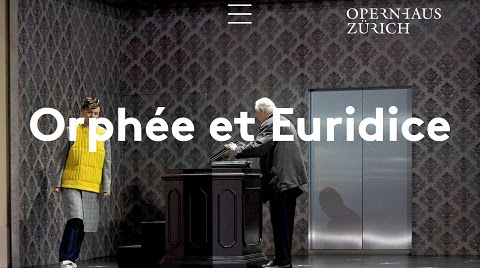
Christoph Marthaler puts several strange figures on the Zurich stage; a man like a caretaker or mortuary attendant (he has that mortuary pallor) shares a space in some indeterminate and likely otherworldly plane of existence with a number of other figures, one of whom - dressed in an ill-fitting bright woolen yellow tank top - we soon discover is Orpheus. The man, after scolding a loudspeaker that a young schoolgirl invisible to him has brought onto the stage for being mysterious, then paces though the rooms passing a funeral urn to shady figures who walk from room to room, into the lift and back again, each exchanging the urn and keeping it out of the reach of Orpheus. Meanwhile another figure makes jerky dance movements as if having a seizure.

What on earth (or heaven, or hell) this has to do with Gluck's opera is anyone's guess, but since the opening scene is Orpheus's lament for the death of Eurydice, we must presume (and it does fit in a way) that we are seeing an expression of the mind-state of Orpheus in a condition of deep bereavement, himself trapped in death's waiting room. I did say anyone's guess and that's mine. A beatific smile/stupid grin appears on the faces of these actors and dancers when one of the figures/abstractions turns out to be Amore/Love, offering Orpheus a way out of the prison of his disturbed state of mind. He has a few more horrors (interruptions, interventions and strange situations with eccentric characters) to face up to first.

I recall that Marthaler did something similar with his 2009 Bayreuth Tristan und Isolde, setting each of the acts on three levels of a descending room (or figures ascending?) as a way of putting them into an emotional space rather than a physical one. It's frankly a bit bonkers and you can hardly say that it's respectful of the work, but respect is overrated and works shouldn't be sacrosanct, not even Orphée et Eurydice. Whether it just throws random ideas out - lost arias, a recital of T.S. Elliott's 'The Hollow Men', pizzas all around - or whether it finds something new to express through the music and the meaning is up to the individual to interpret. Personally, I thought it entertainingly idiosyncratic and intriguingly unresolved, but far from the most spiritual or enlightening of productions.

Whatever you think about Marthaler's contribution, it's still Gluck's Orphée et Eurydice, which means it's still a work of exquisite beauty and delicacy. With its subject of grief, bereavement and the search for peace of mind and for the belief that love can win though times of social distancing and isolation, it's also a work that can have meaning at any time and make a personal connection, not least in these Covid-19 times. Marthaler of course doesn't directly reference the current pandemic, but there's no need to either: the very fact that this production of the opera is even able to take place at all is testament to the power of music and art to soothe and heal the soul in difficult times.

Zurich evidently have to make adjustments in order to put on a live opera performance in February 2021. There are some compromises that have to be made, the orchestra in a separate location, the chorus in another, with even the audience watching it distantly all around the world from a screen, so some disconnect is to be expected. Personally, I didn't find the music as beautiful, soothing and touching as it should be under Stefano Montanari, feeling somewhat disconnected from the stage performance. Whether that's down to the direction, the conducting or the difficulties of performance under current circumstances and blending the elements together is hard to determine, but like the recent Pelléas et Mélisande in Geneva, it feels like there is some vital element missing.

Although the recording and mixing of the live performance in an empty theatre makes it sound a little echoing, it's always a delight nonetheless to hear this work and see its themes explored and challenged. Although it seems like there are more people involved, there are indeed only three singers who carry the whole tormented character of the work and they do so well. Mezzo-soprano Nadezhda Karyazina is a rich lyrical Orpheus, but whether the unusual production played a part in it, I didn't get any sense of real feeling here. Chiara Skerath is not quite so strong vocally, but carried the haunted agnonised aspect of Eurydice better. Musically, I just didn't get the feeling from this that you ought to, and much as I enjoyed Marthaler's eccentric approach, the production didn't really work for me either.

Links: Opernhaus Zurich

Thursday, 12 May 2016

Mozart - Lucio Silla (Philharmonie Paris, 2016)

Wolfgang Amadeus Mozart - Lucio Silla

Philharmonie de Paris, 2016

Laurence Equilbey, Insula orchestra, Rita Cosentino, Franco Fagioli, Olga Pudova, Alessandro Liberatore, Chiara Skerath, Ilse Eerens

Culturebox - 23 April 2016

Written when he was 16 years old, Mozart's early opera Lucio Silla (1772) is never going to be regarded on the same terms as the composer's mature masterpieces, but like most of the Mozart's early works there are flashes of brilliance and a wonderful consistency to the work that can certainly be highlighted in a sympathetic stage production. You would expect however, that as an opera seria, Lucio Silla might need something a little more than the minimal semi-staged production of this rarely performed work at the Philharmonie de Paris, but the quality of the work and the performance is apparent nonetheless.

That's because even in this early work, Mozart's writing surpasses and overcomes the traditional static nature of the opera seria with its repetitive da capo arias and what can often be generic characterisation. There's movement and life in Mozart's energetic score alone, where even the recitative is beautifully orchestrated, flowing into elegant ariosos and inventive melodic arias. A minimal stage set isn't an issue then; in this case the opera is the music, the arias and the sentiments expressed, not the dramatic playing.


The period setting isn't adhered to, but it doesn't need to be either. Lucio Silla might be an old opera - nearly 250 years old - and its subject might be about a Roman dictator in 82 BC - but its sentiments are universal and not dependent upon its historical context. Those sentiments are the familiar ones of love, betrayal, rejection and reconciliation, but with Mozart they are not generic either. They key to making Lucio Silla work is in how successfully a production can manages to capture something of the mood of the piece and complement the young Mozart's delightful score.

That's not as obvious as it sounds, since the music sound largely conventional in its arrangements, even if it is graced by Mozart's characteristic gift for elegance and melody. Try and look in that music for any deeper insight into character or motivation however, and it's not obviously there, but it can be brought out in performance. The subject of an evil dictator would presuppose death and darkness as the dominant mood, and you can at least get a sense of that in the music. The desperation of lives and love in the balance too.

The basic sets for the production directed by Rita Cosentino capture that to some extent also. Largely, the set consists of little more than a couple of panels with some familiar Italian words written graffiti-like on them in chalk. SILLA is juxtaposed with MORTE and transformed into AMORE in Act I while the Roman dictator's position is made clear, silencing opposition (faces of old dead generals with mouths scores out in red on another side of the panels), his banishment of Cecilio a means by which he can set his sights on Giulia, who believes her beloved is dead.

Act II raises the stakes with dire threats of revenge and assassination and accordingly more Italian words are chalked onto the panels, words recognisable and familiar to anyone who has heard Verdi operas - SANGUE, COLLERA, VIOLENZA, FURORE. Act III relies more on visual harmony of colour and symmetry, with the key word at the conclusion being LIBERTÀ. It's these words that underline the sentiments of each of the Acts, and with Mozart's music and some good singing it's more than enough to get across not only the nature of the work, but Mozart's already distinctive take on the traditional opera seria material.


It's a tone that Laurence Equilbey and the Insula orchestra bring out particularly well. Using period instruments and specialising in informed playing of music of this period, the orchestra bring a rich, dynamic, almost percussive sound out of this work's score. There's a harsher, grittier sound there behind the elegant surface of the melodies and rhythms that captures the darker context of the work. It might not be music that is up to the standard of Mozart at his greatest, but it's unquestionably Mozart, full of vitality, perhaps even more so for being an early work of youth. The production and the musical performance can't really be faulted if it fails to find any great depth or originality in Lucio Silla, but they can and do find the essence of Mozart in it.

The singing plays a vital part in that and it does so here with some bright youthful singing. Franco Fagioli demonstrates the benefits of having a countertenor in the role of Cecilio; soaring and lyrical Fagioli has all the emotional qualities you could want for this role. Olga Pudova too has a wonderful Mozartian voice, bright and perfectly controlled with direct expressive ornamentation that can be heard in Giulia's Act II's 'Ah se il crudel periglio' aria. The singing is equally as good from Alessandro Liberatore as Silla, Chiara Skerath as Lucio Cinna, and Ilse Eerens as Celia. The chorus remain present at the back of the stage, vitalising the work's glorious outbursts of Mozart's choral singing. A chance to revisit an early Mozart is always welcome, particularly when it has well-informed and sympathetic playing that is as good as this and when it has a production and singing that does it justice.

Links: Culturebox, Philharmonie de Paris, Insula orchestra