Showing posts with label Orphée et Eurydice. Show all posts

Tuesday, 16 March 2021

Gluck - Orphée et Eurydice (Zurich, 2021)


Christoph Willibald Gluck - Orphée et Eurydice

Opera Zürich, 2021

Stefano Montanari, Christoph Marthaler, Nadezhda Karyazina, Chiara Skerath, Alice Duport-Percier, Sebastian Zuber, Graham F. Valentine, Bérengère Bodin, Marc Bodnar, Liliana Benini, Raphael Clamer, Bernhard Landau

Live Stream - 14th February 2021

There are some operas that seem to exist on another level, tapping into something indefinable and spiritual - Wagner's Tristan und Isolde or Parsifal, Stockhausen's Licht, Glass's Satyagraha, Mozart's Die Zauberflöte, Debussy's Pelléas et Mélisande - and many composers strive to reach that state through the power of music. Some of the best productions I have seen also strive to achieve that level of abstraction, not being held strictly to the exigencies of dramatic narrative, but finding a way in visual terms to tap into the same miraculous source that the music comes from.

One work that should certainly attain a level of transcendence beyond mortal matters is Gluck's Orfeo, or indeed in the French arrangement by Berlioz as Orphée et Eurydice. I presume that is also what director Christoph Marthaler is trying to do with his Zurich production, because it's hard otherwise to relate it to much that happens conventionally in any telling of the myth of Orpheus. Whether he actually achieves it is less certain, and indeed what he actually achieves is hard to define, but at the very least Marthaler attempts to bring an individual vision to a great opera.


There are essentially only three singers in Gluck's opera as well as a chorus, but it's more than enough to express everything that Gluck wanted to achieve in his stripped-back reformist version of opera. Really it couldn't be improved, although admittedly Berlioz's version, combining the best parts of Gluck's own Italian and French versions, is wonderful. What it doesn't need then is any additional figures or obscuring narrative imposed unless it can in some way support rather than distract from the beauty of the score and the intent of the original opera.

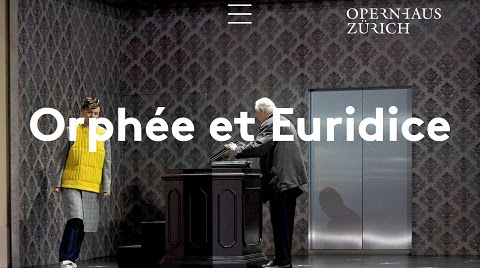
Christoph Marthaler puts several strange figures on the Zurich stage; a man like a caretaker or mortuary attendant (he has that mortuary pallor) shares a space in some indeterminate and likely otherworldly plane of existence with a number of other figures, one of whom - dressed in an ill-fitting bright woolen yellow tank top - we soon discover is Orpheus. The man, after scolding a loudspeaker that a young schoolgirl invisible to him has brought onto the stage for being mysterious, then paces though the rooms passing a funeral urn to shady figures who walk from room to room, into the lift and back again, each exchanging the urn and keeping it out of the reach of Orpheus. Meanwhile another figure makes jerky dance movements as if having a seizure.

What on earth (or heaven, or hell) this has to do with Gluck's opera is anyone's guess, but since the opening scene is Orpheus's lament for the death of Eurydice, we must presume (and it does fit in a way) that we are seeing an expression of the mind-state of Orpheus in a condition of deep bereavement, himself trapped in death's waiting room. I did say anyone's guess and that's mine. A beatific smile/stupid grin appears on the faces of these actors and dancers when one of the figures/abstractions turns out to be Amore/Love, offering Orpheus a way out of the prison of his disturbed state of mind. He has a few more horrors (interruptions, interventions and strange situations with eccentric characters) to face up to first.

I recall that Marthaler did something similar with his 2009 Bayreuth Tristan und Isolde, setting each of the acts on three levels of a descending room (or figures ascending?) as a way of putting them into an emotional space rather than a physical one. It's frankly a bit bonkers and you can hardly say that it's respectful of the work, but respect is overrated and works shouldn't be sacrosanct, not even Orphée et Eurydice. Whether it just throws random ideas out - lost arias, a recital of T.S. Elliott's 'The Hollow Men', pizzas all around - or whether it finds something new to express through the music and the meaning is up to the individual to interpret. Personally, I thought it entertainingly idiosyncratic and intriguingly unresolved, but far from the most spiritual or enlightening of productions.

Whatever you think about Marthaler's contribution, it's still Gluck's Orphée et Eurydice, which means it's still a work of exquisite beauty and delicacy. With its subject of grief, bereavement and the search for peace of mind and for the belief that love can win though times of social distancing and isolation, it's also a work that can have meaning at any time and make a personal connection, not least in these Covid-19 times. Marthaler of course doesn't directly reference the current pandemic, but there's no need to either: the very fact that this production of the opera is even able to take place at all is testament to the power of music and art to soothe and heal the soul in difficult times.

Zurich evidently have to make adjustments in order to put on a live opera performance in February 2021. There are some compromises that have to be made, the orchestra in a separate location, the chorus in another, with even the audience watching it distantly all around the world from a screen, so some disconnect is to be expected. Personally, I didn't find the music as beautiful, soothing and touching as it should be under Stefano Montanari, feeling somewhat disconnected from the stage performance. Whether that's down to the direction, the conducting or the difficulties of performance under current circumstances and blending the elements together is hard to determine, but like the recent Pelléas et Mélisande in Geneva, it feels like there is some vital element missing.

Although the recording and mixing of the live performance in an empty theatre makes it sound a little echoing, it's always a delight nonetheless to hear this work and see its themes explored and challenged. Although it seems like there are more people involved, there are indeed only three singers who carry the whole tormented character of the work and they do so well. Mezzo-soprano Nadezhda Karyazina is a rich lyrical Orpheus, but whether the unusual production played a part in it, I didn't get any sense of real feeling here. Chiara Skerath is not quite so strong vocally, but carried the haunted agnonised aspect of Eurydice better. Musically, I just didn't get the feeling from this that you ought to, and much as I enjoyed Marthaler's eccentric approach, the production didn't really work for me either.

Links: Opernhaus Zurich

Wednesday, 28 November 2018

Gluck - Orphée et Eurydice (Paris, 2018)


Christoph Willibald Gluck - Orphée et Eurydice

Opéra Comique, Paris - 2018

Raphaël Pichon, Aurélien Bory, Marianne Crebassa, Hélène Gilmette, Lea Desandre

ARTE Concert - October 2018

Gluck's original Italian version of Orfeo ed Euridice may already be considered as close to perfection as an opera can get, but you can't really argue that Hector Berlioz's version of the work doesn't respect and have equal value to the original. Well, you could argue the point that it doesn't entirely respect the reformist instrumental minimalism and that it includes a little ornamentation and extensions to suit the taste of a 19th century French audience, but by and large Orphée et Eurydice retains the essential quality of the music being entirely in service to the drama.

You know that because every scene and every note in Gluck's opera is necessary, heartfelt and powerful in conveying the meaning of the work, and the subjects it deals with are the deepest and most heartfelt of human emotions - love, loss, grief and redemption. Although in the latter case, even Gluck might have compromised the qualities of truth for the sake of narrative requirements and audience expectations, even if it remains a work of supreme beauty. Working with Berlioz's 1859 version, Raphaël Pichon attempts his own slight corrective to the 'happy' ending for the Opéra Comique's production, but the purity of Gluck's intentions remain even in their absence.


Directed by Aurélien Bory, the Paris production adheres to those basic principles in Gluck's musical composition and in how best to express the sentiments that lie behind the work in terms of the stage production that achieves maximum impact from minimal means. Berlioz's extended overture permits a way of showing Orpheus's loss of Eurydice, a simple large mirror over the stage giving an overview of the horror of her death. Eurydice falls to the ground, a hole opens up in the stage, a grave, and Eurydice is sucked down into it, the whole backdrop of Orpheus's world dragged down along with her.

The mirror also works effective for the appearance of Amore to inhabit the real world and also be representative of the metaphorical meaning of her presence. Borne aloft by dancing figures dressed in black, she appears in the mirror to float above the stage, achieving maximum impact with minimal means. Another effective use of stage craft is used to represent the Furies as dancers who are appeased by Orpheus, marking his descent into the underworld.

There's nothing old-fashioned in the costume designs, but nothing obtrusively modern about them either, the work inhabiting the same timeless place as the sentiments it is principally concerned with. With his smart suit and clicked back white hair, Orpheus looks less like a businessman and more like a music impresario, and it's in the voice, the musical qualities of that voice, that Orpheus embodies and expresses those qualities that represent humanity in its purest state, vulnerable and yet capable of striving to overcome adversity.


Musically at least, Raphaël Pichon brings out the beauty of this in Gluck's score, even if Berlioz's instrumentation doesn't quite pack the same edge and directness as it would on Gluck's period instruments. A contralto or mezzo-soprano however can bring great range to Orpheus in the Berlioz edition and Marianne Crebassa has tenderness and depth of expression in Orpheus's song of grief. There's a similar purity of expression that is appropriate for Eurydice and Amore in the singing of Hélène Gilmette and Lea Desandre, the overall impact that this gives to the work just breathtaking.

I'm less convinced that you can get away with correcting the limitations imposed on Gluck to provide a happy ending by simply cutting Amore's gift of returning Eurydice to life. I think that this is something that can be redeemed creatively to some extent in the stage directions, as Romeo Castellucci inventively managed in his production of Orphée et Eurydice for La Monnaie, but ending it prematurely by cutting the final scenes just leaves the opera feeling incomplete. Still, the acceptance of loss and bearing grief is perhaps closer to the truth for everyone, and Gluck certainly provides the necessary sombre reflection in that music that still makes for a thoughtful conclusion in this Opéra Comique production.

Links: Opéra Comique, ARTE Concert

Tuesday, 22 July 2014

Gluck - Orphée et Eurydice (La Monnaie-De Munt, 2014 - Webcast)


Christoph Willibald Gluck - Orphée et Eurydice

La Monnaie-De Munt, 2014

Hervé Niquet, Romeo Castellucci, Stéphanie d'Oustrac, Sabine Devieilhe, Fanny Dupont

La Monnaie, Internet Streaming - June 2014

Orphée et Eurydice has the distinction not only of being one of the purest and most pared-back expressions of Gluck's reformist agenda, reducing extravagant ornamentation and bringing opera back to its strength as a dramatic artform, but it's exquisitely beautiful in its simplicity.  The intent of the work is carried principally through the expression of one singer and the music itself. And, even though it has an ancient mythological subject, Orphée et Eurydice is not some lofty expression of sentiments detached from everyday life, but it has something real and meaningful to communicate to its audience. To its credit, I've never seen a performance of the work - in any of its many forms - that was anything but deeply heartfelt and humanistic in its outlook, but Romeo Castellucci's extraordinary 2014 production for La Monnaie touches deeply on the themes in the work in a way that takes it to an entirely new level.

Dealing with gods, demigods and supernatural events, it's easy to forget that there is a real human element to grand mythological subjects. They are only myths because they speak for all of our suffering, our struggles to exist, live, find love and happiness. Using the story of Orpheus, who in his overwhelming grief for the death of his wife Eurydice travels to the Underworld to retrieve her, Gluck recognises that the Orpheus myth is all about love, loss and bereavement. Despite the beauty of the sentiment and the sincerity of his intentions, it of course proves impossible for Orpheus to bring his loved one back to life (notwithstanding the reworked happy ending in the opera version). Those sentiments can work perfectly well in the concise and expressive beauty of Gluck's score alone, but the dramatic expression on the stage is also a vital part of opera, and Castellucci finds an innovative way to reconnect the myth with the reality.


Like mythology, opera too must not be lofty and detached, but should be relatable on a human level. Having carried out extensive research into 'locked-in syndrome' Castellucci literally takes the opera beyond the stage of La Monnaie and out into the world, the production being broadcast live directly to a medical ward 14km outside Brussels where a young Belgian woman called Els lies in bed, completely paralysed. She's effectively dead to the world, beyond the reach of her husband and loved-ones, unable to move or communicate other than through the blinking of her eyes that allow her to painstakingly form words and sentences one letter at a time. At the same time as the music of Orpheus reaches out to her in her condition, Gluck's music reaches out to express Els/Eurydice's condition to the audience and give us some indication of how her family must feel about their loss.

How this is achieved in the production is, like Gluck's music, outwardly simple, but in reality very precise and sophisticated technical measures are used to present art as an expression of deeper truths. For almost the entirety of the performance, Stéphanie d'Oustrac sings the role of Orpheus on a dark bare stage with only a pseudo-microphone in front of her. To the right of the stage is what looks like a life-support system, although it has lights showing music volume-control levels, so it could represent a transmitter of sorts. While Orpheus sings of his loss, the captions on the screen behind the singer show English captions that have nothing to do with the libretto, but rather tell the story of Els, a 28 year-old woman who has been in a pseudocoma for the last 18 months, suffering complete paralysis but retaining full cognitive abilities after brainstem damage caused by a thrombosis. The audience are advised that the opera is being broadcast live to her at this moment.


There's evidently no direct correlation between the story of Els and the Orpheus myth, but the broad sense of losing a person, of them being present but beyond reach and unable to interact with the world outside is identical to how Orpheus, despite every effort to reach Eurydice, is unable to bring her back to life. The descent to the Underworld is in some respect mirrored in the blurred black-and-white footage on the screen that shows a journey towards the medical centre where this real-life Eurydice lies, arriving there as Orpheus finds Eurydice among the spirits of Elysium ("Cet asile aimable et tranquille"). As the on-stage Eurydice (Sabine Devieilhe) appears behind the mesh screen, we meet Els, lying in her bed, blinking but unmoving, a pair of headphones relaying the song of Orpheus direct from the opera house of La Monnaie.

Castellucci's direction is simple but daring and completely in touch with what the work is all about - human grief, battling against outrageous fortune - and relating it back to ordinary people who suffer terribly from everyday trials. Although there's nothing abstract about Gluck's music, it takes the drama away from mere theatricality to show how it fully explores and expresses these vital aspects of the human condition. Castellucci even takes into consideration the happy ending that Gluck was obliged to provide for the stage, showing an Eurydice revived and alive, but - reflecting Els' condition - remaining behind a veil, unable to fully return to the world. This works for the audience and for the intent of Gluck's music drama, making the story vividly real and deeply moving, but Castellucci's production goes beyond even this, telling us something about the power of music and opera to touch on aspects of our lives that other arts cannot reach.

One person who recognised the power of the work and who was instrumental in keeping this Baroque work alive through the 19th century and beyond, was Hector Berlioz. The French version is understandably more popular in French-speaking countries than Gluck's original Italian version, and if Berlioz's 1859 version is not the most "authentic" edition (Gluck wrote a "definitive" French version himself as well as the original Italian and even a German-language version), it at least brings together the best elements of Gluck's variations while retaining the purity of its expression. I have a particular fondness for the Berlioz version myself and this is a superb performance of the work conducted at La Monnaie by Hervé Niquet. It's played slightly faster than usual, the overture in particular a little rushed when it should be a more brooding, but the tone and expression of the work is all there.


It's also there in the singing, which is just as vital in a work with only three individual roles. The singing here is just outstanding, Stéphanie d'Oustrac one of the best mezzo-soprano singers I've heard singing Orpheus, and you could hardly expect to find a brighter or more colourful voice for Eurydice than Sabine Devieilhe, who continues to impress. Also worth mentioning are Fanny Dupont's sensitive and delicate Amour and the powerful work of the Chorus that also serves to establish that otherworldly character of Orphée et Eurydice. It's no coincidence that the Orpheus myth was frequently chosen as the subject for the very first works of opera almost 400 years ago, exploring as it does the power of music to take us to those kind of unreachable places. That myth found its purest expression in Gluck's opera, and Romeo Castellucci's remarkable production of it is one of the finest expressions of opera as both art and life.

Links: La Monnaie - De Munt, RTBF Musiq3