Showing posts with label Peter Whelan. Show all posts

Saturday, 11 May 2024

Vivaldi - L'Olimpiade (Dún Laoghaire, 2024)


Antonio Vivaldi - L'Olimpiade

Irish National Opera, 2024

Peter Whelan, Daisy Evans, Gemma Ní Bhriain, Meili Li, Alexandra Urquiola, Sarah Richmond, Chuma Sijeqa, Rachel Redmond, Seán Boylan 

Pavilion Theatre, Dún Laoghaire - 7 May 2024

The last time I saw Vivaldi's setting of L'Olimpiade was in 2012 at Buxton during the summer of the London Olympics, and here we are now 12 years later with the Paris Olympics just around the corner. If there isn't one already, there really ought to be some kind of rule about performing this work every four years, or even one of the many other versions of the work (Pergolesi's version is one of the best). At least then you might have half a chance of getting your head around the complications of Metastasio’s libretto.

It's not as if you really need to follow all the twists and turns or accept all the coincidences that take place in L'Olimpiade, nor does the opera really even feature sporting events but maybe because we are in an election year (in Ireland and likely in the UK as well), it struck me that the olympiade of the opera is more about the idea of a competition to choose a winner, and our hope that that this outcome - as unpredictable as the results might be - will resolve all our troubles. This is something that the director Daisy Evans acknowledges as a factor in the choices made in this staging the work for the Irish National Opera, that it's more about renewal, rebirth and the chance of new beginnings. It shouldn't be too much of a stretch to compare the misery of lives thrown into turmoil in this opera with the reality for many people in the current cost of living crisis.

Not that this needs to be explicitly pointed out. In fact, the idea of renewal can even be felt from the very fact that a 300 year old opera that can still speak to a modern audience, that its themes and treatment can be renewed with the passing of time to reflect and connect with our own concerns about the world around us. That idea of renewal is also something that the director chooses to feed into the production, and indeed it's probably a necessity for a Baroque opera. This is something that the Irish National Opera have recognised from early on and successfully continued to apply to their progamming of such ancient works. With its references to ancient Greek drama then, the choice is made to play out L'Olimpiade on a small ampitheatre set, the Baroque period of composition acknowledged in the form of the stylised costumes, but all of it brought up to date with modern trainers and neon lighting. 

It's essential to acknowledge the Baroque character of the work in this way; not parody it, but find a way to make it relatable to a modern audience. That is never easy for a work with passages of recitative exposition and arias of various types of woe and lament, with a complicated backstory and some laughable coincidences, but Evans keeps it simple, including amusing little pantomime acted interlude scenes (with additional Vivaldi music) to help the audience understand the strange twists of a plot that you never seem to be able to get your head around, not matter how many times you read the synopsis in the programme. This succeeds wonderfully, keeping it engaging and relatively easy to follow, even if it demands a certain amount of willing credulity.

In terms of plot, well it would serve no purpose to try to unravel it here, but it's the typical Metastasio plot of star-crossed lovers separated by the whims of fate and the thoughtless self-interested actions of ruler and kings. Licida hopes to use the upcoming Olympic games to win the hand of the woman he loves, Aristea (her hand offered as a prize by the King Clistene), by getting his athletic friend Megacle to win the games for him, both of them unaware that in so doing Megacle will be giving to Licida the woman he loves and who loves him, but unable to marry because the King hates Athenians. Oh, the misery and soul searching this is going to cause. And that's not even the half of it! The complications of the opera’s plot - as improbable as they seem - do nonetheless reflect the reality of challenges we all face, even as we do our best to aim towards a favourable outcome. How can we trust our hearts and chose to believe in when there is much deceit, when people turn out not to be who they say they are, when fate throws misfortune our way? L’Olimpiade suggests that things work out for the best in the end, which might not be realistic but hope is important too.

There are a number of factors that help make this work, which you can simply and accurately summarise as just being the magic of opera. Making the plot understandable is the most obvious challenge and as noted above, the director does everything possible to ensure it works. Vivaldi however is evidently also an important factor, his music not only being characteristically invigorating and entertaining, but perfectly attuned to their emotional states, giving each of them a sympathetic hearing and with a distinct character rather than the usual generic interchangeable expressions of woe. In terms of making that work in live performance, the authenticity of the sound in the use and marvellous playing of period instruments by the Irish Baroque Orchestra, conducted with superb pacing and dynamism from the harpsichord by music director Peter Whelan, give the opera the necessary kick and drive to take you along with it.

Most importantly perhaps, vital at least in this opera for making the dramatic developments feel true, is the singing. The casting for the range of characters and voices is superb, and - like Mozart's operas - it helps that these are all fresh young fresh singers. Without in any way wishing to underplay the challenges involved in singing these roles, Vivaldi doesn't provide the usual show-offy arias, but writes for the voice in a way that brings out the underlying sentiments hidden behind the typical Metastasian nautical and meteorological metaphors (weathering the stormy seas of fate). It's more important to imbue the characters with personalities and not just ciphers with the generic feelings that are described in the libretto. That's by design of course, not chance, and it's undoubtedly the reason why this same libretto has been employed so often, first by Antonio Caldara before Vivaldi, and after that over 100 settings by Pergolesi, Scarlatti and Piccini among others in the 18th century, with even Donizetti and Beethoven having a go at it in the 19th century.

Simplicity then is the key to the presentation, trusting in the original and not over-complicating it by imposing a modern concept upon it. It will resonate with the listener itself if it is done right and that is exactly what the creative team and the singers do here. The main players are Megacle, sung by here by a mezzo-soprano Gemma Ní Bhriain and Aristea, sung by another mezzo-soprano Alexandra Urquiola. Their central importance and the quality of their performance is revealed in a beautiful Act 1 duet that combines the ecstasy of their reunion with the tragedy of what they know lies ahead for them, Megacle left with no choice but to give it up his love for the sake of his friend Licida who once saved his life. Both Ní Bhriain and Urquiola demonstrate how critical it is to bring a human element to the work, and so too do the rest of cast, each of whom get the opportunity to put their side across in arias and ariosos, each similarly inviting compassion and understanding. Licida and Aristene, the other key figures with a troubled history (to say the least), are well performed here by Meili Li and Sarah Richmond.

With this kind of treatment, attention to character, music and the efforts to make something of the plot, everything comes together and when you are able to do that with a work like this, it can be breathtaking. We know to expect this now from the INO, with this now being the third Vivaldi opera undertaken by Whelan and the Irish Baroque opera, which no doubt accounts for a 300 year old opera selling out three nights at the Pavilion theatre in Dún Laoghaire. It's also gratifying to see that it is touring more widely with no less than eight upcoming performances at the Royal Opera House's Linbury Theatre in London all already sold out as well. Audiences can still enjoy the work's spirit of renewal and continue to something new from L'Olimpiade 300 years later. Whether they get something new and hopeful in renewal of government is another matter.


Links: Irish National Opera

Production photos: Ros Kananagh

Sunday, 28 May 2023

Mozart - Così fan tutte (Dublin, 2023)


Wolfgang Amadeus Mozart - Così fan tutte

Irish National Opera, 2023

Peter Whelan, Polly Graham, Anna Devin, Sharon Carty, Benjamin Russell, Dean Power, Majella Cullagh, John Molloy 

The Gaiety Theatre, Dublin - 27th May 2023

For a long time sceptical about whether Lorenzo Da Ponte's libretto of farce and misogyny had withstood the test of time and changing attitudes, I've certainly been won around to the true qualities of the work in modern productions that have actually revealed Così fan tutte to be far more layered and meaningful than you would think. I still don't envy any director having to choose how best to bring those qualities out, whether to play it as a straight comedy or whether to mine the deeper attitudes expressed for contemporary relevance. The Irish National Opera production, a touring production directed by Polly Graham, tries to pitch it somewhere in between and doesn't really succeed in doing full justice to either side of the work.

Where it does bring a distinctive touch is in the Irish historical setting. Opera should be tailored to and relatable to its audience, not presented as some stuffy period costume drama museum piece, but that doesn't necessarily mean that it has to be updated and made contemporary. Opera can still speak of contemporary issues if it can be related to a significant period, and such a period in Ireland (and elsewhere in the world) can be found in the early twentieth century. The nature and status of women is a theme worth exploring in Così fan tutte and Ireland has been slow to deal with women's rights which were the subject of interest with the rise of the suffragettes around this time, and that is certainly highlighted here.

War and revolution too since it's revealed that the year is 1914, but that's a little more problematic to add into the farce of this opera, with Guglielmo and Ferrando pretending to head off to fight in the trenches as part of an Irish battalion. It fits well enough though for the purposes of the production, and when the two return disguised as filmmakers with berets and moustaches, making a silent movie about Fionn mac Cumhaill and the Fianna, it's a little more meaningful and acceptable than making fun of oriental costumes, customs and appearances. That's fine as far as it goes, but in terms of direction it feels a little forced, flat, haphazard and inconsistent in its approach, gaining neither sufficient laughs nor significance in exploring the nature of women and men or indeed providing a lesson in the vagaries of love.

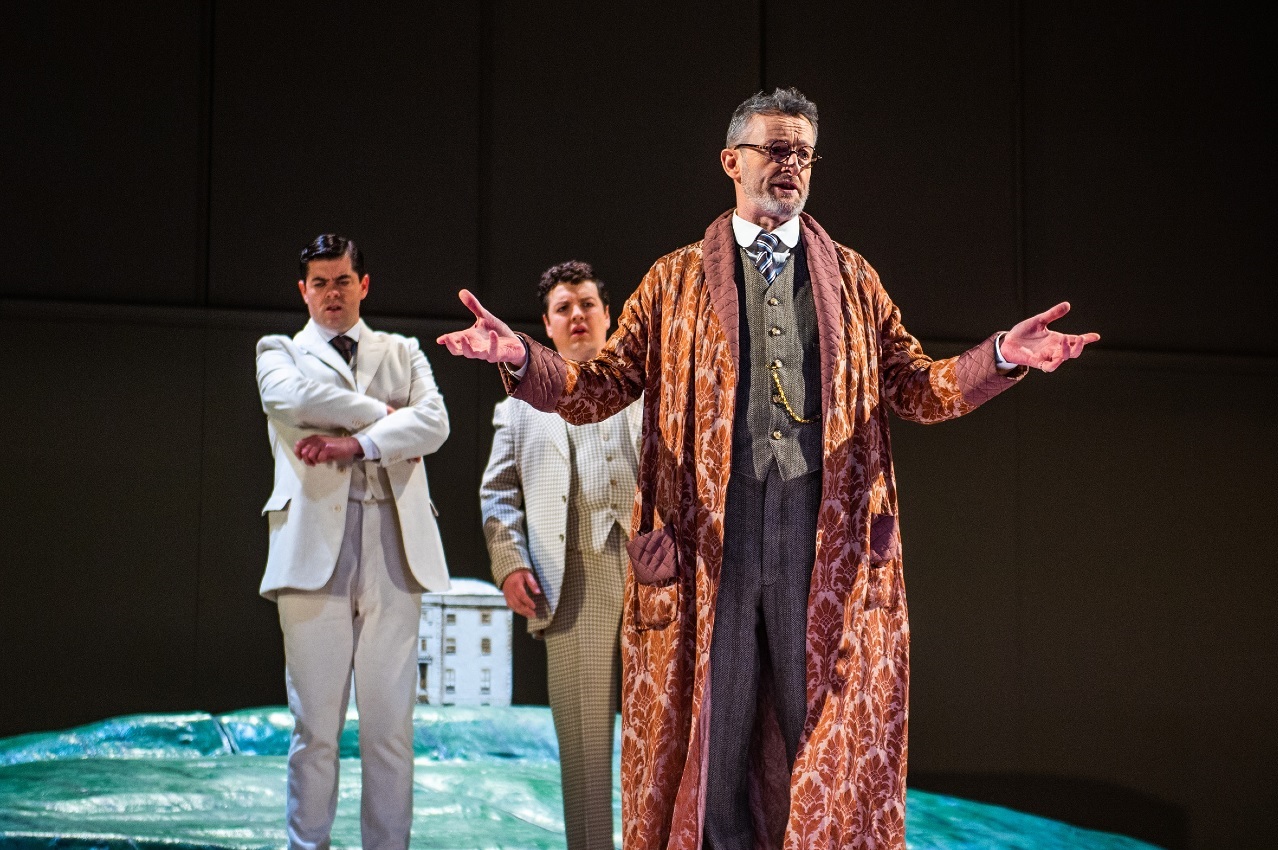
The resultant production design then was also something of a mixed bag. Sure, it has necessarily has to be basic in terms of set designs and effects, designer Jamie Vartan using projections to open it out a little and establish the period with newspaper articles and a sketched big house on the hill. I never quit grasped what the stately manor was about, other than perhaps how chorus of Irish women were treated as servants and second class citizens by the landed gentry. It wasn't a particularly impressive or eye-catching set, a huge hard plastic looking green blob representing a hill with a tiny 'big house' on top that was picked up and carried around by the cast for no discernable reason. Nor could I figure out the nature of Don Alfonso in this setting, walking around in a long house coat in a somewhat professorial manner with Ferrando and Guglielmo his students. None of it quite hit the mark.

To be fair, as ambitious as the Irish National Opera can be, even with reinterpretations of the standards of the opera repertoire, playing to the darker side of Così fan tutte is perhaps not really what they want to do with an opera buffa, particularly for a touring production. Leave that to the likes of Michael Haneke (Madrid, 2013) and Christophe Honoré (Aix-en-Provence, 2016). What they really want to get across is the wonder and beauty of Mozart, and there is no denying what we have here is a light and enjoyable production that certainly entertained the audience at the Gaiety in Dublin. Even though the Votes for Women scenes felt a bit forced in places, like a well meaning corrective for any misinterpretation of misogyny in the comedy. I have to admit, I enjoyed it more after the interval when I accepted the simple pleasure of seeing an amazing Mozart opera performed well, and was able to put aside any expectations of it having something significant to say.

There was certainly plenty to enjoy in the delivery of the singing performances. Anna Devin and Sharon Carty were everything you could hope for as Fiordiligi and Dorabella, their delivery bright and sparkling, filled with emotional sentiments, even if their predicament wasn't fully brought out in the direction of the acting. The same can be said for Dean Power's Ferrando and Benjamin Russell's Guglielmo. Neither were convincing in their disguises, but the emotional impact of the revelations they have about their girlfriends were wholly felt in their singing, which was powerful and true. The ever reliable John Molloy similarly made a great impression, even if his role as a manipulator was undervalued in the direction. On the other hand, Majella Cullagh delivered a fine comic performance in Despina's various guises and was the prime motivator in bringing the two sisters into the new sisterhood, but was slightly underpowered in her singing. It just shows how difficult all the singing roles are in Mozart - there are no secondary or minor roles here.

All credit to the principal roles then (and great idea of the INO to display the cast names in the surtitles as they took their bows at the curtain call), but you can't have any weaknesses at all in a meticulously constructed opera like this. The chorus played their part and the orchestra delivered the musical delights under the direction of Peter Whelan. The niggling inconsistencies in the setting and purpose were easily put aside then, as was any attempt to seek something deeper in Polly Graham's direction of the INO's Così fan tutte. The 'they're all the same' message here was simply that we all deserve to be loved and treated equally, and that was as truthful a reflection of the opera's intent as any.

Links: Irish National Opera

Sunday, 30 January 2022

Vivaldi - Bajazet (Dún Laoghaire, 2022)


Antonio Vivaldi - Bajazet

Irish National Opera, 2022

Peter Whelan, Adele Thomas, James Laing, Gianluca Margheri, Niamh O’Sullivan, Eric Jurenas, Claire Booth, Aoife Miskelly

The Pavilion Theatre, Dún Laoghaire - 29 January 2022

The fact that Vivaldi's 1735 opera Bajazet has made it through to us intact through the centuries feels like something of a miracle. That's obviously partly through chance but it's also partly through design. It's by chance that this opera has survived where many, including many by Vivaldi, have not, but it's also by the fact that Vivaldi created Bajazet as a kind of greatest hits, a pasticcio where he would create recitatives to string together famous arias by other composers and add a few of its own - so yes it's bound to be good. What is also great by design as far as claiming it to be something miraculous is that it communicates its brilliance through to today, and that is by design of the director, cast and orchestra of this Irish National Opera production.

Reading the synopsis beforehand for a refresher, even knowing how the plot of baroque operas usually play out and even having seen several productions of Handel's Tamerlano, I despaired of getting my head around the characters and the typically complicated struggle for power and love between each of them. Maybe it was just the long journey down to Dún Laoghaire. Surely there must be a simpler way of getting the plot and characterisation across? Well of course there is, and after abandoning taking in more than the events of Act I, I trusted that it would all become clear in the delivery in the performance. Making the complicated simple is no easy matter of course and it's down to how good the director and the cast are, and well, this was just thrillingly put across.

Baroque opera can be dry, with not much in the way of dramatic action. There are passages of recitative and a lot of arias with flowery metaphors that have little lyrical relation to the drama. Even more so in a pasticcio, where the arias have been lifted almost wholesale from other works and dropped into a new, usually generic, plot. That is true to some extent with Bajazet, including one aria where Idaspe sings of a boat in a storm at sea, despite their being no naval scene in the opera, although evidently you can take that as a metaphor for emotional turmoil. Writing his own linking recitative for Bajazet however, Vivaldi clearly manages to tie things together very well into a tense dramatic situation.

That however is still only as tense and dramatic as it is allowed to be. The underlying sentiments, rather than being just generic expressions of love, anger, revenge and despair need to be wholly and convincingly played without operatic or period mannerisms. Here Adele Thomas has clearly worked hard to ensure that the performances are robust and related realistically to the situation, with the added bonus that every singer here manages to bring individual life and personality to the characters. It's rare that you see the drama of a baroque opera enacted as if it really mattered.

Molly O'Cathain's impressive gold box set design is also robust and it needs to be because Bajazet and Tamerlano fairly bounce off the walls in aggression and there is much slamming and bursting open of side doors. No walk-on-walk-off scenes here. The other performers wisely give the two principal figures a wide berth and when they aren't able to get out of the way, they get caught up in some rough and tumble that is more than just boisterous. There is anger and violence here that is commensurate with the nature of the figures involved and the implications of the historical drama. It's a tense situation, life or death, and you can feel it. We know what Tamerlano's fate will be, but we can't be sure in this production that his will be the only death.

That's another element of danger and unpredictability that Adele Thomas has introduced into the already tense drama. Anyone familiar with Tamerlano or many similarly themed baroque operas like this can usually expect the insensitive, misguided, proud and cruel ruler to eventually come to his senses and resolve matters, at least as far as affairs of the heart are concerned. Not so here, which is fitting as this Tamerlano is particularly cruel and irredeemable. So, while Bajazet nobly sacrifices himself to be spared the humiliation of his daughter Asteria as is traditional, the lame Tamerlano also meets a just fate through a means that has been hinted at throughout but which also feels in keeping with the amount of pent up anger that has built up.

Where do you start with a cast like this who all have significant roles to play? Probably with the two roles that have the most impact in terms of drama and singing. Stalking the stage with menace James Laing made this Tamerlano really a figure to be feared, his countertenor only adding a sinister quality. He's the only person you could imagine capable of subduing this Bajazet and even then he must have employed some dirty tricks to do it, as Gianluca Margheri's muscular bass-baritone Bajazet was only matched by his physique, straining at the bonds like a rabid dog. He practically shook the walls with every fiery utterance. 

We didn't get to hear Claire Booth's Irene until the close of the first Act, but she more than made up for the late appearance with high-flown coloratura expressing her fury - and like Bajazet you could feel that very real fury of a woman scorned and hurt. Niamh O'Sullivan's Asteria was also an impressive ball of coiled anger, spitting imprecations against her faithless lover Andronico as much as against her captor Tamerlano. The conflicted and inconstant Andronico was brilliantly characterised and sung by countertenor Eric Jurenas, skulking and diving from the formidable forces, no match for any of the forces on the stage around him. Aoife Miskelly's Idaspe also had a vital role to play here dramatically and in the delivery of challenging arias. Vital also is the role of the ensemble of voices, the six creating a stunning array of complementary and contrasting timbres and voices. All close together on the stage too, playing off on another, even when they weren't singing, all adding to the hothouse atmosphere.

I had forgotten how powerful it can be to hear live baroque opera played on period instruments. I can't blame Covid entirely for this, although it certainly delayed this production to the extent that it was almost cancelled entirely and was only allowed to play to a full house this week with the lifting of most restrictions in Ireland, but it's just rare enough to get the opportunity to hear rare works like this close up. In fact my last time might indeed have been at the Pavilion in Dún Laoghaire in 2019 when Peter Whelan led the Irish Baroque Orchestra through Gluck's Orfeo ed Euridice. Once again, they provided a thrilling and revelatory experience, Vivaldi's music (and that of others) just pinging around the hall with crystal clear precision and put to good dramatic use.

This is Irish National Opera doing what it does best, taking on a challenging and wide ranging repertoire. Whether working with familiar standards, new contemporary opera or reviving rare baroque repertoire, they are equally good at bringing opera to life. That's a team effort and when that combines in actual live performance that is ultimately what makes something like Bajazet miraculous, magic or whatever you want to call it. Just 'opera' says it all, I suppose. It's about finding a way to make notes on a page written centuries ago come back to life and this Bajazet makes it into the 21st century alive and kicking.

Monday, 20 May 2019

Mozart - The Magic Flute (Wexford, 2019)


Wolfgang Amadeus Mozart - Die Zauberflöte

Irish National Opera, 2019

Peter Whelan, Caroline Staunton, Anna Devin, Nick Pritchard, Gavan Ring, Kim Sheenan, Lukas Jakobski, Rachel Croash, Sarah Richmond, Raphaela Mangan, Andrew Gavin, Amy Ní Fhearraigh, Padraic Rowan, Nicholas O'Neill, Seán Hughes, Oran Murphy, Fearghal Curtis, Robert McAllister, Matthew Mannion, Peter O' Reilly

National Opera House, Wexford - 17th May 2019


You're taking a big risk if you attempt to remove the magic fairy-tale elements from The Magic Flute and downplay its Masonic underpinnings, but then Irish National Opera have been bold in their interpretation of other popular works this season (Aida, Madama Butterfly), often with impressive results. I'm not sure that their Die Zauberflöte works entirely without all the usual crowd-pleasing set pieces, and I'm not sure you can set out to make the opera work with any basis in the real world, but on the whole it's a worthwhile effort, certainly from the standpoint of the musical and singing performances.

It's certainly worth giving it a go though since, as director Caroline Staunton observes in her programme notes, Mozart's work is almost miraculous in how its compositional ideas and execution far surpasses its origins as "a dramaturgically chaotic narrative intended for a bawdy beer-hall in late 18th century Vienna". The Magic Flute has a lot more to offer than just a romp through its comedy routines and an often pompous approach to its ceremonial elements.


Inevitably, trying to tie that "dramaturgically chaotic narrative" into something real-world, meaningful and coherent is problematic, but even if it doesn't always hold together in the case of INO production, it does throw up a few good ideas and insights. Bringing an Irish element into the work in a late 19th century context means that
Caroline Staunton (who has worked with Dmitri Tcherniakov and Claus Guth at the Berlin State Opera) can replace some of the fairy-tale elements with Irish folklore, but it's not simply a matter of introducing another type of fantasy, and is a little more ambitious than that.

The division is not so much the traditional one of obscurantism versus enlightenment, as much as the ordinary Irish people in opposition to the colonisation of their land by English landlords. In that context, the Queen of the Night can certainly be very much seen in terms of a banshee, her Three Ladies spreading tales of her power and danger. What is obvious to the viewer however is that these are not mythological creatures, but common people in disguise, forging stories and legend to strike fear into ordinary labourers like Papageno as to what will happen to them should they step out of line.

But it's not just to control the likes of Papageno, or indeed create a fantasy in order to get Tamino to serve their purposes. It's also to create a force of resistance against Sarastro, who likewise is not entirely what he seems to be, and certainly not the great font of wisdom that he pretends. Surrounding himself with followers and books, setting up a system that works for his own purposes, in reality all he is doing is imposing another form of outside order on the people of the land, his abduction of Pamina akin to the seizing of their inheritance.


So where do Tamino and Pamina fit into this arrangement? Well, Sarastro sees the trials as a way of conditioning both Tamino and Pamina to his way of thinking. His desire for their marriage is a way of imposing a patriarchal authority through a formal arrangement, through marriage, the wife respecting and honouring the man's position at the head of it. Pamina, in this production, isn't having any of that.

If you're used to seeing the Magic Flute in its traditional way of playing out, this revision obviously confuses how you might think you ought to feel about the work. Mozart and Schikaneder's late 18th century viewpoint was of its time and perhaps some of its views and attitudes can feel a little dated today. Perhaps Die Zauberflöte isn't meant to be taken that seriously and trying to impose a modern-day perspective on it risks distorting the true meaning of the work, but there is indeed a message of enlightenment in the work and it deserves to be given serious attention.

Rather than distort the work's thoughts on enlightened thinking overcoming myths and superstition, on male and female finding accommodation and acceptance of the roles each has to play, it's worth taking a more critical look at the values as they have been perpetuated down through the years. If this was true of the late 18th century, or the late 19th century in this production, we ought to be much further down the path to peace, love and enlightenment than we are as a society, and it's worth considering why we haven't progressed much further to achieve that balance that Mozart clearly believed in and wanted to see established.


What makes such an idea work in the INO production, despite the contradictions that it might sometimes run into, is the central performances and again the perspective on that is not the traditional one. Tamino and Pamina can appear to be rather bland figures in other productions, lacking the colour and wonder of Königin der Nacht and Sarastro (and indeed even Papageno and Papagena), but not here. It's Tamino and Pamina who have the strength to call the shots, to change direction, to find a path that doesn't peddle myths. They are rightly the true heart of the work in this production.

And if that works it's on account of two terrific performances in the Wexford opening night of this production from Nick Pritchard and Anna Devin as Tamino and Pamina. Lyrical and authoritative, they breathe personality into these characters, showing them as they ought to truly be; beacons for a new way, rejecting the ways of the past, steadfast in love above everything else. No guru, no method, no teacher, as another famous Irishman once put it, which fits with the Irish theme of the production and the references that Staunton draws with J.M. Synge and Brian Friel.

So what traditional delights do we miss by going down this route? Well, there's no giant serpent at the start, there are no birds caught by Papageno, Königin's entrance is underwhelming, there's no aged-crone version of Papagena. That means that we miss out on a lot of the glamour and comedy which is unfortunate, but how much does that really add to the work anyway? We lose the Queen of the Night's aura of mystery and majesty, we lose Sarastro's grave presence and the solemnity of the rituals of initiation, but again, it removes distraction and obscurity and allows for a more useful and meaningful employment of Mozart's music and ideas.


What we aren't short of is an impressive set design that matches the tone of the music to a more down-to-earth depiction of beauty and wisdom. There's also a warm and rich account of the marvellous score by the Irish Chamber Orchestra under Peter Whelan, and it's there more than anywhere that the brilliance and wonder of The Magic Flute really comes alive. We also have a great cast of singers - INO always impressive in their casting choices - with Gavan Ring particularly good as Papageno and Kim Sheehan impressing with her "Der Hölle Rache" as Königin der Nacht. Sung and spoken in German, with an ambitious twist to reinterpret the meaning of the work, you really can't ask for much better treatment and respect for Mozart and a great opera like this.


Links: Irish National Opera

Wednesday, 6 March 2019

Gluck - Orfeo ed Euridice (Dún Laoghaire, 2019)


Christoph Willibald Gluck - Orfeo ed Euridice

Irish National Opera, 2019

Peter Whelan, Emma Martin, Sharon Carty, Sarah Power, Emma Nash, Dominica Williams, Fearghal Curtis, Matthew Mannion, Robyn Byrne, Stefaniw Dufresne, Javier Ferrer, Sophia Preidel

The Pavilion Theatre, Dún Laoghaire - 28 February 2019


The absolute wonder of Gluck's Orfeo ed Euridice, the reason for its reputation as one of the greatest works of opera ever composed and the ability of the work to deeply move audiences some 350 years after it was composed, lies undoubtedly in its simplicity. Or rather its apparent simplicity since it relates to deep human feelings that connect us to myth, Gluck's work fully employing all the artistic musical, theatrical and dance elements that are the essence of opera. Refinement rather than simplicity of all those elements and how they work together was at the heart of Gluck's reformist agenda for opera, and it's in adherence to those principals that the Irish National Opera succeed in their beautifully simple but refined production.

Such indeed is the refinement and unadorned beauty of Orfeo ed Euridice and the deeper sentiments that underlie its purpose, that it can sustain all manner of interpretations. It is mythology after all. At the heart of the work is perhaps the rawest and most relatable of human emotions, those connected to love and loss, Orpheus's desire to bring his beloved wife Eurydice back from the dead practically serving as a model for Kübler-Ross's five stages of grief; denial, anger, bargaining, depression and acceptance. Gluck's ability to make those sentiments behind Orpheus's dramatic/symbolic journey vividly real in musical terms lie at the heart of the work.


Unquestionably then, even though La Fura dels Baus have successfully been let loose on the work with their enhanced stage techniques, they recognised nonetheless that it was essential to forge a connection between the music/musicians and the drama. In rather more stripped back conditions, while still presenting a theatrical presentation of extraordinary beauty, director and choreographer Emma Martin likewise, but through entirely different means, succeeds in making the essence of Gluck's timeless musical moods and melodies visible on the stage in the Irish National Opera's production.


First performed last year for the Galway Festival, but taken this year on a wider provincial tour of Ireland, the venues chosen remain (for the most part) small scale, permitting an intimate closeness with the drama and the production. Indeed, my front row seat at the Pavilion Theatre in Dún Laoghaire placed me practically in the 'orchestra pit', sharing a ground level space almost between the orchestra ensemble and 'stage'. Immersive theatre is nothing new, nor indeed is immersive opera, but it's quite another thing to be immersed in the same space that Gluck's Orfeo ed Euridice occupies, particularly one that in every other way strives to make the work's every sentiment tangible.

Stripping back the orchestra to its essential components, Peter Whelan's arrangement and conducting of the Irish Baroque Orchestra permits the beauty of each of the instruments and the part they play in each of the scenes to stand out all the more vividly. Emma Martin's production likewise reduces the vocal ensemble down to the main roles of Orpheus, Eurydice and Amore, with Amore also part of the four-way harmonised voices of the chorus for the Mourners, Furies and Blessed Spirits. Nothing was lost with this reduction, but rather the refinement of Gluck's musical scoring only even more apparent.

Orfeo ed Euridice was of course originally intended to make use of another element of opera that in the subsequent century after its writing tended to not have such a prominent role, and that's dance. Orfeo ed Euridice is written for movement, it's not the static stand-and-sing solitary aria expressions of the requisite numbers and sentiments of baroque opera, nor is it the stop-start division of singing and ballet of the French tragedie-lyrique, but an essential integration of dance into the whole flow and pace of the work. Orfeo ed Euridice indeed has been staged purely as a dance work, but more often opera productions tend to cut the instrumental/dance passages to suit modern tastes.


As a choreographer Emma Martin however knows the value of dance in Orfeo ed Eurydice adding another dimension to the opera and bring those sentiments to life. The INO production accordingly has a four-person troupe of dancers that symmetrically balance and in a way supplement the four-part chorus, flowing and weaving thought the work like the notes of Gluck's score brought to life. They vividly express all those stages of Orpheus's grief, as much as the impassioned singing of
Sharon Carty's Orpheus himself/herself; the anger and the struggle with the Furies (even transforming into a horrifying multi-limbed creature that stalks Orpheus across the stage, wrapping him in his submission to the Blessed Spirits, standing as a barrier between this world and the unreachable other.

The superb flow and choreography extends its mood and reaches outward to take in the stage itself. It doesn't need much in the way of set dressing but everything is purposefully employed, the lighting effective for the mood, the drapes at the back of the stage and the veils wrapped around the figures drawing everything together. It's not just the choreography or even the impressive technical blocking of the singers with the dancers and the sets, it's the direction of every scene to match and express those deeper human sentiments at the heart of the work.

The qualities of the human voice are essential to that purpose and Sharon Carty (Orpheus), Sarah Power (Eurydice) and Emma Nash (Amore) made them soar with love, anger, fear and regret. The essential moral of the mythological take, which was unfortunately lost under the stage requirement of the period to present a happier ending, must also be taken into consideration. Romeo Castellucci managed to address that brilliantly in his living-death element to his production for La Monnaie, and Emma Martin also takes the reality of the nature of bereavement into account here, consigning the happy ending to a kind of postlude that reminds us that after loss, life still goes on.


Links: Irish National Opera

Monday, 16 April 2018

Mozart - The Marriage of Figaro (Wexford, 2018)


Wolfgang Amadeus Mozart - Le Nozze di Figaro

Irish National Opera, 2018

Peter Whelan, Patrick Mason, Jonathan Lemalu, Tara Erraught, Ben McAteer, Máire Flavin, Aoife Miskelly, Adrian Thompson, Graeme Danby, Suzanne Murphy, Andrew Gavin, John Molloy, Amy Ní Fhearraigh, Catherine Donnelly, Dominica Williams

Irish Chamber Orchestra

National Opera House, Wexford - 13th April 2018

"Ah, when we are not fighting each other for personal interest, every woman will march to the defense ofher fellow woman against ungrateful men who seek wrongly to oppress them".

There's always something truthful, relevant and contemporary to be found in Mozart's operas, particularly his works with Lorenzo Da Ponte, and Marcellina's pronouncement in Act IV of The Marriage of Figaro neatly taps into a certain current social phenomenon that is unlikely to be missed by anyone in the audience, even if it needs reduced to something a little shorter and catchier with a hashtag. The fact that the above line was first uttered in 1786 however also highlights just how long the same struggle has been going on. The Irish National Opera's new production of Le Nozze di Figaro could of course have made a lot more of this in a modernised setting, but for the first night of the first production in Wexford of their inaugural season they instead wisely focus on the other essential elements that demonstrate why this is a masterpiece and why opera is important. And they do it rather well.

The latter question of why opera is important is one that I personally felt it was important to address and I had wondered before the opening night what kind of message the first INO production might set for future direction, standards and overall purpose. Every opera of course has its own needs and requirements, and a stuffy period Marriage of Figaro sung in English with nothing new to add to it might have been deemed a safer bet, but it would surely have sent out entirely the wrong message about the importance and relevance of opera to the lives we lead today. A modern high concept production wouldn't be a good move at this stage either, but director Patrick Mason pitches it right here with a bright fresh update that doesn't set about making a statement of its own. Mozart and Da Ponte's adaptation of Beaumarchais can do that perfectly well on its own in performance, and it was in the fine music and singing here that the production made the necessary impression.


That sense of brightness and freshness is to some extent established by the set design and the lighting, which presents an open space that at any moment can work as an interior, an exterior, or both within the same space. With a small model of the Almaviva estate mansion always present on the stage, and a large portrait of Mozart in the background throughout, it also manages to keep the wider context of the work in the back of the mind without having to be too clever or knowing. Not that you would be unaware of Mozart's hand in the work for one moment when the music is played as well as it is here by the Irish Chamber Orchestra under the direction of Peter Whelan; the composer's character stamped across every single, crisp, elegant and emotionally buoyant note.

The period updating of the production isn't over-emphasised, or at least not in any way that might compromise the nature and intentions of the work, but there is a hint of late sixties/early seventies. Glyndebourne did this too with their 2013 production of Figaro and it's a workable solution to the out-dated (if still very much alive in a new form) droit-de-seigneur tradition that Count Almaviva has every intention of re-establishing for the purposes of his designs on Susanna, his wife's maid who is about to be married to his manservant Figaro. In light of recent controversies of misconduct by men in positions of power, the setting here presents a different picture, even from the superficially similar Glyndebourne production. If the 60s/early 70s play to notions of a 'permissive society', it's one where the playing field is not level and indeed playing the field is not seen on equal terms, rather it's one that just gives men the power to take further advantage of the liberties offered.


There's no need for the production to emphasise that with any placards of banners or hashtag references. The implications that it holds for all women, and not just Susanna, are made clear in the several lovely chorus arrangements of the original work in the songs that Figaro has cleverly organised for the other female servants to sing, illustrating precisely what Marcellina recognises in that quotation from Act IV. There's a need for women to combine their strengths and resources, to recognise who the enemy is and to challenge and resist; and it's not just a protest against all men, but "ungrateful men who seek to wrongfully oppress them". Mozart and Da Ponte's enlightened views, as well as the consequences of such oppression, are insightfully woven into every note and word that make up the fabric of this near-miraculous work.

The production however highlighted what is really essential to get right in Le Nozze di Figaro. You can play and sing every note to perfection, but unless the comedy engages and strikes a chord with the audience, it's all to little avail. This is a work that has to implicate and draw you in, and it's done through the personalities of the wonderfully drawn characters who nonetheless essentially need real people to bring them to life. It's here where Patrick Mason has done the necessary work to make the opera - at full length with all the 'supporting' characters arias included - fairly zip along. There are some broad comic gestures but also subtle ones, all the set-pieces run like clockwork to provide the expected laughs and plot developments, the busy but uncluttered and adaptable sets permitting a wonderful flow and openness that allows us, for example, not only to see Cherubino jump from the Countess's bedroom window, but also make a run for it across the garden below.

And it's not just all about the comedy. It's necessary to strike the right tone for each of the emotionally rich and insightful situations that Mozart assembles. It's here that the benefits of including Marcellina's and Basilio's Act IV arias prove their worth, not just balancing and contrasting the emotional tenor of each adjacent scene, or even just rounding out the characterisation, but showing that there is a human side to each of the characters. The actions (or intentions) of the Count don't just have a consequence for the women that he has set his libidinous sights on, but it has an impact on everyone, on how men and women behave towards one another, on how society views such behaviour and the wider impact that it can have on it. It's even more of a joy to have these usually cut scenes included when you have such good performers in the roles of Basilio (Adrian Thompson), Bartolo (Graeme Danby), the gardener (John Molloy) and Marcellina (Suzanne Murphy). Barberina is another role in the opera that can be undervalued and fail to make an impact, but not when you have a young soprano as talented as Amy Ní Fhearraigh to make something of it and show just how musically and emotionally rich a work Mozart has created down to the finest detail. Ní Fhearraigh has already made a stunning impression in the recent Opera Collective Ireland Owen Wingrave and this performance will only enhance that reputation further.


The performing challenges that the principals in this production have to measure up to however is of another degree altogether, balancing and mixing comedy with pathos in arias, duets and complex ensemble arrangements. It's the Count who has the trickiest role to maintain, keeping on the right side of caricature that can either go the way of pathetic bumbling fool to unsympathetic cheating lecher, neither of which tend towards a convincing redemption. Ben McAteer's Almaviva carried a measure of those characteristics, but - in line with the well-considered period setting - was more of a last-gasp opportunist finding that the times (and women's rights) were fast catching up with his sort. His singing was perfectly measured for technique and character, a perfect foil for whoever he was on stage with at any given moment. The Countess is also a challenging role with some of the key arias in the whole opera, and it in places seemed a little too big a role for Máire Flavin. With some terrific support from the Irish Chamber Orchestra however, those arias sang of all the depth of feeling of all Rosina's emotional turmoil and sadness.

It's great to see Tara Erraught back on home shores, having built up an international career in Munich - where most of her performances broadcast on the internet show the breadth of her experience - as well as (controversially) at Glyndebourne and the Met in New York. This was a wonderfully engaging Susanna that Erraught sung brilliantly but just as importantly brought to life with verve, charm and character. Figaro actually ran the risk of being left as a bystander to all the plots and machinations going on around him, but Jonathan Lemalu exuded a quiet confidence in his performance and characterisation of the former Barber of Seville that made it seem a lot more effortless than it really is. Personally, I find a mezzo-soprano a better fit for Cherubino and was surprised at Aoife Miskelly's high and light lyrical soprano being cast for the role, but her 'Voi che sapete' was wonderful and Miskelly's ability for character role playing was a joy to behold. Irish National Opera's impressive inaugural production sets out with high standards, not least of which is to demonstrate the importance of opera today.


Links: Irish National Opera

Monday, 7 August 2017

Handel - Acis and Galatea (Dublin, 2017)


George Frideric Handel - Acis and Galatea

Opera Theatre Company, Dublin - 2017

Peter Whelan, Tom Creed, Susanna Fairbairn, Eamonn Mulhall, Edward Grint, Andrew Gavin, Peter O'Reilly, Sinéad O'Kelly, Fearghal Curtis, Cormac Lawlor

Opera Platform - 11 April 2017

It certainly comes as a bit of a surprise and does initially seem a little jarring to find the mythological content of Handel's pastoral opera Acis and Galatea located in a little provincial Irish pub. In the Opera Theatre Company's 2017 production, Handel's fable opens with the nymphs and shepherds coming in from the fields for a quick half and then changing out of their work clothes to take part in a line-dance hoedown.

It's certainly not the first image that comes to mind when you think of nymphs and shepherds in the bucolic setting of a pastoral opera, but there's ample justification for it. Checking the definition on Google, it says that a pastoral is a work that portrays an idealised version of country life, and when you put it like that and apply it to an Irish setting, the connection not only seems obvious in an equivalent modern context, but the way that the tale plays out in this setting also serves to touch on the true spirit of the piece.

This is always a key point when it comes to bringing Handel to the modern opera stage, particularly in those pieces that are more choral or oratorio in format like Acis and Galatea. It's essential not to ironically poke fun at the easy target of its idealised sentiments, but it doesn't serve the works particularly well either to play them in some kind of kitsch notion of traditional period that a modern audience will find impossible to respond to in the way that they might have 300 years ago.


On the other hand, the idea of idealisation is at the heart of Acis and Galatea, but to make it meaningful, there has to be some basis for it in reality. Tom Creed's Irish setting isn't just modernisation for the sake of being clever, it finds a way to touch more deeply on the sentiments at the heart of the work and bring that across to the audiences on the Opera Theatre Company's Irish tour. It does it so well that there's every reason to believe that it can communicate that to a wider audience in its streamed broadcast on the Opera Platform.

Adjusting expectations, bringing a clear head to lofty ideals and rushes of emotions is very much what Acis and Galatea is about, but it's also about transforming reality or creating something greater out of it. For the nymphs and shepherds, it's about celebrating the end of the day in a song and a dance (and maybe a drink or two). The semi-divine nymph Galatea (here a barmaid, much the same thing after that transformative drink or two) is troubled by the far too lofty ideals she holds in her love for the shepherd Acis, and it needs some helpful intervention from Damon to caution both of them to have a little more restraint.

The same goes for the monstrous ogre Polyphemus (here a belligerent drunk), who thinks he can gain the love of Galatea by force. Again, Damon suggests that a more gentle approach might win a fair maid ("Would you gain the tender creature"). The reaction of Acis is perhaps over-solicitous ("Love sounds th' alarm") and again he is cautioned to be more moderate in his behaviour ("Consider, fond shepherd, how fleeting's the pleasure that flatters our hopes in pursuit of the fair"). It's to no avail, as an inebriated Polyphemus staggers in and clobbers him with a brick to the head ("crushed beneath a stone") in a barroom brawl.

Acis and Galatea is not just a morality tale that warns of giving excessive licence to the sentiments, it's more about recognising them - good and bad - and being able to transform them into something more noble. In this way, humans can aspire towards the divine, and even in death Acis is transformed into a fountain. Tom Creed's handling of this vital scene is critical to the success of the production and its overall message. The flashing lights of the emergency services outside the bar, the ambulance men working on the fatally injured man in the foreground all hit home the reality of the death of Acis, while the 'fountain' supplies his friends with a drink to his memory, the commemoration of which will hopefully serve to transform the lives of others.


Music and opera is also an essential element of the transformative experience, turning stories of love and tragedy into something instructive and ennobling, and that's where Handel comes in. Musically, Acis and Galatea is one of the composer's most beautiful works, all its richness compressed into a short work that if filled with memorable melodies and songs. In the context of the performance by the Irish Baroque Orchestra conducted by Peter Whelan, some of the flute playing even delightfully evokes a sense of traditional folk music, cementing the connection between the mythology and its relocation perfectly.

Paul O'Mahony's revolving set provides a lovingly detailed Irish pub interior, exterior and backroom for the cast to move about and give far more expression than you might expect from a work with little dramatic playing. The cast all take their roles well, with a soft gentleness of expression that is perfect for the overall sentiments of the work and its more down-to-earth reduction of the choral parts. Andrew Gavin's Damon is the gentle spirit of temperance that tries to moderate Edward Grint's Polyphemus - played perfectly as more of an awkward drunken fool than an evil monster. Susanna Fairbairn's Galatea and Eamonn Mulhall's Acis bring the same kind of measured dynamic to those roles, keeping them grounded in the realism that the production strives to achieve, while still matching the opera's aspirations to create something greater.