Showing posts with label Polly Graham. Show all posts

Sunday, 28 May 2023

Mozart - Così fan tutte (Dublin, 2023)


Wolfgang Amadeus Mozart - Così fan tutte

Irish National Opera, 2023

Peter Whelan, Polly Graham, Anna Devin, Sharon Carty, Benjamin Russell, Dean Power, Majella Cullagh, John Molloy 

The Gaiety Theatre, Dublin - 27th May 2023

For a long time sceptical about whether Lorenzo Da Ponte's libretto of farce and misogyny had withstood the test of time and changing attitudes, I've certainly been won around to the true qualities of the work in modern productions that have actually revealed Così fan tutte to be far more layered and meaningful than you would think. I still don't envy any director having to choose how best to bring those qualities out, whether to play it as a straight comedy or whether to mine the deeper attitudes expressed for contemporary relevance. The Irish National Opera production, a touring production directed by Polly Graham, tries to pitch it somewhere in between and doesn't really succeed in doing full justice to either side of the work.

Where it does bring a distinctive touch is in the Irish historical setting. Opera should be tailored to and relatable to its audience, not presented as some stuffy period costume drama museum piece, but that doesn't necessarily mean that it has to be updated and made contemporary. Opera can still speak of contemporary issues if it can be related to a significant period, and such a period in Ireland (and elsewhere in the world) can be found in the early twentieth century. The nature and status of women is a theme worth exploring in Così fan tutte and Ireland has been slow to deal with women's rights which were the subject of interest with the rise of the suffragettes around this time, and that is certainly highlighted here.

War and revolution too since it's revealed that the year is 1914, but that's a little more problematic to add into the farce of this opera, with Guglielmo and Ferrando pretending to head off to fight in the trenches as part of an Irish battalion. It fits well enough though for the purposes of the production, and when the two return disguised as filmmakers with berets and moustaches, making a silent movie about Fionn mac Cumhaill and the Fianna, it's a little more meaningful and acceptable than making fun of oriental costumes, customs and appearances. That's fine as far as it goes, but in terms of direction it feels a little forced, flat, haphazard and inconsistent in its approach, gaining neither sufficient laughs nor significance in exploring the nature of women and men or indeed providing a lesson in the vagaries of love.

The resultant production design then was also something of a mixed bag. Sure, it has necessarily has to be basic in terms of set designs and effects, designer Jamie Vartan using projections to open it out a little and establish the period with newspaper articles and a sketched big house on the hill. I never quit grasped what the stately manor was about, other than perhaps how chorus of Irish women were treated as servants and second class citizens by the landed gentry. It wasn't a particularly impressive or eye-catching set, a huge hard plastic looking green blob representing a hill with a tiny 'big house' on top that was picked up and carried around by the cast for no discernable reason. Nor could I figure out the nature of Don Alfonso in this setting, walking around in a long house coat in a somewhat professorial manner with Ferrando and Guglielmo his students. None of it quite hit the mark.

To be fair, as ambitious as the Irish National Opera can be, even with reinterpretations of the standards of the opera repertoire, playing to the darker side of Così fan tutte is perhaps not really what they want to do with an opera buffa, particularly for a touring production. Leave that to the likes of Michael Haneke (Madrid, 2013) and Christophe Honoré (Aix-en-Provence, 2016). What they really want to get across is the wonder and beauty of Mozart, and there is no denying what we have here is a light and enjoyable production that certainly entertained the audience at the Gaiety in Dublin. Even though the Votes for Women scenes felt a bit forced in places, like a well meaning corrective for any misinterpretation of misogyny in the comedy. I have to admit, I enjoyed it more after the interval when I accepted the simple pleasure of seeing an amazing Mozart opera performed well, and was able to put aside any expectations of it having something significant to say.

There was certainly plenty to enjoy in the delivery of the singing performances. Anna Devin and Sharon Carty were everything you could hope for as Fiordiligi and Dorabella, their delivery bright and sparkling, filled with emotional sentiments, even if their predicament wasn't fully brought out in the direction of the acting. The same can be said for Dean Power's Ferrando and Benjamin Russell's Guglielmo. Neither were convincing in their disguises, but the emotional impact of the revelations they have about their girlfriends were wholly felt in their singing, which was powerful and true. The ever reliable John Molloy similarly made a great impression, even if his role as a manipulator was undervalued in the direction. On the other hand, Majella Cullagh delivered a fine comic performance in Despina's various guises and was the prime motivator in bringing the two sisters into the new sisterhood, but was slightly underpowered in her singing. It just shows how difficult all the singing roles are in Mozart - there are no secondary or minor roles here.
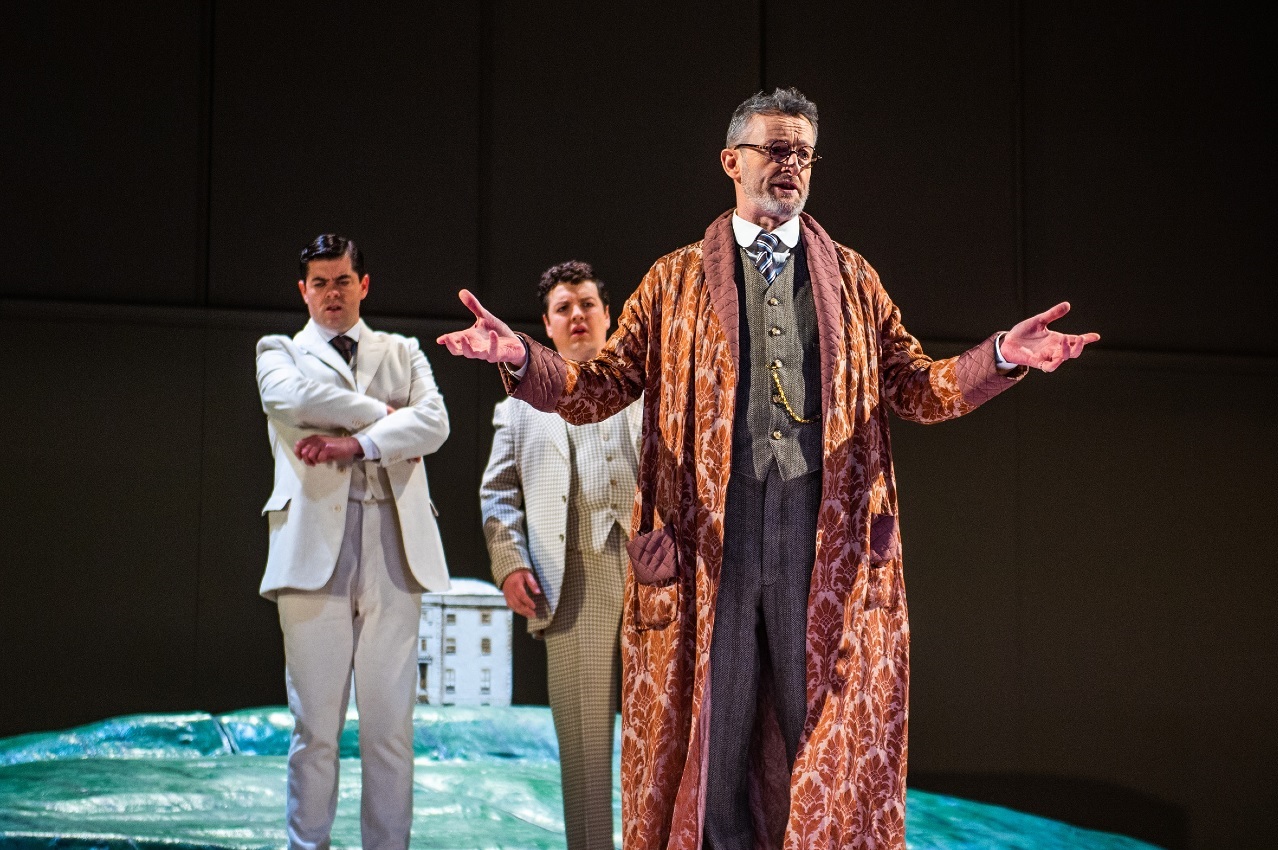
All credit to the principal roles then (and great idea of the INO to display the cast names in the surtitles as they took their bows at the curtain call), but you can't have any weaknesses at all in a meticulously constructed opera like this. The chorus played their part and the orchestra delivered the musical delights under the direction of Peter Whelan. The niggling inconsistencies in the setting and purpose were easily put aside then, as was any attempt to seek something deeper in Polly Graham's direction of the INO's Così fan tutte. The 'they're all the same' message here was simply that we all deserve to be loved and treated equally, and that was as truthful a reflection of the opera's intent as any.

Links: Irish National Opera

Friday, 20 December 2019

Neuwirth - Orlando (Vienna, 2019)

Olga Neuwirth - Orlando

Wiener Staatsoper, 2019

Matthias Pintscher, Polly Graham, Kate Lindsey, Anna Clementi, Eric Jurenas, Constance Hauman, Agneta Eichenholz, Leigh Melrose, Justin Vivian Bond

Staatsoper Live - 18 December 2019


The subject and content of Olga Neuwirth's new opera Orlando is very much related to the fact that she is the first woman composer not only to write an opera for the Vienna State Opera, but is the first woman composer to ever even have an opera performed there. Neuwirth's choice of Virginia Woolf's influential and highly regarded 1928 novel 'Orlando', which follows the course of a young nobleman who lives through the political changes of the centuries, experiencing it from the viewpoint of a man and then changing sex to become a woman, is clearly a pointed commentary on this fact.

Following in the footsteps of Luigi Nono, a composer that she worked with as an assistant, Austrian born Neuwirth is likewise viewed as a 'political' composer, but rather than just seek to make a well-meaning gesture against the injustice of gender inequality in the world of opera, or even take the route of a superficial commentary on current affairs in the world today, in Orlando Neuwirth extends on Woolf's vision to seek to address a deeper problem that could be seen as having an underlying impact on how the nature of the world we live continually changes, but those changes have been shaped by gender inequality throughout the ages, women reduced to a footnote in history, if considered at all.

It's also notable, if purely coincidental, that the period covered in Orlando aligns very closely with the history of opera, which has also evolved and changed over the years. Even baroque opera however has until relatively recently also been a rarity at the Vienna State opera - a 50 year gap only broken in 2011 coincidentally (isn't it strange how much that word comes up, you'd almost think it telling) with a production of Handel's Alcina, a tale of another Orlando - so the history of change in opera is perhaps not something that many of the more conservative element of the audience in Vienna would recognise. I don't think Olga Neuwirth is going to convince them with her Orlando.


Being a well-educated man from a noble family in 1598, Orlando is well placed to be destined for greatness. He determines to be a poet and a great writer, but although he wins the favour of Queen Elizabeth, his ambitious work 'The Oak Tree' doesn't win favour with critics like Mr Greene. Disappointed in love, when he is betrayed by Sasha, a Russian princess, jaded by the politics of the land and war, Orlando falls into a deep coma and reawakens as a woman in a new age. Her experiences as a woman however bring her to recognise the fact that history is made by men and certainly written by them, meaning much the same thing.

Women don't get a whole lot of a look in and Orlando, now a woman, expected to do little more than make tea and marry, finds it unfair that someone can be rejected solely on the basis of the sex they were born into. Worse comes in the Victorian era, where Orlando encounters women and young girls who are victims of sexual abuse and destined for a life of abject misery. She decides to write and record their experiences from the perspective of woman, but finding a publisher continues to prove elusive, even in the age of eBook publishing.


What is interesting, and perhaps something I failed to appreciate in Woolf or in Sally Potter's filmed version of 'Orlando', is that living now in an era where gender reassignment and gender fluidity is relatively common (if not yet wholly accepted and viewed with suspicion in some quarters), it's now possible to see that Woolf was very much ahead of the game in terms of questions of sexual politics. This of course has a more contemporary application later in Neuwirth's updating of 'Orlando' beyond Woolf's time of 1928 up to the present day, Neuwirth thereby highlighting for a modern audiences how society and attitudes change over time. Significantly however, while that change is brought clearly to the forefront, it also makes evident just how far behind attitudes remain in relation to gender inequality.

It's inevitably a huge task to get all that across in a three hour opera and avoid sounding preachy, particularly when Neuwirth's musical approach to the subject is just as complex and all-encompassing, and modernist and dissonant in the most difficult way for an audience to engage with. Neuwirth doesn't entirely succeed in terms of making the case persuasive from the musical viewpoint, embracing early Tudor music, references to Purcell, religious choral pieces with live electronic layering and use of unconventional instruments in the total opera manner of Stockhausen with its spiritual leanings or Nono's direct political engagement, the conclusion featuring a cabaret band and a transgender singer - Orlando's child - does tend to push towards preachiness.

While it can be difficult to listen to - although I'm certain that it would come across with more detail and much more effectively in a live context rather than via the Wiener Staatsoper's streaming service - it's not hard to appreciate what Neuwirth is trying to do and admire how Matthias Pintscher conducts it, but over an extended period it does head towards sensory overload and cacophony. Certainly for the purposes of how it relates to and reflects the subject of embracing change and diversity however it's essential to employ the richness of musical options open to a composer. It's music that, like Orlando, recognises no distinction between past and present, is male and female all rolled into one, pushing beyond restrictive boundaries of convention.


The musical complexity and what it attempts to bring out only makes the challenges of mixing and blending all the historical scene changes even more difficult for director Polly Graham. Forced into a more linear narrative approach, with the passing years displayed in the background, the production design is perhaps a little more theatrically conventional in how it meets those challenges of keeping up, using moving screens and projections, but unless you employ La Fura dels Baus or Stefan Herheim, it would be near impossible to visually match the textural richness of the music, much less add another level of complexity to the work that in an ideal world the theatrical element should equally contribute.

Neuwirth and co-librettist Catherine Filloux succeed to a large extend in their aims of making Orlando relevant to the modern age, addressing the legacy of the male-dominated, war-hawking, money-making agenda that suppresses any possibility of true change in the world, raising again the spectre of fascism. As persuasive as the central performance of Kate Lindsey's Orlando is to standing up against the ways of the past, whether Neuwirth's Orlando aligned with and updating Virginia Woolf's vision makes an equal or greater historical impression seems unlikely, but it's certainly of the moment, another marker along the way to show that we've still a long way to go.


Links: Wiener Staatsoper, Wiener Staatsoper Live at Home