Showing posts with label Sharon Carty. Show all posts

Sunday, 28 May 2023

Mozart - Così fan tutte (Dublin, 2023)


Wolfgang Amadeus Mozart - Così fan tutte

Irish National Opera, 2023

Peter Whelan, Polly Graham, Anna Devin, Sharon Carty, Benjamin Russell, Dean Power, Majella Cullagh, John Molloy 

The Gaiety Theatre, Dublin - 27th May 2023

For a long time sceptical about whether Lorenzo Da Ponte's libretto of farce and misogyny had withstood the test of time and changing attitudes, I've certainly been won around to the true qualities of the work in modern productions that have actually revealed Così fan tutte to be far more layered and meaningful than you would think. I still don't envy any director having to choose how best to bring those qualities out, whether to play it as a straight comedy or whether to mine the deeper attitudes expressed for contemporary relevance. The Irish National Opera production, a touring production directed by Polly Graham, tries to pitch it somewhere in between and doesn't really succeed in doing full justice to either side of the work.

Where it does bring a distinctive touch is in the Irish historical setting. Opera should be tailored to and relatable to its audience, not presented as some stuffy period costume drama museum piece, but that doesn't necessarily mean that it has to be updated and made contemporary. Opera can still speak of contemporary issues if it can be related to a significant period, and such a period in Ireland (and elsewhere in the world) can be found in the early twentieth century. The nature and status of women is a theme worth exploring in Così fan tutte and Ireland has been slow to deal with women's rights which were the subject of interest with the rise of the suffragettes around this time, and that is certainly highlighted here.

War and revolution too since it's revealed that the year is 1914, but that's a little more problematic to add into the farce of this opera, with Guglielmo and Ferrando pretending to head off to fight in the trenches as part of an Irish battalion. It fits well enough though for the purposes of the production, and when the two return disguised as filmmakers with berets and moustaches, making a silent movie about Fionn mac Cumhaill and the Fianna, it's a little more meaningful and acceptable than making fun of oriental costumes, customs and appearances. That's fine as far as it goes, but in terms of direction it feels a little forced, flat, haphazard and inconsistent in its approach, gaining neither sufficient laughs nor significance in exploring the nature of women and men or indeed providing a lesson in the vagaries of love.

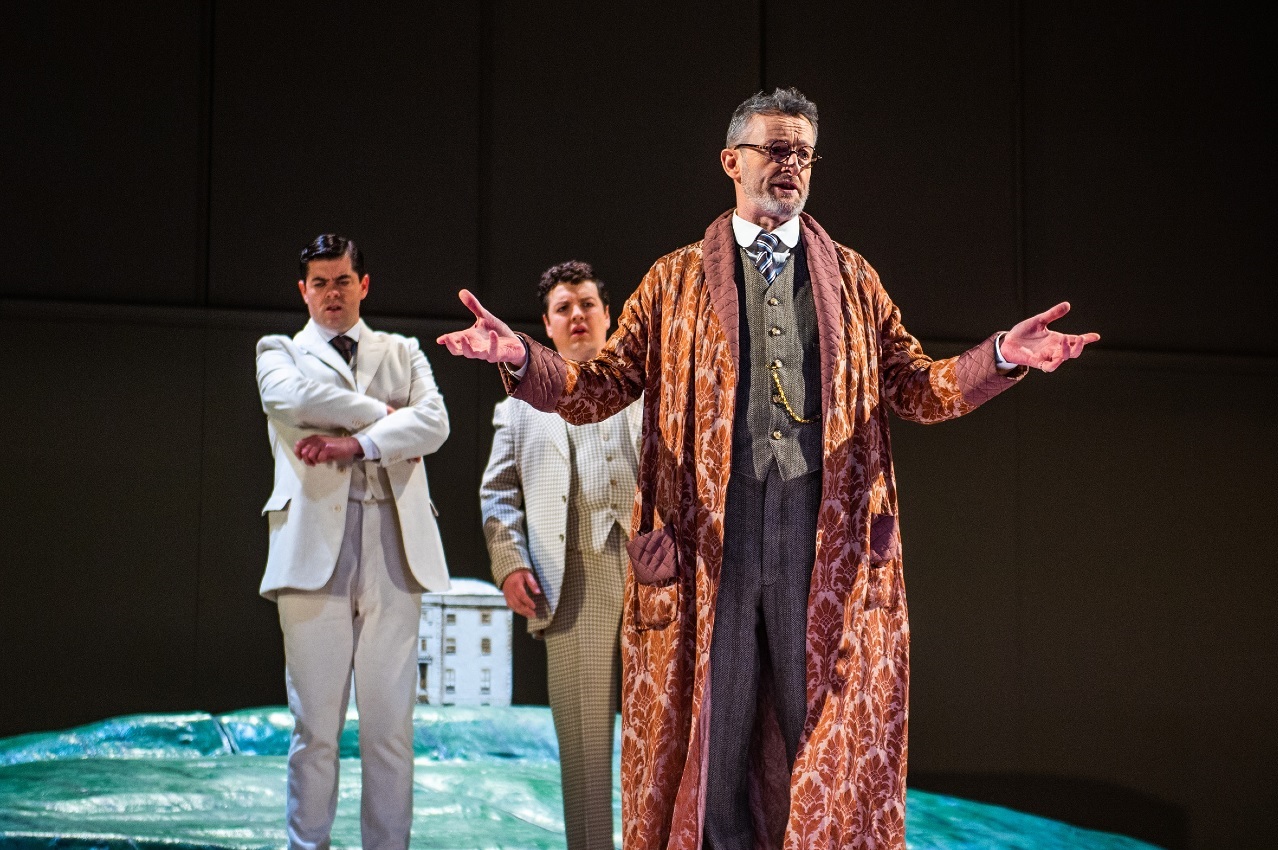
The resultant production design then was also something of a mixed bag. Sure, it has necessarily has to be basic in terms of set designs and effects, designer Jamie Vartan using projections to open it out a little and establish the period with newspaper articles and a sketched big house on the hill. I never quit grasped what the stately manor was about, other than perhaps how chorus of Irish women were treated as servants and second class citizens by the landed gentry. It wasn't a particularly impressive or eye-catching set, a huge hard plastic looking green blob representing a hill with a tiny 'big house' on top that was picked up and carried around by the cast for no discernable reason. Nor could I figure out the nature of Don Alfonso in this setting, walking around in a long house coat in a somewhat professorial manner with Ferrando and Guglielmo his students. None of it quite hit the mark.

To be fair, as ambitious as the Irish National Opera can be, even with reinterpretations of the standards of the opera repertoire, playing to the darker side of Così fan tutte is perhaps not really what they want to do with an opera buffa, particularly for a touring production. Leave that to the likes of Michael Haneke (Madrid, 2013) and Christophe Honoré (Aix-en-Provence, 2016). What they really want to get across is the wonder and beauty of Mozart, and there is no denying what we have here is a light and enjoyable production that certainly entertained the audience at the Gaiety in Dublin. Even though the Votes for Women scenes felt a bit forced in places, like a well meaning corrective for any misinterpretation of misogyny in the comedy. I have to admit, I enjoyed it more after the interval when I accepted the simple pleasure of seeing an amazing Mozart opera performed well, and was able to put aside any expectations of it having something significant to say.

There was certainly plenty to enjoy in the delivery of the singing performances. Anna Devin and Sharon Carty were everything you could hope for as Fiordiligi and Dorabella, their delivery bright and sparkling, filled with emotional sentiments, even if their predicament wasn't fully brought out in the direction of the acting. The same can be said for Dean Power's Ferrando and Benjamin Russell's Guglielmo. Neither were convincing in their disguises, but the emotional impact of the revelations they have about their girlfriends were wholly felt in their singing, which was powerful and true. The ever reliable John Molloy similarly made a great impression, even if his role as a manipulator was undervalued in the direction. On the other hand, Majella Cullagh delivered a fine comic performance in Despina's various guises and was the prime motivator in bringing the two sisters into the new sisterhood, but was slightly underpowered in her singing. It just shows how difficult all the singing roles are in Mozart - there are no secondary or minor roles here.
All credit to the principal roles then (and great idea of the INO to display the cast names in the surtitles as they took their bows at the curtain call), but you can't have any weaknesses at all in a meticulously constructed opera like this. The chorus played their part and the orchestra delivered the musical delights under the direction of Peter Whelan. The niggling inconsistencies in the setting and purpose were easily put aside then, as was any attempt to seek something deeper in Polly Graham's direction of the INO's Così fan tutte. The 'they're all the same' message here was simply that we all deserve to be loved and treated equally, and that was as truthful a reflection of the opera's intent as any.

Links: Irish National Opera

Wednesday, 6 March 2019

Gluck - Orfeo ed Euridice (Dún Laoghaire, 2019)


Christoph Willibald Gluck - Orfeo ed Euridice

Irish National Opera, 2019

Peter Whelan, Emma Martin, Sharon Carty, Sarah Power, Emma Nash, Dominica Williams, Fearghal Curtis, Matthew Mannion, Robyn Byrne, Stefaniw Dufresne, Javier Ferrer, Sophia Preidel

The Pavilion Theatre, Dún Laoghaire - 28 February 2019


The absolute wonder of Gluck's Orfeo ed Euridice, the reason for its reputation as one of the greatest works of opera ever composed and the ability of the work to deeply move audiences some 350 years after it was composed, lies undoubtedly in its simplicity. Or rather its apparent simplicity since it relates to deep human feelings that connect us to myth, Gluck's work fully employing all the artistic musical, theatrical and dance elements that are the essence of opera. Refinement rather than simplicity of all those elements and how they work together was at the heart of Gluck's reformist agenda for opera, and it's in adherence to those principals that the Irish National Opera succeed in their beautifully simple but refined production.

Such indeed is the refinement and unadorned beauty of Orfeo ed Euridice and the deeper sentiments that underlie its purpose, that it can sustain all manner of interpretations. It is mythology after all. At the heart of the work is perhaps the rawest and most relatable of human emotions, those connected to love and loss, Orpheus's desire to bring his beloved wife Eurydice back from the dead practically serving as a model for Kübler-Ross's five stages of grief; denial, anger, bargaining, depression and acceptance. Gluck's ability to make those sentiments behind Orpheus's dramatic/symbolic journey vividly real in musical terms lie at the heart of the work.


Unquestionably then, even though La Fura dels Baus have successfully been let loose on the work with their enhanced stage techniques, they recognised nonetheless that it was essential to forge a connection between the music/musicians and the drama. In rather more stripped back conditions, while still presenting a theatrical presentation of extraordinary beauty, director and choreographer Emma Martin likewise, but through entirely different means, succeeds in making the essence of Gluck's timeless musical moods and melodies visible on the stage in the Irish National Opera's production.


First performed last year for the Galway Festival, but taken this year on a wider provincial tour of Ireland, the venues chosen remain (for the most part) small scale, permitting an intimate closeness with the drama and the production. Indeed, my front row seat at the Pavilion Theatre in Dún Laoghaire placed me practically in the 'orchestra pit', sharing a ground level space almost between the orchestra ensemble and 'stage'. Immersive theatre is nothing new, nor indeed is immersive opera, but it's quite another thing to be immersed in the same space that Gluck's Orfeo ed Euridice occupies, particularly one that in every other way strives to make the work's every sentiment tangible.

Stripping back the orchestra to its essential components, Peter Whelan's arrangement and conducting of the Irish Baroque Orchestra permits the beauty of each of the instruments and the part they play in each of the scenes to stand out all the more vividly. Emma Martin's production likewise reduces the vocal ensemble down to the main roles of Orpheus, Eurydice and Amore, with Amore also part of the four-way harmonised voices of the chorus for the Mourners, Furies and Blessed Spirits. Nothing was lost with this reduction, but rather the refinement of Gluck's musical scoring only even more apparent.

Orfeo ed Euridice was of course originally intended to make use of another element of opera that in the subsequent century after its writing tended to not have such a prominent role, and that's dance. Orfeo ed Euridice is written for movement, it's not the static stand-and-sing solitary aria expressions of the requisite numbers and sentiments of baroque opera, nor is it the stop-start division of singing and ballet of the French tragedie-lyrique, but an essential integration of dance into the whole flow and pace of the work. Orfeo ed Euridice indeed has been staged purely as a dance work, but more often opera productions tend to cut the instrumental/dance passages to suit modern tastes.


As a choreographer Emma Martin however knows the value of dance in Orfeo ed Eurydice adding another dimension to the opera and bring those sentiments to life. The INO production accordingly has a four-person troupe of dancers that symmetrically balance and in a way supplement the four-part chorus, flowing and weaving thought the work like the notes of Gluck's score brought to life. They vividly express all those stages of Orpheus's grief, as much as the impassioned singing of
Sharon Carty's Orpheus himself/herself; the anger and the struggle with the Furies (even transforming into a horrifying multi-limbed creature that stalks Orpheus across the stage, wrapping him in his submission to the Blessed Spirits, standing as a barrier between this world and the unreachable other.

The superb flow and choreography extends its mood and reaches outward to take in the stage itself. It doesn't need much in the way of set dressing but everything is purposefully employed, the lighting effective for the mood, the drapes at the back of the stage and the veils wrapped around the figures drawing everything together. It's not just the choreography or even the impressive technical blocking of the singers with the dancers and the sets, it's the direction of every scene to match and express those deeper human sentiments at the heart of the work.

The qualities of the human voice are essential to that purpose and Sharon Carty (Orpheus), Sarah Power (Eurydice) and Emma Nash (Amore) made them soar with love, anger, fear and regret. The essential moral of the mythological take, which was unfortunately lost under the stage requirement of the period to present a happier ending, must also be taken into consideration. Romeo Castellucci managed to address that brilliantly in his living-death element to his production for La Monnaie, and Emma Martin also takes the reality of the nature of bereavement into account here, consigning the happy ending to a kind of postlude that reminds us that after loss, life still goes on.


Links: Irish National Opera

Tuesday, 3 October 2017

Dennehy - The Second Violinist (Dublin, 2017)

Donnacha Dennehy - The Second Violinist

Wide Open Opera, Dublin - 2017

Ryan McAdams, Enda Walsh, Aaron Monaghan, Máire Flavin, Sharon Carty, Benedict Nelson, Alyssa Hefferman

O'Reilly Theatre, Dublin - 2 October 2017

The core elements from The Last Hotel, the first opera composed by Donnacha Dennehy with playwright and director Enda Walsh, are still in place in their second collaboration, The Second Violinist. The Crash Ensemble are still there to navigate through Dennehy's Irish trad-influenced rhythms; there's a small cast of three singers (two female and one male) and a male actor; even the subject plays on a similar theme of death and desperation. In most other respects however, The Second Violinist expands the range and ambition of both writer and composer, finely adjusting the balance of the various operatic components to create a fuller and more accomplished piece of music theatre.

In one respect there appears to be a simplification or at least a greater refinement and precision in this work's dramatic focus. The Second Violinist really all centres around one man; Martin is a musician, a second violinist (obviously) who appears to be on the verge of a breakdown. He's almost ready for a visit to the Last Hotel, by the looks of it. Like the Woman in that piece, Martin is bombarded by messages on his phone; he gets calls from a local drama group looking for incidental music for a production of 'An Ideal Husband'; constant promotional texts from a pizza company; and angry recriminations from Martin's colleagues who aren't too impressed with his lack of preparation at the last rehearsal.

There's a reason for Martin's distraction, and the reason for it eventually becomes clear - or sort of clearish in a complicated, twisty, mobius loop kind of way. Exasperated and visibly at the end of his tether, Martin finds that the apartment where he lives alone has been taken over by phantoms who act out what at first appears to be a fairly ordinary domestic scene. Married couple Matthew and Amy are having an informal evening with Amy's friend Hannah, having a few glasses of wine and a pizza, but as the evening continues, things go a little awry, causing Matthew to consider how well he really knows the woman he has been married to for four (or is it five?) years.


Martin meanwhile tries to pull his life together, trying his best to ignore this phantom scene that is playing out simultaneously in his apartment, but not managing terribly successfully. The fact that he hasn't screamed or killed anyone yet (as far as we know), means however that he must be just about holding it together. What is keeping him from falling apart is an unexpected phone chat exchange with Scarlett, a viola playing musician who also shares his love for the Italian Renaissance composer, Carlo Gesualdo. The outcome of the fatal social evening however is closing in on Martin at the same time as he is starting to see light at the end of the tunnel.

Without getting too clever and self-referential - since the work's overlapping time-split narrative structure is complicated enough - The Second Violinist looks at life as an opera. Not in the familiar sense of musically-heightened dramatic melodrama, but in the sense of someone - a musician - who is looking for something that will bring a sense of structure, purpose and meaning to his life and put it into some kind of context. Carlo Gesualdo's life and music are an inspiration in this respect (as it has been for other modern composers, notably Salvatore Sciarrino's Luci mie traditrici and George Benjamin's Written on Skin); a tumultuous life with bloodshed and violence that nonetheless gave birth to music of indescribable beauty and poetry.

The Second Violinist consequently places greater demands on the role that the Crash Ensemble have to play under the direction of Ryan McAdams. There are still hints of Irish traditional music underpinning the score, but less of a single rhythmic pulse and a greater variety of tone in a work that has a more complex fractured dynamic with overlapping, contrasting sentiments to convey. It demands a different kind of virtuosity that doesn't rely on individual musicianship as much as a close collaboration of a custom ensemble working together to create that complex shifting sound world.


That's particularly important here because The Second Violinist is much more reliant on instrumental musical expression working with the dramatic narrative than the virtuosity of vocal expression that was rather more conventionally used in The Last Hotel. Sharon Carty, Benedict Nelson and Máire Flavin all handle their individual lyrical pieces well (less abstract than the pieces in The Last Hotel) and a chorus extend the chamber arrangements of the work considerably, but since we are viewing everything through the perspective of Martin, it would seem appropriate that it's Martin's view of life as an opera that is expressed mainly through the music, as well as in the silent intense performance of perpetual motion that actor Aaron Monaghan brings to the main role.

The superb set designs by Jamie Vartan and Enda Walsh's direction are just as vital to the expression and kinetic momentum that is established between the musical performance and the drama. As well as having two levels (woods/apartment) to represent different layers of Martin's psyche, the opera makes good widescreen CinemaScope use of the stage, where multiple events happen at the once or in quick succession but the focus of attention is always clear. The use of projections are also effective, with text messages and phone apps representing another important layer of everyday 'reality' that we can all recognise, not just Martin. Death, when it comes, does not bring the kind of dramatic resolution that we are accustomed to find in an opera; life and how we cope with it, as The Second Violinist shows in a fast and furious 75 minutes, is much more complicated than that.


Links: The Second Violinist, Wide Open Opera, Dublin Theatre Festival

Friday, 16 May 2014

Adams - Nixon in China (Wide Open Opera - Dublin 2014)


John Adams - Nixon in China

Wide Open Opera, Dublin 2014

Fergus Sheil, Michael Cavanagh, Barry Ryan, Claudia Boyle, James Cleverton, Hubert Francis, John Molloy, Audrey Luna, Sharon Carty, Imelda Drumm, Doreen Curran

Bord Gáis Energy Theatre, Dublin - 11 May 2014

For a modern opera that is based on a relatively recent historical event, John Adams' Nixon in China is proving to be an enduring work that continues to gain new productions worldwide. What is even more surprising, and which perhaps accounts for the place it is gaining in the repertoire, is how each production manages to find a new way of approaching the work's themes. It's clear that Nixon in China is about more than one specific event of historical significance only to the 1970s, but is a work of multifaceted complexity that makes it open to continuous reinterpretation and re-evaluation.

Undoubtedly, that's got a lot to do with Alice Goodman's libretto. It doesn't entirely hold together and it can be difficult to comprehend at times, getting bogged down in the competing ideological, political and philosophical views of each of the participants in US President Nixon's visit to Communist China in 1972. Certain passages of the opera feel the weight of some very obscure esoterica, but the libretto also has the ability and the insight to look beneath the jargon, the showmanship and the politicking to make some very pertinent points about the nature of the figures in question as human beings.


In order for the work to endure however, it needs to extend this out beyond the specific to the universal, and while the political landscape has changed much in the intervening years, with the respective powers and influence of both China and the USA starting to reverse, the human aspirations behind them hasn't changed that much. Even if Nixon in China were only to remind us of this fact, highlighting the present by showing us how it once was, or how indeed it all started to change from a globalised technological perspective, it would still be an interesting work, but as this latest Dublin production from Wide Open Opera makes clear, there's evidently much more to the opera than that.

Wide Open Opera's Dublin production of Nixon in China for example threw up a new aspect to the work that I had never considered before. Is Nixon in China a feminist opera? It seems unlikely for a work set in the 1970s based on the meeting between two male heads of state alternately back-slapping each other and competing to prove the supremacy of their vision of the world. In fact, with Henry Kissinger's reputation and attitude towards women satirised in the dances of Act II ("Whip her to death!"), with Pat Nixon being the model First Lady and housewife, deferential to her husband's important career, and China's treatment of women hardly being anything to be proud of, despite Chiang Ch'ing's contribution to the Cultural Revolution, it's not surprising that the possibility of the work having a feminist agenda is rarely considered.


The fact that these issues are shown at all, even in a seemingly unfavourable light, is significant, but the women in Nixon in China are actually very strong personalities, and can even be said to be the true heart of the work. Part of this might be to do with the librettist being female, but in reality it's much more to do with there being considerable thought and attention paid equally to all of the main characters. In attempting to make them real, in attempting to look beneath the surface and see a real person, those issues and how Pat Nixon and Chiang Ch'ing might feel about them are taken into consideration. If there is a feminist view in Nixon in China, what is wonderful is that it's not presented in any dogmatic fashion, but arises out of treating each of the characters as equals in human terms. It's when this conflicts with the public personas, and with the male and the political agendas, that the whole question becomes much more complex.

Part of the reason why there are so many ways of interpreting and looking at Nixon in China is just down to the nature of its creation, and the nature of opera itself. It's not just Alice Goodman's libretto that is important or the only aspect of the opera that plays with ideas, but rather it's the multidisciplinary nature of how it interacts and conflicts with real-life, with the focus, structure and dramatic concept of Peter Sellars' original idea, and with John Adams' music. That reflects and complements the competing personalities on the stage and it creates a dialectic that really opens the work up. And when you hand that over to a new stage director, a new music director and new singers, you have something that can be even more fluid and mutable.

Wide Open Opera's production of Nixon in China originates from Michael Kavanagh's 2010 production for Vancouver Opera. It's a very fine production that retains the historical basis of Nixon's visit to China and adheres relatively closely to Peter Sellars' structuring of the work. At the same time however it finds its own way to capture the spectacle and the grandeur of the event and get underneath to the rather more difficult to define aspects of the personalities that are brought out by the libretto and the music. Broadly speaking however, the tone of the work and the stage direction is defined by its three-act structure.


Act I is all show, making use of impressive projections that show Air Force One landing in Peking Airport, using bold colours and national flags to indicate the jostling for power, position and philosophical superiority between the leaders of the two great nations. There is at the same time a mutual respect and appreciation for each other, for the power that they wield and how they exercise it, and both are fully aware that this is a unique and unprecedented opportunity to extend their influence and reputation across the world via new satellite technology. The staging fully supports the joyous fervour that this generates, each of them dancing around, drunk on power, lost in their own wonderfulness.

Dancing in fact plays a large part in this production, and it highlights just how important it actually is as another means of expression in the work itself. Aside from the obvious Revolutionary ballet The Red Detachment of Women in Act II (a dance of death, liberation), there are references to dancing at the ball put in honour of the Nixons in Act I (a dance of celebration, assertion, joy) and there's a melancholy waltz in Act III (a slow dance of sadness and introspection), each of which conforms perfectly to the tone of the three acts. The deeper interiority of Act III is more difficult to stage and make work than the more obvious tone and the action of the first two acts, and it doesn't quite come together in the opera itself, but Michael Cavanagh's direction, the use of mists (for time, memory, distance) and the use of connections made though the dancing, finds a through-line that holds it all together surprisingly well.

It's important that all this works with the music and singing performances. The musical challenges alone are considerable for a work that makes use of unconventional orchestration with saxophones and electronic keyboards, but Fergus Sheil and the RTE National Symphony Orchestra provided an invigorating and thrilling performance that balanced the rhythms with the nature of the drama expressed in the libretto and on the stage, as well as with the expression of the singers. The program notes that microphones are required to amplify the singers above the orchestra (although a reduced orchestration allowed the Châtelet in Paris to perform it acoustically), but the singing, diction and expression was so strong here that you scarcely believed it was necessary.


As if to confirm the importance of the women figures, the singing was particularly impressive from Claudia Boyle and Audrey Luna. Claudia Boyle's Pat Nixon was confident and accomplished, but touching too, with a real sense of sympathy for her character and the importance of her as the heart of the opera. Audrey Luna's Chiang Ch'ing saw more of the stratospheric notes the coloratura soprano hit in her Met performance of Ariel in Adès' The Tempest. Where the use of microphones might have been useful here was in allowing the male singers to sing rather than project. Barry Ryan's Nixon was accordingly wonderfully musical, showing the lyrical qualities that are in the writing of this character which we rarely hear in English language opera. Like Ryan, we also had sensitive performances from James Cleverton as Chou En-lai, Hubert Francis as Mao Tse-tung, with John Molloy fully entering into the spirit of the playful but sinisterly depicted Henry Kissinger.

Presenting a modern opera to a Dublin audience was always going to be a challenge, but it's one that, following their marvellous The Importance of Being Earnest, has again paid off impressively for Wide Open Opera. This is a far cry from La Traviata or Madama Butterfly, and a new and sometimes challenging experience for many, but judging from the enthusiastic response of the audience at the opening night at the Bord Gáis Energy Theatre for Nixon in China, many were clearly struck at the possibilities this form of music theatre can offer. That's clearly a mark of Wide Open Opera's approach to ensuring quality at every level, and genuinely having something new to bring to the arts and theatre-going public in Ireland.